PINNIPEDIA.
Reading edition
The Pinnipedia (fin-footed) forms a well-marked sub-order of the Carnivora, and may be divided into three distinct families—the Phocidæ, or true Seals; the Trichechidæ, represented by one species only—the Walrus; and the Otariidæ, or Eared Seals.
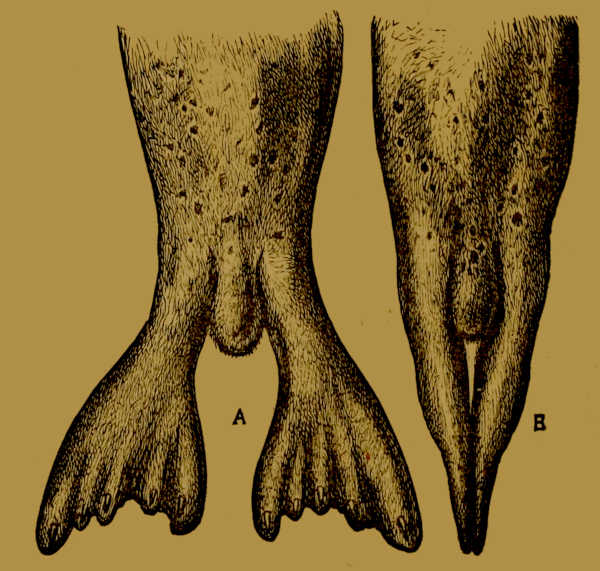
Fig. 1. Hind Flippers of Ringed Seal (after Murie).
A, opened out; B, closed.
The Phocidæ are found both in the Northern and Southern hemispheres, most plentifully in the cold regions, but extending into the temperate seas; in the Northern hemisphere they are found as far south as 40° N. latitude; two species, however, are said to be sub-tropical. The true Seals may readily be distinguished by the absence of external ears, and the position of the posterior limbs, which are not adapted for progression on land, but admirably suited for propelling the animal through the element in which it obtains its sustenance. These limbs are directed backwards, and compressed laterally, the soles of the flippers being turned inwards, and are only free from the ankle-joints. (Fig. 1). Like the whole group, the Seals are carnivorous. Five species are believed to have occurred on our shores.
The family of Trichechidæ is limited to one genus, and that consisting of only one species, the Walrus or Morse, which is essentially Arctic in its habitat, and on our coasts can only be regarded as a very rare and accidental straggler; in this animal there is no external ear; its limbs are adapted for raising the body from the ground, thus enabling it to progress by their means upon dry land.
The third family, Otariidæ, consists of several genera and species (according to Gray); they are distinguished from both Phocidæ and Trichechus by the presence of external ear-conchs, and from the former by the structure of their limbs, which are free and adapted for progression upon land, where at a certain season they take up their abode for a considerable period. Dr. Pettigrew also points out that the fore-feet are hardly used by the true Seals as means of propulsion in the water, whereas in the Eared Seals they form the chief organs used for that purpose, and in the Walrus all four limbs are employed. The Eared Seals inhabit the lonely shores and islands of the Pacific Ocean and South Seas, where they are hunted for their skins; the beautiful “seal-skin” of commerce, so much prized for its lustre and softness, being the dyed and prepared under-fur of some members of this family. The Otariidæ are not represented in our fauna.
The true Seals spend most of their time in the water, but visit the shore or ice to bask in the sun or bring forth their young; this last takes place early in the summer, and it is seldom that more than one is produced at a birth. Some species enter the water almost immediately after birth, but others are two or three weeks before they leave the ice, quitting it at first very unwillingly, but soon becoming expert at swimming and diving. The power of the Seal to remain beneath the water for lengthened periods Dr. Wallace[1] believes to be acquired rather than structural. Their food consists of crustacea and fish, with an occasional sea-bird. Some species are migratory in their habits. In disposition they are usually timid and gentle, and capable of attachment, when in confinement, to those who feed and attend them. The Bladder-nose and Grey Seals, however, appear to be exceptions to this rule; the former is said to be fierce and vindictive, rather courting than fleeing from danger, and altogether a formidable opponent. Their great affection for their young is made use of by the sealers for their destruction.
Although Seals are not found in sufficient numbers round our own coast to be of any commercial value, in the Northern Seas, where they congregate in vast numbers at the breeding season, the seal-fishery is of great importance as a branch of industry, and finds employment for a large number of vessels and men, both from this country and from the ports of Northern Europe. In the Greenland seal-fishery the Norwegian whalers had in 1874 sixteen steamers and nineteen sailing-ships, with an aggregate tonnage of 9,000 tons, manned by 1,600 sailors, and in the three years ending 1874 they killed 142,500 young Seals and 128,000 old ones, notwithstanding which the balance-sheet of the three years showed only a small profit on the steamers and a large loss on the sailing vessels.[2] An official return issued by Messrs. David Bruce and Co., of Dundee, shows that in the season of 1879, eleven Dundee ships and five from Peterhead, were engaged in the Greenland seal-trade; the total catch of these sixteen ships was 35,044 Seals; four ships from Dundee visited Newfoundland and captured 70,355 Seals, making a total for the British ships alone of 105,399 Seals, exclusive of those wounded and lost, or otherwise destroyed. These produced 1280 tons of oil, worth about £25 per ton, or £32,000, exclusive of skins, which sell for about 5s. each. The majority of the Norwegian vessels also bring their cargoes to this country. Captain David Gray informs me that the seal-fishery was commenced from the Port of Peterhead, in the year 1819, since which time to the close of the season of 1879, the large number of 1,673,052 Seals have been taken by the vessels belonging to that port. The Dundee vessels did not take part in the seal-fishery till the year 1860, but have from that time to 1879 taken 917,278 Seals. This total is greatly swollen by the results of the Newfoundland fishery; four Dundee vessels in 1879 took 70,355 Seals in Newfoundland, whereas, in the same season, eleven Dundee and five Peterhead vessels took only 35,044 Seals in the Greenland fishery. The Dundee ships, after the Newfoundland fishery is ended, generally land their oil and skins at St. John’s, and proceed on their whaling voyage to Greenland and Davis’ Straits.
Dr. Wallace[3] estimates the annual produce of the Greenland Seal-fishery alone at the sum of £116,000; the bulk of the seals taken are the Harp Seal (Phoca grœnlandica).
Several attempts had been made to establish a seal-fishery at Newfoundland, from the port of Dundee, but with small success till the year 1876: in that year Messrs. Alexander Stephen and Son secured premises at St. John’s, and sent out two vessels to be manned chiefly by a Newfoundland crew; the result was a great success, and this firm has since prosecuted the fishing with very satisfactory results. The Dundee Seal and Whale Fishing Company have also three steamers in the trade, in addition to those engaged at the Greenland fishery. Mr. David Bruce, of Dundee, to whom I am indebted for the above particulars, informs me that the season of 1880 was a failure in the Newfoundland fishery, and that out of a fleet of twenty-four steamers, not more than six of them would pay their expenses.
Mr. J. A. Allen[4] gives an interesting account of the rise and progress of the Newfoundland fishery, which he characterises as “the sealing-ground, par excellence, of the world, twice as many Seals being taken here by the Newfoundland fleet alone as by the combined sealing-fleets of Great Britain, Germany, and Norway, in the icy seas about Jan Mayen, or the so-called ‘Greenland Sea’ of the whalemen and sealers.” So early as 1721, thousands of “sea-wolves” were killed in the Gulf of St. Lawrence, but, according to Mr. Michael Carroll, of Bonavista, Newfoundland, in his account of the ‘Seal and Herring Fisheries of Newfoundland,’ published in 1873, as quoted by Mr. Allen, it was not till the year 1763 that the seal-fishery was regularly prosecuted there by vessels specially equipped for the purpose. The trade, however, rapidly assumed importance, and in 1807 thirty vessels from Newfoundland alone were engaged in it. In 1834 the Newfoundland fleet had increased to three hundred and seventy-five, besides a considerable number of vessels from Nova Scotia and the Magdalen Islands; in 1857 the number of vessels employed appears to have reached its maximum, exceeding three hundred and seventy, whilst the catch of Seals was estimated at 500,000. About the year 1866, steamships were first introduced, and have ever since been increasingly employed; the result has been a steady decrease in the number of vessels, which, in 1871, were reduced to one hundred and forty-six sailing vessels and fifteen steamers, or less than one-half, but the number of Seals taken annually, up to 1873, appears to have remained about the same, and, notwithstanding the enormous destruction of these creatures, which takes place every season on the Newfoundland sealing grounds, many thousands of which, from the wasteful methods employed in their capture, are never accounted for, Mr. Carroll is still of opinion that up to the year 1873, their numbers were actually on the increase: this can hardly continue much longer to be the case.
I will only mention one of the methods employed by the Newfoundland sealers, which must eventually be attended with the most disastrous effects. This mode is technically called “panning.” Mr. Carroll, writing in 1871 says, “No greater injury can possibly be done to the seal-fishery than that of bulking Seals on pans of ice by crews of ice-hunters. Thousands of Seals are killed and bulked, and never seen afterwards. When the men come up with a large number of old and young Seals, that cannot get into the water, owing to the ice being in one solid jam, they drive them together, selecting a pan surrounded with rafted ice, on which thousands of Seals are placed one over the other, perhaps fifteen feet deep. A certain number of men is picked out by the ship-master to pelt and put on board the bulked Seals, whilst other men are sent to kill more. It often happens that the men are obliged to go from one to ten miles, before they come up with the Seals again, and very often the men pile from five hundred to two thousand in each bulk, which bulks are from one to two miles apart; care is also taken that flags are stuck up as a guide to direct the men where to find such bulked Seals. So uncertain is the weather, and precarious the shifting about of the ice, as well as heavy falls of snow and drift, that very often such bulked Seals are never seen again by the men that killed and bulked them, as the vessels and steamships are frequently driven by gales of wind far out of sight or reach of them, and frequently wheeled or driven into another spot, when the men again commence killing and bulking as before. In many instances it has happened that the crews of vessels, as well as the crews of steamships, have killed and bulked twice their load. No doubt Seals that are bulked are often picked up by the crews of other vessels, but such is the law, that as long as the flags are erected upon the bulks, and the vessel or steamship is in sight, no man can take them, notwithstanding the vessel’s or steamship’s men that bulked them may be ten miles away from them, whilst another vessel may be driven within a quarter of a mile of thousands of bulked Seals, but, owing to the law, dare not take them.” The skins, if left, are also liable to injury by the frost or sun, or by the capsizing of the pan they may be totally lost. In the spring of 1872, some five thousand Seals, obtained to the westward of Bonavista, by the inhabitants of that place, were heaped upon the ice. “There were thirteen flags to be seen in the morning over bulked Seals, and when the drift ice struck the land in the evening, only six of the flags were visible, the ice having rafted over both flags and Seals. Some days after, when the ice moved off from the shore, several bulks of Seals were found, but in such a putrid state that they could not be handled.”[5] Comment upon the consequences which must speedily result from such lamentable waste of life is needless.
Nor, until very recently, was the seal-fishery in the Greenland Seas prosecuted with any greater regard to humanity or economy. “Supposing the sealing prosecuted with the same vigour as at present,” says Dr. Brown, “I have little hesitation in stating that before thirty years shall have passed away, the seal-fishery, as a source of commercial revenue, will have come to a close, and the progeny of the immense number of Seals now swimming about in Greenland waters will number but comparatively few.” Dr. Brown’s remarks were written in the year 1868, and the prediction is already virtually fulfilled: a report, giving an account of the success of the Dundee vessels employed in the Newfoundland seal-fishery in 1877, after stating that 39,000 Seals were said to have been captured by two vessels, concludes thus:—“Previously all Dundee vessels were employed at the Greenland seal-fishing, but Captain Adams has for some years been of opinion that that ground is practically used up, and hence his visit to Newfoundland.”
I will spare the reader, as much as possible, a repetition of the horrors of this cruel trade, and make only a single quotation from a letter written by an old and experienced sealer, Captain David Gray, of the steamship Eclipse. He says that five ships in 1873 shot among the old Seals for four days until the pack was utterly ruined. “I suppose,” he continues, “about 10,000 old Seals had been taken. Add 20 per cent. for Seals mortally wounded and lost, gives an aggregate of 12,000 old ones; add 12,000 young ones which died of starvation (their parents being killed before the young ones were of any value or able to shift for themselves), gives 24,000 ... The whole of the young brood was destroyed, and had these Seals been left alone for eight or ten days, I am quite within the mark when I say that, instead of only taking 300 tons of oil out of them, 1,500 could as easily have been got, and that without touching an old one.”[6] So great are the cruelties perpetrated by the crews of the sealers, that even the men themselves, hardened as they are, sicken at the work, and cry shame that the law does not put a stop to them. Let anybody who cares to know what fearful cruelties man is capable of perpetrating for gain, read Captain Gray’s letter. As a remedy for this waste of life (of course its cruelties can only be modified) Captain Gray suggested that the ships should be kept from sailing before the 25th of March, about a month later than they then started; they would then not reach the fishery and find the young Seals until they were sufficiently grown to be worth killing, and the frightful waste of life which occurred from the destruction of the old Seals before the young ones were able to shift for themselves, resulting in the death from starvation of the whole brood, thus be put a stop to.
With this object in view, an Act was passed in 1875, in which the Foreign States interested concurred, prohibiting the killing of the Seals before the 3rd of April in each year; from some misunderstanding this Act was not enforced in the season of 1876, but in 1877 it was rigidly observed by the ships of all nations engaged in the fishery. The result of the season’s fishing was very unsatisfactory, owing to the absence of the large bodies of Seals which formerly were met with. Captain Gray, after three years’ experience of the operation of this Act, considers that the fishing still opens too early,[7] and that an additional three days are necessary to enable the young Seals to arrive at their best, and prevent the useless slaughter of the old ones, which are getting thin from being suckled. He is of opinion that, since the introduction of the close time, the Greenland Seals are not diminishing quite so rapidly as they were, but that the restriction has not been in operation long enough to form a very accurate opinion.
The Walrus is even more rapidly and surely becoming exterminated than the Seal; it has become extinct from station after station, and but for its ice-loving habits, which render its present strongholds always difficult and sometimes impossible of access, it would now probably, like Steller’s Rhytina, have to be spoken of in the past tense.
THE COMMON SEAL.
This species, Phoca vitulina, of Linnæus, is, par excellence, the Common Seal of the British waters. It is found, although in greatly reduced numbers, on unfrequented shores and sands, from the Orkney and Shetland Islands, where it most abounds, to Cornwall, occasionally ascending estuaries and rivers for a considerable distance, but never quitting the immediate vicinity of the water. According to Bell, it occurs on both sides the North Atlantic, and is common in Spitzbergen, Greenland, and Davis’s Straits; also Northern Russia, Scandinavia, Holland, and France, and is said to occur occasionally in the Mediterranean.[8] It figures largely in the returns of the Danish and Greenland fishery, where the number killed annually of this species and Ph. hispida is estimated by Dr. Brown at about 70,000.
Low, who died in 1795, says in the ‘Fauna Oncadensis,’ “A ship commonly goes from this place once a-year to Soliskerry, and seldom returns without 200 or 300 Seals;” these they killed by landing on the rock, and knocking them on the head. He also says that in North Ronaldsha they take them for the purpose of eating, and that the inhabitants say “they make good ham.” Though at present far less numerous than formerly, it is still abundant in the unfrequented bays and sounds of the Orkney and Shetland Islands; also, on the Hebrides. On the mainland, Mr. Alston (‘Fauna of Scot.’ Proc. Glasgow Nat. Hist. Soc.) says it is found in all localities where it is free from intrusion, especially on the North and West shores; it is also common on some parts of the Irish Coast. In Wales it is not uncommon, and on the Cornish, and some few other favoured localities of the English coast it is still well known; on other parts of our shores it is decidedly rare. In the great estuary between the Norfolk and Lincolnshire coasts, called the “Wash,” this species frequents the sand-banks left dry at low water, and, doubtless, many young ones are produced there annually. At birth, which takes place about the month of June, the young Seal is covered with a coat of white woolly hair, which is shed in parturition, or shortly after, and the young one takes to the water when only a few hours old. Mr. Bartlett gives an account of the birth of a young one (at the time believed to be Ph. hispida) in the Zoological Gardens,[9] and states that it completely divested itself of its coat of fur and hair in a few minutes, and was swimming and diving about within three hours of its birth; its mother turned on her side to let it suck, and its voice was a low, soft “ba.” The first coat is not shed so quickly in some species, nor do they all take to the water at so early an age; as, for example, Ph. grœnlandica, which is two or three weeks before it leaves the ice.
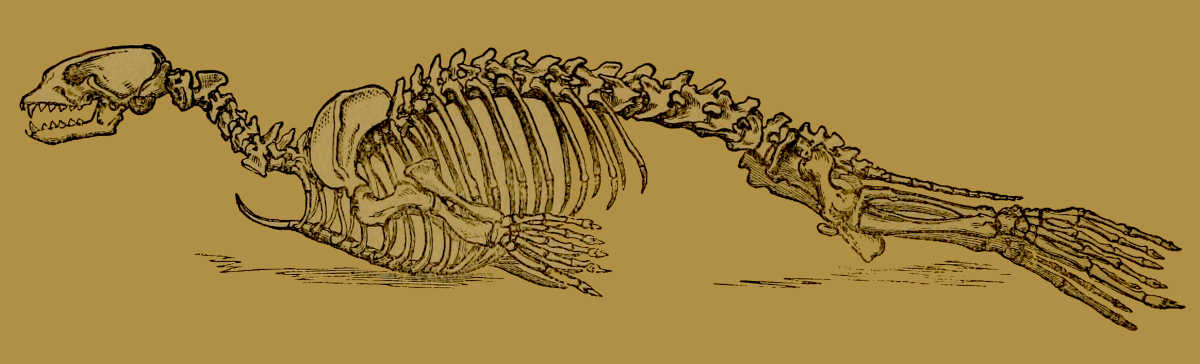
Fig. 2. Skeleton of Seal.
The total length of the adult is about 4 to 5 feet, and its coat is generally of a yellowish colour, thickly spotted with black on the back and upper parts, but less distinctly so on the sides. The under parts are a bright silvery hue; there is, however, considerable variety in colour and in the distinctness of the spots. This species is readily domesticated, and displays great intelligence, and even affection for those who feed and tend it. Almost everybody must have been struck with the docility displayed by the Seals which are occasionally exhibited as “talking fish.” At the Zoological Gardens and at the Brighton and other Aquaria, where they are a never-failing source of attraction, their graceful movements in their confined homes cannot fail to excite admiration. Swimming silently and swiftly along, the animal threads with the greatest accuracy the intricacies of its narrow pond, assuming every possible attitude, and turning over and over in its course, as much at ease when swimming on its back as in its usual position. When, tired with this exercise, it comes to the edge of its pond and raises itself out of the water, its rounded head, and bright, full black eyes have something almost human in their expression, and the fabled “mermaid” seems a reality; but when once it leaves the water, it is clearly seen that it is no longer in the element in which it is destined to live and move, for its motions are laboured and awkward in the extreme. It throws itself along, first on one side and then on the other, just as a man tightly sewn in a sack would do, but, notwithstanding its clumsiness, contrives to make considerable progress.
This species may be distinguished by the arrangement of its molar teeth, which are placed obliquely along either side of the jaw, not in a line with each other. It has been said that this is only a characteristic of youth, and that the peculiar arrangement disappears “before the skull attains its maximum size.” In the second edition of Bell’s ‘Quadrupeds,’ however, the authors express their belief that “it will be found a characteristic of all ages, although certainly more marked in the young than in very old animals.” Dr. Brown says that the Greenland Seal (Ph. grœnlandica) in its second coat has often been mistaken for this species, but that the former may readily be distinguished by its having the second toe of the fore flipper the longest. The hair next the skin is short and woolly, but externally harsh and shining, admirably adapted for repelling the water in which the animal passes so much of its time; the whiskers with which the upper lip is furnished, are thick, flattened hairs, laterally compressed, presenting diamond-shaped inequalities: this form of bristle is found in all the British Seals, whereas Phoca barbata, a species shortly to be mentioned as of doubtful occurrence on our coast, has the bristles compressed, but smooth. The food of the Common Seal consists of fish and crustacea.
THE RINGED, OR MARBLED SEAL.
The only recorded instance of the occurrence of the Ringed Seal, Phoca hispida, of Schreber, on the British coast, is that of an individual captured on the Norfolk coast, in June, 1846, and purchased by Mr. J. H. Gurney, in the flesh, in the Norwich fish-market, the skull of which is now in the Museum of that city. Although no other instance of its occurrence is on record, it seems not improbable that it may occasionally be met with, and pass unrecognized. In the first volume of the ‘Magazine of Zoology and Botany,’ Mr. Wilson, in a paper on the Scottish Seals, speaks of a small Seal which was sometimes seen in the Hebrides, and believed by the natives to be a distinct species: this was rendered probable by their not associating with the Common Seals, and not being so wild in their nature. It is thought that this small Seal may have been Ph. hispida. Small dark-coloured Seals have more than once been seen on the Norfolk and Lincolnshire coast, or exhibited in the towns, which it is quite possible also may have belonged to this species. That it inhabited the coast of Scotland in the past, there is evidence in the abundance of the remains of this species found in the glacial clays of that country, as identified by Professor Turner.[10]
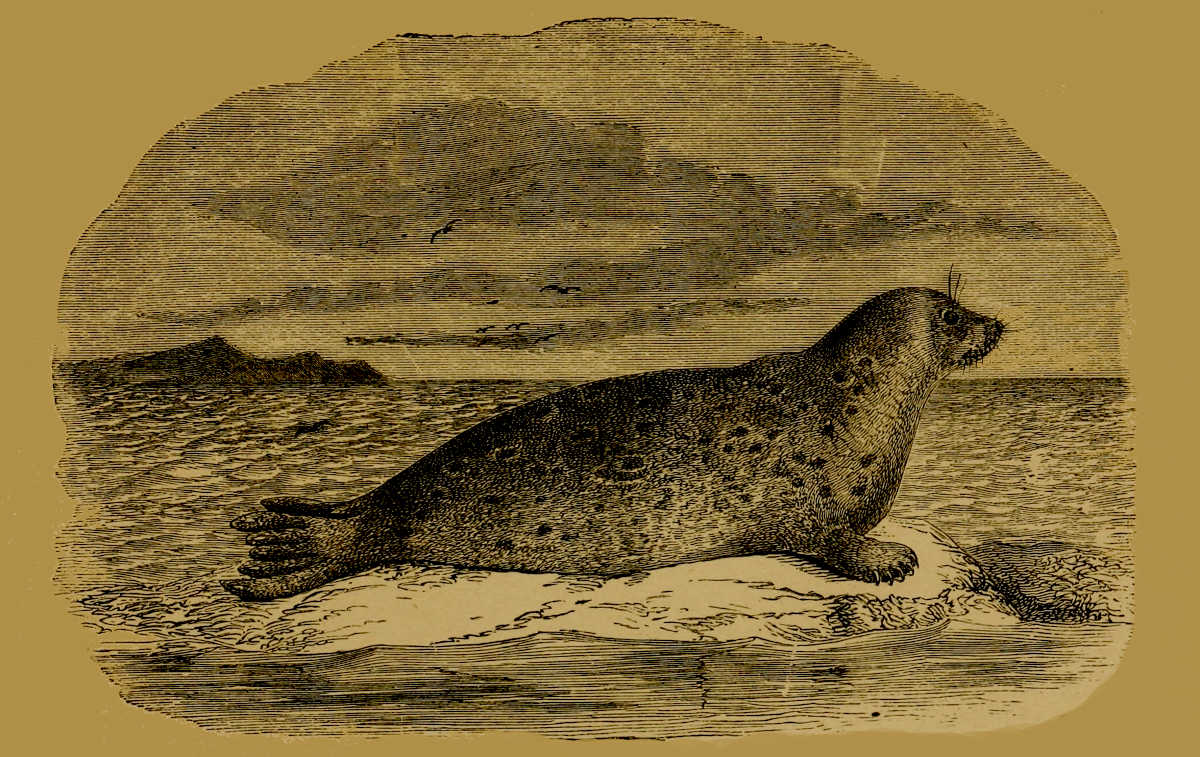
Fig. 3. Ringed Seal (Phoca hispida).
The small Seal found in the inland fresh-waters of Lake Baikal is believed to be a variety of this species, differing only in its darker colour; it has, however, been separated, under the name of Ph. baikalensis by M. Dybowski (Arch. f. Anat. u. Phys., 1873, p. 109). The type of Ph. discolor, F. Cuv., was taken in the Channel, and, according to De Sélys-Longchamps, this species has also occurred on the Belgian coast.
At present its home is the high latitudes of the Arctic seas, especially parallels 76 and 77 deg. North, and many are killed in South Greenland. In Davis’s Straits it is found all the year round, particularly up the ice-fjords; in Cumberland Gulf it is said to be by far the most common Seal, and forms the principal food of the Esquimaux. This was the only species found by the late Arctic expedition north of Cape Union, 82° 15′ N. lat. Captain Feilden, the Naturalist to Sir G. Nares’ Arctic Expedition, in an account of the ‘Mammalia of North Greenland and Grinnell Land’ (Zoologist, 1877, p. 359), thus speaks of this species:—“The Ringed Seal was met with in most of the bays we entered during our passage up and down Smith Sound. It was the only species seen north of Cape Union, and which penetrates into the Polar Sea. Lieutenant Aldrich, R.N., during his autumn sledging, in 1875, noticed a single example in a pool of water near Cape Joseph Henry, and a party which I accompanied in September, 1875, secured one in Dumbell Harbour, some miles north of the winter quarters of the “Alert”: its stomach contained remains of crustaceans and annelids. In June of the following year I observed three or four of these animals on the ice of Dumbell Harbour. They had made holes in the bay ice that had formed in this protected inlet. The polar pack was at this time of the year firmly wedged against the shores of Grinnell Land, and so tightly packed in Robeson Channel that no Seal could by any possibility have worked its way into this inlet from outside. I am, therefore, quite satisfied that Phoca hispida is resident throughout the year in the localities mentioned. A female killed on the 23rd August, 1876, weighed 65 lbs.” This species has, therefore, probably the most northerly habitat of any existing mammal.
Dr. Brown, in his paper on the ‘Greenland Seals’ (Proc. Zool. Soc., June, 1868,) gives an interesting account of this species, which, like the preceding, is littoral in its habits, seldom frequenting the open sea, but found generally in the neighbourhood of the coast ice, in retired situations. It is known by the whalers as the “Floe rat,” and its food consists of various species of crustacea and small fishes. This is the smallest of the Northern Seals, and of very little commercial value: its flesh, however, is eaten, and its skin forms the chief material of clothing in Greenland.
In appearance, this species is very like the Common Seal; but it is darker in colour, more particularly on the back, and the spots in the adult are surrounded by oval-shaped whitish rings; the young ones are lighter in colour. The old male is said to emit a most disgusting smell: hence one of its specific names, “fœtida.” Dr. Rink says that this unpleasant odour is more developed in those which are captured in the interior ice-fjords, “which are also, on an average perhaps, twice as large as those generally occurring off the outer shores. When brought into the hut, and cut up on its floor, such a Seal emits a smell resembling something between that of assafœtida and onions, almost insupportable to strangers. This peculiarity is not noticeable in the younger specimens, or those of a smaller size, such as are generally caught, and at all events the smell does not detract from the utility of the flesh over the whole of Greenland.”[11]
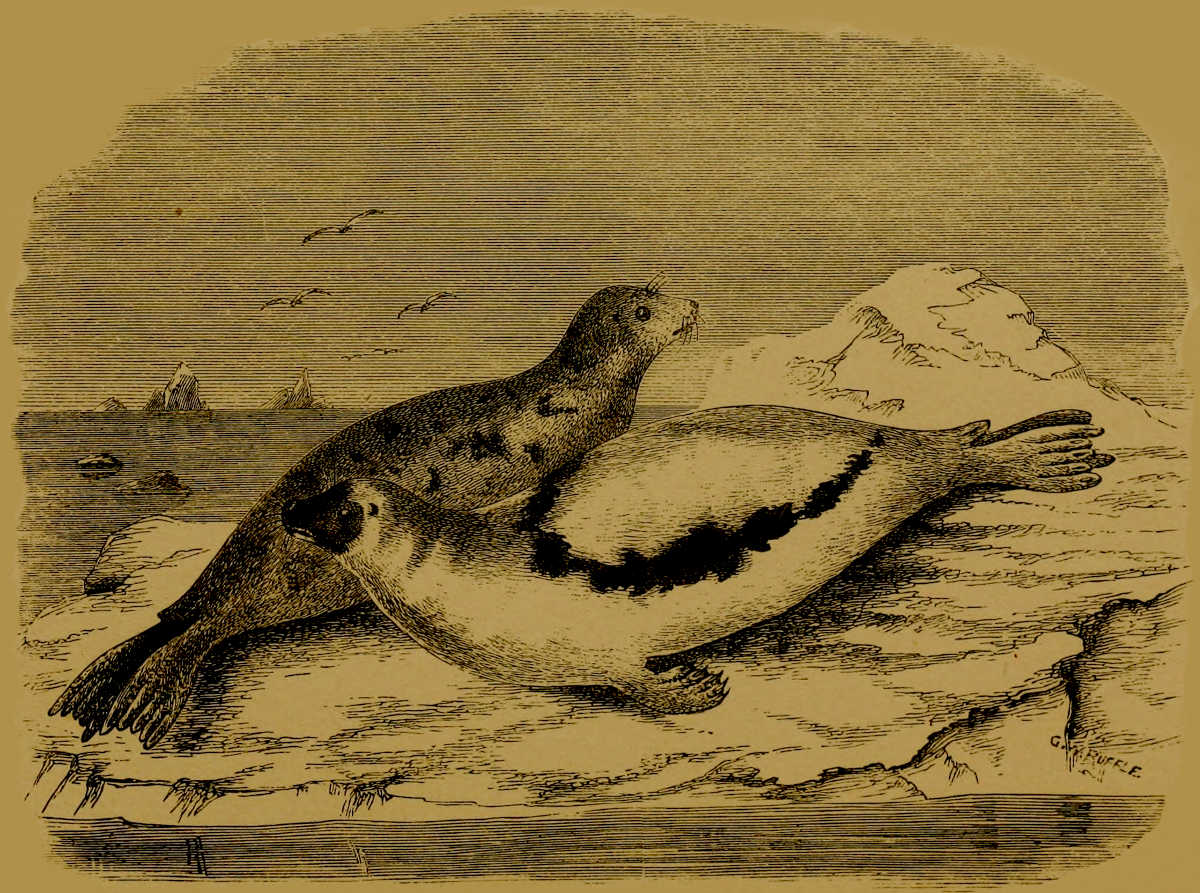
Fig. 4. Greenland Seal (Phoca grœnlandica).
Adult and Immature.
The molar teeth in this species are arranged in a straight line along the jaws, and not obliquely, as in the common species. As this Seal is very likely to pass unnoticed, should it occur on our coast, it will be well to bear in mind that this arrangement of the molars will at once distinguish it from Ph. vitulina, the only species with which it is likely to be confounded. Professor Flower has given a minute description of the skull of the Norfolk specimen in the ‘Proc. Zool. Soc.’ for 1871, pp. 506-12. The figure of this species is copied from Karl Thorin’s ‘Grundlinier Zoologiens Studium,’ p. 53 (Stockholm, 1868).
THE GREENLAND SEAL.
The claims of the Greenland Seal, Phoca grœnlandica (Fab.), to a place in the British Fauna, although long considered highly probable, were not rendered perfectly conclusive until 1874, when they were satisfactorily established by Professor Turner’s identification of a Seal killed in January, 1868, near the viaduct on the Lancaster and Ulverstone Railway, and now preserved in the Kendal Museum. Professor Turner (‘Journal of Anatomy and Physiology,’ vol. ix. p. 163) says that he has himself examined this specimen, and found the dentition exactly to agree with that of the skulls of the Greenland Seals with which he compared it. The individual in question, a male, measured six feet from the tip of the nose to the “point of the hind toes,” and the colour indicated the age to be about three years. Previously to this, the claims of this species to a place in our list rested principally upon the skulls of two Seals killed in the Severn, and exhibited by Dr. Reilly at the meeting of the British Association at Bristol in 1836. These skulls were at first referred by Professor Nilsson to Ph. hispida, but afterwards, both by that gentleman and Professor Bell, determined to belong to Ph. grœnlandica. Doubts having been thrown on the accuracy of this decision, Professor Bell, in the second edition of his ‘British Quadrupeds’ p. 253, again states his belief that he was correct in assigning them to the young of this species. These specimens are unfortunately lost. Several supposed cases of the occurrence of this species are recorded, but in no instance were they supported by the production of the animal itself. Dr. Saxby (‘Zool.’ 1864) says that this Seal is not rare in bad weather in the Voe of Baltasound, Shetland; and Mr. H. Evans, of Darnley Abbey, Derbyshire, in the year 1856, shot what he believes to have been a Greenland Seal near Roundstone, county Galway,—“Unfortunately, the animal sank and was lost; but Mr. Evans, who is well acquainted with the common and grey species, is perfectly certain that it was quite different from either” (Bell, 2 edit., p. 254). Perhaps the best authenticated case of the supposed occurrence of this species on our shores is given by Mr. H. D. Graham in Part I., vol. i. of the ‘Proceedings of the Nat. Hist. Society of Glasgow,’ p. 53 (Feb. 24, 1863). Three large white Seals were seen by Mr. Graham in Loch Tabert, Jura, Western Isles, lying on some shelving rocks, about 300 or 400 yards from the shore. They were watched through an excellent deer-stalking telescope for three hours, and Mr. Graham states that the characteristic markings of the Harp Seal could be distinctly seen. He also believes that, in three authentic instances, captures of white Seals, of extraordinary size, had been made, and states some particulars of the habits and appearance of these animals, as communicated to him by the islanders—to whom they appear to have been well known,—which render it highly probable that they belonged to this species. Mr. J. A. Harvie-Brown[12] also saw four Seals, which he believes to have been of this species, on a rock in the Sound of Harris, on May 2nd, 1870. They took to the water, but as they “kept close in, and often rushed past within a few feet” of where he and his companion were standing, they had an excellent view of them, and “the large splashy-looking dark marks on either side of the back” were distinctly visible. Although essentially an Arctic species, this animal has a very wide geographical range, which, added to its migratory habits, renders it not at all improbable that individuals occasionally wander to our shores.
This species is a native of the Arctic Ocean, and ranges from the N.E. coast of America to the Kara Sea (where it was found by the Swedish Arctic Expedition in 1875), changing its quarters according to season.[13] It is this species which constitutes the chief object of pursuit in the northern Seal-fishery, and the season chosen for the attack is when they visit the ice for the purpose of producing their young ones. Dr. Brown says, “They take to the ice, to bring forth their young, generally between the middle of March and the middle of April, according to the state of the season, &c., the most common time being about the end of March. At this time they can be seen literally covering the frozen waste, with the aid of a telescope, from the ‘crow’s-nest,’ at the main royal mast-head, and have on such occasions been calculated to number upwards of half a million of males and females.”[14] The young, when born, are pure white, which changes to a yellow tint. At about 14 days old they begin to take to the water, and at the age of a month are capable of taking care of themselves: they then assume a spotted coat, which changes gradually to the adult markings, which are perfected in about three years. The adult male is about five feet long, the body generally of a tawny grey, varying to nearly white, marked with a conspicuous band of dark brown or black spots running into each other, which, commencing on the upper part of the back between the shoulders and curving downwards, is continued along the sides, disappearing before it reaches the hind flippers. The under parts are a dingy white, and the muzzle nearly black. The female, according to Dr. Brown, rarely reaches five feet in length, and is a dull white or yellowish straw-colour, tawny on the back, and with similar markings to the male, but somewhat lighter. Some are bluish or dark grey on the back, with “oval markings of a dark colour apparently impressed on a yellowish or reddish-brown ground:” these, Dr. Brown believes to be young females. The adult Greenland Seal is readily recognized, but it varies so greatly in its different stages of immaturity, and individuals differ so much from each other, that the most trustworthy characters are to be found in the dentition and the structure of the skull, which should in all cases be preserved, as affording the most ready and reliable means of determining the species of doubtful individuals. As has before been said, the second toe of the fore flipper is the longest in this species.
HOODED SEAL.
The Hooded or Bladder-nosed Seal, Cystophora cristata (Erxleben), fig. 5, has occurred at least thrice upon our shores. In June, 1847, a young one was killed in the Orwell, and is now in the Ipswich Museum; in 1872 a second young one was killed in Scotland near St. Andrew’s; and a third specimen, an adult male, was caught in February, 1873, at Frodsham, on the Cheshire side of the Mersey, and lived in captivity till the beginning of the following June (Pr. Liverpool Soc. xxvii. p. 63). Others are believed to have been obtained in the Orkneys. Mr. Howard Saunders was assured that the “Bladder-nose” is well-known as a visitor to the Vae Skerries, Shetland (Alston’s ‘Mammalia of Scotland,’ p. 15); and a Seal supposed to be of this species was seen off the Irish coast near Westport. In Hollingshed’s ‘Chronicles,’ in the year 1577, sundry fishes of monstrous shape, with cowls on their heads like monks, and in the rest resembling the body of a man, are said to have occurred in the Firth of Forth (Bell’s ‘Brit. Quads.’), the appearance of which was of course followed by pestilence and famine. Throughout the Polar seas this species is widely distributed, being found in the Greenland seas, Iceland, and Spitzbergen, also occasionally in the temperate waters of Europe and America. It is polygamous and migratory in its habits: during the rutting season it is very pugnacious, and Dr. Brown says great battles take place between the males, and their roaring is said to be so loud that it can be heard for miles off. The young, which are born in April, are pure white at first, which changes to grey, and gradually becomes darker till it assumes the adult colour and markings, which it appears to do about the fourth year; the colour then is “dark chestnut or black, with a greater or less number of round or oval markings of a still deeper hue.” The adult is furnished with a curious bladder-like appendage, commencing at the nostrils, with which it is connected, and continued upwards to the forehead: this, when inflated, presents a very remarkable appearance; when the animal is at rest it remains flaccid, but when irritated or excited, it is blown up to its full extent. It is generally believed that the “bladder” is found only in the male, but Dr. Brown does not think there is any just ground for this belief; he does not, however, assign any reason for doubting what has been positively asserted to be the case. The Bladder-nose Seal is fierce in its nature and dangerous to attack; although not actually taking the initiative it is always ready for battle, and will avail itself of any advantage by turning upon and following its opponent. The air-bladder, which is placed in the spot usually most vulnerable, renders it difficult to kill, as it forms a protection from the clubs of the sealers. This is one of the largest of the Northern Seals, varying, according to different authorities, from 7 to 10 or even 12 feet in length. The first toe of the fore flipper is the longest.
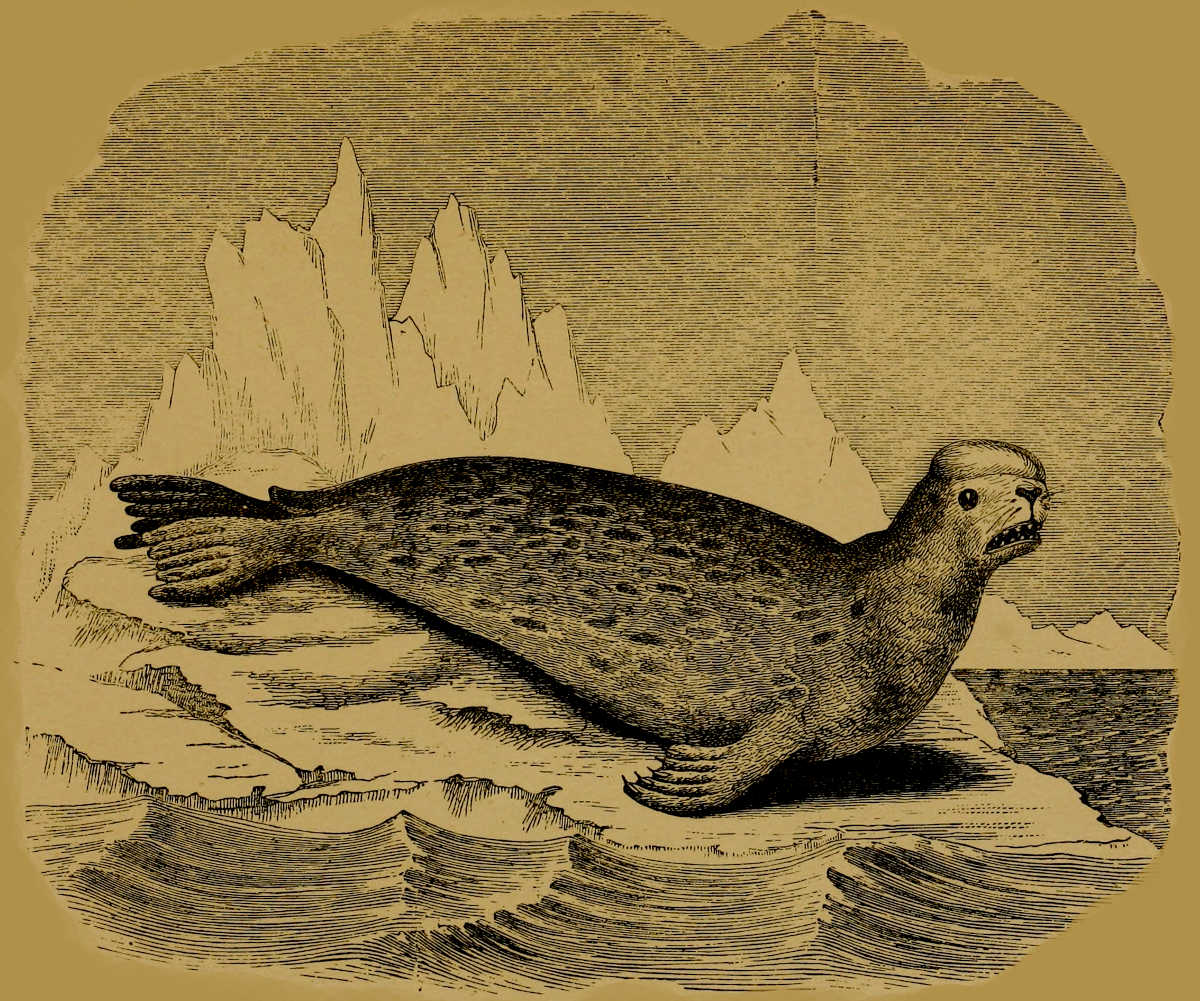
Fig. 5. Hooded Seal (Cystophora cristata).
THE GREY SEAL.
One other species of true Seal, the Grey Seal, Halichœrus gryphus (Fab.), claims a place in the British Fauna. Dr. Brown says the Grey Seal “has no doubt been frequently confounded with other species, particularly Ph. barbata and Ph. grœnlandica.” Such has undoubtedly been the case, and a specimen in the British Museum, long regarded as Ph. barbata, has been referred to this species. There is, I believe, no sufficient evidence that Ph. barbata has ever occurred on the British coast; but so imperfect even now is our acquaintance with the Seals which frequent our shores, that it may even yet be found. As before mentioned, the bristles forming the “whiskers” of Ph. barbata, are simple flattened hairs, without the impressed pattern found in the bristles of the known British species; they are nearly the same thickness throughout, and sharply curved near the end.
The Grey Seal has been found on various parts of the coast, from Shetland to the Isle of Wight; the Orkney and Shetland Isles, the Hebrides, and the west coast of Ireland, however, appear to be its chief places of resort on our shores; it has also been known to breed on the Fern Islands. Haskier Island, off North Uist, has long been known as a favourite breeding-place of this species. Captain Elwes, who visited this island on the 30th June, 1868 (‘Ibis,’ 1869, p. 25), informed Mr. Harvie-Brown that, up to the year 1858, an annual battle was held there in the month of November, when the Seals resort to the rocks with their young ones, and that from forty to one hundred, old and young, would be killed. This wholesale destruction has been put a stop to, and as it is extremely shy and difficult to approach at other seasons, it is to be hoped that this species may for some time escape extermination in this favourite resort.
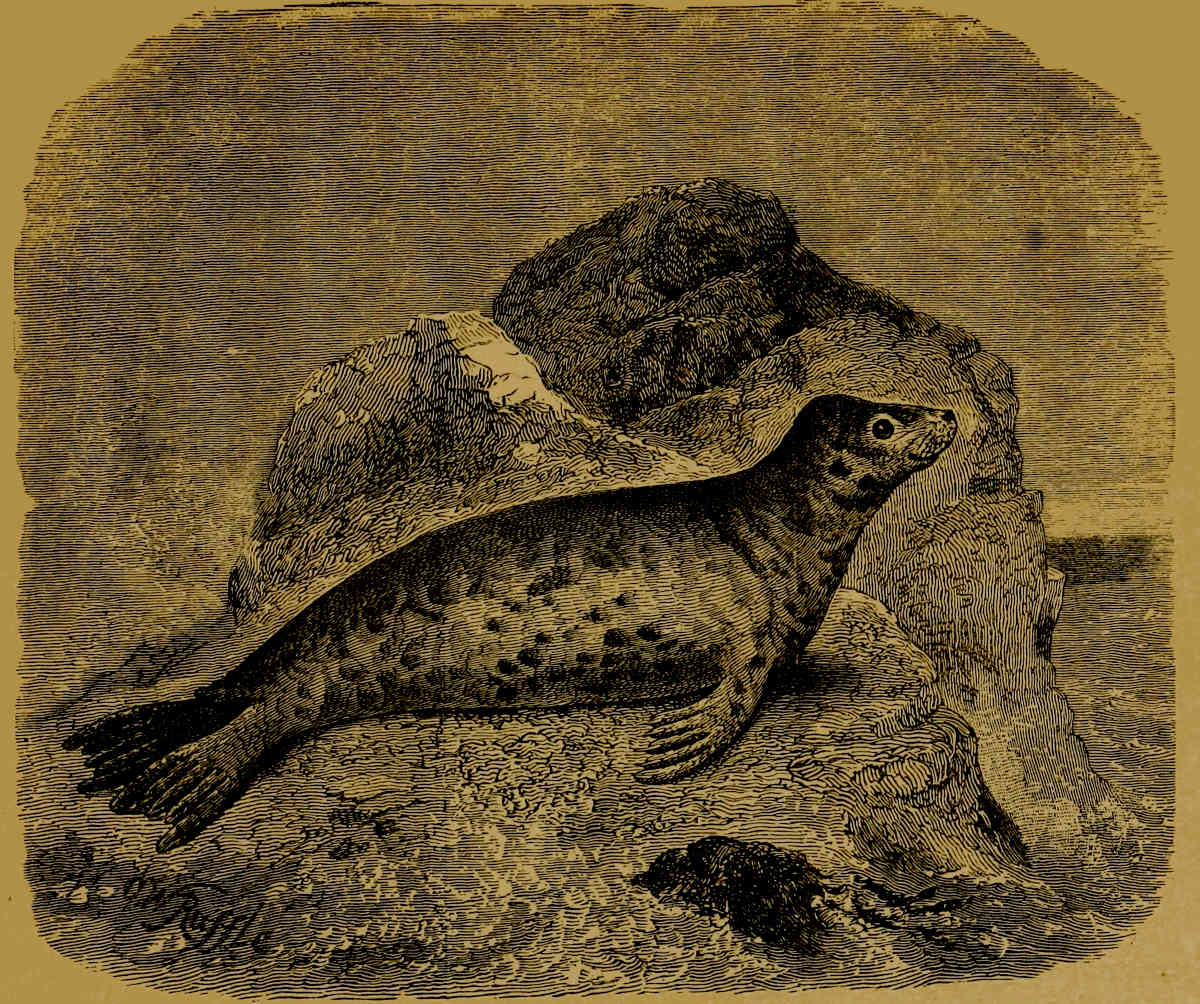
Fig. 6. Grey Seal (Halichœrus gryphus).
According to Bell, this species inhabits the “temperate northern seas rather than the Polar waters,” and is found in the North Sea, Baltic, Iceland, Scandinavia, Denmark, and North Germany. Dr. Brown met with a specimen a little south of Discoe Island, but can only speak of its claims to a place in the Greenland Fauna as strongly probable. Bell gives some interesting information with regard to the habits of this species as observed in various British stations, and calls attention to the remarkable fact, that whereas in this country it produces its young in the months of October and November, on the Continent this is always said to take place in February; he suggests, to account for this singular discrepancy, that in our milder climate pairing takes place much earlier than in Scandinavia. The young, which are born white, are suckled for about a fortnight; the first coat is shed before they take to the water, which is not for some weeks after birth. The colour varies with age, sex, and season, so much, that it is not of great service in their identification, their large size being the best external guide. Lloyd, in his ‘Game-birds and Wild-fowl of Sweden and Norway,’ speaking of this species, says that even should it somewhat resemble the Common Seal in size and colour, as is at times the case, it may always be readily distinguished from the latter by the greater length of its claws and the superior breadth of its muzzle. The claws project considerably beyond the ends of the toes, the first of which is the longest. The general colour of the adult is greyish, tinged with yellow, and spotted and blotched with darker grey; the under parts lighter. The length of the adult varies from 7 to 10 feet. By the form of its skull and teeth it is readily distinguished, as well as by the great size of the animal. In the skull the brain-case is small, the nasal opening very large, and the grinders conical, only the two hinder pair in the upper, and the last pair in the lower jaw, double-rooted, the rest simple. Professor Bell, in his history of ‘British Quadrupeds,’ gives the generic and specific characters, as well as excellent figures of the skulls of the various British Seals, which will be found most useful in determining the species of any doubtful individuals; other figures will be found in Dr. Gray’s ‘Catalogue of the Seals and Whales in the British Museum.’
THE WALRUS, OR MORSE.
Of the many strange forms which the Zoological Society of London has been the means of introducing to the stay-at-home naturalists of this country, certainly not the least interesting is that of the Walrus (Trichechus rosmarus, Linn.) It is true that in neither of the instances in which the young animal has been brought alive to the Gardens, has it long survived in its new home; but, short though its residence amongst us, the opportunity has been afforded to many of becoming acquainted with the Arctic stranger in propriâ personâ, instead of through the distorted medium of the badly-stuffed skins, or the equally bad representations of this interesting animal, which, until recently, we have possessed. The first recorded appearance of the Walrus in this country was, I believe, in 1624, when, according to Hakluyt’s ‘Pilgrimes,’ a young one was brought to England by Master Thomas Welden, in the God-speed, and duly presented at Court. In 1853 the Zoological Society became possessed of a young one, which lived only a few days in their Gardens. On the 1st of November, 1867, another was received, which lived till the 19th of December, when it unfortunately died, notwithstanding the care bestowed upon it, both as regards food and accommodation. This last was captured by the whale-ship Arctic, on the 28th of August, 1867, in lat. 69° N. and long. 64° W., and brought to Dundee, whence it was conveyed by Mr. Bartlett to the Society’s Gardens. The captain of the Arctic saw two or three hundred walruses basking upon the ice, and sent out his boats to the attack: among the killed was an old female followed by her young one; the latter was taken on board and eventually brought to England.
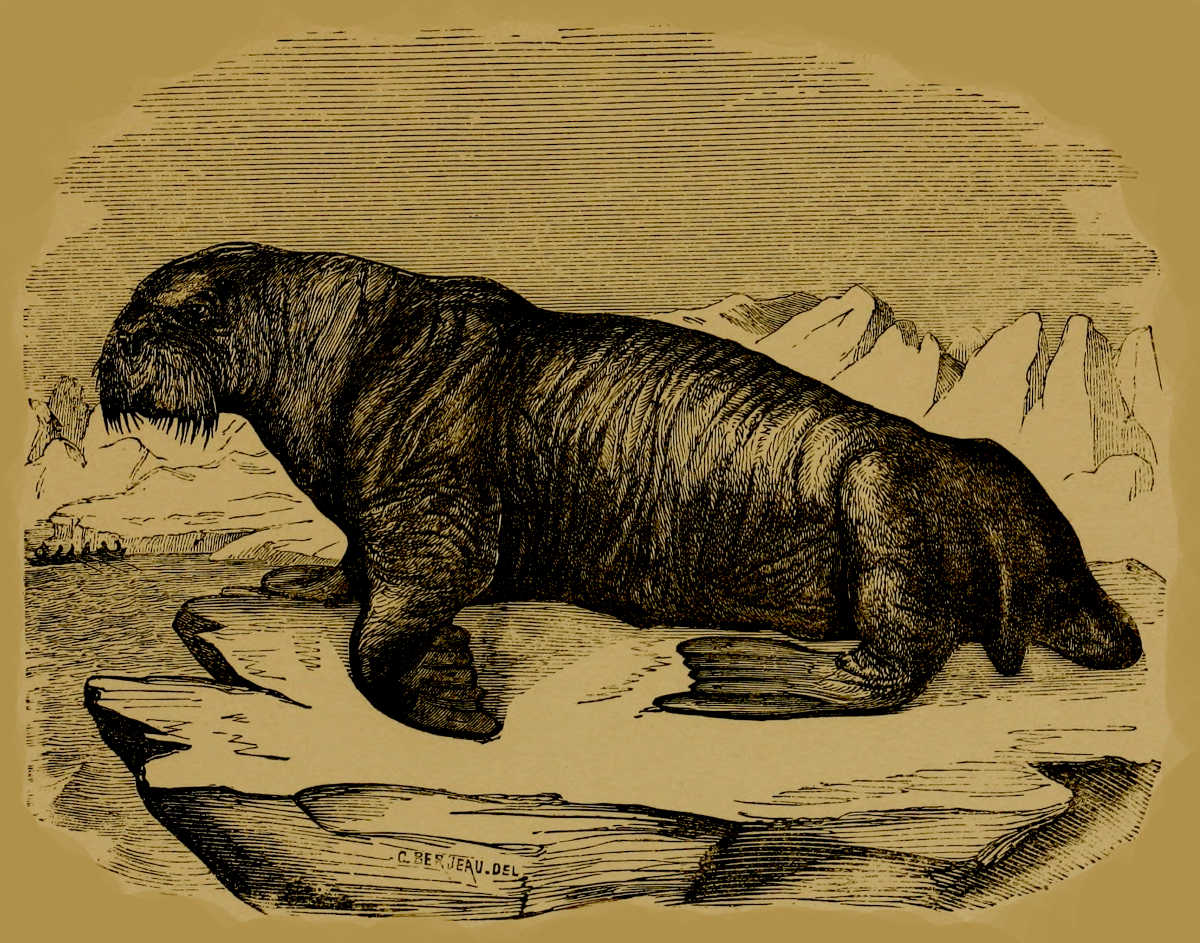
Fig. 7. Walrus, or Morse (Trichechus rosmarus).
Although now confined to the icy seas of the Arctic circle, the Walrus was probably not uncommon on our shores in times long past. The skull is said to have been found in the peat near Ely, and Hector Boece, in his ‘Cronikles of Scotland,’ mentions it as a regular inhabitant of our shores in the end of the 15th century: in the present century it has occurred several times, although it must be considered as a very rare straggler, sadly out of its latitude. Wallace says that its fossil remains have been found in Europe as far south as France, and in America probably as far south as Virginia, and it was common in the Gulf of St. Lawrence so late as 1770 (Leith Adams). In recent times it has retreated before its great enemy, man, from the northern coasts of Scandinavia to the circumpolar ice of Asia, America, and Europe, sometimes, but rarely, reaching as far south as lat. 60°. In Smith’s Sound the Walrus does not appear to move further north than Cape Frazer, the meeting-place of the polar and southern tides: at this point Captain Feilden saw a single example. Whenever met with, it is the object of ruthless persecution, and is rapidly and surely becoming exterminated wherever man can reach it; and but for its ice-loving habits, which render its present strongholds always difficult, and sometimes impossible, of access, it would doubtless long ere this have become extinct.
Recently it has been met with on our shores, according to Bell, on the coast of Harris in 1817; in the Orkneys in 1825; one was seen in 1827 in Hoy Sound, but not captured; and in 1841 one was killed near Harris. Dr. Brown also states that two were seen, one in Orkney and the other in Shetland, in 1857. Prof. Heddle also informed Mr. Harvie-Brown that in 1849 or 1850 he saw an adult, and a young one, off the coast of the parish of Walls, in Orkney (Harvie-Brown, Proc. Nat. Hist. Soc. of Glasgow, 1879, p. 97.)[15]
The Trichechus may be considered as intermediate between the true Seals and the Eared Seals, to both of which families it has affinities: it is carnivorous, feeding on mollusks, fish, and when it can get it, the flesh of whales. The stomach of one, examined by Captain Feilden, contained a large amount of green fluid oil, in which small particles of Ulva latissima could be detected, and minute fragments of the shells of Mya. Its habits were so well and succinctly described by Captain Cook a hundred years ago, that I cannot do better than quote his own words, the accuracy of which has since been amply confirmed. Whilst in Behring’s Straits, in lat. 70° 6′, and long. 196° 42′, on the 19th of August, 1778, Cook first met with the Walrus: “they lie,” he says, “in herds of many hundreds upon the ice, huddling one over the other like swine, and roar or bray very loud; so that in the night, or in foggy weather, they gave us notice of the vicinity of the ice before we could see it. We never found the whole herd asleep, some being always on the watch. These, on the approach of the boat, would wake those next to them, and the alarm being thus gradually communicated, the whole herd would awake presently. But they were seldom in a hurry to get away till after they had been once fired at, then they would tumble one over the other into the sea in the utmost confusion; and if we did not at the first discharge kill those we fired at, we generally lost them, though mortally wounded. They do not appear to us to be that dangerous animal some authors have described; not even when attacked. They are rather more so to appearance than in reality. Vast numbers of them would follow and come close up to the boats, but the flash of a musquet in the pan, or even the bare pointing of one at them, would send them down in an instant. The female will defend the young one to the very last, and at the expense of her own life, whether in the water or upon the ice. Nor will the young one quit the dam, though she be dead; so that if you kill one you are sure of the other. The dam, when in the water, holds the young one between her fore-fins.”[16] Since Cook’s time the Walrus has learned to fear man, its only enemy except the Polar Bear, and is more difficult to approach. When wounded, or its young in danger, it has been known fiercely to attack the boats sent for its capture, striving to overturn them, and piercing their sides with its tusks: many serious accidents have been the result.
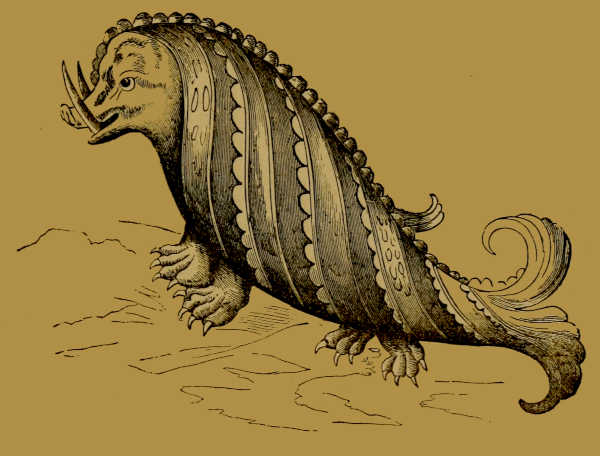
Fig. 8. Vacca marina (reduced from Gesner).
The number of Walruses killed annually by the Norwegian and Russian hunters is very considerable; probably nearly an equal number are wounded and lost. As the female produces only a single young one at a birth, which is said to remain with the mother nearly two years, “until its tusks are grown long enough to be used in grubbing up the shell mud at the sea-bottom,” it will readily be imagined that the destruction is greatly in excess of the production, and that they are rapidly decreasing in numbers. A communication in the Field of March 27th, 1880 (p. 381), received from St. Francisco, points out even more serious consequences resulting from the reckless destruction of the Walrus than the mere extermination of a species, itself a matter of no small regret. “If,” says the writer, “the whalers reach Behring Strait before the ice breaks up, they remain on the coast, and often hunt the Walrus for weeks together, with startling and serious results. Last year’s campaign was considered successful, as about 11,000 Walruses were secured, most of them within the Arctic Sea. But to attain this result, between thirty and forty thousand animals were killed, so that only one-third of the number destroyed were actually utilised. There can be no doubt as to the ultimate consequence of such glaring imprudence; but last year they were so painfully apparent as to touch even the hearts of those who occasioned them. Not that the whalers were moved to compassion by the victims themselves, but by the sufferings of the human beings who were deprived of their chief source of subsistence. The hardy tribes in the neighbourhood of Behring Strait literally cannot exist without the Walrus, and so long as they were its only human enemies the number destroyed was inconsiderable. But the herds soon dwindled under the superior weapons and appliances of civilised nations, and the survivors retreated, like the Whales, towards the Pole. By the end of last season, not a single Walrus was left on the coast, and the immediate result was such a terrible famine among the natives that the whalers themselves speak of it remorsefully. The population north of St. Lawrence Bay has been reduced by one-third; and in a village which formerly contained 200 inhabitants, only one man survived. Several of the whalers have consequently refused to take any part in future Walrus hunts on the coast; they assert that for every hundred animals killed, a native family must perish by starvation, and they will not incur so heavy a responsibility.”
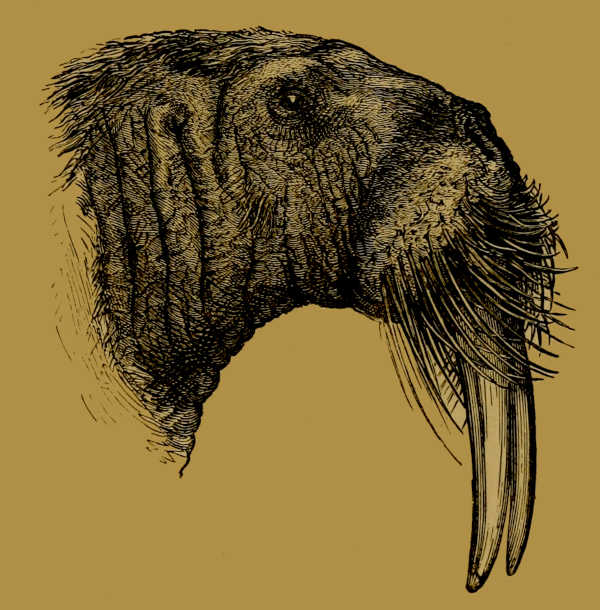
Fig. 9. Head of Walrus (Modified after Murie).
About the month of August they repair to the shore, and congregating in vast herds on the beach of some secluded bay, lie for weeks together in a semi-torpid condition, without moving or feeding. Should their retreat be discovered whilst in this state, great is the slaughter. Mr. Lamont, in his ‘Seasons with the Sea Horses,’ says that in 1852, on a small island off Spitzbergen (one of the Thousand Islands), two small sloops discovered a herd of Walruses consisting of three or four thousand, nine hundred of which they succeeded in killing, only a small portion of the produce of which, however, they were able to carry away.
The colour of the Walrus is brown, paling with age, and the skin is thickly covered with short hairs; the adult reaches the length of 10 or 15 feet, or, according to some authorities, even more, and weighs from two to three thousand pounds. Its rounded head, heavy muzzle, thickly set with stout bristles, small, round blood-shot eyes, and formidable tusks, give to this animal a ferocious appearance which is foreign to its nature, except when greatly excited or at pairing time, when the old bulls are said to fight with great fierceness and determination. A full-grown Walrus will yield from five to six hundred pounds of blubber, the oil from which, however, is not so fine as that of the Seal. The ivory tusks were formerly much used by dentists; at present, I believe, owing to the introduction of vulcanite, very little is applied to that purpose. Mr. Lamont mentions 24 in. in length and 4 lb. each in weight, as the size of a good pair of bull’s tusks: a pair in the Norwich Museum measure 32 in. in length, and the heavier of the two weighs 9 lb. 9 oz. The immensely elongated canine teeth which form the “tusks,” are found in both sexes, but are shorter and more slender in the female than in the male. The skin of the Walrus is valuable for many purposes.
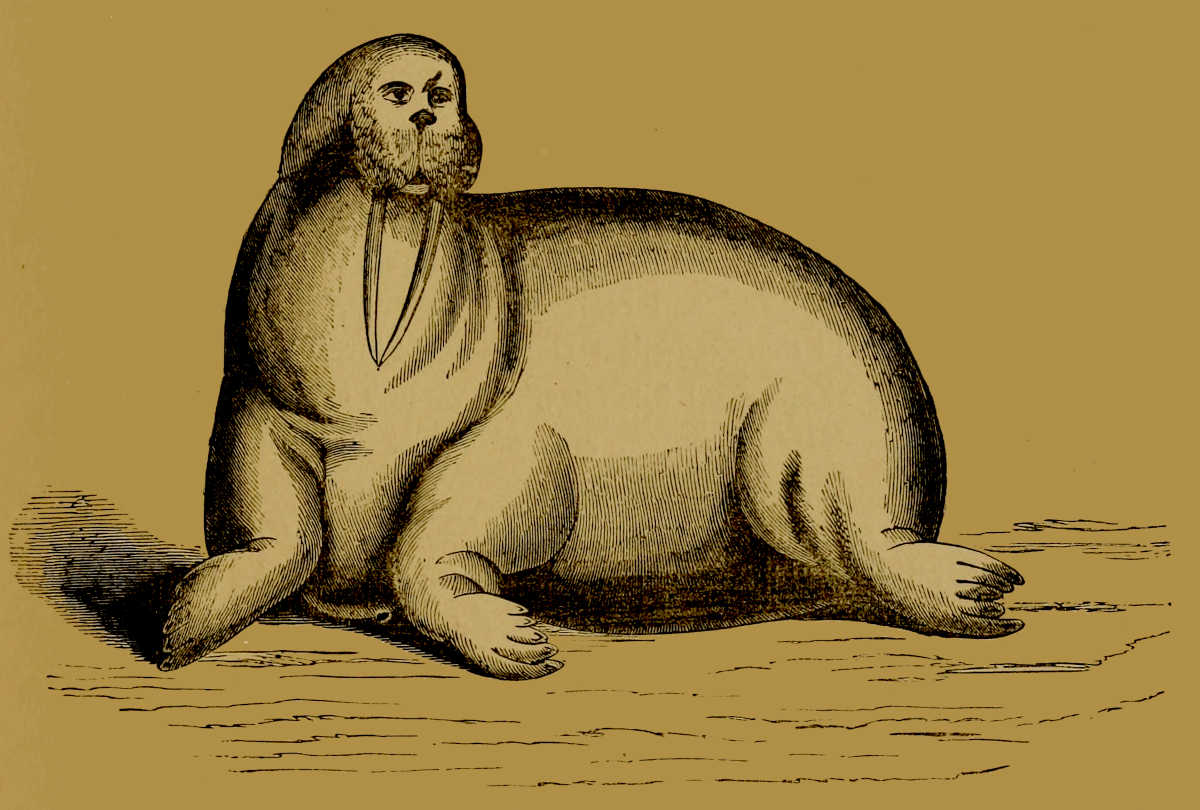
Fig. 10. “Sea Horse” (After Cook).
Few animals, so long known to man, have, when figured, been represented so inaccurately as the Walrus: the hind feet are almost invariably depicted extended backwards, like those of the Seal (so also in stuffed specimens), whereas in the living animals they can be directed to the front, and serve as supports to the body in progression on the land or ice, in the same manner as the hind limbs of the eared seals. Dr. J. E. Gray, in an article ‘On the Attitudes and Figures of the Morse,’ in the Proceedings of the Zoological Society of London for 1853, pp. 112-16, reproduces some of the wonderful prints of this animal from old authors, most of which are purely imaginary: Fig. 8, p. 37, is copied from one of these. By far the best portrait known, till quite recently, is one published in Amsterdam in 1613, where an old female and her young one are very accurately depicted: this has been reproduced in Bell’s ‘British Quadrupeds,’ 2nd edition, p. 269. Fig. 10 is copied from the “Sea Horse,” in the foreground of Cook’s illustration in ‘A Voyage to the Pacific,’ &c., 1784 edit., vol. ii., p. 446; as will be seen, this figure forms the source from which most subsequent illustrations were derived. Fig. 7 is taken, by kind permission of the late Mr. F. Buckland, from his ‘Log-book of a Fisherman and Zoologist,’ and represents “Jemmy,” the young Walrus, whose brief sojourn in the Zoological Gardens has already been referred to. One of Mr. Wolf’s “Zoological Sketches” represents a herd of Walruses in almost every conceivable attitude, and of course beautifully drawn and coloured.
Some authors recognise two distinct species of Walrus, one of which is said to be confined to the northern shores of the Atlantic, the other to the Pacific Ocean. Mr. Allen, in the ‘North American Pinnipeds,’ enters at length into the subject, and minutely describes the peculiarities which characterise each species. Reviving, after the example of Malmgren, the almost obsolete generic name of Odobænus, he describes the Atlantic Walrus under the name O. rosmarus; the animal found in the Pacific he calls O. obesus. The chief external points of difference in the latter appear to be in the facial outline, the longer and thinner tusks, “generally more convergent, with much greater inward curvature; the mystacial bristles shorter and smaller, and the muzzle relatively deeper and broader, in corelation with the greater breadth and depth of the skull anteriorly.” The eyes are also said to lack the “fiery red” appearance attributed to the Atlantic Walrus, and to be smaller and very protuberant. Cook’s figure reproduced at p. 41, also that at p. 177 of Scammon’s book, are those of Odobænus obesus, and the fine pair of tusks mentioned at p. 40, as now in the Norwich Museum, were probably also obtained from a Pacific Walrus. The figure at p. 33, and the excellent figure by Wolf, at p. 457 of Lloyd’s ‘Game-birds and Wild-fowl of Sweden and Norway,’ are of the Atlantic Walrus.
It is much to be regretted that the extinction of this harmless and useful animal is merely a matter of time, and that perhaps before many years have passed it may have ceased to exist; the only hope appears to be that when it has become too scarce to render its pursuit remunerative, a remnant may still be left to continue the species around the far off and unapproachable islands of the Arctic seas. Even in Franz Josef Land, where, in the summer of 1880, Mr. Leigh-Smith found the Walrus very abundant: it will probably not long remain unmolested, for that gentleman informed Captain Feilden that the Norwegian walrus-hunters, when they heard of his discovery, talked of pushing on for Franz Josef Land next summer, the Spitsbergen walrus-hunting having become very uncertain, from the paucity and wariness of the animals.[17]