ODONTOCETI (TOOTHED WHALES).
Reading edition
PHYSETERIDÆ.
The second sub-order into which the Cetacea are divided, is the Odontoceti, or Toothed Whales. In this section, baleen is never present, but well-developed teeth are found in one or both jaws of the adult; in some species they are very numerous; sometimes, though rarely, deciduous. The blow-hole is single, and the skull generally asymmetrical, or not precisely alike on both sides of the medial line. Professor Flower divides the Odontoceti into three families, one of which, the Platanistidæ, as already said, is found only in India and South America: the other two, Physeteridæ and Delphinidæ, are represented in our Fauna by about fifteen species.
Of the Physeteridæ, four genera are represented in the British fauna by four or five species; namely, one Physeter, the Sperm Whale; two Hyperoodon, the common Beaked Whale, and a doubtful species called the Broad-fronted Beaked Whale; one Ziphius, Cuvier’s Whale; and one Mesoplodon, Sowerby’s Whale.
SPERM WHALE, OR CACHELOT.
By far the most conspicuous species of this interesting group is the Sperm Whale, Physeter macrocephalus (Linnæus), which rivals the Right-Whale in commercial importance, and in the value of its products. This species has a very wide geographical range, having been found in almost every sea between lat. 60° north and 60° south. The attempt has been made, I think unsuccessfully, to show that the Sperm Whale of the Southern Hemisphere is distinct from that of the northern; there seems, however, no reason, at present, to doubt, although, of course, it may eventually be found otherwise, that the same species of Sperm Whale ranges over the whole of this vast tract of ocean. North of about 40° it appears to be only a straggler, and although the Arctic seas are almost always stated by authors to be its head-quarters, very few well-authenticated instances of its occurrence farther north than Scotland are on record; Lilljeborg excludes it from his account of the Scandinavian Cetacea, but Herr Collett says that within the last 100 years, at least two individuals of this species have been stranded on the Norwegian coast, and that Professor Sars, during a stay in Loffoden, received information which convinced him that one was seen there in the summer of 1865.
From the middle of the sixteenth to the middle of the seventeenth century, the stranding of individuals of this species on the coast of Great Britain, and, indeed, of other countries in Europe from the Netherlands to the Mediterranean, was by no means a rare occurrence; these were generally solitary males, but occasionally small “schools” were met with, as in July, 1577, in the Scheldt, where three were taken; also, at Hunstanton, in Norfolk, in 1646, mentioned below.
Of its occurrence on the British coast there are numerous instances; in all cases, however, they are believed by Andrew Murray to have been stragglers, “which have rounded Cape Horn (they have never been known to double the Cape of Good Hope) or unpromising colonies, for they are becoming scarcer and scarcer in more than their due proportion.”[29] Eight or ten individuals of this species have occurred on the coast of Scotland between the years 1689 and 1871 (Alston, ‘Fauna of Scot.’, p. 18).
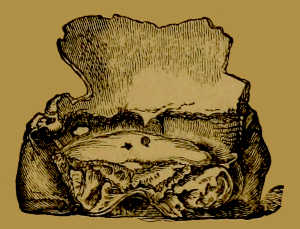
Fig. 17. Chair in Great Yarmouth Church, formed from the basal portion of the skull of the Sperm Whale.
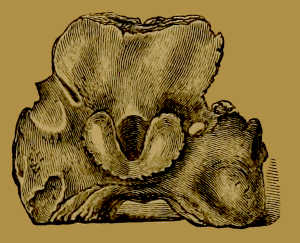
Fig. 18. Back view of the same.
In the church of St. Nicholas, at Great Yarmouth, is the basal portion of a skull of this animal, which has been converted into a chair: it formerly stood outside the church, and of course, as it was an object of wonder, it was relegated to the powers of darkness, and christened (?) the “Devil’s Seat;” it has, however, now been admitted into mother church, and stands beside the north-west door under the clock. In the churchwardens’ accounts for 1606 there is a charge of 8s. for painting this chair, which clearly proves its antiquity. In a letter to Sir Thomas Browne (Wilkins’ edit., 1852, editor’s preface to “Pseudodoxia,” vol. i. p. lxxxi.), Sir Hamon L’Estrange writes that in June, 1626, a Whale, afterwards referred to by Sir T. Browne as a Sperm Whale (vol. iii. p. 324), was cast upon his shore or sea-liberty, “some-tyme parcel of the possessions of the Abbey of Ramsey, &c.” The same author, in his account of the “Fishes found in Norfolk and on the Coast,” says, “A Spermaceti Whale of 62 feet long [came on shore] near Wells, another of the same kind twenty years before at Hunstanton [the one referred to by Sir H. L’Estrange]; and not far off, eight or nine came ashore, and two had young ones after they were forsaken by the water.” The Whale mentioned by Sir H. L’Estrange came on shore in 1626; twenty years after would give 1646 as the date of the Wells specimen; and in December of that year, according to Booth’s “History of Norfolk,” published in 1781 (vol. ix. p. 33), “A great Whale was cast on the shore here [at Holme-next-the-Sea], the wind blowing strongly at the north-west, 57 feet long, the breadth of the nose-end eight feet, from nose-end to the eye 15½ feet; the eyes about the same bigness as those of an ox, the lower chap closed and shut about four feet short of the upper; this lower chap narrow towards the end, and therein were 46 teeth like the tusks of an elephant; the upper one had no teeth, but sockets of bones to receive the teeth: two small fins only, one on each side, and a short small fin on the back; it was a male ...; the breadth of the tail, from one outward tip to the other, was 13½ feet. The profit made of it was £217 6s. 7d., and the charge in cutting it up and managing it came to £100 or more.” It seems probable that a “school” got bewildered in the shallow waters of the Wash, and that the individual of which Booth gives such an excellent description, formed one of the same party as the eight or nine mentioned by Sir T. Browne. In May, 1652, Mr. Arthur Bacon writes to Sir T. Browne about the Sperm Whale cast on shore at Yarmouth, but the actual date of the occurrence is not given. Since these ancient records, many others have occurred at intervals, singly or in small parties, on various parts of the coast; the last instance, I believe, being in July, 1871, when one was stranded on the shore of the Isle of Skye.
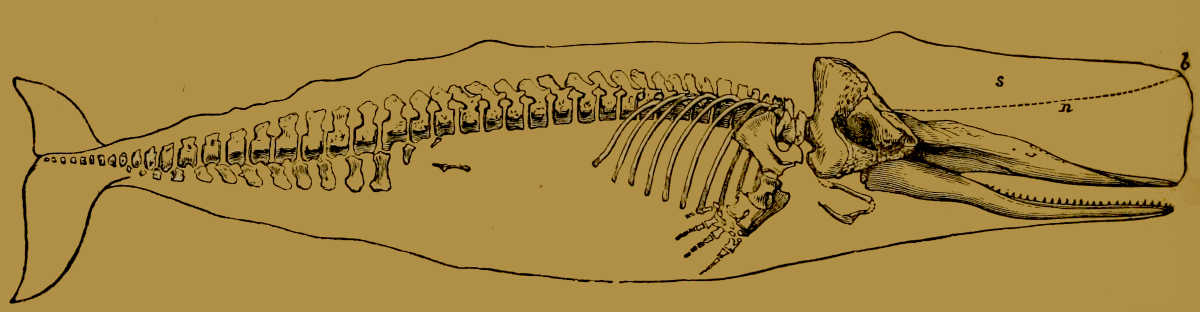
Fig. 19. Skeleton of the Sperm Whale (after Flower).
s, Spermaceti Cavity; n, Nasal Passage, in dotted line; b, Blow-hole.
Of the osteology of the Sperm Whale, Professor Flower has given an exhaustive description in a paper published in the ‘Transactions’ of the Zoological Society, vol. vi., and of its habits a very interesting account is given by Thomas Beale, who, in the capacity of surgeon on board ships employed in the South Sea fishery, had unusual opportunities of observing this remarkable animal. He published a book entitled ‘The Natural History of the Sperm Whale,’ to which I am largely indebted for what I shall have to say about this species.
The colour of the Sperm Whale is black above and grey beneath, the colours gradually shading into each other. The full-grown male is about sixty feet long; the females are much smaller and more slender than the males. The head, which constitutes more than one-third of the whole of the animal, presents a very remarkable appearance, the truncated form of the snout looking as though it were cut off at right angles to the body: at the upper angle is situated the single blow-hole. The juncture of the head with the body is the thickest portion, and the body decreases little in size till the “hump,” which is situated in the place of the dorsal fin, is reached; from this point it rapidly diminishes to the tail. The flukes of the tail are from twelve to fourteen feet in breadth, and the two flippers each about six feet long. The under jaw is pointed, and about two feet shorter than the upper; it is furnished with about twenty-five large conical teeth on each side; but the number is not constant, nor is it always the same on each side. In the upper jaw are no visible teeth, but those of the lower jaw shut into corresponding depressions in the upper. The tongue is small, and, like the lining of the mouth, of a white colour. The upper part of the head, called the “case,” contains the “spermaceti,” which upon the death of the animal granulates into a yellowish substance. Beale says that a large Whale not unfrequently contains a ton of spermaceti. Beneath the “case” is situated the “junk,” which consists of a dense cellular mass, containing oil and spermaceti. The blubber is about fourteen inches thick on the breast, and in most other parts of the body from eight to eleven inches. By the whalers this covering is called the “blanket.” With regard to the apparently ungainly head of the Sperm Whale, Beale remarks as follows:—“One of the peculiarities of the Sperm Whale, which strikes at first sight every beholder, is the apparently disproportionate and unwieldy bulk of the head; but this peculiarity, instead of being, as might be supposed, an impediment to the freedom of the animal’s motion in its native element, is, in fact, on the contrary, in some respects, very conducive to its lightness and agility, if such a term can with propriety be applied to such an enormous creature; for a great part of the bulk of the head is made up of a thin membranous case, containing, during life, a thin oil, of much less specific gravity than water, below which is again the junk, which, although heavier than the spermaceti, is still lighter than the element in which the Whale moves; consequently, the head, taken as a whole, is lighter specifically than any other part of the body, and will always have a tendency to rise at least so far above the surface as to elevate the nostril or “blow-hole” sufficiently for all purposes of respiration; and more than this, a very slight effort on the part of the fish would only be necessary to raise the whole of the anterior flat surface of the nose out of the water. In case the animal should wish to increase his speed to the utmost, the narrow inferior surface, which has been before stated to bear some resemblance to the cutwater of a ship, and which would, in fact, answer the same purpose to the Whale, would be the only part exposed to the pressure of the water in front, enabling him thus to pass with the greatest celerity and ease through the boundless track of his wide domain.[30] When swimming at ease, the Sperm Whale keeps just below the surface of the water, and goes at about three or four miles an hour; but on an emergency it is able to attain a speed of ten or twelve miles an hour: it then progresses by means of powerful lateral strokes of its tail, and alternately rises and sinks at each stroke. In progressing in this manner, the blunt anterior surface of the head never presents itself directly to the water; the animal’s body being in an oblique position, it is only the angle formed by the inferior surface which first presents itself, and this, which Beale likens to the “cutwater” of a ship, offers the least possible amount of resistance.
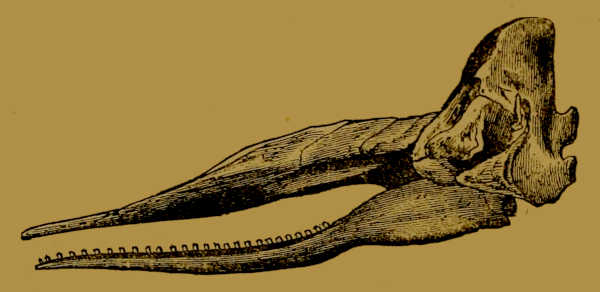
Fig. 20. Skull of Sperm Whale.
When undisturbed, the Sperm Whale rises to the surface to breathe about once every hour. Beale says the regularity with which every action connected with its breathing is performed is remarkable; the time occupied differs slightly in each individual, but each one is minutely regular in the performance of every action connected with respiration, so that the whalers know how long it will remain beneath the surface before reappearing to renew its supply of air. A full-grown “bull,” he says, remains at the surface ten or eleven minutes, during which he makes sixty or seventy expirations; after which he disappears, to return again to the surface in one hour and ten minutes. The blowing is not accompanied by any sound, and notwithstanding the wonderful accounts of its roarings and bellowings, the Sperm Whale may be said to be an absolutely silent animal. The females and young males are gregarious, but are found in separate herds or “schools,” as they are called. A “school” will sometimes consist of five or six hundred individuals. The herds of females are always accompanied by from one to three large “bulls;” but the full-grown males are said to be generally solitary in their habits, except on certain occasions, when it is supposed they are migrating from one feeding-place to another. The majority of those which occur on our coast are these solitary males; when they visit us in herds, as mentioned by Sir Thomas Browne, they are all probably females or young males. The “bulls” are very fierce and jealous, and fight fiercely. The females show great attachment to each other and to their young, so much so that, one being wounded, the others of the herd remain and fall a comparatively easy prey. The young males, on the other hand, are very wary and difficult of approach, and should one be attacked, the others immediately take the alarm and retreat. The female produces one young one, rarely two, at a time, and breeds at all seasons of the year. Their senses of sight and hearing are very acute, and after being once unsuccessfully attacked, they are very difficult and dangerous to approach.
The food of the Sperm Whale consists almost entirely of Cephalopode Mollusks (cuttlefish), although at times, when feeding near the shore, it has been known to take fish as large as salmon. How it contrives to capture such active prey as fish seems difficult to conceive. Beale is of opinion that the Whale sinks to a proper depth in the sea, where remaining as quiet as possible, and opening wide its mouth, the prey are attracted by the glistening white colour of its lining membrane, curiosity leading them to destruction; for no sooner have a sufficient number entered his mouth than the Whale rapidly closes his under jaw, and they are made prisoners, and swallowed.
The pursuit of the Sperm Whale is attended with much greater danger than that of the Greenland Whale, and Beale gives many instances in which, in his own experience, boats were stove in and men lost; stories of fighting Whales, he says, are numerous, and probably much exaggerated; one, known as “Timor Jack,” is said to have destroyed every boat sent against him, till at last he was killed by approaching him from several directions at the same time, his attention thus being diverted from the boat which made the successful attack. Another fish, known as “New Zealand Tom,” destroyed nine boats successively before breakfast, and when eventually captured, after destroying many other boats, many harpoons from the various ships which had attacked him were found sticking in his body. There is one well-authenticated instance of a vessel being attacked and destroyed by a Sperm Whale: the American whale-ship Essex was attacked by one, which, first passing under the vessel, probably by accident, came in contact with her keel and carried it away: then turning and rushing furiously upon the ship, the Whale stove in her bow; so serious was the breach that the vessel speedily filled and went down. Most of the crew were away in their boats at the time, but those on board had just time to launch their one remaining boat before the vessel sank. The boats made for the coast of Peru, the nearest land, many hundreds of miles distant; one of them was picked up drifting at sea, and three of the crew, who were found in it in a state of insensibility, were the only survivors of the ill-fated vessel.
In addition to the sperm and oil, this species yields another product which is, or was, very valuable, although it is the result of disease, and one would imagine a very uninviting substance—I refer to Ambergris, the origin and composition of which was so long a puzzle to the learned. This substance is now well known to be a concretion of the indigestible portions of the Cuttlefish, which form the food of the Sperm Whale. The nucleus of the mass is generally the horny beaks of these creatures, and the substance itself is found in the intestines of the Sperm Whale, or on the shores of the seas frequented by this species: no other Whale is known to be subject to these bezoars. It was formerly believed that the origin of ambergris was in some way connected with the sea, and when it was afterwards found in Whales, the fact was simply attributed to their having swallowed it. Sir Thomas Browne writes of the Sperm Whale which came on shore at Wells, in 1646:—“In vain was it to rake for ambergriese in the paunch of this leviathan, as Greenland discoverers and attests of experience dictate that they sometimes swallow great lumps thereof in the sea; insufferable fœtor denying that inquiry; and yet if, as Paracelsus encourageth, ordure makes the best musk, and from the most fœtid substances may be drawn the most odoriferous essences; all that had not Vespasian’s nose (Cui odor lucri ex re qualibet) might boldly swear here was a subject fit for such extractions” (vol. i., p. 356). It was not until 1783, in a paper read before the Royal Society by Dr. Swediaur, that a scientific account of the origin of ambergris was made known. At the present time its medical virtues, which were formerly considered very great, are altogether at a discount, and the only use to which it is applied is in the preparation of perfumery.
The South Sea whale-fishery was long prosecuted by the Americans before the British ships took part in it, from 1771 to 1775 Massachusetts is said by McCulloch to have had 121 vessels in this trade; about the beginning of the American war, however, the English also sent out ships, and in 1791 had 75 vessels engaged in the South Seas. The number of British ships, as with those employed in the northern fisheries, varied considerably, influenced probably by the varying amounts of bounty offered by the Government, but never exceeded 75; in 1815 they had fallen off to 22; in 1820 they again rose to 68, from which they gradually fell to 31 in 1829, all of which sailed from the port of London. Beale sailed from London, in 1831, in the “Kent,” returning in the “Sarah and Elizabeth,” both of which vessels belonged to Thomas Sturge. The duration of the voyage was from two to four or even five years, the average of 199 voyages being three years and three months, and the yield of oil, 169 tons per voyage. At the present time no British vessels are engaged in the South Sea trade, which has again reverted to the Americans.
I have said very little about the method of pursuit and capture of this species, and of the Right-Whale, because it is a subject in which I take no pleasure; those who wish to know how these peaceful and highly-organised giants are approached, and how they behave when terrified and smarting under the harpoon and whale-lance, can pursue the subject ad nauseam in the pages of Scoresby, Beale, and others; the sickening process of “flensing” and disposing of the blubber is described with equal minuteness. The halo of romance with which some authors seek to surround the whale-fishery, is, doubtless, in a great measure due to the solitary and distant fields of operation, whether it be in the frozen regions of the north, or the vast and trackless oceans of the south, but its stern reality is prosaic enough. The occupation is one of hardship and danger, but the remuneration when successful is large in proportion, and I can hardly conceive, under any circumstances, of men inflicting the fearful amount of suffering which every “full” whale-ship, or in a still greater degree every “full” sealer, represents. Science is constantly adding to our resources, and it is sincerely to be hoped that ere long substitutes may be found for animal oil and whalebone which will supersede their use in the few processes in which they are still requisite: should this be long delayed, it is to be feared that the Seals and Whales, at least of the northern seas, will soon cease to exist. In the meantime, it is gratifying to find that it is from the sealers and whalers themselves that the demand for the better regulation of the trade has emanated, and the name of Captain David Gray, of Peterhead, stands prominent amongst those who have urged upon the governments of this and other countries concerned, such regulations as shall insure greater humanity in its prosecution, and prevent the wasteful destruction which, if continued, must speedily ruin a valuable source of commercial enterprise.
Although so widely spread over the waters of the globe, possessing, I believe, a range greater than any other known mammal, it is only open and deep waters which can be said to be the home of the Sperm Whale; when found in shallow seas, its generally emaciated condition indicates the absence of its proper nourishment; and the readiness with which whole herds precipitate themselves stupidly upon the sands, shows how little they are acquainted with such objects. Mr. Andrew Murray makes some observations upon this subject, which are so interesting and so suggestive that I cannot resist making a long quotation.
Speaking of those specimens which have now and then been cast ashore in the North Atlantic or in the English seas, he says: “They seem to be unprepared for, or not adapted for, shallow seas. Accustomed (perhaps not individually, but by hereditary practice or instinct) to swim along the coral islands of the Pacific within a stone’s throw from the shore, they cannot understand, their instinct is not prepared to meet, shallow coasts and projecting headlands. If they were habitual residents in our seas, they must either be speedily extirpated, learn more caution, or be developed into a new species.” ... Mr. Murray further says: “I observe that almost every place that has been above mentioned as a favourite resort of the Sperm Whales, although not out of soundings, has claims to be considered the site of submerged land. The islands in the Polynesia, which are its special feeding-ground, are the beacons left by the submerged Pacific continent. In pure deep seas animal life is usually scarce, and the absence of breeding-ground is probably the chief cause of it; but this only applies to a certain kind of animals, those which require a bottom on which to deposit their spawn; but there are many which do not require this. The spawn of some floats about unattached; for others a frond of weed is sufficient attachment; and it has occurred to me that the distribution of the Sperm Whale may in some way be connected with the geological antecedents of the ocean it inhabits. I think it not improbable that the site of a submerged land may swarm with life, which originally proceeded, or was dependent on it, long after it had been in the deep bosom of the ocean buried. The Sargasso seas, which swarm with Eolidæ and Crustacea, are examples of this life; it is not invariably either present or absent in deep water, and it is its presence or its absence which is instructive. Those animals which required a bottom to spawn upon may have died out or been developed into others which do not; and those which do not require such a support may have multiplied correspondingly. In one of the maps in Lieutenant Maury’s book, already cited, there is a space of sea opposite the western coast of South America, and lying between Patagonia and New Zealand, marked ‘Desolate region, distinguished by the absence of animal or vegetable life’;—no Sperm Whales here—nothing for them to feed upon—and no symptoms, either by banks of Sargasso or coral islets, of any land ever having existed there. There is no apparent reason why this place, except from some special cause peculiar to itself, should be more desolate than any other in the same latitude—than the deep sea on the east side of Patagonia, for example. I can imagine that, if the bottom of the sea should subside gradually, where animal life had once abounded, animal life—not that animal life, but animal life due in some way to it—might continue to linger over it long after it had passed beyond the depth at which it could practically have any effect upon the animal life above it; but if a part of the circumference of the globe has always been under water, before and ever since the creation of life, no life is likely to be found on that spot, because it has never had a starting-point of life from which to begin; and, as already said, a slender barrier stops the spread of species, and species would certainly not spread to a spot where there was nothing for them to feed upon. Again, animal life could not begin to feed upon animal life till vegetable life had previously prepared the way, by providing food for the animals which were to furnish food for others; and vegetable life could not begin to grow without a foundation of land, accessible either above or below water. The total and constant absence of all life at any particular spot appears to me, therefore, to furnish a presumption that there has never been dry land or shallow water there. Whether the continuance of deep water in one spot for some interminably long time might not have the same effect is another question, which, whatever way it may be answered, would not affect my explanation of the cause of the absence of the Sperm Whale from such spots.”[31]
The woodcuts (figs. 17 and 18), representing the chair in Yarmouth Church, which is formed of part of the skull of an individual of this species, are from the ‘Purlestrations of Great Yarmouth,’ by Mr. C. J. Palmer.
THE ZIPHIOID WHALES.
The sub-family Ziphiinæ, which follows next, is, perhaps, the most remarkable of the whole of this interesting order. The Ziphioid Whales, as they are designated, are, for the most part, very rare, and until the commencement of the present century, with one exception, were known to science only from their numerous remains, found chiefly in the Crag deposits. Even so recently as 1871, Professor Flower, in a memoir of this group[32] speaks of their occurrence at irregular intervals, and at various and most distant parts of the world, to the number of about 30 individuals, in all cases solitary, and that their habits were almost absolutely unknown. Since that time, however, very considerable additions have been made to our knowledge of the group, and Professor Flower, in a second contribution on the same subject[33] made in 1877, states that “instead of being so rare as was then supposed, since the attention of naturalists resident in our colonies has been directed to the importance of losing no opportunity of securing such specimens as accidents of wind and waves may cast upon their shores, it has been proved that in the seas of the Southern Hemisphere these Whales exist in considerable numbers, both as species and as individuals, and that one species, at least [Mesoplodon grayi] is gregarious, having been met with in two instances in ‘schools’ of considerable numbers.” “The geographical distribution of the group,” adds Professor Flower[34] “has a very great interest in relation to that of many other Australian groups, both of vertebrates and invertebrates. Among the earliest known remains of Cetacea, in the Belgian and Suffolk Crags, Mesoplodon and closely-allied forms are most abundant. Up to a little more than ten years ago, the few stray individuals of Mesoplodon bidens occasionally stranded on the shores of North Europe, were supposed to be their sole survivors. Since that time it has been proved that they are still numerous in species, and even in individuals ... in the seas which surround the Australian continent, extending from the Cape of Good Hope on the one side, to New Zealand on the other, though beyond these limits no specimens have yet been met with. It is the history of the Marsupial Mammals, of Ceratodus, of Terebratula, and of numerous other forms.”
The group is divided into four genera—Hyperoodon, Berardius, Ziphius, and Mesoplodon (the second of which is not represented in our Fauna). Its members were formerly distinguished by the absence of functional teeth in the upper jaw, but, recently, a row of small teeth, of determinate number and definite form, has been discovered in many individuals of a species of Mesoplodon. The teeth in the lower jaw are always quite rudimentary, with the exception of one, or occasionally, two pairs. These may be largely developed, especially in the male sex, and are placed, generally, well forward. “They have a small and pointed enamel-covered crown, composed of true dentine, which, instead of surmounting a root of the ordinary character, is raised upon a solid mass of osteo-dentine, the continuous growth of which greatly alters the form and general appearance of the organ as age advances.” In Mesoplodon layardi this little dentine cap is not larger than the portion of the tooth ordinarily shown above the gum, but the fang-like growth is so great that the tips of the “tusks” meet over the upper jaw, so that the animal is only able to open its mouth for a very short distance indeed. The form assumed in Mesoplodon bidens will be seen in the figure of the head of that species, at p. 104. The blow-hole is sub-crescentic, and a pair of remarkable furrows occurs in the skin of the throat, almost in the form of the letter V, the point directed forward. The skull presents a remarkable appearance in the genus Hyperoodon, caused by the enormous maxillary crests which produce the peculiar conformation of the head in the living animal, originating the trivial name “Bottle-head.” The food of the whole group is said to consist mainly of Loligo, commonly called “Squid,” and other Cephalopods which frequent the open sea.
One very singular circumstance with regard to these creatures is that they never seem to be taken at sea, but, whenever procured, it is by their running themselves on shore. This, as before remarked with regard to the Sperm Whale, would seem to indicate that their natural habitat is the deep waters of the open seas, where shallows are unknown. The sand-banks which surround a sloping shore, of which they have had no experience, speedily prove fatal to them.
BEAKED WHALE.
The common Beaked Whale, or Bottle-head (Hyperoodon rostratum, Chemnitz; Hyperoodon butzkopf, Lacépède), is of frequent occurrence in the North Atlantic, and generally visits our shores in autumn, sometimes ascending the estuaries of rivers: it has been taken several times at the entrance to the river Ouse. It is solitary in its habits, more than two being never met with in the same place, and in that case it is often the old female and her young one: the old male is said to be very shy and rarely secured. In September, 1877, an adult female, 24 ft. long, was taken in the Menai Straits; it was accompanied by another, probably its young one. Capt. Feilden met with what he believes to have been this species, just within the Arctic Circle; “each emission of breath was accompanied by a stentorian grunt, which closely resembled that of an elephant.”[35]
The colour is black above, the under parts being lighter: the two teeth in the lower jaw are generally hidden in the gum. Its food consists of cuttlefish, the remains of great numbers of which have been found in its stomach.
BROAD-FRONTED BEAKED WHALE.
Another species of Hyperoodon, for which the name H. latifrons has been proposed, is by some supposed to exist. Scarcely anything is known about it as a species. “The principal distinctive characters of the skull lie in the great raised crests of the maxillary bones, which are very much thickened and flattened above, so as almost to touch one another, whereas, in H. rostratum, they are rather sharp-edged above, and separated by a considerable interval. In H. latifrons, these crests rise absolutely higher than the occipital region of the skull, which is not the case in the common species.”[36] Individuals possessing these peculiarities have been taken three or four times on the British coast, and on one occasion, in Greenland. Another was stranded in 1873, at Hasvig, near Hammerfest, and identified by Professor Sars from its remains; its length was 30 feet (Norse), and the colour dark on the back, but lighter beneath.[37] It has, however, been suggested, with much probability, by Eschricht, that these individuals are, after all, only the males of the preceding species; for all the specimens with broad crests, of which the sex was noted, were males.
CUVIER’S WHALE.
Cuvier’s Whale (Ziphius cavirostris, Cuv.; Epiodon desmarestii, J. E. Gray, ‘Cat. Seals and Whales’), another of this remarkable group, has been met with once on the coast of Shetland, and it, or its remains, have been found about five or six times in other parts of Europe, and also, it is believed, at the Cape of Good Hope, the east coast of South America, and New Zealand. Professor Turner is of opinion that the geographical range of Ziphius cavirostris equals that possessed by the Spermaceti Whale.[38] In colour this species is believed to resemble Sowerby’s Whale; it has two teeth, one on each side of the lower jaw, close to the extremity.
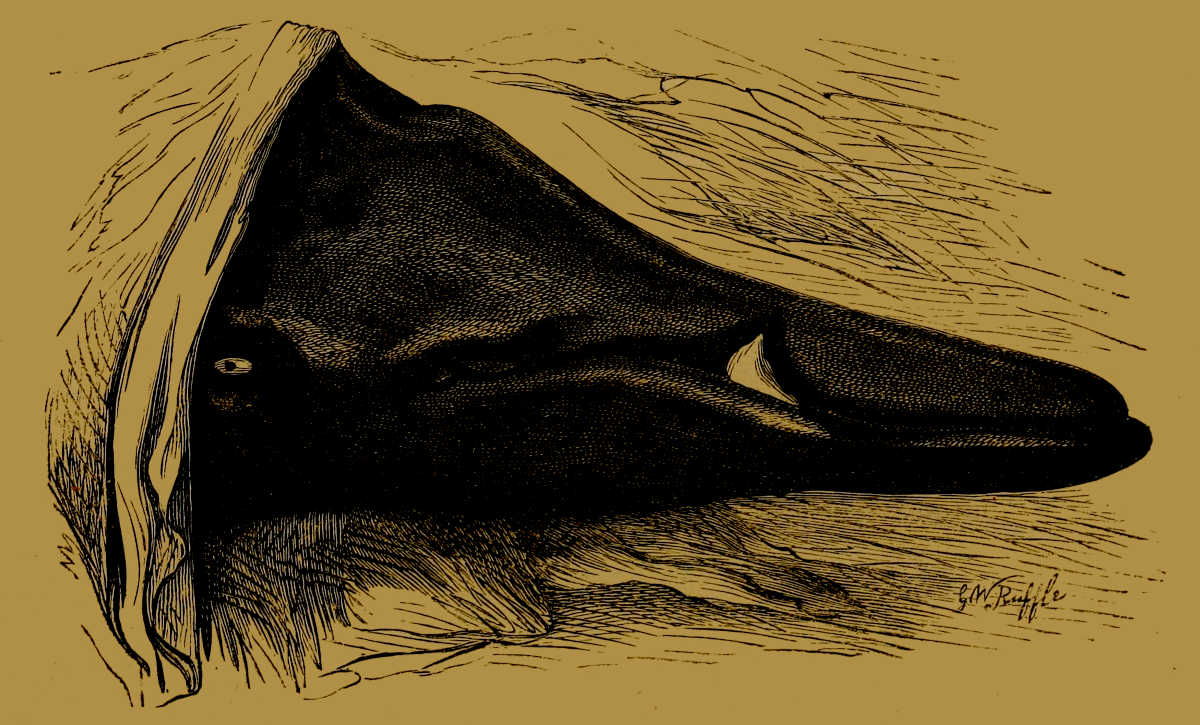
Fig. 21. Head of Sowerby’s Whale (Mesoplodon sowerbiensis, De Blainville).
From Trans. Roy. Irish Acad.
Cuvier established the genus Ziphius in 1825, from a fossil skull found on the coast of Provence in 1804, which he believed at the time to belong to an extinct animal.
SOWERBY’S WHALE.
One more British Ziphioid is known, Sowerby’s Whale (Mesoplodon sowerbiensis, De Blainville); it was first described from a specimen which came ashore at Brodie, Elginshire, in 1800, and has since been found three times in Ireland; there is also a skull in the Museum of Science and Art at Edinburgh, which belonged to a specimen believed to have been captured somewhere on the Scotch coast; the remains of five others are preserved in various Continental museums.
Of the individual which came on shore on the coast of Kerry, in March, 1864, Mr. Andrews has given a description in the “Transactions of the Royal Irish Academy,” for April, 1867. Fortunately, it came under the notice of Dr. Busteed, of Castle Gregory, who being interested in zoology, and aware of the great importance of the occurrence, photographed the head in several positions while it was yet fresh: Dr. Busteed’s photographs were reproduced in the Transactions of the Royal Irish Academy. The head had unfortunately been removed immediately behind the frontal portion of the skull, the base of which is lost, as are also the other parts of the skeleton. The total length of the animal was about fifteen feet, the two teeth largely developed and projecting like the tusks of a boar. On the under part of the throat the V-shaped furrow was very conspicuous. Sowerby’s specimen was coloured black above, and nearly white below. The skin was smooth like satin. “Immediately under the cuticle the sides were completely covered with white vermicular streaks in every direction, which at a little distance appeared like irregular cuts with a sharp instrument.”
DELPHINIDÆ.
The remaining family, Delphinidæ, as before stated, is a very numerous one. It has ten representatives in the British fauna, contained in seven genera, the first of which, according to the arrangement I have adopted, is that of Monodon.
THE NARWHAL.
The Narwhal (Monodon monoceros, Linn.) is a native of the Polar seas seldom leaving the ice; stragglers have occurred three times on the British coast, one in 1648 in the Firth of Forth, another came ashore alive at Boston, in 1800; the third was taken in Shetland in 1808.
This species is very numerous in the frozen seas to the north of latitude 65°, and is remarkable for the enormous development in the male of the left canine tooth, which is projected forward in the form of a tusk or spear, reaching to the length of six or eight feet, while the right tusk remains abortive, and does not pierce the alveolus. The spear is of fine compact ivory, hollow for the greater part of its length, grooved spirally from left to right, along its outer surface, the spiral generally making five or six turns, but smooth at the end, and bluntly pointed. Although the right canine is rarely developed, a few examples have occurred in which both tusks were present; the female is very rarely furnished with this appendage.
Mr. J. W. Clark, in a paper on a ‘Skeleton of Narwhal, with two fully-developed tusks,’[39] writes as follows:—“The skulls of the Toothed Whales are generally asymmetrical, being twisted more or less, usually towards the left. This peculiarity is especially observable in Monodon. One would expect it to be greatly exaggerated in the skulls of the males, where the left tusk alone is developed, and the left maxillary is, in consequence, very large, and the right proportionately small; but it does not seem to be affected by the absence or presence of the teeth. Female skulls, where neither tusk is developed, are equally twisted, and so are the bidental skulls ... the increased size of the right maxillary does not appear to affect the rest of the skull.”
Mr. Clark enumerates eleven skulls of the Narwhal in which both tusks are developed; four at Copenhagen, and one each in the museum of Hamburg, Christiania, Amsterdam, Weimar, Hull, Paris, and Cambridge; to these must be added a twelfth, which was brought from Prince Regent’s Inlet, by Capt. Gravill, of the “Camperdown,” and is now in the Dundee Museum.
Not long since I saw preserved in a country mansion, the tusk of a Narwhal measuring 7 ft. 5 in. long; it was carefully kept in a long case resembling a barber’s pole, and bore a ticket attached, which stated that it was “Bequeathed in 1561 by the Countess of ——, to her daughter ——.” No doubt at the time this formed a valuable bequest, as even royal and ecclesiastical dignitaries are said to have esteemed these strange objects (probably associated with the mythical unicorn), as “good against” poisons and fevers, and prized them accordingly. The use of this remarkable appendage appears very doubtful; it has been conjectured that it serves to stir up food from the bottom of the sea, in which case the female would be badly off without it; or that it is employed to keep breathing-holes open in the ice, and an instance is related in support of this view, in which hundreds were seen at an ice-hole protruding their heads to breathe, but it is not clear whether they made the hole for themselves, or whether they were attracted by it, particularly as there were numbers of White Whales with them. It seems certain, however, that the tusk, which is frequently found in a broken condition, is used for purposes of attack and defence. Like the horn of the stag, it is, no doubt, a sexual distinction.
The Narwhal is very social in its habits, great numbers being often met with together; its food consists of cuttlefish and crustaceans. The length of the full-grown animal is about 16 feet, the upper parts gray, the sides and belly white, and the whole animal spotted with black and gray. The only authentic figure of the Narwhal with which I am acquainted is that given by Scoresby; this is so well known from frequent reproduction that it is not necessary to give it here.
THE WHITE WHALE.
The White Whale, or Beluga (Delphinapterus leucas, Pallas), like the preceding species, is a native of the Polar seas, where it is common; it is abundant in the White and Kara Seas, and in the Gulf of Obi; on the coast of Norway it is occasionally met with. From Scotland, five individuals have been recorded, but it must be regarded as only an accidental straggler. On the east coast of America it is found as far south as the Gulf of St. Lawrence, where, as in the White Sea, it delights in ascending the mouths of large rivers.
No English examples have been met with, but, in the British Association Report on the Fauna of Devonshire (1869, pp. 84 and 85) occurs the following passage. “Mr. H. P. Gosse writes:—‘On August 5th, 1832, I was returning from Newfoundland to England, and was sailing up the British Channel close to the land, when, just off Berry Head, I saw under the ship’s bows a large cetacean of a milky white hue, but appearing slightly tinged with green from the intervening stratum of clear water. It was about 16 feet long, with a round bluff head. It continued to swim along before the vessel’s head, a few yards beneath the surface, for about ten minutes, maintaining our rate of speed, which was five knots an hour, all which time I enjoyed from the bow-sprit a very good view of it. It could have been no other than the White Whale, the B. borealis of Lesson.’” Mr. Alston also states that Mr. J. G. Gordon informed him that in June, 1878, “he saw a large white cetacean, presumably of this species, in Loch Etive.”
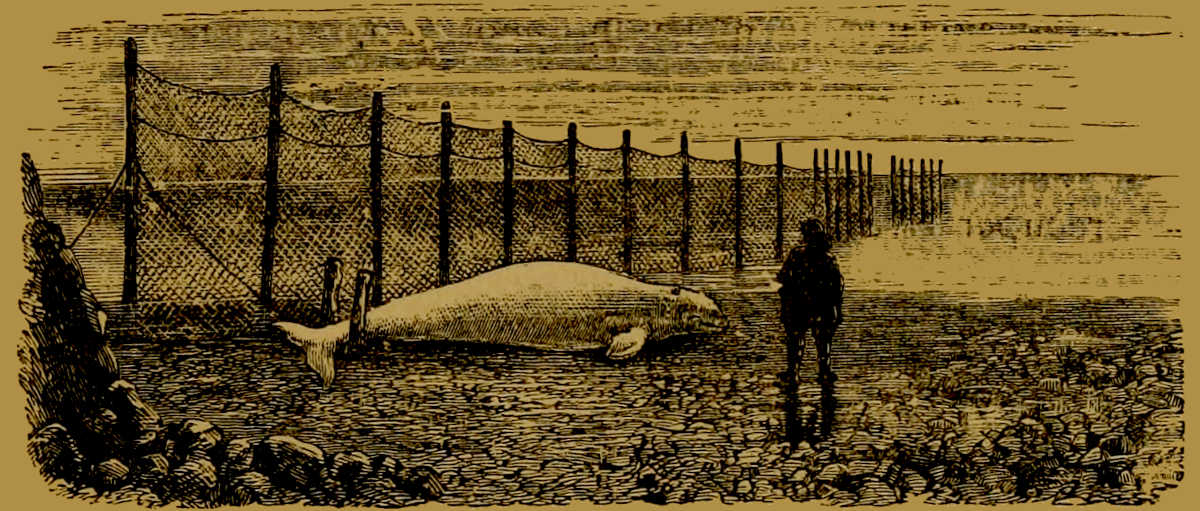
Fig. 22. Beluga, caught by the tail, near Dunrobin, Sutherlandshire.
In a communication to the Zoological Society of London,[40] quoting a letter from the Rev. Dr. Joass, of Golspie, Professor Flower thus describes the singular capture of one of these rare visitants to our seas:—“It was found close to the salmon-nets, near the Little Ferry, about three miles to the westward of Dunrobin, Sutherlandshire, at ebb tide, on Monday, June 9th, 1879, caught by the tail between two short posts, to which a stake-net was fastened; and a salmon, of 18 lbs. weight, which was supposed to have been the object of its pursuit, was found in front of it. It measured 12 ft. 6 in. in length. The tail was 34 inches across, and the flippers 17 inches long. It was a female [adult] and had twenty teeth in the upper jaw, and sixteen in the lower. the stomach contained a few flakes of fish, which, from their size and colour, might have been salmon.... I have heard since, that two days before its capture, it was seen off Cracaig by Brora fishermen, who were lying at their lines. At first they thought it was a human body; as it approached, against the ebb, they took it for a ghost!” On examining the skull of this specimen, Professor Flower discovered that, at some previous period of the animal’s existence, the atlas had been completely dislocated, “the whole of the surfaces, formerly in apposition, being now free from each other,” an injury to an aquatic animal as difficult to account for as it is to imagine the possibility of its surviving, but affording a remarkable instance of the creature’s recuperative power.
The Whales exhibited at the Westminster Aquarium, in September, 1877, and again in May, 1878, belonged to this species; unfortunately they did not live to equal in docility and intelligence a specimen exhibited in America, which “learned to recognize his keeper, and would allow himself to be handled by him, and at the proper time would come and put his head out of the water to receive the harness” by which he was attached to a car in which he drew a young lady round the tank,—or to take his food. A specimen of Delphinus tursio, which was for a time with him in the same tank, is said to have been even more docile than this remarkable animal.[41] The adult Beluga is pure white, and a “school” of these animals “leaping and playing in the calm, dark sea,” is said to be a very beautiful sight. In summer the Greenlanders kill great numbers, extracting the oil and drying the flesh for winter use; in Russia, the prepared skin is much used for reins or other parts of harness requiring great strength and lightness; in this country, too, under the name of porpoise-hide, it is now extensively used, and the salted skins sell for from 3s. 6d. to 4s. 6d. per lb. The whale-ship, “Arctic,” of Dundee, brought home 600 skins from Davis Strait, in the season of 1880. The length of the full-grown animal is about 16 ft., and its food consists of fishes, Crustacea, and Cephalapods.
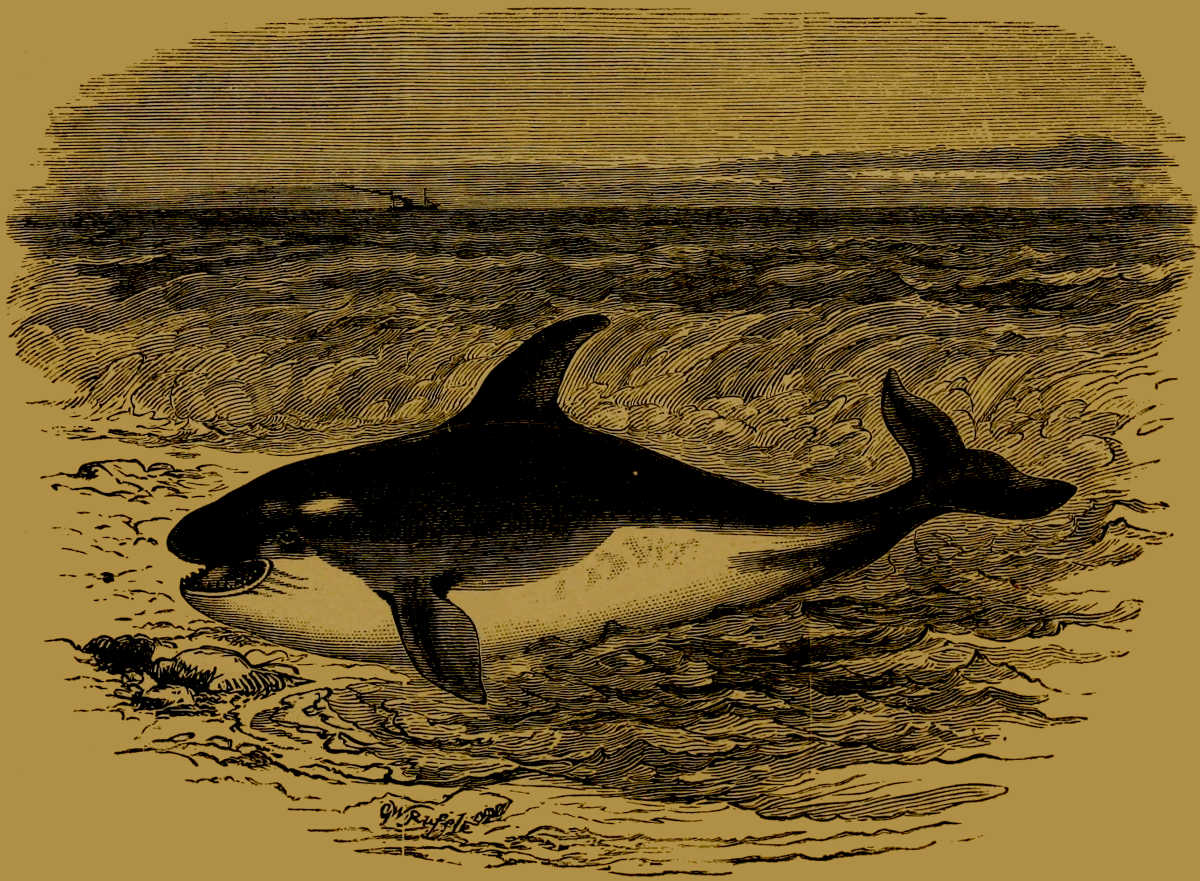
Fig. 23. The Grampus (Orca gladiator, Lacép.)
THE GRAMPUS, OR KILLER.
The common Grampus, or Killer (Orca gladiator, Lacépède), (fig. 23) is a well-known and widely-dispersed species, being found in both the North Atlantic and Pacific Seas. Andrew Murray says “the common Grampus tumbles through the heavy waves all the way from Britain to Japan, viâ the North-west Passage.” In the British seas it is frequently met with, and has occurred in several instances on the coast of Norfolk. This species is very fierce, its appetite insatiable, and carnivorous in the strictest sense of the word; to the Greenland and White Whale, as well as to Porpoises and Seals, it is an implacable enemy, and follows them ruthlessly. Dr. Brown says, “the White Whale and Seals often run ashore, in terror of this cetacean, and I have seen Seals spring out of the water when pursued by it. The whalers hate to see it, for its arrival is the signal for every Whale to leave that portion of the ice.” Eschricht took out of the stomach of a Killer, 21 ft. long, which came ashore in Jutland, no less than thirteen common porpoises and fourteen Seals.
The rounded, compact form of this species gives the idea of great strength and swiftness, and the beautifully-polished glossy black skin of the back contrasting with the equally pure and well-defined white of the lower parts has a very striking effect; over the eye there is a well-defined white spot. It is a very handsome species, but there is something in its appearance which seems to indicate its cruel nature. Thirteen or fourteen strong, slightly curved teeth are found on either side of both jaws; the flippers are broad and oval-shaped, the dorsal fin high and falcate, particularly in the male.
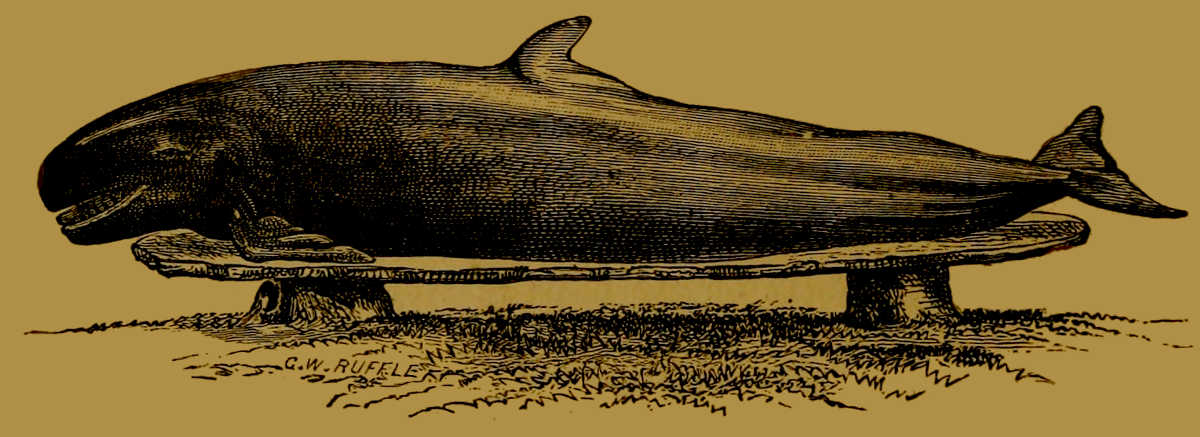
Fig. 24. Pseudorca crassidens (Owen).
As my object is mainly that of assisting in the identification of casual visitants to our shores, rather than of giving anything like a history of the known British species of Cetacea, it may be desirable to mention here a very remarkable form, which, although it has never been known to occur in the flesh on our shores, was first made known to science from an imperfect skeleton found in a semi-fossil condition beneath the peat in a Lincolnshire Fen. To this Dolphin, “come back, as it were, from the dead,” and which forms a connecting link between the genus Orca and the genera Grampus and Globicephalus (and which Owen had named Phocœna crassidens), Reinhardt gives the name of Pseudorca crassidens. On the 24th November, 1861, a large shoal of these dolphins made their appearance in the Bay of Kiel. The sailors succeeded in separating about thirty of them from the remainder, but all, with one exception, escaped. This was a female 16 feet long, which, after being exhibited at Kiel and other places, was bought for the Museum of the University of Kiel. In the summer of 1862, three other individuals, presumably from the same shoal, were thrown ashore on the north-western coast of Zealand. Of the general appearance of this creature the accompanying figure (24), copied, by kind permission, from Professor Flower’s translation of Reinhardt’s paper,[42] published by the Ray Society, will give an idea; the figure is from a photograph of the Kiel specimen, and is not in the original paper. The length is from 16 to 19 feet; of the colour no account is given, but, judging from the woodcut of the Kiel specimen, it appears to be uniformly shiny black. The number of teeth differs in individuals, but in this one it was from 9 to 10 on either side of the lower jaw, and 8 to 10 in the upper. From the observations made by Reinhardt, he suggests a possibility that there may be “a difference in the sizes of the different sexes, and whether the females are not larger, but at the same time, perhaps, provided with a head comparatively smaller than that of the males.” It is very suggestive of how little we know of the inhabitants of the sea, that at least one vast shoal of a species known only from its sub-fossil remains should be roaming the seas only to be accidentally discovered when its members became entangled in shallows from which probably many never lived to extricate themselves.
RISSO’S GRAMPUS.
Risso’s Dolphin (Grampus griseus, G. Cuvier; Grampus cuvieri, Gray, Ann. Nat. Hist., 1846) is a rare and little-known species, which has been met with four times on the south coast of England, and about eight times in France. In the ‘Transactions’ of the Zoological Society, for 1871, Professor Flower gives an account of an adult female which was taken in a mackerel-net, near the Eddystone Lighthouse, on 28th February, 1870, and which eventually was sent up to London. About a month later, a second specimen was received in London, the precise locality of which was not known, but it was probably from somewhere in the Channel. This was also a female, but a very young animal, and as the adult female first taken had recently given birth to a young one, it is quite possible that it may have belonged to her. On the 26th July, a male of the same species was captured alive at Sidlesham, near Chichester, and sent to the Brighton Aquarium, where it lived for a few hours only.
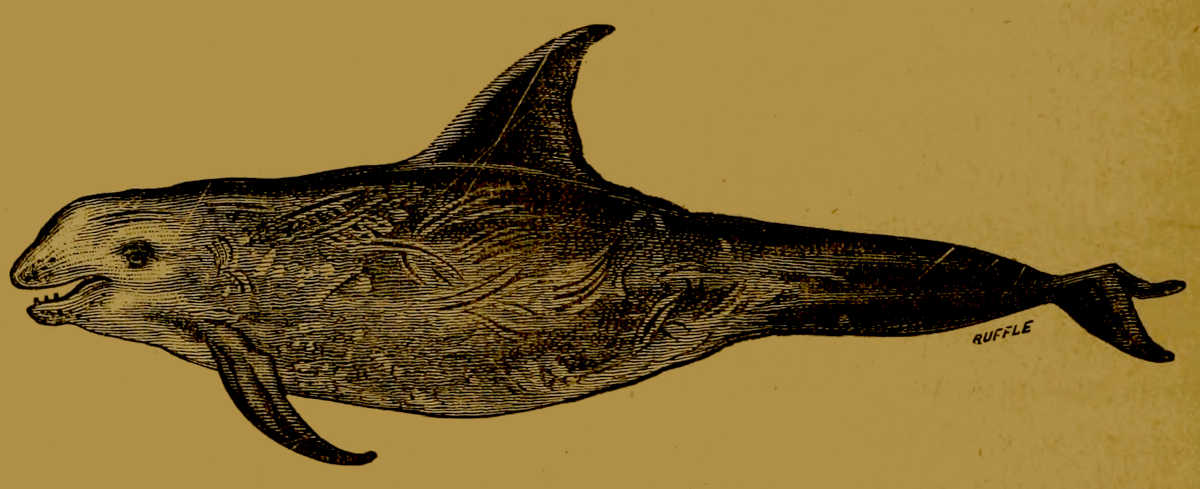
Fig. 25. Risso’s Dolphin (Grampus griseus, G. Cuv.)
Risso’s Dolphin varies very considerably in its colouration. The Sidlesham specimen was bluish-black above, and dirty white beneath; in the adult female described by Professor Flower (from whose illustration our figure is, with his permission, copied), “the head and the whole of the body anterior to the dorsal fin was of a lightish grey, variegated with patches of both darker and whiter hue.... Behind the anterior edge of the dorsal fin the general colour of the surface, including the dorsal and caudal fins, was nearly black, though with a large light patch on the upper part of the side directly above the pudendal orifice. The middle of the belly as far back as the pudendal orifice, was greyish white.”[43] The most remarkable characteristic, however, was the presence, scattered over the body, of irregular light streaks and spots; these markings extended from the head to within about two feet from the tail; and presented a most singular appearance. In the young one the upper parts and sides of the body were almost black, and the lower parts nearly white, the junction between the two colours being very abrupt and sharp. “On each side of the body were six vertical whitish stripes nearly symmetrically arranged, and almost equidistant, being about six inches apart. They did not extend quite to the middle line of the body above, and were lost below in the light colouring of the abdomen.”[44] The length of the Sidlesham male was 8 feet, that of the adult female 10 ft. 6 in.; in the former there were present four teeth on each side the lower jaw, in the latter three only on each side, and in the immature specimen there were present seven teeth, four on the right, and three on the left side; the teeth are always placed in the front part of the mandible, and in every specimen examined there has been an entire absence of teeth in the upper jaw. In general appearance, Risso’s Dolphin, more particularly the dark-coloured specimens, is said very much to resemble the next species (Globicephalus melas). Of its habits and distribution nothing positive is known, but from its visiting France and England in the spring or summer, M. Fischer concludes that this species “is migratory, visiting the shores of Europe in the summer, and passing in winter either to the south towards the coast of Africa, or to the west towards the American Continent.”[45]
THE PILOT WHALE.
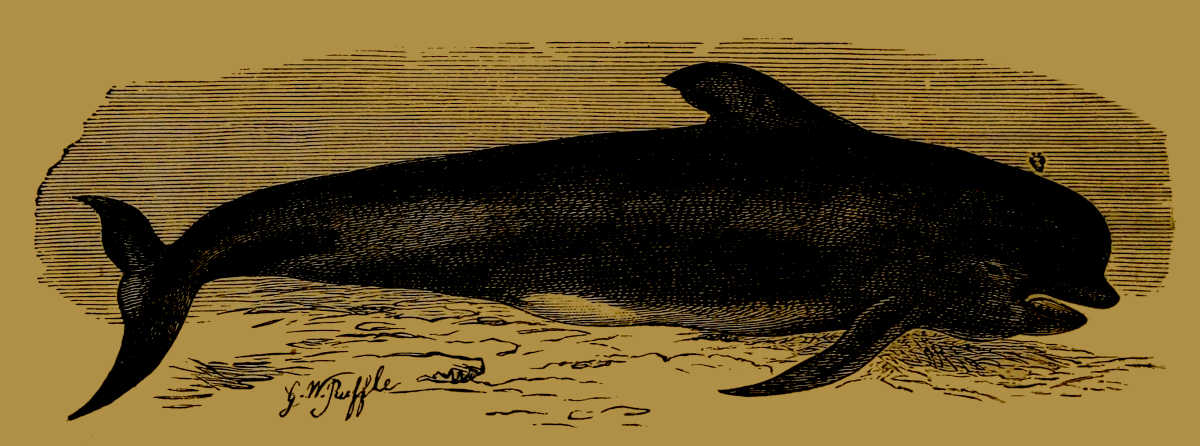
Fig. 26. Pilot Whale (Globicephalus melas, Trail).
The Pilot Whale (Globicephalus melas, Trail; Delphinus melas, Trail; D. globiceps, Cuv.; D. deductor, Scoresby), known in Shetland as the Ca’ing or Driving Whale, is a frequent, although a very uncertain, visitor in British waters. It is met with, according to Lilljeborg, in the North Sea and northern part of the Atlantic Ocean, occasionally as far north as Greenland; off the Orkney and Shetland Islands, and on the North-west coast of Norway, it frequently makes its appearance; and it has been found on the British coast as far south as Cornwall. In Bell’s ‘British Quadrupeds’ it is said that it also appears to enter the Mediterranean. This species is pre-eminently gregarious, and generally occurs in large herds, often numbering several hundreds. So strong is their habit of association that they follow the leading Whale like a flock of sheep, a habit of which the Orkney and Shetland Islanders are fully aware, and avail themselves to the full. When a herd appears in one of the bays, boats immediately put off, and if possible, get to seaward of them, then gradually approaching, with shouts and splashes, they urge the whole herd shoreward, and are generally successful in driving a large number of Whales into shallow water; but should the leader break through the line of boats, the probability is that no efforts the boats’ crews can make will prevent all its companions following. Bell gives many instances of large numbers of these animals being taken, the last of which, quoted from the ‘Zoologist’ for 1846, is, perhaps, the most extraordinary. It is there stated, “on newspaper authority,” that 2,080 were taken in Faroe in the previous year within six weeks, and that 1,540 were killed within two hours in Quendall Bay, Shetland, on the 22nd September, 1845.
As it too frequently happens that the unfortunate cetaceans which fall into the hands of the fishermen are simply hacked to pieces, and die only from exhaustion arising from loss of blood, it is worthy of remark that, according to Herr Collett, of Christiania, in Norway they are readily killed by a rifle shot, in the throat, or under the breast.
This species (fig. 26) is remarkable for its peculiarly rounded head,—hence its generic name; the flippers are long and pointed, the dorsal fin long and low; the teeth are about an inch in length, seldom all present in the adults, and the normal number, according to Bell, about twenty-four on either side each jaw; ten to twelve is, however, the more usual number present. The length of the adult is about nineteen or twenty feet, its colour glossy black, with the exception of a white stripe along the belly, which has a heart-shaped termination under the throat. Its favourite food is said to be cuttlefish. The figure is copied, with permission, from the ‘Transactions’ of the Zoological Society, vol. viii., pl. 30.
PORPOISE.
The Common Porpoise (Phocœna communis, F. Cuv.; Delphinus phocœna, Linn.) is the best known of the Cetacea inhabiting the North Sea, being met with in abundance all round the British Isles, seldom occurring far from land, and often ascending large rivers for a considerable distance: it has been seen in the Thames as high as London Bridge.
Nothing can be more interesting than to watch a shoal of these animals at sea, sometimes tumbling and gambolling under the bows of the vessel which is passing rapidly through the water, with as much ease as if she were motionless, or chasing each other playfully round and round the ship as she lies becalmed, their white bellies glistening in the clear sea, and frequently, apparently out of pure mad delight, leaping completely out of the water, returning to their native element with a most determined header. But it is not till seen in the glass-sided tank of the aquarium that the beauty, and even poetry of motion of these animals can be fully appreciated; swimming along in a series of gentle curves, they just bring the blow-hole to the surface, breathe without stopping, and continue the curve, till in due course they reach the surface again. This is repeated for the whole length of their spacious tank, or is varied by unexpected eccentricities, all indescribably graceful. Under these favourable circumstances for observation it is also clearly seen that the horizontal tail is the propeller which gives the motion; the alternate upward and downward pressure of this organ against the water evidently producing the graceful mode of progression which is so difficult to describe, but so easily understood when witnessed. The flippers are not used as propellers. When the animal is moving forwards they are laid back, against the body; but when it wishes to stop, they are stretched out at right angles to it, so as to offer a resistance to the water, and so arrest the onward motion of the animal. All this, although perfectly understood in theory before, strikes the beholder as a new and beautiful sight when first viewed in practice, from a stand-point, on a level with the animal itself, and as it were in its own element.
The food of the Porpoise consists of fish, and it follows the shoals of herrings, &c., amongst which it commits great depredations; it has a taste for salmon, and is sometimes taken in the salmon-nets. The period of gestation is said to be six months, and it brings forth one young one at a birth; its colour is black on the back, shaded off to silver-grey on the belly, the whole skin beautifully smooth and polished. The teeth number about twenty-five on each side of either jaw, and are spatulate, with a contracted neck, unlike the usually conical teeth of the Delphinidæ. The length is four or five feet. The flesh of the Porpoise seems formerly to have been esteemed as an article of food, and is mentioned several times in the L’Estrange Household Book (1519 to 1578) and other similar records; it is said by one who has eaten it to be “excellent meat, dark in colour, and large in fibre, but of excellent flavour, very tender, and full of gravy.”
THE COMMON DOLPHIN.
The Common Dolphin (Delphinus delphis, Linn.), fig. 27, is not unfrequently met with in the seas surrounding the southern portion of the British Isles; but from the northern division of the kingdom, although it, doubtless, occasionally visits Scottish waters, there is no reliable record of its occurrence. This species, probably, often passes unrecognized. It may, however, be at once distinguished from the Porpoise by its attenuated beak, the head of the Porpoise being obtuse, and the beak altogether absent. It is a native of the temperate seas, and becomes scarcer as the north is approached. Van Beneden was not able to record it as frequenting the Belgian coast, but Lilljeborg says it is occasionally obtained on the coasts of Scandinavia, and Herr Collett has hardly any doubt that it occurs on the Norwegian coast as far north as Finmarken, and a large “school,” seen by Malmgren in April, 1861, in West-fjord, between the Loffoden Islands and the mainland, was referred by him, without hesitation, to this species. In Greenland it is said to be met with, but Professor Flower thinks it doubtful whether some species of an allied genus may not have been mistaken for it.
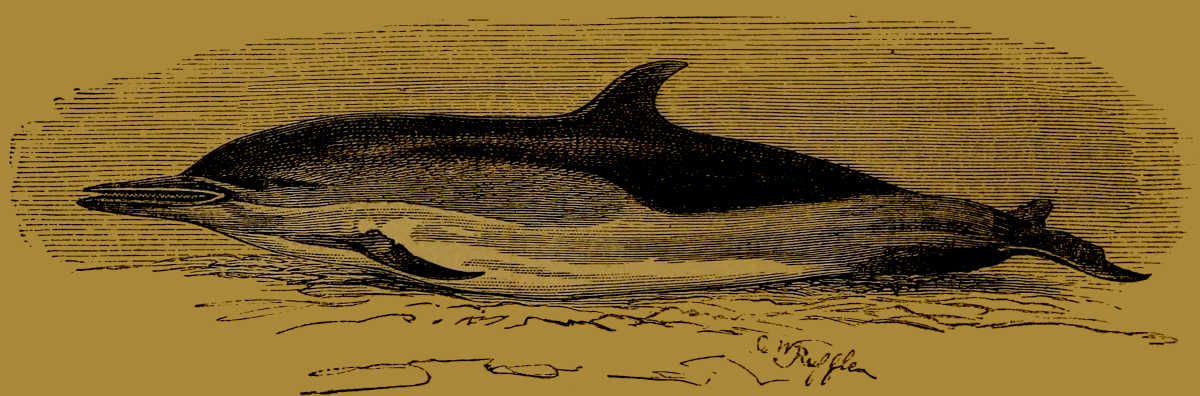
Fig. 27. Common Dolphin (Delphinus delphis, Linn.).
This is the true Dolphin of the Ancients, of which Professor Bell, in his ‘British Quadrupeds,’ says: “the mythological and poetical associations which belong to the Dolphin, its reputed attachment to mankind, its benevolent aid in cases of shipwreck, its dedication to the gods, and many other attributes expressive of the high estimation in which it was held in olden times, afford a striking example of how the unrestrained imagination of the ancients could raise the most gorgeous structures of poetry and religion upon the most slender basis.... It requires some stretch of the imagination to identify the round-headed creature which is represented in ancient coins and statues, with the straight sharp-beaked animal,” which is here figured. It is sad to destroy at one fell swoop all the romance which once surrounded this species; but Dr. Gray tells us that “the dying Dolphin’s changing hues” are not observed in a cetacean at all, but in a fish of the genus Coryphæna, which, although normally black, is stated by Mr. Couch (as quoted by Mr. Yarrell) to have changed to a fine blue whilst he was making a drawing of it. The food of the Dolphin consists of fish, cuttlefish, and crustaceans, and on the Cornish coast it makes its appearance in considerable numbers, according to Mr. Couch, in the month of September during the pilchard season. It is very social in its habits, and even more sportive in the water than its relative, the Porpoise. The illustration is copied from Reinhardt’s figure.
Professor Flower thus describes a specimen taken in March, 1879, Mevagessey: “Instead of being simply black above and white below, as usually described, the sides were shaded, mottled, and streaked with various tints of yellow and grey, ... the under surface was of the purest possible white; perfect symmetry was shown in the colouring and markings on the two sides of the body.”[46] There is, probably, much variation in the disposal of the colour; in a beautiful drawing, in my possession, made by Mr. Gatcombe from a specimen taken at Plymouth, the colour is so disposed as to show two graceful waving lines, crossing each other about the centre of the animal’s body, forming a figure somewhat like an elongated figure eight. The dental formulæ vary from 40/40 40/40 to 50/50 50/50, the numbers not always being equal, even on the different sides of the mouth of the same individual. The length is from 5 to 8 feet.
BOTTLE-NOSED DOLPHIN.
The Bottle-nosed Dolphin (Delphinus tursio, Fab.; Tursio truncatus, Gray), fig. 28, appears to be found occasionally from the Mediterranean to the North Sea; it is by no means, however, a common species. Professor Flower says it “is rare in the Mediterranean, though Gervais gives several instances of its capture in the Gulf of Lyons. It probably has a more northern range than D. delphis; but, as in the case of that species, there is still much obscurity as to the exact limits of its distribution.”[47] A specimen was seen in January, 1873, in the fish-market at Algiers, by Mr. J. W. Clark, of Cambridge.
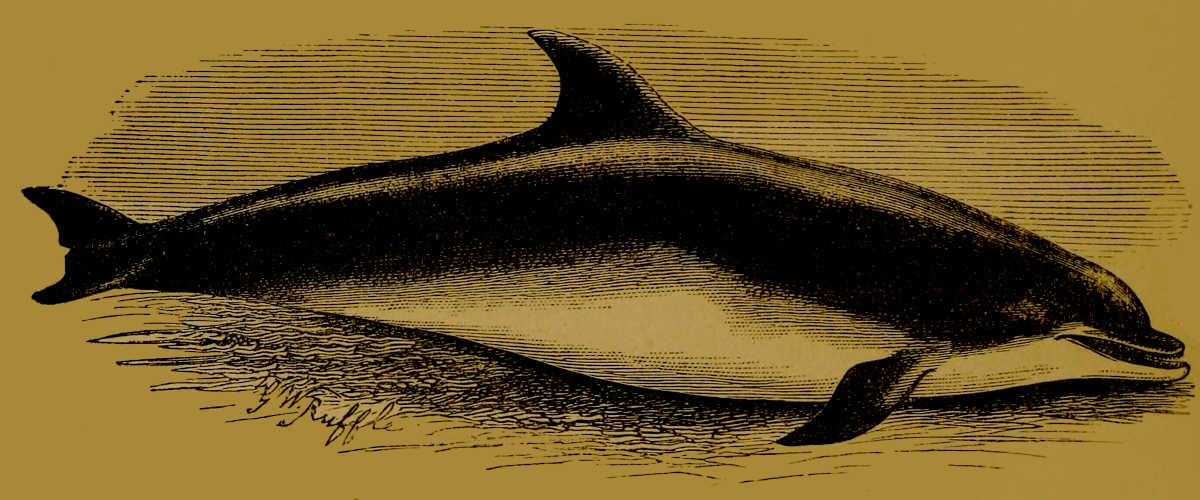
Fig. 28. Bottle-nosed Dolphin (Delphinus tursio, Fabricius.)
Of the habits of this species very little is known: its colour is black above, shaded to white below, and its length from 8 to 12 feet; teeth from 21 to 25 on either side of each jaw, truncated when old. The figure is from a drawing of a nearly adult male, taken at Holyhead, in October, 1868, for which I am indebted to the kindness of Professor Flower.
WHITE-SIDED DOLPHIN.
The White-sided Dolphin (Delphinus acutus, J. E. Gray; Lagenorhynchus acutus, Gray, Zool. Erebus and Terror), is a rare species, which has occurred in a few instances on the British coast; it is said, however, by Dr. A. R. Duguid, often to be seen about the Orkney Islands, but rarely secured. Its colour is black above and white below, between which runs a broad band of yellowish brown, about the centre of which, and surrounded by it, is a large oblong patch of pure white. The adult measures from 6 to 8 feet in length. A figure and description, by Dr. Duguid, taken from one of a herd of twenty landed at Kirkwall, on the 21st August, 1858, will be found in the ‘Ann. and Mag. of Nat. Hist.’ (3rd series) for August, 1864, vol. xiv., p. 133.
WHITE-BEAKED DOLPHIN.
The last species on the British list, the White-beaked Dolphin (Delphinus albirostris, J. E. Gray; Lagenorhynchus albirostris, J. E. Gray, Zool. Erebus and Terror), is also of rare occurrence: it is a native of the North Atlantic, has occurred at the Faroe Islands, and on the coasts of Norway and Sweden, and Denmark, also at Ostend, but little is known of its habits. A Dolphin of this species was killed at Hartlepool in 1834, but not recognized at the time: the skull is now in the Cambridge Museum. This species was, I believe, first described as British by Mr. Brightwell, under the name of D. tursio, from a specimen taken off Yarmouth, in 1846. His paper, with a figure from a drawing made by Miss Brightwell, will be found in the ‘Ann. and Mag. of Nat. Hist.,’ first series, January, 1846, vol. xvii, p. 21. Another specimen was shot by Mr. H. M. Upcher, near Cromer, and will be found recorded by Dr. Gray in the same Magazine, for April, 1866, vol. xvii., p. 312. A fourth, an adult male, 9 feet long, was taken at the mouth of the Dee, in December, 1862; and a fifth on the south coast, in 1871.
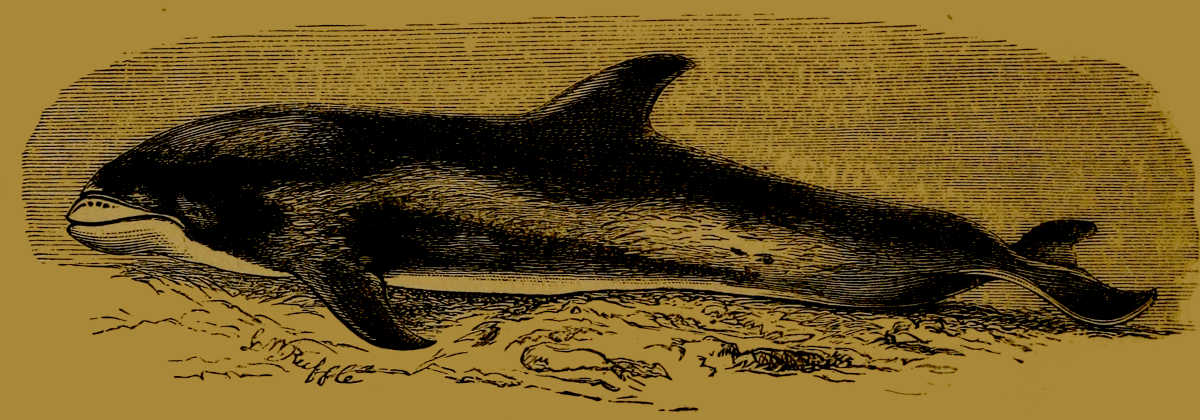
Fig. 29. White-beaked Dolphin (Delphinus albirostris, J. E. Gray).
In September, 1875, a young female was taken off Grimsby, and in March, 1876, a young male was captured off Lowestoft. The first-named of these latter formed the subject of a communication to the Zoological Society of London, by Dr. Cunningham, of Edinburgh, and the latter of a subsequent notice, by Mr. J. W. Clark, of Cambridge. Both papers will be found printed in the ‘Proceedings’ of the Zoological Society for 1876, p. 679, et seq., and figures of the two specimens are given on the same plate. On the 24th August, 1879, a young female, the skull of which is now in the Norfolk and Norwich Museum, was landed at Yarmouth, and on the 22nd March, 1880, another young female was also landed at the same place, the exact locality in which it was taken being uncertain. On the 7th September, 1880, a young male, the first recorded Scotch specimen, was taken on the east coast, near the Bell Rock, thus realising the belief, expressed shortly before (‘Mammalia of Scotland,’ Nat. Hist. Soc. of Glasgow, 1880, p. 23) by Mr. Alston, that it might be expected to occur in Scottish waters. The total length was 5 ft. 8 in.
Through the kindness of Mr. Clark, I am enabled to give a figure of the Lowestoft specimen. Mr. Clark’s figure differs considerably from Dr. Cunningham’s, both in outline and in the disposal of colour, being much more slender, and showing considerably less white; both, however, differ still more from Mr. Brightwell’s figure than they do from each other. A good figure of the adult animal is still a desideratum, that by Miss Brightwell being obviously incorrect. Mr. Clark’s specimen was glossy black on the upper part, and creamy white on the under; the upper lip white, with a black spot at the tip, and a few irregular pale grey cloudings on its surface; the coloration exceedingly beautiful, and such as no drawing could give an adequate idea of. The two last-named Yarmouth examples agreed very closely in all respects with Mr. Clark’s description. Mr. Brightwell’s specimen had the whole upper part and sides rich purple-black, the lips, throat, and belly cream-colour, varied by chalky-white. This specimen, an adult, measured 8 ft. 2 in. in length, Mr. Clark’s 5 ft. 5½ in., and Dr. Cunningham’s 4 ft. 2 in. Two others, also both young ones, measured respectively 4 ft. 3 in., and 5 ft. The teeth vary in number, but are about twenty-six on either side each jaw; in one specimen, carefully examined by the writer, they were 26/24 26/24, several of the front teeth not having pierced the gum.
In addition to those enumerated above, others are said to have occurred on the coast of Belgium, Denmark, Norway, Sweden, and to have been seen off the Faroe Islands. It is singular that 5 of the 10 recorded British specimens should have been landed on the Norfolk coast.
This species concludes the short list of the twenty-two British Cetacea, of which I have endeavoured to give a popular, but I hope, at the same time, so far as it is at present known, a reliable account; my principal object, as I stated in my introductory remarks, being to induce those residing in suitable localities to take up the study of this interesting family, and to assist in the identification of those specimens which from time to time are cast upon our shores.
Note to page 77, Rudolphi’s Rorqual (Balænoptera laticeps, J. E. Gray).—Professor Flower, since the brief account of this animal at p. 77 was printed, has called my attention to the undoubted priority of Lesson’s name for this species, Balænoptera borealis, which was founded upon Cuvier’s “Rorqual du Nord”; he also points out that Van Beneden and Gervais follow Lesson in this respect, and says that in future it is his intention to do the same. As it is most important to establish an uniform nomenclature, I do not hesitate to follow so distinguished an authority, and now wish to supply the omission as far as it is possible to do so. The species will, doubtless, henceforth be known as Balænoptera borealis, Lesson, Complément des Œuvres de Buffon, Cetacés.
JARROLD AND SONS, PRINTERS, LONDON AND EXCHANGE STREETS, NORWICH.
Cloth, 6s.; or in Half Morocco, 10s. 6d.
Observations on the Fauna of Norfolk,
AND MORE PARTICULARLY ON
THE DISTRICT OF THE BROADS.
BY
THE LATE REV. RICHARD LUBBOCK, M.A.,
Rector of Eccles.
NEW EDITION, WITH ADDITIONS FROM UNPUBLISHED MANUSCRIPTS OF THE AUTHOR, AND NOTES BY THOMAS SOUTHWELL, F.Z.S., Hon. Sec. to the Norfolk and Norwich Naturalists’ Society; Author of “Seals & Whales of the British Seas;” ALSO A MEMOIR BY HENRY STEVENSON, F.L.S.; AND AN APPENDIX CONTAINING NOTES ON HAWKING IN NORFOLK BY ALFRED NEWTON, M.A., F.R.S., &c. AND ON THE DECOYS, REPTILES, SEA FISH, LEPIDOPTERA, AND BOTANY OF THE COUNTY.
OPINIONS OF THE PRESS.
“Lubbock’s volume, written five-and-thirty years ago, has long been out of print and scarce; and the reliable nature of the information which it affords has for some time rendered a new edition a desideratum with naturalists. A new edition has at length appeared, edited by Mr. Thomas Southwell, of Norwich, who has made some valuable additions of his own in the shape of notes on the existing mammalia of Norfolk, and on decoys past and present in the county, prefaced by a memoir of the author by Mr. Henry Stevenson, and supplemented by some interesting notes on Hawking in Norfolk, from the pen of Professor Newton.”—The Field.
“In addition to the intrinsic merits of the book, of which we can personally speak in the superlative degree as one of the most pleasantly written of the many pleasant natural history books our language is so rich in, describing, as it does, the ‘Broad District’—a country unlike any other part of England, and a very paradise to the botanist, entomologist, and ornithologist—this new edition is edited by Mr. Thomas Southwell, the active Secretary of the Norfolk and Norwich Naturalists’ Society, whose full and accurate knowledge of the natural history of Norfolk better fits him for the task than any other man we know of.”—Science Gossip.
“While Mr. Lubbock’s personal observations were chiefly directed to the neighbourhood of the Broads, the editor has endeavoured to make the work as comprehensive in its scope as possible, and he includes the district known as Lothingland, between Lowestoft and Yarmouth, which, though in Suffolk, belongs geographically to Norfolk.”—Midland Naturalist.
“We promise to those who have never yet read this book, a rare treat from its perusal.”—Zoologist.
“We can scarcely speak too highly of the way in which this volume has been ‘got up,’ and the publishers have added such a map as has never yet been executed of this county, showing, as it does, not only the rivers and broads, and other principal pieces of water, but the sites of heronries and decoys (used or disused), gulleries, and other localities, having a special interest for Naturalists.”—Norfolk Chronicle.
“The ‘Fauna’ is a book which everyone should read who desires to know something of the natural history of Norfolk.”—Norfolk News.
“Absolutely reliable and authoritative as a work of reference, and invaluable to every naturalist and ornithologist.”—Live Stock Journal.
JARROLD AND SONS, 3, PATERNOSTER BUILDINGS, LONDON; AND LONDON AND EXCHANGE STREETS, NORWICH.
Large 8vo., Cloth Boards, Seven Shillings and Sixpence.
Rambles of a Naturalist IN EGYPT AND OTHER COUNTRIES, WITH AN ANALYSIS OF THE CLAIMS OF CERTAIN FOREIGN BIRDS TO BE CONSIDERED BRITISH, AND OTHER ORNITHOLOGICAL NOTES. BY J. H. GURNEY, Jun., F.Z.S.
JARROLD AND SONS, 3, PATERNOSTER BUILDINGS, LONDON; AND LONDON AND EXCHANGE STREETS, NORWICH.