CETACEA.
Reading edition
The occasional stranding upon our shores of some monster member of the order Cetacea serves from time to time to reawaken our interest in these wonderful animals, and sets us thinking how little we know about them, and how small is our acquaintance with their life-history.
Nor is this lack of information surprising when we consider that the difficulties in the way of studying the larger Cetacea, are so great as to be almost insuperable to any ordinary person, and even to the leaders of zoological science rarely does the opportunity present itself of examining specimens in the flesh; for, of the rare instances in which they are cast ashore, the majority occur in wild and unfrequented parts of the coast, where they are probably cut up for their oil before a naturalist has an opportunity of examining them. From their unnatural position when cast up, and their altered appearance, owing to the falling in of some parts and the distension of others, correct portraiture is almost impossible; and their great size renders it difficult and expensive to make them serviceable to science, while from the putrid condition in which they are frequently found, a close examination is too often anything but agreeable. If seen in their native element, where alone they should be seen duly to appreciate their grand proportions and perfect adaptation to their mode of life, the view must be brief and too often distant, certainly affording rare opportunities for close observation. There is thus little left for naturalists to study, except the bony skeletons, and of these often mere fragments. Under these circumstances, we shall cease to wonder at the great confusion which, till recently, existed in the classification and nomenclature of the Cetacea, and which has been only partially cleared away, chiefly by the labours of Professors Flower and Turner in this country, and by Professors Eschricht, Reinhardt, Van Beneden, Gervais, and others on the continent. The literature of the subject is widely scattered and difficult of access; and, although Dr. Gray and Professor Flower have done much to condense and systematize what is known, our acquaintance with the tropical and southern species of this interesting order is not at present sufficient to furnish materials for a monograph worthy of the subject. No class of animals has been called so many names, or so vilely caricatured in portraits, as the unfortunate Whales.
It is scarcely necessary now to say that the Cetacea hold a fully recognized place in the great class Mammalia, although this honour has not always been accorded to them. Ray classed them with the Fishes; and although Linnæus finally placed them in their true position, Pennant, following his earlier mistake, failed to do so. The members of this order, which includes the Whales proper, Narwhal, Dolphins, and Porpoises (with which, until recently, the Dugong and Manatees were improperly associated under the name of Herbivorous Cetaceans), bring forth their young alive. These are nourished by the female, which, for this purpose, is furnished with two inguinal mammæ. They are warm-blooded, and breathe by means of lungs, rendering frequent visits to the surface of the water necessary, as the animal can only respire when the orifice of the nostrils, called the blow-hole, which is placed on the top of the head, is above water. The breathing apparatus is very peculiar, being so modified that the air is admitted into the trachea without passing through the mouth; the Whale can thus breathe freely, provided the blow-hole be above water, even when its mouth is submerged or filled with water. There are no external ears, but a small aperture situated just behind the eye, communicates with a perfectly-constructed internal hearing apparatus, and this, as the water is an excellent conductor of sound, is all-sufficient. The food of the Cetacea consists of various forms of marine animals, from the Seal, which frequently forms a meal to the fierce Grampus, to the minute creatures which go to build up the giant form of the Right-Whale. Some possess numerous formidable teeth in both jaws; others have teeth in the lower jaw only; and in one section the teeth are only present in the embryo, but in their stead, from the upper jaw depend curious plates, arranged side by side, to which the name of baleen has been given. The animal is encased in a layer of fat called “blubber,” which lies beneath the skin, and serves to retain the heat of the body, and the skin is smooth, polished, and quite devoid of hair or scales. On the back of most species is found a fleshy dorsal fin, and the fore limbs are represented by flippers externally undivided; the hind limbs, so far as external appearance is concerned, are altogether absent, but a rudimentary pelvis is found embedded in the flesh. The tail-fin forms the chief organ of locomotion: it is always fixed horizontally, and is of great size and power, enabling the animal, by its vigorous use, to attain great speed. There are many and striking peculiarities in the bony skeleton which it is not necessary here to enumerate.
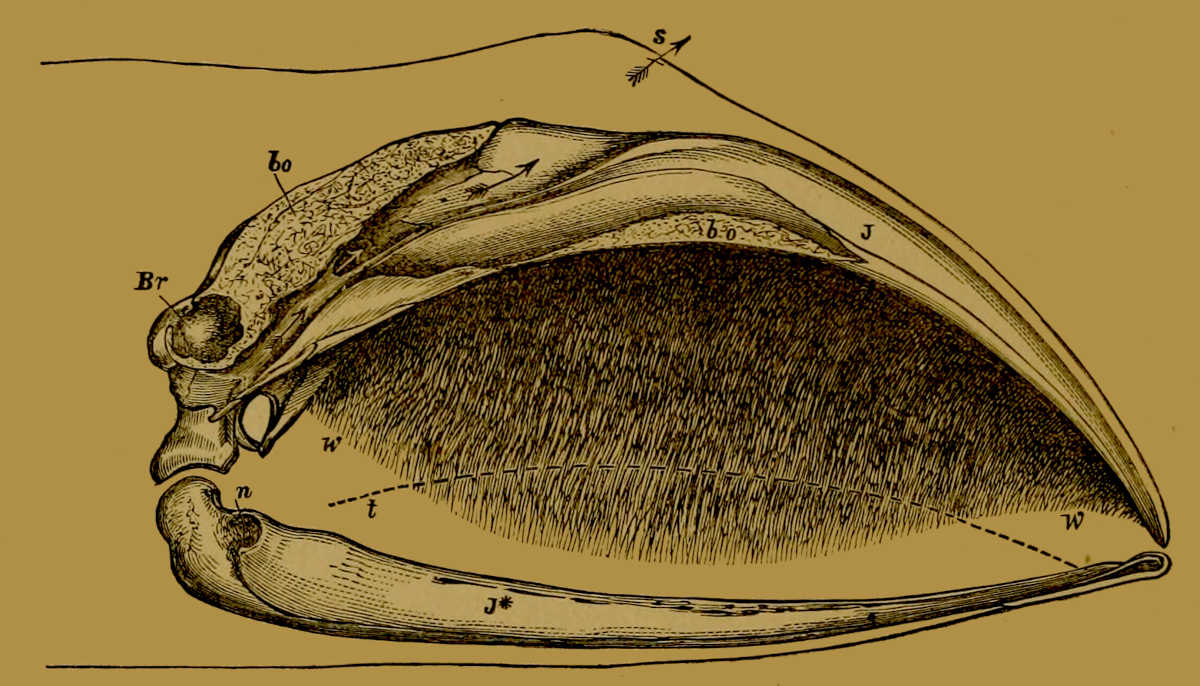
Fig. 11. Median Section, showing outside Left Half of Skull of Whalebone Whale, with Baleen in position (modified after Eschricht).
Br., brain cavity; J, J*, upper and lower jaw-bones; bo, bo, being roughened parts of the bone sawn through; arrows indicate the narial passages, which open at s, spout-hole; w, whalebone; t, tongue, in dotted outline; n, nerve aperture, lower jaw.
Before proceeding to give some account of the species which have been found in the British Seas, it will first be necessary to say a few words as to the arrangement of the genera and species. I shall enter into this part of the subject, however, so far only as is necessary for us clearly to understand the relative positions of the species which we shall have to consider.
Professor Flower divides the order Cetacea into two sub-orders: First, Mystacoceti, or Balænoidea, in all the members of which baleen takes the place of teeth, which are never developed, disappearing before birth; second, Odontoceti or Delphinoidea, in which teeth (sometimes very numerous) are always developed after birth. The first sub-order is a very restricted one, embracing only two families, Balænidæ and Balænopteridæ, to the former of which belong the two genera of Right-Whales, Balæna and Eubalæna; and to the latter, two genera, namely, Megaptera and Balænoptera. To these two genera[18] belong the Rorquals, which occasionally occur in the British seas. The second sub-order, Odontoceti, contains the families of Physeteridæ, represented by the Sperm Whale, Beaked Whale, and several allied species; Platanistidæ, consisting of some curious forms found only in India and South America; and Delphinidæ, comprising the Narwhal, Beluga, or White Whale, Grampus, Porpoise, and Dolphins. The total number of British Cetacea has been variously estimated; Dr. Gray, in 1864, described thirty, and in 1873 thirty-three species; while Bell, whom we shall follow, recognised only twenty-two species in his second edition, published in 1874.
The following table of the British Cetacea will serve to indicate at a glance the precise position assigned to each species, in the two main divisions into which the order is divided:—
BRITISH CETACEA.
SUB-ORDER. FAMILY. SUB-FAMILY. GENERA. SPECIES.
{Balænidæ Balæninæ Balæna {(?) B. mysticetus, Right-Whale
1. { {B. biscayensis, Atlantic Right-Whale
Mystacoceti { {Megapterinæ Megaptera M. longimana, Hump-backed Whale
(Whalebone-Whales.) {Balænopteridæ { {B. musculus, Common Rorqual
{Balænopterinæ Balænoptera {B. sibbaldii, Sibbald’s ”
{B. laticeps, Rudolphi’s ”
{B. rostrata, Lesser ”
{Physeterinæ Physeter P. macrocephalus, Sperm Whale
{Physeteridæ { {Hyperoodon {H. rostratum, Beaked Whale
{ { { {H. latifrons, Broad-fronted Beaked Whale
{ {Ziphiinæ {Ziphius Z. cavirostris, Cuvier’s Whale
2. { {Mesoplodon M. bidens, Sowerby’s Whale
Odontoceti { { Beluginæ {Monodon M. monoceros, Narwhal
(Toothed Whales.) { { {Delphinapterus D. leucas, White Whale, or Beluga
{Delphinidæ { {Orca O. gladiator, Grampus, or Killer
{ {Grampus G. griseus, Risso’s Grampus
{ Delphininæ {Globicephalus G. melas, Pilot Whale
{Phocœna P. communis, Porpoise
{ {D. delphis, Common Dolphin
{ Delphinus {D. tursio, Bottle-nosed Dolphin
{D. acutus, White-sided Dolphin
{D. albirostris, White-beaked Dolphin