Part 2 — CHAP. XV. (continued 2)
Reading edition
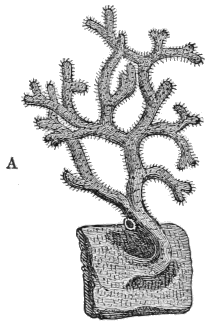
Eschara cervicornis. (Natural size.)
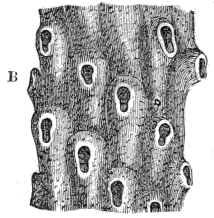
Portion of a branch of the polypary of Eschara cervicornis, magnified twenty diameters, to show the form and arrangement of cells.
In cabinets of natural history, the species commonly called Neptune's ruffles will rarely be found wanting. It is a native of the Mediterranean, but individuals of a smaller size are also found in the British seas.
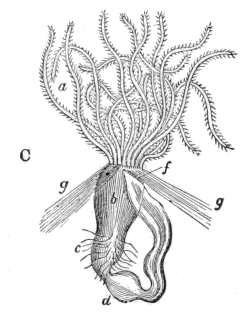
An individual of Eschara cervicornis, highly magnified. a. Tentacula b. First digestive cavity. d. Stomach. f. Anus.
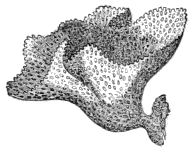
Retepora cellulosa. (Neptune's Ruffle.)
The Lepraliæ, or Sea-Scurfs, form thin calcareous crusts of a white-yellow or reddish colour on rocks, shells, and sea-weeds. To the naked eye they appear as rude unsightly eruptions, so as to justify their name derived from the hideous leprosy of the East, but, when magnified, their cells, generally disposed in regular concentric rows, exhibit a surprising diversity and elegance of structure. Forty species are found in the North Sea alone; hence we may judge how great the number of still unknown forms must be that spread their microscopic traceries over the algæ and shells of every zone.
It would lead me too far were I minutely to describe the Cellulariæ with their cells disposed in alternating rows on narrow bifurcated branches; the Tubulipores, with their mouths at the termination of tubular cells without any movable appendage or lip; the Bowerbankias and Lagunculas, with their creeping stems and separate cells; suffice it to say that a wonderful exuberance of fancy displays itself in the structure of the numerous varieties of the Polyzoa.
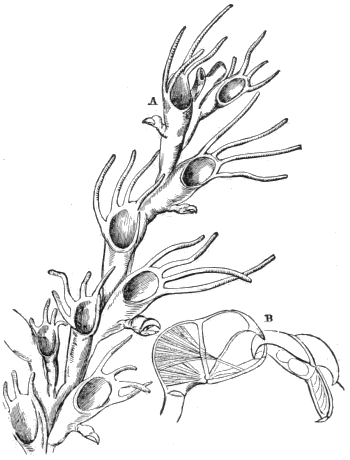
A. Portion of a Cellularia, magnified. B. A Bird's Head Process, more highly magnified, and seen in the act of grasping another.
But a closer inspection reveals still greater miracles to the marine microscopist, for most genera, and chiefly the Cellulariæ, possess very remarkable appendages, or processes, presenting the most striking resemblance to the head of a bird. Each of these processes, or "aviculariæ," as they have been named, has two "mandibles," of which one is fixed like the upper jaw of a bird, the other movable like its lower jaw; the latter is opened and closed by two sets of muscles, which are seen in the interior of the head, and between them is a peculiar body, furnished with a pencil of bristles, which is probably a tactile organ, being brought forwards when the mouth is open, so that the bristles project beyond it, and being drawn back when the mandible closes. During the life of the polyzoon, these tiny "vulture-heads," which are either sessile or pedunculated, keep up a continual motion, and it is most amusing to see them see-sawing and snapping and opening their jaws, and then sometimes in their incessant activity even closing upon the beaks of their neighbours.
It is still very doubtful what is their precise function in the economy of the animal; whether it is to retain within reach of the ciliary current bodies that may serve as food, or whether it is like the pedicellariæ of the sea-urchins to remove extraneous particles that may be in contact with the surface of the polyzoary. The latter would seem to be the function of the "vibracula," which are likewise pretty generally distributed among the polyzoa. Each of these long bristle-shaped organs, springing at its base out of a sort of cup, that contains muscles by which it is kept in almost constant motion, sweeps slowly and carefully over the surface of the polyzoary, and removes what might be injurious to the delicate inhabitants of the cells, when their tentacles are protruded. So carefully have these lowly molluscs been provided for!
The polyzoa can neither hear nor see, at least as far as we are able to ascertain, but the delicacy of their sense of touch is very great. "When left undisturbed in a glass of fresh sea-water," says Dr. Johnston,[R] "they push their tentacula beyond the mouth of the cell by straightening the body, and then expanding them in the form of a funnel or bell, they will often remain quiet and apparently immovable for a long time, presenting a very pretty and most interesting object to an observer of the 'minims of nature.' If, however, the water is agitated, they withdraw on the instant, probably by aid of the posterior ligament or muscle; the hinder part of the body is pushed aside up the cell, the whole is sunk deeper, and by this means the tentacula, gathered into a close column, are brought within the cell, the aperture of which is shut by the same series of actions. The polyzoa of the same polyzoary often protrude their thousand heads at the same time, or in quick but irregular succession, and retire simultaneously, or nearly so, but at other times I have often witnessed a few only to venture on the display of their glories, the rest remaining concealed, and if, when many are expanded, one is singled out and touched with a sharp instrument, it alone feels the injury, and retires, without any others being conscious of the danger, or of the hurt inflicted on their mate. The polyzoa propagate by gemmation and by ova or eggs, which, germinating on the inner surface, escape at a later period into the visceral cavity, and are finally discharged into the wide sea, so to fulfil their mission in creation, and people the shores of every clime with myriads of busy workers in horn and in lime, which, with subtle chemistry, they draw from a fluid quarry and build up in textures of admirable beauty and heaven-ordered designs."
Each polyzoon begins with a single ovum. The original or seminal cell of a flustra or lepralia has no sooner fixed itself upon some stone, shell, or alga, than new buds begin to shoot forth, which in their turn produce others from their unattached margins, so as rapidly to augment the number of cells to a very large amount. Thus a common specimen of Flustra carbasea presents more than 18,000 individual polyzoa, and as each of these has about twenty-two tentacula, which are again furnished with about a hundred ciliæ a piece, the entire polyzoary presents no less than 396,000 tentacula and 39,600,000 ciliæ. The Rev. David Landsborough calculated that a specimen of Flustra membranacea five feet in length by eight inches in breadth had been the work and the habitation of above two millions of inmates, so that this single colony on a submarine island was about equal in number to the population of Scotland. As the tentacula are numerous in this species, four thousand millions of ciliæ must have provided for its wants, about four times the number of the inhabitants of this globe!
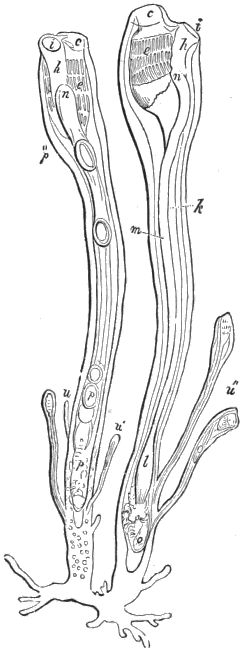
Clavellina producta. Group of two adult and several young individuals, magnified about five times. c. Branchial orifice. e. Branchiæ. i. Anal orifice. l. Stomach. o. Heart. u, u′, u″. Reproductive buds, springing from the abdomen of the adults.
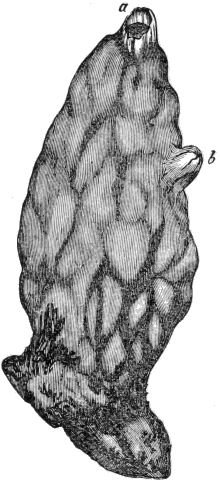
Ascidia mammillata. a. Branchial orifice, open. b. Anal orifice, closed.
The Tunicata are so called because their soft parts are not enclosed in a calcified shell such as invests the majority of their class, but in a more or less coriaceous envelope or tunic which is either bag-shaped, and provided with two apertures, or tube-shaped, and open at the ends. They present a strong resemblance to the Polyzoa, not merely in their general plan of conformation, but also in their tendency to produce composite structures by gemmation; they may, however, be at once distinguished from them by the absence of the ciliated tentacula which form so conspicuous a feature in the external aspect of a flustra or a retepore. Their branchiæ, which have generally the form of ridges (e), occupy a large sac, forming, as it were, the antechamber of the alimentary canal, which is barely distinguishable into gullet, stomach, and intestine, and always convoluted or folded once on itself. The Tunicata are exclusively marine, and widely spread from the arctic to the tropical seas. All of them are free during the earlier parts of their existence; some remain permanently so (Pyrosomidæ, Salpæ), but the generality (Ascidiæ, Botrylli) become fixed to shells and other marine bodies; some exist as distinct individuals (Ascidiæ, Cynthia), whilst various degrees of combination are effected by others (Botryllus, Clavellina, Pyrosoma), and some are simple in one generation and combined in the next (Salpæ).
Thus the whole family is divisible into two groups, the simple and the aggregate; both branching out into numerous genera, of which my limits only allow me to mention some of the most remarkable. The simple Ascidiæ, or Sea-Squirts, are very common on our shores. "Rarely," says Forbes, "is the dredge drawn up from any sea-bed at all prolific in submarine creatures without containing few or many of their irregularly shaped leathery bodies, fixed to sea-weed, rock, or shell, by one extremity, or by one side, free at the other, and presenting two more or less prominent orifices, from which, on the slightest pressure, the sea-water is ejected with great force. On the sea-shore, when the tide is out, we find similar bodies attached to the under surface of rough stones. They are variously, often splendidly, coloured, but otherwise are unattractive or even repulsive in aspect. Some are of a large size, several inches in length. As may easily be imagined, they lead a very inactive life, except in the young state, when by means of a long tail they rapidly swim about, until finally settling in some convenient spot, they gradually assume the form and adopt the quiet life of the parent from which they sprang."
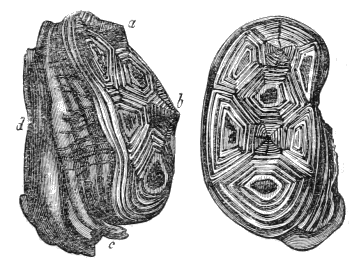
To the simple Tunicata belong also the Chelyosomata, whose coriaceous envelope, consisting of eight somewhat horny angular plates, reminds one of the carapace of the turtle. Their small and prominent orifices, perforating the plated surface, are each surrounded by six triangular valvules.
Some species of simple Ascidians on the coasts of the Channel and the Mediterranean are valued as articles of food. At Cette sea-squirts are taken regularly to market, and Cynthia microcosmus, although so repulsive externally, furnishes a very delicate morsel.
Chelyosoma Macleayanum. a. Branchial orifice. b. Anal orifice. c. Coriaceous envelope of the sides. d. Stone to which the animal is fixed. Botryllus violaceus. Two of the stems magnified. a. Common test. b. Some of the branchial orifices. c. The common anal orifice of one of the systems.
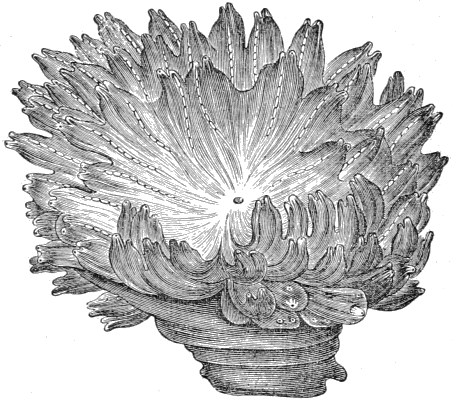
Diazona violacea (magnified).
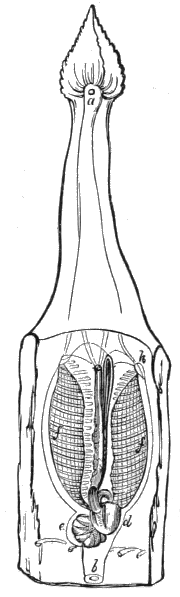
A single individual of Pyrosoma giganteum, cut out of the common test and magnified. a. Branchial or external orifice. b. Anal or internal orifice. d. Stomach. e. Liver. f. Branchiæ.
While in the Clavellinidæ the animals are connected by creeping tubular prolongations of the common tunic through which the blood circulates, the Botrylli form translucent jelly-like masses of various hues of orange, yellow, purple, blue, grey, and green; sometimes nearly uniform in tint, sometimes beautifully variegated, and very frequently pencilled as if with stars of gorgeous device; now encrusting the surface of the rock, now descending from it in icicle-like projections. They are also frequently attached to the broad-leaved fuci, investing the stalks, or clothing with a glairy coat the expanse of the fronds. "In examining their bodies," says the distinguished naturalist previously quoted, "we find that it is not a single animal which is before us, but a commonwealth of beings bound together by common and vital ties. Each star is a family, each group of stars a community. Individuals are linked together in systems, systems combined into masses. Few bodies among the forms of animal life exhibit such exquisite figures as those which we see displayed in the combinations of these compound Ascidians."
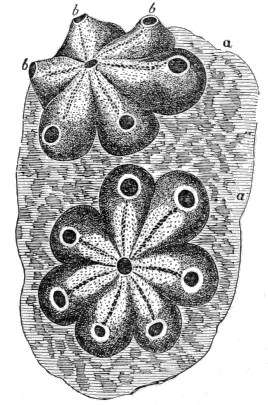
In the genus Diazona, which has its chief seat in the Mediterranean, the animals, which are very prominent and arranged in concentric circles, form a single system expanded into a disc like that of a flower or of an Actinia. The anal orifices, it will be seen, are situated close to the branchial apertures at the free end of the single animals, while in the Botrylli they open into a central excretory cavity.
In the Pyrosomes we find large colonies of small individuals aggregated in the form of a cylinder open at one end. Their mouths or anterior extremities are situated on the exterior of this hollow body, which they bristle with large and longish tubercles (a), whilst the opposite or anal orifices (b) open into the cavity of the cylinder, whose smooth wall they perforate with numerous small holes. By a simultaneous action the central cavity is either narrowed or enlarged, and by this means the strange social republic glides slowly through the waters.
The Pyrosomes inhabit the Mediterranean and the warmer parts of the ocean. In the former at times their abundance is a source of great annoyance to the fishermen, sometimes even completely clogging their nets, and on the high seas they are not seldom met with in almost incredible profusion. Their delicate and transparent forms, their elegant tints, and their unrivalled phosphorescence render them objects of admiration to the voyager, and entitle them to rank amongst the most resplendent living gems of the ocean.
Salpa maxima. a. Upper lip or posterior orifice. b. Anterior orifice. c. Prolongations of the test by which the animal is adherent to its neighbours. Salpæ, isolated and associated. A. Salpa runcinata, solitary. B. Salpa runcinata, associated. C. Salpa zonaria, aggregated.
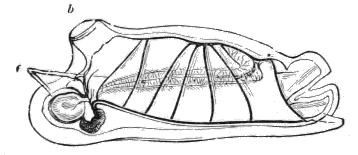
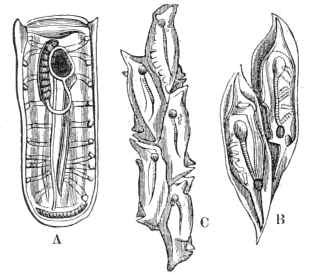
While the sessile Ascidiæ remind one of the polyps, the transparent Salpæ, freely swimming in the sea, bear a great resemblance to the pellucid jelly-fishes. Each resembles a crystalline tube, through which one can distinctly see the internal coloured parts. Sometimes these animals, which abound in the warmer seas, are found solitary, at other times associated in circular or lengthened groups, termed garlands, ribands, and chains; but, strange to say, these two forms so different in outward appearance are only the alternating generations of one and the same animal. The chained Salpæ produce only solitary ones, and the latter only chains, or, as Chamisso, to whom we owe the discovery of this interesting fact, expresses himself, "a salpa mother never resembles her daughter, or her own mother, but is always like her sister, her grand-daughter, or her grand-mother." When Chamisso first made known his discovery, he was laughed at as a fanciful visionary, but all later observations have not only fully confirmed his statement but also discovered similar or even more wonderful metamorphoses among the jelly-fish, polyps, crustacea, sea-urchins, and other marine animals. Thus Chamisso gave the first impulse to a whole series of highly interesting observations, and his rank is now as well established among naturalists as it has long been among the most distinguished poets of Germany. The Salpæ progress by the alternate contractions and dilatations of their tubular body. In this manner the chains, as if obeying a common impulse, glide along with a serpentine movement, and are often regarded by sailors as sea-snakes.
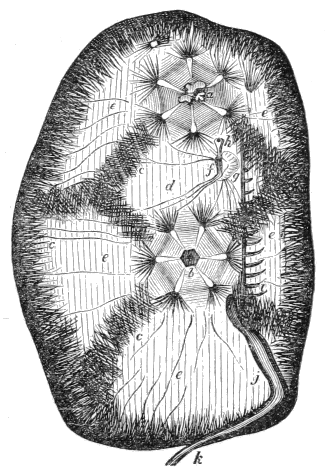
Inner or under side of the superior plated surface of Chelyosoma Macleayanum. a. Branchial orifice. b. Anal orifice. c. Muscles bordering the carapace-plates. d. Central hexagonal plate. e. Surrounding plates. f. The nerve-ganglion and nerve-fibres. g, h. Auditory apparatus. i. Row of tentacles, anterior to the œsophagus. j. Stomach. k. Part of the intestine.
Before quitting the Tunicata, a few points of interest in their simple history remain to be noticed. Despite their humble organisation, they have a heart which, as may easily be ascertained in the transparent species, is subject to strange alternations of action. For after having received for a minute or two the blood from the branchiæ, and propelled it to the system at large, it will at once cease to pulsate for a moment or two, and then propel the blood to the branchial sac, receiving it at the same time from the system generally. After this reversed course has continued for some time, another pause occurs, and the first course is resumed. It is very probable that many of the Tunicata are able to hear and to see. In Chelyosoma, organs have been discovered whose structure seems to indicate that they are destined for the transmission of sound, and the Ascidiæ have frequently around the extremity of their tubes a row of coloured points similar to the imperfect organs of sight present in the majority of the bivalve Acephalans. Thus a closer examination of the lower animals is constantly bringing new faculties to light, and the further we penetrate into the secrets of their life the more we find occasion to admire the power and wisdom of their Maker!