Part 2 — CHAP. XII. (continued 2)
Reading edition
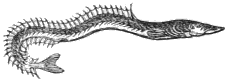
Ammodyte, or Launce.
The Launces are distinguished from the eels by their large gill openings, and their caudal fin being separated from their dorsal and anal fins. The common Sand Launce abounds on many parts of our shore. On account of its silvery brightness it is highly esteemed by the fishermen as bait for their hooks, and its remarkable habit of burrowing in the sand as the tide recedes affords easy means of capture. While underground, it most likely gets hold of many an unfortunate lob-worm, mollusc, or crustacean, but on emerging from its retreat it is in its turn preyed upon by the larger fishes. On a calm evening it is an interesting sight to see the surface of the water broken by the repeated plunges of the voracious mackerel as they burst upon the launces from beneath. On the sands at Portobello, near Edinburgh, people of all ages may be seen when the tide is out diligently searching for the sand launce, and raking them out with iron hooks. On the south coast of Devonshire, where the sand launces are extremely plentiful, the fishermen employ a small seine with a fine mesh, and are frequently so successful that six or seven bushels are taken at one haul. The usual length of the sand launce is from five to seven inches. In many localities it is prepared for table, and considered a great delicacy.
Although the Lamprey essentially differs from the eel in the formation of its gills, the softness of its cartilaginous skeleton, and its funnel-shaped mouth provided with sharp teeth, disposed in circles, yet it resembles it closely in its outward form. Its colour is generally a dull brownish olive, clouded with yellowish-white variegations; the fins are tinged with dull orange, and the tail with blue. The Marine or Sea Lamprey inhabits the ocean, but ascends the rivers in spring. Though capable of swimming with considerable vigour and rapidity, it is more commonly seen attached by the mouth to some large stone or other substance, the body hanging at rest, or obeying the motion of the current. Its power of adhesion is so great that a weight of more than twelve pounds may be raised without forcing the fish to quit its hold. Like the eel, it is remarkably tenacious of life, the head strongly attaching itself for several hours to a stone, though by far the greater part of the body be cut away from it. The lamprey is still considered as a delicacy; every schoolboy knows that King Henry I. died of an indigestion caused by this favourite dish; and the town of Gloucester still sends every Christmas a lamprey-pie to Queen Victoria, such as it was wont to offer to its sovereign in the days of the Plantagenets and Tudors.
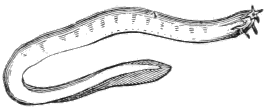
Myxine.
The Myxine, Glutinous Hag, or Borer, bears a near resemblance to the lamprey, but stands upon a much inferior degree of organisation, having no eyes—(the sole example of blindness among fishes), and a still softer skeleton, so that, when boiled, it almost entirely dissolves into mucus. In the lamprey and myxine, the branchial cells, which admit water, are lined by the delicate membrane through which the blood is aërated. In the former, however, the external apertures of the branchial cells are placed on the side of the neck; while in the myxine, which feeds on the internal parts of its prey, and buries its head and part of its body in the flesh, the openings of the respiratory organs are removed sufficiently far back to admit of the respiration going on while the animal's head is so inserted. Thus, even in this lowest and meanest of all vertebrate animals, we find a remarkable adaptation of its construction to its wants, and the proof that it has been as well taken care of by its Creator as the highest organised creatures of its class.
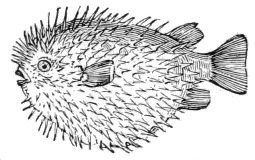
Porcupine-Fish—(Diodon hystrix.) Globe-Fish.
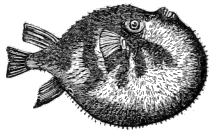
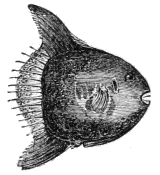
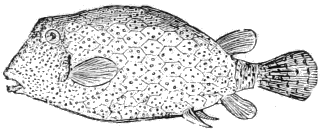
Short Sun-Fish.—(Orthagoriscus Mola.) Trunk-Fish.—(Ostracion triqueter.)
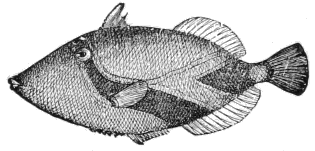
File-Fish.—(Balistes erythropterus.)
One of the most remarkable orders of fishes is that of the Plectognaths, which are distinguished by having the superior maxillary bones and the intermaxillaries soldered together so as to render the upper jaw immovable, or incapable of projection. Among the Plectognaths, we find among others the prickly Globe-fishes and sea-porcupines; the curiously-shaped Sun-fishes, all head and no body; the Ostracions or Trunk-fishes, clothed like the armadillos in a defensive coat of mail, leaving only the tail, fins, mouth, and a small portion of the gill-opening, capable of motion; and the gorgeous Balistæ or File-fishes, which owe their family-name to the peculiar structure of their first dorsal fin. The first and strongest spine of this organ is studded up the front with numerous small projections, which, under the microscope, look like so many points of enamel or pearl arising from the surface of the bone and giving it the appearance of a file. The second smaller spine has in the fore part of its base a projection which, when the spines are elevated, locks into a corresponding notch in the posterior base of the first spine, and fixes it like the trigger of a gun-lock; from which the fish is called in Italy pesce balestra, or the cross-bow fish. The strong spine cannot be forced down till the small one has been first depressed and the catch disengaged.
The Plectognaths are mostly denizens of the warmer seas, but the pig-faced trigger-fish of the Mediterranean (Balistes capriscus) has been caught three times in the British waters since 1827, and the short sun-fish or molebut, though occurring but occasionally, may be said to have been taken from John o' Groat's to the Land's End. It grows to an immense size, often attaining the diameter of four feet, sometimes even double that size, and occasionally weighing from 300 to 500 pounds. When observed in our seas, the sun-fishes have generally appeared as though they were dead or dying, floating lazily along on one side and making little or no attempt to escape. It is to be presumed that in more congenial waters they evince a greater degree of liveliness.
The order of the Lophobranchii is in many respects too curious and interesting to be passed over in silence. Here the gills, instead of being as usual ranged like the teeth of a comb, are clustered into small filamentous tufts placed by pairs along the branchial arches; the face projects into a long tubular snout, having the mouth either at its extremity, as in the Hippocampus and in the Pipe-fishes, or at its base, as in the Pegasus of the Indian seas; and the body is covered with shields or small plates, which often give it an angular form, and encase it as it were in jointed armour. But the most interesting feature of their economy is the pouches in which the males of the most characteristic genera carry the eggs until they are hatched. In the hippocampi this provision for the safety of the future generation, which strongly reminds one of the kangaroo or the opossum, forms a perfect sack, opening at its commencement only; in the pipe-fishes it is closed along its whole length by two soft flaps folding over each other. Another peculiarity of these interesting little fishes is the independent motion of their eyes, the one glancing hither and thither while its fellow remains motionless, or looks in different directions. This phenomenon of double vision, which was long supposed to be peculiar to the chameleon, is, however, not confined to this singular reptile or to the hippocampi and pipe-fishes, but has been found by Mr. Gosse to exist likewise in the Little Weever (Trachinus vipera), in the Suckers (Lepidogastri), a small family remarkable for the power they possess of attaching themselves to stones or rocks by means of an adhesive disk on the under surface of their bodies, and in several other fishes.
When imprisoned in an aquarium, few subjects of the deep display more intelligence or afford more entertainment than the little Hippocampus brevirostris, or Sea-Horse.
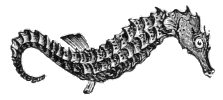
Sea-Horse.
"While swimming about," says Mr. Lukis,[P] "it maintains a vertical position, but the tail, ready to grasp whatever meets it in the water, quickly entwines itself in any direction round the weeds, and, when fixed, the animal intently watches the surrounding objects, and darts at its prey with great dexterity. When two of them approach each other, they often twist their tails together, and struggle to separate or attach themselves to the weeds; this is done by the under part of their cheeks or chin, which is also used for raising the body when a new spot is wanted for the tail to fasten upon afresh."
"In captivity," says Mr. Gosse, "the manners of the Worm Pipe-Fish (Syngnathus lambriciformis), the smallest of our native species, are amusing and engaging. Its beautiful eyes move independently of each other, like those of the chameleon, and another point of resemblance to that animal our little pipe-fish presents in the prehensile character of its tail. It curves just the tip of this organ laterally round the stem or frond of some sea-weed and holds on by this half-inch or so, while the rest of its body roves to and fro, elevating and depressing the head and fore parts, and throwing the body into the most graceful curves. All the motions of the Pipe-fish manifest much intelligence. It is a timid little thing, retiring from the side of the glass at which it had been lying when one approaches, and hiding under the shadow of the sea-weeds, which I have put in, both to afford it shelter, and also to supply food in the numerous animalcules that inhabit these marine plants. Then it cautiously glides among their bushy fronds, and from under their shelter peeps with its brilliant eyes at the intruder as if wondering what he can be, drawing back gently at any alarming motion. In swimming, it is constantly throwing its body into elegant contortions and undulations; often it hangs nearly perpendicular with the tail near the surface; now and then it butts against the side of the vessel with reiterated blows of its nose, as if it could not make out why it should not go forward where it can see no impediment. Now it twists about as if it would tie its body into a love knot, then hangs motionless in some one of the 'lines of beauty' in which it has accidentally paused."
The family of the Pleuronectidæ or Flat-fishes recommends itself to our notice as much by the singularity of its form as by its usefulness to man. "The want of symmetry," says Yarrell, "so unusual in vertebrated animals, is the most striking and distinctive character of these fishes: the twisted head with both eyes on the same side, one higher than the other, not in the same vertical line, and often unequal in size; the mouth cleft awry, and the frequent want of uniformity in those fins that are in pairs, the pectoral and ventral fins of the under side being generally smaller; and the whole of the colour of the fish confined to one side, while the other side remains white, produce a grotesque appearance: yet a little consideration will prove that these various and seemingly obvious anomalies are perfectly in harmony with that station in nature which an animal possessing such conformation is appointed to fill.
"As birds are seen to occupy very different situations, some obtaining their food on the ground, others on trees, and not a few at various degrees of elevation in the air, so are fishes destined to reside in different depths of water. The flat-fishes and the various species of skate are, by their depressed form of body, admirably adapted to inhabit the lowest position, where they occupy the least space among their kindred fishes."
"Preferring sandy or muddy shores, the place of the flat-fish is close to the ground; where, hiding their bodies horizontally in the loose soil at the bottom, with the head only slightly elevated, an eye on the under side of the head would be useless; but as both eyes are placed on the upper surface, an extensive range of view is afforded in those various directions in which they may either endeavour to find suitable food or avoid dangerous enemies. Light, one great cause of colour, strikes on the upper surface only; the under surface, like that of most other fishes, remains perfectly colourless. Having little or no means of defence, had their colour been placed only above the lateral line on each side, in whatever position they moved their piebald appearance would have rendered them conspicuous objects to all their enemies. When near the ground, they swim slowly, maintaining their horizontal position; and the smaller pectoral and ventral fins, on the under side, are advantageous where there is so much less room for their action than with the larger fins that are above. When suddenly disturbed, they sometimes make a rapid shoot, changing their position from horizontal to vertical; and, if the observer happens to be opposite the white side, they may be seen to pass with the rapidity and flash of a meteor. Soon, however, they sink down again, resuming their previous motionless horizontal position, and are then distinguished with difficulty, owing to their great similarity in colour to the surface on which they rest."
The number of species of the flat-fishes diminishes as the degrees of northern latitude increase. In this country we have twenty-three species; at the parallel of Jutland there are thirteen; on the coast of Norway they are reduced to ten; in Iceland the number is but five, and in Greenland only three.
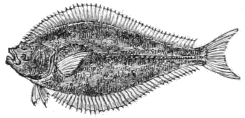
Halibut.
Many of them attain a considerable size, particularly the Halibut (Pleuronectes hippoglossus). In April 1828 a specimen seven feet six inches long and three feet six inches broad was taken off the Isle of Man, and sent to Edinburgh market. Olafsen mentions that he saw one which measured five ells; and we are told by the Norwegian fishermen that a single halibut will sometimes cover a whole skiff. Let us, however, remember that these stories proceed from the country where monstrous krakens and sea-snakes are most frequently seen, and where the mists of the north seem to produce strange delusions of vision. At all events, the halibut is better entitled to the name of maximus than its relation the Turbot, to which that epithet has been improperly applied by naturalists. The turbot, equally esteemed by the ancients and the moderns for the delicacy of its flesh, is often confounded in our markets with the halibut, but may be easily recognised by the large unequal and obtuse tubercles on its upper part.
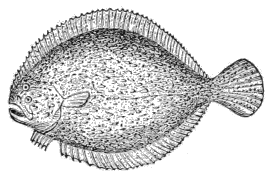
Turbot.
The number of turbot brought to Billingsgate within twelve months, up to a recent period, was 87,958. Though very considerable quantities of this fish are now taken on various parts of our own coasts, from the Orkneys to the Land's End, yet a preference is given to those caught by the Dutch fishermen, who are supposed to draw not less than 80,000l. for the supply of the London market alone. According to Mr. Low, it is rare along our most northern shores, but increases in numbers on proceeding to the south.
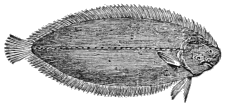
Sole.
Next to the turbot, the Sole is reckoned the most delicate of the flat-fishes. It inhabits the sandy shore all round our coast, where it keeps close to the bottom, indiscriminately feeding on smaller testaceous animals, crustacea, annelides, radiata, and the spawn and fry of other fishes. It is found northward as far as the Baltic and the seas of Scandinavia, and southward along the shores of Spain, Portugal, and the Mediterranean. The consumption is enormous, for Mr. Bertram informs us that no less than 100,000,000 soles are annually brought to the London market.[Q] They seldom take any bait, and are caught almost entirely by trawling. The principal fishing-ground in England is along the south coast from Sussex to Devonshire, where the soles are much larger and considered otherwise superior to those of the north and east. On the Devonshire coast, the great fishing-station is at Brixham in Torbay, where the boats, using large trawling nets from thirty to thirty-six feet in beam, produce a continual supply.
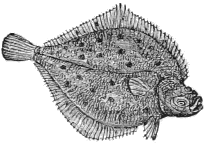
Plaice.
The Plaice and Flounder, though far inferior to the sole in quality, are still in great request as articles of food. On the English coast, the plaice are obtained in abundance on all sandy banks and muddy grounds, wherever either lines or trawl-nets can be used. On the sandy flats of the Solway Frith, they are taken by the fishermen and their families wading in the shoal water with bare feet. When a fish is felt, it is pressed by the foot firmly against the bottom until it can be secured by the hand and transferred to the basket. Long practice gives the dexterity which renders this kind of fishing successful.
In some parts of the North of Europe, where from the rocky nature of the soil the sea is remarkably transparent, plaice and some other flat-fish of large size are taken by dropping down upon them from a boat a doubly-barbed short spear, heavily leaded, to carry it with velocity to the bottom, with a line attached to it, by which the fish, when transfixed, is hauled up.
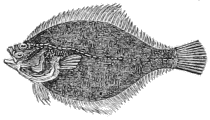
The Flounder.
The Flounder, one of the most common of the flat-fish, is found in the sea and near the mouths of large streams all round our coast, particularly where the bottom is soft, whether of sand, clay, or mud. It also ascends the rivers, and is caught in considerable quantities from Deptford to Richmond by Thames fishermen, who, with the assistance of an apprentice, use a net of a particular sort, called a tuck-sean. "One end of this net," says Yarrell, "is fixed for a short time by an anchor or grapple, and its situation marked by a floating buoy; the boat is then rowed or rather sculled by the apprentice in a circle, the fisherman near the stern handing out and clearing the net: when the circle is completed and a space enclosed, the net is hauled in near the starting-point in a direction across the fixed end."
The Sail-fluke, a species of flat-fish common among the Orkneys, where it is highly prized as an article of food, its flesh being firm and white, is remarkable for its curious habit of coming ashore spontaneously, with its tail erected above the water, like a boat under sail, whence it has derived its name. This it does generally in calm weather, and on sandy shores, and the country people residing near such places train their dogs to catch it. In North Ronaldshay, the northernmost island of the group, a considerable supply is obtained in an original manner: thus described in a letter from a resident inserted in Yarrell's "British Fishes:" "In the winter and early spring, a pair of black-headed gulls take possession of the South Bay, drive away all interlopers, and may be seen at daybreak every morning, beating from side to side, on the wing, and never both in one place, except in the act of crossing as they pass. The sail-fluke skims the ridge of the wave towards the shore with its tail raised over its back, and when the wave recedes is left on the sand, into which it burrows so suddenly and completely that, though I have watched its approach, only once have I succeeded in finding its burrow.
"The gull, however, has a surer eye, and casting like a hawk pounces on the fluke, from which, by one stroke of its bill, it extracts the liver. If not disturbed, the gull no sooner gorges the luscious morsel than it commences dragging the fish to some outlying rock, where he and his consort may discuss it at leisure. By robbing the black backs, I have had the house supplied daily with this excellent fish, in weather during which no fishing-boat could put to sea. Close to the beach of South Bay, a stone wall has been raised to shelter the crops from the sea-spray. Behind this we posted a smart lad, who kept his eye on the soaring gulls. The moment one of the birds made its well-known swoop, the boy rushed to the sea-strand shouting out with all his might. He was usually in time to scare the gull away and secure the fluke, but almost in every case with the liver torn out. If the gull by chance succeeded in carrying his prey off the rock, he and his partner set up a triumphant cackling, as if deriding the disappointed lad."
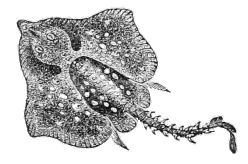
Thornback.
The Rays resemble the side-swimmers by the flatness of their form, but differ widely from them in many other particulars. Like the sharks and sturgeons, they belong to the cartilaginous fishes, and as their branchiæ adhere to the cells, these respiratory membranes are not furnished with a gill-cover, but communicate freely with the water by means of five spiracles on either side. More unsightly fishes can hardly be conceived. The rhomboidal broad body, the long narrow tail frequently furnished with two and sometimes three small fins, and mostly armed with one or more rows of sharp spines along its whole length, the dirty colour, and the thick coat of slime with which it is covered, render them pre-eminently disgusting. Their mode of defending themselves is very effectual, and forms a striking contrast to the helplessness of the flat fish. The point of the nose and the base of the tail are bent upwards towards each other, and the upper surface of the body being then concave, the tail is lashed about in all directions over it, and the rows of sharp spines frequently inflict severe wounds.
Eleven species of rays are found on the British coasts, some, like the skates, with a perfectly smooth skin; others, like the thornback, with an upper surface studded with spines, and some, like the sting-ray, with a tail still more powerfully armed with a long serrated spine: a formidable weapon, which the fish strikes with the swiftness of an arrow into its prey or enemy, when with its winding tail it makes the capture secure. The lacerations inflicted by the tropical sting-rays produce the most excruciating tortures. An Indian who accompanied Richard Schomburgk on his travels through Guiana, being hit by one of these fishes while fording a river, tottered to the bank, where he fell upon the ground and rolled about on the sand with compressed lips in an agony of pain. But no tear started from the eye, no cry of anguish issued from the breast, of the stoical savage. An Indian boy wounded in the some manner, but less able to master his emotions, howled fearfully, and flung himself upon the sand, biting it in the paroxysm of his anguish. Although both had been hit in the foot, they felt the severest pain in the loins, in the region of the heart, and in the arm-pits. A robust man, wounded by a sting-ray, died in Demarara under the most dreadful convulsions.
The rays are very voracious; their food consists of any sort of fish, mollusc, annelide, or crustacean, that they can catch. So powerful are their muscles and jaws that they are able to crush the strong shell of a crab with the greatest ease. Even in our seas they attain a considerable size. Thomas Willoughby makes mention of a single skate of two hundred pounds' weight, which was sold in the fish market at Cambridge to the cook of St. John's College, and was found sufficient for the dinner of a society, consisting of more than a hundred and twenty persons. Dr. G. Johnston measured a sharp-nosed ray at Berwick, which was seven feet nine inches long and eight feet three inches broad. But our European rays are far from equalling the colossal dimensions of the sea-devil of the Pacific. This terrific monster swims fast, and often appears on the surface of the ocean, where its black unwieldy back looks like a huge stone projecting above the waters. It attains a breadth of twelve or fifteen feet, and Lesson was presented by a fisherman of Borabora with a tail five feet long. The Society Islanders catch the hideous animal with harpoons, and make use of its rough skin as rasps or files in the manufacture of their wooden utensils.
Creatures so voracious and well armed as the rays would have attained a dangerous supremacy in the maritime domains had they equalled most other fishes in fecundity. Fortunately for their neighbours, they seldom produce more than one young at a time, which, as in the sharks, is enclosed in a four-cornered capsule ending in slender points, but not, as in the former, produced into long filaments.
Thus nature has in this case set bounds to the increase of a race which else might have destroyed the balance of marine existence; in most fishes, however, she has been obliged to provide against the danger of extinction by a prodigal abundance of new germs. If the cod did not annually produce more than nine millions of eggs, and the sturgeon more than seven; if the flat-fish, mackerels, and herrings, did not multiply by hundreds of thousands, they could not possibly maintain themselves against the vast number of their enemies. "Not one egg too much," every one will say who considers that of all the myriads of germs which are deposited on the shallow sand-banks and shores to be quickened by the fructifying warmth of the sun, not one in a hundred comes to life, as fishes and molluscs, crabs and radiata, devour the spawn with equal voracity; that a thousand dangers await the young defenceless fry, since everywhere in the oceanic realms no other right is known than that of the stronger; and that, finally, the insatiable rapacity of man is continually extirpating millions on millions of the full-grown fishes. But if very few of this much-persecuted race die a natural death, a life of liberty makes them some amends for their violent end. The tortured cart-horse or the imprisoned nightingale would, if they could reflect, willingly exchange their hard lot and joyless existence for the free life of the independent fish, who, from the greater simplicity of his structure, his want of higher sensibilities, his excellent digestion, and the more equal temperature of the element in which he lives, remains unmolested by many of the diseases to which the warm-blooded and particularly the domestic animals are subject.
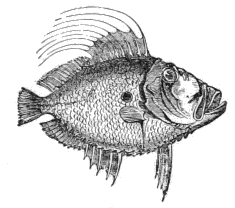
Dory.