Volume 1 / Part 1 — CHAPTER XXXVI. (continued 2)
Reading edition
“May it please your Royal Highness.
“As no person in these kingdoms ventured more frankly in the cause than myself, and as I had more at stake than almost all the others put together, so, to be sure, I cannot but be very deeply affected with our late loss and present situation; but I declare, that were your royal highness’s person in safety, the loss of the cause, and the misfortunate and unhappy situation of my countrymen, is the only thing that grieves me, for I thank God I have resolution to bear my own family’s ruin without a grudge. Sir, you will, I hope, upon this occasion, pardon me, if I mention a few truths, which all the gentlemen of our army seem convinced of.
“It was highly wrong to have set up the royal standard without having positive assurances from his Most Christian Majesty, that he would assist you with all his force; and as your royal family lost the crown of these realms upon the account of France, the world did and had reason to expect that France would seize the first favourable opportunity to restore your august family.
“I must also acquaint your royal highness, that we were all fully convinced that Mr. O’Sullivan, whom your royal highness trusted with the most essential things with regard to your operations, was exceedingly unfit for it, and committed gross blunders on every occasion of moment. He whose business it was, did not so much as visit the ground where we were to be drawn up in line of battle, and it was a fatal error to allow the enemy these walls upon their left, which made it impossible for us to break them, and they, with their front fire, and flanking us when we went upon the attack, destroyed us without any possibility of our breaking them, and our Athole men have lost a full half of their officers and men. I wish Mr. O’Sullivan had never got any other charge in the army than the care of the baggage, which, I am told, he had been brought up to and understood. I never saw him in time of action, neither at Gladsmuir, Falkirk, nor in the last, and his orders were vastly confused.
“The want of provisions was another misfortune which had the most fatal consequence. Mr. Hay, whom your royal highness trusted with the principal direction of ordering provisions of late, and without whose orders a boll of meal or farthing of money was not to be delivered, has served your royal highness egregiously ill. When I spoke to him, he told me the thing is ordered, it will be got, &c.; but he neglected his duty to such a degree, that our ruin might probably have been prevented had he done his duty. In short, the three last days which were so critical, our army was starved. This was the reason our night march was rendered abortive, when we possibly might have surprised and defeated the enemy at Nairn; but for want of provisions a third of the army scattered to Inverness, &c., and the other who marched had not spirits to make it so quick as was necessary, being really faint for want of provisions.
“The next day, which was the fatal day, if we had got plenty of provisions we might have crossed the water of Nairn, and drawn up so advantageously, that we would have obliged the enemy to come to us, for they were resolved to fight at all hazards at prodigious disadvantage, and probably we would in that case have done by them as they unhappily have done by us. In short, Mr. O’Sullivan and Mr. Hay had rendered themselves odious to all our army, and had disgusted them to such a degree, that they had bred a mutiny in all ranks, that had not the battle come on, they were to have represented their grievances to your royal highness for a remedy. For my own part, I never had any particular discussion with either of them; but I ever thought them uncapable and unfit to serve in the stations they were placed in.
“Your royal highness knows I always told I had no design to continue in the army. I would of late, when I came last from Athole, have resigned my commission; but all my friends told me it might be of prejudice to the cause at such a critical time. I hope your royal highness will now accept of my demission. What commands you have for me in any other situation, please honour me with them.—I am, with great zeal, Sir, your royal highness’s most dutiful and humble servant,
“George Murray.
“Ruthven, 17th April, 1746.
“I have taken the liberty to keep 500 pieces, which shant be disposed upon except you give leave.”[1222]
It would appear from the preceding document that Lord George Murray, who, of all men, was the best judge of the propriety of trying another campaign, did not in the least contemplate that Charles would abandon the enterprise. His own opinion was, that the war should be continued; and when he heard that Charles had resolved to depart for France, he sent Secretary Hay to Glenboisdale with a message to Charles, to dissuade him against such a step; but Charles informed Hay that his resolution was fixed. Lord George maintained that the Highlanders “could have made a summer’s campaign without the risk of any misfortune: they could have marched through the hills to places in Banffshire, Aberdeenshire, the Mearns, Perthshire, Lochaber, and Argyleshire, by ways that regular troops could not have followed; and if they (the regular troops) had ventured among the mountains, it must have been attended with great danger and difficulty: their convoys might have been cut off, and opportunities would have offered to attack them with almost a certainty of success. And though the Highlanders had neither money nor magazines, they would not have starved in that season of the year so long as there were sheep and cattle: they could also have separated themselves in two or three different bodies, got meal for some days’ provision,—met again at a place appointed, and might have fallen upon the enemy when they least expected: they could have marched in three days what would have taken regular troops five: nay, had those taken the high roads as often as they would have been obliged upon account of their carriages, it would have taken them ten or twelve days. In short, they might have been so harassed and fatigued that they must have been in the greatest distress and difficulties, and at length probably been destroyed, at least much might have been expected by gaining of time: perhaps the Highlanders might have been enabled to have made an offensive instead of a defensive war.”[1223]
After receiving Charles’s orders to disperse, the officers at Ruthven, to use an expression of one of themselves,[1224] “took a melancholy leave of each other,” and went off in different directions to secure their personal safety, and the common men proceeded straight to their respective homes.
While Secretary Hay was at Boisdale, Charles drew up a letter to the chiefs, stating the reasons of his departure, which he inclosed in one to Sir Thomas Sheridan,[1225] with instructions to show it to them, but to keep it as long back as he conveniently could. He stated that it was “of the last consequence” to conceal his departure on some pretext or other, which he enjoined him to contrive, and to recommend, particularly to every person to whom he showed the paper, to follow the same course. In using this precaution Charles probably wished to keep the government in ignorance of his design to leave the kingdom. The letter to the chiefs, which, though written on or before the 23d of April, the date of the letter to Sir Thomas Sheridan, is post-dated the 28th, with the view, perhaps, of allowing Sir Thomas to withhold it for a few days, by which time Charles expected that he would be on his way to the Long island, where he expected to find a vessel to carry him to France. The letter to the chiefs runs thus:—
“For the Chiefs,
“When I came into this country, it was my only view to do all in my power for your good and safety. This I will always do as long as life is in me. But alas! I see with grief I can at present do little for you on this side the water, for the only thing that can now be done is to defend yourselves till the French assist you, if not to be able to make better terms. To effectuate this, the only way is to assemble in a body as soon as possible, and then to take measures for the best, which you that know the country are only judges of. This makes me be of little use here; whereas, by my going into France instantly, however dangerous it be, I will certainly engage the French court either to assist us effectually and powerfully, or at least to procure you such terms as you would not obtain otherways. My presence there, I flatter myself, will have more effect to bring this sooner to a determination than any body else, for several reasons; one of which I will mention here; viz. it is thought to be a politick, (policy,) though a false one, of the French court, not to restore our master, but to keep a continual civil war in this country, which renders the English government less powerful, and of consequence themselves more. This is absolutely destroyed by my leaving the country, which nothing else but this will persuade them that this play cannot last, and if not remedied, the Elector will soon be as despotick as the French king, which, I should think, will oblige them to strike the great stroke, which is always in their power, however averse they may have been to it for the time past. Before leaving off, I must recommend to you, that all things should be decided by a council of all your chiefs, or, in any of your absence, the next commander of your several corps with the assistance of the Duke of Perth and Lord George Murray, who, I am persuaded, will stick by you to the very last. My departure should be kept as long private and concealed as possible on one pretext or other which you will fall upon. May the Almighty bless and direct you.”[1226]
At Glenboisdale Charles was joined by Clanranald, Lockhart, younger of Carnwath, Æneas Macdonald, the banker, and several other adherents, who endeavoured to dissuade him from embarking for the isles, where, from the number of cruisers which hovered among the Hebrides, they considered he would run greater risk than if he remained on the mainland. Charles seemed disposed to adopt this advice; but O’Sullivan being averse to it, and having represented the great probability of speedily finding a ship among the isles to convey him to France, and the great danger of staying where he was, the prince adhered to his determination of seeking a temporary refuge in the Long island. With the intention of soliciting the protection of Sir Alexander Macdonald and the laird of Macleod, Charles sent to Kinlochmoidart for one Donald Macleod, a trustworthy person whom he wished to intrust with his despatches. Macleod had been at Inverness shipping a cargo of meal for Skye when Charles entered that town, and had been employed to accompany Æneas Macdonald to the island of Barra, for the purpose of bringing over a sum of about £380, which was lying there. They had reached Kinlochmoidart, on their way back, and were about setting out for Inverness, when Macdonald received a letter from the prince announcing his defeat, and requesting him to repair to Borodale. On receiving this message Macleod immediately set out, and in passing through a forest in the vicinity of Glenboisdale, he observed a solitary wanderer among the trees, who immediately came forward and asked him if he was Donald Macleod of Gualtergill in Skye. Macleod answered that he was, and having recognised the prince in the person of his interrogator, he stated that he was at his service. “Then,” said the prince, “you see, Donald, I am in distress. I therefore throw myself into your bosom; do with me what you like. I hear you are an honest man, and fit to be trusted.” The aged Highlander doubting his capacity to serve him, Charles stated to him the nature of the mission on which he intended to send him. Macleod, startled at the proposal, positively refused to undertake the task; and having remonstrated with Charles upon the impropriety of asking the protection of men who had, contrary to their promise, taken part against him, he abandoned his design.[1227]
During the few days that Charles spent at Glenboisdale, he is said to have wavered in his plans. Though informed of the dispersion of his troops, he had hopes that a good many might still be collected as occasion offered. He is said even to have entertained thoughts of again assembling his scattered forces, and acting on the defensive. He sent a few men, with whom Clanranald had supplied him, on all sides to obtain intelligence, but they learned nothing favourable; and accounts which he received from the Isle of Skye, that Lord Loudon was about to come over immediately to the coast of Arisaig, joined to a report, which, however, turned out to be false, that a detachment of the Duke of Cumberland’s army had already reached Fort Augustus, hastened his departure from the mainland.[1228]
Accordingly, on the evening of the 26th of April, Charles, accompanied by O’Sullivan, O’Neil, Allan Macdonald, a catholic priest of Clanranald’s family, and Edward Burke, embarked in an eight-oared boat at Borodale, in the bay of Lochnanuagh, where a few months before he had landed full of hope and enthusiasm. Besides the persons enumerated, and Donald Macleod who acted as pilot, there were seven boatmen. Charles sat down in the bottom of the boat at the feet of the pilot. Macleod, who observed indications of an approaching storm, had advised Charles to postpone his voyage till next day; but the prince was so intent upon proceeding, that he would not put off his departure. Four pecks of oatmeal were all the provision the whole party carried along with them, and the only cooking utensil was a pot which Macleod had taken care to provide.
Charles soon had occasion to repent of his obstinacy in not listening to the advice of the aged mariner; for before the boat had proceeded far, a storm arose, which is described by Macleod as the most violent he had ever witnessed, though he had been all his life a seafaring man. The danger was greatly increased by the darkness of the night, and to add to the distress of the party, the rain poured down in torrents. Vivid flashes of lightning which threw a momentary gleam over the face of the troubled deep, and the crash of the thunder which rolled over the heads of the affrighted party, increased the horrors of the scene. Unprovided with a compass, they were entirely ignorant of the course they were steering; but they had, from the violence of the tempest, no alternative but to go before the wind, and in the event of escaping the fury of the waves, running the risk of being driven upon Skye, where the prince might fall into the hands of the militia who were in that island. But all their apprehensions of danger on this score were removed, by discovering at day-break that they were on the coast of the Long island. At seven o’clock in the morning they landed with great difficulty at Rossinish, a point of land on the north-east of Benbecula, one of the islands which form the group called the Long island. Having secured their boat, Charles and his party entered an uninhabited hut, in which they kindled a fire to warm themselves and dry their clothes, which were saturated with rain and salt-water. Charles purchased a cow, which was immediately slaughtered; and which, with the small quantity of meal provided by Donald Macleod, served to support the party during the time they remained on the island.[1229]
Meanwhile the Duke of Cumberland was using every effort to capture the persons of the young Chevalier and his principal adherents. For this purpose, several detachments were sent out by the duke from his camp at Inverness in different directions, and as he was desirous that Charles should not fall alive into his hands, his instructions to the commanders of the detachments were to make no prisoners. One of these detachments, under Colonel Cockayne, proceeded to Moy castle, and after shooting some fugitives who had taken refuge in that mansion, and massacring some old men, women and children, returned to Inverness, carrying along with them Lady Mackintosh, who, on her arrival there, was committed to custody by the duke. Another party went to castle Downie, the seat of Lord Lovat, which they burnt to the ground, having previously secured a large quantity of booty, which they carried to Inverness. A body of 600 Grants was sent into the Frasers’ country to reduce and disarm that powerful clan; and the Monroes, Mackays, and Sutherlands, were scattered over the shires of Ross, Cromarty, Sutherland, and Caithness, to keep the disaffected in these counties in check. To secure the passages to the isles, Lord Fortrose, son of the Earl of Seaforth, proceeded to raise the Mackenzies, and orders were given along the coast to prevent any suspicious persons from making their escape by sea. Cobham’s and Lord Mack Ker’s dragoons were posted along the east coast, and bodies of militia were stationed at the passes leading into the Highlands to intercept all persons who might attempt to escape to the lowlands. The pass of Stirling was also guarded by a detachment posted at the Fords of the Frew, and the Edinburgh regiment was spread along the south side of the Frith of Forth, to apprehend such of the insurgents as might attempt to cross that arm of the sea. Besides these different detachments, a body of 1,700 militia, under the Earl of Loudon, the laird of Macleod, and Sir Alexander Macdonald, the last of whom had raised his men before the battle of Culloden, and another body of 800 Argyleshire men under General Campbell, afterwards Duke of Argyle, spread themselves over Lochaber, all eager to secure the person of the prince. In short, no means were neglected to attain this object; and the eager pursuers required no other stimulus to urge them on than the splendid reward of £30,000, which had been offered for the capture of the royal fugitive.
The departure of Charles from Lochnanuagh was not known at Inverness till some days after he had sailed, and the place of his destination become a matter of interesting speculation. No doubt could exist that he designed to seek refuge among the western islands, and as St. Kilda is the most distant and the least frequented of the whole, it was supposed that Charles had repaired thither. Acting on this supposition, General Campbell collected some sloops of war and transports, and having embarked a considerable body of troops, set sail for St. Kilda.[1230] After touching at Barra and some other islands, and searching for the prince, he approached St. Kilda, the inhabitants of which, alarmed at the sight of the fleet, fled and concealed themselves in the cliffs of the rocks. Landing with some of his forces, the general inquired at some of the inhabitants, whom he discovered in their recesses, what had become of the “Pretender;” but these people answered, with great simplicity, that they had never heard of such a person,—that they had indeed been informed that their laird (Macleod) had lately been at war with a woman a great way abroad, and that he had overcome her. This, they added, was all they knew of the affairs of the world. General Campbell, however, not satisfied with this statement, made a search over the island, but not finding any strangers, returned to the main land after visiting South Uist.
Anticipating the utter ruin which awaited them and their followers, if no attempt was made to resist the meditated designs of the Duke of Cumberland, several chiefs and others[1231] held a meeting at Mortlaig on the 8th of May, at which they entered into a bond for their mutual defence, and agreed never to lay down their arms, or make a general peace, without the consent of the whole. They may be supposed to have come to this resolution the more readily, as a sum of 35,000 louis d’ors had been received a few days before by two French frigates which had arrived on the west coast. By the bond of association, the chiefs agreed, and solemnly promised, with the utmost expedition, to raise in behalf of the prince and in defence of their country, as many able-bodied armed men as they could on their respective properties, and they further promised and agreed, that the following clans, viz., Lochiel, Glengarry, Clanranald, Stewarts of Appin, Keppoch, Barisdale, Mackinnons and Macleods, should assemble on Thursday, the 15th of May, at Auchnacarry, in the braes of Lochaber. To facilitate the junction of the different corps with all possible speed, it was agreed that the Frasers of Aird and the other Jacobite clans on the north side of the river Ness, should join the people of Glenmoriston and Glengarry, and that the Frasers of Stratherrick, the Mackintoshes and Macphersons, should assemble and meet at the most convenient place in Badenoch on the same day;—that the Macgregors, and Menzies’ and Glenlyon’s people should march to Rannoch and join the Rannoch and Athole men, and be kept in readiness to receive intelligence and orders to meet the main body in the braes of Mar, or at any other place that might be considered convenient,—that Gordon of Glenbucket and Colonel Roy Stewart should intimate the resolutions of the meeting to Lord Lewis Gordon, Lords Ogilvy and Pitsligo, the Farquharsons, and the other principal gentlemen in the north, who were to be directed to fix a place of rendezvous among themselves, and that Macpherson of Cluny and Colonel Roy Stewart should advertise the principal gentlemen of the Mackintoshes of the resolutions adopted by the meeting. The better to conceal their designs from the Duke of Cumberland, the assembled chiefs agreed not to discover or reveal to any of their men or inferior officers, the agreement they had entered into, nor the day and place of rendezvous, till they had assembled their respective corps. It was finally agreed, that should any one engaged in the association make separate terms for himself, he should be looked upon as a traitor to the prince, and be treated by his associates as an enemy.[1232]
The associated chiefs had been too sanguine in their expectations, not one of them being able, for various reasons, to meet on the day appointed. Clanranald’s people refused to leave their own country, and many of Glengarry’s had delivered up their arms. Lochgarry came with a small party to Invermely on the 20th of May; but, after staying one night, he crossed Loch Arkaig and did not return. Lochiel and Barisdale met at Auchnacarry, the place of rendezvous, on the 21st or 22d of May, but with very few men, and they were almost surprised by a large party of the government forces on the morning of the 23d, who took an officer and two of Lochiel’s men prisoners. The Highlanders immediately dispersed, and Lochiel, seeing no chance of making an effectual stand under existing circumstances, wrote a circular to his brother chiefs, advising them to disperse their people; but, as great expectations were entertained that the French king would send assistance, he requested them to preserve their arms as long as possible.
Conceiving that the only effectual mode of suppressing the rebellion was to march into the Highlands with the whole of his army, the Duke of Cumberland began, about the middle of May, to make preparations for his journey. He had in the beginning of that month issued a proclamation, ordering the insurgent clans to deliver up their arms; but little attention was paid to this mandate, and the continuance of considerable armed parties convinced him that the Highlands could never be reduced without the presence of a considerable army stationed in a central district. Having pitched upon Fort Augustus for his new head-quarters, the duke left Inverness, on the 23d of May, with eleven battalions of foot and Kingston’s horse, and reached Fort Augustus next day. Charles had intended to make this place a rallying point in case of a defeat; but his plan was rejected by the chiefs, and, that it might not be serviceable to the royal troops, the buildings had been blown up. No accommodation being therefore found for the duke’s army, a camp was formed in the neighbourhood, and a turf hut with doors and windows, and covered with green sods and boughs, was erected by Lord Loudon’s Highlanders for the use of his royal highness.[1233]
Resolving to inflict a signal chastisement upon the rebels, the duke sent, from his camp at Fort Augustus, detachments of his troops in all directions, which devastated the country with fire and sword, and committed excesses scarcely paralleled in history, resembling, though perhaps on a minor scale, those committed by the hosts of Hyder Ali, when that merciless destroyer burst into the Carnatic. The seats of Lochiel, Glengarry, Kinlochmoidart, Keppoch, Cluny, Glengyle, and others, were plundered and burnt to the ground, and great numbers of the houses of the common people shared the same fate.[1234] Major Lockhart, whose name, by his cruelties on this occasion, has obtained an infamous notoriety, marched with a detachment into the country of the Macdonalds of Barisdale, and laid waste and destroyed their dwellings. Some of these poor people had obtained protections from Lord Loudon; but the major disregarded them, and told the people who had them, that not even a warrant from heaven should prevent him from executing his orders. Another corps, under Lord George Sackville, ravaged the country about the glens of Moidart, while others carried fire and desolation through other districts. Not contented with destroying the country, these bloodhounds either shot the men upon the mountains, or murdered them in cold blood. The women, after witnessing their husbands, fathers, and brothers murdered before their eyes, were subjected to brutal violence, and then turned out naked, with their children, to starve on the barren heaths. A whole family was inclosed in a barn, and consumed to ashes. So alert were these ministers of vengeance, that in a few days, according to the testimony of a volunteer who served in the expedition, neither house, cottage, man, nor beast, was to be seen within the compass of fifty miles: all was ruin, silence, and desolation. Deprived of their cattle and their small stock of provisions by the rapacious soldiery, the hoary-headed matron and sire, the widowed mother and her helpless offspring, were to be seen dying of hunger, stretched upon the bare ground, and within view of the smoking ruins of their dwellings.
It may seem surprising that the Highlanders did not avenge themselves upon their oppressors, by assassinating such stragglers as fell in their way. It cannot be supposed that men in whose bosoms the spirit of revenge must have taken deep root, would have spared their relentless adversaries from any scruple as to the mode of despatching them; nor can it be imagined that the Highlanders could not have selected fit occasions when they might have inflicted vengeance upon individuals. The reason of their forbearance probably was, that such a system of warfare, if adopted, would lead to acts of retaliation on the part of the military, and thus increase their calamities. Only one instance is known where an injured person attempted to avenge himself. This was the case of a Highlander who had his house burned, his cattle plundered, and his son killed, while defending his family, who were turned out in the snow. Vowing revenge, he watched the officer who was the author of this inhuman outrage, and who, he was informed, was to be distinguished by a cloak of a particular kind. This officer riding one day with Captain George Munro of Culcairn in a shower of rain, lent him his cloak; and while marching in it with a party of men along the side of Loch Arkaig, the captain was shot by the enraged Highlander, who perceived the cloak, but could not distinguish the difference of person. The man escaped, and although he was well known, and might have been afterwards apprehended, he was allowed to pass unpunished.[1235]
Of the immense quantity of cattle carried off by Cumberland’s troops, some idea may be formed from the fact mentioned in a journal of the period,[1236] that there were sometimes 2,000 in one drove. Intelligence of such a vast accumulation of live stock reaching the ears of the graziers of the south, numbers of them went to Fort Augustus well provided with money, which they laid out to great advantage. Some of the people, impelled by starvation, repaired to the camp to solicit from the spoilers some of their flocks, to preserve an existence; but their supplications were unheeded, and they were doomed to behold their cattle sold and driven away, while famine stared them in the face.
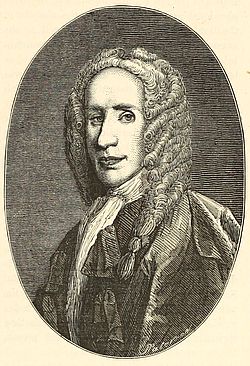
Duncan Forbes of Culloden, Lord President. From Original Painting at Culloden House.
The atrocities committed by the English must have been revolting to the humane mind of Lord President Forbes. On paying his respects to the duke at Inverness, he hinted to his highness that the laws of the country should be observed even by his army; but the duke, who entertained very different ideas, not relishing such an intrusion upon his authority, cut the worthy president short with this exclamation, “The laws of the country, my Lord! I’ll make a brigade give laws, by God!” Judging farther remonstrance to be vain, Forbes dropped the subject, and was compelled to deplore in silence the cruelties which he could not prevent. He might have represented the matter to the government; but he was perhaps unwilling to run the risk of incurring its displeasure, and thereby deprive himself of the chance of being afterwards useful in saving many families from ruin.[1237]
The enormities of the lawless soldiery were not confined to the Highlands, but extended to all the adjoining lowland districts where the spirit of disaffection was known to exist. The houses of the low country Jacobite gentry were plundered and destroyed, and the chapels of the nonjurant episcopal clergy, as well as the more humble and secluded places of worship belonging to the Catholics, were either razed or burnt to the ground. “Rebel-hunting” was the term adopted by the ruffians of the British army to designate their bloody occupation.
To complete the work of extermination, the duke issued a proclamation, denouncing the punishment of death, by hanging, against every person who should harbour the insurgents, and a similar fate was declared to await such as should conceal arms, ammunition, or any other thing belonging to them, or should not immediately deliver up to persons authorized by the duke to receive the same, any property or effects in their possession belonging to the rebels. In compliance with a requisition made by the duke, the General Assembly of the Church of Scotland, about the end of May, enjoined the ministers of the different parishes to read a proclamation from the pulpits, in which they themselves, and every well affected person, were ordered by his royal highness to use every exertion to discover and seize the unfortunate fugitives; and to facilitate their discovery and apprehension, the clergy were required to furnish lists of the names of all persons in their respective parishes who had had any share in the insurrection. Many clergymen, including those of Edinburgh, with feelings of humanity and independence which did them honour, refused to read this proclamation, or to comply with the order requiring them to give in the names of such of their parishioners as had been engaged in the rebellion. The government, equally intent with its sanguinary general upon the destruction of the unfortunate adherents of the house of Stuart, offered rewards for apprehending such of the fugitives as might land in Ireland, and instructions were sent to the British ministers at foreign courts in alliance with George II., to seize all who might seek refuge in the territories of such powers.
The guilt of all these acts of bloodshed and rapine has been laid to the charge of the Duke of Cumberland, and the single fact that he issued no orders to put an end to the enormities which were daily committed, almost under his own eyes, and with his perfect knowledge, seems of itself sufficient to justify the charge. But when taken in connexion with his sanguinary order not to make prisoners, the proofs of his criminality, or rather unconstitutional severity, are evident. Though the foul stain of wanton cruelty must ever attach to the British army on the present occasion, from the commander down to the private, there were some redeeming exceptions among the officers, who alleviated the sufferings, and, in some instances, saved the lives of the devoted Highlanders. “I think myself,” says Mr. Maxwell, “bound in justice to let the reader know that there were in the duke of Cumberland’s army officers of all ranks, whom neither the prospect of ingratiating themselves and making their fortunes, nor the contagion of bad example were able to corrupt. Some of those that had done the government the most essential services were as conspicuous now for their humanity as formerly for their courage and conduct. It might be indiscreet to be particular at present; but their names, which are written with indelible characters in the hearts of those poor people that owe to them the preservation of their being, will be carefully handed down to posterity. They are already known, and even, in the worst of times, meet with the applause they deserve from all those that have a fellow-feeling for their species.”
With the honourable exceptions here alluded to, neither the duke nor the submissive slaves of his tyrannical will ever appear to have felt the least compunction for the miseries they inflicted upon the unfortunate Highlanders. On the contrary, they seem to have revelled amidst the ruin and desolation which they spread around; and when their occupation of “rebel-hunting” was gone, by the destruction of their victims, they endeavoured to relieve the ennui of repose by ludicrous and indecent diversions. Horse and foot races were instituted by the royal duke, who did not think it beneath his dignity to induce the women of the camp to enter the lists, and to expose themselves in a way at which decency revolts.[1238] This species of amusement produced great insubordination in the army, for the soldiers got very fond of it, and, according to a volunteer, most of them had horses, which they bought and sold with one another at a low price, and on which they rode about, neglecting their duty, and consequently it became necessary to publish an order to part with them, otherwise they were all to be shot. “I saw,” continues the same writer, “a soldier riding on one of these horses, when, being met by a comrade, he asked him, ‘Tom, what hast thou given for the Galloway?’ Tom answered, ‘Half-a-crown.’ To which the other replied, with an oath, ‘He is too dear; I saw a better bought for eighteen-pence.’ Notwithstanding the low price, the vast quantities of cattle, such as oxen, horses, sheep, and goats, taken from the rebels, and bought up by the lump by the jockies and farmers from Yorkshire and the south of Scotland, came to a great deal of money, all which was divided amongst the men that brought them in, who were sent out in parties in search of the Pretender; and they frequently came to rebels’ houses, which they had left, as their owners would not be reduced to obedience. These our soldiers commonly plundered and burnt, so that many of them grew rich by their share of spoil.”
When the zeal and activity of the military in pursuing the leading fugitives on the one hand, and the great care of the government to prevent their escape to the continent on the other, are considered, it is surprising that so many succeeded in their attempts to leave the kingdom. Besides the Earls of Cromarty and Kilmarnock, and Lord Macleod, the only other Jacobite chiefs who fell into the hands of the government were the Marquis of Tullibardine, Lords Balmerino and Lovat, and Secretary Murray. The Marquis being unable, from the bad state of his health, to bear the fatigue of running from covert to covert, surrendered himself, on the 27th of April, to a Dumbartonshire gentleman, who committed him to the castle of Dumbarton; and Lord Balmerino, by the advice of Mr. Grant, younger of Rothiemurchus, most unwisely delivered himself up at Inverness, two days after the battle of Culloden. After having the mortification of witnessing, from the summit of a mountain, the conflagration of his seat of Castle Downie by the king’s troops, Lord Lovat took refuge in the western parts of Inverness-shire, and finally concealed himself in the hollow of a tree which grew on a small island in Loch Morar, where he was apprehended early in June by a party from the Furnace sloop of war. When discovered, he was wrapt up in a blanket; and, though he had between five and six hundred guineas in his pocket, had been obliged to live twelve days in his miserable retreat on oatmeal and water. Being unable, from his great age and infirmity, to ride, he was carried in a litter to the royal camp at Fort Augustus. Secretary Murray contrived to escape from the Highlands, and sought for safety in the house of his brother-in-law, Mr. Hunter of Polmood, in Peebles-shire; but information having been given of his retreat, he was apprehended on the morning of Saturday, the 28th of June, by a party of St. George’s dragoons, carried to Edinburgh, and committed the same evening a prisoner to the castle.
Macdonald of Barisdale and his son were also taken prisoners, but were almost immediately set at liberty. That a man who had taken such an active part in the insurrection as Barisdale did should have been liberated unconditionally is very improbable; and it was generally understood that he had entered into an engagement to apprehend the prince, and deliver him up to the Duke of Cumberland. So strong were the suspicions of Charles and his friends of Barisdale’s treachery, that when Colonel Warren arrived in the West Highlands for the purpose of transporting Charles to France, he actually seized Barisdale and his son, and carried them along with him to that country as prisoners. A list of charges, in the shape of interrogatories, was afterwards drawn up by Charles at Paris, to each of which Barisdale was required to make a direct and particular answer in writing; but the nature of his answers, if he made any, is not known. There may have been no foundation for these grave charges; but well or ill founded, an opinion long prevailed in the Highlands that Barisdale had been unfaithful.
If Glengarry’s apprehension proceeded upon the information of the gentlemen of his own clan, they must have had better grounds for taking the extraordinary step they are alleged to have done than the mere assertion of Barisdale; but the charge against Glengarry seems highly improbable, as it is scarcely credible, if, as stated, they had letters from him in their possession, advising them to take up arms in support of Charles, while he himself kept back, that he would, by such a perfidious act, have put himself in their power. Glengarry, after his apprehension, was sent to London, and, along with the other chief prisoners, was committed to the Tower, where he suffered a long and tedious confinement. Young Glengarry had been taken up some months previously and sent to the Tower, in which he was kept a close prisoner for twenty months.
Notwithstanding the sanguinary ferocity with which Cumberland’s soldiers hunted down the unfortunate fugitives, the lives of a considerable number of those who were taken or surrendered themselves were saved from immediate destruction by the interference of a few humane persons, who did everything in their power to put a stop to the exterminating system of these bloodhounds. Though they thus escaped the merciless sword of the destroyer, they were nevertheless doomed to suffer the most extraordinary privations. After having been cooped up in the loathsome prisons of the north, without any attention to their wants, many of them were afterwards huddled together in the holds of ships, where they were condemned unheeded to pine away, and, amidst a mass of filth and corruption, to inhale the seeds of pestilence and death. Of 157 persons who were immured for eight months in the hold of one transport, only 49 survived the cruel treatment they received.[1239]
Meanwhile several of the chiefs of the insurrection succeeded in effecting their escape to the Continent. The Duke of Perth, Lord John Drummond, Lords Elcho and Nairne, Maxwell of Kirkconnel, and others, embarked at Lochnanuagh, on board one of the French ships which arrived on the western coast about the end of April. The Duke of Perth, who had been long in bad health, died on the voyage. Another party of twelve or thirteen persons, including Lords Pitsligo and Ogilvy, and Hunter of Burnside, after skulking some time in Buchan, got a vessel which conveyed them to Bergen in Norway. The British consul applied to the governor to have them secured, but he disregarded the application, and the party proceeded to Sweden. Stewart of Ardshiel, and General O’Sullivan also succeeded in reaching France. Old Glenbucket, after being hunted from place to place, eluded his pursuers by assuming the garb of a beggar, and allowing his beard to grow. In the month of November he escaped to Norway in a Swedish vessel. Lord George Murray remained in concealment in Scotland till the month of December, when, after paying a private visit to his friends at Edinburgh, he took shipping at Anstruther in the Frith of Forth, and reached Holland in safety.