Volume 1 / Part 1 — CHAPTER XX. (continued 2)
Reading edition
This mission was totally unsuccessful, for although he had fallen in with several officers, few of them took any notice of him; and all who had survived the battle were now scattered far beyond Mackay’s reach. While receiving this afflicting intelligence, Mackay descried in the twilight, a large body of men, who appeared to form themselves along the edge of a wood on Balfour’s left, where Lieutenant-colonel Lauder had been posted with 200 men. As he was not yet aware of the fate of Lauder’s corps, which was among the first that fled, he supposed that the body he had observed might either be that party or another body of his men who had retired to the wood on the descent of the Highlanders, and he therefore rode off to reconnoitre them, after directing his officers to endeavour to put their men in a condition to fire one discharge, at least, if attacked. Mackay approached the party sufficiently near to discover that they were Dundee’s men, and having turned his horse’s head he walked slowly back, that he might not excite the apprehensions of the Highlanders. The ground on which Mackay stood with the wreck of his army, amounting to scarcely 400 men, was the farthest removed of any other part of the position he had selected in the morning, from the point to which he was necessarily obliged to direct his retreat, and over the intervening space he could not but expect to fall in with parties of the Highlanders, who would fall upon him, and kill or disperse his tired followers. But he extricated himself from the difficulties which beset him, with considerable adroitness. He advised them on no account to show any inclination to run, as it could not add to their personal safety, but, on the contrary, might endanger it the more, as the Highlanders, observing their terror, would certainly break in among them, and pursue them with the greater avidity. When about to retire down the hill the party was joined by Lord Belhaven, and a few other horsemen, who proved very serviceable as scouts during the retreat. Mackay then led his men slowly down the hill, and evaded the enemy so completely that he did not meet with the least interruption in his march. He retired across the Garry without molestation, and made a short halt to ascertain whether he was pursued. Seeing no disposition on the part of the Highlanders to follow him, he began to think of the best way of retiring out of Athole. All his officers advised him to return to Perth through the pass of Killiecrankie, but he saw proper to reject this advice, and resolved to march several miles up Athole and cross over the hills to Stirling.
Giving orders, therefore, to his men to march, he proceeded to the west along the bank of the river, and had the satisfaction, when about two miles from the field of battle, to come up with a party of about 150 fugitives almost without arms, under the command of Colonel Ramsay, who was quite at a loss what direction to take. Mackay then continued his march along the edge of a rivulet which falls into the Garry, till he came to some little houses. Here he obtained from one of the inhabitants, information as to the route he meant to follow, and having made himself acquainted, as far as he could, by an examination of his map, with the situation of the country through which he had to pass, he crossed the stream and proceeded across the hills towards Weem castle, the seat of the chief of the clan Menzies, whose son had been in the action with a company of 100 Highlanders he had raised for the service of the government. After a most fatiguing journey, he reached the castle before morning. Here he obtained some sleep and refreshment, of which he stood greatly in need, having since his departure from Dunkeld, on the morning preceding, marched about 40 miles.
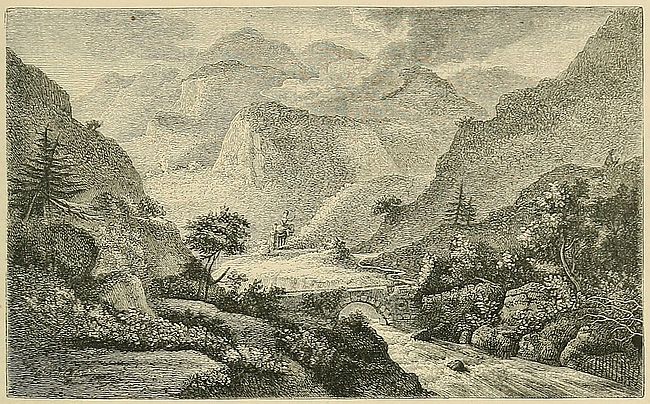
Pass of Killiecrankie in last century. From an old crayon drawing.
The news of Mackay’s defeat had preceded his retreat; and on his march during the following day, he found the country through which he passed in an uproar, and every person arming in favour of King James. The people of Strathtay alarmed at the approach of Mackay’s men, whom they took to be Highlanders, and considering their houses and cattle in danger, set up a dreadful shout, which so frightened Mackay’s men that they began to flee back to the hills under an apprehension that the Highlanders were at hand. Mackay and some of his officers on horseback, by presenting their pistols and threatening the fugitives, succeeded in rallying them, but owing to the thickness of the morning more than 100 escaped, all of whom were killed, stripped, or taken prisoners by the country people. Mackay continued his march with very little halting all that day, being Sunday the 28th, and arrived late at night at Drummond castle, in which he had a garrison. Next day he reached Stirling with about 400 men.
On the morning after the battle—for night had thrown its curtain over the horrors of the scene, before the extent of the carnage could be ascertained—the field of battle and the ground between it and the river, extending as far as the pass, presented an appalling spectacle in the vast numbers of the dead which strewed the field, whose mutilated bodies attested the savage and unrelenting ferocity with which Mackay’s men had been hewn down by the Highlanders. Here might be seen a skull which had been struck off above the ears by a stroke from a broad-sword—there a head lying near the trunk from which it had been severed—here an arm or a limb—there a corpse laid open from the head to the brisket; while interspersed among these lifeless trunks, dejectaque membra, were to be seen broken pikes, small swords and muskets, which had been snapt asunder by the athletic blows of the Lochaber axe and broad-sword.[601]
If the importance of a victory is to be reckoned by the comparative numbers of the slain, and the brilliant achievements of the victors, the battle of Killiecrankie may well stand high in the list of military exploits. Considering the shortness of the combat, the loss on the part of Mackay was prodigious. Not less than 2,000 of his men were either killed or captured. Among the slain were Lieutenant-colonel Mackay, brother of the General, Brigadier Balfour, and several other officers. Highland tradition reports that Balfour was cut down by the Reverend Robert Stewart, a Catholic clergyman, nephew to Stewart of Ballochin, for having contemptuously refused to receive quarter when offered him by the priest. The same tradition relates that Stewart, who was a powerful muscular man, followed the enemy in their flight down to the river, and towards the pass, wielding a tremendous broad-sword, with which he cut down numbers of the fugitives, and so much did he exert himself in the use of his fatal weapon, that, at the conclusion of the carnage, his hand had swollen to such an extent, that it could only be extricated from the basket-hilt of his sword, by cutting away the net-work.
But as the importance of a victory, however splendid in itself, or distinguished by acts of individual prowess, can only be appreciated by its results, the battle of Killiecrankie, instead of being advantageous to the cause of King James, was, by the death of the brave Dundee, the precursor of its ruin. After he had charged at the head of his horse, and driven the enemy from their cannon, he was about to proceed up the hill to bring down Sir Donald Macdonald’s regiment, which appeared rather tardy in its motions, when he received a musket shot in his side, through an opening of his armour, the ball probably passing out in front through the centre of his breastplate (See Plate of Dundee’s Armour).[602] He attempted to ride a little, but was unable, and fell from his horse mortally wounded, and almost immediately expired.[603] The loss on the side of Dundee was never properly ascertained, but is supposed to have been about 900.
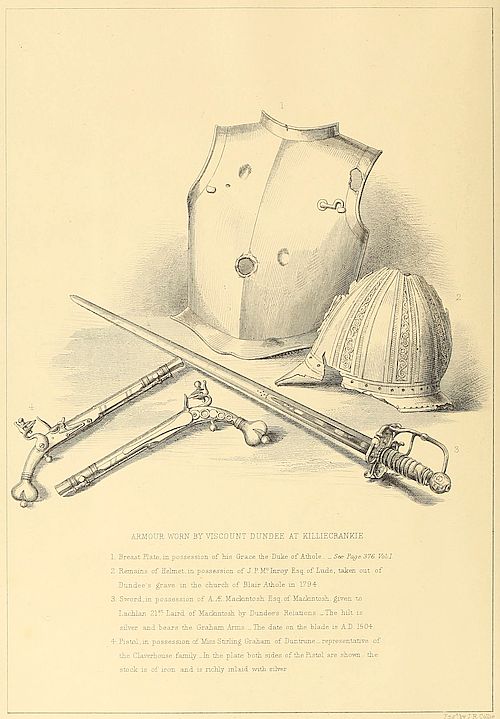
ARMOUR WORN BY VISCOUNT DUNDEE AT KILLIECRANKIE
1. Breast Plate, in possession of his Grace the Duke of Athole. See Page 376. Vol I.
2. Remains of Helmet in possession of J P McInroy Esq. of Lude, taken out of Dundee’s grave in the church of Blair Athole in 1794.
3. Sword in possession of A Æ. Mackintosh Esq. of Mackintosh, given to Lachlan 21st Laird of Mackintosh by Dundee’s Relations.—The hilt is silver and bears the Graham Arms—The date on the blade is A.D. 1504.
4. Pistol, in possession of Miss Stirling Graham of Duntrune—representative of the Claverhouse family.—In the plate both sides of the Pistol are shown; the stock is of iron and is richly inlaid with silver.
Among the slain, Alister Dhu (black Alexander) the chief of Glengarry, who, at the head of his battalion, mowed down two men at every stroke, with his ponderous two-handed sword, had to lament the loss of a brother, several other relatives, and still nearer and dearer to him, of his son, Donald, surnamed Gorm, from the blueness of his eyes. This youth, who had exhibited early proofs of bravery worthy of his name, and the race whence he sprung, killed, it is said, 18 of the enemy with his own hand. No less than five cousins of Sir Donald Macdonald of the isles fell, together with the tutor of Macdonald of Largo and his sons. Colonel Gilbert Ramsay, and the brave laird of Pitcur, “who, like a moving castle in the shape of men, threw fire and sword on all sides,”[604] were also numbered with the dead on this eventful day.[605]
In the Viscount Dundee, King James lost the only man in Scotland possessed of all the qualifications necessary for conducting to a successful issue the great and important charge which had been committed to him by his sovereign. Educated in the strictest principles of toryism, he could never divest his mind of the abstract ideas of passive obedience and hereditary right, and to him, therefore, any attempt to resist the authority of the sovereign, no matter how far that authority was abused, appeared highly treasonable. Though a sincere Protestant Episcopalian, the heresy of the successor of Charles II. as the religion of James must have appeared to him, in no respect altered his ideas of implicit fidelity to the sovereign, nor did his views undergo any change when the arbitrary and unconstitutional proceedings of James seemed to the leading men of the nation to have solved the great political problem, when resistance should commence and obedience end.[606] In his eye, therefore, the revolution which drove the unfortunate James from his throne, was a great national sin, which could only be atoned for by restoring to him his crown, an object, in the accomplishment of which, he conceived all good men were bound to lend a helping hand. These ideas ingrafted upon a temperament peculiarly sanguine, made him an enthusiast in favour of hereditary right, and his appointment by the fallen monarch as the chosen one by whose instrumentality his restoration was to be effected, imparted a charm to his enthusiasm which dispelled every difficulty that appeared to obstruct the grand object of his ambition and his hopes. With an inflexibility of purpose, which no temptation could overcome, he steadily pursued the course which the duty he conceived he owed to his sovereign and the natural inclination of his own mind directed him to follow. But Dundee had not merely the will, but, what was of no less importance, the ability, had he lived, to have executed the commission intrusted to him, one of his highest qualifications for such a purpose—considering the fickle and unruly bands he had to command—being that he stood unrivalled among his contemporaries in the art of gaining the affections of his troops, and communicating to them a full measure of the spirit which animated himself. His death, therefore, was a fatal blow to James’s prospects, and with him the cause of the Stuarts may be said to have perished. Dundee and his friend Pitcur were interred in the church of Blair-Athole. “Never vaulted roof or marble monument covered the last abode of a more restless and ambitious heart than that which has slept in this quiet spot amidst peasant dust.”[607]