Volume 1 / Part 1 — CHAPTER XXVII. (continued 2)
Reading edition
To understand the nature of the last charge against Mar, that he laid the scheme before the Regent of France with a design to ruin James, Mar refers to the plan itself for his justification. The expulsion of the Stuarts from the British throne had been always looked upon by the French court as an event which, by dividing the nation into rival factions, would enable France to humble and weaken an ancient and formidable rival. To encourage the Jacobites and Tories in their opposition to the new dynasty, and to embroil the nation in a civil war, the French ministry repeatedly promised to aid them in any attempts they might make to overturn the government; but true to the line of policy they had laid down for themselves, of allowing the opposing parties in the state to weaken each other’s strength in their contest for ascendency, they sided with the weaker party only to prolong the struggle, in the hope that, by thus keeping alive the spirit of discontent, France might be enabled to extend her power, and carry into effect her designs of conquest.
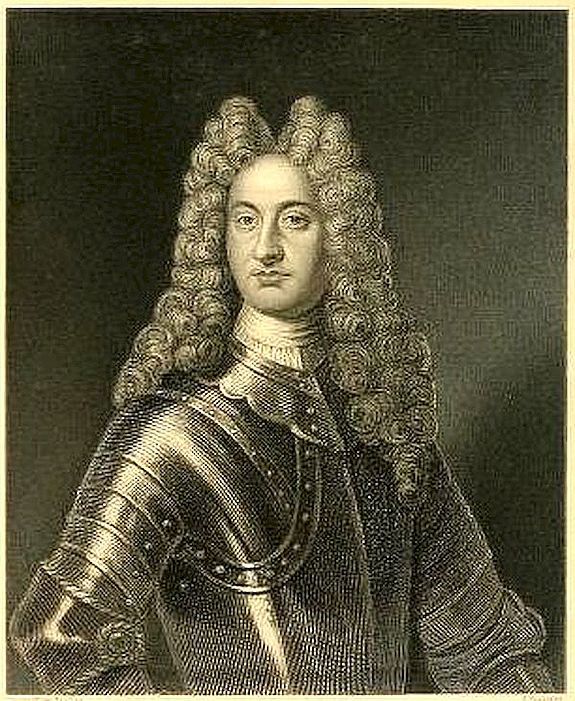
JOHN ERSKINE, EARL OF MARR.
To remove the objections which such a policy opposed to the restoration of James, Mar proposed that, upon such event taking place, Scotland and Ireland should be restored to their ancient state of independence, and protected in their trade, and thereby enabled, as they would be inclined, to support “the king in such a manner as he’d be under no necessity of entering into measures contrary to his inclinations to gratify the caprices, and allay the factions of his English subjects.”[773] He also proposed that a certain number of French forces should remain in Britain after James was restored, till he had modelled and established the government on this footing, and that 5,000 Scots and as many Irish troops should be lent to the French king, to be kept by him in pay for a certain number of years. Mar was fully aware that such a scheme would be highly unpopular in England, on which account he says, that although he had long ago formed it, he took no steps therein during the life of Cardinal Dubois, whom he knew to be particularly attached to the existing government of Britain; but that obstacle being removed, he laid it before the regent of France, who, he says, he had reason to believe, received it with approbation, as he sealed it up, and addressed it to the Duke of Bourbon, and recommended it to his care. To excuse himself for laying the scheme before the Duke of Orleans without the Chevalier’s knowledge, he states that he did so to prevent James, in case of the scheme being discovered, being blamed by those who, for particular reasons, would be displeased at it; but that immediately after the delivery he acquainted James thereof, and sent him a copy of it, and at the same time represented to him the absolute necessity of keeping it secret. Notwithstanding this injunction, Colonel Hay sent a copy of it to the Bishop of Rochester, and Mar attributes the bad feeling which Atterbury afterwards displayed towards him, to the proposal he made for restoring Scotland to her independence.
The memorial was presented by Mar to the Duke of Orleans in September, 1723; but so little secrecy was observed, that, in the month of January following, a statement appeared in the public newspapers, that a certain peer, then in Paris, had laid a plan before the regent for restoring the exiled family. Though the British government must have been aware, or at all events must have suspected, after such a notification, that Mar was the author of the scheme, his pension was still continued, and they even favoured him still more by allowing the family estate, which was exposed to sale, to fall again into the hands of the family on favourable terms.
On reviewing the whole circumstances of Mar’s conduct, evolved by Atterbury’s charges, it must be admitted that his justification is far from being complete. From the position in which he placed himself as a debtor of Stair, and a pensioner of the British government, he could no longer be trusted with safety by his Jacobite colleagues, and as he had come under an obligation, as a condition of his pension, not to act in behalf of the Stuarts, he was bound in honour to have abstained from all farther interference in their affairs; but for reasons only known to himself, he continued to act as if no alteration of his relations with the exiled family had taken place since he was first intrusted by them. Selfish in his disposition, and regardless whether the Chevalier de St. George, or the Elector of Hanover wore the crown, provided his ambition was gratified, it is probable, that, without harbouring any intention to betray, he wished to preserve an appearance of promoting the interests of the Stuarts, in order that the compact which he had entered into with the British government, might, in the event of a restoration of that family, form no bar to his advancement under a new order of things; but whatever were his views or motives, his design, if he entertained any such as has been supposed, was frustrated by his disgrace in 1725.
The breach with Mar was looked upon by some of the Jacobites as a rash act on the part of the Chevalier, and they considered that he had been sacrificed to gratify Colonel Hay, between whom and Mar an irreconcilable difference had for some time existed. This opinion had a pernicious influence upon the councils of the Chevalier, and to the rupture with Mar may be attributed the denouement of an unhappy difference between James and his consort, which, for a time, fixed the attention of all the European courts.
In the year 1720 the Chevalier de St. George had espoused the Princess Clementina, granddaughter of John Sobieski, king of Poland, who had born him two sons, viz. Charles Edward, celebrated for his exploits in 1745, and Henry Benedict, afterwards known as Cardinal York.[774] Prince Charles was placed under the tuition of one Mrs. Sheldon, who, it is said, obtained a complete ascendency over the Princess Clementina. As alleged by the partisans of Colonel Hay, she was entirely devoted to Mar, and served him as a spy in the family. To counteract the rising influence of Hay, she is represented to have incited the princess against him to such a degree, as to render the whole household a scene of constant disturbance. But whatever may have been the conduct of Mrs. Sheldon, there is good reason for believing that the cause of irritation proceeded entirely from the behaviour of Hay and his lady, who appear not to have treated the princess with the respect due to her rank, and who, from the sway they appear to have had over the mind of her husband, indulged in liberties which did not become them.
To relieve herself from the indignities which she alleged she suffered, the princess resolved to retire into a convent, of which resolution the Chevalier first received notice from a confidante of the princess, who also informed him that nothing but the dismissal of Colonel Hay from his service would induce her to alter her resolution. The princess afterwards personally notified her determination to her husband, who remonstrated with her upon the impropriety of a step which would prejudice them in the eyes of their friends, and make their enemies triumph; but she remained inflexible.
Finding the Chevalier fully determined to retain Colonel Hay in his service, the princess made preparations for carrying her resolution into effect; and, accordingly, on the morning of Thursday, the 15th of November, 1725, under the pretence of taking an airing in her carriage, she drove off to the convent of St. Cecilia, at Rome, into which she retired, without taking any notice of a long letter, by way of remonstrance, which her husband had written her on the 11th.[775]
The Chevalier was anxious that his friends should form a favourable opinion of the course he had adopted in resisting the demand of his wife; and, accordingly, on the morning after her departure, he assembled all his household, and explained to them fully the different steps he had taken to prevent the extraordinary proceeding of the princess. He also entered into a justification of his own conduct, and concluded by assuring them that it should be his principal care to educate his two sons in such a manner as might contribute one day to the happiness of the people he expected to govern. With the same view, he immediately despatched copies of the memoir, and of the two letters he had written to the princess, to Mr. Lockhart, to be shown to his friends in Scotland; but as the memoir and letters had been made public, copies of them were publicly hawked through the streets of London and Edinburgh, with a scurrilous introduction, several weeks before Mr. Lockhart received his communication. This was done apparently with the approbation of the government, as the magistrates of Edinburgh compelled the porters of the city to cry the papers through the streets.[776] At first, the Jacobites imagined that these documents were forgeries got up by the government, to make the Jacobite cause contemptible in the eyes of the people; but they were soon undeceived, and great was their consternation when they found that the papers in question were genuine.
The court of Rome seemed to approve of the Chevalier’s conduct in refusing to remove Hay; but when it was understood that the removal of Murray, the young princes’ governor, was considered by their mother even of more importance than the dismissal of Hay, the pope sent a message to James, intimating that if Murray were removed and Mrs. Sheldon restored to favour, a reconciliation might be effected with the princess,—that, however, he would not insist on Mrs. Sheldon being taken back, but that he could not approve of nor consent to Murray being about the prince. The Chevalier did not relish such interference, and returned for answer, that he had no occasion for the pope’s advice, and that he did not consider his consent necessary in an affair which related to the private concerns of his family. As James was the pensioner of his holiness, the answer may be considered rather uncourteous, but the Chevalier looked upon such meddling as an insult which his dignity could not brook. The pope, however, renewed his application to bring about a reconciliation, and with such earnestness, that James became so uneasy as to express a wish to retire from his dominions.[777] By the efforts, however, it is believed, of the princess’s friends, aided by the repeated remonstrances of a respectable portion of the Jacobites, the Chevalier at length reluctantly dismissed Hay from his service. According to Mr. Lockhart, Hay and his wife had obtained such a complete ascendency over the Chevalier, that they had the direction of all matters, whether public or domestic, and taking advantage of the confidence which he reposed in them, they instilled into his mind unfavourable impressions of his best friends. By insinuating that the princess, and every person that did not truckle to them, were factious, and that their complaints against the colonel and his lady proceeded from a feeling of disrespect to himself, his temper became by degrees soured towards his wife. To escape from the insolence of these favourites, the princess, as has been seen, embraced, for a time, a conventual life; and while some of the Chevalier’s adherents, who had lost their estates in his service, left his court in disgust, others were ordered away. It was currently reported at the time that Mrs. Hay was the king’s mistress, and that jealousy on the part of the Princess Clementina was the cause of the rupture; the princess herself in her letters distinctly speaks of Mrs. Hay as “the king’s mistress,” although persons who had ample opportunities of observation could observe no impropriety. The pertinacity with which James clung to his unworthy favourites tended greatly to injure his affairs.[778]
The death of George I., which took place on Sunday, the 11th June, 1727, while on his journey to Hanover, raised anew the hopes of the Chevalier. He was at Bologna when this intelligence reached him, and so anxious was he to be nearer England to watch the progress of events, and to be ready to avail himself of the services of his friends in Britain to effect his restoration, that he left Bologna privately for Lorraine, the day after the news was brought him, although the princess, who had just left the convent, by the advice of her friends, was at the time on her way from Rome to Bologna to join him. The journey of the princess being publicly known, the Chevalier availed himself of the circumstance to conceal his real design, by giving out that he had left Bologna to meet her. On arriving at Nancy, the Chevalier despatched couriers to Vienna, Madrid, and Paris, announcing the object of his journey, and at the same time sent a messenger with a letter to Mr. Lockhart, who, in consequence of a warrant being issued by the British government for his apprehension, had a few months before taken refuge on the continent, and was then residing at Liege. Although he expected no assistance from any foreign power, still, he says, “the present conjuncture appears so favourable in all its circumstances that had I only consulted my own inclinations, I should certainly out of hand have crossed the seas, and seen at any rate what I could do for my own and my subjects’ delivery; but as on this occasion I act for them as well as myself, and cannot hope without their concurrence to succeed in what I may undertake in our mutual behalf, I find myself under the necessity of making no further steps without their advice.
“’Tis true the disadvantages I lie under are great and many; I have but a small stock of money, scarce sufficient to transport what few arms I have and what officers I may get to follow me on this occasion. I’m sensible that it is next to impossible that a concert should be established amongst my friends at home, such as would be sufficient for a rising in arms in my favour before my arrival, and by what is said before, the little hopes of foreign assistance will be sufficiently seen; but with all this, many arguments may be brought to authorise an undertaking which at first sight might appear rash.... All put together it must be concluded that if the present conjuncture is slip’d, it cannot be expected that we ever can have so favorable a one for acting by ourselves, and that we run the risk of allowing the general affairs of Europe to be less favorable to us than they are at present; so that whatever is not absolutely desperate ought certainly to be undertaken, and the sooner the better.
“I desire therefore you may think seriously on this matter, and let me have your opinion as soon as possible, and if my going into England be not adviseable, whether my going to the Highlands of Scotland might not be found proper.” To this letter is appended the following postscript in James’s own handwriting. “The contents of this will show you the confidence I have in you, and I expect you will let me know by the bearer, (Allan Cameron,) your advice and opinion, particularly on this important occasion.”[779]
From Cameron Mr. Lockhart was surprised to learn that the Chevalier, notwithstanding his certainty that he could look for no foreign aid, and that his friends, both in Scotland and England, had made no preparations to receive him, was not only inclined, but seemed even resolved, to repair to the Highlands of Scotland, and there raise the standard of insurrection, and that Colonel Hay, whom he had so lately discarded, was one of his counsellors on the occasion. As Cameron, who had visited the Highlands some time before, and was well aware of the almost insuperable difficulties which opposed themselves to the contemplated step, seemed to approve of the Chevalier’s design, Mr. Lockhart expressed his wonder that one who knew the state of the Highlands so well, and the determination generally of the Highlanders not to take the field again till they saw England actually engaged, could advise his master to risk his person, and expose the country and his friends to certain destruction. He observed, that there were indeed some persons who would venture their all in any attempt headed by the Chevalier in person, but as matters then stood, the number of such persons would be few, and that the great majority of those that might be expected to join him would consist of idle persons, actuated solely by the hopes of plunder, who would abandon him eventually to the mercy of the government troops that would be poured into the Highlands, and that, under the pretence of punishing the few who had taken up arms, they would ravage the country and cut off the inhabitants, for doing which the government only wanted such a handle.
In accordance with these sentiments, Mr. Lockhart represented in his answer to the Chevalier’s letter, that the design he contemplated was one of the greatest importance, and though it was very proper for him to put himself in a condition to avail himself of any favourable circumstances that might occur, yet that appearances did not warrant such expectations,—that the people of England seemed to have forgot all the grievances under which they had laboured during the late reign, in hope of a better order of things, and that until they found themselves disappointed, he could expect nothing from them,—that with regard to such of the people of Scotland as were favourably disposed, they could not possibly do any thing without being previously provided with many material things they stood in need of, and that before these could be supplied, many difficulties had to be surmounted and much time would be lost, during which preparations would be made on all hands to crush them,—that although it would be of advantage to strike a blow before the government had time to strengthen itself at home and abroad, yet the attempt was not advisable without necessary precautions and provisions to insure its success, as without these such an attempt would be desperate, and might ruin the cause for ever,—that no man living would be happier than he (Mr. Lockhart) to see the dawning of a fair day, but when every point of the compass was black and cloudy, he could not but dread very bad weather, and such as could give no encouragement to a traveller to proceed on his voyage, and might prove the utter ruin of himself and attendants.[780] This judicious advice was not thrown away upon the Chevalier, who at once laid aside his design of going to Scotland, and retired to Avignon, where he proposed to reside under the protection of the pope; but his stay at Avignon was short, being obliged to leave that place in consequence, it is believed, of the representations of the French government to the court of Rome. He returned to Italy.