Part 1 — PART I.
Reading edition
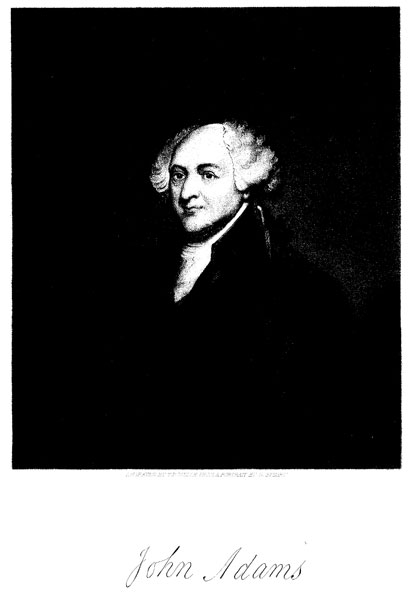
JOHN ADAMS.
ENGRAVED BY T.B. WELCH FROM A PORTRAIT BY G. STUART.
The history of men should interest every reader. It is the mirror of mind—imparting lessons of thrilling interest, essential improvement, exquisite pleasure—substantial advantage. It is a matter of deep concern to the investigating student. Remoteness increases veneration. Human foibles are buried in the tomb. Faults are often eclipsed by towering virtues—find no place on the historic page and after generations gaze upon a picture of rare perfection, which, as time advances, assumes shades—richer and holier—until it commands the reverence of every beholder. The names of many of the ancients, whose crowning glory was virtue, over whose ashes centuries have rolled, are often referred to with as profound respect as if angel purity had given the impress of Divinity to their every action. A country—a nation may be lost in the whirlpool of revolution—the fame of good and great men is enduring as time. In the persons of the Sages and Heroes of the American Revolution, ancient and modern wisdom, patriotism and courage were combined. Let us join the admiring millions who are gazing on their bright picture and impartially trace the character of those who pledged their lives, fortunes and sacred honors in behalf of FREEDOM.
Among them, John Adams was conspicuous. He was a native of Quincy, Mass. born on the 19th of Oct. (O.S.) 1735. He was the fourth in descent from Henry Adams, who removed from Devonshire Eng. with eight sons and located near Mount Wollaston.
During his childhood he was under the instruction of Mr. Marsh of Braintree and made rapid progress in his education. At the age of sixteen he entered Harvard college at Cambridge and graduated at the age of twenty-one with high honors.
At Worcester he commenced the study of law under Mr. Putnam, finished with Mr. Gridley, supporting himself by teaching a grammar class. Wisdom to discern the path of rigid virtue and uncompromising justice, with moral courage to act, marked his career from the dawn of manhood. He boldly grasped the past, present and future and made deductions truly prophetic. On the 12th of Oct. 1755, he wrote the following paragraph in a letter.
"Soon after the reformation, a few people came over into this new world for conscience sake. Perhaps this apparently trivial incident may transfer the great seat of empire into America. It looks likely to me, if we can remove the turbulent Gallics, our people, according to the exactest computation, will, in another century, become more numerous than England herself. Should this be the case, since we have, I may say, all the naval stores of the nation in our hands, it will be easy to obtain the mastery of the seas and then the united force of all Europe will not be able to subdue us. The only way to keep us from setting up for ourselves, is—to disunite us. Keep us in distinct colonies and then some men in each colony, desiring the monarchy of the whole, will destroy each other's influence and keep the country in equilibrio."
Mark two things referred to in this letter. He plainly saw that the navy is our right arm of defence and yet treated, by our government, with a parsimony that has long astonished the old world. "To disunite us"—the only thing that can ruin us now that we have set up for ourselves. Lay this to heart ye demagogues who are sowing broadcast the seeds of disunion and no longer court a monarchy.
At the end of three years study Mr. Adams was admitted to the practice of law and commenced a successful professional career at Braintree. Constitutional law had become a subject of investigation. Disputes had commenced between the people and the officers of the crown who were employed in the custom-house and claimed the right to search private dwellings for the pretended purpose of discovering dutiable goods. This preliminary act of usurpation was frequently prompted by personal animosity without a shadow of evidence to raise even suspicion. The right of search was vigorously resisted. Writs of assistance were issued—the seeds of the revolution were sown. Mr. Gridley, the friend and admirer of Mr. Adams, defended the officers—not on constitutional ground but from the necessity of the case to protect the revenue, from which Mr. Adams strongly dissented. The question was argued before the Superior Court at Boston—Mr. Gridley for and Mr. Otis against the crown. Mr. Adams listened to both gentlemen with intense interest and has often been heard to say—"The oration of Mr. Otis against writs of assistance breathed into this nation the breath of life. American independence was then and there born."
The court publicly decided against the writs but secretly issued them. No richer fuel could have been used to increase the volume and force of the revolutionary fires already kindled. Mr. Adams was roused by the hypocrisy of the court and the audacity of the crown officers and at once took a bold stand in favor of justice. The Assembly interfered in behalf of the people and in 1762, prepared a bill to prevent the issue of these volcanic writs only upon specific information on oath—which was vetoed by the governor. The Assembly retaliated by reducing the salary of the judges.
In 1761 Mr. Adams rose to the rank of Barrister—in 1764 married the accomplished Abigail Smith, daughter of Rev. William Smith, who nobly participated with her husband in the thrilling scenes of their lives for fifty-four years. Judge of her patriotism from the following extract from one of her numerous and able letters.
"Heaven is our witness that we do not rejoice in the effusion of blood or the carnage of the human species—but, having been forced to draw the sword, we are determined never to sheathe it—slaves to Britain. Our cause, Sir, I trust, is the cause of truth and justice and will finally prevail, though the combined force of earth and hell should rise against it."
The Stamp Act kindled an enduring flame of indignation in the patriotic bosom of Mr. Adams. He at once became a champion for chartered rights and rational freedom. He published an essay on Canon and Feudal Law which proved him a fearless, able and vigorous writer. It penetrated the joints and marrow of royal power as practised and parliamentary legislation as assumed. He traced the Canon law to the Roman clergy—shrewdly planned, acutely managed and rigorously enforced to advance their own aggrandizement. He delineated the servile dogmas of the Feudal code, each manor being the miniature kingdom of a petty tyrant. He exposed the unholy and powerful confederacy of the two, aiming to spread the mantle of ignorance over mankind, drive virtue from the earth, producing the memorable era of the dark ages, shrouded in mental obscurity. He then ushered in the dawn of returning light, exhibited the gigantic struggles of the reformers—the bloody scenes of persecution and finally placed his readers upon the granite shores of New England, where, for a century, Liberty had shed its happy influence upon the sons and daughters of freemen, undisturbed by canons or feuds. "Tyranny has again commenced its desolating course—it must be arrested or we are slaves." This is a mere syllabus of a pamphlet of over forty pages, strong in language, bold in sentiment, and nervous in style.
Mr. Adams became associated with other prominent whigs, Samuel Adams, Quincy, Otis and many kindred spirits, whose influence produced the repeal of the Stamp Act and the removal of Mr. Grenville from the ministry. An apparent but delusive calm ensued on the part of the crown officers. At intervals, a cloven foot would be seen, festering wounds would be irritated and no balm was found to restore them to perfect soundness.
In 1766 Mr. Adams removed to Boston where his talents became so strongly developed that the king's governor thought him worth purchasing. He was offered the most lucrative office in the colony—Advocate General in the court of Admiralty. He spurned the bribe with the disdain that none but freemen can exhibit.
In 1769 he was on the committee that prepared instructions for the legislature, which were very obnoxious to the royal governor. He had outraged the people by quartering a mercenary army in the town—was unyielding in his purposes and hastened a tragedy that gave a fresh impetus to the embryo revolution.
On the 5th of March 1770, an affray occurred between the military and citizens, in which five of the latter were killed and others wounded. Mr. Adams thus describes the result.
"The people assembled, first at Faneuil Hall and adjourned to the old South Church, to the number, as was conjectured, of ten or twelve hundred men, among whom were the most virtuous, substantial, independent, disinterested and intelligent citizens. They formed themselves into a regular deliberative body—chose their moderator and secretary—entered into discussions, deliberations and debates—adopted resolutions and appointed committees. These public resolutions were conformable to the views of the great majority of the people—'that the soldiers should be banished at all hazards.' Jonathan Williams, a very pious, inoffensive and conscientious gentleman, was their moderator. A remonstrance to the governor, or governor and council, was ordained and a demand that the regular troops should be removed from the town. A committee was appointed to present this remonstrance, of which Samuel Adams was chairman. The soldiers were removed and transient peace restored."
Captain Preston was brought before the court charged with giving the order to fire upon the citizens. The regulars who committed the fatal act were also arraigned and tried. Each party charged the other with commencing the affray. Some inconsiderate citizens had thrown snow-balls at the King's troops who returned lead in payment. Mr. Adams was employed to defend the accused. A delicate task he performed, but so ingeniously did he manage the case that Captain Preston and all the soldiers but two were acquitted and the two were only convicted of manslaughter. When the trial closed Mr. Adams stood approved by the citizens, having performed his professional duty to his clients and at the same time vindicated the rights of the people.
The same year he was elected to the legislative body and boldly opposed the arbitrary measures of the British cabinet. He was one of the committee that prepared an address to the governor, the style of which induces me to think that it was penned by him. After clearly pointing out the violation of chartered rights the address concludes, "These and other grievances and cruelties, too many to be here enumerated and too melancholy to be much longer borne by this injured people, we have seen brought upon us by the devices of ministers of state. And we have, of late, seen and heard of instructions to governors which threaten to destroy all the remaining privileges of our charter. Should these struggles of the house prove unfortunate and ineffectual this Province will submit with pious resignation to the will of Providence—but it would be a kind of suicide, of which we have the utmost abhorrence, to be instrumental in our own servitude."
A blind obstinacy on the part of the ministers increased the opposition of the people, inducing a rapid accumulation of combustible materials, increasing the volcanic fires by their own strong exertions. Being alarmed at the boldness of the citizens, the governor ordered the legislature to convene at Cambridge contrary to the law which fixed the place of meeting—consequently, the members refused to do anything more than to adjourn to the proper place. A war of words and paper ensued, in which the patriots were victorious. Mr. Adams was one of the sharp-shooters and made great havoc among the officers of the crown. Mr. Brattle, the senior member of the council entered the field in defence of the ministry but was put hors de combat by our champion. The governor was compelled to direct the legislature to convene again at Boston. New causes of complaint were constantly accruing. The governor, judges and troops were paid by England instead of the colony—thus aiming to render the executive, judiciary and military, independent of the people, destroying all confidence in the servants of the crown. The tax on tea was another source of aggravation, striking more tender chords. Wo to the ruler who rouses the fair sex. He may more safely defy the fury of Mars and challenge the speed of Atalanta.
Tea became forbidden fruit—several vessel loads were sacrificed to Neptune—an oblation for the sins of the British cabinet—a jollification for the fish of Boston harbour. Royal authority increased in cruelty—patriots increased in boldness. The message of the governor to the legislature of 1773 maintained the supremacy of parliament. This was denied by the members and a reply written by Mr. Adams in answer to a second message from the governor, more strongly in favor of the crown. The pen of this functionary was paralyzed—his arguments proved fallacious—his mouth sealed upon this exciting subject. The reply of Mr. Adams was an exposition of British wrongs and American rights, so clearly presented that no sophistry could impugn—no logic confront. So highly was it appreciated by Dr. Franklin, that he had it republished in England—a luminary to patriots—confusion to tyrants.
On taking his seat in the legislature Mr. Adams was placed on the list of committees. So vindictive was governor Hutchinson that he erased his name—an act that recoiled with such force as to rapidly close his public career in the colony. He was succeeded by Governor Gage, who was more fully charged with ministerial fire—more successful in accelerating the millennium of Liberty. He placed his cross upon the name of John Adams—removed the legislature to Salem—enforced the Boston Port Bill and seemed to tax his ingenuity to enrage the people. On convening, the members of the legislature requested the governor to fix a day for a general fast which he peremptorily refused. As well might he have undertaken to extinguish a flaming fire with pitch, as to refuse this boon to the descendants of the Puritans. The people en masse venerated religion and would not yield to the violation of ancient custom.
The legislature then proceeded to project a general congress. Governor Gage sent his secretary with an order to prorogue—the door was locked against him—patriotic resolutions were passed and five delegates appointed to meet a national convention, one of whom was John Adams.
At the appointed time he repaired to Philadelphia—took his seat in that assemblage of sages, whose wisdom has been sung by the most brilliant poets, applauded by the most eloquent orators—admired by the most sagacious statesmen of the civilized world. On reading the proceedings of the first congress in 1774, Chatham remarked, "I have studied and admired the free states of antiquity, the master spirits of the world—but, for solidity of reasoning, force of sagacity and wisdom of conclusion, no body of men can stand above this congress."
Some supposed the ardent zeal of Mr. Adams might induce rashness. Not so—he was calm as a summer morning but firm as the granite shores of his birth-place. He was discreet, prudent—the last man to violate or submit to the violation of constitutional law. He kept his helm hard-up—knew when to luff—when to take the larboard tack—when to spread and when to take in sail. He was one of the few who believed the mother country would remain incorrigible—that petitions would be vain—addresses futile—remonstrances unavailing.
At the close of that congress Mr. Adams had a close conversation with Patrick Henry in which he expressed a full conviction, that resolves, declarations of rights, enumeration of wrongs, petitions, remonstrances, addresses, associations and non-importation agreements—however they might be accepted in America and however necessary to cement the union of the colonies, would be waste water in England. Mr. Henry believed they might make an impression among the people of England, but that they would be lost upon the government. Mr. Adams had just received a hasty letter from Major Hawley of Northampton, which concluded with these prophetic words, "after all we must fight." Mr. Henry raised his hands and vehemently exclaimed, "I am of that man's mind." Richard Henry Lee held a contrary opinion—Washington was in doubt. The two former based their conclusions on the past and present from which they drew deductions for the future. They penetrated the arcanum of human nature, passed in review the multiform circumstances that inflated power-backed by superior physical force—deluded by obstinacy and avarice, is callous to the refined feelings of humanity—deaf to wisdom—blind to justice. Lee, equally determined to vindicate right and oppose wrong, could not believe the ministry would dethrone reason and court ruin.
Washington, deep in reflection, an impartial and strong investigator—his soul overflowing with the milk of human kindness, did not arrive rapidly at conclusions on so momentous a subject. In weighing the causes of difference between the two countries—reason, justice and hope, on the one side—power, corruption and avarice on the other—at that time held his mind in equilibrio. He clearly perceived the right and fondly but faintly hoped England would see it too and govern herself accordingly. He was as prompt to act as the others when action became necessary.
Mr. Adams returned among his friends and stood approved by his constituents and his country. His pen was again brought into service, in answering a series of ingenious essays written by Mr. Sewell in favor of the supremacy of Parliament. Over the name of "Nonvanglus," Mr. Adams stripped the gay ornaments and gaudy apparel from the brazen image Mr. Sewell had presented to the public gaze. A meagre skeleton of visible deformity was all that remained. Attorney General Sewell trembled us he received the deep cuts from the falchion quill of this devoted patriot. So profound was his reasoning—so learned were his expositions—so clear and conclusive were his demonstrations—that his antagonist exclaimed, as he retired in a rage from the conflict, "He strives to hide his inconsistencies under a huge pile of learning."
The pile proved too "huge" for royal power and supplied the people with an abundance of light.
The supremacy of parliament was an unfortunate issue for ministers. It placed the patriots in a position to hurl their darts at them without refusing allegiance to the king. The British cabinet worked out its own destruction with regard to the American colonies—if not with fear and trembling it was with blindness and disgrace—impolicy and injustice—obstinacy and infatuation.
In May, 1775, Mr. Adams again took his seat in Congress with renewed responsibilities resting upon him. Revolution was rolling fearfully upon his bleeding country—hope of redress was expiring like the last flickerings of a taper—dark and portentous clouds were concentrating—the ministerial ermine was steeped in blood—the dying groans of his fellow-citizens and the lamentations of widows and orphans had fallen upon his ears and the prophetic conclusion arrived at by him and Henry but a few months previous, was forced upon the mind of every patriot, "after all we must fight."
As a preliminary measure it was necessary to appoint a leader of the military forces to be raised. To fix upon the best man was of vital importance. Some thought the measure premature. Not so with the sons of New England. When the blood of their friends was wantonly shed upon the heights of Lexington they hung their siren harps upon the weeping willows that stood mournfully over the graves of their murdered brethren. In their view, war was inevitable. A commander-in-chief must be appointed. Several prominent persons were named in private conversations. John Adams, alone, had fixed his mind upon George Washington, in whom he saw the commingled qualities of philanthropist, philosopher, statesman, hero and Christian. All opposed his appointment at first but gradually yielded to the reasons urged by John Adams. Satisfied that the measure would be approved by a majority, he rose in Congress and proposed that a commander of the American armies should be appointed. When his resolution passed, he described the requisite qualities of the man to fill this important station and remarked with great emphasis—"such a man is within these walls." But few knew to whom he referred, no one believing himself duly and truly prepared or properly vouched for as a military man. A pause—a painful suspense—then the name of Col. George Washington of Virginia was announced by Mr. Adams. No one could be more surprised than the nominee. No intimation of the intended honor had been made to him. The vote was taken the day following and was unanimous in his favor. So judicious was this selection that La Fayette remarked—"It was the consequence of Providential inspiration." Be it so—John Adams was the patriot who nominated him—thus placing at the head of the American armies just such a man as the crisis required—prudent, dignified, bold, sagacious, patient, persevering—universally esteemed by the friends of freedom—admired by the most fervent friends of the crown.
In 1776 Mr. Adams again took his seat in the National Assembly. The period had arrived for decisive measures. Massachusetts had been disfranchised by Parliament. England had hired legions of soldiers from German princes to subdue rebels in America. The last note of peace had been sung by echo—every patriot became convinced that resistance or slavery were the two horns of the dilemma presented. Independence had been conceived but by a few. It was a startling proposition. At this juncture Mr. Adams marked out a bold course and had the moral courage to pursue it. On the 6th of May he offered a resolution, proposing that the colonies should organize a government independent of England. On the 10th of the same month it was modified and adopted, recommending such government by the colonies "as might be conducive to the happiness and safety of their constituents in particular and America in general." All admitted the justice of this measure but some opposed it on the ground of the physical imbecility of the colonies—already crowded with a hireling army and their shores lined with a powerful navy. Mr. Adams knew no middle course. He had succeeded in obtaining the adoption of the preface to his broad folio of an independent compact—he then proceeded to prepare the text. He had commenced the work of political regeneration. Each day new and genuine converts were made. The legislature of his own state encouraged him to strike for independence. North Carolina had openly started the ball—Virginia gave it a now impetus and on the 7th of June, Richard Henry Lee became the organ to present the proposition to Congress. A most animated discussion ensued. Then the powers of Mr. Adams were more fully developed. Mr. Jefferson said of him, in alluding to his debates on the Declaration of Independence—"John Adams was the pillar of its support on the floor of Congress—its ablest advocate and defender against the multifarious assaults it encountered. He was our Colossus on the floor—not graceful, not elegant, not always fluent in his public addresses—yet he came out with a power, both of thought and expression, that moved us from our seats."
The noblest powers of his soul were raised to the zenith of their strength, determined to accomplish the mighty work he had commenced. Although one of the committee to prepare the instrument of eternal separation, he confided the labor to his colleagues—spending his whole force upon the opponents of the measure. Manfully did he contend—gloriously did he triumph. He bore down upon his adversaries like a mountain torrent—a rushing avalanche—hurling the arrows of conviction with such precision and effect that a majority soon became converted to the measure.
The day for decision arrived. The 4th of July, 1776, dawned auspiciously upon the patriots. At the appointed hour they assembled. The past, the present, the impenetrable future, big with coming events—rushed upon their minds. Moments flew—the pulse quickened—the heart-throb increased—bosoms expanded—eyes brightened—patriotism rose in majesty sublime—the question was put—the Gordian knot was sundered—Independence was declared—the colonies were free—Liberty was proclaimed—a nation was redeemed—regenerated—disenthralled and born in a day.
Early in the winter of 1776 Mr. Adams wrote a form of government for the colonies which was substantially the same as the present constitutions of the states. It was first submitted to Richard Henry Lee in a letter with these remarks.
"A constitution founded on these principles introduces knowledge among the people and inspires them with a conscious dignity becoming freemen. A general emulation takes place which causes good humor, sociability, good manners and good morals to be general. That elevation of sentiment, inspired by such a government, makes the common people brave and enterprising. That ambition which is inspired by it makes them sober, industrious and frugal. You will find among them some elegance, perhaps, but more solidity—a little pleasure but a great deal of business—some politeness but more civility. If you compare such a country with the regions of domination, whether monarchical or aristocratical, you will fancy yourself in Arcadia or Elysium."
Here is inscribed upon the tablet of truth the blessings derived from a government like our own in its principles—faithfully adhered to by every true patriot but trampled under foot by the demagogues of the present day and the aristocracy of all time.
Among all the great men of our country, no one has exhibited a more clear and minute conception of human nature and human government, than John Adams. He traced causes and effects through all their labyrinthian meanderings and deduced conclusions that seemed the result of inspiration. Many of his predictions of the future bear the impress of prophecy and show how deeply he investigated—how clearly he perceived.
On his return from Congress, Mr. Adams was elected to the legislature of Massachusetts under the new constitution. He was also appointed Chief Justice which he declined.
In 1777 he resumed his seat in Congress and performed an amount of labor, which, if imposed upon any ten demagogue legislators of the present day might induce suicide. He was an active member of ninety committees—chairman of twenty-five—chairman of the board of war and appeals, discharged all his duties promptly and was uniformly in his seat when any important measure was under discussion.
In December, 1777, he was appointed a commissioner to France. In February following he embarked on board the frigate Boston. During the voyage a British armed ship hove in sight—an action commenced—Mr. Adams seized a musket, gave the enemy a well-directed shot but was immediately deprived of this recreation by Capt. Tucker, who led him out of danger, pleasantly remarking—"I am commanded by the Continental Congress to carry you in safety to Europe and I will do it."
Before his arrival, Dr. Franklin and his colleague had succeeded in concluding a treaty of alliance with the French nation. After an absence of a little more than a year he returned and was elected to a convention of his native state, convened for the purpose of perfecting a constitution and the full organization of government. The original draft of the constitution of Massachusetts is from his pen. Before his term closed in this convention he was appointed by Congress—"A minister plenipotentiary for negotiating a treaty of peace and a treaty of commerce with Great Britain." In Oct. 1779, he embarked from Boston. The passage was boisterous, it being February before he arrived at Paris. Chagrin and pride prevented the British ministry from at once placing themselves on an equality with our own. The negotiation, on their part, commenced with equivocations. Mr. Adams could not be ensnared and was determined to submit to nothing wrong and left them to farther reflection.
On learning that Mr. Laurens, American commissioner to Holland, had been captured, Mr. Adams repaired to that kingdom. In August he received a commission from Congress to negotiate a loan—to conclude a treaty of amity and commerce and to accede to any treaty of neutral rights that might arise from regulations to be made by a congress of the European states then in contemplation. In a few months he was overwhelmed with important duties. Minister to Great Britain—to the States General of Holland—to all the European states for pledging the United States to the armed neutrality—with letters of credit to the Russian, Swedish and Danish envoys in Holland and a commissioner to negotiate a loan of ten millions of dollars for the support of the Home department and foreign embassies. All these duties he discharged with skill and approbation, a lasting monument of the gigantic powers of his mind. At every point he encountered intrigue which he uniformly discovered and crushed in embryo.
In July, 1781, he was directed to repair to Versailles to make a further attempt at negotiation with England. The terms offered did not fully recognize the rights of the United States as an independent nation. Peace was desirable and ardently urged by the Duke de Vergennes, who was the head and front of the French cabinet. Mr. Adams was anxious for peace—but only on just, dignified and honorable terms. The Duke, who had uniformly manifested a disposition to make the United States feel a dependence on France, dictated to Mr. Adams, placing him in the position of a subordinate agent. This was a French bull. Mr. Adams recognized no dictator but the Continental Congress and his own keen perception and penetrating judgment. This independence of the American minister enraged the Duke. He wrote to the minister of France in the United States to lay a formal complaint before Congress against the recusant for insubordination. This the minister did ingeniously but not successfully. As a matter of respect for their new and important ally, Congress partially modified the instructions of Mr. Adams but did not place him under the dictation of the Duke as requested. They knew the granite man too well to suppose he would ever compromise the dignity of his country. They had full confidence in his capacity to perceive right—in his moral courage to enforce it.
From all the evidence in the premises I am fully convinced that the motives of the French Court in aiding our country during the revolutionary struggle, were not based on patriotism but had ulterior objects in view. Not so with the noble La Fayette and others who came to the rescue.
Again Mr. Adams left ministers to arrive at a second sober thought and learn their true position. He then returned to Amsterdam.
Owing to sad reverses in the cause of freedom the French minister made such an impression in favour of the position of the French cabinet as an umpire between England and the United States, that congress added to the commission of Mr. Adams—Dr. Franklin, Jefferson, Jay, and Laurens—with the humiliating directions, "That they should govern themselves by the advice and opinion of the ministers of the King of France." The Duke de Vergennes was elated with triumph. He was virtually made sovereign minister of the United States. This act is the darkest spot upon the proud escutcheon of the Continental Congress—an act that I would gladly "expunge from the record." No full apology can be found. The tremendous revolutionary tornado that was then sweeping over our country, charged with the dismaying materials of terror, is a partial one and the true cause of this quailing error.
The exultation of the Duke was transient. Adams and Franklin were there, masters of ceremony. They dared to disobey instructions believing they had been improperly extorted by an intriguing and designing court. They at once took a bold stand and were promptly sustained by their colleagues and ultimately by congress, to which Adams communicated the chicanery of the Duke and the duplicity, or rather the toolicity of the French minister in the United States. The result was glorious. An honourable peace was obtained—the dignity of our nation preserved. A provincial treaty was signed at Paris on the 30th of November, 1782 and a definitive treaty on the 3d day of September, 1783 and all without the advice or consent of the Duke de Vergennes, whose golden schemes of finesse proved abortive. He addressed a bitter letter of reproach to the American commissioners, expressing great astonishment at their presumption in daring to act independent of him, which was not answered.
Among the golden schemes of the court of France, two are worthy of particular note. 1. To secure to France and Spain the fisheries of the United States. 2. To secure the perpetual and uninterrupted navigation of the Mississippi. Very modest. Other propositions were made, equally absurd, all of which form an unanswerable excuse for our commissioners in disobeying instructions.
After the important commission of concluding peace with England was completed, Mr. Adams returned to Holland where he had negotiated a loan of eight millions of guilders in September, 1782, which was one of the means of terminating the war by enabling the United States to prosecute it with more vigor. It had a direct influence on England, inducing Lord Shelburne to make proposals of peace soon after this was known.
During the same year he was placed at the head of a commission empowered to negotiate commercial treaties with all foreign nations. He returned to Paris where he met Franklin and Jefferson who were associated with him—forming a trio of combined, versatile and exalted talent—never surpassed if ever equalled.
In 1785 Mr. Adams was appointed the first minister to Great Britain after the acknowledgment of the Independence of the United States. He was received with marked attention and courtesy so far as courtly etiquette was concerned but found the ministry morose and bitter towards the new Republic. They seemed disposed to treat the peace as a mere truce between the two nations. Mr. Adams performed the delicate duties of his station with great sagacity and wisdom—patiently removing subsisting difficulties. Nor did he forget the internal interests of his country at home. To win independence was one thing—to preserve it another and more important matter. The theories of a Republican form of government by Thurgot and others, had been freely circulated in the United States. These he deemed wild and visionary. This was proved by the transient existence of the first French Republic and has been more fully demonstrated recently in Europe and South America. More success might attend these experiments, even with imperfect skeletons of a free government were the people as well prepared to receive it as were the colonists at the time of the American Revolution. Intelligence and primitive Christianity must pervade the mass. The European pioneers came to this country with the bible in their hands and based our government upon its eternal principles, where it will securely rest until ignorance darkens intellect and the bible is banished. Let all read its plain truths, teaching, as they do, freedom in religion, freedom of conscience—pointing us to our high origin and final destiny—then our Republic cannot be destroyed by kingly influence, aristocratic corruption, ultra fanaticism, reckless demagogues, or heartless politicians. Troubles have arisen, now exist, may continue to occasionally break out—but they ever have been and I trust ever will be confined to a small portion of the great and accumulating mass—the bone and sinew of our beloved country.
To strip from these delusive theories of a free government their sophistry, Mr. Adams published a learned and able disquisition on Republican constitutions which became a polar star to his own country and operated powerfully in correcting error and allaying prejudices in England adverse to the United States. His "Defence of the Constitution" placed him on a lofty literary eminence in view of the literati of Europe.
In 1788 he obtained permission to return home and in the autumn of that year was elected the first Vice President of the United States. He became the confidential counsellor of Washington on all important questions. He was re-elected in 1792 and in 1796 was elected President of that Republic for which he had freely periled life, fortune and honor.
At that time party spirit had commenced its reckless career which afforded an example set by Adams and Jefferson worthy of all praise and imitation. No bitterness of party spirit, no abuses from their partisans and party press, could sever the patriotic and moral ties of friendship that bound them together up to time death removed them from the theatre of life. So high did party spirit rage that Mr. Jefferson thus rebuked a clique of politicians who were hurling slanders against Mr. Adams.
"Gentlemen, you do not know that man. There is not upon earth a more perfectly honest man than John Adams. Concealment is no part of his character. Of that he is utterly incapable. It is not in his nature to meditate anything he would not publish to the world. The measures of the general government are a fair subject for difference of opinion—but do not found your opinions on the notion that there is the smallest spice of dishonesty, moral or political, in the character of John Adams for I know him well and I repeat—that a man more perfectly honest never issued from the hands of the Creator." Demagogues—read the above just encomium upon his opponent by a candidate for an office—then search for a parallel case of magnanimity among modern politicians—if you find one, proclaim it to the people of our vast country that they may be convinced a true patriot is in our midst—a lump of genuine salt in the body politic.
Mr. Adams proceeded to the conscientious and independent discharge of his presidential duties, prompted by the best motives for the good and glory of the infant Republic. He was an open, frank old-school federalist. During his administration the ranks of the democratic party increased rapidly, which defeated his re-election. Much has been written and more said relative to the causes that produced his political overthrow. To my mind the solution is plain and brief. His cabinet was not of his own choice—he was too independent to bend to party intrigue—he opposed the humiliating demands of the then self-styled democratic France—he advocated the augmentation of the navy of the United States and recommended the law for the suppression of the venality of the press. In the two first points he was impolitic as the head of a party—in the two next he did what all now acknowledge to be right in principle. On the last, he took the wrong method to correct an evil that has caused unceasing trouble from that time to the present—an evil that will ever exist in a government like ours, because, in annihilating this, we should destroy an essential part of our political machinery—a free press. The three last were the strong points seized upon by his opponents, which enabled them to achieve an easy victory. He retired with a good grace on the best of terms with his successful opponent and his own conscience. He supported the policy of Mr. Jefferson towards England and approved of the declaration of war in June 1812. He attributed the opposition of the eastern states to the impolicy of our government in neglecting the navy. He compared them to Achilles, who, in consequence of his being deprived of Briseis, withdrew from the Grecian confederacy. The increase of the navy was a long-nursed theory of his national policy. Had his views been carried out by our country, our nation would now have been mistress of the seas. As it is, we have scarcely armed vessels enough to protect the expanding commerce of our enterprising merchants—a fact that is often tauntingly referred to by Englishmen and has often crimsoned the cheeks of liberal-minded Americans. If all the money that has been expended within the last twenty years in worse than useless legislation and speech-making throughout these United States had been appropriated in building ships of war, our navy would now be larger than that of Great Britain. Add what has gone into the hands of peculators since the formation of our Republic—it would sustain that navy for thirty years. Some of our people have been occasionally a little too free.
Soon after his retirement from the presidential chair, Mr. Adams was solicited to become the governor of his native state, which he declined on account of his advanced age. In 1817 he was placed at the head of the list of presidential electors. In 1820 he was elected president of the convention that revised the constitution that he had written forty years previous. The compliment was duly appreciated by him but his infirmities did not permit him to preside. He imparted much counsel and rendered special aid in the revision. This was the last public act of this great man. Two years before this, the partner of his bosom had gone to her final rest—an affliction most keenly felt by him. She was a Christian—to know was to love her.
Surrounded by friends who delighted to honor him—his country prosperous and happy—enjoying the full fruition of divine grace which had produced the green foliage of piety through a long life—political animosities buried in oblivion—his now frail bark glided smoothly down the stream of time until the fiftieth anniversary of Independence dawned upon our beloved country. On the morning of the 4th of July 1826, an unexpected debility seized him but no one supposed he was standing on the last inch of his time. He was asked for a sentiment to be given for him at the celebration on that day. "Independence forever," burst from his dying lips, which were the last words he ever uttered with a loud and animated voice. He expired about four in the afternoon without a groan, sigh, murmur or apparent pain, with a full assurance of a happy reception in that brighter world where sin and sorrow never interrupt the peaceful joys of the angelic throng.
On the same day and but a few hours previous, the immortal spirit of the illustrious Jefferson had left its tenement of clay, thrown off its mortal coil and returned to Him who gave it. Perhaps these kindred spirits met in mid air and ascended together to an ecstatic meeting with the friends they had loved and lost and whom they should gain, love and never lose.
This unparalleled coincidence in death produced a deep sensation in the United States and in Europe. The simultaneous departure of two of the noblest spirits that ever graced the theatre of human life—illuminating the world with freedom—whose acts had elicited the admiration of all civilized nations—whose mighty deeds will be a theme of praise through all time—was an incident that seemed designed by the great Jehovah to impress their precepts—their examples and their names upon the minds of the human family with all the force of Divinity.
Mr. Adams was a plain man, low in stature, not graceful in his movements—at times rather repulsive. In public he was austere but in the social circle, familiar, pleasing and instructive. He disliked formal ceremony and abhorred pedantry. He admired and exemplified strong common sense. He spoke his sentiments freely and could not have been transformed into a modern technical politician. His open frankness was proverbial. He called it one of his failings. When looking at Stuart's fine paintings, he fixed his eyes upon the portrait of Washington with compressed mouth—then upon his own, with open lips, and facetiously remarked—"Ah! that fellow never could keep his mouth shut." Such a man never can be a popular politician as the writer knows from experience.
The highest eulogy that can be pronounced upon John Adams is the history of his bright and useful career. For more than half a century he served our country ably and faithfully. He continued to impart salutary counsel until the curtain of death closed the scene.
In all the relations of private life he was too pure for the palsying touch of slander. The foulest of all pestiferous atmospheres—party spirit—could not, dare not approach his private character with its damning miasma or impute to his public action an iota of political dishonesty or impurity of motive. If any demagogue dares to contradict this position, let him hear the voice of Jefferson from the tomb—"An honester man than John Adams never issued from the hands of the Creator."
SAMUEL ADAMS.
Many of the sages and heroes of the American Revolution were consistent and devoted Christians—some of them eminent ministers of the gospel of Christ. They all were evidently actuated by motives of purity, prompted by the demands of imperious duty based upon the inalienable rights of man. They had no innate love of military glory aiming only at conquest. Their pilgrim fathers fled front servile oppression—planted the standard of freedom in the new world—spread civilization over our happy land and transmitted the rich behest to their children. With the principles of rational liberty each succeeding generation was made familiar. When tyranny reared its hydra head, the monster was readily recognized. The people were prepared to drive the invading foe from their shores.
Samuel Adams was one of the revolutionary sages who boldly espoused the cause of equal rights. He was born in Boston, Mass. on the 22d of Sept. 1722. His parents were highly respectable. His father was long a member of the Assembly of Massachusetts, from whom this son imbibed those liberal principles which he so fearlessly and successfully vindicated during his subsequent life. In childhood he exhibited a strong inquiring mind—talents of a high order. He was prepared for college by Mr. Lovell. His application to study was close—his progress rapid. His highest pleasure was found in his books. Being naturally sedate, his father placed him in Harvard College, believing him destined for the gospel ministry. In that institution he advanced rapidly in science and in favor. During his whole course he was reproved but once and that for sleeping too late. In conjunction with other studies he had thoroughly investigated theology. The affairs of state had also occupied his mind. When he graduated, he chose for his subject of discussion the following question. "Is it lawful to resist the supreme magistrate if the commonwealth cannot otherwise be preserved?"
His hearers were astonished at the masterly manner he advocated the affirmative of this bold proposition. With enrapturing eloquence and convincing logic, he painted in vivid colors the beauties of that liberty for which he so nobly contended during the Revolution. From that time he became a prominent politician—an advocate of equal rights—a stern opposer of British wrongs.
By rigid economy during his time in college he had saved a sum of money from that allowed him by his father to defray expenses. This first fruit of his pecuniary prudence he sacrificed upon the altar of Liberty. With it he published a pamphlet from his own pen entitled—"The Englishman's Rights." This was one of the entering wedges of the Revolution. It awakened a spirit of inquiry—kindled a flame of opposition to the increasing oppression of the crown. It did great credit to the head and heart of this devoted patriot then dawning into manhood.
Anxious that his son should embark in some business his father placed him in the counting-house of Thomas Cushing, an eminent merchant, that he might be prepared for commercial business. For this sphere nature had not designed him. Political knowledge, international law and the rights of man engrossed his mind. To this end he formed a club of kindred spirits for the purpose of political inquiry and discussion. They furnished political essays for the Independent Advertiser which were so severe in their strictures upon the conduct of the creatures of the crown, that the association obtained the name of "Whipping Post Club." The hirelings of the King treated these essays with derision—upon the people they exerted an influence that prepared them for the approaching crisis. Stamped with plain truth, sound reasoning, uncontroverted facts—they operated upon British power like the sea-worm upon a vessel—silently and slowly but with sure destruction. They contributed largely in perforating each plank of the proud ship of monarchy, then riding over the American colonies, until she sank to rise no more.
After remaining a suitable time with Mr. Cushing, his father furnished him with a liberal capital with which he commenced business. Owing to the pernicious credit system he lost all his stock in trade. By the death of his father he was left, at the age of twenty-five, to take charge of the paternal estate and family. In the discharge of that duty he proved himself competent to manage pecuniary matters. The estate was involved and under attachment—he relieved it entirely from debt. This done he again spent the most of his time in disseminating liberal principles. He was a keen sarcastic writer—analyzed every point at issue between our own and the mother country—exposed the British ministry in their corrupt and corrupting policy and roused the indignation of the populace against their oppressive measures. He was hailed as one of the boldest leaders of the whig party.
No man had examined more closely or understood better the relative situation of Great Britain and her American Colonies. He weighed every circumstance in the scale of reason—based his every action upon the sure foundation of immutable justice. He was not impetuous—appealed to the judgment of his hearers and readers—sought to allay—not to excite the passions of men. He was a friend of order—opposed to sudden bursts of popular fury—to every thing that could produce riotous and tumultuous proceedings. Religion, in its pristine purity, was ever his polar star.
Organized and systematic opposition against the unwarranted encroachments of the crown, emanating from the great majority of the sovereign people was his plan. Petitions, remonstrances—every thing consistent with the dignity of man to be resorted to before an appeal to arms. If this was rebellion it was in a very modified form.
When the offensive Stamp Act was proclaimed he exposed its odious features with unsurpassed severity and boldness. When the climax of oppression was capped by the imposition of taxes upon articles of daily consumption he believed forbearance no longer a virtue and openly advocated resistance as an imperious duly. He demonstrated fully that Great Britain had violated the constitution. Americans had vainly claimed protection under its banner—its sacred covering was rudely snatched from over them—they were left exposed to foreign officers who were drawing them closer and more effectually within the coils of tyranny. To be slaves or freemen was the question.
Being a member of the assembly and clerk of the house, Mr. Adams exercised an extensive and salutary influence. With great zeal he united prudence and discretion. From 1765, to the time he took his seat in congress he was a member of the state assembly. He had exerted the noblest powers of his mind to prepare the people for the approaching storm and had kindled a flame of patriotic fire that increased in volume as time rolled on. He was the first man who proposed the non-importation act—the committees of correspondence and the congress that assembled at Philadelphia in 1774. He corresponded with the eminent patriots of the middle and southern states and contributed largely in producing unity of sentiment and concert of action in the glorious cause of liberty throughout the colonies. Over his own constituents his influence was complete. At the sound of his voice the fury of a Boston mob would cease. He could lead it at pleasure with a single hair. The people know well he would maintain what was clearly right and willingly submit to nothing clearly wrong.
When the affray occurred on the 5th of March, 1770, between the British soldiers and citizens, the influence of Samuel Adams prevented the further effusion of blood after the populace had become roused and were on the point of avenging the death of their friends who had just fallen. He obtained the immediate attention of the assembled enraged multitude—proposed the appointment of a committee to wait on the governor and request the immediate removal of the troops. His plan was approved—a committee appointed of which he was chairman. The governor at first refused to grant the request. The chairman met all his objections fearlessly—confuted them triumphantly and told him plainly that an immediate compliance with the wishes of the people would alone prevent disastrous consequences and that he would be held responsible for the further waste of human life. The governor finally yielded.
Mr. Adams was one day surprised by a message from Gov. Gage communicated through Col. Fenton, offering him what modern truckling politicians would call a great inducement to change and in case he refused, to inform him he would be arrested and sent beyond the seas there to be tried for high treason. To the last part of the message he listened with most attention and asked Col. Fenton if he would truly deliver his answer. Receiving an affirmative assurance Mr. Adams rose from his chair, assumed an air of withering contempt and said—"I trust I have long since made my peace with the King of Kings. No personal consideration shall induce me to abandon the righteous cause of my country. Tell Gov. Gage it is the advice of Samuel Adams to him—no longer to exasperate the feelings of an insulted people." This reply roused the ire of the royal governor and when he subsequently issued a proclamation offering a free pardon to those rebels who would return to what he termed their duty he expected Samuel Adams and John Hancock—the highest compliment within his power to bestow on the two patriots. They received this mark of distinction as a special commission from the throne directing their future course—a royal diploma of liberty that left them as free as mountain air in their future action.
No bribe could seduce—no threat divert Mr. Adams from the path of duty. He placed his trust in the Rock of Ages—enjoyed the rich consolations of an approving conscience—the unlimited confidence of his friends, the approbation of every patriot. These were more dearly prized by him than all the dazzling honors of kings and potentates. He became an object of vengeance and was the immediate cause of the memorable battle at Lexington on the 19th of April 1775—the troops sent being in pursuit of him and John Hancock. Apprised of their mission Gen. Joseph Warren sent an express late in the evening to the two patriots warning them of approaching danger. In a few minutes after they had left, the British troops entered the house which they had just emerged from. In a few ominous hours the crimson curtain rose—the revolutionary tragedy commenced. The last maternal cord was severed—the great seal of the original compact was broken—the covenants of the two parties were cancelled in blood.
Mr. Adams remained in the neighborhood during the night. The next morning, as the sun rose without an intervening cloud, he remarked to a friend, "This is a glorious day for America." He viewed the sacrifice as an earnest of ultimate success and future blessings.
To rouse the people to action now became the sole business of this devoted friend of his bleeding country. The grand signal for action had been given—the tocsin of war had been sounded—the requiem of battle had been sung—its soul-stirring notes had been wafted far and wide on the wings of wind and were responded to by millions of patriotic hearts.
Mr. Adams mourned deeply the death of his friends, the martyrs of that tragical but auspicious day. He knew well that martyrs must be sacrificed and that the funeral knell of those who had just fallen would shake British colonial power to its very centre. He believed their blood would cry to Heaven for vengeance and incite the hardy sons of Columbia's soil to vigorous and triumphant action. The event added new strength to his propulsive powers and doubly nerved him to meet the fiery trials in reserve for him. As dangers increased he became more urgent for the people to maintain their rights. As the wrath of his enemies waxed hotter he was more highly appreciated by the people and was uniformly styled—Samuel Adams the Patriot. His fame and influence strengthened under persecution, his friends were animated by his counsels, his foes were astounded and chagrined at the boldness of his onward career. In the Assembly he effected the passage of a series of resolutions deemed treasonable by the royal governor.
In the Congress of 1776 he was among the first to advocate the Declaration of Independence—contending that it should have followed immediately after the battle of Lexington. In all his debates he was earnest and zealous but not rash—ardent and decisive but wise and judicious. When the Declaration of Rights was adopted he affixed his name to that important instrument without the least hesitation although he stood proscribed by the royal power.
During the darkest periods of the Revolution he was calm and cheerful and did much to reanimate the desponding. In 1777 when Congress was obliged to fly to Lancaster and a dismal gloom hung over the cause of the patriots like a mantle of darkness several of the members were in company with Mr. Adams lamenting the disasters of the American arms, concluding that the chances for success were desperate. Mr. Adams promptly replied—"If this be our language, they are so indeed. If we wear long faces they will become fashionable. Let us banish such feelings and show a spirit that will keep alive the confidence of the people. Better tidings will soon arrive. Our cause is just and righteous. We shall never be abandoned by Heaven while we show ourselves worthy of its aid and protection." At that time there were but twenty-eight members in Congress. Mr. Adams said—"It was the smallest but truest Congress they ever had."
Soon after that dark period the surrender of Burgoyne was announced which proved a panacea for long faces and put a new aspect upon the cause of Liberty. Many recovered from a relapsed state—hearts beat more freely, courage revived from a typhoid stupor—the anchor of hope held the ship of state more firmly to her moorings.
The arrival of Lord Howe and Mr. Eden with what they termed the olive branch of peace from Lord North, added to the excitement. Mr. Adams was one of the committee to meet these high functionaries. On examining the terms proposed, the committee found that the proposed olive branch had been plucked from the Bohun Upas of an overbearing and corrupt ministry and promptly replied through Mr. Adams—"Congress will attend to no terms of peace that are inconsistent with the honor of an independent nation." This reply was as unexpected to the royal messengers as it was laconic and patriotic. The grand Rubicon had been passed—the galling chains had been thrown off—the Sodom of British power was doomed and nothing could induce the sages and heroes of '76 to look back or tarry on the plain of monarchy. Lord Howe and his colleague had permission to return—report progress of locomotion and walk again. Mr. Adams continued one of the strong pillars in the rising temple of liberty until the superstructure was completed—recognized and approved by the mother country and all Europe.
In 1787 he was a member of the convention of Massachusetts convened to act upon the Federal Constitution. He did not fully approve of some of its provisions but avoided opposition believing it to be the best policy to adopt it, subject to future amendments. He was most particularly opposed to the article rendering the states amenable to the national courts. He submitted sundry amendments that were adopted by the convention and submitted with the Constitution for the future consideration of Congress, some of which have since been adopted.
From 1789 to '94, Mr. Adams was lieutenant-governor of his native state and from that time to '97, was governor. He performed the executive duties with great ability and contributed largely in raising the commonwealth to a flourishing and dignified condition. He watched over all her interests with parental care—viewed her rising greatness with an honest pride. He had seen her sons writhing under the lash of oppression and their bones bleaching in the field. He now beheld the people independent, prosperous, virtuous and happy. He could now be gathered peacefully to his fathers when his time should arrive to depart. Age and infirmity compelled him to retire from the great theatre of public life where he had been so long conspicuous. His health continued to fail sensibly with each returning autumn. On the 3d of October 1803, his immortal spirit left its mansion of clay—soared aloft on the wings of faith to mansions of bliss beyond the skies. He died rejoicing in the merits of his immaculate Redeemer who had given him the victory. He had fought the good fight of faith as well as that of Liberty and felt a full assurance of receiving a crown of glory at the hands of King Immanuel.
Amidst all the turmoils of political and revolutionary strife Mr. Adams never neglected religious duty. When at home he was faithful to the family altar and uniformly attended public worship when practicable. He was a consistent every day Christian—free from bigotry and fanaticism—not subject to sudden expansions and contractions of mind—rather puritanical in his views yet charitable in his feelings and opposed to censuring any one for the sake of opinion. He adorned his profession by purity of conduct at all times.
Mr. Adams was of middle size, well formed, with a countenance full of intelligence indicating firmness of purpose and energy of action. As a public man and private citizen he was highly esteemed and richly earned a place in the front rank of the American patriots. He placed a low value upon wealth—died poor but not the less esteemed for his poverty which was then no crime. He placed a high value upon common school education and properly estimated the higher branches of science. General intelligence among the great mass he considered the strongest bulwark to preserve our independence.
As a writer Mr. Adams had few equals. His answer to Thomas Paine's writings against Christianity is probably superior to that of any other author. His few letters on government published in 1800, show a clear head, a good heart and a gigantic mind.
As an orator he was eloquent, chaste, logical—rising with the magnitude of his subject. He always spoke to the point—addressing the understanding—not the passions.
His manners were urbane, unaffected and plain—his mode of living frugal and temperate—his attachments strong—his whole life a golden chain of usefulness. Let his examples be imitated by all—then our UNION will be preserved from the iron grasp of ambitious partisans—the snares of designing demagogues—the whirlpool of blind fanaticism—the tornado of party spirit. Let these examples be discarded—our Union will prove a mere rope of sand—the temple of our Liberty will crumble and moulder in the dust with Samuel Adams. O! think of this disorganizers and tremble!
BENEDICT ARNOLD.
Cause is treated with cold neglect by a large portion of the human family. All gaze at effect—but few trace it to its producing original. Especially is this true with men in forming opinions of the conduct of their fellow-men. Petty errors are construed into crimes—petty crimes into felonies. Often have I known this to be the case in sectarian churches where charity was loudly professed but sparingly practised. The causes that operated upon the erring brother may have been extenuating but are not examined. Away with him is the simultaneous cry. Kindness might have reclaimed and saved him. Too rarely are extenuating causes sought for—too partially are they credited when brought to light. But a limited number stop to analyze human nature—divest themselves of prejudice and become competent to pass an intelligent, impartial judgment upon the conduct of others. They do not inquire how formidable a force of temptation they could vanquish if attacked by the arch enemies of ethics and Christianity. They can never fully know their own strength in morals until they measure arms with the foe. In the balmy days of prosperity a man may act justly in all things and be the censor of others. Reverses may drive this same man into great error—perhaps crime. Keen adversity is a crucible from which but few emerge like gold seven times tried. Charity is the specific to ameliorate these evils but too cheap to obtain a wide circulation. Abstruse dogmas cost more labour and by many are more highly prized.
There are crimes so flagrant that no extenuating circumstances can form a legal excuse—crimes that blight like the sirocco—crimes so dark that they hide the noblest deeds—the most brilliant talents—the most towering genius—consigning the perpetrator to lasting disgrace—enduring infamy. Treason stands high on the black catalogue. But one traitor was found among the disciples of Christ—but one was found among the sages and heroes of the American Revolution. That traitor was Benedict Arnold, a Major General in the army of the illustrious Washington.
He was a native of New London, Connecticut. At the commencement of the struggle for liberty he resided at New Haven and was captain of a volunteer company. When the hoarse clarion of war was sounded on the heights of Lexington he was among the first to march his company to the American headquarters at Cambridge where he arrived in ten days after that painful event.
The Massachusetts authorities conferred upon him the commission of Colonel with directions to raise 400 men and make an attempt to capture Ticonderoga. He repaired to Castleton, Vermont, where he met Col. Allen. On the 10th of May, 1775, this fortress surrendered at discretion. On the 6th of September of that year he commenced his march for Canada through the dense forest with 1000 men from New England consisting of infantry, one company of artillery and three companies of riflemen. A portion of his troops were obliged to return for want of provision to sustain them all, through the wilderness. The balance endured the severest hardships on the march and arrived at Point Levi opposite Quebec at the end of six weeks. But from the fact that Arnold had sent a letter forward to a friend by an Indian who betrayed his trust by giving information of the approaching troops it is believed Quebec would have been easily captured. To prevent this all means of crossing the river had been removed and the fortifications put under rapid improvement. It was not until the night of the 14th of October that he led his little band of 700 men up the heights that had been surmounted by Wolfe and formed them near the memorable plains of Abraham. The city had become so well fortified that the summons to surrender was treated with contempt. To attack with so small a force would be a reckless waste of human life. In a few days he marched to Point aux Trembles twenty miles above Quebec to await the coming of Gen. Montgomery who arrived on the first day of December. A siege upon the city was immediately commenced which was successfully resisted. On the morning of the 31st of that month a simultaneous assault was made on two sides of the city in which Montgomery was killed and Arnold severely wounded in the leg. Officers and men behaved with great gallantry. No other assault was attempted—the blockade was continued to May 1776. On the 18th of June Arnold withdrew from Canada. He subsequently commanded the small fleet on Lake Champlain and exhibited great skill and bravery.
In August, 1777, he relieved Fort Schuyler, then besieged by Col. St. Leger with, an army of near 1800 men. At the battle near Stillwater on the 19th September he fought like a tiger for four hours. After the British had been driven within their lines in the action of the 8th of October, Arnold pressed forward under a destructive fire and assaulted their works, forced their entrenchments and entered their lines with a handful of desperate followers and only retreated upon his horse being killed and himself severely wounded again in his unfortunate leg. For desperate bravery on the field of battle he had no superior. He seemed enchanted with danger and infatuated with military glory. But this was not his ruling passion. He was licentious, voluptuous, amorous and epicurean. The want of means to fully pamper these ruinous propensities, which had destroyed all sense of moral rectitude—solves the problem of his treason.
Being disqualified by his wounds for field service he was put in command of the garrison at Philadelphia. He made the house of Gov. Penn his headquarters which he furnished in princely style and commenced a course of extravagant living and equipage far beyond his salary. To raise funds he laid violent hands upon all property belonging to those who did not enter fully into the cause of the patriots. He oppressed, extorted, used public money and properly for private purposes and made his public accounts more than duplicate. He rushed into unsuccessful trading speculations and made himself amenable to a series of grave charges and was summoned to appear before the commissioners of accounts who rejected more than half the amount of his charges against government. He appealed to Congress whose committee confirmed the report of the commissioners with the remark that Arnold had been allowed too much. So violent was his language and conduct towards his superiors that he was arraigned before a court-martial and sentenced to be reprimanded by Washington. This sentence was sanctioned by Congress and promptly executed. His mortification had now reached its zenith. He was bankrupt in means—his reputation wounded—his pride lacerated. He became surcharged with fell revenge—treason was the best panacea for that dark passion. He was quick to see that West Point would command the most money and inflict the deepest wound upon the cause of liberty. He suddenly professed deep repentance and applied to the New York delegation in Congress to obtain for him the command of that important post. Through Gen. Schuyler the same application was made to Washington who was anxious to have his services in the field but willing to comply with his wishes. Early in August, 1779, Arnold repaired to the camp of Washington and made the application in person without apparent anxiety, stating that his wounds disqualified him for field service. With full confidence in his fidelity he received the desired command.
It has been intimated by some writers that the plan of treason was suggested to Arnold by an English courtesan with whom he was intimate. It is true that he wrote to Col. Robinson of the British army upon the subject before he applied for the command. That letter opened to him a correspondence with Sir Henry Clinton who sanctioned the project and probably fixed the price of the base deed. On the conclusion of these preliminaries the traitor solicited the appointment he received. He repaired to the garrison at West Point and opened an ostensible mercantile correspondence with Major Andre the British agent to consummate the nefarious plot. The names assumed were Gustavus and Anderson. For convenience of escape the British sloop of war Vulture was moved up the river at a distance not to excite suspicion. An interview was arranged for the night of September 21, 1780. Andre was landed below the garrison under a pass for John Anderson. Arnold received him at the house of a Mr. Smith within the American lines in violation of his sacred promise not to do so to avoid the penalty of a spy—showing the reckless daring of the traitor. The sun rose upon them before their plans of operation were completed. Andre remained with Arnold during the day. When ready to leave in the evening it was found the Vulture had been compelled to move too far down the river for him to reach her with a boat. He exchanged his regimentals for a plain suit—received a pass from Arnold and proceeded by land for New York. On the 23d he had proceeded so far that he felt perfectly secure when one of a militia scout suddenly seized the reins of his bridle and brought him to a stand. Instead of producing his pass he asked the man where he belonged. He answered—"below." "So do I" was the response and declared himself an English officer on urgent business and wished not to be detained. At that moment two others of the scout came up when the spy discovered his true position. He offered a purse of gold and his gold watch to let him pass. To those patriot soldiers the offer was an insult. He then offered them any amount they would name in money or dry goods, with himself as a hostage until the amount should be received. Fortunately for the cause of freedom, British gold could not purchase these honest men in humble life. They had met the tempter and had moral courage to repel all his assaults. Their virtue paralyzed the treason of the only traitor in the American army. Let their names be handed down to posterity with profound veneration. John Paulding, David Williams and Isaac Vanwert secured Andre and foiled Arnold. Williams lived respected and died regretted in my native neighborhood. Often have I heard him relate the minute circumstances of that important capture. He claimed to be the one who first arrested the spy. These three men proceeded to examine their prisoner and found concealed in his boots an exact account of the garrison at West Point in detail in the handwriting of Arnold. They took him to Lieut. Col. Jameson who commanded the scouting parties. Anxious to save the traitor, he persisted in the character assumed and shrewdly asked that Arnold should be informed that Anderson was taken, who would explain and make every thing satisfactory. The ruse succeeded—an express was sent to the garrison which enabled Arnold to escape on board the Vulture on the 25th of September, a few hours only before Gen. Washington reached West Point. He proceeded to Sir Henry Clinton at New York where he received $50,000 and the commission of brigadier general in the British army—the price of his base treachery. Although the foul transaction was tolerated by the English government, all honorable men in England detested the traitor and his treason. This was frequently manifested after his location in that country at the close of the Revolution. Lord Lauderdale expressed his disgust on seeing Arnold seated on the right hand of the king and exclaimed—"His majesty is supported by a traitor." Lord Surry rose to speak in the House of Commons and on perceiving the traitor in the gallery sat down and exclaimed—"I will not speak while that man is in the House." In addition to the money paid and the disgrace of associating with this vile man—the British army lost one of its brightest ornaments in the death of Maj. Andre. Contrary to his sacred pledge Arnold made him a spy by taking him within the American lines. He was tried, convicted and hung. Washington would gladly have warded off the dreadful sentence could he have found any excuse for doing so. The law demanded the sacrifice—it was made from the necessity of the case.
The news of Arnold's treason created surprise and indignation among the people of his native country. At Philadelphia his effigy was made large as life and drawn through the streets at night in a cart with a figure of the devil at his side holding a lighted lantern to his face and the inscription in large capitals—TRAITOR ARNOLD. The cart was followed by a dense crowd with martial music playing the rogue's march. The principal being absent the representative was hung and then burnt. Arnold had become so hardened by a long indulgence in improper practices that he was apparently steeled against all reflection upon the past. Soon after he commenced his murderous career in the British service, Washington remarked of him in a private letter-"I am mistaken, if, at this time Arnold is undergoing a mental hell. He wants feeling. From some traits of his character which have lately come to my knowledge, he seems to have been so hackneyed in crime—so lost to all sense of honor and shame, that while his faculties still enable him to continue his sordid pursuits there will be no time for remorse." An ingenious, bold but unsuccessful attempt was made to abduct him from New York before the execution of the unfortunate Andre. He made a hair-breadth escape.
The baseness of Arnold's treason was increased in blackness by his subsequent conduct. He had the assurance to write to Washington the day he escaped on board the Vulture, stating that he was acting for the good of his country and requesting the commander-in-chief to protect his wife and pass her and his baggage to him. Mrs. Arnold was immediately forwarded to New York with her effects and those of her husband. Arnold professed to his new companions in arms to be radically changed to a staunch loyalist. The Declaration of Independence he declared a treasonable paper—its authors a company of ambitious rebels seeking power to enslave the people. He wrote a threatening letter to Washington relative to the execution of Andre and assured him of a fearful retaliation unless a reprieve was granted. He published an address to the people of America fully justifying his treasonable conduct. He then issued an artful tirade of insulting sophistry for the purpose of inducing others to plunge into the same quagmire of disgrace with himself—calling it a proclamation with the following caption. "To the officers and soldiers of the Continental army who have the real interests of their country at heart and who are determined no longer to be the tools and dupes of Congress or of France."
All his vile paper demonstrations deepened his infamy, increasing the boiling indignation of the American people without inducing a single one to desert the cause of his country. To do this was a part of the consideration of the Arnold purchase. Sir Henry Clinton was deceived by the traitor and egregiously mistaken in the stern integrity of the patriots. Finding his Proteus brigadier powerless over the minds of his former companions, Sir Henry deducted $100,000 from the $150,000 which was the stipulated price for West Point and the traitor and despatched him to Virginia to act upon the persons and property of the obstinate rebels. In January 1781 Arnold entered Chesapeake Bay with a protecting naval force and landed with about 1700 men. His cruelties, ravages and plunders along the unprotected coast could not be surpassed by a band of practised pirates. Revenge seemed to be the motive power of his action. During one of his predatory excursions he captured an American captain of whom he inquired what the Americans would do with him if he fell into their hands, to which the officer replied—"If my countrymen should catch you I believe they would first cut off that lame leg which was wounded in the cause of freedom and bury it with the honors of war and afterwards hang the remainder of your body in gibbets."
After returning from Virginia he was sent on an expedition against New London where he first breathed the vital air. He landed his troops in two detachments—one on each side of the harbor. He led one against Fort Trumbull which could make but a feeble resistance. Fort Griswold made a spirited defence against the other division commanded by Lieut. Col. Eyre but was compelled to yield to an overwhelming force. When the Americans surrendered but seven men had been killed within the lines—after the surrender a murderous slaughter was commenced by the British and about 100 killed and wounded. On entering the fort an English officer inquired who commanded the garrison. Col. Ledyard presented his sword and answered—"I did—but you do now." His sword was taken by the officer and immediately plunged through his heart. In the attack the enemy had 48 killed and 145 wounded. Arnold commenced his favorite work of plunder—loaded and sent away 15 vessels mostly freighted with private property—fired the place and reduced 60 dwelling-houses and 84 stores to ashes and in his haste four of his own ships were burned. He completed this work of destruction and was absent from New York only eight days. Such expeditions afforded the richest aliment for the black heart of this traitor. He continued the scavenger of the British army to the close of the war and then removed to London where he died in 1801. To the lasting disgrace of the British government Arnold received a liberal pension to the time of his death which is continued to his descendants and is frequently complained of by the British press.
With the blackness of eternal disgrace resting upon his character this traitor has had apologists among American writers. They attribute his treason to a want of liberality on the part of our government. I have said the want of means to give full scope to his sordid passions was the cause. A want of liberality does not appear upon the record. He was allowed more than justice demanded—more than other officers under like circumstances. He was unsound at the core—void of moral rectitude—was proved dishonest before the commissioners of accounts—the committee of Congress and the court-martial. His name should then have been erased from the roll of officers regardless of consequences. That would have saved him from the treason he perpetrated—the accomplished Andre from the scaffold and thousands from the ravages subsequently committed by the reckless traitor. All apologies for Arnold are sophisms. His name is stamped with a lasting infamy that blots out the noble deeds that preceded his Lucifer-fall.
JOSHUA BARNEY.
The navy of a nation is justly termed the right arm of its strength. The life of a mariner is full of romance—often spiced with thrilling events—sometimes fraught with danger. The sons of the main are a hardy, noble, generous, bold class of men. None but those who have rode upon the green mountain waves of old ocean when lashed to a foaming fury by mighty wind, can fully appreciate the perilous service of a seaman.
The importance of increasing our navy is felt but by a few of our legislators and not urged by them. Americans are the favorite sons of Neptune. With shamefully limited means they have fought their way to the temple of fame. With a maritime force far inferior to the resources and magnitude of our prosperous and expansive country—far inferior to that of the enemy whom they met and conquered—they have snatched the laurels of victory from the mistress of the seas and placed them upon their own manly brows. Had our government been as forward in providing ships of war as our naval officers and noble tars have been in courting danger, shedding their blood and sacrificing life in defence of the star spangled banner—the combined forces of the old world would dread our power more than they now respect our flag. By an equal force our seamen cannot be conquered. History points to a long list of heroes—sons of America—who have carved their names as high on the temple of fame as Sidney and Nelson.
Among them is that of Joshua Barney—born in Baltimore, Maryland on the 6th day of July 1759. His father was a respectable farmer cultivating the soil now within the city limits. His son was sent to a common school until he was ten years of age and was then placed in a retail dry goods store at Alexandria. In 1771 he revealed to his parents his long nursed vision of a seaman's life. Reluctantly his father obtained for him a place on board a pilot boat commanded by an intimate friend. After a few months service he was apprenticed to Capt. Drisdall whose brig was bound to Ireland. After a long and rough passage the vessel reached the cove of Cork. From thence the Captain proceeded to Liverpool where he sold his cargo and brig. Young Barney returned home by the way of Dublin. Soon after his arrival his father was killed by the accidental discharge of a pistol in the hands of a young son but seven years of age. Joshua subsequently made a voyage to Cadiz and Genoa. In 1775 he sailed to Italy. On arriving there the mate was discharged, the captain taken sick which put Barney in command of the ship. He was not then sixteen years of age.
In July of that year he joined an unsuccessful Spanish expedition against Algiers. In October 1776 he arrived in Chesapeake Bay where he was boarded by the officers of the British sloop of war King Fisher and plundered of all his letters and arms. He there first received intelligence of the battle of Bunker Hill. He was at length permitted to proceed to Baltimore where his vessel was laid up. He had been her captain eight months—had passed through many perils with courage and skill that would have done credit to a man ripe in years and experience. He had earned the fame of a skilful navigator and judicious commander. He was not long in choosing whom he should serve for the future. He was born a patriot. The fire of liberty illuminated his soul. Freedom pointed him to the service of his beloved country. He was appointed master's mate on the sloop of war Hornet under Capt. Stone. Com. Hopkins presented him with a flag which he mounted on a staff—obtained martial music—beat up for volunteers and in one day raised a full complement of men for the sloop. He was the first one who unfurled the star spangled banner in Maryland.
In November the Hornet and Wasp sailed for the Delaware to join Com. Hopkins. The British fleet was in Hampton Roads to intercept them but could not bag the game. On their arrival the fleet of the Commodore consisted of two small frigates, two brigs and four sloops. With this infant navy just bursting into life he sailed for the Bahama Island New Providence—took the fort without opposition—secured the military stores—treated the people and private property with due respect and returned safely to the Delaware with his booty. Soon after his return Barney was stationed on board the Wasp under Capt. Alexander who was ordered to conduct the ship beyond the capes that conveyed Benjamin Franklin to France. On its return the Wasp was closely pursued by two British ships carrying 72 guns and escaped by running into Wilmington creek. The next morning Com. Hazelwood went down from Philadelphia with several row gallies and boldly attacked the Englishmen which enabled the Wasp to come out and take part in the action. This little schooner stung the British brig Tender so severely that she surrendered in a short time and was immediately taken to the Jersey shore. On his return to join the games amidst a dense fog, Capt. Alexander came in close contact with the fleet of the enemy. He met with a warm reception and returned the salutation promptly and effectually. After an exchange of the most impressive compliments he returned to the gallies. A brisk fire was kept up during the day which convinced the creatures of the crown that the infant navy was not to be trifled with. During the action young Barney went on board another vessel that was not fully manned. His bold and noble daring on that occasion elevated him in the esteem of his superiors and companions in arms. Robert Morris, then President of the Marine Committee, presented him with a lieutenant's commission and put him in command of the sloop of war Sachem. He was then but seventeen years of age. Shortly after receiving his commission Lieut. Barney participated with Capt. Robinson in a severe action of two hours which resulted in the capture of an English brig. A large sea turtle, designed as a present to Lord North, was one of the delicacies of the prize. It was presented to Robert Morris. In a few days after his return Lieut. Barney spread the canvas of his little craft in company with the Andrew Dorin with fourteen guns and the Lexington—all under the command of Capt. Barry and sailed for the West Indies. On their return they fell in with the British sloop of war Race Horse—tender to Admiral Parker's fleet, which he had sent out from Jamaica on purpose to capture these American "small craft." After a sanguinary action of two hours the English nag was cut in pieces, distanced and surrendered at discretion. Shortly after that brilliant victory the British sloop of war Snow was captured and Lieut. Barney placed on board as prize-master. He was overtaken by a gale that threatened to land all hands in Davy Jones' locker—was badly crippled and captured by the Perseus of twenty guns. During the passage young Barney was insulted by the purser of the Perseus and knocked him down the hatchway for which he was commended by the British captain. On their arrival at Charleston an exchange of prisoners took place which enabled Lieut. Barney to return to Philadelphia with fresh laurels on his youthful brow.
In the spring of 1777 he joined the squadron for the defence of the Delaware composed of the Delaware—32 guns—the Sachem, Andrew Dorin and several smaller vessels—all under the command of Com. Hazelwood. They were stationed near Fort Mifflin and bravely maintained their position until the next autumn when the little fleet and fort were compelled to yield to a superior force. Lieut. Barney was then ordered on board the frigate Virginia at Baltimore commanded by Capt. Nicholson. In an attempt to run her to sea at night the pilot brought up on the opposite shore where she and her crew fell an easy prey to the enemy. In August the ensuing year Lieut. Barney was exchanged—proceeded to Baltimore—took command of a small schooner with two guns and eight men and was again captured in an attempt to run out of Chesapeake Bay. He was soon exchanged and joined his old friend Capt. Robinson at Alexandria on board a vessel with 12 guns, 35 men and but a small supply of ammunition. On the third evening after leaving port they fell in with the British privateer Rosebud—fully manned and eager for action. A running fight was continued during the night. Daylight revealed a rapid opening and expansion of the Rosebud—she hauled off with 47 of her men killed and wounded. Capt. Robinson had none killed and but one man wounded. He then sailed to Bordeaux—mounted eighteen guns—shipped 70 men—took in a cargo of brandy and sailed for home. On his way he captured a valuable prize—placed it in charge of Lieut. Barney who arrived with it at Philadelphia in October 1779. He was received with great enthusiasm and applause. Lavished praises did not inflame his youthful mind. Vanity had no resting-place in his noble soul. Pomp and parade had no charms for him. He bore his prosperity with the calm dignity of a Socrates. He steered clear of the alluring quicksands of vice—the rocks of sinful pleasure on which many young men founder and are lost forever. His manly conduct gained the esteem of the great and good—his fame was based on substantial merit. Familiarity with scenes of blood and carnage—the rage of battle and the clash of arms did not enervate the exalted powers of his refined sympathies and softer passions. These were commingled with those of an accomplished daughter of Alderman Bedford of Philadelphia and were consolidated in one at the hymeneal altar before he left the city of brotherly love. After basking in the rays of the honey-moon for a few days he proceeded to Baltimore. On the way his money was stolen from the box of his carriage where he thought it more safe than in his pocket. He returned to Philadelphia—concealed his loss—went to sea in the Saratoga of 16 guns under Capt. Young.
Their first prize was a vessel carrying 12 guns. In a short time they came in contact with an English ship mounting 32 guns with 90 men accompanied by two brigs. Under the disguise of British colors Capt. Young ran alongside the ship. In a few brief moments the star spangled banner was floating in the breeze upon the three English vessels. Lieutenant Barney was put in charge of one of them. Becoming separated from the others he was captured by the seventy-four Intrepid commanded by Capt. Malloy and treated with great cruelty. On arriving at New York Lieut. Barney and 70 other prisoners were placed on board the ship of war Yarmouth by Admiral Rodney. They were confined under five decks in a dark filthy apartment but three feet between floors—twelve feet by twenty in area and ordered to England. They were 53 days performing the passage. Eleven of the prisoners died on the way—the survivors were scarcely able to walk. They were covered with vermin and when landed could not bear the light for some time. They were sent to Mill prison where they found nearly three hundred of their fellow-countrymen sharing the same tender mercies with themselves. Soon after this new accession of rebels preparations for escape were discovered. Lieut. Barney was suspected—loaded with heavy irons and thrown into a dungeon for thirty days. By the assistance of a soldier he made his escape from prison on the 18th of May 1781—was discovered and remanded. In a second attempt he succeeded—visited Bristol, London, Amsterdam, Rotterdam and the Hague. He reached Philadelphia in March 1782 amidst the heart-felt congratulations of his family and numerous friends. His sufferings had been aggravated and heart-rending. He had almost tasted death. The barbarous treatment of the American prisoners on board the English prison-ships is without a parallel. It has left a stigma on the Christian escutcheon of the British nation that time or angels' tears can never expunge—a foul blot, lasting as the pages of history. My strong language may be excused when I inform the reader that one out of eight of my patriot uncles was literally suffocated and starved to death on one of those ships in the port of New York. Were I to draw a full picture of the demoniac cruelties heaped upon the American prisoners in the loathsome dungeons of these floating Pandemoniums—a horror too painful to be borne would oppress the aching heart of the reader.
As a manifestation of the high value placed upon the services of young Barney, the State of Pennsylvania presented him with a captaincy and placed him in command of the Hyder Ally of 16 guns with 110 men. In a few days he proceeded down the Delaware as a convoy. On the 8th of April 1782 he was anchored in Cape May road waiting for a move favorable wind. At 10 A. M. he discovered four vessels making all sail towards him. On nearing they proved to be a British frigate, ship, brig and sloop of war. About noon the frigate made for Cape Henlopen channel—the other vessels steering for Cape May. Capt. Barney weighed anchor and sailed up the bay to elude pursuit. At 1 P. M. the ship and brig came into the bay by Cape May channel—the frigate coming round under Cape Henlopen. The following account of the action is from a gentleman who was a volunteer on board the Hyder Ally.
"At one P. M. prepared for action—all hands to quarters. At three quarters past one the brig passed us after giving us two fires. We reserved our fire for the ship then fast coming up. We received very little, damage from the brig which stood after our convoy. She mounted 16 guns and was formerly the Fair American privateer commanded by Capt. Decatur and equal to us in force. At 2 P. M. the ship ranged upon our starboard quarter and fired two guns at us. We were then at good pistol shot. We attempted to run her on board by laying her across the starboard bow—at the same time poured in our broadside from great guns and small arms. Our fire was briskly kept up for twenty-six minutes when she struck her colors. Immediately sent our first lieutenant on board and stood up the bay—the frigate being in chase under all sail and the brig ahead in pursuit of our convoy. We again prepared for action and stood for the brig. On perceiving this she tacked for the frigate and got aground. We were obliged to pass her as the frigate was gaining upon us. At 4 P. M. the frigate came to anchor in the bay—as we supposed for want of a pilot. We then spoke the prize for the first time and learned that she was his majesty's ship Gen. Monk—Capt. Rodgers—with 20 nine-pounders—136 men of whom 30 were killed and 53 wounded, including 15 out of 16 officers." The Hyder Ally had four killed and eleven wounded—mounted 12 six and 4 nine-pounders—a little more than half the weight of metal carried by the Gen. Monk—with a crew of 110 men and 5 volunteers who went on board as a matter of recreation. Capt. Barney proceeded to Philadelphia with his prize—treating his conquered foe with great kindness, soaring above retaliation for the recent base treatment he had received when a prisoner.