Part 1 — PART I. (continued 6)
Reading edition
WILLIAM IRVINE.
Mobocracy is a fearful spirit that is roused to action by a greater variety of elements than either of the unfortunate propensities of human nature. Based upon the boiling anger of those who put this ball in motion—reason is dethroned—reflection paralyzed—justice unheeded—mercy banished—the laws disregarded—power defied. It is the volcano of human society—the earthquake of social order—the whirlpool of brutality—the vortex of destruction. It is fanned by fell revenge—inflamed with burning fury—propelled by reckless impulse—delights in human gore—revels in demoniac confusion—rides on the tornado of faction—snuffs the whirlwind of discord and provokes the indignation of all peaceful citizens.
Occasions rarely occur to justify these sudden demonstrations of disorder and more rarely result in good. Deliberate action is usually the best to remedy evils that exist in fact—most certainly the best to cure those that are only imaginary. Thus reasoned the Sages and Heroes of the American Revolution and governed themselves accordingly. After petitions and entreaties for redress failed to remove the wrongs heaped upon them—a systematic and dignified mode of resistance was adopted—not mobocracy. They could then appeal to Heaven for the justice of their cause and elicited the admiration of gazing nations in the course they pursued.
Among those who put forth their noblest exertions to advance the interests of the cause of equal rights was William Irvine who was born near Enniskillen, Ireland, in 1742. His ancestors removed from the north of Scotland to the Emerald Isle. His grandfather was an officer in the corps of grenadiers that fought so desperately at the battle of the Boyne. The grandfather of General Wayne was a brave officer in the same service. The noble descendants of both were in the same corps in the glorious cause of American Independence.
After completing his school education Mr. Irvine became a student of the celebrated Dr. Cleghorn and proved to be an excellent surgeon and physician. On the completion of his studios he was appointed a surgeon on board a British man of war where he served for several years with great diligence and success. In 1763 he came to America and located at Carlisle, Pennsylvania. His eminent talents—professional acquirements and large experience, soon gained for him a liberal practice and proud reputation. Having no innate love for mother Britain, he was prepared to meet the fearful crisis of the American Revolution. There were numerous powerful influences in Pennsylvania adverse to war with England. There was a large number of the Society of Friends opposed to war under all circumstances, although quick to seize the benefits resulting from it. The Proprietary interests were very extensive and in favor of the crown. To rouse the people to resistance was a herculean task. In this work Mr. Irvine was active and successful. He was a member of the several preliminary conventions in the colony and became extensively influential in preparing the people for action.
In January 1776 he was commissioned to raise and command a regiment which duty he performed promptly. On the 10th of the following June he joined Gen. Thompson's brigade with his troops near the village of Trois Rivieres. A disastrous attack was immediately made upon the vanguard of the British army stationed at that place. Gen. Thompson, Col. Irvine and near two hundred subordinate officers and privates were taken prisoners and sent to Quebec. An exchange was not effected until April 1778. On his return Gen. Irvine was put in command of the second Pennsylvania brigade and continued in that position until 1781. He was then transferred to Pittsburgh and assigned to the important and delicate duty of guarding the north-western frontier. It was important because difficult to obtain supplies and was menaced with British and Indians. It was delicate because there existed strong animosities between the first inhabitants of that region and those from Western Virginia who claimed the territory occupied. Under those circumstances the appointment was a high compliment from the sagacious Washington. The happy results were a strong eulogy upon the wisdom of both. Gen. Irvine succeeded in reconciling the two contending factions—brought order out of confusion and restored harmony and good feeling among those who had long been at variance. This augmented his strength against the enemy and increased the confidence of the people in that entire section of country. He was continued in that command until the war closed and the star spangled banner waved triumphantly over the United States of America.
In 1786 Gen. Irvine was elected to Congress and proved an efficient and valuable member. He was active and useful in the board to settle the accounts between the states and the general government. He was a member of the Pennsylvania convention that sanctioned the Federal Constitution. In 1796 he was one of the commissioners who were despatched to visit the whiskey boys and endeavor to bring them back to reason, duty and safety. When it became necessary to order out a military force to quell the insurrection Gen. Irvine was put in command of the Pennsylvania troops.
A short time after he rendered this last service in the tented field he removed to Philadelphia. He there received the appointment of Intendant of military stores which office was subsequently long and ably filled by his son Callender. He was also President of the Society of Cincinnati. Peacefully and calmly Gen. Irvine glided down the stream of time until the summer of 1804 when he closed his active and useful career and took his departure for "that country from whose bourne no traveller returns." He had lived highly respected—his death was deeply mourned. His public and private reputation were untarnished—he performed all the duties of life nobly and fulfilled the great design of his creation.
THOMAS JEFFERSON.
ENGRAVED BY T.B. WELCH FROM A PORTRAIT BY G. STUART.
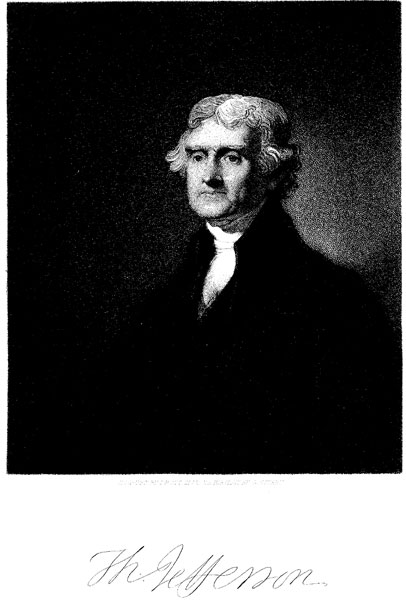
Genuine moral courage is a sterling virtue—the motive power of the true dignity of man. It invigorates the mind like a refreshing dew falling gently on the flowers of spring. It is a heavenly spark—animating the immortal soul with the fire of purity that illuminates the path of rectitude. It is an attribute that opposes all wrong and propels its possessor right onward to the performance of all right. Based on virtue and equity, it spurns vice in all its borrowed and delusive forms. It courts no servile favors—fears no earthly scrutiny. No flattery can seduce it—no eclat allure—no bribe purchase—no tyrant awe—no misfortune bend—no intrigue corrupt—no adversity crush—no tortures can subdue it. On its breastplate is inscribed in bold relievo—Fiat justitia—ruat calum. [Let justice be done though the heavens fall.] Without it, fame is ephemeral—renown transient. It is the saline basis of a good name that gives enduring richness to its memory. It is a pillar of light to revolving thought—the polar star that points to duty, secures merit and leads to victory. It is the soul of reason—the essence of wisdom—the crowning glory of mental power. It was this that nerved the leaders of the American Revolution to noble and god-like action.
In the front rank of this band of patriots stood Thomas Jefferson, who was born at Shadwell, Albemarle County, Virginia, on the 24th of April 1743. His ancestors were among the early pioneers of the Old Dominion and highly respectable. They were Republicans to the core—in affluent circumstances and exercised an extensive and happy influence.
Thomas was the son of Peter Jefferson, a man much esteemed in public and private life. The liberal feelings imbibed from him by this son were conspicuous at an early age. From his childhood the mind of Thomas Jefferson assumed a high elevation took a broad and expansive view of men and things.
He was educated at the college of William and Mary and was always found at the head of his class. Untiring industry in the exploration of the fields of science marked his collegiate career. He analyzed every subject he investigated, passing through the opening avenues of literature with astonishing celerity. His mind became enraptured with the history of classic Greece and republican Rome. Improving upon the suggestions of liberal principles found in the classics, he early matured his political creed and opposed every kind of government tinctured with the shadow of monarchy, hierarchy or aristocracy.
After completing his collegiate course he commenced the study of law under Chancellor Wythe, whose liberal views were calculated to mature and strengthen those already preponderating in the mind of Jefferson. With regard to the oppressions of the mother country—the justice and necessity of resistance by the Colonies, their kindred hearts beat in unison. By a thorough investigation of the principles of law and government, Jefferson became rapidly prepared to enter upon the great theatre of public life—the service of his injured country. Planting himself upon the broad basis of Magna Charta—encircling himself within the pale of the British Constitution—he demonstrated most clearly that the ministry of the crown had long been rapidly advancing beyond the bounds of their legitimate authority—exercising a tyranny over the Colonies not delegated to them by the constitution of the monarchy they represented. So luminous were his expositions of chartered rights on the one hand and accumulating wrongs on the other, that he became the nucleus of a band of patriots resolved on liberty or death.
At the age of twenty-two he was elected to the legislature which enabled him to disseminate his liberal principles throughout the Colony. He proclaimed himself the unyielding advocate of equal rights and had engraved upon his watch seal—"Resistance to tyrants is obedience to God." By his eloquence and unanswerable arguments he kindled the flame of opposition in old Virginia which increased as tyranny advanced. In 1769 a resolution was passed by the legislature—not to import a single article from Great Britain. In the advocacy of this proposition by Mr. Jefferson, the adherents of the crown were astonished at the boldness and firmness with which he exposed and laid bare the venal corruption of the British cabinet. It gave a fresh impetus to the cause of Liberty just bursting into life.
With ample pecuniary means—with talents equal to the work he had undertaken, his soul illuminated with the fire of patriotism—his indignation roused against the hirelings of the king—his sympathies excited by the sufferings of his country—his moral courage raised to the zenith of its glory—Mr. Jefferson was amply armed for the conflict and became one of the master spirits of the Revolution—a gigantic champion of universal freedom—a pillar of fire, flashing terror and dismay into the ranks of the foe.
He wrote "A Summary View of the Rights of British America"—addressed it to the king respectfully but very plainly pointed to the true position of the two countries and the final result of the policy of ministers. The following is an extract. "Open your breast, sire, to liberal and expanded thought. It behooves you to think and act for your people. The great principles of right and wrong are legible to every reader. To perceive them needs not the aid of many counsellors. The whole art of government consists in the art of being honest." The art of being honest in matters of government is a knotty problem for some modern politicians to solve. Were they all honest a political millennium would illuminate our country—bring us back to primitive tangible landmarks and unmask multitudes of political wolves cunningly dressed in sheep's clothing.
So exasperated was Lord Dunmore on perusing this article from the pen of Jefferson that he threatened to arrest him for high treason. Finding most of the members of the legislature, then in session, quite as treasonable in their views he at once dissolved that body.
The following year the British ministry, in answer to petitions for redress of grievances, sent to the legislature of the Old Dominion a series of propositions that they termed conciliatory but which added insult to injury. Their fallacy was exposed by Mr. Jefferson in such a masterly strain of eloquent burning logic and sarcasm, that conviction was carried to a large majority of his colleagues. They were referred to a committee which reported an answer written by him and was very similar to the Declaration of Independence. This reply was immediately adopted. The ball of resistance was put in motion—the electric fluid of patriotism commenced its insulating powers in the north and south—extending from sire to son, from heart to heart, until the two streams of fire met in the centre—then rising in grandeur, formed the luminous arch of Freedom—its chord extending from Maine to Georgia—its versed sine resting on the city Penn.
Under its zenith at Philadelphia, Mr. Jefferson took his seat in the Continental Congress on the 21st of June 1775. Although one of the youngest members of that venerated assembly of patriotic sages, he was hailed as one of its main pillars. Known as a man of superior intelligence, liberal sentiments, strict integrity, stern republicanism and unbending patriotism—his influence was strongly felt and judiciously exercised.
From the beginning he advocated a separation from the mother country and ably met every objection urged against it. In his view, oppression, not recognised by Magna Charta, had dissolved all allegiance to the crown—that the original contract had been cancelled on the heights of Lexington by American blood. Submission was no longer a virtue—the measure of wrongs had been overflowing for years—public sentiment demanded the sundering of the Gordian knot—a voice from Heaven proclaimed in tones of thunder—"Let my people go."
The following year the Declaration of Independence was proposed. Mr. Jefferson was appointed chairman of the committee to prepare this momentous document. The work was assigned to him by his colleagues. He performed the task with a boldness of design and beauty of execution before unknown and yet unrivalled. The substantial result of his labor has long been before the world. Admiring nations have united in bestowing the highest encomiums upon this sacred instrument. As a masterpiece of composition—a lucid exposition of the rights of man—the principles of a free government—the sufferings of an oppressed people—the abuses of a corrupt ministry and the effects of monarchy upon the destinies of man—it stands unequalled. Pure in its origin—graphic in its delineations—benign in its influence and salutary in its results—it has become the chart of patriots over the civilized world. It is the ne plus ultra [nothing more beyond] of a gigantic mind raised to its loftiest elevation by the finest touches of creative Power—displaying its noblest efforts—brightest conceptions—holiest zeal—purest desires—happiest conclusions. It combines the attributes of justice—the flowers of eloquence—the force of logic—the soul of wisdom. It is the grand palladium of equal rights—the polar star of rational Liberty—the Magna Charta of universal freedom and has crowned its author with laurels of enduring fame.
In the autumn of 1776 Mr. Jefferson was appointed a commissioner to the court of France in conjunction with Messrs. Franklin and Deane for the purpose of forming a treaty of alliance. Ill health of himself and family and an urgent necessity for his services in his native state, induced him to decline the proffered honor and resign his seat in Congress.
He was immediately elected to the first legislature of his state convened under the new Constitution. On taking his seal in that body his attention was at once directed to the demolition of the judicial code which had emanated from the British Parliament. The work of rearing a new superstructure was mostly performed by him. The first bill he introduced was aimed at the slave trade and prohibited the farther importation of negroes into Virginia. This is a triumphant refutation of the accusation often reiterated against Mr. Jefferson—that he was an advocate of slavery. To its principles he and a large majority of the South were always opposed and submitted to it practically by entail. It is a fact beyond dispute that he struck the first blow in the Colonies at the unhallowed trade of importing human beings for the purpose of consigning them to bondage. That this was the first great step to towards a correction of the most cruel feature of this system, originated by philanthropic England, is equally true. To transfer those negroes, born in the United States, from one section of this country to another, bears no comparison in cruelty to the heart-rending barbarity of forcing the African from his native home—even should he fall into the hands of those emancipators who, instead of returning him to his native shores—put him an "apprentice" to hard labor on their own plantations. Consistency thou art a jewel rather rare. Common humanity forbids the sudden emancipation of the slaves as proposed by emissary Thompson and his converts.
Mr. Jefferson next effected the passage of bills destroying entails—primogeniture—the church as established by England and various others—assimilating the entire system of jurisprudence in the state to its republican form of government. He reported one hundred and twenty-six bills, most of which were passed and constitute the present much admired statutory code of Virginia.
In 1779 Mr. Jefferson was called to the gubernatorial chair of his native state, then surrounded by perils. The British troops, led on by the proud Tarleton and the traitor Arnold, were spreading death and devastation over the Old Dominion and contemplated the capture of the governor. Terror seized the more timid patriots—the boldest were alarmed at the approach of the merciless foe. The energy of the governor was equal to the emergency. He rallied the bone and sinew of old Virginia, who "with hearts of oak and nerves of steel," checked the enemy in their bold career of indiscriminate slaughter. He imparted confidence and vigor to the desponding and roused them to bold and noble action. He dispersed the black cloud that hung over his bleeding state and inspired the friends of liberty with cheering hopes of ultimate success. So highly were his services appreciated during the eventful term of his administration that the legislature entered upon their records a unanimous vote of thanks to him for the able and efficient manner he had discharged his public duties—highly complimenting his talents, rectitude, moral courage and stern integrity.
In 1783 he again took his seat in Congress—one of the brightest luminaries in the galaxy of statesmen. The chaste and moving address to Washington when he surrendered his commission, was from the soul-stirring pen of Jefferson. He was chairman of the committee to form a territorial government for the extensive regions of the then far west. True to his long cherished desire to ultimately emancipate the negro, he introduced a clause prohibiting slavery in any of the territories or the states that should be formed from them after 1800.
In May, 1784, he was a minister plenipotentiary in conjunction with Dr. Franklin and John Adams, with power to negotiate treaties of commerce with several European nations. In July he embarked for France and arrived in Paris on the 6th of August. During his absence he visited several foreign courts but spent most of his time in France. He commanded the highest respect and was made a welcome guest in the halls of literature, legislation and jurisprudence. Kings and courtiers treated him with profound deference and were convinced intelligence and talent were not exclusively confined to the old world.
He was in Paris when the French Revolution commenced and was often consulted by the leading members of the national convention relative to the best course to be pursued in order to establish their government upon the Republican basis. So far as was proper he gave his opinions freely in favor of rational Liberty.
He returned on the 23d of November 1789 and was received with great enthusiasm and kindness by his fellow citizens. Soon after his arrival he resigned his ministerial commission and became Secretary of State under President Washington. The appointment was a compliment to the matured judgment of the chief magistrate and proved a lasting benefit to our country. Familiar with every principle of government—comprehending the requisites necessary to perfect and perpetuate the new confederation—he proposed amendments to the constitution, which, with some suggested by John Adams and others, were adopted. He did much towards reducing the new order of things to harmonious system. Well versed in diplomacy, international law and the policy of European courts—he was prepared to plant the permanent land marks of foreign intercourse which stand as beacon lights to guide our nation safely in its onward career. A reciprocity of commerce and honorable peace with other governments—a rigid neutrality with belligerents—a careful avoidance of entangling alliances were some of his leading principles. To submit to nothing that was clearly wrong—to ask for nothing that was not clearly right—was a doctrine of Jefferson forcibly inculcated in his able correspondence with the French ministers during the brief period of their Republic. This motto has been handed down from sire to son and is firmly nailed to the flag staff of the star spangled banner.
To the domestic concerns of our country he devoted a laudable and laborious attention. He recommended the adoption of a uniform system of currency, weights, measures and many other things designed to advance the best interest of the infant Republic. He urged the importance of protecting our fisheries and of encouraging enterprise in all the branches of industry. He demonstrated the advantages of every species of commerce and the necessity of preventing others from monopolizing the sources that legitimately belonged to the United States. He exhibited a masterly exposition of existing facts, showing the increasing policy of European courts to restrict the intercourse of America that they might engross trade. He submitted to Congress an elaborate and able report relative to the privileges and restrictions of the commercial intercourse of this with other countries, which showed great foresight, close observation and thorough investigation. It received great attention and was the foundation of a series of resolutions introduced by Mr. Madison, embracing the doctrines it contained—forming the great line of demarkation between the old school federal and democratic parties. It would require a skilful engineer to trace the original line now in consequence of the rapid growth of under brush.
Having served his country long and faithfully and contributed largely in placing her on the great highway of freedom and prosperity, Mr. Jefferson retired from public life on the 31st of December 1793 enjoying for a season the more peaceful and substantial comforts of life at Monticello. He imparted comfort to all around him—treated his slaves in the kindest manner, reducing to practice the mode of treatment he always recommended to others. The education of his children—the cultivation and improvement of his land and the resumption of his scientific researches, gave to him an exhilarating consolation he had long desired and could never enjoy in the arena of public business and political turmoil. His manner of life at the time alluded to is happily described by the Duke de Liancourt who visited him during his brief time of repose.
"His conversation is of the most agreeable kind. He possesses a stock of information not inferior to any other man. In Europe he would hold a distinguished rank among men of letters and as such he has already appeared there. At present he is employed with activity and perseverance in the management of his farms and buildings and he orders, directs and pursues, in the minutest detail, every branch of business relating to them. I found him in the midst of harvest from which the scorching heat of the sun does not prevent his attendance. His negroes are nourished, clothed and treated as well as white servants could be. Every article is made on his farm—his negroes being cabinet makers, carpenters and masons. The children he employs in a nail manufactory and the young and old negresses spin for the clothing of the rest. He animates them all by rewards and distinctions. In fine, his superior mind directs the management of his domestic concerns with the same ability, activity and regularity, which he evinced in the conduct of public affairs and which he is calculated to display in every situation of life."
During his recess from the toils of public life Mr. Jefferson was unanimously elected President of the American Philosophical Society with which he was highly gratified. It afforded him much pleasure to occupy the chair which had been ably filled by his revered friends—the illustrious Franklin and philosophic Rittenhouse.
After a repose of three years he was again called to the theatre of public action. President Washington had announced his determination to retire to the peaceful shades of Mount Vernon. The people had become divided in two political parties, each determined to nominate a candidate for the high and responsible office about to become vacant. The federalists nominated John Adams—the democrats Thomas Jefferson. The former was elected President—the latter Vice President of the United States. As the presiding officer of the Senate Mr. Jefferson discharged his duty with dignity and impartiality. Familiar with parliamentary rules, he was prepared to decide questions promptly and uniformly to the satisfaction of members.
At the next Presidential Election he was again opposed to Mr. Adams. The mountain waves of party spirit rolled over the United States like a sweeping torrent. Each party presented a bold front regardless of danger pressed on by a rear rushing to conflict. The two candidates were bosom friends. Honest political differences did not interrupt their private good feelings. Not a word fell from the lips of either disparaging to his opponent. They regretted the fever heat of their partisans during the canvass but could not allay it. The Democrats carried the election and returned an equal number of votes for Mr. Jefferson as President and Col. Burr as Vice President. This singular circumstance imposed the election of the Chief Magistrate upon the House of Representatives. To defeat the election of the great leader of the popular party, several of his opponents voted for Col. Burr. A very spirited contest ensued. Thirty-five ineffectual ballotings were made. The ambition of Burr for promotion induced him to omit doing at once what propriety dictated and that which would have rendered him popular and perhaps saved him from the vortex of disgrace into which he subsequently plunged—the immediate withdrawal of his name. This he was finally compelled to do and on the thirty-sixth ballot Mr. Jefferson was duly elected President by a majority of eight votes and Col. Burr Vice President.
I have long been convinced that the Federal Constitution should be amended with reference to the election of these two officers. The votes for each should be confined to each office independent of the other. The election should never go to the House of Representatives, especially as political honesty is constantly deteriorating. The history of all time shows clearly, that as a government grows older corruption increases until it finally dissolves the state. Let the President be elected for four years and until another shall be elected in his place and let this be done directly by the people. Reckless party management would then be stripped of half its horrors. Better pay the expense of two elections than have one unworthy incumbent in the Presidential Chair. The following extract from the Inaugural Address of Mr. Jefferson should be committed by every man and boy in our country—the principles would then be better understood and perhaps more generally exemplified in practice.
"Equal and exact justice to all men of whatever state or persuasion—religious or political—peace, commerce and honest friendship with all nations—entangling alliances with none—the support of the state governments in all their rights as the most competent administrations for our domestic concerns and the surest bulwarks against anti-republican tendencies—the preservation of the general government in its whole constitutional vigor as the sheet anchor of our peace at home and safety abroad—a zealous care of the right of election by the people—a mild and safe corrective of abuses which are lopped by the sword of revolution when peaceable remedies are unprovided—absolute acquiescence in the decisions of the majority, the vital principle of Republics from which there is no appeal but to force—the vital principle and immediate parent of despotism—a well disciplined militia our best reliance in peace and for the first moments of war till regulars may relieve them—the supremacy of the civil over the military authority—economy in public expenses that labor may be lightly burthened—the honest payment of our debts and sacred preservation of the public faith—encouragement of agriculture and of commerce as its handmaid—the diffusion of information and arraignment of all abuses at the bar of public reason—freedom of religion, freedom of the press and freedom of the person under the protection of the habeas corpus and trial by juries impartially selected. These principles form the bright constellation which has gone before us and guided our steps through an age of revolution and reformation. The wisdom of our sages and blood of our heroes have been devoted to their attainment. They should be the creed of our political faith, the text of civic instruction, the touch stone by which to try the service of those we trust and should we wander from them in moments of error or alarm, let us hasten to retrace our steps and to regain the road which alone leads to peace, liberty and safety."
Here is a statesman's chart drawn by one of the ablest, navigators that ever stood at the helm of government. His soundings were frequent—his observations were made with mathematical precision—he combined science and experience and traced his lines with boldness and truth. To follow its directions is to ensure safety. Its delineations are not designed for partisan use but for our whole country and the freemen of the world through all time.
Based upon these principles practically, the administration of Jefferson became popular, peaceful and prosperous. He understood the reasonable desires of the people and exerted his noblest powers to gratify them.
He knew that the art of governing harmoniously consisted in honesty and governed himself accordingly. He anticipated the future wants of the rising and expanding Republic and proposed in his annual and special messages to Congress wise and politic measures to meet them. So fully was his course approved that he was re-elected by a majority of one hundred and forty-eight. His second inaugural address reiterated the same magnanimous principles of his first, manifesting a deep and growing interest in the prosperity and welfare of our common country.
As he has been repeatedly charged with infidelity by those who descend so low as to desecrate the ashes of the illustrious dead and the charge repeated but a few days ago in a prominent print in the city of New York, I insert the following extract from his annual message, which sentiment is found in all his writings where the subject is alluded to. I have recently read two of his unpublished letters to a gentleman who is now a member of the New Jersey Senate, in which the same view is expressed.
"I shall need, too, the favor of that Being in whose hands we are, who led our forefathers, as Israel of old, from their native land and planted them in a country flowing with all the necessaries of life—who has covered our infancy with his Providence and our riper years with his wisdom and power." Washington and Adams said no more.
If all who profess the religion of the Cross discarded sectarianism and honored unsophisticated practical religion as much as did Thomas Jefferson, the prospect of christianizing the world would burst upon us with refulgent brightness. The partition walls of various creeds, claimed to be drawn from the same pure fountain, would be dissolved by heaven-born Charity and the superstructure of the Redeemer's kingdom would rise in majesty sublime.
Soon after Mr. Jefferson entered upon the duties of his second term, a portentous storm darkened the horizon of our country, charged with the lightning of discord. In consequence of being disappointed in riding into the presidency on the whirlwind of confusion he created at the time he was made Vice President and at the end of four years—dropped like a traitor as he was, Aaron Burr mounted upon the tornado of his wild ambition and attempted the formation of a new Republic in the Spanish Provinces on the Mississippi, aiming at an ultimate division, if not dissolution of the Union. He was arrested and tried for high treason but being a man of great foresight, consummate genius and deep cunning—no overt act could be proved against him within the technical meaning of the law and he was acquitted—yet the dark stigma is marked upon the splendor of his brilliant talents in traces so deep, that time nor angels' tears can ever remove it. Like a comet propelled by its own centrifugal force from its constitutional orbit, he fell to rise no more—our country was saved from his Cataline grasp by the Cicero of our nation.
About the same time France and Great Britain were at war—both of whom and more especially the latter—had repeatedly insulted the American flag under various but false pretences. Redress was promptly demanded and measures pursued to obtain it. Anxious to preserve peace but determined to vindicate our rights and dignity—Mr. Jefferson simultaneously prosecuted a negotiation and prepared for war. He well understood the importance of the importing and exporting trade to England. Among the means used to bring her to honorable terms, he recommended to Congress the embargo law which was passed on the 22d Dec. 1807. This measure was violently assailed by those opposed to his administration. As he anticipated, it had a salutary effect upon the British government and caused propositions to be made by England for an honorable adjustment of all differences.
Thus were the foreign relations of the United States situated when the second term of Mr. Jefferson closed. He then bid a final farewell to public life and consigned the destinies of his beloved country into other hands. He had been an efficient and faithful laborer in the vineyard of American Liberty nearly forty years. He left it richly covered with green foliage and fruit—in the full vigor of health—enclosed by the palisades of truth and honesty—adorned with the crowning glories of philanthropy and patriotism.
From that time he declined all public honors and remained in peaceful retirement to the day of his death—seldom leaving his sweet home—the beautiful Monticello. Unlike too many with ample means he did not lead a life of inglorious ease. The same innate activity that had marked his bright career from youth—the same nobleness of mind and energy of character that raised him to the loftiest pinnacle fame could rear, still promoted him to action. He reduced his time to a harmonious arrangement—his business to perfect system. He uniformly rose before the sun and held a supervision over all the concerns of his plantation. The various productions of his pen during the period of his retirement, show that he labored arduously in the fields of science and philosophy. For the promotion of literature and general intelligence, he opened an extensive correspondence with men of letters in this country and Europe. He considered the diffusion of knowledge among the great mass of the human family the greatest safeguard against tyranny and oppression—the purest source of earthly bliss—the surest passport to freedom and happiness.
Acting from this impulse, he submitted the plan of a University to the legislature of Virginia to be erected at Charlottesville, situated at the foot of the romantic mountain in front of his mansion. It was to be built with funds raised by donations from individuals in the state, himself to be a liberal contributor. The plan of the buildings and course of instruction were drawn by him and so much admired and approved by the members of the legislative body that an act was passed to carry into effect the design and Mr. Jefferson was appointed Rector. For the completion of this object he spent all necessary time and more money than strict justice called for. It became the doating object of his old age. His best efforts were exerted in its accomplishment, which were crowned with success and the University filled with students to whom he paid great attention. The course of instruction was designed to prepare youth for the general routine of business, public and private and was not strictly classical. The library was selected by him with great care, being composed entirely of solid useful books, treating on subjects important to every citizen in preparing him to discharge properly the duties he owes to his God, his family, his country and himself. A catalogue, written by Jefferson, is still there in a good state of preservation. He exercised a parental care over this institution until his physical powers failed.
Much of his time was devoted to visitors to whom he was hospitable and kind. Thousands of his own countrymen paid their grateful respects to him—Europeans of distinction thought their tour in this country incomplete until they took by the hand the patriot, sage, philosopher and philanthropist of Monticello. He was ever anxious to please, delight and instruct. He was familiar with every subject. His mind united the vigor of youth with the experience of age. The broad expanse of the universe—the stupendous works of nature—the Pierian fields of science—the deep recesses of philosophy and labyrinthian avenues of the intellect of man—seemed spread before him like the map of the world. He was an encyclopædia of the age he adorned—a lexicon of the times he enlightened—one of the brightest diadems in the crown of his country's glory.
With a calm and peaceful quietude Mr. Jefferson glided down the stream of time toward the ocean of eternity until he reached the eighty-fourth year of his age. Forty-four years had passed away since his amiable companion had been laid in the tomb. She was the daughter of Mr. Wayles, an eminent lawyer of Virginia. One of two interesting daughters was also resting in the grave. The charms of earth were receding from him—he felt sensibly that he stood on the confines of another and a better world. The physical powers and mechanical structure of his frame were fast decaying—the canker worm of disease was doing its final work—the angel of death hovered over him with a keen blade awaiting Jehovah's signal to cut the silver cord of life and set the prisoner free.
Early in the spring of 1826 his bodily infirmities increased. From the 26th of June to the time of his death he was confined to his bed. He then remarked to his attending physician—"My machine is worn out and can go no longer." His friends who attended him thought he would again recover but he was convinced that his voyage of life was about to close and that he would soon cast his anchor in the haven of rest. To those around him he said—"Do not imagine that I feel the smallest solicitude as to the result. I do not indeed wish to die but I do not fear to die." Do infidels die thus calm and resigned? Echo answers—Do infidels die thus?
On the second day of July his body became extremely weak but his mental powers remained as clear as a crystal fountain. He called his family and friends around him and with a cheerful countenance and calm dignity gave direction for his funeral obsequies. He requested that he might be interred at Monticello without pomp or show and that the inscription on his tomb should only refer to him as "The author of the Declaration of Independence—of the Statutes of Virginia securing religious Freedom and the Father of the University." He then conversed separately with each of his family. To his surviving daughter, Mrs. Randolph, he presented a small morocco case which he requested her not to open until after his death. It was found to contain a beautiful and affectionate poetic tribute to her virtues.
The next day, being told it was the 3d of July, he expressed a desire that he might be permitted to inhale the atmosphere of the fiftieth anniversary of our national freedom. His prayer was granted—the glorious 4th of July 1826 dawned upon him—he took an affectionate leave of those around him and then raising his eyes upward articulated distinctly, "I resign myself to God and my child to my country"—and expired as calmly as an infant sleeps in its mother's arms. Thus lived and thus died Thomas Jefferson, universally esteemed in life—deeply mourned in death by a nation of freemen—sincerely lamented by every patriot in the civilized world.
In person he was slender and erect—six feet two inches in height—light and intelligent eyes—noble and open countenance—fair complexion—yellowish red hair and commanding in his whole appearance. In all the relations of public and private life he was the model of a great and good man. His whole career was calm and dignified. Under all circumstances his coolness, strong moral courage—deliberation and equanimity of mind, placed him on a lofty eminence and enabled him to preserve a perfect equilibrium amidst all the changing vicissitudes and multiform ills flesh is heir to. He kept his passions under complete control and cultivated richly the finer qualities of his nature. His charity, the brightest star in the Christian diadem, was as broad as the human family—his sympathies co-extensive with the afflictions of Adam's race. He was created for usefulness—nobly did he fulfil the design of his creation. If his were not the fruits of practical Christianity, the immaculate Redeemer and the Apostles did not truly describe them. You who basely charge Thomas Jefferson with infidelity, remember—O! remember, that his last words were those uttered by many of the martyrs—"I resign myself to God and my child to my country."
BARON DE KALB.
A love for the land of our birth is natural—commendable. A continued oppression from those in power may drive us from that land—compel us to seek an asylum under a more congenial government—still the associations of our native spot are a source of frequent and pleasing thought never to be entirely eradicated from our minds.
No man should ever adopt a new country and government without a full determination to become a good and useful citizen and submit implicitly to the laws as they are until he shall find himself in a majority of the virtuous who rise in their majesty to change for the better. With this principle for a polar star—foreigners who seek a peaceful asylum in our country may become as staunch supporters of our national Constitution and Union as native born patriots. If they cannot—they should retrace their steps quickly and return to the iron blessings of monarchy. We want none among us who do not love our country and her noble institutions. An open door—a hearty welcome awaits every foreign patriot that comes to this land of the brave and home of the free. We have an overplus of native demagogues, fanatics, ultraists, disunionists and bigots—without importing any from Europe.
During the American Revolution a number of illustrious and noble patriots of high standing came from the old world to aid in planting the tree of Liberty in the new. Among them was the brave Baron de Kalb, a native of Germany. Of his early history we have no record. He was a brigadier-general in the French army and had earned a high military reputation. He was a knight of the order of Military Merit and highly esteemed by his fellow officers. A philanthropist of high order—imbued with liberal principles—in favor of a Republican form of government—familiar with the oppressions of England in America—acquainted with the noble efforts of the oppressed to free themselves from tyranny—Baron de Kalb at once resolved to be the companion of the patriotic La Fayette. On his arrival he was commissioned a major-general in the Continental army and placed in command of the Maryland division. He readily gained the esteem and confidence of all who made his acquaintance. He was a man of strong common sense—great experience—a close observer of men and things—an admirable disciplinarian—a brave and prudent officer. With a robust frame and iron constitution—he was able to endure the proverbial fatigues and privations of the American army. He was remarkably abstemious—living mostly on bread and water. His industry and zeal in the glorious cause he had espoused were worthy of all praise. He was up early and late and spent all his leisure from official duty in writing in some retired place. Unfortunately his writings were lost and the subject matter was known to no one but himself.
The brilliant career of this noble patriot soldier was closed at the battle of Camden, S. C. He there commanded the right wing of the American army composed of regulars. The left wing was composed of militia who fled at the sight of the red coats advancing with fixed bayonets—as terrified as young horses at a locomotive. Not so with the right wing. Although contending against overwhelming numbers they stood their ground and fought like tigers. In his last desperate attempt to seize the laurels of victory—the Baron fell helpless with eleven wounds. In this prostrate condition a base attempt was made to pierce him with several bayonets which was prevented by one of his aids—Chevalier de Buysson—who threw himself over the fallen hero and received the bayonets in his own body—exclaiming "Save the Baron de Kalb!" The British officers interfered—saved him from instant death and made him their prisoner. He was kindly treated by his captors and survived but a short time. To an officer who expressed his sorrow for his sufferings he replied—"I thank you for your sympathy—I die the death I always prayed for—the death of a soldier fighting for the rights of man."
In his last moments he dictated a letter to Gen. Smallwood who succeeded him in command of his division. He expressed his ardent affection for his officers and men—lauded their bravery which had forced admiration from their enemies—urged them to persevere in the glorious cause of freedom until triumphant victory should perch upon their manly brows. He then invoked a benediction on his beloved division—reached out his trembling hand to Col. de Buysson—resigned his soul to God and closed his eyes in death.
In that battle both armies suffered severely. Several others of the American officers were killed—among them Col. Potterfield who was a favorite of the whole army.
Baron de Kalb was a man of amiable disposition—modest and unassuming in his manners—frank and generous in his intercourse—strictly moral and temperate in his habits—was highly esteemed by all who knew him and died deeply lamented. He was buried at Camden. His memory is cherished by every friend of liberty.
Some years after he had slumbered under the clods of the valley, Gen. Washington visited his grave. He contemplated it thoughtfully for a few moments and remarked—"So there lies the brave De Kalb—the generous stranger who came from a distant land to fight our battles and to water the tree of our liberty with his blood. Would to God he had lived to share its fruits."
In 1780 Congress caused a monument to be erected to his memory in Annapolis, Maryland, with the following inscription,
Sacred to the memory of the BARON DE KALB, Knight of the royal order of Military Merit, Brigadier of the armies of France, and Major General In the service of the United States of America. Having served with honor and reputation For three years, He gave a last and glorious proof of his attachment to the liberties of mankind And the cause of America, In the action near Camden in the State of South Carolina On the 16th of August 1780, Where, leading on the troops of the Maryland and Delaware lines Against superior numbers And animating them by his examples To deeds of valor, He was pierced with many wounds And on the nineteenth following expired In the 48th year of his age. The Congress Of the United States of America, In gratitude to his zeal, services and merit, Have erected this monument.
GILBERT MOTTIER DE LA FAYETTE.
Patriotism is one of the noblest attributes of man. It is the soul of freedom—the fulcrum of liberty—the lever of independence. It soars sublimely above self—is prompted by honest motives—aims at glorious ends. It is the motive power of philanthropy and would gladly consolidate the human family in one harmonious universal brotherhood by the heavenly law of love which can fraternize the world. It is opposed to all oppression—abhors all tyrants—rejoices in the promulgation of liberal principles. Its desires to do good are diffusive as the sun light—it is not confined to country—nation or caste. No sectarianism can swerve it—no monarch suppress it—no obstacle paralyze it. The patriot may be crushed in person by illegitimate power—the principle—never. Chains and dungeons will kindle it to a brighter flame—persecution will increase its volume. The history of all time proves the truth of these assertions—they form a corollary firm as the perpetual hills—incontrovertible as the problems of Euclid. The man who is destitute of this noble attribute is a mere automaton. There is a vacuum in his soul which nature abhors and all despise—except kings, aristocrats and demagogues. Patriotism is the dread incubus that hangs over thrones. The true patriot delights to see all basking in the refulgent rays of rational liberty and is ever ready to peril life and fortune in the cause of equal rights whenever the people of any nation rise in their native dignity to reclaim them from oppressors.
Thus it was with Gilbert Mottier de La Fayette, born on the 6th of September 1757 at the castle Chavaniac in Auvergne. Soon after the birth of this son, his father fell at the battle of Minden. As childhood dawned upon young La Fayette he exhibited talents of unusual strength and vigor. Under the genial rays of science they rapidly burst from embryo—budded, blossomed and ripened into fruit of the most perfect kind. At the age of seven years he was placed in the college of Louis le Grand at Paris. His rapid progress in the elements of his education exceeded the fondest anticipations of his numerous friends. By his modesty, urbanity and innate goodness of heart he gained the esteem of all who knew him. He graduated at an early age and was made a page to the queen and soon rose to the rank of a commissioned officer—an honor then conferred upon none but those presumed to possess superior merit and talent. At the age of seventeen he married the Countess Anastatie de Noailles—one of the most beautiful and amiable ladies of France. With kindred spirits they united splendid fortunes sufficient to support them in princely style through a long life. They were in the enjoyment of all the pleasures earth could give—favorites at the gayest court in Europe—caressed and beloved by those they held most dear—an ornament to every circle in which they moved. Mutual esteem gave a rich zest to every enjoyment—their social felicity was complete. All things combined to rivet La Fayette to his happy—his enchanting home. Nothing but the loftiest patriotism—the purest philanthropy could have induced him to burst these infatuating bands and peril his life, fortune and sacred honor in the cause of human rights in a foreign country.
Amidst the fascinating allurements that surrounded him, this noble youth paused, reflected and reasoned. Through the bright vista of the future Columbus saw the cheering vision of a new world. Through the same clear mirror La Fayette saw the sun of freedom reflecting its refulgent rays over Columbia's prolific land. A band of patriots had sounded the clarion of liberty. Echo had wafted it from Bunker's bloody mount to the ears of this young hero. The thought that there was a remnant left in the world who dared to assume their native dignity and strike for their just rights enraptured his soul. Contrary to the wishes of his friends and the King of the French, he resolved to fly to the aid of the oppressed Americans and participate in the unfading glory of planting the standard of freedom in the western hemisphere. Nor did he split on the rock of resolves and re-resolves where many waste away their lives. He at once proposed to the American Commissioners, then in Paris, to enter the army of Washington. They informed him of the recent adverses of those who were struggling for Liberty. They could present no bright picture to induce him to hope for laurels or emolument. It was not necessary. Nobler motives incited him to action. He still resolved to go. Anxious as were Messrs. Franklin, Dean and Lee to secure his services, they had not the means to convey him to the scene of action. Obstacles of various kinds were vainly thrown across his path. Impelled to an onward course by the noble impulses of patriotism—no difficulties were too great for him to surmount—no hardships too severe for him to endure, no sacrifice of wealth too large for him to make. Embarrassments strengthened the resolution he had formed to enroll his name with the brave and the free, even should he perish in the attempt.
He immediately fitted out a vessel at his own expense—freighted it with munitions of war and clothing—received letters of high commendation from the American commissioners to the Congress of their bleeding country and embarked secretly for the land of the pilgrim fathers in the winter of 1777. He then looked forward with anxious solicitude to that happy day when he should aid in unfurling the banner of freedom—in planting deep the tree of liberty in a soil congenial to its growth and take by the hand those bold and daring sages and heroes who had thrown the stars and stripes to the breeze in defiance of despotism—resolved on freedom or death. Nothing short of a deep, strong, inherent devotion to liberal principles could have induced La Fayette to leave his native country under the existing circumstances and peril everything in behalf of strangers. In vain we search history for a benevolence so broad and disinterested. Call it ambition if you please. Would to God the same laudable ambition reigned triumphant in the breast of every human being. We should then see tyrants trembling—thrones crumbling—crowns falling—fetters bursting and the grand jubilee of freedom celebrated amidst the expiring groans of monarchy—the chaotic ruins of tyranny. Call it a thirst for glory. Would to God that all who have figured largely on the grand theatre of public action could have the same glory emblazoned on the escutcheon of their names. A purer, fairer sheet of biography would then meet the eyes of the present and generations to come.
On the 25th of April 1777 Lafayette and his companions landed in South Carolina near Charleston and were warmly welcomed by Gen. Moultrie, Major Huger and the little band of veterans around them. The destitute condition of the American soldiers excited the sympathy of the Marquis. He distributed clothing to those under Gen. Moultrie and a sword to each of his officers. From Charleston he hastened to Philadelphia and delivered his letters and despatches from the American Commissioners to Congress. He offered himself as a volunteer—desiring to enter the army with no remuneration except the proud satisfaction of enrolling his name with the brave heroes whose motto was—Liberty or Death. His unassuming manners, patriotic sentiments, stern resolution, devotedness to the cause and dignified bearing—combined to inspire confidence in all who made his acquaintance. In July Congress passed a resolution accepting his services and commissioned him a Major-General in the Continental army. He immediately placed himself under the supervision of Washington and commenced a brilliant career that gained increased lustre during a long life of usefulness. Shortly after he entered the service he acted a conspicuous part in the battle of Brandywine where he was wounded and disabled for six weeks. In the battle of Germantown he proved himself a cool, brave and skilful officer. He soon gained the full confidence of Washington and was put in command of a choice corps of daring young men selected by himself and was entrusted with several expeditions which he conducted with great prudence and success and to the entire satisfaction of Washington and Congress. On all occasions he exhibited talents of the highest order. Discretion—the strong helm of human action, guided him in all his actions.
At that period the question of maintaining American Independence was truly problematical. Prospects darkened as time rolled on. The general gloom was an impetus to this young patriot that impelled him to more vigorous exertion. In the autumn of 1778 he returned to France and exerted his influence in favor of a treaty of alliance and greatly aided in consumating that desideratum. This imparted fresh courage to the American army—then writhing under privations and distress that truly tried the souls and bodies of men. Nothing short of an Almighty hand could have sustained the Sages and Heroes of the Revolution and nerved them to persevere in their noble undertaking until crowned with triumphant victory. La Fayette returned in the spring of 1780 and was followed by a French naval force in July which came to the rescue. A new impetus was thus given to the cause of human rights in America. La Fayette was put in command of the expedition against Lord Cornwallis in Virginia. He found his troops in a naked, forlorn condition and Congress without means to furnish them with the common comforts of an army. Upon his own credit he borrowed money from merchants in Baltimore—purchased a portion of the necessary supplies—appealed to the fair daughters of the monumental city who responded nobly to the call. Their eyes and needles brightened as they made up garments for the brave soldier boys—soon the Marquis saw his men comfortably clad, fully equipped—eager to drive the minions of tyranny from their blood stained soil.
La Fayette took the field with a force far inferior to that of Cornwallis who was the pride of his king and acknowledged no superior in the science of military tactics. In the wary and sagacious "boy" as La Fayette was termed by the veteran British General, Cornwallis found a leader too formidable to be treated with contempt—too cautious to be easily ensnared. He was constantly annoyed without being able to bring his antagonist to a general action. Chagrined and disgusted he retired to Yorktown and commenced formidable fortifications. As his army was now the bulwark of England in America, the combined forces of the United Colonies and France lost no time in concentrating in front of his entrenchments. A vigorous siege was commenced on the 29th of September 1781. The British General felt that an awful crisis had arrived. By a surrender—the Colonies were lost. A tremendous responsibility rested upon him. His resistance corresponded with these high considerations. His spirited defence was worthy of a better cause.
On the 14th of October it was found necessary to silence two redoubts that were pouring a destructive fire into the works of the besiegers. This was to be done with the bayonet. The young Marquis was selected to lead the assault. The order was no sooner received than obeyed. He led his men to the charge with the impetuosity of a tornado. Like a mighty avalanche, rushing from the mountain top with the fury of Mars—they bore down all opposition. Although the enemy were double in number—so sudden and irresistible was the onset that they were all killed or taken prisoners but six. Against such troops fighting for Liberty, Cornwallis found it useless to contend. The injured Colonists had risen in their might—a fearful retribution awaited him. The last ray of success was expiring in the socket of hope—his cruel military career was about to close in the new world. Keen and blighting anguish seized his tortured soul in view of outrages committed upon an oppressed people. The cries of murdered innocents rang through his ears—his courage lost its equilibrium and was supplanted by despair. On the 18th of October the proud hero of Britain surrendered his whole army to the illustrious Washington and the brave La Fayette—the champions of liberal principles and human rights.
That signal victory closed the long, bloody, doubtful struggle. Several nations promptly acknowledged the Independence of the United States. The ensigns of royalty were banished from our shores—the star spangled banner waved triumphantly over the land of the brave and free. Washington and La Fayette mingled tears of gratitude and thankfulness for their preservation, success and final deliverance. They richly merited and freely received the plaudits of the American people and of admiring nations. A gazing world looked upon them with ecstatic delight as they stood on the loftiest pinnacle of fame in all the sublime majesty of republican simplicity. They were among the brightest of the dazzling luminaries of emancipation—the terror of tyrants—the hope of freemen. The consummation of Liberty was then and there proclaimed to grateful and happy millions. Seraphs listened to the cheering news with thrilling joy—carried the glad tidings to the unerring chancery of the great Eternal where they received the sanction of Jehovah's high authority and were recorded on the unfading pages of the book of lasting renown in letters of gold by the Grand Scribe of Heaven. Echo caught the talismanic sound and wafted it to the remotest bounds of every nation on wings of mighty wind.
Having accomplished all in his power to establish the Independence of our country La Fayette prepared to return to the bosom of his anxious family in France. He had served more than six years and expended one hundred and forty-seven thousand dollars in the glorious cause he had nobly, ardently, successfully espoused. He asked no pecuniary emolument at the commencement of his services—he demanded no pay—presented no account at their termination. He had a richer reward, more precious than gold—more valuable than rubies—the gratitude of the American nation deeply felt and strongly expressed. He had the invaluable satisfaction of having contributed largely towards preparing a nursery for freemen—an asylum for the oppressed. His conduct stood approved at the dread tribunal of conscience.
"The man who stands acquitted at that fearful bar Holds the first round prize the world has to give. 'Tis like Heaven's sunshine—priceless."
At his departure he received the highest tokens of respect from Congress, the officers of the army and our nation at large. The richest blessings of a kind Providence were invoked for him. He was received with great enthusiasm on his arrival at home. He was hailed as a prominent hero of the new world—the tried friend of Liberty—the unyielding advocate of universal Freedom—the spotless patriot—the brave and skilful officer—the hope of the down-trodden and oppressed in the old world.
The success of the United States in shaking off the yoke of bondage had its influence on the nations of Europe as a natural consequence. That the people of France felt it most is not surprising. The French army had drank freely at the fountain of Liberty that had gushed out in the United States. The holy flame of freedom was burning in their bosoms and was soon communicated to their brethren at home. The insulating fire of patriotism ran through the mass and the too resolved to be free. Unfortunately for the cause of human rights they seized upon the abstract principles of Liberty without learning the art of self-government. They plucked the fruit before it was ripe—it disorganized their system producing a raging fever and wild delirium. So rapidly did the excitement rise that it was found necessary to convene the States General—an assembly that had slumbered 172 years—the dernier resort of that nation to suppress internal commotion. It consisted of deputies chosen by the nobility, clergy and common people. So terrific was the storm of passion that this august body trembled like a reed shaken by the wind. Anarchy mounted its desolating car—mad ambition rolled its mountain waves over reason and justice—malicious jealousy sought its victims in every avenue—Jacobinism reared its hydra head—the fountain of mercy was dried up—the bloody guillotine did its fearful work. Civil war raged in all the plenipotence of exterminating revenge—cruelty ceased only for the want of victims—the streets were deluged with purple current. Such are the outlines of the first French Revolution. The picture is filled with darker shades.
Amidst this scene of dreadful carnage—this tornado of angry passions—La Fayette stood calm and undismayed. He commanded the military and had their confidence. At one bold stroke he might have cut off the cold hearted Robespierre—the cruel Mirabeau—the treacherous Duke of Orleans—the ambitious Paine—the bloody Nero—Murat. Under Washington and from his own innate goodness he had learned to soar above revenge and practice humanity. For some time he paralyzed the efforts of the various factions and succeeded in giving France a constitution approximating towards republicanism. But the typhoid of faction had become too firmly fixed on the body politic to be arrested in its sanguinary career by this panacea. It gathered new strength as it advanced. The awful whirlpool of boiling passion was fast drawing La Fayette to its vortex of destruction. The National Assembly yielded and became subservient to the Jacobins. Plans were suggested by which to rid themselves of the man they most dreaded. At this alarming crisis he exhibited moral and physical courage without a parallel. He repaired to the National Assembly and in language bold and strong portrayed the conduct of those whose wild ambition had brought upon France threatened ruin and impending destruction. His dignified manner, unanswerable logic, powerful eloquence, stern integrity, open frankness, anxious solicitude and noble boldness filled the delegates and leading Jacobins with awe and astonishment. They believed he had an armed force within call to protect him. When he had finished his address he immediately withdrew and resumed the command of the army then marching against the Austrian Netherlands. Learning that he had gone, the National Assembly became so courageous that they proscribed him and set a price upon his head. Finding the wild disorder of his country beyond his control and his life in jeopardy, he resolved to fly to the United States. With an aching heart he left, with seven companions. In their flight they fell into the hands of the Prussians and were delivered over to the Austrians. After enduring every indignity and insult La Fayette was thrown into a loathsome dungeon at Olmutz where a bed of rotten straw, a broken chair and an old table constituted all the furniture of his wretched apartment. There he suffered by privations and disease—neglected and alone until he was so reduced that the hair fell from his head and death seemed sure of an early victim. At the same time his estate was confiscated by the Jacobins and his amiable wife thrown into prison. To advocate him in France was a sure passport to the bloody guillotine.
England, the United States and several other governments looked upon the incarceration of La Fayette as a violation of the laws of nations, of common justice and humanity. Washington and many others made great exertions to obtain his release. The Emperor of Austria was inexorable. The staple of his mind was adamant—he delighted in human misery. He had caged the European Eagle of Liberty determined to immolate him slowly but surely on the altar of revenge and crush the embryo buds of liberal principles in the old world. A bold but unsuccessful attempt to rescue the prisoner was made by Col. Huger and Dr. Bollman of South Carolina. Its history is full of thrilling interest and does great credit to the heads and hearts of its persevering and ingenious authors.
The amiableness and dignity of Madame La Fayette forced respect from the bloodthirsty Jacobins who ultimately released her. Learning the forlorn condition of her husband her native tenderness rushed upon her noble soul like a mighty flood. She at once resolved to fly to him and share in all the vicissitudes that awaited him. With her two daughters she left France in disguise and arrived safe at Olmutz. Her application to see her husband could not be granted unless she consented never to leave the prison after entering it. With this inhuman decree she cheerfully complied. The most brilliant imagination can but faintly conceive—the strongest language can never portray to the life the thrilling—the melting scene that followed. The sunburnt cheeks of the soldiers who guarded the prison were flooded with the tears of sympathy and compassion. With the two pledges of their love Madame La Fayette passed the grating iron doors. The next moment she was clasped in the arms of the companion of her youth. My loyal husband—was all she could utter. My dear father—burst from his angelic daughters as they clung around his emaciated form. My dear wife—my lovely daughters—passed his trembling lips in broken accents—a flood of tears from each told a tale of mingling woes and joys in the language of that mute eloquence which casts words into the shade. That scene can never be presented in full original force by the finest touches of the painter's pencil—the boldest stroke of the poet's pen—the loftiest flights of historic eloquence. At that meeting with his family the situation of La Fayette in prison was more enviable than that of a king of nations or a conqueror of worlds. The ministering angel—woman—can convert a dungeon into a paradise and light up a smile in the deepest aspect of woe. Without her earth would be desolate—man miserable—a savage.
With Christian fortitude and heroic patience this affectionate family bore their privations and sufferings. Madame de Stael has well observed—"Antiquity offers nothing more admirable than the conduct of Gen. La Fayette, his wife and daughters in the prison of Olmutz."
Fresh exertions were made to obtain the release of these innocent sufferers. The question was agitated in the United States Congress and in the House of Commons in England. Nothing could move the obdurate heart of the tyrant who held them. They seemed doomed to waste away their lives in that loathsome dungeon. God had otherwise determined. The time was rolling on rapidly when they should be restored to liberty, their friends and their home. The conquering Bonaparte humbled the proud and cruel Emperor and compelled him to release these illustrious prisoners. In the treaty of Campo Formio in 1797 it was expressly stipulated that all the French prisoners at Olmutz should be immediately liberated. The Emperor of Austria attempted to impose restrictions on the future conduct of the Marquis. Amidst all his sufferings his dignity and liberal principles remained unimpaired. He spurned all conditions of a restrictive nature. His unconditional release occurred on the 25th of August 1797 when he and his family again inhaled the exhilarating atmosphere of Freedom. He had been in prison five years. His noble wife and affectionate daughters had shared with him the miseries of a damp dungeon twenty-two months. The release of these prisoners is one of the brightest stars in the diadem of Bonaparte.
When the French nation became more tranquil La Fayette and his family returned to the land of their birth. He located at La Grange and soon gained a salutary influence over those around him. He did all in his power to promote the interests of his country and the cause of human rights. Although he was truly grateful to Bonaparte for his release from a gloomy dungeon he believed he owed a duty to his nation paramount to all private considerations. He opposed all his measures that he considered dangerous to the prosperity and happiness of France. From the time of his return to that of his last illness, La Fayette took a conspicuous part in the civil and military departments of his country. With an Argus eye he watched her destinies through all her convulsing changes. The smiles of princes and the huzzas of the multitude could not flatter him—the miseries of a dungeon and frowns of tyrants could not depress him. Without those brilliant talents that dazzle and captivate every beholder, like his revered Washington he possessed an uncommon share of sound common sense, a clear head, a good heart, a discriminating judgment that gave him a more universal influence than any man then in Europe. His magic power over the enraged populace of Paris during the Three Days' Revolution of 1830 has no parallel when we consider the effervescent nature of the French people. In the short period of seventy-two hours he restored tranquillity—formed a new government and commenced a new era in the history of that impulsive nation. He could then have been crowned King of France. To him crowns were empty bubbles, expanding only to burst—airy phantoms, formed to allure for a time—then vanish in abdication, chaos or blood.
When he visited our country in 1824 his reception at every point was an earnest of the deep feeling of gratitude that pervaded the bosoms of our people. The presence of no man ever elicited more enthusiastic joy in any country. During his stay party spirit retired to its lair—all united in paying the profoundest respect to the benefactor of our nation—the companion of Washington—the noble philanthropist. In every crowd La Fayette sought his surviving companions in arms who had fought and bled by his side in the glorious cause of American Independence. When he met them the scene was always interesting—sometimes affecting. In some instances a simultaneous rush to each other at the moment of recognition and the eloquent tears that rolled down their veteran cheeks told what was passing in their kindred hearts more strongly than words can express. It affords me great pleasure to state—that the finances of our government were such at that time and the liberality of Congress in such a state of expansion that La Fayette was remunerated for his services and the large amount of money expended in obtaining our Independence—reversing the adage—Republics are always ungrateful. When he departed from our shores—bid a last farewell to his American friends and our country—he left a painful vacuum in the hearts of millions that was not speedily supplied. He was emphatically a man whom the people admired, loved, and delighted to honor. He arrived safely in France and continued to watch over her interests until the 18th of May 1834 when he took a violent cold in following on foot the remains of the patriot Dulong, to Pere le Chaise, or Garden of the Tombs. So violent was his illness that it baffled all medical skill and ended his eventful and useful life on the 21st of May 1834. He died in full faith of a blissful immortality in a better and brighter world. He expired at his hotel in Paris.
The pageant of his funeral was of the most imposing character. He was a member of the Chamber of Deputies at the time of his decease. The marked attention and mingling tears of the members of that body—the deep lamentations of the French and American people—the demonstrations of grief by every civilized nation on receiving intelligence of his death—combined to show the high estimation in which he was held by the old and new world.
The grateful memory of La Fayette is held sacred by every friend of Liberty. His history has no parallel on the Eastern continent. His career was not tarnished with bold strides of misguided ambition or base attempts at self-aggrandizement. He was consistent to the last. Compared with his—all borrowed greatness is an empty show. Unblemished virtue marked his bright career—philanthropy his whole course—integrity his entire conduct—justice his every action. A calm resignation to the will of God under all circumstances and a confiding trust in His wisdom added a more brilliant lustre to all his noble and amiable qualities. Unborn millions will read his biography and sing the praises of this great and good man. He has left examples of human conduct worthy the contemplation and imitation of all who move in the private or public walks of life. His influence did not terminate with his existence. Ages to come will be benefited by the rich fruits of his useful and monitory life. The sweet incense of freedom will continue to ascend from his hallowed grave in cerulean perfumes with increasing fragrance until the old world shall be revolutionized, regenerated and free. Coming generations will gaze upon the bright picture of his history with enrapturing delight—the holy flame of patriotism and the pale torch of Liberty now glimmering in the old world will be replenished at the sacred tomb of La Fayette.
FRANCIS LIGHTFOOT LEE.
The actions of men cannot be well understood without a thorough knowledge of human nature. We must trace the map of the immortal mind, learn the avenues of its circuit, follow it through the regions of revolving thought, become familiar with the passions that influence and control it—learn its natural desires, innate qualities, springs of action—its multifarious combinations. We must understand its native divinity, earthly frailty, malleability, expansions, contractions and its original propensities. In addition to all this knowledge, to judge correctly of the actions of an individual we must know the predominants and exponents of his mind—the impress it has received from education, the motives that impelled him to action, his propulsive and repulsive powers, the ultimatum of his designs and his ulterior objects. With all these guides we may still become involved in error unless we move within the orbit of impartiality, divest ourselves of all prejudice and have our judgments warmed by the genial influence of heaven-born charity. With all these lights we should never pass judgment of censure upon any person unless the good of community requires it or a court of justice demands it. Could this rule be strictly adhered to by individuals and the press—rays of millenial glory would burst upon the wilderness of mind and cause it to bud and blossom as the rose. A peaceful and quiescent rest would calm the angry feelings and boiling passions of men, daily lashed to a foaming fury by the unnecessary and often erroneous expressed opinions of others. On this point the Sages and Heroes of the American Revolution were examples worthy of imitation. Each one held most sacred the reputation of his co-workers. The few violations of this principle were frowned upon with an indignity that gave the recusants the Belshazzar trembles.
Among them no one was more tender of character than Francis Lightfoot Lee. He was the son of Thomas Lee—born in Westmoreland county, Virginia, on the 14th of October 1734. He was the brother of Richard Henry Lee whose eloquence rose higher but whose reflections were no deeper than those of Francis. In childhood he was admired for his docility and amiable deportment—in youth he was the pride of every circle in which he moved and when manhood dawned upon him he exhibited a dignity of mind and maturity of judgment that all delighted to honor.
He was educated by the Rev. Mr. Craig a Scotch clergyman of high literary attainment and profound erudition. Under his tuition the germs of knowledge took deep root in the prolific mental soil of young Lee and produced plants of rapid and luxuriant growth. The Scotch literati are remarkable for deep investigation, thorough analyzation and lucid demonstration. I have never met one who was a pedant, a vain pretender or a superficial scholar. Under such an instructor the intellectual powers of Francis assumed a vigorous and healthful tone that placed him upon the substantial basis of useful knowledge and enduring fame. He was delighted with the solid sciences and spent less time in the bowers of Belles Lettres than his Ciceronean brother. The history of classic Greece and Republican Rome enraptured his mind with the love of liberty and liberal principles. He read closely, thought deeply and investigated thoroughly. He prosecuted his studies with untiring industry and became an excellent scholar without the advantages of European seminaries to which most of the sons of wealthy men were then sent to complete their education. Imitating the examples of his elder brothers who had received the highest polish of English gentilesse and French etiquette he became a polished gentleman in his manners. Raised in the midst of affluence, actuated by the purest ethics, free from a desire to participate in the follies of the world, living in the peaceful enjoyment of those refined pleasures that promote felicity without enervating the body or corrupting the heart, the favorite of his numerous acquaintances—his earthly happiness was of the purest kind. His mind richly stored with scientific theory and with correct moral and religious principles, he entered the school of experience and became emphatically a practical man. Possessed of an ample fortune he could devote his time to what he deemed most useful. Having early imbibed a love for rational liberty and having fully canvassed the conduct of the British ministry towards the American Colonies, Mr. Lee resolved to oppose the encroachments of the king upon the rights clearly guaranteed by the English constitution. He could not consent that the trappings of the crown, the pomp of the courts, the extravagance of the ministry and the expenses of the Parliament of Great Britain should be borne by the yoemanry of America who were eloigned from the protection and fraternal feeling of that power, deprived of participating in legislation, subject to the caprice of every new cabinet created by the King, dragged from their native homes to be tried by a foreign jury, oppressed by the insolence of hireling officers, driven from under the mantle of constitutional rights and treated as mere vassals of the mother country.
In 1765 he was elected to the house of Burgesses to represent Loudoun county where his estate was situated. He at once took a bold stand in favor of rational Liberty. Blessed with a strong and investigating mind, a deep and penetrating judgment, a clear and acute perception, a pure and patriotic heart, a bold and fearless disposition—he became one of the most efficient advisers in the legislative body. He continued to represent Loudoun county until 1772 when he married the estimable Rebecca—daughter of Col. Taylor of Richmond county where he located permanently. The same year he was elected from his new district and continued to do good service in the house of Burgesses until he repaired to the Continental Congress. Amidst the gathering storm of the Revolution and the trying scenes that accumulated thick and fast around him—he stood unmoved and undismayed. He advocated every measure calculated to promote the independence of his country and was prolific in plans for the accomplishment of that much desired object. As a member of committees he had no superior. He was familiar with every form of government and understood well the rights conferred by Magna Charta and the British constitution. He was prepared to act advisedly and was resolved to resist unto blood the illegal advances of the designing and avaricious ministry. He made no pretensions to oratory, seldom spoke in public but when so highly excited as to rise he poured upon his opponents a flood of keen and withering logic that often made them quail.
On the 15th of August 1775 Mr. Lee was elected to the Continental Congress. A more expansive field was then opened before him. To do or die—to live in chains or peril everything for Liberty had become the dilemma. Columbia's soil had been saturated with the blood and serum of Americans shed by the very men who had been cherished by their bounty and fed by their labor. The dim flickerings of hope for redress and conciliation were fast expiring in the socket of forbearance. The great seal of the compact had been broken by the British ministry—the last petitions, addresses and remonstrances were prepared—the final course for the Colonies to pursue was soon to be determined. Inglorious peace or honorable war were the two propositions. In favor of the last Mr. Lee put forth the strong energies of his mind. Eternal separation from England and Independence for America could only satisfy his views. Being upon numerous committees his influence was strongly felt. Liberty had become a desideratum with him. When the proposition of final separation from the mother country was submitted by his brother his soul was raised to the zenith of patriotic feeling. When the Declaration of Rights was adopted his mind was in an ecstacy of delight. His influence, vote and signature told how pure and strong were his desires in its favor.
He rendered essential aid in framing the Articles of Confederation that governed Congress and the Colonies during the Revolution. This was a subject of great delicacy and labor. Besides the work of the committee it passed through thirty-nine discussions in the House. He contended that the rights of contiguous fisheries and the free navigation of the Mississippi river should be incorporated in the claims of the United States in all propositions of peace. The wisdom and sagacity of his position are now fully demonstrated. It was then opposed by some and not duly appreciated but by few.
Mr. Lee was continued in Congress up to 1779 when he declined a re-election and retired from the public arena to scenes more congenial to him but less beneficial to the deliberations of the august body he had long graced with his wisdom. His enjoyment of domestic life was transient. Contrary to his wishes he was elected to the legislature of his native state and repaired to the post of duty. After aiding in removing the perplexing difficulties that embarrassed the government of the Old Dominion he again retired to the peaceful retreat of private life where he remained until April 1797 when he was summoned to appear forthwith at the Bar of the God he loved and had honored through life. Calm and resigned he bowed submissively to the messenger who bore the mandate—bid his friends an affectionate farewell and took his departure triumphing in faith with a full assurance of a joyful reception in a brighter and better world. He died of pleurisy and was followed in a few days by his wife. They had no children but their graves were moistened by the tears of numerous relatives and friends.
In public life Mr. Lee was eminently useful—his private worth shone with equal brilliancy. Always chaste, cheerful, amusing and instructive—he delighted every circle in which he moved. Wealthy, benevolent and liberal—he was the widow's solace, the orphan's father and the poor man's friend. Kind, affectionate and intelligent—he was a good husband, a faithful companion and safe counsellor. Polished, urbane and gentlemanly—his manners were calculated to refine all around him. Moral, discreet and pious—his precepts had a salutary influence upon the minds of all who heard them and were not callous to good advice. He spurned the slanderer, kindly reproved the vicious and by counsel and example disseminated the principles of morality and religion. He was a bright model of human excellence.
It has been erroneously stated that he was unfriendly to Washington. The mistake of the writer probably arose from incorrectly associating Gen. Charles Lee, who came from Wales in 1773, with the Lees of Virginia and who was suspended from his command one year for disobedience to orders at the battle of Monmouth. He was a brave officer and only made a small mistake which he deeply regretted. The approval of the sentence was voted for in Congress by Francis. After the adoption of the Federal Constitution he was asked his opinion upon it. His answer shows his confidence in Washington. "I am old and do not pretend to judge these things now but one thing satisfies me it is all right—General Washington is in favor of it and John Warden is opposed to it." Warden was opposed to our Independence.
Let the shining examples of Mr. Lee be reflected forcibly on our minds and lead us to do all the good in our power whilst we live and prepare for a peaceful and happy exit from the abysm of time.
RICHARD HENRY LEE.
Rhetoric, as defined in the lexicons, as taught in the schools, as practised in times of peaceful leisure—is not the kind that graced the forum during the American Revolution. No studied or written speeches were then crowded upon the audience to kill time or gain popularity. Judge McKean remarked just before his death—"I do not recollect any formal speeches, such as are made in Parliament and our late Congresses. We had no time to hear such speeches—little for deliberation—action was the order of the day."
School eloquence is very different from native heart-thrilling soul-stirring rhetoric. The former is like the rose in wax without odor—the latter like the rose upon its native bush perfuming the atmosphere with the rich odors distilled from the dew of heaven. The former is the finely finished statue of a Cicero or Demosthenes, more perfect in its lineaments than the original—the latter is the living man animated by intellectual power—rousing the deepest feelings of every heart—electrifying every soul as with vivid lightning. The former is a picture of the passions all on fire—the latter is the real conflagration pouring out a stream of impassioned words that burn like liquid flames bursting from a volcano. The former brings the fancy of an audience into playful action—the latter sounds an alarum that vibrates through the tingling ears to the soul and drives back the rushing blood upon the aching heart. The former moves the cerebral foliage in waves of recumbent beauty like a gentle wind passing over a prairie of tall grass and flowers—the latter strikes a blow that resounds through the wilderness of mind like rolling thunder through a forest of oaks. The former fails when strong commotions and angry elements agitate the public peace—the latter can ride upon the whirlwind of faction, direct the tornado of party spirit and rule the storm of boiling passion. This was the only kind of eloquence practised by the Sages and Heroes who achieved our Independence. At such times school elocution is a mockery—a vain show that disgusts men when the fate of millions is suspended by a single hair. At such a crisis the deep fountains of the soul are broken up and gush out in living streams of natural overwhelming eloquence.
Among the powerful orators of '76 was Richard Henry Lee, son of Thomas Lee, born in Westmoreland County, Virginia, on the 20th of January 1732. His ancestors were among the early settlers of the Old Dominion and were prominent in directing the destiny of the Colony. They were men of liberal principles and at all times promptly resisted every encroachment upon their rights. The arbitrary power exercised by Charles I. over his European subjects which hurled him from his throne, was resisted by the Lees. When Cromwell assumed the crown he was never recognised by Virginia. The mandate that proclaimed the second Charles King—originated with Lee and Berkley of the Old Dominion. The plan of ultimate Independence was cherished by the elder Lees. Through the bright vista of the future they contemplated the millennium of Freedom in America. So strongly impressed was the father of Richard Henry with this idea that he fixed in his mind the location of the seat of government and purchased lands in the vicinity of Washington. By some historians this act is called a paradox that philosophy has been perplexed to explain. To my mind the solution has no perplexity. A man of deep reflection and large intelligence does not draw his conclusions alone from present appearances. He compares the past with the present and makes deductions for the future. The historic map of the world is covered with the rise, progress and extinction of nations, kingdoms and empires. From the causes and effects delineated upon the same map, it was the natural conclusion of a penetrating mind that the expansive territory of this country, with all the bounties of nature lavished upon it, must eventually become so densely populated that its physical force would be too powerful for any European country to hold dominion over it. The geographical centre was also plain as the settlements were then progressing. This prophecy, as it has been termed, was the result of deep thought arriving at conclusions drawn from the unerring laws of nature, showing that Mr. Lee possessed an analyzing mind that moved in an extensive orbit.
Richard Henry Lee commenced his education at Wakefield, Yorkshire, England and remained in that kingdom until he completed it. He returned a finished scholar, an accomplished gentleman with a reputation untarnished by vice or folly. From his childhood honesty and morality were his darling attributes—he delighted in reposing under the ethic mantle. During his absence his innate republicanism did not become tinctured with the farina of European courts or the etiquette of aristocracy. In classic history he found the true dignity of man portrayed—his inalienable rights delineated. In the philosophy of Locke he saw the rays of light reflected upon human nature—the avenues of the immortal mind opened to his enraptured vision. In the Elements of Euclid the laws of demonstration were presented to his delighted understanding and gave fresh vigor to his logical powers. Endowed with these qualifications he was prepared to enter upon the great theatre of public action and adorn the circle of private life.
His first public act was in raising a company of troops and tendering his services to Gen. Braddock. That proud Briton considered the Provincials puerile and declined the proffered aid. His fate is a matter of history. In 1757 Mr. Lee was appointed a Justice of the Peace and President of the Court. Shortly after he was elected to the House of Burgesses and made himself thoroughly acquainted with the laws of legislation and government—the true policy and various interests of the colony and with the rules of parliamentary proceedings. Retarded by an almost unconquerable diffidence, he took very little part in debate at first. It was not until he became excited by a subject in which he felt a deep interest that his Ciceronean powers were developed. A bill was before the House imposing a duty on the importation of slaves into Virginia—virtually amounting to a prohibition. It was strongly opposed by several influential members. Mr. Lee became roused and poured upon his astonished audience such a flood of burning eloquence against the importation of human beings to be made slaves, that his opponents trembled as they listened. In vivid colors he painted the cruelties of Cortes in South America, the Saracens in Spain and passed through the dark catalogue of monsters who had disgraced humanity with barbarism—then pointed his colleagues to the darker blot—the more barbarous practices that branded with infamy the unhallowed slave-trade then monopolized by mother Britain. He pointed to the bloody scenes of other times when the physical force of the slaves had enabled them to rise and crush their masters at one bold stroke. By stopping the traffic, the evil entailed upon them might be provided for and the certain and dreadful consequences of a constant influx from Africa be warded off. His eloquence was applauded but his philanthropic views were voted down by the friends of the crown. The trade was virtually originated and long continued by Great Britain, now so loud in complaints against us for not at once providing for an evil entailed by her. Had this bill passed, her revenue would have been less and thousands of Africans left at their peaceful homes. O! shame where is thy blush!
This powerful effort raised Mr. Lee to the rank of the Cicero of America. The exposure of the base corruptions practised by Mr. Robinson, then treasurer of the Colony, was the next important service rendered by him. As this was an attack upon the aristocracy, it required much skill, boldness and sagacity to introduce the probe successfully. This he did in a masterly manner and proved clearly that the treasurer had repeatedly re-issued reclaimed treasury bills to his favorite friends to support them in their extravagance by which the Colony was robbed of the amount by their payment a second time without a quid pro quo [equivalent.] For this bold act Mr. Lee was applauded by every honest man—hated and dreaded by public knaves.