Front matter (continued 5)
Reading edition
A narrow, gravelled walk led to the house, situated in a lovely garden, and separated by a wilderness of wild plants and prickly-pears from the neighboring Christian village. A long veranda with stone steps led down to the gravelled path. Just in front stood an old banyan-tree, lusty and burly in the full strength of its gnarled trunk, and vigorous, long boughs and branches forming arched and leafy bowers all round it.
The pathway ran through a shrubbery luxuriant with oleanders, jessamine, roses, laurel, and the Indian myrtle. Beneath these small wild rabbits had formed a colony, and it was curious to see a leaf moved upwards mysteriously, a head and ears protrude themselves, or a tail and legs, and then disappear as suddenly. This road ran to a great distance behind the house, and led through nearly three miles of ground, laid out in sugar, rice, cocoanut, and tobacco plantations. A small stream trickled through these, stagnating here and there into deep, green pools.
In passing near one of these pools I noticed that my hostess turned away her face, and in answer to my questions, she told me that it was once a large tank, but was now called Tâlataie, the Pool of Death. On further inquiry, I learned that this name had been given it from a tragic circumstance which had happened in her family; that shortly after her eldest daughter's engagement to a young Siamese Christian, the betrothed pair went out for a ramble along the banks of the streamlet. Night descended, and the shadows deepened into midnight, but her daughter and her lover did not return. At length her fears were aroused, and the whole household set out with lanterns to search the grounds; but nowhere could they find a trace of the absent couple until morning dawned upon their fruitless search, when her daughter was found lying on her face in the dark pool, stripped of all the beautiful jewels in which she had arrayed herself on the previous evening; and her Christian lover was never seen or heard of again. "But her spirit still haunts the spot," said the sad mother to me, "and on moonlight nights I see her pale form floating in the pool and crying to us for help."
The lady then wiped away her tears with her black p'ha hom, or scarf, and led us into the house. Her husband, a much older and more melancholy-looking person, now appeared, and the slaves brought us a great many delicacies on silver trays.
While we partook of them, our hostess asked me a number of questions about my home, friends, children, and relatives. She then informed me that her family now consisted of one son and a daughter, and that the former was a Buddhist priest, serving in the very temple where she had met me.
"Where is your daughter now?" I inquired.
She pointed to a window which opened into an inner chamber. I looked in, and to my glad surprise saw seated on a low stool, holding an open book in which she seemed wholly absorbed, the same girl who had so attracted me on the Sunday evening previous.
Her face was very fine and seemingly full of spiritual beauty, and her figure surpassingly beautiful. While we stood gazing at her, some sudden and apparently painful emotion flitted rapidly across her face as she read in the book, like the shadow of a dark cloud over the quiet water.
The mother was silent, evidently making an effort to master the feelings which this sight occasioned in her breast, so as to speak calmly about it.
I sat down again, and inquired the name of the book in which her daughter was so absorbed.
"It is a book called Beeble," said the woman. "What kind of a book is it?"
I assured her that it was a very good book, the Book above all others ever printed; that her daughter did well to read it, and that it would help to develop her into a lovely and beautiful character.
I then left my kind hostess, satisfied and yet saddened by my trip to Tâmsèng.
FOOTNOTES:
CHAPTER XXVII.
NANG RUNGEAH, THE CAMBODIAN PROSELYTE.
TÂMSÈNG presented a picture of the sea at the moment when the tide is on the turn: there is always a lull, and sometimes a profound calm, before the mighty currents shift and set in another direction. The eager child who is piling up castles of sand one upon another on its shores pauses in wonder and astonishment at the sight. That strong angel, the tide, that he had watched in breathless delight advancing resistlessly, ever onward, nearer and nearer, rushing on to kiss with its foaming mouth his wayward feet, then rolling back, and "laughing from its lips the audacious brine," is suddenly arrested. The dull, surging roar that filled his ear, as if it were the voice of some mysterious sea-god, is hushed; the great sea has become silent and still, and the strong angel has expired. His last faint effort, and his feeble dying moan, fall upon the child's attentive eye and listening ear like a death-knell, for he has been told that this "tide" keeps the salt sea fresh and its shores healthful. He sets up a shout of despair, and prays the strong angel to return and trouble again the still waters, to renew the life which has passed away, and prevent that in-setting of stagnation that must bring with it mortal disease to the earth.
Religions have their tides as well as the ocean, and all life has its grand cyclical currents, whether in the church, the state, the individual, or the nation. Thus this little village of Tâmsèng seemed long since to have arrived at the period of that reaction which marks the disappearance of the tide from the sea, and the influx of that sluggish insensibility which foretells the beginning of the stagnation, which, if not removed, must inevitably end in mortification and death.
But now, after the torpor of nearly half a century, and through the death-like stagnation of the decaying village, there is heard a voice of general rejoicing. The main features of the place undergo a slight change; a gentle flow of life stirs its corpse-like visage; a beautiful and wealthy Cambodian heiress, the Lady Nang Rungeah is a candidate for baptism in the Roman Catholic Church.
On the 25th of June, it being the morning of her first confessional, the bells are set in motion and ring all day till sunset, as is the custom for a new convert, resounding in the glens and hollows and amid the spires of the Buddhist and Roman Catholic temples.
The chamber into which I had looked at a young girl reading with her heart and eyes a copy of the New Testament—translated, not by a Roman Catholic, but by an American Presbyterian missionary, the Rev. Mr. Mattoon—is now the centre of a most animated scene. Khoon P'hagunn and his wife Jethamas are seated in the little room in earnest conversation. They are interrupted by their daughter Rungeah, who comes quietly in, throws her arms around her mother, kneels before her and lays her head in her lap. The mother folds her arms tenderly around her child, and caresses her lovingly, smoothing her soft hair.
"Ah! Rungeah, art thou dressed already? Thou dost not need much adornment." And the old man's eyes brightened with pride and love as they lighted on the pleasant beauty and the graceful proportions of his daughter.
Nang Rungeah, the bright lotus-flower, was indeed pleasant to look upon. Hers was the half Indian and half Cambodian beauty so rare in Siam,—the large, long, drooping eye, round, oval face, and clear complexion, with a touch of healthful ruddiness in her cheeks, purple-black hair, soft and rich, falling loosely in long curls over her shoulders. The charms of her face and feature, however, were as naught to the brightness and kindliness that played over them like a sunny gleam. Her figure was remarkable, tall and lithe, yet perfectly rounded, and swelling fairly beneath the graceful bodice and the full skirt that fell in soft folds to her sandalled feet. The pin by which her veil was fastened was set off with a number of brilliants; her arms were ornamented with gold bangles, and on her neck she wore a new chain, a gift from her sad and loving mother, a rosary of gold and black coral beads, to which was attached a massive gold figure of the Christ on the cross.
"Alas! my child," said the mother at length, "I pray P'hra Buddh the Chow that no harm will come to thee through this new religion."
"I wonder to hear you speak thus, dear mother," replied the young girl, lifting her eyes reproachfully to her mother's face. "O, I wish you could be brought to see how much more beautiful this religion of P'hra Jesu is than that of Buddha; and then think of the beautiful 'Marie,' his Holy Mother, who is ever at his side, ready to whisper words of tender love and pity in behalf of such poor sinners as we are. I feel as if I should never go astray, or do any evil thing, now that I have the good priest to pray for me, and the Holy Mother and her Son to be my gods."
"P'hra Buddha forbid that I should mistrust your gods, my child; but I do mistrust the priests and my own heart," said the anxious mother.
In spite of her love and her faith, Rungeah's cheek grew pale and her eyes filled with tears as she reached the chapel of Tâmsèng. With a palpitating heart she knelt at the confessional-box, waiting for the priest to take his place within, and open the small window through which he heard the confessions of the congregation.
She hears a footstep on the other side. The priest enters, he shuts the door upon himself and takes his place; he then pulls a cord which opens the little window of the confessional-box, and shuts at the same time the door which she had left ajar as she came into the chamber.
The confessional window is open, and the priest coughs a slight cough; but Rungeah kneels there with her heart beating and her hands folded, gazing on that ideal and perfect manhood who has given up his life to save hers.
After a long interval of silence, the voice of the priest breaks upon her ear, like the boom of a cannon amid a garden of flowers.
"My daughter," said the voice, "confess your sins."
"My father," replies Rungeah, her love and joy breathing from her heart and struggling for utterance on her lips, "whenever I think of Him, His goodness and His love, of which I never tire reading, I am filled with gladness and praise; I am now never weary, never cast down, never afflicted, nor does my heart or my pulse ever fail me in loving and adoring Him."
"My daughter," interrupted the priest, suddenly, "this is not confession; you must tell me of your secret sins, the guilty thoughts, words, and acts you have cherished, spoken, or committed, when you were still a believer in the false and horrible doctrines of the Buddha."
A deep flush of pride, which the girl herself does not quite understand, overspreads her beautiful face, and her lips, still quivering, remain parted in surprise. Her secret sins and guilty thoughts! Why blame her for not remembering them?
She was as pure as the snow-flake upon the mountain-top.
She turned her thoughts upon herself, and tried to recall some sin; she would have given the world to find some grave fault which she could justly own as hers, to pour into the ears of the impatient priest. But she could not recall a single one.
"My memory is treacherous, good father," said she; "I cannot now recall any one of my sins in particular, though I must have done many, many wrong things, unless, indeed, it is the one I have committed in forsaking my dear old god Buddha, whom I did truly love and reverence until I heard and read of the beautiful P'hra Jesu?"
"This is not satisfactory," said the priest, dryly; "you will have to do penance for such thoughts as these; and where did you read of P'hra Jesu?"
"Ah!" said the girl, "I have a beautiful book which tells me all about him."
"But who gave it to you?" persisted the priest.
"I found it in the temple of Adi Buddha Annando, where it was left for my brother by an American priest."
The priest of Tâmsèng turned uneasily in his seat, and coughed a low cough preparatory to what he was going to say.
"My daughter," said he at length, in a voice of grave reproof, "this last is a dreadful sin. That book is dangerous, and those American priests are our enemies. They lie in wait to deceive the children of the true Church. They deny the divinity of the Holy Mother of God, and they go about the country preaching their false doctrines and giving away their books only to delude the simple-hearted natives. Be sure that you never listen to them, and that you abstain from looking into that book again. Bring the book to me, and you will be saved from this great temptation."
The girl listened, abashed, hanging down her head, and with tears of repentance in her eyes.
He then proceeded to state the penance she would have to perform.
To repeat fifty paternosters, walk, on the following Sabbath morning, barefooted, and dressed in her meanest garb, to the chapel of Tâmsèng, and be admitted thus by baptism into the true Church.
The priest again pulled the cord; the window was shut, the door stood ajar, and the girl rose and passed out to join her attendants. Her bright face was overcast, unbidden tears were in her eyes, and all her love and joy in the beautiful Saviour she had found blighted like autumn leaves before the wind. When she gained her boat, great black clouds lowered in the sky, the winds rose into a squall, and the waves tossed and tumbled and rolled high upon the banks. It was one of those sudden hurricanes that are so common in Siam. The boat proved unmanageable, and, in spite of all the combined efforts of the three women, she was capsized in the middle of the angry, surging waters. Long and desperately the women struggle for life, again and again they try to swim towards the bank, but the stronger waters carry them away in their irresistible grasp.
The high-priest of the temple of Adi Buddha Annando has taken shelter beneath the porch of his temple. He sees the empty boat and the struggling women; he hesitates. His vows forbid him to touch a woman, even his own mother, and still hold his office as a priest of Buddha. He sees the women throw up their arms as if imploring his aid. He casts aside his upper yellow robe, and plunges in to their rescue, regardless of his vows, his office, of everything else.
And now a sudden dizziness veils the eyes of the Nang Rungeah; while her companions are safe on the bank, she relaxes her efforts; a sickness like that of death overcomes her, and she sinks. But again the strong man plunges and dives deeper and deeper, and at last holds her firmly in his herculean arms. She hears, or she thinks she hears, the voice of the priest reproving her, and the jubilant chimes of Tâmsèng clang at her fainting heart as she is home out of the dark waters and laid upon the flowery bank; but at length she opens her eyes on Maha Sâp, the chief priest of the temple of Adi Buddha Annando, her brother's tutor and guide. A slight shudder, and then a blush of shame passes over her as she recognizes her early religious teacher. But he, stooping, gathers a handful of flowers, hands them to her, and says: "Sadly and heavily did my heart ache to see thee in the grasp of the strong demons of the storm, and to save thee I have violated the vows of my order. But if thou wilt return to me one of these flowers as a token, I will neither regret the loss of my sanctity nor yet of my priestly office, but rejoice in the fates that have blessed me with a new life."
To the sonorous rushing and wild dash of the waters is joined the deep melodious voice of the priest, urging her to give him a token from his flowers; and the chimes now seem to swell into joyful choruses of jubilant anthems as she gives him the sweet token.
After the fury of the storm had abated, the priest left them and set off to confess himself to the Archbishop of the Ecclesiastical Court; and the women returned home.
The first thing Nang Rungeah did was to relate to her mother all that had befallen her from the time she entered the chapel of Tâmsèng to her return home. She then took the "dangerous book" from under her pillow and laid it on a high shelf out of her reach, but put in its place her crumpled flowers. Then she knelt down and repeated her fifty paternosters with lessening fervor, and tried to believe that she was a better woman. But how was it that her thoughts would stray from the morrow's bright vision, when she would publicly be baptized into the Church of Christ, to the dark face of Maha Sâp and the tenderness she had seen in his eyes.
She shut herself up in her chamber to weep and pray in agonizing doubts and fears, because of that something which has come between her and her beautiful P'hra Jesu.
CHAPTER XXVIII.
AD OGNI UCCELLO SUO NIDO È BELLO,—"TO EVERY BIRD ITS OWN NEST IS CHARMING."
When Rungeah awoke on the following morning, it seemed to her that she had just thrown off some wondrous and powerful spell that had somehow girt its strong and mysterious illusions about her heart. A new soul from within that inmost chamber had started into life. She faltered, hesitated, and dropped on her knees and raised her eyes towards heaven, and felt as she had never done before.
In her visions—strange contradiction of human nature—and in her holiest thoughts of the beloved Mother and her Son, the face of the priest of Buddha would intrude.
Her prayers finished, she put on her most faded and meanest robe, laid aside all her customary adornments and jewels, save only her veil and her rosary, and, attended by a host of fond relatives and slaves, and among them the priest her brother, and Maha Sâp in a layman's dress, went her way barefooted to the chapel, where she solemnly recanted the errors of Buddhism, and was baptized into the church of Christ.
Again the merry bells were rung, and on the dark face of the priest of Tâmsèng might be seen
"The slow wise smile, that round about His dusty forehead dryly curled, Seemed half within and half without, And full of dealings with the world."
A month after her baptism, Mariâ, as Rungeah was now named, was selected, on account of her great piety and devotion, to be one of the female wardens of the chapel.
This distinction she enjoyed with six other girls, whose duty it was to dust and sweep the chapel, clean the lamps and the gold and silver candlesticks, and to dress the altar with fresh flowers.[42]
Saturday was the day appointed to Mariâ to serve in the chapel, and a lovely warden was the gentle Cambodian girl. She had given up the dangerous book to her father confessor. But the handful of crumpled flowers still nestled under her pillow, and her secret preference for Maha-Sâp was deeply hidden in her heart; and yet it proved an impenetrable barrier, as long as she lived, between her and her confessor.
It was touching to see this girl at her duties in the chapel. After the floor had been swept, and the candlesticks polished and replenished with fresh candles, and the flowers arranged in the vases in the niches, and the garlands hung over the images of the gods and the saints, she would kneel at the foot of the sad Christ, after having touched with her lips the nailed and bleeding feet, praying to him to make her as noble and as self-sacrificing as himself, and to the tender Mother to intercede for her at the throne of grace.
One Saturday evening, Mariâ, having spent a comfortless day within herself, repaired to the chapel as usual, attended only by the oars-women, to open it for the evening service. She opened wide the doors, and sat herself down under the cross. There were rays of comfort emanating from that figure nailed on it forever, that had now become very precious to her.
Long after the congregation had dispersed, she knelt on the floor of the sanctuary. All the religion of the place and the hour came over her, and a strange yearning sorrow, for which she could not account. And as she knelt there she fancied that a shadow darkened the lights that streamed down from the altar upon her, but only for a moment, for the next found the shadow gone, and tears gathering in her eyes. "Alas! what is it that steals my thoughts from Thee to Buddha, and the temple in which I once loved to worship?" muttered the girl, conscience-stricken at her own depravity.
The chapel bell suddenly "flung out" the hour of five, i.e. ten o'clock. She rose from her knees, put out the lights, and, locking the doors, turned into the dark deserted street; but somehow a sudden fear overcame her, and a feeling that somebody was watching her, perhaps following her. She drew her veil over her face and ran breathlessly towards the river, where she gained her boat and returned home for the night.
The Roman Catholic Missionary Society at Bangkok consisted of one bishop and from fifteen to twenty priests, besides a number of proselytes from the Siamese and the Chinese, who also were admitted into the priesthood. Of the former, most of the priests were endowed with every talent that a strict collegiate education could furnish; but the latter were particularly useful, because, besides being professing and, some of them, sincere Christians, they possessed the power of expounding the doctrines of the Church to their native brethren in a language natural to themselves from their birth. Nor was this all; they were nearly all well skilled in medicine and surgery, which gave them more power than the French priests in winning over the discontented followers of the Buddha to lend a willing ear to the marvellous facts of the Christian faith. And, moreover, as the teachings and ceremonies of the Roman Catholic Church are in many respects almost identical with the Buddhist teachings and ceremonies, the Roman Catholic priests are more successful in making proselytes than their Protestant colaborers in the same field.
When a poor ignorant Buddhist goes into his temples he sees the images of the Buddha, and he sees certain forms and prostrations practised, the burning of incense, the bowing before the well-lit shrines, and hears prayers uttered in an unknown tongue, and he knows also that the most heinous sin that can be committed by the Buddhist priest is the violation of his oath of celibacy. And if from idle curiosity he should be induced to enter a Roman Catholic chapel or church, to his surprise and delight he observes not only forms and ceremonies very nearly approaching to those used in his own temple, but also images and pictures far more beautiful and attractive than those of his own gods. On inquiring he finds that the priests of this faith also do not marry, that they have the marvellous power to absolve the transgressor from the consequences of his deadly sins, and that the only thing necessary to escape the irresistible "wheel of the law" is faith in Christ. So the poor, timorous, trembling soul, that feels a certain consciousness of a fearful retribution awaiting his sins, and yet knows not where or to whom to fly, hails with joy the name of Christ, the all-atoning sacrifice, as a rock on which to rest his weary wings, and fears no more the inexorable "wheel" of the Divine vengeance.
It is not to be wondered at, then, that the Siamese, Peguans, and Cambodians readily give ear to the native Catholic priests, and particularly when even the French and Portuguese priests adapt themselves, in many instances, to the usages and customs of the natives themselves, the most striking of which are in employing the children of the rich as wardens and keepers of the churches, and of never wearing any covering on their heads.
On the morning following the night on which Mariâ had lingered so late in the chapel, Khoon Jethamas had risen at daybreak; for ever since the day of the eventful thunder-storm she had troubled dreams accompanied with signs and omens that foretold approaching calamity; and now she sat alone on the doorstep, meditating sadly on the future of her dear child.
It had been predicted by a wise old man, in the days of Rungeah's infancy, that "she was born under the fatal star Sathimara, who would assume the form of a fair and beautiful angel to lead her on to her own destruction."
The pagan mother could not discern between the heavenly and the earthly church of Christ, nor between the true and the false ministers of the gospel. And now the prophecy seemed in a way of being fulfilled, but, like all prophecies, in the most unlooked-for manner.
Suddenly the dark priest of Tâmsèng with a band of officers appeared on the gravel walk. The lady gave a cry of alarm that brought nearly the whole household to her side, and, as the priest with the officers persisted in forcing an immediate entrance into the house, there ensued a violent scuffle between the officers of the law and the slaves of P'hagunn.
"Very good," said the padre, doggedly; "it is certain, however, that the chapel of Tâmsèng has been plundered by Mariâ and a vile pagan who was seen lurking in its vicinity last night."
On hearing this the blood rushed violently to the mother's temples, and she fell back in a death-like swoon.
P'hagunn and his numerous attendants were also stupefied by horror and dismay at this dreadful accusation; and the officers, headed by the padre, proceeded coolly to search the house for the missing jewels and the gold and silver candlesticks, censers, and vases that had ornamented the altar of the chapel of Tâmsèng.
At last they reached Mariâ's chamber. She had just risen, and was now on her knees before the open window. The door was burst open, and she turned, still kneeling and holding her breath, her fixed and terrified gaze upon the intruders.
The chapel and the convent bells struck six. It was the hour when she usually set out to perform her small round of sacred offices and to open the church doors. But she had no power to move. She saw the padre dash aside her pillow and then her mattress, and with it her crumpled flowers. One of the men came towards her and demanded the key of the chapel. But she could not open her lips to speak; she knelt there petrified in the morning sunlight.
"To think that you should have connived at such an outrageous sacrilege upon the altar of God!" said the padre; and he ordered the men to handcuff her and carry her away to the prison at Tâmsèng.
She made no resistance, but let them do whatever they wished with her; she seemed even to have lost the power of comprehension. She sees the trees, the thatched roofs, the plantations, the fields, the tapering spires of the Temple of the Infinite, and a thousand small objects; she hears voices and cries that would have escaped her at another time, as she is dragged from the home of her parents to the prison cell of the doomed, but she cannot speak, or cry, or even think where she put the key. She knows that her mother is seated outside of the prison door, wailing and crying, and protesting that her child is innocent of the dreadful crime of which she is accused; and this is all that is clear to the stricken girl.
Twilight was falling just as I was coming out of the palace,—for I had been detained there all day helping the secretary to despatch the royal mail,—when Khoon Jethamas came running up to me, took both my hands in hers, and told me the story of her daughter's imprisonment.
What was to be done? The woman was frantic with grief, and I was almost as much confounded as she.
"You must come with me to-night, dear lady, this very evening. I cannot rest till I get her out of that dreadful place."
I at last persuaded her to come to my house and take a cup of tea, and when I had soothed her so that she could make herself intelligible, I thought the affair did not look quite so hopeless as she supposed, and I tried to make her take a more cheerful view of the matter. The only thing that seemed strange was that Mariâ could give no account of what she had done with the key of the chapel door.
Whoever robbed the chapel had got possession of the key. The locks on the chapel were of European manufacture, and there were only two keys that could open them, one in the possession of the padre Tomas, and the other in the keeping of the young wardens, who transferred it to the next person on duty after the morning service.
In a short time Khoon Jethamas and I were rowing against the tide for the village of Tâmsèng. On cross-questioning the lady, I discovered that the late priest Maha-Sâp had been seen prowling about the chapel when Rungeah, as the mother still called her, was at her devotions, and that on the following morning he was going towards the same spot when he was taken prisoner.
I confess that now I began to feel anxious, for the value of the jewels, etc., that were stolen was fixed at several laks or millions of ticals, an incredible sum which no person could pay. I hardly knew what to think.
Amid hopes and fears, and innumerable plans, which were abandoned as soon as formed for new ones that seemed equally impracticable, we reached the prison of Tâmsèng.
What a dreadful spot it was in the night-time! And the very darkness was aggravated by the people around, who looked more savage and fiercer than wild beasts. Before and behind and on all sides there were rags and filth and wretchedness crowding upon us with the double darkness of night and misery. Some hideous women were jailers; for a few ticals and a promise not to tell upon them, they allowed us to go in and see the girl.
Rungeah sat as one entranced, with her eyes fixed upon the ground, as if she expected Jesus or the Mother to rise up out of it to vindicate her cause. We could not get her to say a word, to utter a cry or even a moan. We were almost as much overwhelmed at her grief as she was by the padre's accusation.
What was to be done?
Leaving Rungeah, we set off for the convent of Tâmsèng.
The clock had long before struck eight, when we came to the convent gate, and we were full of hope. But no light was to be seen, and a high wooden fence ran all round the house. Groping our way, we came to a gate at last, but it was locked. We began to knock, and we knocked loudly for a quarter of an hour, and then we waited to see if any one would come to open it. No one came. We were uncertain what to do, the night came on full of clouds, clothing with darkness even the star-filled depths. The convent clock struck nine, and the thought of poor Rungeah struggling with her anguish came with redoubled force upon the mother's heart, and again we both knocked together more and more loudly. At length lights appeared amid the gloom, and three women with lanterns approached and demanded who we were and what we wanted. On hearing that I was a Christian woman, they opened the gate, and after surveying us carefully, passing their lanterns up and down our persons from head to foot, they led the way to the apartments of the Lady Abbess. When we entered, we found a morose-looking old lady of Portuguese descent seated on a tall high-backed chair, with nine or ten young women, mostly Siamese, sewing scapulars. All round the room were dreadful pictures of the Christ and the Mother in all kinds of agonizing attitudes.
We proceeded to make our business known, which was only to go bail for Rungeah until the trial should come off, and to ask the Abbess's influence with the padre Tomas in urging our request.
The old lady coolly replied that it was her duty to wait upon the Lord Jesus, and not to rush about the country, as some folks did, intermeddling with other people's business.
We left her with clouded hearts, and set out for the house of the padre. As we were women, which we in our distress of mind had quite forgotten, the servants or slaves of this holy individual drove us from the doorstep with scorn and contemptuous language for our indelicacy in going there at all.
We then, but less hopefully, turned our almost fainting steps to the house of the Governor P'haya Visate. Khoon Jethamas was afraid to enter, but I was not going away without seeing him. I climbed the steps and entered the veranda; two slaves went before to report our arrival. I saw the great man seated on a cushion in a room adjoining, with women and men crouching in all sorts of abject attitudes before him. I walked in, ready, at the mother's request, to double and treble the bail if necessary. As soon as he saw me approaching, the governor rose, retired to his bedchamber, and shut the door violently in my face.
I came away completely cast down and defeated; as for the poor mother, she wrung her hands and wept piteously. It was now nearly eleven o'clock, and we went back to the prison. The unhappy Khoon Jethamas took up her abode near the only window of the cell where her daughter was immured. I left her sitting on a strip of matting, with her hands over her face, shutting out the outer darkness, in order to realize the utter darkness that had fallen upon her life and upon the light of her home.
Nights and days succeeded each other in regular succession, and day after day I went to the prison to find the patient, loving mother living under the shadow of its roof, so as to be ever near her child, and once a day she was admitted to see her loved one visibly wasting away. The only change that had taken place in the prisoner, that was hopeful, was, that now it was she who comforted her mother every day, by relating to her her bright visions, and assuring her that she felt the time was not far distant when the Mother and her Son would come down from heaven to proclaim her innocence; that the holy angels descended at night to bless and comfort her with loving promises of speedy justice, and that now the prison-house had been transformed by them into a paradise.
There are mysteries in all religions, which the uninitiated cannot penetrate, and we stood abashed and silent on the other side of the veil that was lifted for the spiritual consolation of this strange girl.
The burning July sun shone daily on the tiled roof of the prison of Tâmsèng. The ground on one side was full of muddy pools, and the river on the other was the cesspool of the village,—a liquid mass of poison from which rose the pestilence and the cholera that brooded with their death-like wings over the inhabitants of Tâmsèng. The evening air was either heavy with noxious vapors or it came in fitful burning gusts across the river, and brought no balm to the suffering prisoners within.
Rungeah languished day after day, for the case was to be tried before the International Court of Siam, and the days and the weeks and the months passed away like
"A stream whose waters scarcely seem to stray, And yet they glide like happiness away."
With them poor Rungeah's bright faith began to grow dim, and her nightly prayers to the Mother and her holy Son were less and less hopeful, but yet she still strove with each returning day to revive her drooping spirits, and with sweet self-deceit "to paint elysium" upon the darkness of her prison-walls.
The mother bribed the jailers to take to her daughter some little delicacies every day, for the coarse prison food disgusted the girl, and she was gradually being starved to death; and now a low cough and a hectic fever had set in.
The judicial courts of Siam, one and all included, were neither better nor worse than that of other Oriental and despotic kingdoms; and the judges of the outer city, with the exception, as far as I know, of only one man, his Highness Mom Kratai Rajoday, were very far from being model judges. They aimed no higher than the traditional policy of the empire, "the good old rule" that "might makes right," which had guided the rulers of Siam ever since Siam began to exist as a kingdom and a nation; so that everybody preyed upon his weaker neighbor, and everybody was obliged to suffer, without hope of redress, the wrongs which one stronger than himself could inflict.
Meanwhile the mother grew more and more impatient for her daughter's trial, which seemed to her as if purposely delayed, and in an unguarded moment she accused the padre Tomas of having secreted the jewels and ornaments of the altar of Tâmsèng, and of having made a false accusation against her daughter for the sole purpose of laying claim to her estate. The padre became exasperated and brought a charge of libel against the mother; and poor Rungeah was more and more hopelessly a prisoner.
The timid P'hagunn shut himself up in his house, and left it to his brave wife to threaten the Christian officials, and to haunt the courts with her complaints, expending large sums of money, but without result.
At length, as Rungeah was really very ill, and I feared she would die, I accompanied Khoon Jethamas on a private visit to his Highness Mom Kratai Rajoday, the chief judge of the International Court, taking with me a private letter from the king, which simply stated that I wished to be made personally acquainted with him.
The judge received us very cordially indeed, and the unhappy Jethamas threw herself at his feet, and with tears and sobs implored of him to hasten the trial of her child, which he most kindly promised to do.
It was now December, and three days after our visit to the chief judge the trial came on.
I could not attend on the two first days, but on Saturday, the 10th of December, 1864, I accompanied Khoon Jethamas and the feeble and wasted Rungeah to the court, where I was rejoiced to see his Highness Mom Kratai Rajoday presiding in person. All the preliminaries had been gone through with on the two previous days. The court-house was crammed with native Christians, Buddhists, and Cambodians, so that there was not even standing room to be had anywhere.
After going through a great many forms and ceremonies, such as laying the right hand on a branch of the boh-tree, and thence on his left side, and taking the Buddhist's oath, Maha-Sâp's innocence was clearly proved. He confessed, however, that he was in the habit of repairing to the chapel morning and evening, but that his sole motive was to be near by to protect Rungeah from any danger that might threaten her.
The judge then turned and asked Rungeah to relate again all that she had done on the night of the robbery.
All her natural grace of feature, all her excellences of mind and soul, shone out as she calmly repeated her story; the only thing she could not account for was where she had dropped the key. "But," said she, "my soul and my conscience acquit me of this sin. How then shall I plead guilty to that which I have not done? Will it not be accounted a sin against myself by P'hra Jesu and his Holy Mother in heaven?"
The beating hearts of the crowd were suspended in breathless expectation; some being interested for and some against the prisoners. The next moment the judge declared that Rungeah and Maha-Sâp had been imprisoned on insufficient grounds; that their innocence was quite apparent, even without or rather before the trial, and that the case was dismissed.
Scarcely were these words articulated, when a shout like that of a great hurricane broke from the excited masses of the people; the boarded floor seemed to thrill and ripple as with the throes of an earthquake, and the crowd staggered to and fro as if inebriated with the sudden paroxysm of joy. It was to them not so much the cause of a young and beautiful Cambodian lady of high rank, as the cause of Buddhism against Roman Catholicism.
I was stunned with their deafening roar. But poor Rungeah was too feeble to bear the sudden and overwhelming joy of her acquittal; an exclamation of the wildest delight broke from her pale lips, and she fell back insensible.
The excited crowd unable to master their now as sudden agony at the sight of the apparently lifeless girl, were hushed, and a lull as profound as death succeeded. They bore her to the boat and laid her down in it, and her mother implored me to go home with them. In the fresh air, as we rowed slowly along, the girl soon revived, and, putting out her arms, drew her mother down to her, and held her firmly to her breast.
Maha-Sâp, her brother, both noble-looking men, and a crowd of people, followed in another boat.
As we approached the temple of Adi Buddha Annando, Rungeah whispered to her mother to take her in there to rest; that she was weary, and that it would comfort her to enter its sacred precincts once more.
The sun is near his setting, and broad lights and shadows are lying upon and veiling the grand proportions of the temple of the "Infinite."
Now the boats are fastened to the pier, and a little group follows the women who are bearing the form of Rungeah into the temple.
It is the hour of the Buddhists' evening prayer. They bring a small mat, and she is laid in the middle of the temple, while the bonzes are seated on either side, waiting for the high-priest to open the vesper service.
During the service the girl lies there with her eyes closed.
Sunshine is reflected in wonderful glory from the head of the great silver image of the Adi Buddh. Sunshine is flooding the temple, glorifying the stolid idols that are standing around, and streaming on the floor and over the quiet figure of the girl. Her face assumes an ashy hue, and she again puts out her arms and draws her mother down to her.
"O mother, pray to the Virgin Mother for me," says the girl, "to tell P'hra Jesu that I am innocent."
The pagan mother makes no reply, but bends an agonized look on her dear child's face, and the girl's face becomes grayer in the floods of sunlight. Her fingers twitch and quiver around her mother's neck.
The priests are hushed, and the temple is more and more flooded with light; and the faint, sweet, pleading voice of the girl is again heard: "Mother, dear mother, pray to P'hra Jesu that he shut not the heavenly gates upon me"; and the strong love of the mother conquers her religious scruples, and, lying there with her head cushioned on the bosom of her dying child, she raises her voice and prays:—
"O thou who art called P'hra Jesu, free my child from sin. O forgive her, sacred One. She has loved thee to the last. She believes in none but thee. Be thou her God, and shut not, O shut not thy heavenly gates upon her, even though they shut her out forever from my sorrowing heart and eyes."
At the utterance of those strange syllables falling from the lips of a Buddhist mother in the most solemn of the temples of the Buddha, a marvellous change passed over the face of the dying girl; the gray pallor of death gave place to a heavenly light, and a faint but lovely smile irradiated her pale lips. She opened her eyes and gazed enraptured upon some vision that seemed to float before her. "O mother, mother," cried the exulting voice of the girl, "I see P'hra Jesu and P'hra Buddha; P'hra Jesu is above and P'hra Buddha is below, and the two mothers, Marie and Maia[43] are sitting side by side, and they are all smiling and calling me upward, upward." And Rungeah stretched out her arms and closed her eyes, the gray pallor returned; her spirit fluttered for a moment, and then was gone forever. But the smile never left her lips.
She was buried with the rites of the Roman Catholic Church, with her rosary and the golden image of Christ on her bosom, by a French priest from the other side of the village of Tâmsèng.
Two years after, a man was taken in the act of plundering the jewels of a princess of Siam, as she was travelling in her boat to Ayudia, and on his trial he confessed that he was a Christian, that he had been betrothed to Rungeah's sister, whom he had murdered for the sake of her jewels, and then fled to Ayudia, whence having gambled away all the proceeds of his spoils, he once more returned to Bangkok and robbed the chapel of Tâmsèng. He offered to deliver up the jewels, etc., if his life should be spared. His request was granted, but he was condemned to life-long imprisonment, while the crown and the diadem are once more to be seen on the brows of the figure of the Christ and the Virgin Mary, and the gold and silver candlesticks again light up the altar of the little chapel of Tâmsèng.
FOOTNOTES:
CHAPTER XXIX.
STRAY LEAVES FROM THE ROYAL SCHOOL-ROOM TABLE.
The three temples around which the city of the Nang Harm had taken root and gradually grown to its present dimensions were especially remarkable. The one in which I taught, Watt Khoon Chom Manda Thai,—Temple of the Mothers of the Free,—was formerly dedicated to the mother of the Buddha, as its ancient name Manda Maia Goudamana clearly shows; and the other was dedicated to the "Buddha Thapinya," Buddha the Omniscient, and the third and most beautiful to the "Buddha Annando,"[44] Buddha the Infinite,—all names from the Pali. The general effect of each of these buildings is that of some great church in the southern part of Europe. The basement story is a square mass of about two hundred feet on each side, with double rows of windows flanked by pilasters and crowned with a curious flamboyant spiral canopy, in what may be called the French-Gothic style. These pilasters and this canopy are the two most marked and universal features in the Buddhist architecture; at the middle of each side of the basement rises a lofty porch or ante-hall, terminating in an immense gabled façade, pilastered and canopied like the windows. These halls or vestibules convert the temple into a vast Greek cross. Over the basement rise a number of diminishing terraces with small pagodas at the angles, the whole culminating in a pyramidal steeple like the Hindoo shivala; and lastly the steeple itself is crowned with a chayatree, or tapering umbrella of gilt iron-work, rising to nearly two hundred feet from the ground.
The interior consists of two great concentric corridors with large recesses for the images. Most of the images are standing figures; the Buddha alone is either seated or reclining, in various attitudes of benediction, or preaching on elevated lotus-shaped pedestals. The vaulted cells in which the Buddha is seated reach up to the second and sometimes to the third terrace, and from a small window in the roof there streams a flood of sunlight downwards on the head and shoulders of the colossus, with wonderful effect.
There is great uncertainty about the dates and builders of these three temples, and I know nothing more interesting and beautiful than the legend which is attached to the spot on which they stand. In the Siamese annals, however, it is stated that these temples have stood here for nearly twelve hundred years, embedded in what was once a sacred grove of olive, palm, and boh trees, before Bangkok was ever settled, and in the palmy days of the ancient and beautiful city of Ayodhya or Ayudia; that they then attracted pilgrims from all parts of the world, particularly women, who came to perform vows or to offer votive sacrifices at their shrines.
It was P'hra P'huthi Chow L'huang, a usurper, who, in order to establish more securely his throne, selected the vicinity of these triad temples as the seat of government, removed his palace from the west to the east bank of the Mèinam, founded a city, surrounded it with triple walls, and called it the abode of the beautiful and invincible archangel.
As often as I sat in the porches of these temples, the chanted prayers of the worshippers boomed through the aisles and inspired me with feelings of the deepest devotion; and whenever I passed along the dim, silent corridors, and came unexpectedly in front of one of the great golden images with its folded arms and drooping eyelids, looking down upon me in monitory sadness, with the wisdom of ages stamped upon its brow, amid the gloom of a never-ending twilight, while the head and shoulders were illuminated by a halo of light from the unseen source above, the effect was strangely mystical, solemn, and profound.
The character of these buildings I do not exaggerate in calling them sublime; they prove unmistakably that the architect, whoever he was,
"Wrought in a sad sincerity; Himself from God he could not free; He builded better than he knew: The conscious stone to beauty grew."
This impression was deepened every time I visited them, and, though I knew every inch of the temples and their surroundings, the meanings of some of the symbols remained mysterious and incomprehensible. If I succeeded in unravelling one portion, the remainder was lost in inextricable perplexity and doubt.
My pupils in that wonderful city numbered from twenty to twenty-five boys and girls, the loveliest and most remarkable of whom were the heir-apparent, the Prince Somdetch P'hra Paramendr Maha Chulalonkorn, his younger sister, the little fairy-like creature Fa Ying,[45] the Princesses Wanee, Ying-You Wahlacks, Somawati, the Prince Kreta-Bhinniharn, the only son of Hidden-Perfume, P'hra Ong Dwithwallabh, and Kabkranockratin, the sons of the child-wife; and in addition to these were several gentlewomen of the harem.
We always began school immediately after the Buddhists' morning service, which I was obliged to attend, so as to muster my pupils together in good order, and which was held precisely at nine o'clock in the temple of the Chom Manda Thai. The long inlaid and richly gilt table on which we pursued our studies day after day was the same on which had been laid every morning for hundreds of years offerings to the priests of Buddha, and whereon stood the bronze censers and the golden vases from which ascended clouds of fragrant incense amid the perfume of still more fragrant flowers, while the brilliant colors of the silks, satins, diamonds, and jewels that adorned the regal worshippers relieved the gloom.
The studies that took the most absolute possession of the fervid Eastern imaginations of my pupils were geography and astronomy. But each had his or her own idea about the form of the earth, and it needed no small amount of patient repetition to convince them that it was neither flat nor square, but round.
The only map—and a very ancient one it was—which they had ever seen was one drawn and painted about a century before, by a Siamese who was thought to possess great scientific and literary attainments.
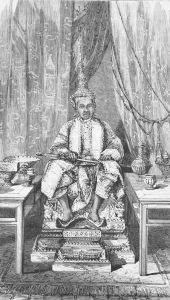
QUEEN OF SIAM.
This map was five feet long by three wide; in the centre was a great patch of red, and above it a small patch of green. On the part painted red—which was intended to represent Siam—was pasted a comical-looking human figure, cut out of silver paper, with a huge pitchfork in one hand and an orange in the other. There was a crown on the head and spurs on the heels, and the sun was shining over all. The legs, which were of miserably thin dimensions, met sympathetically at the knees. And this cadaverous-looking creature was meant for the king of Siam,—indicating that so vast were his strength and power they extended from one end of his dominions to the other. In the little patch of green, intended to represent Birmah, was a small Indian-ink figure, consisting of a little dot for the body, another smaller one for the head, and four scratches of the pen for the legs and arms; this was meant for the king of Birmah. A legion of little imps, in many grotesque attitudes, were seen dancing about his dominions; and these almost unintelligible hieroglyphics were to show to the uninitiated in what a disturbed state the Birman Empire was, and what an insignificant personage in his own dominions was the king of that country. On the north side of the green patch was painted a huge Englishman, sporting a cocked hat with red feathers, clasping in his arms what was meant for a vast tract of land. This was marked as British Birmah, and the Englishman was Lord Clive, holding on to it. The rest of the map was all blue, and all around the Siamese territories richly painted and heavily freighted ships were sailing to and fro. But the poor Birmese monarch had not a boat to display. My simple pupils knew just so much as this map taught them, and no more. Birmah on the north, and Siam on the south, and the sea all around,—this was the world to them.
But of their celestial geography they could tell me a host of interesting particulars, all of which they would relate with the accuracy and picturesque vividness of a fairy tale; and whenever a dispute arose as to the height of some of the mountains or the depth or breadth of the oceans in the celestial worlds, they would at once refer to a Siamese book, called "Tri Loke Winit Chai,"—a book which settles all questions about the three worlds, of angels, of demons, and of gods,—and find therein a satisfactory solution of their difficulties. In their celestial chronology they were all equally well grounded. A little fellow of nine years old, when speaking of "time," stood upright in his chair and informed me that he was "time." His name signified a period of time appointed for the creation or the destruction of a world. He then proceeded to tell me with wonderful clearness for one so young, "that the first time, or Kâp, is reckoned by the Siamese from the appearance of a certain cloud called god-thirst, which was the harbinger of a creative rain, and which brought into existence the worlds and their attendant suns and moons; that the second Kâp, or time, is the period between the creation of these worlds and the coming of another great cloud denominated the dissolving cloud, and which is the third Kâp and the forerunner of the dissolution of the worlds; and the fourth Kâp is the period when matter remains in a chaotic mass, waiting for the generative cloud,—god-thirst,—which again pours forth the creative rain, and life once more springs into being. These four periods added together make a Maha-Kâp."
When I pressed him to state the number of years contained in a Maha-Kâp, he became indignant, and replied, "that as the length of a single Kâp could not be computed by the gods themselves, it was unreasonable for me to suppose that he could give me any correct estimate of their actual duration."
I soon found that my pupils were in some respects much wiser than I, and thenceforth we exchanged thoughts and ideas. I gave them sound realities in return for their poetic illusions and chimeras, which had for me a certain charm and a great deal of odd reasonableness, for it was their way of explaining the incomprehensible.
When a large English map and globes of the celestial and terrestrial spheres arrived, they created quite a sensation in the ancient temple of the "Mothers of the Free." His Majesty caused the map to be set in a massive gold frame, and placed it with the globes on ponderously gilt supporters in the very middle of the temple, and for nine days crowds of women came to be instructed in the sciences of geography and astronomy, so that I found my hands quite full. It was hard for them to see Siam reduced to a mere speck on the great globe, but there was some consolation in the fact that England occupied even a smaller space. After the first excitement had worn off, my pupils began to enjoy their lessons; they would cluster round the globes, delighted with the novel idea of a world revolving in space, and some of them were as keen as any Arctic explorer for the discovery of the North Pole, where they could some day sit astride, as they thought, with perfect ease and security, and satisfy their doubts about the form and the revolution of the earth.
I found them always full of eager inquiry, unlike most Western children, about the sun and moon and stars; but they preferred to have them peopled with demons, ghosts, and hobgoblins, rather than to have them uninhabited.
On one occasion, when I informed them that the moon was supposed to be uninhabited, all the little eager faces were clouded, and their interest flagged, and little Wanee declared, "that for her part she was convinced that the moon was the beautiful daughter of a great king of Ayudia, who lived many thousands of years ago, and the head wife of the sun, and not a great stupid ball of earth and rock rolling about in the sky to no purpose but for the sun to shine upon."
One day the steamer "Chow P'haya" brought his Majesty a box of ice from Singapore, and I obtained some for an object-lesson. The women and children found no difficulty in believing that it was water frozen; but when I went to tell them about snow, the whole school became indignant at what they considered an evident stretch of my imagination, and my dear simple friend, Hidden-Perfume, laid her hand gently upon my arm, and said, "Please do not say that again. I believe you like my own heart in everything you have taught to me, but this sounds like the story of a little child who wishes to say something more wonderful than anything that was ever said before." So my lesson of the snow proved a stumbling-block to me for several days; my pupils' imaginations had taken alarm, and they could not be brought to believe the simplest statements.
I informed his Majesty of my dilemma; he came to my aid, and assured the royal children that it was just possible that there was such a thing as snow, for English books of travel spoke frequently of some phenomenon which they designated as "snow."
On another occasion, as we were all busily engaged in tracing the river Nile on an ancient map of Egypt, there fell suddenly from the vaulted roof above our heads, and upon the very centre of our chart on the table, a coil of something that looked at first like a beautiful thick silk cord neatly rolled up; in another instant, however, the coil unrolled itself, and began to move slowly away. I screamed, and fled to the extreme end of the temple. But what was my surprise to see all my pupils sitting calmly in their seats, with their hands folded in veneration and their eyes fixed in glowing admiration on the serpent as it moved in tortuous curves along the entire length of the table. With a blush of shame and a sense of inferiority I returned to my seat and watched with them the beautiful creature; a certain feeling of fascination dawned upon me as I looked into its clear, bright, penetrating eyes; the upper part was of a fine violet color, its sides covered with large scales of crimson edged with black; the abdominal parts were of a pale rose-color edged likewise with black; while the tail terminated in tints of a bluish ash of singular delicacy and beauty. As the snake slowly dragged itself to the end of the table I held my breath in terror, for it dropped on the arm of the chair on which the Prince Somdetch Choufa Chulalonkorn was seated, whence it fell on the floor, trailed itself along through the dim corridor and down the steps, and finally passed out of sight under the stone basement of the temple.
On the moment of its disappearance my pupils jumped up from their seats and clustered around me in the wildest joy, caressing me, and declaring that the gods loved me dearly, else they would not have sent me such an auspicious token in favor of my teaching. I was told that the gliding of the snake all over the table was full of happy omens, and that its dropping on the arm of the Prince's chair was an unmistakable sign that he would one day become famous in wisdom and knowledge. All the old and young women congratulated me, as did even the king himself, who, when he heard of the singular visitor we had had, caused the circumstance to be made known to the wise men and women of the court, and they all united in pronouncing it to be a wonderful and inspiring recognition of favor from on high. From this time I was treated with great consideration and respect by the simple-hearted women and mothers of the harem, but I nevertheless felt not a little uncomfortable for days after the sudden descent of the snake, and secretly hoped I might never again be so signally favored by the gods.
I afterwards learned that this snake has three names. In Sanskrit it is celebrated as the Sarpa Rakta, the red snake, who brings secret omens from the gods; in Pali, as the Naghalalvana, the crimson snake of the woods, who carries on his person in glowing letters the name of his great master; and in Siamese, Gnuthongdang, the crimson-bellied snake, who brings with its appearance all that is good and great to the beholder.
I leave it with my readers to decide which is the better, our inherited dread of and desire to destroy the serpent race, or the Siamese custom of idealizing, though with a certain superstitious reverence, the meanest of the works of nature.
Among the ladies of the harem, I knew one woman who more than all the rest helped to enrich my life and to render fairer and more beautiful every lovely woman I have since chanced to meet. Her name translated itself—and no other name could ever have been so appropriate—into "Hidden Perfume." Her clear, dark eyes were clearer and calmer, her full lips had a stronger expression of tenderness about them, and her brow, which was at times smooth and open, and at others contracted with pain, grew nobler and more beautiful as the purposes of her life, strengthened by new elements, grew deeper and broader each day.
She had been deprived of her opportunity of loving as a wife and a woman, and the sorrow that had broken up the fountains of her nature now caused them to flow into deeper channels, for she had become an earnest and devoted mother.
Our daily lessons and talks had become a part of her happiest moments. They gave her entrance into a new world, without requiring that she should abandon any part of the old world she had known, or that she should accept any new religious feelings or dogmas. Her aim was to find out all things that are pure, noble, brave, and good, and to adopt them, whether Pagan or Christian in their origin, and to leave dogmas, creeds, and doctrines to those who were inclined to them by temperament.
One day, it being the Siamese Sâbâto (Sabbath), I called at her house on my way home. In passing into the little room that she had fitted up to receive me, and which we had dignified with the title of "the study," I saw that my friend, in the room adjoining, was at prayer, kneeling before her altar, on which was a gilt image of the Buddha, while on either side hung pictures of the king and her little son. The room in which she knelt was a gay one, covered with Birmese paper, on which were seen huge trees, some standing, and others uprooted and carried away by the inundation of a mighty tropical river, here and there drifting along passive and lifeless, and anon covered with gay flowers. Thousands of miles distant the sun left open his golden gates, that his waves of light might rest in benediction and with protecting fondness on her dark, upturned face and colored brow. There was a mysterious joy in her worship, which transfigured by its soft inner light her otherwise not beautiful face, and she seemed as if she were holding direct communion in her inner soul with the Infinite Spirit. I stepped into the study and waited until her prayer was offered up. In a little time after I heard her clear voice calling me, and in another moment I was seated beside her at the foot of her pretty little altar. She then asked me to look at her paper, which I did, telling her that I thought it was a very gay one indeed for her little oratory.
"I see you do not understand the meaning of it." And she proceeded to explain the allegory to me in her quaint and broken English.
"That big green tree there," said she, "is like unto me when I was young and ignorant, rejoicing in earthly distinctions and affections; and then I am brought as a gift to a great king, and only think how grand and how rich I may become; and there you see that I am drooping and my leaves are all withering and begin to fall; here I am shattered and uprooted by a sense of sorrow and humiliation, drifting along an impetuous river, but by and by a little flower stops my downward course. That little flower is my child; he springs out of the very waters which threatened my destruction; and now he grows into a garden of flowers, to hide away from me that which would make me sad and sorrowful again; and now I am always glad."
After a little while, desirous of knowing what the glittering image of Buddha really was to her, I said kindly: "Sonn Klean, you were praying to that idol?"
She did not reply at once, but at length, laying her hand gently upon my arm, said: "Shall I say of you, dear friend, that you worship the ideal or image which you have of your God in your own mind, and not the God? Even so say not of me that I worship the golden image up there, but the Great One who sent me my teacher Buddha, that he might be the guide and the light of my life."
On another occasion when she read and translated the Sermon on the Mount, she suddenly exclaimed with great emotion: "O, your sacred P'hra Jesus is very beautiful! Let us promise one another that whenever you pray to P'hra Jesus you will call him Buddha, the Enlightened One; and I, when I pray to my Buddha, I will call him P'hra Jesu Karuna, the tender and sacred Jesus, for surely these are only different names for the one and the same God."
Her favorite book, however, was "Uncle Tom's Cabin," and she would read it over and over again, though she knew all the characters by heart, and spoke of them as if she had known them all her life.
On the 3d of January, 1867, she invited me to dinner, and she sent to me, in the course of the day, so many messages, telling me to be sure to come, that I began to suspect it was going to be a very grand entertainment. So I put on my best dress, and made myself as fine as I could.
My friend was looking down the street, with her head and shoulders out of her window, as we appeared, and the moment she saw us she rushed to greet us in her own sweet, cordial manner. Dinner was served in the study, for it boasted of one table and five chairs; but our party numbered six in all, so my boy and the Prince Kreta B'hiniharn were obliged to squeeze themselves into one chair, and then there was one apiece for the rest of us. We were served by Peguan slave-girls in the Peguan fashion, on little silver plates, the slave-girls kneeling around us. Fish, rice, jelly, and a variety of sweetmeats, came first, then different kinds of vegetables; after them a course of meat, venison, and birds of all kinds, and we finished with sweet drinks, preserves, and fruit.
When dinner was over, my friend, in concert with her sisters and slave-girls, performed on several musical instruments with wonderful effect. At last all Sonn Klean's slave-women with their children appeared in a group, one hundred and thirty-two in all, in nice new dresses, all looking particularly happy.
"I am wishful to be good like Harriet Beecher Stowe,"—or Stowâ, as my friend persisted in pronouncing that name,—"and never to buy human bodies again, but only to let go free once more, and so I have now no more slaves, but hired servants. I have given freedom to all of my slaves to go or to stay with me as they wish. If they go away to their homes, I am glad; if they stay with me, I am still more glad; and I will give them each four ticals every month after this day, with their food and clothes."
Thenceforth, to express her entire sympathy and affection for the author of "Uncle Tom's Cabin," she always signed herself Harriet Beecher Stowe; and her sweet voice trembled with love and music whenever she spoke of the lovely American lady who had taught her, "even as Buddha had once taught kings," to respect the rights of her fellow-creatures.
During a severe illness which confined me a month or more to my room, I used to receive the most affectionate letters from this dear lady, signed Harriet Beecher Stowe; and when I once more returned to the palace, she took all the credit of my recovery from an illness so fatal as cholera as due to her intercessions and prayers. In one temple she had vowed that she would save seven thousand lives if mine were granted to her prayers.
I was perplexed and curious to know how she would perform the conditions of such a vow, but she assured me there would be no difficulty about it, and forthwith despatched her servant-women to the market to purchase seven baskets, containing each a thousand live fish, which, with great pomp and ceremony, were set free again in the river, and the seven thousand lives were thus actually saved.
One day, when I was sitting with my friend in her little study, she learned that I had recently lost a very dear relative, and she related to me, in a voice full of the tenderest sympathy and affection, the following Buddhist legend, which I give here as nearly as possible in her own words.
"In the village of Sârvâthi there lived a young wife named Keesah, who at the age of fourteen gave birth to a son; and she loved him with all the love and joy of the possessor of a newly found treasure, for his face was like a golden cloud, his eyes fair and tender as a blue lotus, and his smile bright and beaming like the morning light upon the dewy flowers. But when the boy was able to walk, and could run about the house, there came a day when he suddenly fell sick and died. And Keesah, not understanding what had happened to her fair lotus-eyed boy, clasped him to her bosom, and went about the village from house to house, praying and weeping, and beseeching the good people to give her some medicine to cure her baby.
"But the villagers and neighbors, on seeing her, said: 'Is the girl mad, that she still bears about on her breast the dead body of her child?'
"At length a holy man, pitying the girl's sorrow, said to himself: 'Alas! this Keesah does not understand the law of death; I will try to comfort her.' And he answered her, and said: 'My good girl, I cannot myself give you any medicine to cure your boy, but I know a holy and wise physician who can.'
"'O,' said the young mother, 'do tell me who it is, that I may go at once to him!'
"And the holy man replied, 'He is called the Buddha; he alone can cure thy child.'
"Then Keesah, on hearing this, was comforted, and set out to find the Buddha, still clasping to her heart the lifeless body of her child. And when she found him she bowed down before him, and said: 'O my lord and master, do you know of any medicine that will cure my baby?'
"And the Buddha replied and said: 'Yes, I know of one, but you must get it for me.'
"And she asked: 'What medicine do you want? Tell me, that I may hasten in search of it.'
"And the Buddha said: 'I want only a few grains of mustard-seed. Leave here the boy, and go you and bring them to me.'
"The girl refused to part with her baby, but promised to get the seed for him.
"As she was about to set out, the pitiful Buddha, recalling her, said: 'My sister, the mustard-seed that I require must be taken from a house where no child, parent, husband, wife, relative, or slave has ever died.'
"The young mother replied, 'Very good, my lord'; and went her way, taking her boy with her, and setting him astride on her hip, with his lifeless head resting on her bosom.
"Thus she went from house to house, from palace to hut, begging for some grains of mustard-seed.
"The people said to her: 'Here are the seeds; take them, and go thy way.'
"But she first asked: 'In this, my friend's house, has there ever died a child, a husband, a parent, or a slave?'
"And they one and all replied: 'Lady, what is this that thou hast said? Knowest thou not that the living are few, but that the dead are many? There is no such house as thou seekest.'
"Then she went to other houses and begged the grains of mustard-seed, which they gladly gave her, but to her questionings one said, 'I have lost a son'; another, 'I have lost a parent'; and yet another, 'I have lost a slave'; and every one and all of them made some such reply.
"At last, not being able to discover a single house free from the dead, whence she could obtain the mustard-seed, and feeling utterly faint and weary, she sat herself down upon a stone, with her baby in her lap, and thinking sadly said to herself: 'Alas! this is a heavy task I have undertaken. I am not the only one who has lost her baby. Everywhere children are dying, parents are dying, loved ones are dying, and everywhere they tell me that the dead are more numerous than the living. Shall I then think only of my own sorrow?'
"Thinking thus, she suddenly summoned courage to put away her sorrow for her dead baby, and she carried him to the forest and laid him down to rest under a tree; and having covered him over with tender leaves, and taking her last look of his loved face, she betook herself once more to the Buddha and bowed before him.
"And he said to her: 'Sister, hast thou found the mustard-seed?'
"'I have not, my lord, she replied, 'for the people in the village tell me there is no house in which some one has not died; for the living are few, but the dead are many.'
"'And where is your baby?'
"'I have laid him under a tree in the forest, my lord,' said Keesah, gently.
"Then said the Buddha to her: 'You have found the grains of mustard-seed; you thought that you alone had lost a son, but now you have learned that the law of death and of suffering is among all living creatures, and that here there is no permanence.'
"On hearing this Keesah was comforted, and established in the path of virtue, and was thenceforth called Keesah Godami, the disciple of the Buddha."[46]
The pleasantest of the days that I spent in the city of the "Nang Harm" were those that fell on the first full moons in the months of May, which days are always held as the anniversary of the birth, inspiration, and death of the Buddha. On the morning of the 21st of May, 1864, I was conducted by a number of well-dressed slave-women to the residence of my pupil, the "child wife." Her house was a brick building with a low wall running round it, which took in some few acres of ground devoted to gardens and to residences for her numerous slaves and attendants. I was the first, that morning, to pass between the two brick and mortar lions which guarded the entrance, and after a kindly greeting I took my place at the inner end of the hall or antechamber which gave access to the residence.
The "child wife," a remarkably pretty little woman, dressed in pure white silk, stood in the hall beside a small marble fountain, with her two sons on either side of her. All round the fountain were huge China vases containing plants, covered with flowers, and between them were immense silver water-jars, each large enough to hold a couple of men, and each containing a huge silver ladle. Thirty or more young slave-women were engaged in filling them with cool fresh water drawn from a well in the garden.
The hall was freshly furnished with striped floor-matting, and with cushioned seats for a hundred guests. In the garden opposite the doors of the hall was a circular thatched roof supported on one great mast, like a single-poled tent, and this was the theatre erected for the occasion. In one part was an elevated stage for the marionettes, and the whole was very gracefully and prettily ornamented, showing, as did everything around, a desire to please and to entertain. Some fifty women-porters came from an inner court, hearing on their heads massive silver dishes of sweetmeats and choice viands, and placed them along the hall; then came some maidens dressed in pure white, and arranged flowers in small gold vases beside each of the seats designed for the expected guests; and when this was done they took their places behind their mistress.
It was early morning, just seven o'clock. But this entire woman's city had been up for hours engaged in the important work of rightly celebrating the great day. The grounds around the house were all in a glow with roses, and the pure silver of the water-jars glistened resplendently in the morning sunlight.
The gate was thrown wide open, and into this fairy-like scene, amid flowers and sunshine and fragrance, and the dew still trembling on the leaves, were ushered in the guests, one by one,—a hundred decrepit, filthy, unsightly looking beggar-women covered with dirt and rags and the vilest uncleanliness.
And the "child wife," who might have numbered twenty-five summers, but who looked as if she were only sixteen, blushing with a delicacy and beauty of her own, advances and greets her strange guests with all the more respect and tenderness because of their rags and poverty, leads them gently and seats them on low stools around her sparkling fountain, removes their disgusting apparel, and proceeds with the aid of her maidens to wash them clean with fragrant soap and great draughts of cool water ladled out of the silver jars. What a transformation, when the matted hair was washed and combed and parted and dressed with flowers, and the rags were replaced by new robes of purest white! Then she led them towards the hall, and seated them on the silk cushions before the silver trays, and bowed on her knees before them and served to them the delicacies prepared for them, as if they each one and all deserved from her some special token of her love and veneration. After breakfast the music struck up and the actors and puppets appeared on the stage. The music was particularly good. The royal female bands were assembled for the occasion, and relieved each other in succession; the acting was occasionally interspersed with the plaintive notes of female voices; the priestesses of this beautiful scene, who seemed sometimes deeply moved, collected from within themselves all the charms and joys of love to pour them forth with the inspiration of music at the feet of their lowly listeners.[47]
And at length, as the curtain of the last act dropped, and the prolonged cadence of the voices and the instruments died away, a loud buzz of delight and pleasure broke from the listening crowd of old, decrepit women, who received each a sum of money from their kind hostess, and went on their lonely way rejoicing.
"This," said my friend to me, "I do every year, to show my love and obedience to my dear teacher, the Buddha." And to my unaccustomed heart and eyes it seemed the sight in all the world the most worth gazing upon.
FOOTNOTES:
CHAPTER XXX.
THE SIAMESE SYSTEM OF SLAVERY.[48]
Under the late king, his Majesty Somdetch P'hra Paramendr Maha Mongkut, there existed in Siam a mixed system of slavery, in part resembling the old system of English feudal service, in part the former serfdom of Russia, and again in part the peonage of Mexico.
Three fourths of the population of Siam are in this condition of modified slavery, branded with the mark of their owners, or held by their creditors in a form of qualified servitude to work out a debt. The royal family, princes, and chief rulers and magistrates of the country, are the only exceptions to this rule. But even they are obliged to serve the king in times of war, or to provide a fitting substitute.
"Slaves," in the minute subdivisions of the law, are classed under seven different heads: first, prisoners of war; second, slaves by purchase; third, slaves by birth; fourth, by gifts and legacies; fifth, those who become slaves from gratitude; sixth, voluntary slaves in times of famine; seventh, debtors and their children.
But these may all be embraced in three general classes, called Prie, Baw, and Bâtt, that of slaves by birth and attached to the land, of slaves by purchase, and of slaves captured in war.
The prisoners of war and their descendants are composed of the following nations and numbers: Malays, fifty thousand; Cochin-Chinese, seventy-five thousand; Peguans, one million; Laotians, twenty-five thousand; and Birmese, fifty thousand. All these, with few exceptions, belong to the kings of Siam. Some few are given to the principal nobles and chiefs who have distinguished themselves in the state; but even these, with their descendants, are held as Baw Chow Chewitt,—the king's slaves. The Cochin-Chinese captured in war, and all their numerous descendants, belong exclusively to the second king,—the first or supreme king having a positive antipathy to that people. They are formed into an army under the command of the second king, to guard his person, palaces, harem, etc.
The Malays and Peguans are employed as sailors and soldiers in company with the native Siamese. These are all branded on the left side a little below the armpit, and they are bound to serve three months in every year; the remaining time they may employ in their own private interests.
The slaves by purchase are divided into two classes, "redeemable" and "irredeemable." The first class must furnish security that they will fulfil the legal requirements of their masters. These can always free themselves by refunding the purchase-money, or can change their masters on procuring payment of the sum due to the old masters.
The second class are chiefly young girls sold by their parents, relatives, or owners; with these no security is either given or taken, because they generally become the wives or concubines of the buyer. As a natural consequence more than four fifths abscond whenever they get an opportunity, and the owner has no redress. Women-slaves are not branded or enrolled as the men-slaves are.
Husbands may sell their wives, parents their children, and masters their slaves and debtors; but no one can sell an adult man-slave after he is sixteen, or a woman-slave after she has attained puberty, without his or her consent.
Prices of slaves vary according to the appearance, color, strength, physical proportions, and parentage of the person sold, from one hundred and twenty ticals for men, and sixty to a hundred ticals[49] for women. But if the woman be fair and pleasing in form and feature, she will bring as much as a thousand ticals for the harem of a great noble.
The method of selling one's self is very simple. Every man, on becoming a slave, signs an agreement, of which I give a copy below. This paper his master retains, but is obliged to surrender whenever the slave produces the amount mentioned in it.
"Wednesday, the seventh day of the waning moon of the year 1227 of the little era Choola Sakarat,[50] I, Khow, sell myself to Nai Dang for ticals one hundred and twenty, to be refunded by me, Khow, at the time and hour of being set free."
Such is the bill of sale. But as it generally happens that the parents have also sold themselves, some other security is required, which is given in another paper. The value of anything that the slave may break or destroy is added to the original account.
The masters are bound to furnish their slaves with rice and fish daily, but not with clothes.
The position of the slaves by birth differs in no respect from that of slaves by purchase, with the exception that while the prices of the latter vary, the price of the former is fixed by law for every age, size, and sex, and the owners cannot demand more for them than that which is determined by the law.
The severest punishment for slaves is being made to work in chains. If no improvement takes place from this punishment, the slave is handed over to the king's judges, and is, provided the crime or misdemeanor is proven, incarcerated in the Siamese convict prison,—a punishment to which death itself is preferable.
The principal hardship that the slave suffers is being obliged to marry at the will of his or her owner, and this with a people who are highly susceptible of conjugal affection is often the cause of great suffering to the women.
Then comes the difficulty of lodging a complaint against their masters for an insufficiency of food, and sometimes for an absolute want of clothes, for which latter even the law does not hold the master responsible.
There are four conditions under which a slave is freed from the obligations of servitude,—slaves voluntarily manumitted by their masters; slaves admitted to the priesthood; those who are given to serve the priests; and when the master himself takes the vows of a priest, he is obliged to free all his slaves, as the ecclesiastical court will not otherwise receive him into the priesthood, and he can at no time reclaim them for actual service, unless on quitting the priesthood he repurchases them.
Debtors may be made slaves when they do not pay the interest for money borrowed, and will not work to make good the failure of payment; and in case of death the nearest relative becomes a slave till the original amount, with the interest added, is refunded. The rate of interest in Siam is about thirty per cent, and the poor are unable, unless by labor, to pay such an exorbitant rate.
If the bought or rather the redeemable slave should die in his master's service,—even after a lifetime of labor,—the security must refund the original sum or become a slave in his stead. If a slave be sick, and is attended to during his illness in his master's house, the security is liable for the interest of the slave's purchase-money during the period of illness. When children are sold under the full value, they must not be beaten till they bleed.
When a slave volunteers out of affection for his master or mistress to take his or her place in prison or in torture, one half of his or her purchase-money must be refunded to the security. But if the slave is irredeemable, no part is to be refunded.
If a man sell a slave, and after receiving the money refuse to give him or her up to the purchaser, he shall pay double the sum,—three fourths to the buyer and one fourth into the government or state treasury.
If a buyer disapprove of a slave before three months have elapsed, he may recover his money.
If a master strike his slave so that he die, no claim can be made upon the security, and the master shall be punished according to the law.
Anything that a slave may break can be added, at the will of the owner, to the purchase-money.
If in herding cattle he be negligent, and they be lost, he shall pay for them; if more be given into his charge than he can attend to, he shall pay only half; but if robbers bind him and steal the cattle, he cannot be held responsible.
Any claim against a slave must be made by the owner before he is sold to another party.
If a master or mistress force a female slave to marry one man when she has openly professed a preference for another, half her redemption-money must be remitted.
If a slave go to war instead of his master, and fight bravely, he must be set free at the termination of the battle. If he fight only ordinarily well, half his purchase-money shall be remitted.
If a master repurchase a slave, and he die in his service, he can demand only half the original amount from his security.
If a slave begin to plant rice, he cannot, even if able, purchase his freedom until the harvest is over.
If, when rice is dear, a man sell himself to slavery below the standard value, when rice gets cheap the price must be raised, and the balance paid over by the purchaser.
If a slave injure himself while at his master's work, compensation must be made according to the nature of the injury.
If a slave die in the stead or in the defence of his master, nothing can be demanded from the security.
In all cases of an epidemic, nothing can be claimed from the security.
If a man have several wives, and the lesser sell themselves to the higher wives, or the poorer to the richer, no interest can be claimed on the purchase-money, as they are considered sisters in the sight of the law.
If the slave demand a change of masters, and the master cannot dispose of him, he must take him to the judges to sell; and if they find no purchaser within three days, he must return to his master and be thenceforward Khai-Khat, irredeemable.
If a slave run away, the money expended in apprehending him or her must be added to his original account.
Slaves having children, the children become slaves, and must be paid for according to age.
If a master compel a slave to bear a child against her will, both she and the child are free in the sight of the law, even if irredeemable at first.
If a slave complain against his master, the judges will not file the complaint unless he has first paid his purchase-money, except in cases of murder and treason.
If a slave accuse his master falsely of capital crimes, his tongue and lips shall be cut off. But if the charge be true, he shall receive his freedom, even if Khai-Khat irredeemables.
If a slave make money on his or her own private account, at his or her death it will become the property of the master. But if the money be left to him, it shall go to the nearest relative.
In all cases of doubt between the slave-woman and her master, the law shall protect the mother, and the children must be given to her if she bring the price, under penalty of forfeiting both mother and child.
Two slaves, husband and wife, brother and sister, having their names on the same bill of sale, if one run away, the other shall be charged with the entire debt.
FOOTNOTES:
CHAPTER XXXI.
THE ROYAL PROCLAMATIONS.
In the beginning of the reign of P'rabat Somdetch P'hra Paramendr Maha Chulalonkorn, a new era dawned upon the kingdom of the white elephant.
On the 11th of October, 1868, a royal proclamation of the new and auspicious reign was made in all parts of the vast kingdom and provinces of Siam, and a national holiday was appointed. The multitudinous pagoda bells rang all day, while louder still boomed the cannon, up went the rockets, and aloft streamed the red and white banners of the white elephant. Still higher rose the glad hearts of the princes and chiefs of the people, and low in reverential attitudes, even in the very dust, were bowed the heads of the millions of the enslaved subjects.