Front matter (continued 4)
Reading edition
She contrived to be always in favor with the king, simply because she was the only woman among all that vast throng who really loved him; though at no period of her life had she ever enjoyed the unenviable distinction of being the "favorite."
Her natural enthusiasm and kindliness of disposition made her generally loved, however; while, despite her immense wealth and influence, no woman's life had a truer and deeper purpose. She was always ready to sympathize with and help her suffering sisters, whatever their shortcomings might have been, or whatever the means she was obliged to resort to in order to render them the smallest assistance.
She reconciled all her little plots, intrigues, and deceptions to herself by saying: "Surely it is better for him not to know everything; he knows too much already, what with his Siamese and his English and his Pali and his Sanscrit. I wonder he can ever get to sleep at all with so many different tongues in his head."
It was after school that I accompanied one of my most promising pupils, the Princess Somawati, one of Thieng's daughters, to her mother's house. Being the head of the royal cuisine, Thieng had two houses. One was her home, where her children were born and brought up,—a quaint, stately edifice with stuccoed fronts, situated in the ladies' or fashionable part of the inner city, and in the midst of a pleasant garden. In the other, adjoining the royal kitchen, she spent the greater part of each day in selecting, overlooking, and sometimes preparing with her own fair hands many of the costly dainties that were destined to grace the royal table.
Thieng received me with her usual bright, pleasant smile and hearty embrace; to give me the latter, she put down her youngest baby, a boy about two years old, to whom I had, during my repeated visits to her house, taught a number of little English rhymes and sentences, and who always accosted me with, "Mam, mam, how do do?" or "Mam, make a bow, make a bow"; while he bobbed his own little head, and blinked his bright eyes at me, to the infinite delight of his mother and her handmaids.
Little "Chai" settled himself in my lap, as usual, and the host of women, like children eager to be amused, gathered around to listen to our baby-talk; and great was the general uproar when Chai would mimic me in singing scraps of baby-songs, or thrust an orange into my mouth, or put on my hat and cloak to promenade the chamber, and say "How do do?" like a veritable Englishman; then his fond mother, in ecstasies of joy, would snatch him to her arms and cover him with kisses, and the delighted spectators would whisper that that boy was as clever as his father, and must surely come to the throne some day or other.
In the midst of these fascinating employments one of the lady-physicians was announced.
Thieng retired at once with her into an inner chamber, carrying her beloved Chai in her arms, and beckoning me to follow her. Here she consigned Chai to me for further instruction in English, and laid herself down to be shampooed.
I felt that now was my opportunity; but I waited a little in order to make sure whether the doctor was to be trusted.
The ladies were silent for a little while; no word was spoken, with the exception of a sigh that now and then escaped from poor Thieng, partly to indicate the responsibilities of her position, and partly to show that the particular member which was being manipulated was the one most affected. Whatever might have been the question between the ladies, the doctor waited for Thieng to give the word, and Thieng evidently waited for the termination of my visit. But seeing that I made no attempt to go, she at length turned to the doctor, and said: "My pen arai, phöt thöe, yai kluâ" (Never mind, speak out, don't be afraid), all of which I understood as perfectly as I did English.
The doctor ceased her manipulations, and, after having cast a cautious glance round the room and shaken her head sorrowfully, remarked: "I don't think she'll live many weeks longer."
Thieng sat bolt upright, and, clasping her hands together, said, "Phoodth thô!"[31]
"It is impossible," added the doctor, very earnestly. "It were better to put her to death at once than to kill her by inches, as they are now doing."
"P'hra Buddh the Chow,[32] help us!" cried Thieng, still more agitated. "What shall I do? What can I do to save her?"
"Something must be done, and at once," replied the doctor, suggestively.
"Well," said Thieng, "why don't you draw up a paper and give it to Mai Ying Thaphan?" (the chief of the Amazons.) "And now mind that you say she cannot live a day longer unless she is removed from that close cell and allowed to take an airing every day."
"Poor child! poor child!" repeated Thieng, tenderly, to herself. "With such a noble heart to perish in such a way! I wish I could find some means to help her to live a little longer, till things begin to look more bright."
"He has forgotten all about her by this time," rejoined the doctor.
The physician then took her leave of Thieng, and I inquired if they had been speaking of the Princess Sunartha Vismita. The good lady started and looked at me as if she supposed me to be supernaturally endowed with the art of unravelling mysteries.
"Why! how do you know the name," said she, "when we never even mentioned it?"
I then told her of the visit I had had from May-Peâh, and begged of her to help me to deliver the letter to the dying princess as soon as possible.
"We are all prisoners here, dear friend," said Thieng, "and we have to be very careful what we do; but if you promise never to say a word on this subject to any one, and in case of discovery to bear all the blame, whatever that may be, yourself, I'll help you."
I gave her the required promise gladly, and thanked her warmly at the same time.
"You must not think me weak and selfish, dear mam," said she, after a little reflection. "You are a foreigner, he has not the same power over you, and you can go away whenever you like; but we who are his subjects must stay here and suffer his will and pleasure, whatever happens."
With that she told me to come to her after sunset, and I bade her a grateful adieu and returned home.
FOOTNOTES:
CHAPTER XIX.
THE PRINCESS SUNARTHA VISMITA.
AN hour after dark I again sought the good and tender-hearted Thieng, who not only hurried me off, telling me in a voice of great exultation that the physician's report had in a great measure ameliorated the rigorous confinement to which the royal prisoner had hitherto been subjected, but bravely sent two of her women to tell the Amazons to show me the apartment to which the sick princess had been removed.
The small apartment into which I was ushered was dimly lighted by a wick burning in an earthen vessel. The only window was thrown wide open. Immediately beneath it, on a pair of wooden trucks which supported a narrow plank, covered with a flowered mat and satin pillow, lay the wasted form of the Princess Sunartha Vismita. Her dress was that of a Laotian lady of high rank. It consisted of a scarlet silk skirt falling in firm folds to her feet, a black, flowered silk vest, and a long veil or scarf of Indian gauze thrown across her shoulders; some rings of great value and beauty and a heavy gold chain were her only ornaments. Her hair was combed smoothly back, bound in a massive knot behind, and confined by a perfect tiara of diamond-headed pins. She was not beautiful; but when you looked at her you never thought of her features, for the defiant and heroic pride that flashed from her large, dark, melancholy eyes fixed your attention. It was a face never to be forgotten. At her feet were two other truckle-beds; on these were seated the two young Laotian women who shared her captivity, and who looked very wan and sad.
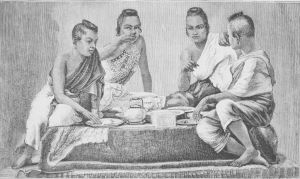
LADIES OF THE ROYAL HAREM AT DINNER.
Advancing unannounced close to this mournful group, I sat down near them, while the dark, depressing influence of the place stole upon my spirits and filled me with the same dismal gloom.
The princess, who had been gazing at the little bit of sky, of which she could only get a glimpse through the iron bars of the open window, turned upon me the same quiet, self-absorbed look, manifesting neither surprise nor displeasure at seeing me enter her apartment.
It was a look that spoke of utter hopelessness of ever being extricated from that forlorn place, and a quiet conviction that she was very ill, perhaps dying, yet without a trace of fear or anxiety.
The air was heavy and difficult to breathe, and for a moment or two I was silent, confounded by the unexpected bravery and fortitude evinced by the prisoner. But, quickly recovering my self-possession, I inquired about her health.
"I am well," said the lady, with a proud and indifferent manner. "Pray, why have you come here?"
With a sense of infinite relief I told her that my visit was a private one to herself.
"Is that the truth?" she inquired, looking rather at her women for some confirmation than at me for a reply.
"It is indeed," I answered, unhesitatingly; "I have come to you as one woman would come to another who is in trouble."
"But how may that be?" she rejoined, haughtily. "You must know, madam, that all women are not alike; some are born princesses, and some are born slaves." She pronounced these words very slowly, and in the court language of the Siamese.
"Yes, we are not all alike, dear lady," I replied, gently; "I have not come here out of mere idle curiosity, but because I could not refuse your foster-sister May-Peâh's request to do you a service."
"What did you say?" cried the lady, joyfully rising, and drawing me towards her, putting her arms ever so lovingly round my neck, and laying her burning cheek against mine. "Did you say May-Peâh, May-Peâh?"
Without another word, for I could not speak, I was so much moved, I drew out of my pocket the mysterious letter, and put it into her hands.
I wish I could see again such a look of surprise and joy as that which illuminated her proud face. So rapid was the change from despair to gladness, that she seemed for the moment supremely beautiful.
Her bps trembled, and tears filled her eyes, as with a nervous movement she tore open the velvet covering and leaned towards the earthen lamp to read her precious letter.
I could not doubt that she had a tender heart, for there was a beautiful flush on her wan face, which was every now and then faintly perceptible in the flickering lamp-light.
A smile half of triumph and half of sadness curved her fine lip as she finished the letter and turned to communicate its contents to her eager companions in a language unknown to me.
After this the three women talked together long and anxiously, the two attendants urging their mistress to do something to which apparently she would not consent, for at last she threw the letter away angrily, and covered her face with her hands, as if unable to resist their arguments.
The elder of the women quietly took up the letter and read it several times aloud to her companion. She then opened a betel-box and drew out of it an inkhorn, a small reed, and long roll of yellow paper, on which she began a lengthy and labored epistle, now and then rubbing out the words she had written with her finger, and commencing afresh with renewed vigor. When the letter was finished, I never in my life saw a more unsightly, blotted affair than it was, and I fell to wondering if any mortal on earth would have skill and ingenuity enough to decipher its meaning. But she folded it carefully, and put it into a lovely blue silk cover which she took from that self-same box,—which might have been Aladdin's wonderful lamp turned inside out, for aught I knew to the contrary,—and, stitching up the bag or cover, she sewed on the outside a bit of paper addressed in the same mysterious and unknown letters, which bore a strong resemblance to the Birmese characters turned upside down, and were altogether as weird and hieroglyphic as the ancient characters found in the Pahlavi and Deri manuscript. When all her labors were completed, she handed it to me with a hopeful smile on her face.
Meanwhile the princess, who seemed to have been plunged in a very profound and serious meditation, turned and addressed me with an air of mystery and doubt: "Did May-Peâh promise you any money?"
On being answered in the negative, "Do you want any money?" she again inquired.
"No, thank you," I replied. "Only tell me to whom I am to carry this letter, for I cannot read the address, and I'll endeavor to serve you to the best of my ability."
When I had done speaking she seemed surprised and pleased, for she again put her arms round about my neck, and embraced me twice or thrice in the most affectionate manner, entreating me to believe that she would always be my grateful friend, and that she would always bless me in her thoughts, and enjoining me to deliver the letter into no other hands but those of May-Peâh, or her brother, the Prince O'Dong Karmatha, who was concealed for the present, as she said, in the house of the Governor of Pak Lat.
I returned her warm embraces, and went home somewhat happier; but I seemed to hear throughout the rest of the night the creaking of the huge prison door which had turned so reluctantly on its rusty hinges.
CHAPTER XX.
PAK LAUT, OR THE MOUTH OF THE OCEAN.
Pak Lat, or, more properly, Pak Laut, is situated a few miles above Pak Nam, and is in itself a picturesque village containing from six to seven thousand inhabitants. The most important portion of the town faces a beautiful bend of the great river Mèinam, and is rather irregularly built, and surrounded by a great many rude houses and shops, some of them quite old, and others quite new.
A magnificent new Buddhist temple is seen gradually raising its head close by the side of an ancient one which has so far crumbled to decay that the bright sun pours down unchecked a flood of golden light on the tapering crown of a huge brass image of the Buddha, which sits with its hands folded in undisturbed and profound contemplation on its glittering altar. On the other side, as far as the eye can reach, stretch unlimited groves of bananas and extensive plantations of cocoanut and betel-nut palms. The mango, tamarind, banyan, and boh, or bogara, trees here are of wonderful size and beauty, ponderous and overshadowing, as if they had weathered a thousand summers and winters, and would live unimpaired through a thousand more; and as you wander through the deep cool shade which they afford, you find that many of them must have served hundreds of years ago—before Buddhism was introduced into Siam, and at a period when both the "Tree" and "Serpent" worship prevailed here, as in other parts of the Old World—as altars to a generation long gone by.
Many of their huge old trunks have been hollowed out and carved in the form of oriel chapels or windows, in the inmost recesses of which may still be traced the faint remains of what was intended to represent the cobra-de-capello, or hooded snake of India, now covered over with tender leaves and brilliant flowers, and forming at once the cosiest and most delicious of couches for the weary traveller to rest upon.
Pak Laut, with all its ancient splendor and attractiveness, had one drawback, and that was a very serious one. Among the village edifices was an open sala, or hall, which had long been the favorite place of rendezvous for all the rough and riotous seamen, English and American, the crews of the merchant vessels trading to Bangkok; and it was in consequence set down in the code of etiquette observed by the dozen or so of the élite of the English and American foreigners who resided at Bangkok "as a dreadfully improper place for a lady to visit alone."
Thus it was quite out of the question that I should go there without an escort, and not be tabooed by those good people as one utterly outside of the pale of their society.
Luckily, at this time Monsieur M——, an attaché to the French consulate, had been sent by Dr. Campbell to Pak Laut for change of air, and Monsieur L——, the commander of the king's guard, and his wife, were going to see him. Being acquainted with the invalid, I obtained their permission to make one of the party.
Notwithstanding the perplexity of friends, who could not imagine my motive for going there, and who made themselves quite merry at my expense, I found myself in a boat, with the blue letter pinned in my pocket, my boy at my side, and Monsieur and Madame L—— opposite me, at five o'clock one morning, sailing down with the tide to Pak Laut.
When I arrived there, I made a hasty breakfast with the sick man and his friends, and leaving my boy at play in charge of the lady, I hurried off in the direction of the governor's palace.
P'haya Keean, the governor, was a Peguan prince by birth, and the father of my dear friend, whose name, translated into English is "Hidden Perfume."
He received me so kindly and looked so benevolent that I felt encouraged to tell him the object of my visit at once.
Taking my hand in his, and keeping the smile of appreciation on his honest face, he led me through several long halls and corridors, which brought us at length to a very queer-looking old tower, covered with moss and black with age, with narrow loopholes for windows, and surrounded by a deep moat or ditch full of stagnant water.
From the roof of this extraordinary building descended two flights of steps built in the wall, and leading directly to two ruinous old drawbridges that spanned the moat. The one communicated with the governor's palace, while the other led to a low arched gateway which opened immediately on a canal, and thus had access to the river.
What the moat was intended for I could in no wise imagine, unless it were especially designed to connect the tower, independent of the bridges, with the river, and thus, in cases of necessity, afford the inmates an opportunity of immediate flight by water. There were two boats on the moat, ready for any such emergency.
The governor left me standing outside of the low wall that skirted the moat, crossed one of the crumbling old bridges, and entered the tower through an arched doorway, solemn and ponderous as if it had withstood the storms of many a dreadful siege.
In a few minutes May-Peâh, the Laotian slave-girl, came running out, crying, "O, I love you dearly! I love you dearly! I am so happy. Come in, come in and see the prince!" So saying, she pulled me after her into that singular, toppling-down-looking old edifice, which I must confess inspired me with a dread that I could not overcome, nor could I divest myself of the feeling that I was under the influence of some wild, fantastic dream.
The only floor of the old tower (for there was but one) consisted of three rooms; one was rather large, and might have been in its best days of a vermilion color, but was now utterly discolored by great patches made by rain-water, which had changed it to a dull, yellowish, muddy hue. It was an ancient and gloomy-looking apartment, with all manner of rusty and antique Indian armor, shields, banners, spears, swords, bows and arrows, and lances ranged along the wall, which seemed to have been wielded by men of gigantic stature, and pointed to an epoch beyond the memory of the present race. Passing through this hall, we entered another and smaller room, the walls of which had also once been painted with gigantic flowers, birds, and beasts, among which the figure of the crocodile was most conspicuous. It contained a bed of state which looked like Indian, i.e. Bombay, workmanship, lifting to the ceiling a high, solemn canopy of that ponderous flowered silk called kinkaub.
I cannot depict the scene: how the glimmering light within and the changing lights without, reflected from the dark green waters, touched upon and singled out for a momentary illumination one after another the picturesque arms and the gigantic pictures on the walls, and diffused an air of mystery over the whole.
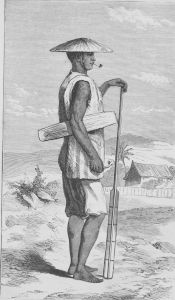
A LAOTIAN.
"Welcome, welcome, brave friend!" said one of the three dark young men I found seated within, who rose and came to meet me with a singular gesture of courtesy and respect, and whom I at once recognized, from his strong likeness to the Princess Sunartha Vismita, to be the Prince P'hra O'Dong Karmatha. The prince, for it was he, with an excitement he could not quite control, inquired if I had seen his sister. As I spoke, May-Peâh drew near and listened to what I said, with intense interest and anxiety expressed in her fine face. But when I handed the prince the letter, they were all inexpressibly delighted. All the others waited anxiously, turning silent looks of sympathy and affection on him, as he read it first to himself, and then aloud to the party.
"May-Peâh" were the only two words I understood of its contents; but I saw two big drops like thunder-rain fall suddenly from the eyes of P'hra O'Dong on the blotted yellow paper, and his voice died away in a hoarse whisper as he concluded the strange epistle.
After which the party were silent, saying nothing for nearly a whole hour, as it appeared to me, and absorbed each with his own thoughts.
Then P'hra O'Dong cast an upward glance as if in prayer, and May-Peâh crept quietly to his side and looked at him with the calm, deep determination of high and noble resolve depicted on her fine face. The two faces presented the strongest contrast possible,—the one dark, troubled, impetuous, and weak; the other resolute, passionate, unchangeable, and brave. I wanted no further proof of the nature of the friendship which May-Peâh bore to the young prince and his sister. There are times when one almost knows what is passing in the mind of another. Thus it was that I was able to form some glimmering conception of the elevated character of the slave-woman before me.
It was time for me to go. The prince begged me to take something from him by way of compensation, but I declined, thanking him all the same, and carrying away with me only loving words of comfort and hope to his long-imprisoned sister and her companions.
May-Peâh followed me out, and her fine face—for the oftener I saw it the finer it looked—was never more expressive than when she thanked me, and bade me tell her beloved mistress to keep a stout heart, adding, in a whisper: "I do not know what I am going to do, but something shall be done to save her, even if I die for it."
It was in vain that I urged her to be patient, and not to do anything so rash as to attempt the rescue of the princess; nothing that I could say would move her from her purpose.
The day, though it commenced brightly, now began to be overcast, and the tide was turning for Bangkok, so I left her. As we parted, she was standing in one of the long corridors, with her hands folded and raised high above her head, and a flood of tender emotions brimming over into her eyes.
CHAPTER XXI.
NARRATIVE OF THE PRINCESS OF CHIENGMAI.[33]
My good friend Thieng arranged another interview for me with the princess, who seemed wonderfully improved in health and spirits, and who related to me, almost word for word, the following narrative.
"The Prince P'hra O'Dong Karmatha and I are the only children of the Prince P'hra Chow Soorwang, the brother of the present king of Chiengmai. Chiengmai is now tributary to Siam. But there was a time when my ancestors were the independent sovereigns of all the land lying between Pegu and Birmah on the one hand, and Siam and the mountains of Yunan on the other.
"It was the Prince P'hra Chow O'Dong Karmatha, after whom my brother was named, who founded the beautiful city of Chiengmai, and built those stupendous works which bring water to its inhabitants.
"My poor mother died at the time of my birth, and May-Peâh's mother brought me up as if I were her own child; and thus May-Peâh and I became sisters in the flesh, as we are indeed in spirit.
"My brother, the Prince O'Dong, is just seven years my elder. He was fond of pleasure, but he loved glory and honor and independence still more, and it was ever a source of mortification to him that our house should be obliged to pay the triennial tribute which the sovereign of Siam exacts as our homage of fealty.
"It was on one of these occasions, when my brother became the representative of our uncle, and the hearer of the gold and silver trees to the court of Siam, that he met with his Royal Highness P'hra Somdetch Pawarendr Ramasr, the second king of Siam. Being both fond of the chase, and experienced hunters, they formed a strong friendship the one for the other.
"God forbid that I should disparage the supreme king of Siam, but every one who knows them will admit the superiority of the younger brother," said the lady, proudly.
"Soon after this the second king came on a visit to our home, and accompanied my brother on many a hunting expedition. I cannot describe to you my first meeting with the prince, whose praises had already inflamed my imagination. If I could coin words of deeper meaning, or if I could learn from the angels some new language wherein fitly to clothe the higher and purer joy that fell upon me in his presence, I might reveal to you something of the charm and the spell of that hour.
"When he at length returned to Sarapure, I was as one who had lost the key-note of her existence.
"My brother, apprehending the cause of my grief, sent May-Peâh, unknown to me, to Sarapure, to serve in any capacity whatever in the palace of the prince, and to discover, if possible, the state of his affections.
"May-Peâh and her mother set out for the palace of Ban Sitha. Having arrived there, she contrived to get admission into the harem of the prince, in order to visit some of her friends. While there, she drew out of her vest a silver flute, and played it so exquisitely—for she is the best musician in our country, and can perform on ten different instruments—that she charmed her hearers, who at once introduced her to the chief lady of the 'harem,' Khoon Klieb, who purchased her from her mother, and presented her to the prince, her master.
"She was then invited to perform before the prince; he too was delighted with her wonderful skill and power, and being at the time in ill health and feeble in body, he hardly ever left his palace, and retained her almost always by his side.
"On one occasion, seeing that she had soothed and charmed the unhappy and suffering prince with her melodies, she begged permission to sing him a song of her own composition, set to his favorite air of 'Sah Mânee Chaitee' (The Lament of the Heart).[34] The prince smilingly assented, not without, as he afterwards told me, surprise and wonder at the singular hardihood and fearlessness of the young stranger. 'But,' to use his own words, 'she sang her wonderful song with such power, such a sweet mixture of the fragrance of the heart with the melody of touch, that the memory of it lingers still with me as a dream of a day in Suan Swarg (paradise). Then I snatched from her hand the lute, and struck on it in wild and imperfect utterances the burden of my love for thee, dear Sunartha Vismita.'
"Just three months from the time of May-Peâh's departure, when I had become weary and disconsolate because of her unaccountable absence, she returned home, bearing letters and presents from the prince; and a month afterwards I set out, a happy bride, for the beautiful palace of Ban Sitha.
"When we arrived at Sarapure, my brother went on before to announce my arrival to the prince—" Here she ceased suddenly, and gave way to a burst of passionate tears.
After a little while she resumed her story, saying: "And so we were privately married. The prince, however, had long been failing in health, and after a few short months of unalloyed happiness he again fell grievously sick, and exhorted me to return home to my father, lest by his death I should fall into the power of his elder brother. But I refused to leave him, and followed him to his palace at Bangkok, where he sickened rapidly and died. His last words to me were: 'Fare thee well, Sunartha! thy presence has been to me like the light of the setting sun, illumining and dispersing the dark clouds which have hitherto obscured my sad life. Fear not; I will keep the memory of thy face bright and unclouded before my fading eyes, as I pass away rejoicing in thy love.'
"A short time after my husband's death I found myself a prisoner in his palace, and as time passed on I was removed to this palace, where a residence befitting a queen was appointed to me, and where I first had the honor of receiving and entertaining the elder brother of my husband, the great king Maha Mongkut, who, ignoring my deep sorrow and deeper love for my late husband, offered me his royal hand in marriage.
"Openly and proudly I rejected the cruel offer, for which reason I am here again a prisoner, and perchance will remain forever."
She ceased speaking, and the Amazon entered to say it was time to shut the prison door. With her lips firmly pressed together, her nostrils quivering, and her head bowed in her strong grief, she motioned me her adieux. I saw her once or twice afterwards, sitting leisurely among the palace gardens, under the watchful eyes of the Amazonian guard, as self-absorbed, but, I thought, more hopeful than she used to be.
FOOTNOTES:
CHAPTER XXII.
"BIJREPUREE," OR THE DIAMOND CITY.
Meanwhile his Majesty was better, and it was the last day of October. So the court and I, with my boy, and all the most favored of the royal family, set out for our annual visit to Bijrepuree,—leaving the Invincible City and the disconsolate princess with her pale-faced companions to the care of the high officials Mai Ying Thaphan within, and the Kroma Than Song Wang without.
Bijrepuree, or Petchabury, as it is commonly called, is the third city in size, and second in importance, in Siam, and is situated nearly one hundred and fifty miles in a south-westerly direction from Bangkok, on a river of the same name, which waters a country a thousand-fold more picturesque and beautiful than that around Bangkok. As you ascend the river, a chain of mountains varying from seventeen to nineteen hundred feet in height rises above the surrounding country, the loftiest of which is called Khoa L'huang, or Royal Mountain. This is one of his Majesty's most favored country residences. A splendid palace has been built on its summit, on which five hundred laborers have been employed daily for ten years, and it is still (1866) unfinished. A winding path which leads up to it has been admirably contrived amid the volcanic rocks which cover the surface of this mountain district. I climbed to no such favored spot during my residence in Siam.
On the hither side far away stretches from north to south a chain of mountains called Khoa Dèng, and inhabited by many rude and independent tribes of the primitive Kariengs. Beyond these again rises another chain of lofty hills, the outlines of which appear like misty clouds in the distant horizon.
On the slopes and in the valleys are immense forests of magnificent trees, hiding in their dark recesses myriads of unknown plants and lesser forests of ferns, with palm-trees, rice-fields, tobacco and sugar plantations looking intensely dark in the setting sun, and dividing the lights and shades into numberless soft radiating shafts which fall in a red haze of different degrees of strength on the pellucid river that flows gently through them.
Then to the south and east stretches another plain, and beyond this lies the Gulf of Siam, on whose waters, fading away in the distant horizon, were sometimes sparkingly revealed a few scattered sail, outward and homeward bound.
On the peaks of several mountains adjoining the royal residence rise stately temples and p'hra-cha-dees. All over these mountains the workmen are still toiling, laying out the grounds into gardens and shrubberies. In the centre of many of them may be seen beautiful stone vases of Egyptian form, cut out of the self-same rock, and filled with gorgeous flowers. Attached to the palace is a school-house and a residence for the teacher, with a private chapel for the ladies; but no distinct "harem," or woman's city, as at Bangkok. Those of the women who accompany the king on his annual visits have rooms allotted to them in the western wing of the palace, which is only curtained off by a wall and guarded by Amazons.
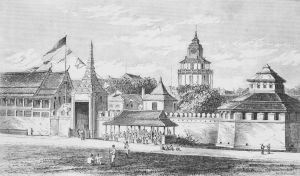
CRENELLATED TOWERS OF THE INNER CITY.
We, that is the young Prince Somdetch Chow Fa, my boy, and I, made the most of our visit to this delightful region, rambling over the hills and forests, gathering wild flowers, and visiting the hot springs, caves, and grottos, which form some of the more interesting features of the neighborhood. In the foreground, near the school-house, stood a clump of ferns full of pictures; a little farther on was a cave, over the mouth of which trailed huge convolvuli; and immediately above it an overhanging rock variegated with natural tints and colors, the effect of which was most wonderful.
From this spot there were tempting walks through groves of dark green trees, opening upon wide terraces which commanded exquisite views of the country, rich with cultivation or dotted with houses and gardens, or the still more fertile valleys, winding amongst which might be traced the silvery thread of the Diamond River.
Not far from the Royal Mountain are several grottos, two of which are of surprising extent and great beauty, an exact painting of which would be looked upon with incredulity, or as an invention of fairy land.
Whatever may have been the origin of these grottos, owing to the moisture continually dropping through the damp soil of the rocks they have been clothed with the richest and most harmonious colors, and adorned with magnificent stalactites, which rise in innumerable slender shafts and columns to support the roof and walls. The setting sun reveals a gorgeous mass of coloring, ending in dark blue and purple shadows in the distant chambers and hollows.
I never witnessed such wonderfully illusive transformations as the sunlight effected wherever it penetrated these subterranean halls. No human hands have as yet touched their marvellous walls and roofs and pillars. All that has been done by man is to cut a staircase in the rock, to aid the descent into the grottos, and enable the visitor to see them in all their regal beauty.
The largest grotto has been converted into a Buddhist temple; all along the richly tinted rock-walls are contemplative images of the Buddha, and in the centre, just where is concentrated the richest depth of coloring, lying on a horizontal bed of rock, is a large sleeping idol of the same inevitable figure, with the same mysterious expression about the closed eyelids, as if he were in the habit, even in sleep, of penetrating distant worlds, in his longing to gaze upon the Infinite.
Lower down the mountain lies a calm lake, with its smooth silvery surface ever and anon broken by the leaping of a fish, as if to prove that it is water and not glass, and beyond the lake are more mountains rolling up into the sky in purple and green folds, with the faintest of blue borders and crimson-tipped edges, for they are many miles off.
It was evening, and we had just spent a delicious fortnight here, teaching in the mornings and rambling in the evenings, and his Majesty had assured me, to my great delight, that we should stay yet another while among the mountains; my boy and I had retired to our little rocky nest, around which there was an impression of savage grandeur and of loneliness almost overpowering, and where I used to imagine the "Hill Giants," of whom I had heard so much, lurking in secret in the caves and hollows, as ready to tear the Royal Mountain from its base and cast it into the gulf beyond, for the pitiless way in which the monarch doomed those poor five hundred slaves to toil on and on, without any prospect of ever coming to an end, in smoothing and shaping its rugged sides. And it was here that I first realized and appreciated the belief of the simple people about me in ghosts and spirits, pleasant and unpleasant:—
"Genii in the air, And spirits in the evening breeze, And gentle ghosts with eyes as fair As starbeams through the twilight trees."
But in spite of them all we were sleeping soundly that night in the third story of our little eyry, when, about three o'clock in the morning, the sound of tocsins, gongs, and trumpets was flung out all over the distant hills and mountains, and re-echoed tauntingly, like the cry of so many demons full of mad sport, in the multitudinous voices of the rocky solitudes. We were suddenly transported from deep sleep to wide-awake realities, to find the royal palace all alive with lights and sedans and horsemen, and torch-bearing, shadowy phantoms, issuing from dark portals, gliding hither and thither among the rocks, and coming towards us.
What did it all mean?
The whole thing looked so mysterious that I at first thought the king was dead, or that the palace was besieged, or that the "favorite," Peam, taking advantage of the mountain fastnesses, had run away.
The torchlight phantoms proved to be veritable brawny Amazons, who came to inform us that the court would return to Bangkok within an hour. "What! not stay another fortnight?" I inquired, sadly.
"No, not another hour. Get ready to follow," was the peremptory order. And so, on the third day succeeding, we were all settled down in our respective places at Bangkok.
CHAPTER XXIII.
THE DEAF AND DUMB CHANGELING.
In the next morning's cheerful daylight I set out to resume once more my school routine within the sombre walls of the "invincible" city. But, as we proceeded on our way, we were surprised to see knots and clusters of people reading with absorbing interest huge placards written in Siamese, Pali, Cambodian, Birmese, Peguan, and every other language spoken by the many distinct peoples who inhabit the mountains and valleys watered by the great river Mèinam, and posted all along the imperial walls.
Here was another mystery.
I could read printed Siamese and Pali tolerably well. But the written characters, wherein every scholar invents an orthography of his own, baffled all my linguistic efforts, and not a glimmering of light could the numberless questions I put to many of the curious readers procure for me; they were as afraid to speak of royalty as of the devil, lest he should appear. So I went on to school to find the same mysterious announcements, which had sprung up like mushrooms during the night, running zigzag over all the walls, and playing hide and seek along the dark, narrow lanes and streets, only to elude my strictest inquiries.
Now, to tell the truth, as I was treasonably disposed against slavery and polygamy and several other gross abuses that grew out of them, and had stoutly set my face against them from the very first day of my installation as teacher in the palace, I began to fear that these placards might concern me and my teachings; so when school closed I went to see my friend, Lady Thieng. But she was even more mysterious than the unintelligible hieroglyphics on the walls, looking at me curiously, and shaking her head in a solemn manner, and feeling me all over in a pathetic way, so as to reassure herself that I was not a spirit, but made of flesh and bones like herself, and could not have been, as she had begun secretly to suspect, at Bijrepuree and at Bangkok at the same time.
She then gravely asked me if I had ever practised sorcery or witchcraft. My lips trembled with irrepressible laughter as I assured her I had not as yet enjoyed the good fortune of knowing a real witch; but that nothing in the world would please me better than to be introduced to one who would give me lessons in that art. She admonished me sternly for my levity, and went on to say that there had really been a very powerful sorceress in the palace during the king's absence at Bijrepuree, who had, unseen by human eye, conjured away the beautiful and disconsolate princess, and left in her place a rustic deaf and dumb slave-girl.
Amazed and altogether taken by surprise, I looked into my friend's face in unspeakable sorrow. My heart whispered to me the last words of May-Peâh, "I do not know what I am going to do, but something shall be done to save her, even if I die for it." I could not bring myself to ask another question, I was so afraid of confirming my worst fears. I had learned to love that slave-woman better than her mistress, and would have braved a thousand perils if I had thought I could save her through them.
"I wish," cried Thieng, at last, in a sudden burst, as if her thoughts had been going on in this strain and only broke from her when she could restrain herself no longer,—"I wish that this deaf and dumb slave-girl could be exorcised and made to speak, and then we would know how it happened, and how the old witch looked.
"O dear! O dear! I am afraid for my life and the lives of my poor children; and even the very stones out of which this dismal city is built inspire me with dread and horror," said poor Thieng, ruefully; "and do you know?" she added,—her eyes growing rounder and rounder every moment, as the awfulness of the situation presented itself to her mind,—"his Majesty has shut himself up in his topmost chamber, and guards are set at all the doors and windows, lest any suspicious-looking person should enter, and no one but only the old lady-physician, Khoon Maw Prang, is allowed to see him to serve his meals, and he won't come down till the palace and whole city has been exorcised. And there will be no school to-morrow," she continued, growing more and more communicative, "for he has ordered all the royal children to be shut up in their homes until noon, when the old devil shall have been driven out by the priests of Brahma; and the priests of Buddha will then purify the city with burning incense and sprinkling the houses, walls, and all its inhabitants with holy water."
Up to the last moment a natural cause for the disappearance of the Princess Sunartha Vismita never even presented itself to the mind of my simple-hearted friend, and I was not a little comforted, for the sake of the strange Laotian woman, to find that it was thought so absolutely the work of some supernatural agent. For Thieng also told me that the court astrologers and wizards were trying to unravel the mystery; that large rewards had been promised to them if they could throw any light on the subject; and, lastly, that the two Laotian captives, with the deaf and dumb changeling, were to be exorcised and examined in the ecclesiastical court on the following day by the "wise" men and women in the country.
After which the poor unhappy lady laid her head down upon her pillow, utterly grieved and terrified by her fears. I tried in vain to comfort her. But what between her dread of the supernatural and her misgivings that to-morrow the chances were that certain accusations against herself and me, as secret agents of some devilish sorceress, might be brought forward with unanswerable logic, she was quite inconsolable and greatly to be pitied.
I believe she would have been content to give her life, ere day broke, only to catch a glimpse of the poor unfortunate princess whom the demon had thus maliciously kidnapped and carried off.
The only thing I could say, that seemed in the slightest degree to soothe her, was that I would endeavor to be present at the ecclesiastical court at the time appointed for the exorcism, and obtain such intelligence of its proceedings, and the facts elicited during the trial, as my imperfect knowledge of the technical language and formalities of the Siamese courts would enable me to gather for her.
CHAPTER XXIV.
WITCHCRAFT IN SIAM IN EIGHTEEN HUNDRED AND SIXTY-SIX, COMPARED WITH WITCHCRAFT IN ENGLAND IN SEVENTEEN HUNDRED AND SIXTEEN.
It might be difficult, at the present time, anywhere in any enlightened Christian community, to find persons of the most ordinary intelligence who entertain the smallest faith in witchcraft.
But yet there are thousands upon thousands who implicitly believe in spirit-rapping and in table-turning, in mesmerism and animal magnetism, and in Mr. Joseph Smith and Brigham Young, his successor, who exhibits such extraordinary powers in prophecy and sensualism at Utah; and in fact it would seem that the doctrine of "Credo quia impossibile" never had more earnest disciples than it now numbers.
Yet we all alike, with one accord, profess our utter disbelief in witchcraft.
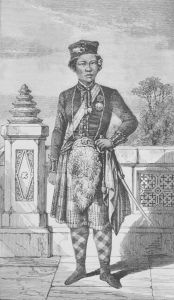
AN AMAZON OF THE ROYAL BODY GUARD.
This scepticism on our part, however, is of very modern date; for even in the early part of this century the belief was not quite eradicated in England, and we have only to step back a century more to find it acknowledged without shame by a civilized and highly enlightened people, and at a time, too, when the literary intellect of England shone as brightly as ever in her history; when the memory of Dryden was still fresh in the minds of many of his most cherished friends and admirers; when Pope had risen, and Addison was painting his genial portrait of Sir Roger de Coverly; when the bewitching "nightingale at Twickenham" poured forth his sweetest songs, and kind-hearted Steele and Swift, stern, incorrigible, and lonely, domineered over the proudest of English peers and statesmen. Nothing can ever be more touching than the sad record of those dark days when the fair Eleanor Cobham, the wife of a duke, and the aunt of a king of "Great Britain," did penance for her "witchcraft," and walked "hoodless save her 'kerchief" through all the crowded streets of London and Westminster, taunted and hooted at by a ragged crowd, to offer a "consecrated taper" at the high altar of St. Paul's, and thence to her cruel, life-long imprisonment at Kenilworth, while her wretched accomplice, Bolingbroke, expiated his crime on a gibbet at Tyburn. And there are those seemingly darker days when Archbishop Cranmer, a high-priest of the tender Jesus, directed his clergy at large to make "strict inquiry into all witchcraft and such like craft invented by the devil"; and when that very honorable personage, the Lord Chief Justice Coke, uttered these memorable words: "It would be a great defect in government if so great an abomination had passed with impunity." Then no one cast even the shadow of a doubt on the existence of witchcraft, or even questioned the extraordinary powers which were at the time imputed to a witch. And one becomes sensible of the dark superstitions that must have pervaded even the general atmosphere of the immortal poet Shakespeare, when he makes Ford lay his cudgel across the shoulders of Falstaff, supposing him to be the "wise woman of Brentford," and embodies the grander and more terrible idea of witchcraft as no man has ever done before or after him in the tragedy of "Macbeth."
Almost every page of ecclesiastical history of ancient times is full of monstrous relations of the powers of the devil, or of those who had entered into copartnership with him; and, emerging thence into the light of more recent times, we shall find the same superstition in such men as Matthew Hopkins, the "witch-finder"; in Matthew Hale, presiding at the trial of the Bury St. Edmunds witches; and in Sir Thomas Browne, author of the "Religio Medici," and of the "Inquiry into Vulgar Errors," giving the evidence on which so many wretched old and young women were sent to the gallows. But, alas! what shall we say when we hear such holy men as Baxter and Wesley asserting that the belief in witchcraft was essentially connected with Christianity, and one of its most important points; and, down almost to our own day, find Johnson half doubting and half believing in the existence of witches and in their supernatural powers?
It was not until the close of 1763 that the statute which made witchcraft a felony punishable by death was repealed; and so lately as 1716 the curious reader will find in Gough's Brit., Vol. I., p. 439, an account of a substantial English farmer, named Hicks, who publicly accused his wife and child—a girl of only nine years of age—of witchcraft; and, what seems more incredible still, that they were actually tried at the assizes at Huntingdon before a learned judge, and visited by pious and God-fearing "divines" to whom the poor victims confessed the belief—which was forced into their own convictions by the strong current of public opinion, and still more by the unnatural conduct of a father and a husband—"that they were witches"; for which the unhappy wife and tender child were hanged at Huntingdon, on the 28th of July, 1716.
Can any page in the history of Siam be more appalling than this? Let the reader turn from England in her light and glory, her civilization, refinement, and power, from her altars raised to the true God, and centuries after her baptism in the matchless name of Christ, to benighted Siam still bound in the iron fetters of paganism, idolatry, and slavery, and he will find there in many respects just such a picture as England presented in the seventeenth and eighteenth centuries.
Nothing can be more appalling than the incurable superstition of the Eastern mind, and even while their belief in the supernatural inspires them with perpetual horror, they cannot be brought to give it up. In fact, it seems a part of their nature to cherish in their secret hearts the belief that there are spirits, good and bad, who walk the earth unseen, and delight either to bless or to cheat and abuse mankind; and that there are witches and wizards in the country who have the power of turning men into any shape they choose.
Rational and reasonable on all other points as the Siamese are, the moment you try to approach them through their religious senses they appear like a world coming suddenly under an eclipse of the sun; slowly and surely the disk of their mind is darkened, and the gloom and perplexity increase, till it becomes completely obscured.
CHAPTER XXV.
TRIAL FOR WITCHCRAFT.
No one who has had the good or bad fortune to alight in the northeastern portion of the city of Bangkok can ever forget the temples and monasteries of Brahmanee Wade. They are situated by themselves, at the northeastern extremity of the city walls, where not a modern building is to be seen, for even the few houses which were erected as lately as yesterday have been fashioned after the ancient model prescribed by the Hindoo architect; and in no part of the world is there seen so perfect an historical picture of the ancient Brahminical architecture as in this part of the city of Bangkok. The varied gables, the quaint little windows, the fantastic towers and narrow doorways, with the endless effects of color, make this spot a perpetual delight to the curious traveller; and the Brahmins who occupy this part of the city, allotted to them from time immemorial by the kings of Siam, still preserve the ancient costume of their forefathers, which makes the picture complete.
On the morning of the 20th of November, 1866, three women, half stupefied by the foul air of the damp cells in which they had been immured, were conducted through the silent, sleeping streets of the palace and city to a small room or "black hole" adjoining the great court-hall of the temple of Brahmanee Wade, and locked up therein, while the file of Amazons and the troop of soldiers in charge took their places around it.
While the Invincible City was being disenchanted by one set of Brahmins to be purified by another set of Buddhist priests, I set off on horseback, attended only by my Hindostanee syce, or groom, to the scene of the trial.
November here is the pleasantest month in the year; and the morning sun shone brightly, but not too warmly, as we approached the walls of the temples and monasteries of Brahmanee Wade,—so wild, so isolated, so set in contrast by oddness of architectural effects to the general order and appearance of the rest of the town, as to seem, indeed, to belong to another age and another world. The dark walls and huge trees were covered with parasitic plants. A deep, narrow valley, through which a tiny streamlet runs, over a stony bed, betwixt sloping sides of grass and furze-clad steeps, is crossed by a stone bridge, black with time, which leads to the portals of Brahminism. The little mad stream roared and fled darkly on, as it will perhaps forever.
There was a dreadful loneliness about the place, and a sort of darkness, too, whether in my mind or in the place I cannot say, but it spoke of all kinds of magic and witchcraft, and even of devilcraft.
Deep in the glen, sloping down to the stream, amid picturesque and romantic surroundings, stood the old temple of Kalee Durga; and running along, like a huge, jagged shadow, dark even in the brightest sunlight, rose the roofs of the monastic dwellings of the Brahmin ascetics, from which the place is named.
I alighted, and told my syce to wait outside for me; but he, being a pious Hindoo, bestrode the pony and rode off, to return in a quarter of an hour with oil and fresh flowers and sweetmeats enough to propitiate a great many dark goddesses.
There was not a soul to be seen anywhere, whether of Brahmanic or Buddhistic faith. So I followed my syce into the temple, and while he prostrated himself at full length before each one of his gods, I took out my note-book and occupied myself in making sketches and memoranda of the strange scene before me.
Vishnu, Siva, Krishna, and the goddess Kalee, were the chief deities of the place, and figured as the heroes and heroines among the numerous grotesque and monstrous myths sculptured on the walls.
Here was Vishnu lying comfortably on the thousand-headed snake Shesha, or sporting as a fish, or crawling as a tortoise, or showing his fangs as a wild boar, or shaking his head in his last and fifth avatar as a dwarf, all admirably executed. Here too was Krishna, like another Apollo, whipped out of heaven for playing tricks on the lovely shepherdesses of Muttra, whose tender hearts he stole away, and whose butter he found so tempting that he perpetually ran off with it in secret, and whose jars of milk it was this madcap's pleasure roguishly to upset. In another compartment, crumbling with age, he is seen again in his last mad prank, perched on a stony tree with the milkmaids' stony habiliments under his arm, and an unmistakable grin on his stony, greasy[35] face, while the owners of the dresses are standing below in various attitudes of bashfulness imploring their restoration. Before them in different places stands the Lingam. Here was also a beautiful sculpture of Siva and his wife Parvati, with the sacred bull Nandi lying at their feet, and Kalee in combat with the monster Mahashasura; and close by again she is seen caressing a Nylghau,[36] that is looking up to her.
The figures of the goddesses are wonderfully spirited, and of exquisite symmetry, conveying the idea of perfect and beautiful womanhood. And yet Kalee is represented elsewhere in the same temple as a black and terrible being, covered with symbols of the most ferocious cruelty.
Having finished my notes, I passed out by another entrance, and tried to quiet my fears for May-Peâh by continuing my rambles and explorations until breakfast-time. Instead of returning home for that meal, I despatched the syce to buy from the small Hindoo village close by an earthen lota of milk and a flat cake of Bâjree bread, of which I made a pleasant repast, sitting under the deep shadows of the temples and trees dedicated to Brahma, of whom there is rarely, if ever, any representation.
Very soon I was repaid for my patient waiting, for I heard the sound of drums beating and martial music playing; and, rushing to the side whence it proceeded, the queerest and most weird-looking procession met my astonished eyes,—old women dressed in scarlet and yellow, and old gray headed men in every variety of costume, combining all the known and unknown fashions of the past, some on foot and others on horseback, with embroidered flags of the same multiplicity of colors flying before the wind; and in the centre of all, clad in black and crimson vestments, riding on white mules, a band of about twenty men and women, some quite young and others extremely old, advancing with slow and solemn steps. These were the royal astrologers, wizards, and witches who, incredible as it may seem, are supported by the supreme king of Siam, and receive from the crown large and handsome salaries. I observed that the whole procession was composed of persons of the Hindoo religion.
In the rear came some Chinese coolies hired for the occasion, carrying two boxes and two long planks, which excited my curiosity. As they drew near they were joined by large numbers of well-dressed Siamese and a host of ragged slaves, which completed the motley scene.
I stepped out of the solemn shade of the boh and peepul trees, and took my seat on a broken stone pillar, still under shelter, and commanding a view of the grand hall. The roof, which was fast crumbling away, was an inferior imitation of that of the wondrous temple of Maha Nagkhon Watt, and had scarcely been touched for centuries, for there still figured the inevitable Siva and Kalee, and all the rest of the Hindoo gods and goddesses, dismantled and broken, but still in sufficient preservation to show the wild grotesqueness of the Hindoo imagination, which seems to have grown riotous in the effort to embody all its imperfect conceptions of the Divinity.
When this strange and solemn procession entered the portal of Brahmanee Wade they suddenly halted, threw up their arms and folded their hands above their heads, and repeated one of the most magnificent utterances of Krishna: "O thou who art the life in all things, the eternal seed of nature, the understanding of the wise and the weakness of the foolish, the glory of the proud and the strength of the strong, the sacrifice and the worship, the incense and the fire, the victim and the slayer, the father and the mother of the world, gird thy servants with power and wisdom to-day to slay the slayer and to vanquish the deceiver,"[37] etc. After which they marched to the sound of music into the temple, and offered sacrifices of wine and oil, and wheaten cakes and fresh flowers, and with their eyes lifted to the dark vaulted roof they again prayed, calling upon Brahma the father, the comforter, the creator, the tender mother, the holy way, the witness, the asylum, the friend of man, to illumine with the light of his understanding their feeble intellects to discern the devil and to vanquish him.
At length the astrologers, wizards, and witches took their places in the hall, with eager crowds all round them, standing in rows on all the steps of the building. Then came two officers from the king with a royal letter,—one was the chief judge of the Supreme Court, and the other his secretary to report the trial. After this lordly personage had taken his seat, the prisoners—the two handmaids of the princess and my friend May-Peâh, who, as I feared, was the deaf and dumb "changeling"—were brought in. She was deadly pale, and there was a wild light as of madness or intense suffering in her eyes. They were placed at the end of the hall, strongly guarded by as many as fifty Amazons, while the soldiers scattered themselves all round about the building. Not a word was spoken, and the strange assembly looked into one another's faces, as if each knew his neighbor's thoughts. I trembled for the unhappy prisoners; and the crowd, who seemed to look upon poor May-Peâh as a veritable witch, were silent in breathless expectation.
It was a frightful spot, and a still more indescribably terrifying scene, where one might indeed say with Hassan of Balsora, "Lo! this is the abode of genii and of ghouls and of devils." I had half a mind to slip down from my rocky perch and run away. But very soon my anxiety for poor May-Peâh absorbed every other feeling.
The three prisoners sat profoundly silent, waiting in sadness to hear their doom.
But why did they not begin the trial? There were the boxes and the planks with little niches cut into them, deep enough to enable any nimble person to climb with the tips of their toes, and scale any wall against which they might be placed. I turned to a soldier who was standing close by, and asked him why they still delayed the trial.
"They are waiting," said he, as if he knew all about it, and had witnessed many such scenes before, "for the 'sage,' or holy man of the woods; it is for him that they have blown the conch-shells these three times." There was, to me, nothing improbable in the soldier's story. He told me that this holy man, or yogi,[38] lived in a cave, in the rocks adjoining, all alone, and that he rarely issued from his unknown retreat during the day, but that pious Hindoos, while performing their ablutions in the stream after the close of their labors, could see him moving in the moonlight, and hear him calling upon God. Feeding on tamarinds and other wild fruits, he slept during the day like a wild animal, and prayed aloud all night, oppressed by his longing and yearning after the Invisible, as by some secret grief that knew no balm. Even the cool evening air brought him no peace; for,
"At night the passion came, Like the fierce fiend of a distempered dream; And shook him from his rest, and led him forth Into the darkness, to pray and pray forevermore."
By and by a man appeared on the opposite banks of the stream, plunged into it, and emerged on the hither side; shook the wet from his hair like a veritable beast, and made his way towards the hall, where he sat himself shyly down near the prisoners. This strange mortal, who lived the life of an "orang-outang," had a remarkably fine, sensitive face, and a noble head, around which his long, matted, unkempt hair fell like dark clouds. He was meagrely clad, and his wiry frame gave evidence of great muscular power. There was, to my thinking, a gleam of a better and higher humanity in his fine, dark face, that shot out in irrepressible flashes, and convinced me, in spite of his filth and nudity, of a noble and impressive nature.
The soldier assured me, in a tone of the utmost reverence, "that this man's eyes were opened, that he could see things which the paid mercenaries of the court could not begin even to comprehend; and that therefore they always made it a point to invite him to aid them in their spiritual examinations."
I somehow drew comfort from the yogi's shy and fascinating face.
And now the trial commenced by the judge reading the king's letter, which spoke of the mysterious and important nature of the accusation made against some unknown person for the abduction of a state prisoner, a lady of high rank and unflinching integrity, and called upon the assembly to do their utmost to unravel the inexplicable affair.
After the royal letter had received its customary salutations, and at the command of the judge, the two Amazons who were on duty on the night of the abduction of the princess testified to the following facts: "That on the night of the 12th, on a sudden a strong wind arose that extinguished their lanterns, leaving them in utter darkness, and immediately afterwards they were sensible that a tall, dark figure enveloped in a black veil entered the hall, and that as she approached them they saw, somewhat indistinctly, that she held a short dagger in one hand and a ponderous bunch of keys in the other; that never before having known themselves liable to any illusion of the senses, the horror which fell upon them at the moment deprived them of all power of speech or action; that, as the strange being stood over them brandishing her glittering knife, there flashed all round about her a hideous light; that by this light they saw her proceed to the cell in which the Princess Sunartha Vismita was confined, open it with one of her mysterious keys, and lead the princess forth, pulling her forcibly along by the hand, and as the flashes died away a double darkness fell upon them; that after an interval of nearly two hours, as they were still paralyzed and unable to move from the spot, the strange figure reappeared, pallid, and more ghastly than before, but without the veil, or the dagger, or the bunch of keys; that she passed quickly by them into the cell, and drew the prison door so forcibly that it closed upon her with a dismal cry of pain."
Then the two Laotians stated "that on the night of the 12th they were awakened by the slamming of the cell door, and, on looking in the darkness towards the bed on which the princess slept, they saw a figure sitting on it; on which they lit the lamp, and found it was not their mistress, but a dumb slave-woman in her place, and that they instinctively shrank away from her in fear and horror lest she should metamorphose them also into some unnatural beings."
As for the Amazons, it could readily be seen that their imaginations had been so vividly impressed that they were prepared to swear solemnly to their having seen a supernatural being twice the size and altogether unlike the deaf and dumb creature before them. The unnatural light of pain or madness or frenzy, or whatever it was, burned still more brightly in May-Peâh's eyes. Her reddish-brown dress seemed to be stained here and there with darker spots, as if of blood, and her face grew more and more colorless every moment. But to all the numberless questions put to her by every one of the crafty wizards and witches, she returned no reply. Her lips were of an ashy whiteness, and they really seemed to have been closed by a supernatural power.
I recalled her volubility of speech when I first met her, and her impassioned song, by which she won for her mistress the acknowledgment of a deep and undying love; and I asked myself the question over and over again, "Is it possible that she can be acting?" At a signal, an alarm-gong was struck, and so suddenly and immediately behind her that the whole assembly started, and May-Peâh, taken by surprise, turned to see whence the sound came. "Now," shouted the wily judges, "it is plain that you can speak, for you are not deaf."
No sooner was this said than the feeling against the accused ran high, on account of her obstinacy, and she was forthwith condemned to all the tortures of the rack. But the humane yogi, on hearing this, raised his bare arms on high, and uttered the wild cry of "Yah" (forbear) so commandingly that it rang through the temple, and arrested the cruel process.
He then turned to the poor girl, and, placing his huge, bony hands upon her shoulders, tenderly whispered in her ear something which seemed to move the prisoner for she raised her burning eyes, now filled with tears, to his face, and, shaking her head solemnly and sadly to and fro, laid her finger on her mouth to indicate that she could not speak.
A tender light kindled the dark face of the yogi, as he informed the assembly that "the woman was not a witch, nor even obstinate, but powerless to speak, because under the influence of witchcraft."
The tide of feeling was again turned in the prisoner's favor. "Let her be exorcised," said the chief judge of the Supreme Court, whose secretary was making minutes of all that took place during the trial.
On which the queerest-looking woman of the party, an old and toothless dame, drew out a key from her girdle and opened the wooden boxes, from which she took a small boat, a sort of coracle,[39]—such as are still found in some parts of Wales, made by covering a wicker frame with leather,—a long gray veil of singular texture, an earthen stove, whereon to kindle a charcoal fire, and some charcoal; out of the second box she produced some herbs, pieces of flint, cast skins of snakes, feathers, the hair of various animals, with dead men's bones, short brooms, and a host of other queer things.
At any other time I should have been highly amused at the grotesqueness of the figure, and the comically ludicrous manner in which she drew, one after another, her mysterious ingredients out of her boxes; but now I was too anxious, and too much pained by the situation of May-Peâh, and by what seemed to me diabolical jugglery, to think of the comical side of the scene.
With the charcoal the old woman proceeded to light a fire in her earthen stove; when it was red-hot she opened several jars of water, and, muttering some strange incantations, threw into them portions of her herbs, repeating over each a mystic spell, and waving a curious wand which looked like a human bone, and might have been once the arm of a stalwart man. This done, she seated the prisoner in the centre of the motley group, covered her over with the veil of gray stuff, and handing the short hand-brooms to a number of her set, she, to my intense horror, began to pour the burning charcoal over the veiled form of the prisoner, which the other women, dancing around, and repeating with the wildest gestures the name of Brahma, as rapidly swept off. This was done without even singeing the veil or burning a hair of May-Peâh's head. After this they emptied the jars of water upon her, still repeating the name of Brahma. She was then made to change her clothes for an entirely new dress, of the Brahminical fashion. Her dressing and undressing were effected with great skill, without disclosing her person in the least. And once more the yogi laid his hands upon her shoulders, and whispered again in her ears, first the right, and then the left. But May-Peâh returned the same intimation, shaking her head, and pointing to her sealed lips.
Then the old wizard, Khoon P'hikhat,—literally, the lord who drives out the devil,—prostrated himself before her, and prayed with a wild energy of manner; and, rising suddenly, he peremptorily demanded, looking full into the prisoner's face, "Where did you drop the bunch of keys?"
The glaring daylight illuminated with a pale lustre the fine face of the Laotian slave, as for the third time she moved her head, in solemn intimation that she could not or would not speak.
To see her thus, no one would believe but that, if she willed, she could speak at once.
"Open her mouth, and pour some of the magic water into it," suggested one of the "wise women."
But they who opened her mouth fell back with horror, and cried, "Brahma, Brahma! an evil fiend has torn out her tongue." And immediately the unhappy woman passed from being an object of fear and dread to one of tender commiseration, of pity, and even of adoration.
So sudden was the transition from fear and hate to love and pity, that many of the strong men and women wept outright at the thought of the dreadful mutilation that the fiend had subjected her to.
Now came the last and most important question, "Was the exorcism effectual?" To prove which a small taper was lighted and put into the witches' boat; and the whole company betook themselves to the borders of the stream to see it launched. The boat swept gallantly down the waters, and the feeble lamp burned brightly, without even a flicker,—for it was a calm day,—till it was brought to a stand by some stones that were strewn across the stream.
Then the yogi raised a shout of wild delight, and all the company re-echoed it with intense satisfaction and pleasure. And, in accordance with the king's instructions, being fully acquitted of any complicity with the devil in the abduction of the princess, the prisoners received each a sum of money, and were set at liberty.
The planks, which in any other court would have been one of the most tangible evidences that some person had thereby scaled the palace walls, were never even thought of during this singular trial. So irrational and so superstitious is the native character, that they preferred to believe in the supernatural rather than in any rational cause for the disappearance of the princess; and for once in my life I was led to rejoice in their ignorance.
It was sunset before this inconceivably grotesque and self-deluded and deluding set of maniacs dispersed. The yogi went back to the solitude of his unknown cave to sleep by day and pray alone by night. And I sent my syce home, and remained behind under a jamoon-tree, to which my pony was tied, in the hope of getting an opportunity of speaking alone with the women who still lingered with May-Peâh in the hall.
When May-Peâh at length saw me, she rushed into my arms, and laid her head upon my shoulder, uttering the most doleful and piteous of cries; they were not cries of sorrow, but of the wildest joy! I embraced her with something of the tenderness and sorrow with which a mother takes a brave but reckless child to her heart.
May-Peâh's friends then told me, what I had all along surmised, that it was she who scaled the walls by means of the two planks, terrified the Amazons, opened the prison doors with the keys she had provided, and led her mistress forcibly out. After assisting her to climb the walls on the inner side, she sat on the top of the outer wall until she saw her safely on the other side. She then dropped the keys to her, to be flung into the river. Here the prince and his two friends received the princess, and led her to a small craft that was ready to convey them to Maulmain. In vain they entreated May-Peâh to come down from the wall and join their flight. She resolutely refused to leave the companions of her beloved mistress in peril, and, full of dread lest, by the dreadful torture which she knew awaited her, she might be forced to betray those who were dearer to her than her own life, she with one stroke of her sharp dagger deprived herself forever of the power of uttering a single intelligible sound.
"O, but why did you not all go off with the princess?" I inquired.
"Because we were too many, and we should have only delayed and perhaps imperilled the success of the enterprise," said the women; "and May-Peâh had promised not to leave us to bear the penalty of her doings."
It was difficult to tear myself away from her. I was at once proud to be loved by her, and heart-broken to think that she would never speak again.
But at length we parted, and she, raising her hands high above her head, waved them to and fro, and smiled a joyful adieu, in spite of the pain she still suffered from her cruel mutilation.
They took the way to the river to hire a boat for Pak Laut, whence they were to sail to Maulmain to join the fugitive prince and princess.
Assuredly, so long as men and women shall hold dear human courage and devotion in what they believe to be a just cause, so long will the memory of this brave and self-sacrificing slave-girl be cherished.
FOOTNOTES:
CHAPTER XXVI.
THE CHRISTIAN VILLAGE OF TÂMSÈNG, OR OF THOMAS THE SAINT.
It was on a bright Sunday morning in the month of May that a handsome boat with four young women at the oars conveyed me and my boy to the residence of Mrs. Rosa Hunter, situated in the village of Tâmsèng.
My friend Mrs. Hunter was a native of Siam, but of Portuguese parentage. Her husband, Robert Hunter, was private secretary to the supreme king. She had two sons, who had been taken away from her in their infancy by their Protestant father,—lest they should be brought up in the Roman Catholic faith,—and shipped off secretly to Scotland, in order that they might be educated under the influences of the Free Church of Scotland, in which he had himself been brought up. This occasioned a breach between the husband and wife which led to their ultimate separation, and Rosa returned all but heart-broken to the home of her childhood, where I visited her at short intervals to write the long, loving letters which she dictated to me in Siamese, and which I wrote in English to her absent boys.
A day at her house was always a pleasant change. On one of these visits, which I remember well, the table had been spread by the window that looked up the river, and lost it amid high banks and the projecting spires of the Roman Catholic and the Buddhist temples adjoining.
I had finished and sealed her loving messages to her absent children; the moon was rising, and we needed no other light, as the conversation between us, often shifting and often pausing, had gradually become grave, and we fell into confiding talk of what we hoped and what we feared, as we saw the future of our children stretched before us in deep shadows.
"There is so much power in faith," said Rosa, "even in relation to earthly things, that I am surprised you are not a Roman Catholic. I believe in my church; when I go to confession and receive the holy communion, I am filled with peace and trust, and have no fears for the future."
"There is a great deal in what you say, Rosa," I replied; "but I am afraid that I should not make a good Catholic, since I am disposed to question everything that does not accord with my own perceptions of the right and the true."
"Well, I suppose," said Rosa, "that our natures differ; all my life has its roots in the Roman Catholic Church. I never doubt, therefore I never question. The Holy Virgin and her Son are sufficient for me, and the good priest who absolves me from my sins. My only one sorrow is that my children are cast out of the pale of salvation by the foolish prejudices of their father."
This was said in a voice of much feeling, and tears gathered to her eyes. I moved to her side, and tried to comfort her by saying, "After all, Rosa, you seem to let your fears for your children cloud your faith in that Saviour who died for them as well as for you."
While I was speaking, my eyes fell upon a long, narrow canoe, called by the natives Rua Keng, in which was seated a tall, slender, and shapely young girl, who was slowly, with the aid of two short paddles, making her way towards us through the water, while her face was raised to the moonlight that fell brightly upon her. It was nearly high tide; a fleet of canoes, boats, and barges was moving in all directions over the broad waters.
We watched the girl as her paddles rose and fell softly and slowly, silver-tipped by the moonlight, now dipping into the water, now rising above it, like the white wings of some lazy bird. Nearer and nearer came the long boat, and clearer shone the fair face that was still uplifted, and reflected back the moonlight, till it almost looked as if divinely inspired. It is impossible to do any kind of justice to this beautiful moonlight picture. Gently the boat shot under our window, and was lost to our sight.
I bade my friend adieu, and hastened to the pier, where I met the girl again. She had fastened her canoe to one of the posts that supported the quay, and was crossing the street: in one hand she held a bunch of lilies, and in the other a lotus-shaped vase full of flowers.
Yielding to the impulse of the moment, instead of stepping into my boat I took my boy's hand and followed her graceful figure.
It was not yet seven o'clock. A number of people were in the squalid, dirty streets of Tâmsèng. The twinkling evening lights were stealing out one by one, and the girl drew over her face a veil or covering which was attached to her hair by a large and beautiful pin. A dozen or more steps, and we stood in the porch of the Roman Catholic chapel dedicated to "Tomas the Saint."
Lights were burning on the altar, over which were two figures of the Christ: one suspended above it with a crown of thorns, bleeding, and nailed to the cross; the other, of magnificent stature, was enveloped in a costume as gorgeous as the coronation robes of an emperor, the vestment being a sort of Indian brocade of woven gold arabesqued with jewels and scented with spikenard; a diadem lavishly adorned with emeralds and diamonds pressed its forehead, in some measure confining the hair which streamed down in abundant tresses upon the shoulders, and mingled with a beard no darker than the glossy hue of the chestnut. On either side of the altar were two other figures, one of the Virgin Mother, in the same regal attire, and crowned as the queen of heaven; while the other was the patron saint, with a flowing beard and a benevolent face. Suspended over the altar was a grand Japanese lamp.
The priest, a dark, heavily built man, a native, but of Portuguese parentage, was standing before it, with his cap on his head and his back to the congregation.
The moment the girl beheld the glory of the altar and the lights that shot up and quivered and were reflected in a thousand beautiful tints upon the magnificent figure of the Christ, she dropped on her knees and held down her head in mute adoration. After a little while she rose, and, advancing a few steps nearer, placed her golden lotus-shaped vase of flowers on the bare floor, dropped on her knees again, and, holding the white lilies between her folded hands, seemed absorbed in her devotions.
In her attitude and bearing there was a depth of feeling which, harmonizing with her beautiful figure, arrested the eye of the observer, and cast every other object in the shade.
I withdrew reluctantly and returned to my boat, wondering who she could be. On my way home I gathered from the women at the oars that she was known by the name of Nang Rungeâh (Lady Rungeâh);[40] that her parents were Buddhists and Cambodians, proprietors of a large plantation east of Tâmsèng. Her father, Chow Suah P'hagunn, was a distinguished noble, and her mother a Cambodian lady of high birth, who claimed to be descended from the rulers of that ancient and almost unknown kingdom, and that her only brother was a Buddhist priest. But the Nang Rungeâh had become deeply impressed with the beauty of the Christian religion, and was at this moment the only candidate who had offered herself, for a number of years, for baptism into the Roman Catholic Church.
"Tomas Saint," the founder of the beautiful church around which had grown up this Christian village, was a Portuguese gentleman renowned for his piety and his wealth. He had obtained the title of "saint," even in his lifetime; but the good people, fearing to arouse the jealousy of the Apostle of Christ, after whom he was named, placed the title after, instead of before, his name, and out of it had grown the name of "Tâmsèng."
On the very next Saturday following, it being the first holiday that offered itself to me, I set out with my boy very early in the morning to explore the village of Tâmsèng.
We chose for our head-quarters one of the most beautiful Buddhist temples in the neighborhood, the grounds and monasteries bounded the Catholic village on the northeast side of the river.
This temple, called Adi Buddha Annando, i.e. The First Buddha, or The Infinite, was embowered in a grove of trees of luxuriant growth, affording a delicious shade. It must have been, in its best days, a magnificent building; for even now, though much of its beauty was obliterated, it was covered from its massive base to its tapering summits with sculptures, and frescoed within and without with marvellous effect, so that wherever you turned your eyes the impression of a more subtle and a finer spirituality dawned upon you, as it was meet it should, in a temple dedicated to One whom the pious Buddhists will never even name, so great is their reverence for the First or Supreme Intelligence.
After a simple breakfast of fruit and milk, we strolled about the village and its surroundings, making notes and sketches of all that could be seen.
It was surprising to me that it looked so well in the early sunshine. The places that had struck me as foul and repulsive in the dim twilight now wore a different aspect, as if bent on looking their brightest and best in acknowledgment of the prodigal sunlight.
But the farther we penetrated into the heart of the village the more we were disappointed, and my first impressions were more than realized. We soon came upon scenes of the most squalid misery and filth, poverty and destitution, amid heaps of refuse and puddles of mud that caused us to shrink aside with disgust.
It is natural to demand that beautiful ideas should be clothed with beautiful forms. It was therefore to me an outrage on the name of Christianity to find that while all around lay scenes of luxuriant beauty which brightened the eye and cheered the heart, the only Christian village in the vicinity of Bangkok, which should have been an embodiment of all that is pure and lovely, had been transformed by the greed and oppression of the local officers to a pestilential spot to fester and poison the pure air of heaven. Some few native Christian women were about milking their goats, others were seated on their doorsteps, unwashed and uncombed; they seemed even to have lost the virtue of personal cleanliness, which with the Indian covers a multitude of sins. Stray packs of pariah dogs and herds of swine were barking and grunting in the ill-kept streets, and all kinds of poultry were picking a scanty breakfast from the heaps of garbage. Every now and then we were compelled to cross a stagnant pool or a muddy gutter alive with insects.
I never saw anything like the mud; it was a black liquid, sticky, slimy, and yet hard, hurting like hail when it struck the flesh.
And now we reached the quaint little chapel of "Tomas Saint." Its glories were sadly obscured by wet and damp, and the painting and gilding on the outside looked cold and dull.
A colored priest, a descendant of the renowned Tomas, was officiating. It was some saint's day. An assemblage of men, women, and children was seated on the floor, some in groups and some on rude benches. The priest bends over his missal, and pours forth in execrable Latin the exquisite prayers of the Church of Rome; and all the congregation, in their silks, and in their rags and wretchedness, are hushed and silent, with bent heads and folded hands, while the sound of the prayers—which they do not understand, beyond that it is the voice of prayer—fills their unenlightened but reverent hearts with mysterious dread and worship.
On quitting the chapel, we were at once beset by a numerous horde of beggars. It was not food or money that they craved, but, strange to say, it was justice. They followed us all the way back to the temple, importuning me to redress their wrongs and find a remedy for their grievances. Some of the poor wretches were half-witted, and not a few were crazed. An elderly lady, evidently once of superior rank, came crawling up to me, and clasped my feet, making a painful noise in a language that I could not understand, and piteously gesticulating some incomprehensible request. The people of the place denied all knowledge of her. At last she insisted on my giving her a leaf out of my note-book full of writing, which she apparently considered as a charm, for she attached it to a cord round her neck, and seemed to be perfectly happy in its possession. God only knows what the poor thing wanted to tell me, but likely enough her story was one of some great wrong, of some cruel injustice. If the smallest details of what I heard that day might be credited, the wrongs of these people were of the most harrowing nature, and altogether without hope of remedy under the twofold and inveterately vicious system of Siamese and Portugo-Siamese administration that prevailed there.
I was alarmed when I found that my visit was thought to be one secretly intended "to spy out the land," in the service of the king of Siam, and that I was expected to wipe away the tears from all eyes. In vain I protested to the contrary; no one would listen to me, but the crowds kept coming and going, and pleading and praying, and promising me fabulous sums of money if I would only see their wrongs redressed.
Many a heart-rending tale was told to me that day, with quivering lips and streaming eyes, as I rested beneath the porch of the temple of Adi Buddha Annando, by women who had been plundered of all they once possessed, their children sold into slavery or tortured to death, their habitations despoiled, merely because they happened to have property, and presumed to live independently upon lands which their more powerful neighbors coveted.
The greater number of these depredators were Siamese of influence, who had enrolled themselves as Christians under the French or the Portuguese flags, and unless the sufferer could claim the protection of either the one or the other, it seemed a cruel mockery to refer them for redress to any existing local authority, so long as P'haya Visate, a high but unprincipled Roman Catholic dignitary, was the governor of this district; and the saddest part of it all was, that the sufferers themselves felt there was no use in applying for justice to him.
In talking with some Buddhist men and women who were land proprietors in the vicinity, they told me that they were afraid of their Christian brethren, and would not, if they could prevent it, permit them to lease farms on their estates.
"Why?" I asked.
"Because, if they once get hold of a house or a farm, they manage in time to turn us out."
"But how?"
"Well, they lease small bits of land, year after year, expend money on it, and then, when they have a sufficiently large plantation to settle upon, they refuse to pay rent, go to law, and bring false witnesses to prove they have purchased the land of the owners, while the local authorities either take the part of the wrong-doers or imprison both parties until they have squeezed all they can out of them. The Buddhist does not dare," said they, "to lay his hand upon the sacred tree[41] and swear falsely, because the god who lives in it sees all, and he dreads his vengeance. But the Christian may swear to as many lies as he pleases, for the priests of the P'hra Jesu will give him absolution for them. Where, then, is the harm to him?"
I observed among the crowd a highly respectable looking and handsomely dressed woman, who sat apart, taking no share in the conversation, but listening with apparent interest to all that was said. Her eyes were very dark and very fine, but filled with rather a sad expression.
Towards evening she rose to go away, but, as if on second thought, she turned to me and greeted me in a peculiarly sweet voice, that sounded like music to my ears after all the voices of the crowd, inviting us to go and take our evening meal at her house, to which she at once led the way.