Front matter (continued 3)
Reading edition
Fresh troops of men to be enrolled and branded arrived every moment.
Then came Nai Dhamaphat; the Kromathan, or overseer; and lastly the Grand Duke, followed by an army of slaves, attendants, scribes, and cup and punka bearers. As he looked about him he saw, with a gleam of satisfaction, the veiled figure seated at her post, guarded by Amazons.
After a few minutes of conversation with the scribe who sat at his side, he ordered the prisoner Rama Singalee to be brought in.
No one remembered when the old, white-headed stranger was ushered in. But every one heard the wild cry of joy that seemed to die away on the lips of the strange girl, as, throwing off her saree, she sprang across the hall, and clasped the old man about the neck. After the first paroxysm of joy was over, she realized that her father was a prisoner; she looked still hopefully into his face, but, seeing no light there, laid her head upon the fetters that bound his feet, as if the iron had entered into her very soul.
Dhamaphat started, as if struck, and gazed sadly at the girl and her father.
Never scene so touching had been presented in that hall before. It arrested every eye, and filled every heart with sympathy; and it was no wonder,—the girl was a creature such as that country had never before produced. Her beauty was of the purest Indo-European type, rich brown complexion, delicate almond-shaped eyes, finely arched eyebrows, nose almost Greek in the purity of its outlines. Her feet, which had never worn either sandals or shoes, were large and perfect in shape; her arms, slender as those of a very young girl, were set off to great advantage by the metallic and glass bangles she wore; her rich black hair hung in long braids over a coarse blue bodice, which revealed a form of faultless proportions; on her breast, suspended by a yellow cord, was a flat silver ring, on which some mystic characters were inscribed.
The wondrous beauty of the prostrate girl filled the father and the son first with pleasure, then with fascination, afterwards with rapture; drawn on by irresistible steps, they both arrived, unknown to the other, at that stage of passion which blinds the sensibilities to everything else.
But the desire of one was to possess, the other to rescue.
The old soldier did not attempt to raise his daughter, but, taking off his turban, buried his face in it.
The duke was transported, stupefied; he paused, hesitated, then, suddenly, without knowing what moved him, he said, in a gentle, tender voice: "Why, girl? Raise up your head. See! your father is now going to be set free."
Smâyâtee lifted up her head, and looked at the speaker with an expression of childlike gladness and trust that brought to the heart of the wretch before her the long-lost sense of shame, and he could not for the moment give utterance to the iniquity he was about to perpetrate against her; he beckoned to an attendant, however, a sort of treasurer, with a heavy box, who approached, crawling, and at his instructions counted upon the floor forty pieces of gold,—sixteen times the value of an ordinary slave-woman.
Rama still covered his face with his turban, so that none could have told what was passing within him. His daughter laid her hand upon his arm, saying: "O, my father, the good duke gives us all this gold and promises us freedom! take it, and thank him, that he may permit us to return home."
The unhappy Rajpoot turned a look full of mournful tenderness upon his child. At the same moment the scribe, who had been industriously writing, laid a paper before him, and said, in rather an authoritative manner: "Tham Khai khat thedeo" (make the sale good, i.e., sign the paper).
Even now it did not occur to the girl what the paper and the forty pieces of gold meant.
To her mind they brought visions of freedom, as her heart yearned for the hills and groves of her native land. She once more whispered to her father to "take the money, and thank the duke, that he may let us go back home."
But the old man looked at her in silence, seemingly unable to utter a single word; his breathing came quick and hard, and all at once he gasped out: "The gods forbid me to sell my daughter to thee, my lord. Indra, Agni, and the Maruts, at whose roaring every dweller upon earth trembles, forbid me. O, pardon thy servant, my lord, and let us depart hence in peace."
The duke was doubly enraged, because of his last night's promise and the forty pieces of gold with which he had hoped to bribe him into an easy parting with his child. He turned to the bewildered Smâyâtee, and said: "Come hither, girl." But as she only looked at him, and made no attempt to go nearer, he added: "One thing is certain; this old fool, thy father, is still drunk, and knows not his mind; he sold you to me last night, and now he refuses, saying the gods forbid it."
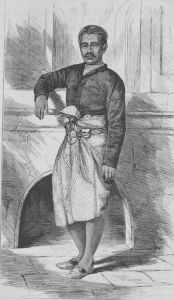
A YOUNG SIAMESE NOBLEMAN.
Smâyâtee turned from the duke to her father, her look changing from incredulity to surprise, from surprise to anguish, while the duke continued: "Now it is you who must decide for him; shall I hand him over to the royal judges to be tried and executed for the crime he is accused of, or will you consent to be my slave for life? I will make you rich and happy, and I will give him this gold, and he shall return in safety to his home."
He uttered these sentences in a loud, harsh voice, very different from that in which he had spoken to her a few minutes before.
When he had finished, the crowd cheered the speech.
The girl looked at them, and, not knowing why, began to cry.
This exasperated the duke.
He blew a small silver whistle; instantly a hand of armed men entered the hall, and he gave orders that the prisoner should be conveyed to the supreme court to be tried for attacking the chief officer of the royal guard, with intent to murder him, while he was on duty.
At this instant the girl seemed to take her resolution; she crawled up to the savage duke's feet, laid her head down upon them and kissed them, saying: "I consent to be thy slave, my lord. O, give not my father up to the king's officers."
The duke countermanded his orders.
"Yes," said she, her face suddenly transfigured, beaming with the twofold radiance of beauty and nobility of soul, "strike off his chains, and let him go free, dear, good lord."
There were no longer any arms being pricked with lancet-shaped needles. There were no longer any scribes enrolling the people's names. There were only fixed eyes, listening ears, and beatings of sympathetic hearts. The crowd was dimly conscious of the sublimity of the act; they were thrilled, awed, as much by her beauty as by the simplicity of her heroic self-sacrifice.
But Dhamaphat, who felt more deeply than the rest, noted how suddenly she had overcome her horror, how readily she had sacrificed herself for her father, and thought he saw in her face the effulgence of a heavenly light.
The order was given, and the Rajpoot was free. One final embrace, one look of triumph and despair from the girl, and she was led away by some female attendants.
Rama disappeared in the crowd, regardless of the gold, and the paper which his daughter had signed.
The work of branding and enrolling went on again, and the red light of the noonday sun shone upon the walls of the palace as if no young heart had been broken within its halls that day.
Dhamaphat left his work and went away, cursing the old priest, his tutor, and himself, in the impotency of his rage and sorrow.
CHAPTER XII.
THE INTERIOR OF THE DUKE CHOW P'HAYA MÂNDTREE'S HAREM.
Every harem is a little world in itself, composed entirely of women,—some who rule, others who obey, and those who serve. Here disinterestedness vanishes out of sight. Each one is for herself. They are nearly all young women, but they have the appearance of being slightly blighted. Nobody is too much in earnest, or too much alive, or too happy. The general atmosphere is that of depression. They are bound to have no thought for the world they have quitted, however pleasant it may have been; to ignore all ties and affections; to have no care but for one individual alone, and that the master. But if you became acquainted with some of these very women under favorable conditions,—very rare, however,—you might gather glimpses of recollections of the outer world, of earlier life and strong affections, of hearts scarred and disfigured and broken, of suppressed sighs and unuttered sobs, that would dispose you to melancholy reflections and sad forebodings, and, if you were by nature tender, to shedding of tears. Their dress and manners often betray all sorts of peculiarities, and yet all is harmonious outwardly. They are unconscious of the terrible defacement they have undergone. Yet it sometimes happens that this same little world has its greatness, and always when a woman becomes a mother her life changes; she passes from the ignoble to the noble; then she becomes pure, worthy, honorable.
The wall that surrounded the duke's palaces and temples enclosed also about five hundred houses, with gardens and artificial lakes and fountains and aviaries. Most of the houses were built of solid masonry, with here and there a theatre of carved wood; the streets were narrow, and the covered bazaars in no way remarkable except for the shops of female jewellers, gold and silversmiths. All the palaces and temples faced the river. The oldest Hindoo temple stood here, beside a Buddhist temple and monastery, from which the priests who officiated in the duke's household were supplied. The most remarkable edifice, however, was the duke's tower, or summer-house, of four lofty stories, opening all round into arches, made entirely of carved wood, and richly gilt. It commanded a magnificent view of the river, and overlooked more than one half of the city of Bangkok. When you mount the highest chamber, you open your eyes upon a scene too solemnly and mysteriously beautiful to be adequately described. You seem to be midway in the air, looking down upon a city of temples and palaces, gardens, lakes, minarets, pagodas and p'hra-chai-dees; thousands of boats glide noiselessly over the silver floor that winds on forever. The great height hushes out even the joyous voices that are hushed nowhere else. In the gloom at the upper end of the river many a boatman, perched on the prow of his boat, seems like the Angel of Death guiding some helpless passenger to the silent shore. And overhead the sky looks like some blue door, such as must lead straight into heaven.
In every ducal or royal harem there are a great many buildings designed and built for the express purpose of training and educating the women, and every girl has to go through certain forms and observances before she is admitted among the favored ones.
The female teachers, physicians, and judges, who are placed over them, generally receive a careful professional education,—the best the country can supply. Mere children are often taken into these places and trained to be actresses, dancers, musicians, and singers.
Every department has a superintendent, who is generally a lady of high rank, and is responsible to the duke only.
The mode of teaching in the schools is peculiar; no books are used by the pupils, who are placed in rows, with female officers in attendance to administer the rattan in all cases of inattention. The teacher either reads or sings the first line of a poem, or plays the first bar of an air; the head pupil repeats it after her, and so on to the last girl in the class; then all together, until they have learned it by heart. Dancing and gymnastics are taught in the same way.
Often a hundred different airs and poems are committed to memory by very young girls, who are thus converted into walking libraries.
Smâyâtee was led into the adytum of the duke's palace, conducted to a small chamber, and left there; while her guards betook themselves to their dinner. Very soon, the rumor of her great beauty having spread, nearly all the lovely girls in the harem rushed in to get a glimpse of her; but finding her closely veiled, and that no persuasion could prevail with her to uncover her face, they gradually departed, one young woman only remaining behind, sitting apart in silent sympathy.
After a while two female physicians came in, talking in low tones one to the other. They then proceeded to question the girl, and to all of their questions she returned modest replies; after they were satisfied they bade her unrobe, which she did with some little hesitancy. When she laid aside her veil, her eyes met those of her silent visitor; an indescribable something beamed from every feature of the stranger, and they became friends. The physicians then examined the girl, just as if she were an animal; having finished their inventory of her perfections and imperfections, they dropped a few pleasant words, and departed. Smâyâtee had no sooner dressed herself and taken her place close to her new friend, and they had in the brief moment exchanged names, when another batch of women appeared, and told her to follow them. She rose, and went out, holding her new friend's hand. After passing through a dark and silent street, they brought her to a marble building, with baths and fountains all round it. Here she was again told to undress, and take her place on a marble couch. With her eyes she pleadingly besought her friend to stay, who did so, seated, leaning against a pillar. The bathers then anointed Smâyâtee's person with a fragrant preparation; when she was completely besmeared they suspended their labors, in order to let the stuff dry on the poor girl, who knew no more what was going to be done to her than if she had been a little kitten; and as she sat there, her skin glowing and her heart palpitating, she heard herself discussed by the bathers, whose language she only partially understood. But she heard enough to realize the life in store for herself. After half an hour they seized her again, rubbed off briskly the dried paste, and showered buckets of hot and cold water upon her. Another set of women now took charge of the poor girl, and dressed her in beautiful silk robes, like those worn by the Loatian women of high rank. Her hair was combed, perfumed, and ornamented with flowers, finally she was conducted to a pretty little house, luxuriously fitted up, and left in the charge of a number of female slaves.
Smâyâtee now wore a new veil of Indian gauze, but she would rather have kept the old one. She cowered down in a corner, and laid her tired head in the lap of her new friend, who began patting and soothing her, without uttering a single word.
Most girls, as soon as they have overcome the horror which such a life must naturally inspire in the young and enthusiastic, begin to calculate on their chances of promotion to the highest place in the harem.
As for Smâyâtee, no thought but of escape presented itself to her mind; her nature was too wild and untamed to be flattered by the luxuries that now surrounded her; she looked upon them only as so many fetters. All kinds of wild plans for running away took violent possession of her brain; but the soothing influence of the bath, combined with the exhaustion of the day, overcame her, and she was soon sound asleep.
CHAPTER XIII.
A NIGHT OF MYSTERIES.
Mai Chandra, Smâyâtee's new friend, redoubled her tenderness and sisterly love for the poor, forlorn girl when she found that she was asleep. As midnight approached, she gently placed her head on a cushion, and then went home to her supper, deeply in love with the beautiful stranger.
The Duke Chow P'haya Mândtree's pavilion was thronged, as usual, with courtiers and nobles. All manner of attractions and diversions were there. The duke himself, partly intoxicated, sat amidst them, boasting of the rare purchase he had made that day: "She is so beautiful," said he to one of his boon companions, "that she inspires me as this glass of English brandy does." And he filled and refilled the jewelled goblet out of which he drank.
This man, in his whole person, was a type of many who may be seen any day in Siam,—a human being sunk in the lowest depths of sensualism and savage barbarity. From his hair, which was a dull gray, his wrinkled brow, his livid lips and watery eyes, there breathed forth an atmosphere which would have repelled even the mother who bore him.
At one time it was his intention to have Smâyâtee brought into the pavilion, that his friends might judge of her beauty; but, with his faculties already greatly enfeebled by the immoderate use of English brandy, he forgot his purpose.
At length the distant sounds of trumpets, conch-shells, and the ringing of multitudinous pagoda-bells proclaimed the last hour of day,—i.e. midnight. The nobles, courtiers, and friends retired and some elderly female attendants appeared; to them the duke gave orders to have the new slave-girl conducted to the upper story of his summer tower.
The day had been hot and sultry; no clouds were to be seen, except low on the eastern horizon, where they stretched in lengthened ridges of gold and purple, like the border between earth and sky.
As the women departed on their mission, a dark, heavy mass of clouds rose in the black outline of the distant hills. A sudden gust of wind, in fits and starts and snatches, came sweeping up the river, and tossed its waters wildly against the banks; then flashed incessant lightnings, and the winds rang and roared as though they heralded with joy the coming thunder-storm. Suddenly the moon was blurred with clouds, and the tempest raged outright. In the midst of the storm the poor terrified girl was roused from her slumbers, led to the lofty chamber, and left alone, while the attendants retired to one of the little alcoves to be in waiting.
Rama—who had that day made a circuit of the walls, and had promenaded every nook and corner in the vain hope of finding some means of getting, unseen, into the duke's palace, had hired a boat, and was sailing wildly up and down the river in front of it, laying desperate plans of finding his daughter and carrying her off at any risk and peril—was at the same moment, by one mighty sweep of the water, dashed on the banks that bounded on one side the gardens and temples of the palace. He staggered to his feet, and raised his head to the dreadful sky. A sudden flash of lightning revealed the gilded top of the lofty summer tower and the tapering summits of the Buddhist and Hindoo temples.
With a dreadful purpose burning in his heart, he walked straight on to the latter building, which was dimly lighted, and stood open as if inviting him to take shelter under its sacred roof. He entered. Happy memories, every sweet emotion he had known, came crowding upon him, as he once more recognized, in the partial darkness, the faint outlines of the images of his long-forgotten gods, Dâvee and Indra and Dhupiyâ.
There is compensation in all things. He had lost his child, and found his gods. Joy and sorrow are bound up in every event of life,—even as opposite poles are inseparable in the magnet. The pity is that the night of trouble is at times so dark that the interwoven gold with which Providence relieves the woof of calamity remains undiscovered.
Thus it was with Rama; there was joy and sorrow in his heart as he bowed before the gods of his fathers, but there was hatred and revenge there too, mingled with dark and bloody thoughts.
"Life is now a useless gift, an insupportable burden," groaned Rama.
In how many lives there lurks a hidden romance or a hidden terror. No one was near to mark the secret workings of this terrible man's nature. He recalled his home on the hills of Orissa, the yearly sacrifice that his fathers had been wont to offer up on Dâvee's altar, and he suddenly resolved that he would himself be the sacrifice to his long-forgotten and neglected gods.
Only one person could have saved him from his rash purpose, and she was sitting up there alone, midway between earth and heaven. He slowly drew out from his cumberbund a glittering knife, and his expression became exultant as he felt its sharp edge.
Not all the gods, not all the love-lit eyes, not all the hills of Orissa, can move him from his purpose now. He laid the knife upon the altar, and cried aloud to the insatiable Earth Goddess.
"O Dâvee, thou hast been unworshipped for years; multitudes crowd thy sister temples, but thine they pass unnoticed by. Behold my child now in the grasp of the spoiler. Defend, preserve her, that her honor may shine bright among men, and I will pour out to thee the life of my heart. Drink of my blood, and be revenged on the defiler of my house and my race."
Then, snatching up the knife, he waved it thrice over his head, and thrust it into his side. Leaning forward, he tried to picture his child's face, but could not for the light that love threw around her, and the mist that death wrapped round him; he drew nearer to his childhood's God, and, drawing out the knife, fell down at its feet, turning up his face to it, reverently, lovingly; and there was joy—joy of conscious strength, of victory—mingling with the life-blood of the heart that was fast flowing away forever.
It is two o'clock. The night is changed. The storms and clouds and darkness are all dispersed. The blue sky has thrown aside her veils, and the moon rides serenely in limitless range, undimmed by a single fleck of cloud. The very air breathes sweetness and perfume and peace.
But of all the mysteries of the night there is one yet to be solved.
Smâyâtee still sits on one of the sills of the arches in the topmost chamber of the summer tower, nearest to where the women have retired out of sight. She hears them whispering. She hears, too, some one slowly mounting the stairs; the footsteps are heavy, and sound like those of an aged man. She looks around to see if there is any way by which she may escape. The tower has but a single spiral stairway. She remains still and motionless. In a few minutes the sound of the footsteps comes nearer; through the archway opposite, the tottering figure of a dark, heavy man enters and approaches her. In the dim light she looks up at him with a terror-stricken, pleading face, daring neither to breathe nor speak; she shrinks away to the other side, where the women are in waiting. The duke, rather admiring her coyness, laughs a drunken laugh, and attempts to follow her. In crossing the threshold he stumbles. In trying to recover his footing he is thrown back. His head strikes violently against a massive gold spittoon.
A wild cry, and Smâyâtee rushes from her hiding-place, springs across the prostrate figure, down the flights of stairs, and through the labyrinths of flowering shrubs and plants, to hide herself beside a low tank of water.
The attendants and slaves who were lying around heard wild cries for help proceeding from the summer tower, and hurried to the spot with lamps and lanterns. All the piazzas, streets, gardens, and avenues are alive with anxious faces and inquiring looks.
The duchess's fears are aroused. She too summons her maidens with their lanterns, and sets out for the tower.
Suddenly she stops.
A few steps from her she sees an object dressed in bright colors, crouching in a pool of rain-water by the tank. She stooped to scrutinize the figure, and found it was that of a young and strange girl. She bent over her again, and said, gently, "Why art thou hiding here, my child?"
"I am afraid of him, dear lady," replied the girl, pointing to the lofty chamber.
"Afraid! art thou, indeed?" said she, a little coldly, remembering the news of the day; "didst thou not sell thyself to the duke in spite of thy father's wishes?"
"O yes, I did, dear lady," replied Smâyâtee; "but—" and she began to cry bitterly, and could not say another word for her tears and sobs.
The true woman triumphed in the "wife," for she put out her arms, and raised the forlorn stranger to her bosom, and comforted her with such words as women who have great and loving hearts only can. Then, confiding her to the tender care of her own women, she went on her way to find out the meaning of those dreadful cries.
Nai Dhamaphat, who had been watching in sadness and despair the marvellous expression of Nature's tears and smiles, was the first to mount the spiral staircase, to find his father in the last agonies of death. He takes him up gently, with the assistance of the women, and places him on his luxurious couch.
The duke is dead.
Everything is forgotten. He sees the pale face of the duchess, his mother, that silent woman, and, catching a glimpse of the bitter sorrow of that patient soul, who was so worthy of his father's love in her right of youth and beauty,—the foremost to love him, the last and only woman of all those whom he had wronged to mourn him,—he bows his head and weeps. The son and the mother are drawn closer than ever. They two had suffered in silence apart. Now they sorrowed together.
CHAPTER XIV.
"WEEPING MAY ENDURE FOR A NIGHT, BUT JOY COMETH IN THE MORNING."
A year has passed since the occurrence of the fearful events here related.
The river in front of the palace is thronged with a numerous procession of gayly gilded boats and barges.
It is the morning after the cremation of the Duke Chow P'haya Mândtree.
The king, with sixty or more nobles and princes of the land, all armed and in regal attire, presides in the grand hall of the late duke's palace.
The duchess and her two sons, and a fair sprinkling of Siamese ladies and children, are here assembled. A vast number of serfs, soldiers, pages, and women are in waiting.
Around the deep embrasure formed by the windows in the massive wall, there ran a low seat, the space thus occupied being raised as a kind of dais above the general level of the floor. Here were seated on either side of the wall the principal officers, male and female, of the duke's household, headed by the priests of Brahma and of Buddha, who were to play a part in the important drama of the day.
The hall is hung with tapestry of the most original design, for the birds and beasts and flowers which are pictured there had surely never prototypes, unless in some lost geological formation, though patterns very like them seemed to be unanimously adopted as models by all the fair embroideresses of Siam.
In the middle of the dais were two ducal chairs of state. On one was seated a young girl, very closely veiled, on the other the young duke, now Chow P'haya Dhamaphat; over them is spread a canopy of white muslin, decorated with the sweetest white flowers.
The girl, beneath her white veil, thinks it all perfection, and her eyes light up, and her cheeks burn, and her heart beats in perplexing fashion; and Dhamaphat believes that he alone holds the key to the temple of Elysium.
It is one of those rare occasions when the whole assembly is rapt in the regions of fancy.
The old priest, P'hra Chow Sâduman is there too, and he often raises his eyes in admiration, and his heart in prophecy of a propitious marriage. At length he begins the grand, old, harmonious nuptial chant, and all the priests of Buddha and of Brahma join in sonorous concert, and through the canopy over the happy couple the typical waters of consecration, in which had been previously infused certain leaves and shrubs emblematic of purity, sweetness, and usefulness, are gently showered.
And now Smâyâtee's earnest friend, Mai Chandra, with her tender mother-in-law, the duchess, conduct her, all dripping, by a screened passage, to a chamber magnificently appointed, where she is divested of her former apparel, and arrayed in robes becoming her now lofty station.
Then Chow P'haya Dhamaphat is ushered in. At the moment of his entrance Smâyâtee rises to throw herself at his feet, according to the custom of the country; but he prevents her, embraces her in the European manner, and presents her, standing upright by his side, to his relatives, with which the ceremony for the day terminates.
There is a general move towards the gateway by which P'hra Chow Sâduman is to pass. All, even the king, press to the front and fall on their knees to ask his blessing. He blesses them in a broken voice; he is strangely moved to-day.
Yet another year, and in this same palace nowhere will you find a trace of either Dhamaphat, Smâyâtee, or the gentle duchess. A younger brother fills his place, and is lord over all, following closely in the footsteps of his late father.
Far away, near the suburbs of Bijree Puree, i.e. the Diamond City, stands a lovely little cottage, where the ex-duke, his mother, and his sweet wife reside. He has freely resigned all the splendor and state of his position for the quiet and peace of a country life; and nothing is wanting here. The grand old trees are dressed in tender green, and the bright sun touches with its golden-yellow light every nook and corner of the lovely scene around.
The cottage within is furnished partly in the European and partly in the Oriental style. There are here no slaves, but hired servants, who have an air of freedom, loyalty, and comfort about them very delightful to witness.
In an inner chamber is Smâyâtee, rocking a little boy to sleep in a rude Laotian crib, with a mystic Hindoo triform suspended over it,—she cannot make up her mind to put him into the European cradle which stands close by; she fears some secret evil influence may lurk about its pretentious aspect,—and the boy, with his finger in his mouth, looks at his mother as if he felt she was divinely beautiful, and could not bring himself to shut his dreamy eyes for the light upon her face.
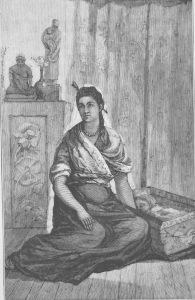
SMÂYÂTEE.
Nai Dhamaphat has become a convert to the Roman Catholic faith, but his pagan wife cannot be persuaded to forsake the gods who have brought her so much happiness, to whom her father sacrificed his brave life, and therefore she has raised an altar in her nursery to Dâvee and Dhupiyâ and Indra. Her father's ashes, too, rest here in a golden pagoda; but with the true, loving, tender veneration of her womanly nature, she has exalted over them all, in a niche on either side of the altar, an image of the Christ, and another of the Virgin Mary with her infant Son in her arms. These, in their symmetry and beauty, are to her the most beautiful of the gods upon her altar. In those porcelain images of the Christ, and the Mother with her tiny Infant, she feels that there is something higher, purer, loftier, than in the forms of her own dear gods, and she bows in worship, and trembles at the height to which her thoughts of that Mother and her Son elevate her soul.
Her religion, you can see at a glance, is not a gloomy one like that of her ancestors. There is a smile all over the chamber, and happiness all over her sweet face. Loving everything in her purity, worshipping everything in her humility, morning and evening she raises her eyes and her heart from those sombre old gods of hers to the tender ones of her husband; and this quiet pagan city has never before been lighted up with such a gleam of heaven upon earth as when her evening prayer bursts into song:—
"To Thee are all my acts, my days, And all my lore, and all my praise, My food, my gifts, my sacrifice, And all my helplessness and cries. Dâvee! leave my spirit free, And thy pure soul bequeath to me Unshackled. Let me in thine essence share, Let me dwell in thee forever, And thou, O Dâvee! dwell in me."
CHAPTER XV.
THE FAVORITE OF THE HAREM.
The morning on which his Majesty set out on his annual visit to Pitchaburee was one of those which occur in the climate of Siam at almost any season of the year, but are seen in their perfection only in October. The earth, air, and sky seemed to bask in a glory of sunlight and beauty, and everything that had life gave signs of perfect and tranquil enjoyment. Not a sound broke the stillness, and there seemed nothing to do but to sit and watch the long shadows sleeping on the distant hills, and on the warm golden fields of waving corn.
Reluctantly quitting my window, I turned my steps toward the palace, leaving all this beauty behind me in a kind of despair; not that my temple school-room was not in itself a delicious retreat, but that it always impressed me with a feeling I could never analyze; when there, it seemed as if I were removed to some awful distance from the world I had known, and were yet more remotely excluded from any participation in its real life.
Taking out my book, I sat down to await the coming of such of my pupils as might not have accompanied the king on his visit.
In the course of an hour, only one presented herself; she was a young woman called Choy, a fair and very handsome girl of about twenty summers, or perhaps not so many, with regular features,—a very rare thing in a Siamese woman; but the great beauty of her face was in her large lustrous eyes, which were very eloquent, even in their seeming indifference. Her hair, which was so long that when unbound it covered her whole person, even to her feet, was tied in a large knot behind, and ornamented with the jessamine and Indian myrtle. She had a careless, and I might almost say even a wicked, expression in her face, which was slightly marked with the smallpox.
Choy was the youngest sister of the head wife (or concubine) Thieng, and had been my pupil for about six months. This morning she brought me a flower; it was a common wild-flower, that grew up everywhere in great profusion, making a lovely carpet, blossoming as it did in every nook and crevice of the stone pavements within the palace. It was just like her to snatch up the first thing that attracted her, and then to give it away the very next moment. But I received it with pleasure, and made a place for her at my side. She seemed to be out of humor, and, jerking herself impatiently into the seat, said abruptly: "Why don't you despise me, as all the rest of them do?" Then, without waiting for an answer, she went on to say: "I can't be what you wish me to be; I'm not coming to school any more! Here's my book! I don't want it, I hate English!"
"Why, Choy, what is the matter?" I inquired.
"I am tired of trying to do so much; I am not going to learn English any more," she replied.
"Don't say so, Choy," I said, kindly; "you can't do everything at once; you must learn by degrees, and little by little, you know. No one grows good or clever at once."
"But I won't learn any more, even to grow good and clever. There's no use, no one will ever care for me or love me again. I wish they had let me die that time," she continued. "Bah! I could kill that stupid old consul who saved my life. It were better to be quartered, and cast to the crows and vultures, than to live here. Every one orders me about as if I were a slave, and treats me like a dog. I wish I could drown myself and die."
"But, Choy, you are here now, and you must try to bear it more bravely than you do," I said, not fully understanding the passionate nature of the woman.
"Mam," she said, suddenly, laying her hand upon my arm, "what would you do if you were in my place and like me?"
"Like you, Choy? I don't quite understand you; you must explain yourself before I can answer you."
"Listen, then," she said, passionately, "and I will tell you."
"When I was hardly ten years old,—O, it seems such a long, long time ago!—my mother presented me, her favorite child, as a dancing-girl, to his Majesty. I was immediately handed over to that vicious old woman, Khoon Som Sak, who was at that time the chief teacher of the dramatic art in the palace. She is very clever, and knows all the ancient epic poems by heart, especially the Rāmāyānā, which his Majesty delighted to see dramatized.
"Under her tuition we were subjected to the most rigorous training, mentally and physically; we were compelled to leap and jump, to twist and contort our bodies, and bend our arms, fingers, and ankles in every direction, till we became so supple that we were almost like young canes of rattan, and could assume any posture the old hag pleased. Then we had to learn long passages from all sorts of poets by heart, with perfect correctness, for if we ever forgot even a single word, or did not put it in its right place, we were severely beaten. What with recitations, singing, dancing, playing, and beating time with our feet, we had a hard life of it; and it was no play for our instructress either, for there were seventy of us girls to be initiated into all the mysteries of the Siamese drama.
"At length, with some half-dozen of my companions, I was pronounced perfect in the art, and was permitted to enter my name among the envied few who played and danced and acted before the king.
"I would not have you think that the tasks imposed upon me were always irksome, or that I have always felt so depressed and unworthy as I do now. The study of the poets, and above all of the Rāmāyānā, opened to me a new world as it were; and it was a great gain to have even this, with the half-smothered yearning for life in the outer world that it inspired. It helped me to live in a world of my own creation, a world of love, music, and song. Rama was my hero, and I imagined myself the fair and beautiful Sita, his wife. I particularly delighted to act that part of the poem describing Rama's expedition to Lanka[9] to rescue Sita from the tyrant Râwânâ, and their delicious meeting in the garden, where Rama greets her with those beautiful lines,—
'O, what joy! abundant treasures I have won again to-day, O, what joy! Of Sita Yanee[10] Now the hard-won prize is mine.
O, what joy! again thou livest, within this breast. So mighty, armed with love, and with the wealth of heaven beyond[11] Soon shall Sita, Indara's fairest daughter, Stand by my side, as stands her matchless mother, Aspārā, in heaven refulgent by the great Indara.'
"My face is slightly pock-marked I know; but when painted and dressed in the court jewels I looked remarkably well as Sita, with my hair floating away over my shoulders and down to my feet, bound only by an exquisite crown of gold, such as Sita is supposed to have worn. On the very first occasion of my performing before the king I had to take part in this drama. As soon as we had got through the first scene, the king inquired my name and age. This set my heart beating in great wild throbs all through the rest of the play. But after this weeks passed by, and I heard nothing more from his Majesty. He had forgotten me.
"I grew tired of reciting, and keeping time, and singing my sweetest songs for no one's amusement but that of the old hag, who made me work like a slave for the benefit of the rest of her pupils.
"I began to wish there would be some great fête outside of the palace, where all the court, nobles and princes, and the king, would assemble, and where I could act Sita and sing like Narawèke,[12] and dance like Thawadee.[13]
"Then father and mother might see me too, and O, how pleased they would be! I thought. You do not know how dull it is to be acting before women, and with women only, dressed in robes of kings and princesses. If it were only a real king, or a prince, or even a noble, it would not be quite so bad; but all that mockery of love, bah! it is too stupid. I was sick of my life. I wished mother had kept me at home, instead of Chand. I could then have done just what I had a mind to, and have been just as gay and idle as she was.
"Well! the day came at last. I was all but sixteen when that great and eventful day arrived. The fête was in honor of the king's grandson's hair-cutting.
"Though I had performed several times at the court, his Majesty had taken no further notice of me, and I was sorely discontented with myself, piqued at the indifference of the king, and enraged against the old ladies, who seized every opportunity to snub me, and take down my pride, declaring that a pock-marked face was not a fit offering for the king.
"The longed-for day arrived at length. How elated I was! I had to represent the character of the wondrously beautiful Queen Thèwâdee in one of those ancient dramas of Maha Nagkhon Watt, whose beauty is said to have entranced even the wild beasts of the forest, so that they forgot to seize upon their prey as her shadow passed near them. My dress was of magnificent silk and gold, covered with precious gems; my crown was an antique and lovely coronet, one that had graced the brows of the queens of Cambodia. It was richly studded with rubies and diamonds. The first day of my rehearsal in this costume, all my companions declared that I looked enchantingly beautiful, that my fortune was made, and that, if I would only look and act thus, I could not fail to captivate the king. The bare idea of being elevated above my hateful old teacher, and above some of the proud women who domineered over me, half intoxicated me. In this mood I began to realize my future as already at hand, and, growing impatient with my doubts and fears, I sought at nightfall a crafty old female astrologer named Khoon Hate Nah. She took me into a dark and dismal cell underground, and, putting her ear to my side, numbered the pulsation of my heart for a whole hour; she then bound my eyes, and bade me select one of the dark books that lay around me. This done, she expounded to me my whole future, out of her mysterious book of fate, in which all my romantic visions of greatness were as clearly predicted as if the old fiend himself had revealed to her my secret and innermost thoughts. I was troubled only at one part of the old woman's revelations, which said, that, though I was destined to rise to the greatest honors in the realm, a certain malignant star which would greatly influence my destiny would be in ascendency during the month of Duenjee,[14], and that if I neglected to pass the whole of that period in deep fasting, prayer, and meditation, I should sink at once from the highest pinnacle of my grandeur into the lowest and most terrible abyss.
"I resolved that I would fast and pray for that entire month every year of my life. How I wish now that I had never consulted the old hag, because my confidence in her predictions made me proud and defiant to the old duennas, who are now my bitterest enemies!
"Alas! dear father and mother. It were better to have cast your daughter Choy into the Mèinam than to have given her to amuse a king.
"On the day of the fête, I awoke at five o'clock in the morning, and began anointing my person with the perfumes and unguents provided for us at the king's expense. I then spent the rest of the forenoon in making my hair glossy and lustrous, which I did by rubbing it with the oil of the doksarathe.[15] How I gloried and exulted to see it floating away in long shining masses, waving over my shoulders and covering my feet! The afternoon came, and with it the old hags bearing my dress and the costly jewels I was to appear in. They opened the box and laid them before me. I had never seen anything so beautiful. The boxes absolutely sparkled like the stars of heaven in one blaze of light and beauty.
"When I saw these jewels I was seized with a fit of temporary madness. I could not help skipping and dancing in a sort of frenzy about my chamber, saying all sorts of absurd things and foretelling my future triumphs. My slave-women looked on amazed at the wildness of my spirits; and as for the old women who had the care of robing me for the evening, they were wrathful and silent.
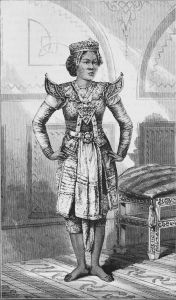
A ROYAL ACTRESS.
"We were all ready at last. A small gilt chariot of a tower-like form, made of ivory and decorated with garlands and crowns of flowers, drawn by a pair of milk-white ponies, and attended by Amazons dressed superbly in green and gold, conveyed me, as the Queen Thèwâdee, to the grand hall where we were to perform. My companions, similarly attended, followed me on foot. His Majesty, the princes, and princesses, surrounded by all the courtiers, were already there. The king and royal family were seated on a raised dais under a tapering golden canopy.
"The moment the king saw me approach, my ponies led gently forward by Amazons, he rose and, before the whole court of lords and nobles and princes assembled, inquired my name of one of the duennas. This recalled me once more to his memory, for he said aloud, 'Ah! we remember, she is the one who dances so beautifully.' O, what a moment of triumph that was for me! I felt as if my heart in its wild, ecstatic throbs would burst through its gorgeous fetters of silk and gold. I rose up in my chariot and bowed low before him three times. 'But, how now!' he exclaimed angrily, looking around; 'where are the nobles who are to lead the ponies? Let those Amazons fall back to the right and left.' In an instant there emerged from the crowd two most distinguished-looking noblemen, dressed in flowing white robes, threaded with gold and sparkling with gems; they took their places beside the ponies on either side of my chariot. One was P'haya[16] Râtani, the other was a stranger to me.
"They did homage to me, as if I were a real queen, and stationed themselves at my ponies' heads.
"At this moment I was saluted with a burst of music and the curtain fell. P'haya Râtani bent his head close to mine and whispered, 'How beautiful thou art!' I turned a frowning look upon him for his presumption, and replied, 'Have a care, my lord, a word from me may be too much for thee'; but he immediately assumed so humble and penitent an expression that I forgave him. I was both flattered and piqued, however, at the other nobleman's conduct; for though he looked admiringly at me, he said not a word. I would have given my eyes if it had been he who said I was beautiful; for there was a majesty of youth, strength, and manly beauty about him that made a blinding radiance around my chariot, and excited an oblivious rapture in my heart. I panted, I was athirst, for one word of recognition from him. At length I became so vexed at his silence that I asked him what he was looking at. He replied more cautiously than his companion, 'Lady, I thought that I beheld an angel of light, but thy voice recalls me to the earth again.'
"I was so enraptured at this speech, that I could hardly contain myself. A flood of delight swept over me, my breast heaved, my eyes glowed, my lips parted, my color came and went through the maize-colored cream that covered my face and concealed my only deformity.
"When the curtain rose, I, with this new life rushing through my veins, looked triumphantly at the troop of my companions who did me homage. This new existence made me so joyous that I must have been beautiful. Thus inspired I acted my part so wondrously well that a deep murmur of applause ran throughout the hall. His Majesty's eyes were riveted upon me in startled astonishment and evident admiration. I acted my part with a keen sense of its reality, and gave utterance to the burning passion of my heart. As if I were really a queen, I commanded my courtiers to drive away the suitors who wooed me, declaring that anything beneath royalty would stain my queenly dignity and beauty.
"But when the banished prince, my lover, appeared, I rose hastily from my gilded and ivory chariot, and with my hair floating round my form like a deep lustrous veil, through which the gems on my robe shone out like glorious stars of a dark night, I laid myself, like the lotus-stem uprooted, prostrate at his feet. I pronounced his name in the most tender accents. I improvised verses even more passionate than those contained in the drama:—
'Instantly I knew my lord, as the heat betrays the fire, When through the obscuring earth unclouded Shining out thou didst appear Worthy of all joy; my soul is wrung with rapture, And it quivers in thy presence, as the lotus petals before a mighty wind.'
"The courtiers raised me up from the floor, and led me back to the chariot. The prince, who was no other than 'Murakote,' took his, or more properly her, place beside me, and the curtain fell. The play was over. With nothing but the memory of a look, I returned to my now still more dismal rooms. I disrobed myself of all my glittering ornaments with a sigh, bound up my long, shining hair, and sat down to enjoy the only happiness left me,—my proud, swelling thoughts. I was just losing myself in soft, delicious reveries, which illuminated as with a celestial light the whole world within me, when I observed a couple of old duennas, who came fawning upon me, caressing and praising me, while telling me that his Majesty had ordered that I should be in attendance in his supper-chamber that evening.
"I listened in mute pain. The power of the new passion that now filled my heart seemed to defy all authority, and the very thing for which I had so long worked and longed had become valueless and as nothing to me. But I dared not excuse myself, so I silently followed my conductresses, and for the first time in my life ascended to his Majesty's private supper-chamber.
"How changed I was! that which had been my sole ambition ever since I was ten years old came down upon me with a gush of woe that I could hardly have believed myself capable of feeling.
"I sat down to await the coming of the king; but I could have plucked out the heart that had rushed so madly on, casting its young life away at the feet of a man whose name even I did not know, whose face I had not seen till that day, but the tones of whose voice were still sounding through and through my quivering pulses.
"Well, my forehead, if not my heart, I laid at his Majesty's feet. 'I am your slave, my lord,' said my voice, the sound of which startled my own ears, so hollow and deceptive did it seem.
"'Do you know how fascinating you were this evening?' said the king. 'Older by forty years than my father,' thought I, as, dissembling still, I replied, 'Your slave does not know.' 'But you were, and I am sure you deserve to be a queen,' he added, trying to play the gallant. 'My lord is too gracious to his slave,' I murmured.
"'Why, Thieng!' he said, speaking to my eldest sister; 'why have you hidden this beauty away from me so long? Let her not be called Choy[17] any longer, but Chorm.'[18] I would weary you if I tried to tell you how he praised and flattered me, and how before a week was over I was the proudest woman in the palace.
"I became a stranger to my dismal rooms in the street, to my slave-women as well as to my companions. I lived entirely in his Majesty's apartments, and it was only when he was asleep or in the council hall that I rushed down to plunge into the lotus-lake or to ramble in the rose-garden. But I never stopped to think. I would not give my heart a moment to reflect, not a moment to the past, not a moment to the future. I was intoxicated with the present. Every day gifts rare and costly were brought to me from the king; I affected to despise them, but he never relaxed his endeavors to suit my taste, to match my hair and my complexion. The late proud, insolent favorite, who used to order us girls about as if we were dogs, knelt before me, as half from ennui and half from coquetry I feigned illness and inability to rise from my master's couch. I cannot tell you how well I acted my part; I was more daring than any favorite had yet been.
"In the tumult and excess of the passion I felt for a stranger, I was able to make the king believe that he was himself its object; and he was so flattered at my seeming admiration and devotion, that he called me by the tender name 'Look' (child), and indulged me in all my whims and fancies.
"But at length I grew tired of so much acting, and the intensity of my manner began to flag. I complained of illness in order to escape to my own room, where I flung myself down upon my leather pillow, and drove my teeth through and through it in the after-agony that my falseness brought upon me. I was worn with woe, more than wasted by want of food. My sister observed my paleness, and said, half in earnest and half in jest: 'Don't take it so much to heart, child; we have all had our day; it is yours now, but it can't last forever. Remember, there are other dancing-girls growing up, and some of them are handsomer than you are.'
"'What do you mean?' I retorted, fiercely; 'do you suppose I am sorrowing because of my grandfather? Bah! take him, if you want him.' 'Hush, child,' she replied, 'and don't forget that you are in a lion's den.'
"'Lion or tiger,' I said, laughing bitterly, 'I mean to play with his fangs, even if they tear my heart, until I am rich as you at least.' 'Do you, indeed?' she rejoined. 'Be quick, then, and give him a p'hra ong.'[19] With that she left me to my own wild, bitter, maddening, condemning self.
"Months of triumph, rage, agony, and despair wore away, and my day was not over I was acknowledged by all to be the wilful favorite 'Chorm.' In the mean time I had one ray of comfort. I found out the name of the man I loved, from a new slave-woman who had just entered into my service. It was P'haya P'hi Chitt. That very day I took a needleful of golden thread and worked the name into a scrap of silk which I made into an amulet and wore round my neck. This greatly solaced me for a little while, after which I began to crave something more.
"The new slave-woman who had entered my service, just because I was the favorite, seemed so kind and attentive, and was such a comfort to me, whenever I rushed to my rooms for a respite, that I determined to employ her in obtaining information of the outside world for me. 'Just to beguile me of my weary hours,' I said. She seconded the idea with great alacrity. 'To whose house shall I go first?' she inquired. 'O, anywhere,' I replied, carelessly; then, as if suddenly remembering myself, I said, 'O Boon, go to P'haya P'hi Chitt, and find out how the groom of the Queen Thèwâdee lives in his harem.'
"When she returned, which was close upon nightfall, I was impatient to hear all she had to tell me; but after she had told me all, I became more impatient and restless still. Her face lighted up as she expatiated on the manly beauty of P'haya P'hi Chitt, and her voice trembled slightly—she did it on purpose, I thought—as she went on to say that ever since the day he had met the lovely Thèwâdee he had become so changed, and had grown so melancholy, that all his dearest friends and relatives began to fear some secret distemper, or that some evil spirit had entered into him. This was ample food for me for months. It comforted me to think that he shared my misery.
"Then I drooped and languished once more, and began to long for some more tangible token of his love for me. I grew bolder and bolder, and the tender-hearted slave-woman sympathized with my passion for him. At last I sent her out with a message to him. It contained but two words, Kit-thung,[20] and he returned but two more, Rak-mak.[21]
"All this while I still visited the king, and was often alone with him; he continued to indulge me, giving me costly rings, betel-boxes, and diamond pins for my hair. Every petition I made to him was granted. Every woman in the palace stood in awe of me, not knowing how I might use my power, and I was proud and wilful. My father was created a duke of the second rank in the kingdom, my brothers were appointed governors over lucrative districts. I had nothing left to wish for but a child. If I had had a child, I might have been saved. A child only could have subdued my growing passion, and given to my life a fairer blossom and a richer fruit than it now bears. At last, I don't know what put it into my head, but I began to solace myself by writing to P'haya P'hi Chitt every day, and destroying the letters as soon as they were written.
"My next step was to send one of these letters to him by Boon. He was very bold, and it makes my heart ache even now to think how brave and fearless he was. He wrote to me at once, and implored me in a depth of anguish and in words as if on fire to disguise myself in Boon's clothes, to quit the palace, and go out to meet him. I burnt the letter as soon as I had learned it by heart. My heart was set on fire; and I pondered over and over the proposition of my lover, until it became too fascinating for me to resist much longer.
"So I took Boon into greater confidence than ever, put a bag heavy with silver into her hands, and, moreover, promised her her freedom if she would assist me to escape. 'Keep the silver till I ask you for it, lady,' she replied, 'but trust me to help you. I will do it with all my heart.'
"Her devotion and attachment surprised me. It could not have been greater had she been my own sister. Poot-tho![22] could I have seen the end I would have stopped there. I saw nothing but the face that had kindled a blinding fire in my heart.
"The faithful Boon served me but too well. It was all arranged that I should go out at the Patoo-din[23] the next evening at sunset, with my hair cut off, and disguised as Boon. P'haya P'hi Chitt was to be there with a boat ready to convey us to Ayudia, and Boon was to remain behind until the whole thing should have blown over. This last was her own proposition. I tried in vain to urge her to accompany us in our flight. She said it would be safer for us both to have a friend in the palace, who could give us information of whatever took place.
"In the agitation in which I wrote these last instructions to my lover, I made so many blunders that I had to write the letter all over again. Boon implored me to put no name to it, for we still feared some discovery. I gave it, sealed with my ring, to Boon, who carried it off in great delight; and I laid myself down upon my couch to dream of an overflowing happiness. In the blessedness of the great love that absorbed every feeling of my heart, I loved even the king, whom I had most injured and deceived, with the loving devotion of a child.
"In the midst of my ecstatic dreams I fell asleep, and dreamed a dream, O, so different! As plainly as one sees in broad daylight, I saw myself bound in chains, and P'haya P'hi Chitt flung down a dreadful precipice.
"My chamber door was thrown rudely open, I was seized by cold hands, harsh voices bade me rise, and I opened my eyes upon that woman who is called by us Mai Taie.[24] There was Boon, tied hand and foot, lying before my door. It was all over with us. 'If I could only save him,' was my only thought.
"They were putting chains on my hands, and jostling me about; for so benumbed and prostrated was I at the sight of Boon that I could not rise. I did not dare to ask her a single question for fear of implicating ourselves all the more, when my sister Thieng rushed into my room screaming, flung herself upon my bed, and clasped me around the neck.
"'Hush! sister,' I said. 'Make these women wait a little, and tell me how they came to find it out.'
"'O Choy, Choy!' she kept repeating, wringing her hands and moaning piteously.
"'Sister Thieng, do you hear me? I don't care what they do to me. I only want to know how much you know, how much he knows.'
"'A copy of a letter you wrote to some nobleman was picked up about an hour ago, and taken to the chief judge. She has laid it before the king.'
"Then, if that is all, he does not know the name,' I said with a sigh of deep relief.
"'Ah! But he'll find it out, sister,' said Thieng. 'Throw yourself upon his mercy and confess all, for he still loves you, Choy. He would hardly believe you had written the letter.'
"'Has Boon said anything?' I next inquired.
"'No, not a word, she is as silent as death,' said my sister. 'But where did you get her? Who is she? She was taken on her return, because you had mentioned your slave Boon in your letter. Now I must leave you and go back to the king,' said my sister. Then, weeping and abusing poor Boon, she went away.
"Boon and I were chained and dragged to the same cell you visited the other day.
"As soon as we were left alone, I asked Boon if she had confessed anything. 'No, my lady,' she replied with great energy, 'nothing in this world will make me confess aught against P'haya P'hi Chitt.' At the instant it flashed upon me that this woman, whoever she was, also loved him, and I looked at her in a new light. She was young still, and well formed, with small hands and feet, that told of gentle nurture.
"'Boon, cha,'[25] said I, in great distress, 'who are you? Pray, tell me, it is of no use to conceal anything from me now. Why are you so happy to suffer with me? Any one else would have left me to die alone.'
"'O my lady!' she began, folding her hands together as well as she could with the chains on them, and dragging herself close to me, 'forgive me, O, forgive me! I am P'haya P'hi Chitt's wife.'
"I was silent in amazement. At length I said, 'Go on and tell me the rest, Boon.'
"'O, forgive me!' she replied, humbly. 'I cried bitterly the night he returned from the grand fête because he told me how beautiful you were, how passionately he loved you, and that he should never be happy again until he obtained you for his wife. He refused to eat, to drink, or to sleep, and I vowed to him by my love that you should be his. But I found you were the favorite, and that it would be a more difficult task than I had at first thought; so rather than break my promise to my husband, nay, lady, rather than meet his cold, estranged look, I sold myself to you as your slave. Every ray or gleam of sunshine, every beautiful thought that fell from your lips, I treasured up in my heart and bore them daily to him, that I might but console my noble husband. You know the rest. If I deceived you, it was to serve both you and him, while my heart wept to think that I was no longer beloved. Gifted with unnumbered virtues is my husband, lady; and my heart, like his shadow, still follows him everywhere, and will follow him forever.'
"I was so sorry for Boon, I had not the heart to reproach her. I crept closer to her, and, laying my head on her bosom, we mingled our tears and prayers together. And I marvelled at the greatness of the woman before me.
"Next morning—for morning comes even to such wretches as my companion and me—we were dragged to the hall of justice. The king did not preside as we had expected. But cruel judges, male and female, headed by his Lordship P'haya Promè P'hatt and her Ladyship Khoon Thow App. Not knowing what charge to make, they read the copy of my letter over and over again, hoping to guess the name of the gentleman to whom it was sent. Failing to do this, they subjected Boon to a series of cross-questionings, but succeeded only in eliciting the one uniform reply, 'What can a poor slave know, my lords?'
"Her feet were then bastinadoed till the soles were raw and bleeding. She still said, 'My lords, be pitiful. What can a poor slave know?'
"After a little while, Khoon Thow App begged Boon to confess all and save herself from further suffering. Boon remained persistently silent, and the lash was applied to her bare back till it was ribbed in long gashes, but she confessed not a word. At last the torture was applied to her thumbs until the cold sweat stood in great drops on her contorted and agonized brow; but no word, no cry for mercy, no sound of confession, escaped her lips. It was terrible to witness the power of endurance that sustained this woman. The judges and executioners, both male and female, exhausted their ingenuity in the vain attempt to make her betray the name of the man to whom she had carried the letter; and finally, when the lengthening shadows proclaimed the close of day, they departed, leaving me with poor Boon bleeding and almost senseless, to be carried back by the attending Amazons to our cell.
"I tried to comfort poor Boon. She hardly needed comfort; her joy that she had not betrayed her husband was even greater than her sufferings.
"Another day dawned upon us. Boon was borne in a litter, and I crept trembling by her side, to the same hall of justice. Boon was subjected once more to the lash, the bastinado, and the thumb-screws, till she fell all but lifeless on the ground. It was all in vain; that woman possessed the heart of a lion; if they had torn her to pieces, she would not by the faintest sound have betrayed the only man she had loved in her sad life.
"The physicians were sent for to restore her to life again. She was not permitted the luxury of death. Then, when this was over, they bound up her wounds with old rags, gave her something to revive her, and laid her on a cool matting. My turn came, and her eyes fixed themselves upon me with an intensity that fairly made me shiver. They seemed to cry aloud to my inmost soul, saying as plainly as lips could speak, 'What is suffering, pain, or death, compared to truth? Be true to yourself. Be true to your love. If you love another, you love not yourself. Flinch not. Bear bravely all they can inflict.' I shuddered as the judges began to question me, but I shuddered more whenever I met Boon's eyes, so fixed, so steadfast, so earnest, so appealing. I prevaricated. I told the judges lies. 'That letter was written as a joke to frighten my youngest sister. I was only playing. I know no man in the world but my father and brothers and my gracious master the king.'
"My sister was summoned. If I could have spoken with her, she might have helped me in my strait; but the women who were sent to bring her questioned her before she knew what they were about, and she plainly exposed my lies to the judges.
"A messenger was despatched to the king. The judges feared to proceed to extreme measures with me, who had so lately been the plaything of their sovereign. After half an hour's delay the instructions were received, and I was ordered to bare my back. A feeling of shame prevented me. I would not obey. I resisted with what strength I had. 'You may lash me with a million thongs,' I said to them, 'but you shall not expose my person.' My silk vest was torn off, my scarf was flung aside, my slippers were taken from my feet. My arms were stretched and tied to a post, and thus I was lashed. Every stroke that descended on my back maddened me into an obdurate silence. Boon's eyes searched into my soul. I understood their meaning. My flesh was laid open in fine thin stripes, but I do not remember flinching. My feet were then bastinadoed, and I still preserved, I know not how, my secret. Then there was a respite, and they gave me something to drink.
"In fifteen minutes I was once more exhorted to confess. The judges, finding me still unsubdued, ordered the thumb-screws to be administered. Not all the agonies, not all the horrors I have ever heard of, can compare with the pain of that torture. It was beyond human endurance. 'O Boon, forgive me, forgive me!' I cried; 'it is impossible to bear it.' With Boon's eyes burning into my soul, I gasped out the beloved name. Boon threw up her arms, gave a wild shriek of terror, and became insensible.
"I was released from further punishment. Two of the pha-koons[26] were despatched for P'haya P'hi Chitt. He was betrayed to the king's officers for a heavy reward, and before noon was undergoing the same process of the law. When Boon was once more brought to life, she saw her husband in the hands of the executioners. She started upright, and, supporting herself on her rigid arms and hands, cried out to the judges and to Koon Thow App: 'O my lords! O my lady! listen to me. O, believe me! It was all my doing. I am P'haya P'hi Chitt's wife. It was I who deceived the Lady Choy. It was I who put it into his head. Did I not? You can bear testimony to my guilt!' An ineffable smile beamed on her pale lips and in her dim eyes as they turned towards her husband.
"There was profound silence among the judges. P'haya P'hi Chitt, I, and even the rabble crowd of slaves, listened to her with astonished countenances. There was an incontestable grandeur about the woman. Khoon Thow App, that stern and inflexible woman, had tears in her eyes, and her voice trembled as she asked, 'What was thy motive, O Boon?' There was no reply from Boon. There was no need to torture P'haya P'hi Chitt. He was chained and conveyed to the criminals' prison, and we were carried back to our cell.
"The report of our trial and the confessions elicited were sent to the king. That very night, at midnight, the sentence of death was pronounced by the Secret Council upon us three; but the most dreadful part of all was the nature of the sentence. Boon and I were to be quartered; P'haya P'hi Chitt hewn to pieces; and our bodies not burned, but cast to the dogs and vultures at Watt Sah Katè.[27]
"My sister Thieng implored the king in vain to spare my life. My poor mother and father were prostrated with grief. As for Boon, she never uttered a single word, except, in answer to my inquiries if she were suffering much, she said very gently, 'Chan cha lah pi thort' (Let me say farewell, dear). Her pallor had become extreme, but her cheeks still burned; all the beauty of her spirit trembled on her closed eyelids. She appeared as one almost divine.
"On Sunday morning at four o'clock the faithful and matchless Boon was taken from our cell to undergo the sentence pronounced upon her and her husband. The day appointed for my execution, which was to be private, arrived, and I had no wish to live, now that P'haya P'hi Chitt and Boon were gone; but the women who attended me said that no preparations were as yet made for it. I wondered why I was permitted to live so long.
"After two weeks of cruel waiting to join my beloved Boon, I was removed to another cell, where my sister visited me, with the good Princess Somawati, her daughter, at whose earnest request, as I was told, the British Consul[28] had pleaded so effectually with the king that my life had been granted to his petition.
"Alas! it was Boon who deserved to live, and not I. I am not grateful for a life that is little better than a curse to me. God sees that I speak the truth. Woe still hovers over me. It is the doom of guilt committed in some former lifetime. I am an outcast here, and in this world I have no part, while every day only lengthens out my life of sorrow."
Here the poor girl broke off, laid her head on the table, and wept, as I never saw a human being weep, great tears of agony and remorse.
As soon as Choy left me, I hurried home and wrote down her narrative word for word, as nearly as I could; but I encountered then, as always, the almost insuperable difficulty of finding a fit clothing for the fervid Eastern imagery in our colder and more precise English.
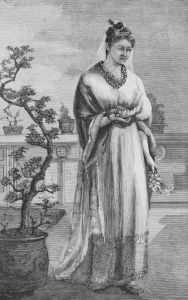
RUNGEAH, THE CAMBODIAN PROSELYTE.
We became better friends. I maintained a constant oversight of her, and persuaded her gradually out of her griefs. She learned in time to take pleasure in her English studies, and found comfort in the love of our Father in heaven. Without repining at her lot, hard as it was, or boasting of her knowledge, but with a loving, humble heart, she read and blessed the language that brought her nearer to a compassionate Saviour.
FOOTNOTES:
CHAPTER XVI.
MAY-PEÂH, THE LAOTIAN SLAVE-GIRL.
On the evening of the 10th of August, 1866, I found myself suddenly and unexpectedly, and almost without being aware of it, involved in a conflict with the king, who thenceforth regarded me with distrust and suspicion, because I declined to affix my own signature to a certain letter which he had required me to write for him.
I began heartily to wish myself out of Siam, though still deeply interested and absorbed in my work of educating the prince,—the present King of Siam,—for I felt that, with regard to foreigners, there existed no laws and customs to restrain and limit the capricious temper and extravagant demands of the king, and I had everything, too, to fear from the jealousy with which certain royal courtiers and judges watched my previously growing influence at court. The heat of the day had been intense, the atmosphere was sultry and oppressive, and every now and then a low, rumbling sound of distant thunder reached my ears, while the parched trees and leaves drooped and hung their heads as if impatient of waiting for the promised rain. Nervous, and undecided what to do, I returned home, where I remained prostrated with a sense of approaching danger. From time to time I had had similar conflicts with the king, which very greatly disturbed my already too much impaired health. All manner of fears which the mind so prodigally produces on such occasions came crowding upon me that evening, and I felt, as I had never before, weighed down by the peculiar sadness and isolation of my life in Siam.
In this frame of mind I sat and pondered over and over again the only course remaining open to me,—to withdraw from the court,—when I was suddenly recalled to what was passing around me by what I at first imagined must be an apparition or some delusion of my own mind. I started up from the spot where for hours I had been seated like a statue, and, looking more attentively, perceived a pair of bright black eyes watching me with the fixedness of a basilisk, through the leaves of some flowering shrubs that grew over my window. My first impulse was to scream for help; but I was soon ashamed of my fears, and, summoning all my courage, I demanded, "Who is there?"
"It is only me, your ladyship," said a strange, low voice. "I have been waiting here a long while, but your servants would not let me in; they say you have forbidden them to let any Siamese person enter your house after sunset."
"It is true," said I; "I don't want to see any one this evening; I am ill and tired. Now go away, and, if you have any business with me, come to me in the morning."
"P'hoodth thô!" said the woman, speaking still in the same low tones; "I am not a Siamese, and you do not know that I have rowed thirty miles against the tide to come and see you, or else you could not have the heart to send me away."
"I don't want to know anything," I said a little impatiently; "you must go now, and you know it is not safe for you to be away from home at this late hour in the day."
"O lady! do let me in; I only want to say one word to you in private; please do let me in," whispered the woman, more and more pleadingly.
"Then say what you have to tell me at once, and from where you are," I replied; "there is no one here to overhear you; for I cannot let you in."
"Alas!" said the voice, plaintively, as if speaking to herself, "I would not have come all this long distance but that I heard she was a good and brave woman,—some people indeed said she was not so,—still, I thought I would try her, and now she says she cannot let me in, a poor fugitive and desolate slave-girl like me! O dear! O dear!"
"But I am afraid I cannot help you, whatever your trouble may be," I said more gently, touched by the woman's despairing tones. "The king is offended with me, and the judges know it, and I have no more influence with them now."
As I said this, the girl sprang through the window and came forward, and exhibited not only her bright eyes but her full figure and somewhat singular dress, for she was, as she had stated, not a Siamese, but a Laotian. She held her head erect, though her hands were clasped in the attitude of wild supplication. The symmetry of her form was enhanced by a broad English strap or belt which was buckled round her waist, and which had the effect of showing off her beautiful figure to the best advantage. She was unusually tall, and altogether a most pleasing-looking young woman.
The moment she stood before me she commenced talking with a volubility and an amount of action which it would be almost impossible to describe. Her face became so animated, and her tears and sobs flowed so spontaneously, that I stood bewildered, for, in truth, I had rarely seen so interesting and so natural a woman in Siam.
She watched my countenance during the whole time she was speaking, with the quickness of the native character, and I began at length to suspect that she prolonged her statements for the sole purpose of forming an idea of her success, so that she might vary her line of action according as circumstances revealed themselves; and even while I had a glimmering perception of this, and also that perhaps she was only acting, my interest in her increased so rapidly that she became convinced in her own mind, I think, of having gained my entire sympathy.
"Ah! I knew you had a kind heart," said the woman, as she came forward with the graceful salutation of her country, and laid a thick Oriental letter, enveloped in velvet and fastened with silken cords and sealed with English sealing-wax, at my feet.
She then dropped on her knees, and knelt before me in an attitude of mute supplication.
I was never more embarrassed in my life, with that mysterious letter, enveloped in crimson velvet, and written on the outside in characters I had never before seen, lying at my feet, and this woman kneeling there with such strange, wild energy in her manner, such vehement pleading in her dark, passionate eyes, imploring my aid in a secret, daring scheme which I had neither the courage nor the ability to undertake, nor yet the stoutness of heart to refuse point-blank.
I therefore told the woman, with as much gentleness as I could summon, that it was impossible for me to aid her, and almost as much as my life was worth to become the bearer of her letter to any prisoner in the palace. "It is not for my own personal safety I fear so much, but for my son's, whose young life depends on mine."
As I was speaking, the woman's face grew still and cold, her features became rigid and fixed as stone, large, dewy drops of perspiration broke out on her forehead, and there fell upon her face such an expression of blankness and utter desolation that I thought she was absolutely dying from the pain of her disappointment.
This produced such a revulsion of feeling in me that I started from my seat in terror, and, taking her chilled, moist hands in mine, said, anxiously: "Does what I have said distress you so much? Why won't you speak? If there is any way by which I can help or comfort you, tell me. Please tell me, and I'll try to do my best for you."
The effect of this promise was immediate, but it was some time before the woman could recover her voice; then, laying her hand upon my arm, she spoke hurriedly, but in the same soft, low tones and fervent manner.
"You have not asked me my name and who I am," she said. "But I'll tell you; I am sure you will not betray me, and it may be this is the last opportunity I shall have of serving my dear foster-sister."
As she uttered these words the hope and courage which had evidently been revived by the sympathy she saw in my face now seemed to forsake her; tears and sobs burst from her afresh, and she crouched at my feet as if utterly overwhelmed with her grief. At last, by a strong effort, she turned to me, and said: "My name is May-Peâh; my home is in the city of Zienmai, i.e. Chiengmai; my father, Manetho, is one of the most trusted councillors and friends, though a slave, of the Prince P'hra Chow Soorwang. My mother was a household slave in the family of the prince when my father obtained her for his wife, and I was only a month old when she was asked to be the wet-nurse and mother of the little infant daughter of the prince, whose wife had died in child-birth; and thus it was that I became the life-long companion and friend and foster-sister of the young Princess Sunartha Vismita. But alas! dear lady, she is now, and has been ever since the death of her husband, the second king, a prisoner in the palace of the supreme king, and neither does her brother nor any one else know whether she is alive or dead.
"This letter has nothing in it that will bring you into any trouble. It is only one of greeting from her brother, my master, the Prince O'Dong Karmatha. O, dear lady, don't say no! the gods will bless and reward you, if, sooner or later, you will put it into her hands; but it must be done with the greatest caution and secrecy, and it may be the means of saving her life. O, think of that, of saving her life! for, if alive, she must be dying of grief and pain to think that we have never yet replied to a letter she sent us almost a year ago."
"And where is the prince, your master?"
"He is on a visit to the governor of Pak-lat."
Saying this, she almost instantaneously sprang out of the window, and fled towards the river, as if conscious of having delayed too long her return home; as she did so, I noticed that she wore in the folds of her skirt a small Laotian dagger attached to her English belt.
The storm which had been gathering in strength for hours now burst forth, and for full three hours the thunder and lightning and rain were the only things that could be seen or heard; and I sat in the same spot, lost in anxious fears for the safety of that solitary woman battling with the tremendous currents of the Mother of Waters.
It was an awful night. Sick at heart, and full of natural and unnatural fears, I locked up the letter at last in my drawer, and tried to forget in sleep the disturbing events of the day.
CHAPTER XVII.
AN ACCIDENTAL DISCOVERY OF THE WHEREABOUTS OF THE PRINCESS SUNARTHA VISMITA.[29]
FOR some time afterwards the mysterious letter remained locked up in my drawer, as nobody whom I knew seemed to be aware even of the existence of such a person as the Princess Sunartha Vismita, much less of her imprisonment in the palace, and I was afraid to open my lips on the subject before a stranger, lest I should inadvertently say something that might still more imperil her health and safety.
The king was once more reconciled to me, and had taken me into greater confidence than ever. Just at this time he was laid up with an illness which confined him to his topmost chamber, where I was summoned every day to write notes, or translate, with the help of the native female secretary, English documents into Siamese.
On one occasion, as I was at work in a room adjoining the royal bedchamber over a mass of perplexing manuscripts in the king's own handwriting, to be arranged for publication in the "Bangkok Recorder," the chief of the Amazons brought in the intelligence that the prisoner, Princess Sunartha Vismita, was very ill; and, his Majesty being in the best possible humor, having just finished the above-mentioned manuscript, which completely refuted, as he fondly believed, Dr. Bradley's theory of Original Depravity, gave orders that the princess should take an airing in the palace gardens, and be removed to another cell, and that the chief lady physician should attend her without delay.
The Amazon made haste to carry out her instructions, and I quietly left my desk to follow her.
I shall not attempt to enter into a particular description of the prison in the interior of this strange city. Indeed, it would be impossible to describe with any degree of accuracy so irregular and rambling an edifice. The principal features consisted of a great hall and two courts or enclosures, one behind the other, in which the prisoners were permitted to walk at stated times. Three vaulted dungeons occupied three sides of the enclosures; immediately below these were the cells already described in my former book.[30]
The upper cells were used more or less for the reception of women convicted of petty crimes, such as gambling, stealing, immodest language, etc. Besides these, there were other dungeons under the floor in various parts of the prison, some of them quite dark, and closed by huge trap-doors, designed for those whom it might be expedient to treat with peculiar severity. The prison was approached by two long corridors, opening into the courts; here were several small secret apartments, or cells, in which prisoners condemned to death, either by the Supreme Court or by the still more supreme will of the king, passed the last days of their existence. It was in one of these that the princess was confined.
The opening of the prison doors attracted, as usual, a crowd of idle slave women and girls, who hailed the slightest event that broke the monotony of their lives with demonstrations of the liveliest joy; and as I stood there a guard of Amazons appeared, marching in file, and in the centre was the Laotian princess, followed by two of her countrywomen. She did not seem to notice the general sensation which her appearance created, nor the eager curiosity with which she was regarded, but walked on wearing the depressed and wearied look of one who sought to meditate on her sorrows in silence and privacy. Her features were remarkably stern, however, and she moved along with a firm and steady step.
I followed with the crowd, who kept at a respectful distance.
When the procession arrived at one of the nearest gardens, laid out in the Chinese style, the princess, with a proud intimation that she could go no farther, took her seat on the edge of an artificial rock beside a small pond of water in which gold and silver fish sported merrily together. She hung down her head, as if the fresh air had no power to remove the smallest portion of her sorrows and sufferings.
A deep murmur of compassion now rose, not only from the idle crowd of women and girls, who gazed awe-stricken into her face, but from the "Amazonian Guard," those well-disciplined automatons of the royal palace of Siam.
I could see that she just raised her dark, sad eyes to us, and then cast them down again; and that their expression, as well as that of her whole attitude, was one of mute and touching appeal against this most ungenerous usage.
After the lapse of an hour the procession resumed its course, and the crowd, who had by this time exchanged looks and whispers of sympathy to their hearts' content,—while some poor half-palsied and aged slave-women had lifted up their hands and prayed aloud for the happiness of the ill-fated princess,—brought up the rear, till they saw the same prison doors open and close once more on the noble lady and her attendants, when they dispersed to their various abodes.
When I returned home, the scene would constantly reproduce itself, and my thoughts would unceasingly revert to those sad eyes of which I had only caught a hasty glance; and that utter friendlessness, expressed in a few brief, slight actions, dwelt in my memory like the impressions of childhood, never to be wholly forgotten.
I could not help picturing to myself how those eyes would brighten if I could but put that letter into her hands, and tell her of one earnest friend at least whose love and sympathy knew no bounds.
This feeling at length urged me, now that with the restored favor of the king there could be no real danger to myself and my boy, to find some means of gaining access to the poor, sad prisoner.
I immediately put the letter into my pocket, and pinned it carefully there, and determined that after my school duties were over I would advise with my good friend Lady Thieng, of whom mention has already been made. Only one circumstance troubled my mind greatly, and it was how to broach the subject to her in the presence of the number of women who always attended her at all times and in all places.
FOOTNOTES:
CHAPTER XVIII.
LADY THIENG, THE HEAD WIFE AND SUPERINTENDENT OF THE ROYAL CUISINE.
Lady Thieng was a woman of about thirty, fair even to whiteness, with jet black hair and eyes; by nature enthusiastic, clever, and kind, but only partially educated when compared to many other of the cultivated and intellectual women of the royal harem.
She was the first mother,—having brought his Majesty four sons and eight daughters,—for which reason she was regarded with peculiar veneration and ranked as the head wife in the palace, the queen consort being dead. All these considerations combined entitled her to the lucrative and responsible position of superintendent of the royal cuisine.