Front matter (continued 5)
Reading edition
"The 'Topaze' is in the roadstead," said Hythe, as he rapidly turned over the pages. "Ah, here we are. Commander the Hon. C. L. Sedgwyke, I know him, but I'm afraid he doesn't know me. Lieutenant Totterbull--h'm, yes, he might. But here's Dewerstone, he was in my term at Dartmouth. Would you mind if he were sent for, sir?"
"Certainly not. I will have a signal made at once," replied the Consul.
"You wouldn't mind, sir," continued the sub, addressing Captain Restronguet. "Dewerstone is a fellow to be trusted. He wouldn't say a word to anyone outside."
Accordingly a signal was made from the roof of the Consulate, and Sub-Lieutenant Dewerstone was informed by his captain that his presence was required ashore. The young man did not feel particularly joyful at the intelligence. He had already obtained permission to go to a tennis party, and having to attend on Consular Service did not appeal to him. Nevertheless, as soon as a boat could take him off, Dewerstone was ready.
"Good afternoon, Dick," exclaimed Hythe as soon as the sub from the "Topaze" had paid his respects to the Consul.
"Well, Hythe, where did you roll up from?" asked Dewerstone nonchalantly. "I thought you were in Davy Jones's locker."
"I am not," said Hythe earnestly. "Perhaps you would not mind proving my identity to His Britannic Majesty's Consul."
"Considering we were in the semi-final for the heavyweight and you knocked me out I think I can safely do that," replied Dewerstone.
"We need not go further, gentlemen," announced the Consul. "I must apologize for not accepting your word, Captain Restronguet. Now what do you wish me to do?"
As briefly as he could Captain Restronguet explained the circumstances under which he rescued the survivors of the "Iticaba," and the reason why he wished salient facts in connection with the affair to be temporarily suppressed.
"I think it can be arranged," said the Consul. "At all events, I will take down the depositions of Captain Rees, and omit any details I consider necessary."
As soon as this was done Captain Rees took his departure.
His men had already been quartered in the Consulate, where they were to remain until they could be sent back to Liverpool.
"You will dine with me, gentlemen?" asked the Consul of Captain Restronguet and the two subs. "There is no immediate hurry for you to get back?"
"I must get a boat before four o'clock," replied Captain Restronguet. "So I must ask to be excused."
Hythe was also unable to accept, while Dewerstone, still intent upon the tennis party, managed to find a reason for declining the stiff formality of dinner at the Consulate.
During their stay at Zanzibar Captain Restronguet and his companions visited the old town, but finding it remarkable for its malodorous nature, they beat a hasty retreat and went for a stroll inland. Before they returned it came on to blow fairly hard from the sou'west, and by the time they reached the landing-place it was pretty evident that a boat could not put off without great risk.
In vain Captain Restronguet offered the native boatmen a large sum to be rowed off beyond Bawi Island. He even tried to charter a dhow, but without success.
"We could ask the Consul to communicate with the 'Topaze' or any of the cruisers and gunboats in the roadstead; they would send a piquet-boat for us," suggested Hythe.
Captain Restronguet shook his head.
"Not if it can be avoided," he answered. "I have reasons for not falling in with your plan. We will see if we can get better luck at Shangani Point. The water ought to be smoother there."
Accordingly both men set off as briskly as they could in the moist, enervating heat, but before they had passed the Sultan's palace a short, sparsely-built man in European clothing overtook them. Twice the man looked over his shoulder at Captain Restronguet, then suddenly wheeling he intercepted him and held out his hand.
"What ho, there, Tretheway! Whoever would have thought of meeting you in this dead and alive corner of the globe?"
Hythe naturally thought it was a case of mistaken identity on the part of the little fellow, but to his surprise Captain Restronguet replied in a cordial manner.
"Bless my soul! It's Jenkins. What are you doing here?"
"It is," assented that worthy. "I've been knocking about a bit since I last worked--I mean, slaved--with you in a British dockyard. Fallen on my feet at last though, that is, unless I fall on my precious skull. Just fancy, Tretheway, I am aeroplanist-in-chief to His Highness the Sultan of Zanzibar."
"Better you than me," remarked the Captain with a laugh. "But I was unaware that the Sultan was a devotee of the art of flying."
"He is, and he isn't," replied Jenkins. "He owns a good many air crafts of various types, and I and several others, mostly Frenchmen, by the by, give exhibition flights while he sits in his state chair and watches us. But how goes it? You look jolly fit, and don't appear as if you were hard up for a dollar?"
"No, I cannot complain on that score," said Captain Restronguet quietly.
"Well, come and have a look at my little air-fleet. Really they don't make a bad show. And your friend, of course."
"Sorry," replied Captain Restronguet. "But we're in a regular hurry. I am trying to get a boat to put me off."
"Where to?" asked Jenkins. "One of the liners in the Roads?"
"No, further out; quite five miles off."
"Guess you won't get a Zanzibari to take on the job. There's a brute of a swell tumbling in. Look here, I'll tell you what: I'll give you a lift in one of our aero-hydroplanes, if you like."
"Is it safe?" asked Captain Restronguet earnestly, whereat Hythe wondered, for his companion had never before shown signs of timidity, even when in tight corners in the depths of the sea.
"Safe as a house," replied Jenkins reassuringly.
"Jenkins, my friend, you misunderstand me, although I quite admit the question was ambiguous. Is it safe--or shall we say discreet?--to take us for a 'joy-ride' in one of the Sultan's air-craft?"
"If anything His Highness would be pleased to see me making a flight in gusty weather with two passengers; so say the word and I'll trot out the contraption. It's the only way."
"Carry on, then," assented Captain Restronguet.
Within the spacious outer courtyard of the palace stood a number of lofty sheds with sliding doors. At a wave and a gesture from the chief aviator a number of natives opened the doors and dragged a huge aero-hydroplane of an obsolete pattern into the sunlight. The machine was a biplane. Underneath the two long floats were four wheels, so that it could be adapted either for alighting and rising from the sea or land.
Jenkins critically examined various nuts and tension wires, started the engine, till the machine was all a-quiver with the vibration from the revolving cylinders.
"All correct," he bawled, for the rapid explosion of the motor practically deadened every other sound. "Get aboard."
Captain Restronguet occupied a seat immediately behind and slightly higher than the pilot, while Hythe sat behind the biplane. Jenkins vaulted agilely into his place, motioned to the attendants to stand clear and thrust home the clutch of the propeller shaft.
The aero-hydro-craft leapt over the ground for about twenty yards with a jerk that nearly capsized the two passengers; then soaring upwards it cleared the courtyard wall by barely six feet, passed over the upturned faces of a crowd of natives in the roadway, and shot rapidly across the harbour.
The motion was exhilarating, but the air, by contrast with the heat ashore, was cold and cutting to the faces of the passengers. Hythe realized that aeroplaning in white ducks, even in the Tropics, was rather out of place.
"Look, sir," he exclaimed. "There's the 'Topaze' going out."
"That's rotten luck," replied Captain Restronguet leaning sideways to watch the cruiser, that, a thousand feet below, looked no larger than a model boat. "Your friend Dewerstone has given the show away."
"I think not," replied the sub confidently. "He told me he was on leave till the day after to-morrow."
"Where's your ship, Tretheway?" shouted Jenkins.
"Away beyond Bawi Island. There she is."
"Rum looking craft, anyway," commented the aviator. "Looks more like a dog's kennel to me."
"Thanks," remarked Captain Restronguet in an undertone; then louder he added, "She's hove-to. If you come down within hailing distance they'll range up alongside to pick us up; they haven't a boat."
"Haven't a boat," ejaculated Jenkins. "Rum craft. Look here----"
He ended abruptly, for with a report like a pistol shot one of the wires supporting the wing plane snapped. The aero-hydroplane began to tilt ominously. Hythe and his companion instinctively realizing that a disaster was imminent grasped the rods nearest to hand in a grip of iron.
Pluckily the aviator strove by manipulating the elevating rudder to restore the doomed aircraft's equilibrium, but in vain. He, therefore, shut off the engine and attempted a vol-plane. Already the air-craft was standing almost on its nose, and falling with fearful velocity, till Captain Restronguet slid out of his seat and was prevented from falling clear only by his grasp upon a metal rod.
Finding that the machine was quite out of control, Jenkins touched a lever with his foot. Instantly a length of stout canvas trailed out astern. Before the aero-hydroplane had descended another fifteen feet the canvas, distended by the resistance of the air, took the shape of a huge parachute. The fall, though still rapid, was appreciably retarded, while the three men, literally hanging on tooth and nail, became aware that hope was not yet dead.
With a tremendous splash the wrecked aero-hydroplane struck the water. Hythe found himself torn from his support, and plunging feet below the waves. Fearing that he might be entangled in the sinking machine he struck out and swam a considerable distance ere he rose to the surface.
Shaking the water out of his eyes, he looked around. The aero-hydroplane was still floating, but with a heavy list. The concussion had burst the seams of one of her floats, which was now completely filled with water, while the other was leaking slightly. Clinging to the still buoyant float were the captain and Jenkins. The "Aphrodite" was nowhere to be seen.
"We're all right for the present," called out the former cheerily. "The water's warm and I have not seen any sharks about, and the cruiser will bear down and pick us up."
"Where's your ship, Tretheway?" asked the aviator anxiously. "We were falling close to where she was hove-to."
"I'm rather afraid she didn't spot us," replied Captain Restronguet. "And seeing the 'Topaze' approaching, she dived."
"Dived!" exclaimed the astounded Jenkins. "What d'ye mean? You don't mean to tell me the ship you belong to is a submarine?"
"It is," assented the Captain coolly.
"Not that rascally 'Vorwartz' by any chance?"
"No."
"Well, then, what's her name? I haven't heard of any other submarine in these waters."
"Not the 'Aphrodite'?"
"Don't try to be funny, Tretheway. You know as well as I do that that submarine was blown to atoms."
"I am afraid, my dear Jenkins, that I cannot agree with you. The 'Aphrodite' is even now submerged in the Zanzibar Channel, and I--whom you know as Hugh Tretheway--I am Captain John Restronguet."
CHAPTER XXV.
THE APPROACH OF THE "VORWARTZ."
Beyond muttering "Well, I'm dashed!" the aviator relapsed into silence. In vain Captain Restronguet and Hythe looked for a trace of the "Aphrodite." As a last resource the former produced a silk green and white flag from his pocket and lashed it to one of the vertical stays in the hope that the submarine might locate it by means of her periscope.
"They're carrying out orders," said Captain Restronguet at length. "I told Devoran to dive if he saw any vessel approaching. He spotted the 'Topaze' and immediately descended. It's awkward, because the secret is bound to leak out. But after all it is rather remarkable that it didn't become common property hours ago."
"How shall we get on board the 'Aphrodite,' sir?" asked the sub.
"We'll manage it sooner or later, but there's valuable time lost. Ha, there's the 'Topaze' altering helm. She's sighted us."
A quarter of an hour later the cruiser's gig picked up the three unlucky aviators, while the aero-hydroplane was secured and towed alongside before she sank, and was hoisted on board by means of a boat's davit. Dry clothing was immediately forthcoming, and clad in borrowed garments the rescued men were taken aft to be introduced and interviewed by the Hon. Charles Sedgwyke, captain of H.M.S. "Topaze."
Realizing that it would be useless to attempt to conceal anything Captain Restronguet made a full report of all that had occurred, and requested that he and his companions might be taken back to Zanzibar, whence the "Aphrodite" might be communicated with by wireless.
"I am afraid that it is at present impossible, Captain Restronguet," said the Hon. Sedgwyke. "We are under urgent orders to proceed to Delagoa Bay, for there that villainous von Harburg has been making himself particularly objectionable. We are to meet and co-operate with the 'Pique,' and should our efforts meet with success we are to carry on to Table Bay. There is, I am afraid, no option. You must accompany us, and no doubt, your valuable experience in connection with the affair will enable us to settle with the 'Vorwartz.'"
"I would much rather settle with her myself," replied Captain Restronguet.
"That I can quite understand. I can also safely assert that Captain Restronguet will not prevent the 'Topaze' from distinguishing herself by standing aloof when he might otherwise render us good service."
Captain Restronguet bowed. "Naturally," he added. "Our interests in the business lies in the same direction."
"Anything I can do to aid you I will most willingly do," continued Captain Sedgwyke. "I might suggest that the wireless of this vessel is at your disposal, and by sending a message to the Admiralty you could have it re-transmitted through your agent to the 'Aphrodite.'"
"An excellent arrangement," said Captain Restronguet, "only it is certain that the news will reach Karl von Harburg, and that is what I particularly wish to avoid."
"I trust that within the next few days Karl von Harburg will be totally indifferent to news of any description," remarked the captain of the "Topaze" drily. "But in the meanwhile make yourselves comfortable on board. You will, I hope, do us the honour of being a temporary member of the Ward Room. Mr. Hythe, who is still under the Naval Discipline Act, must, of course, mess in the Gun Room. I am still slightly hazy as to the exact official and social status of the aviator-in-chief to His Highness the Sultan of Zanzibar."
Three days later the "Topaze" was threshing her way southward at a good twenty-two knots and was approaching the rendezvous. It was now night, but the moon, shining with all the lustre that only the tropics can enjoy, made everything on deck quite discernible.
Surrounded by a group of officers, all of whom were most anxious to gather particulars of the rival submarines from two of the principal characters, Captain Restronguet and Hythe had to exercise their ingenuity to prevent themselves being "pumped," for even to their kind hosts it was not advisable to give themselves away. Nevertheless the time passed pleasantly. The paymaster's cigars were excellent, the surgeon was a lively raconteur, and the first lieutenant was kindness personified; but at length Captain Restronguet contrived to draw Hythe aside to the lee of the after nine-point-two-inch gun turret.
"No doubt you wondered why that fellow Jenkins addressed me as Hugh Tretheway," he began. "Well, it certainly was strange running across him in far-off Zanzibar. You may remember I told you that for some months, when down on my luck, I worked as an electrical fitter in Devonport Dockyard? That man Jenkins was in the same shop. He isn't a bad fellow by any means, though somewhat of a rough diamond. Hugh Tretheway is my baptismal name, but for certain reasons I preferred to drop it and assume the name of John Restronguet. I hope that for the present at all events you will keep that information a secret. I have already had a quiet talk with Jenkins on the matter, and from what I already know of him, he will be as silent as the dead."
"Of course I will carry out your wishes, sir," said the sub.
"Thank you. But to change the subject: what do you think of the chances of the 'Topaze' against the 'Vorwartz'?"
"She has her work cut out," replied the sub. "But I feel certain that every man on board will do his best."
"They cannot do more," added Captain Restronguet earnestly. "At the same time they are running needless risks when, once I locate the 'Vorwartz,' I could destroy her without a quarter of the danger. Suppose, now, that the Delagoa Bay report was false and Karl von Harburg is knocking about in these waters: what is there to prevent her from torpedoing the ship and sending her to the bottom?"
"That is a risk that every ship must run in naval warfare," replied Hythe. "Ever since the invention of torpedoes that risk has increased, and now that submarines form a formidable arm of the Naval Service there is still the greater possibilities of a ship being sent to the bottom without a shot in self-defence."
Before Captain Restronguet could say another word a hoarse order came from the fore bridge, followed by a shrill bugle-call for "General Quarters" and the long-drawn notes of the bo's'un's-mates' whistles.
"What's that?" demanded Captain Restronguet.
"'Clear for action'--a test order perhaps," replied Hythe. "See how those fellows get to work."
Up the companion-ladders officers hurriedly appeared, still fumbling with the buckles of their sword-belts. From for'ard tumbled a swarm of hefty bluejackets, who, invading the sacred precincts of the quarter-deck, began to unship stanchions, davits, ventilating-cowls, and other impedimenta; steel covers were lowered over skylights and companion-hatchways. The securing bolts of the after nine-point-two gun turrets were cast loose, and the long muzzle swung round, causing Captain Restronguet to hurriedly duck his head. In five minutes the quarter-deck of the "Topaze" was deserted, as were the other exposed parts of the ship, every man being at his station behind the armoured portions of the vessel.
Another bugle-call.
"As you were," exclaimed Hythe. "Suppose we go up on the after-bridge. They are exercising. Perhaps the next evolution will be 'Out collision mats.'"
"Hope they won't have to do it in real earnest," remarked his companion as the two men ascended to their coign of vantage.
Once more the bo's'un's-mates' whistles sounded while the bo's'un shouted in stentorian tones "Out nets." The cry was repeated in half a dozen different parts of the ship, and the hither-to deserted decks became a scene of disorder and chaos: at least that's what it seemed to Captain Restronguet, who was for the time being a stranger in a strange land.
Instinctively Hythe pulled out his watch, which once more had stedfastly resisted the assaults of the sea water. Captain Restronguet, gripping the rail, leant over and watched the scene of activity upon the moon-lit deck. Over the side of the gently-rolling craft active seamen slid down upon the apparently insecure net-shelves, and by a series of gymnastic feats succeeded in rolling ten tons of close-meshed steel netting over the side, to the accompaniment of shouts of "Look alive there!" from their officers. Hardly had the last man regained the deck ere the motor capstans of the fo'c'sle began to clank. Seamen armed with spars thrust at the ends of the torpedo booms to give the motor-worked wire rope a chance; then slowly yet surely the twenty hollow steel booms were swung outwards till the "Topaze" was encircled with a "crinoline" of nets at sufficient distance from the ship to stop a deadly torpedo. Back doubled the men to their stations for action.
The sub glanced at his watch. The evolution had taken only forty-five seconds.
"Smart work!" ejaculated Captain Restronguet.
"Yes," assented Hythe. "But we did it in forty seconds on the old flagship. Apparently Captain Sedgwyke is not satisfied for I can hear him storming to some one."
"It is hardly my place to offer suggestions," said Captain Restronguet, "but I think it would be advisable if they kept the nets in position. It might save the 'Topaze' from being torpedoed, although I know that the speed is greatly diminished by the drag in the water."
"We never do," replied the sub. "It is the first time I have seen 'Out nets' performed with the ship underway. It is essentially a defence when lying at anchor. There: 'In net defence,' they are going to stow the nets."
In the midst of the scramble that ensued the bugle suddenly sounded "General Quarters." To leave an evolution half completed was a very unusual thing.
Something prompted Hythe to look seaward. At less than a cable's distance the two conning-towers of a submarine had just appeared above the surface of the moon-lit sea, a smother of foam making them still more conspicuous. The sub gripped his companion's arm and pointed.
"The 'Vorwartz!'" he exclaimed.
Several of the officers of the "Topaze" had observed the sudden appearance of the sinister craft, and hence the call to General Quarters. The light quick-firers were manned, their muzzles swung round till they pointed full at the submarine's conning-towers, which, proceeding at nearly the same rate and in a similar direction to that of the cruiser, presented an easy target.
Captain Sedgwyke was puzzled. It was inexplicable that the submarine should show herself when she might have let loose a torpedo while completely submerged. Nevertheless he was on the point of giving the order to open fire when Captain Restronguet, in a voice that could be heard from one end of the ship to the other, shouted:--
"Don't fire, it is the 'Aphrodite.'"
Something in the captain of the "Aphrodite's" words prompted Captain Sedgwyke to issue a confirmatory order. Hythe was astonished--even doubtful. He could not be certain as to whether it was the "Aphrodite" or her counter-felt rival; but the inventor and constructor had made no error. It was the "Aphrodite."
Thirty feet in front of the fore conning-tower the sharp bows of the submarine appeared above the water, followed by the whole length of her decks, from which the water poured in silvery cascades.
Then a hatch was thrown open and a figure that Hythe recognized as that of the first officer appeared. Raising a megaphone Devoran shouted:--
"Is Captain Restronguet on board?"
"Ay, ay," replied a voice from the fore-bridge. "What submarine is that?"
"The 'Aphrodite,'," replied Devoran, merely as a matter of form, since his identity was now established. "Can you send a boat? We have important intelligence to communicate."
At that moment a petty officer ran up the ladder of the after-bridge and requested Captain Restronguet to speak to Captain Sedgwyke.
"I suppose you wish to board your craft," said the Captain of the cruiser. "We will lower a boat as soon as we get a bit shipshape."
"If you will kindly do so I will rejoin the 'Aphrodite,'" replied Captain Restronguet. "At the same time I think the information is urgent. Shall I ask my first officer to deliver it verbally to save time?"
"Very good," assented Captain Sedgwyke.
The information was indeed startling. The electric detector of the "Aphrodite" had picked up the position of the "Vorwartz." Karl von Harburg's submarine was proceeding northwards, and was even now within twenty miles of the British cruiser.
CHAPTER XXVI.
THE SINKING OF THE "TOPAZE."
"This is indeed news!" exclaimed Captain Sedgwyke. Then in a lower tone he added, "Captain Restronguet, will you do me a favour? If we fall in with the 'Vorwartz' will you stand off and give the 'Topaze' a chance to distinguish herself? If so you will earn the gratitude of every officer and man on board."
The captain of the "Aphrodite" hesitated a few moments.
"Captain Sedgwyke," he replied, "you have asked a hard thing. Had any other captain made me a similar request I would have declined. But I owe you a debt of gratitude for having picked us up out of the sea. I will do as you request. I will give you an hour's uninterrupted action from the time the 'Vorwartz' is within four miles of us. One thing I would suggest, the 'Vorwartz' is the attacking vessel; you will not have to pursue her, so, since speed is not a vital consideration, keep your torpedo nets out."
"I, too, am indebted to you," said Captain Sedgwyke. "In an hour I hope to be able to help to uphold the glorious traditions of the Flag under which I serve."
"You have my best wishes," added Captain Restronguet as he turned to go over the side into the waiting boat. "At the end of the hour it will be my show; but should you require any assistance before then either communicate by means of wireless--I will order the coil to be adjusted as soon as I get on board--or else give four blasts in quick succession should anything happen to put the wireless out of gear."
"Are you taking Mr. Hythe?"
"Certainly; he is officially lent to the 'Aphrodite'; and Mr. Jenkins will accompany us, since I am morally responsible to His Highness, the Sultan of Zanzibar, for his safety."
The two captains shook hands, and Captain Restronguet and the sub entered the waiting boat, which had to pass over the upper edge of the torpedo nets that had to be lowered beneath the surface for the purpose.
Barely was the cruiser's boat clear of the "Topaze" when the order came "Out nets."
"Captain Sedgwyke is acting upon my suggestion," observed Hythe's companion. "It is the best plan, but honestly I favour the chances of the 'Vorwartz.'"
"You have a bias towards the advantage of submarines," said Hythe. "At the same time you must remember Karl von Harburg has, for the first time, to try conclusions with a British ship whose guns are sighted by trained seamen-gunners."
"We shall see," observed Captain Restronguet oracularly, and both men relapsed into silence until the boat ranged alongside the "Aphrodite."
"'Vorwartz' is now only eleven miles off, sir," announced Devoran. "We've cleared for action, I presume you will go straight for her, sir?"
"No," replied Captain Restronguet. "We are going to run away."
"Run away, sir?"
"Yes; in a moment of weakness I promised the captain of yonder cruiser to give him a free hand for one hour from the time the 'Vorwartz' gets within four miles of her. He wishes to distinguish himself. Accordingly we will run northward and put a good two miles between us. That, I think will be a safe distance, for on no account must we let the 'Vorwartz' spot us, or she will be off like a startled hare."
Hythe took up his position in the wake of the foremost conning-tower, whence he could command an uninterrupted view of the "Topaze." The British cruiser made a fine picture in the dazzling moonlight in spite of her ugly lines and the absence of masts and funnels. Already her boat had returned, but, instead of being hoisted to the davits, was made fast astern, while the remaining boats were being hurriedly yet methodically lowered into the water, one man being placed in each to act as boat-keeper. These were taken in tow of a motor-cutter, so that they would be safe from any explosions against the side of the ship.
This done, the "Topaze" trimmed her fringe of nets, and forging slowly ahead, bore down in the supposed direction of the on-coming "Vorwartz."
There was no attempt at concealment. Her so-called masthead light, hoisted on the slender signalling-mast abaft the conning-tower, was burning brightly; Hythe could see the green starboard lamp throwing its reflection upon the scintillating water. It was part of Captain Sedgwyke's plan to deceive the "Vorwartz." The latter, thinking she had fallen in with a large tramp, would doubtless either fire a torpedo at her to wantonly send her to the bottom, or else rise to the surface and demand her to surrender. In the first case the torpedo would, he hoped, explode harmlessly against the net. The submarine would then rise to enable the scoundrel Karl von Harburg to witness the sinking of his latest victim. In the event of either of these possibilities taking place the "Vorwartz," once on the surface, would be the target for twenty powerful quick-firing guns, and since the "Topaze" nearly headed the list of results in the Gunlayers' Test for the whole of the British Navy, the destruction of the modern pirate seemed certain.
Captain Sedgwyke was a man who scorned to take a mean advantage; and since he would not encroach upon the distance limit set down by his chivalrous rival, he ordered the helm to be put over, thus keeping the "Topaze" within a radius of three cables' length, until the "Vorwartz" was within four miles of him. Seeing this Captain Restronguet gave the word for half speed ahead, until he placed a distance of two miles between him and the cruiser.
"Seven and a half miles, sir," announced Devoran.
"Then another two minutes will be the commencement of the hour's limit," said Captain Restronguet consulting his watch. "Mr. Kenwyn, will you please signal the 'Topaze' and give her the latest information as to her enemy's position." The second officer, adroitly working the flashing lamp, communicated the intelligence, receiving in reply an affirmative signal.
Practically every officer and man, except those on urgent duty below, stood on the upper platform of the "Aphrodite." Telescopes and binoculars were brought to bear upon the cruiser that now looked like a phantom castle in the moonlight.
Hythe felt his blood tingle in his veins. He realized that he was to be the spectator of a duel to the death between a cruiser and a submarine--the first engagement of such a character that had ever taken place in naval history.
"Four miles, sir," announced Devoran, as the position of the "Vorwartz" was reported to him by the seaman stationed at the detector. "She's coming straight for the cruiser, by Jove!"
"I thought she would swallow the bait," exclaimed Hythe.
"Let us hope she will swallow more than is good for her," added Kenwyn. "By Jove! The 'Topaze' has opened fire."
A flash like distant lightning seemed to leap from the cruiser's deck, followed by another, and then by a regular salvo of quick-firers. Ere the first deep report reached the ears of the watchers on the "Aphrodite" the "Topaze" unscreened her search-lights and played them on a spot about four hundred yards on the starboard hand, where the shells were churning up a perfect cauldron of foam and spray.
"Good heavens! they've hit something!" exclaimed several voices. Those of the "Aphrodite's" crew who possessed glasses could see a dark mass, rent in deep furrows by the projectiles, appear amid the columns of foam; then throwing itself ten feet into the air the object disappeared from view.
Captain Restronguet clenched his fists. He deeply regretted his action in allowing the captain of the "Topaze" a free hand. His quest was over. The rival submarine had been sent to the bottom with all hands, and he----
"Cruiser signalling, sir," announced Kenwyn, who was perched upon the rounded top of the fore-conning-tower. "Reports having wasted ninety rounds of ammunition by firing at a whale, and requests to know whether the captain of the 'Aphrodite' has been guilty of a senseless joke?"
"Senseless joke, indeed!" ejaculated Captain Restronguet. "If those fellows in their excitement mistake a whale for a submarine they will be rudely awakened when the 'Vorwartz' does show. Senseless joke, indeed! Look here, Mr. Kenwyn, reply that my detector does not record the presence of whales, but it does record the presence of the 'Vorwartz.' She is now only--how many miles, Mr. Devoran?"
"Two and three quarters from us, sir."
"Only three quarters of a mile from the 'Topaze,'" continued the Captain. "It was quite possible that that wilful waste of ammunition made the valiant Karl von Harburg turn tail; but evidently such is not the case. It has made the task of the 'Topaze' still more difficult, since the 'Vorwartz' is now aware that she is not about to tackle a merchant vessel."
The "Topaze" had now shut off her searchlights, and was slowly circling to port. After the deafening cannonade there seemed an ominous silence in the air. The detector showed that the "Vorwartz" was still approaching.
"She will be within range shortly," remarked the sub. "I hope to goodness those nets will ward off the torpedoes. What charge do they carry, sir?"
"I believe I am right in saying a charge of eighty pounds of nitro-gelenite, which is equivalent to nearly a ton of gunpowder. You may remember how the shock of the explosion shook the 'Aphrodite' in the chase off Ushant?"
"Rather," remarked Hythe. "At that time I----"
A column of mingled flame and water bursting apparently from the fo'c'sle of the "Topaze" effectually checked the sub's remarks. To the watchers on the "Aphrodite" it seemed as if the bows of the cruiser were lifted clear of the water. Then came a deafening detonation, like the noise of thunder above one's head.
The cruiser rocked violently two or three times, then seemed to settle on an even keel, while her quick-firers blazed away in a frantic, aimless manner, for several of the projectiles could be observed striking the water a mile apart.
"Any wireless message?" asked Captain Restronguet coolly.
"No, sir," replied Kenwyn.
"She's withstood the shock, thank heavens!" ejaculated Hythe, then, "No, she hasn't, by George! There's 'Out Collision Mats,'" he added, as a bugle rang out from the stricken ship.
"'Vorwartz' is making off, sir," announced Mylor, who had relieved the observer at the electric detector.
"Hard lines on us," exclaimed Captain Restronguet. "What are we to do? The hour is not anything like up, and no signal of distress from the 'Topaze.' Send them a message, Kenwyn. Wireless, please."
"No reply, sir," announced the second officer after a wait of nearly two minutes.
"Then her wireless is disabled by the shock. Speak her in Morse, Kenwyn. Ask whether Captain Sedgwyke will release us from the remainder of our period of inaction, as the 'Vorwartz' is now making off in a southerly direction."
But before Kenwyn could get to the flashing signal lamp four loud blasts from the motor fog-horn of the "Topaze" sent forth their cry for urgent assistance.
"She's settling down by the bows," exclaimed one of the spectators of the ocean drama.
"Full speed ahead," ordered Captain Restronguet. Within five minutes from the request for aid the "Aphrodite" was abreast the stricken vessel at less than a cable's length away. Her fore part, already deep in the water, showed unmistakable signs of the mortal blow she had received. Her armoured belt, that extended right to the bows, had already disappeared from view, but for nearly thirty feet on the starboard side and nearly opposite the for'ard nine-point-two-inch gun the lighter steel plates were rent and buckled in all directions. Over the gaping wound a collision mat had been placed, but one might as well attempt to stop a mill-stream with a mop-head.
The order had already been given to abandon ship, and with the utmost precision and coolness the seamen were drawn up to await the approach of the cruiser's boats, that were now only a few yards off.
"Do you want me to pick up any of your crew, sir? I'll stand by if you desire it," shouted Captain Restronguet to a solitary figure on the steeply-inclined fore-bridge that the men of the "Aphrodite" recognized as Captain Sedgwyke.
"Thank you," replied the captain of the "Topaze." "We have enough room in the boats for the whole of the ship's company. Do you, sir, kindly take up the work that I had the misfortune to interrupt you in, and may you have better luck."
Captain Restronguet gravely saluted the gallant yet ill-fated officer. At the same time, although anxious to set off in pursuit, he was loth to leave the cruiser until every man was saved.
"What are you waiting for, sir?" hailed Captain Sedgwyke, his voice barely audible above the hundred different noises emanating from the doomed cruiser, as the water, pouring in, broke down bulkheads, swept buoyant objects 'tween decks in a wild stampede against the partitions, and caused the imprisoned air to escape with a vicious hiss.
"I am standing by," replied Captain Restronguet. "You gave a signal for urgent aid, sir."
"We thought the ship would sink before the boats could arrive," said the captain of the "Topaze." "There is no danger to life. Our consort the 'Pique' is on her way to pick us up."
Still Captain Restronguet stood by. He was not so sure that the "Pique" might not share the same fate as the "Topaze" since the "Vorwartz," going south, was almost bound to fall in with the British cruiser from Delagoa Bay.
Just then the "Topaze" gave a sudden lurch to starboard, heeling so much that the line of men still remaining on board was broken. But only for an instant, it was the unexpected lurch and not panic that caused the seamen to move out of position. Sharply they redressed line--and waited.
Boat after boat received its full complement, and pushed off to a safe distance lest the cruiser in her final plunge should swamp them. Not until the last of his officers and men had taken to the boats did the gallant captain descend from the bridge.
It was touch and go with him, for to gain the boat he had to wade up to his waist in water that swirled over the steeply sloping decks.
"She's going!" ejaculated Devoran.
Heeling more and more the "Topaze" turned completely on end, so that the whole length of her keel plates and her four propellers were out of water. Then, slipping bows foremost, she disappeared from view in a smother of foam, leaving only an expanse of oil and petrol, a few floating pieces of timber and her boats to mark the grave of a splendid cruiser. Twenty seconds after she had disappeared the muffled sound of an explosion--the bursting of the air in one of her compartments--threw up a column of water that almost swamped the nearest boat, the gig in which Captain Sedgwyke had taken refuge. That was the last message from the "Topaze" as she sped to her ocean grave one hundred and eighty fathoms beneath the surface.
CHAPTER XXVII.
A PILOT UNDER COMPULSION.
Dawn was just breaking as the "Pique" arrived on the scene of the disaster. Her escape, of which her crew were totally in ignorance, was owing solely to the fact that Karl von Harburg had fired his last torpedo at the ill-fated "Topaze." His means of offence were now reduced, for the power of being able to deliver his antagonist a smashing blow below the surface was no longer possible: he could only ram. Yet the captain of the "Vorwartz" hesitated to attempt to deal thus with the "Pique." The British cruiser had passed within two cables' length of where the modern buccaneer was running beneath the surface; but the risks to himself by ramming a large armoured vessel travelling at thirty knots were far too great.
Seeing that he could render no further assistance Captain Restronguet ordered the "Aphrodite" to be submerged. It was the safest plan, for although he communicated with the "Pique" by wireless, the message was not in code, and the British cruiser, determined to take no risks, might open fire at the submarine.
The position of the "Vorwartz" was now, according to the detector, forty miles S.W. of her pursuer. When Captain Restronguet came to fix her position on the chart he knitted his brows in perplexity. The rival submarine was, if his information was correct, actually within the delta of the great Zambezi River.
"Now we have her!" exclaimed Captain Restronguet gleefully. "It will be a bit of a shock to Von Harburg when he finds that his return journey is barred by the only craft he feared and one that he thought he had destroyed."
"Do you think he's heard that the 'Aphrodite' was not smashed up after all?" asked Hythe.
"It is doubtful. If he has I can only conjecture that he has decided to ascend the Zambezi in the hope of eluding us. Otherwise I cannot suggest any reason unless he wishes to form a base in this unhealthy Portuguese territory since his Sumatran refuge is closed to him."
"I have heard that the district is reeking with fever, sir," remarked the sub. "Many times men-of-war have sent exploring parties up the river and almost invariably some, and once every man, of the crew have been stricken down. The Portuguese have, apparently, taken no active steps to rid the locality of the mosquitoes. If the deadly climate could be rendered habitable, as in the case of the Canal Zone at Panama, the Zambezi would be one of the greatest trading arteries of the world."
"Some day it will," said Captain Restronguet. "The British Government has had its eye upon Portuguese East Africa for some time. Could the Portuguese Republic be induced to sell it there would be a splendid outlet for Rhodesia, and under active management the Zambezi would make a splendid waterway. Even now it is navigable as far as Kebrabassa Falls, nearly three hundred miles from the delta."
"It strikes me, sir, that we shall be grilling in a fetid atmosphere before many hours are past," observed Devoran. "Why couldn't Karl von Harburg stick to the sea?"
"There's nothing like variety," replied Captain Restronguet complacently. "After we've settled with the 'Vorwartz' we may have a little shooting; lions and rhinos are fairly plentiful, to say nothing of smaller fry. But I do not think we need entertain fears of the climate. It is only at night that the pestilential mists are really dangerous. Every day just before sunset, we will submerge the 'Aphrodite,' since there is reason to suppose there are deep holes in the bed of the river for this to be done even if the normal depth is insufficient. We shall not thus be inhaling the noxious gases, nor be exposed to the attacks of mosquitoes and other germ-bearing insects; whilst river-water passed through our condensers will be perfectly drinkable."
According to the rosy views held by the captain of the "Aphrodite" the new phase of the cruise was to be a sort of picnic; but he had reckoned without his host.
On arriving off the First Bluff Point, on the western side of the main outlet of the Zambezi, it was found that there was such a heavy tumble on the bar that to attempt to cross it would be an impossible task.
The detector showed that the "Vorwartz" was maintaining her distance; evidently she was in luck, and had negotiated the difficult entrance in the nick of time.
For twenty-eight days the "Aphrodite" lay in sight of the clump of high, straight trees, that lay very close together, giving the point the appearance of a cliff, to which the name of First Bluff Point owes its origin.
Meanwhile the news of the great disaster to H.M.S. "Topaze" had been sent by wireless to Cape Town by the captain of the "Pique," and in a very short space of time the Admiralty were in possession of the salient facts of the latest outrage by Karl von Harburg. There was a panic amongst the merchantmen in East African waters; the scanty harbours of that coast were filled with ships whose skippers feared to put to sea. Even the mail-boats took particular care to give the supposed cruising-ground of the "Vorwartz" a wide berth; while the liners running between London and Liverpool and Australia and New Zealand abandoned the Cape route and stuck to that via Cape Horn.
People began to ask what was the use of having command of the sea when one solitary submarine could do practically what it liked beneath the surface. Vast sums had been spent to keep the British navy in a state of efficiency and numerical supremacy; money had been poured out like water to provide defence against hostile aircraft that might menace our shores; yet one submarine--not a new invention, but merely a great improvement on existing types--was playing a one-sided game not only with British shipping, but with the mercantile marine of the whole of the nautical world. And now even warships were being sent to the bottom without so much as a glimpse of the attacker.
In the midst of this gloomy outlook came a consoling gleam of light. The "Aphrodite" was now known to have survived the attack made upon her by her rival; and to Captain Restronguet the entire civilized world pinned its faith.
Although Captain the Hon. C. L. Sedgwyke had refused to make any public statement concerning the disaster to his ship until the impending court martial took place, he telegraphed a full report to the Admiralty. It was the plain, unvarnished story of a brave yet unfortunate British officer. He laid particular emphasis upon the fact that Captain Restronguet was in the "Aphrodite," ready and willing to grapple with the modern buccaneer, but only at earnest solicitation of the captain of the "Topaze" did he stand passively aloof in order to give the British cruiser a chance to distinguish herself.
Britons are generally supposed to be a phlegmatic race, but when they have an attack of hero-worship they get it pretty badly. Captain John Restronguet was the hero of the day. A photograph that an amateur photographer on the "Persia" took of him during the "Aphrodite's" passage through the Red Sea appeared in all the papers, edition de luxe copies were sold by hundreds of thousands, and the firm who bought the copyright for one guinea made nearly £30,000 out of the transaction. Restronguet coats, hats, and boots were all the rage; in fact the name Restronguet applied to any article ensured it a ready sale. The nation was Restronguet mad.
But the captain of the "Aphrodite" was not a man to have his head turned by fatuous hero-worship. He knew perfectly well that in the course of a few years his name would be a mere byword. Reports of his popularity had been transmitted to him by his agents. He merely shrugged his shoulders, and impressed upon the wireless operator who received the messages to maintain a strict reticence as to their nature. He had a mission to perform, and he meant to accomplish it. Thus, with ill-concealed impatience he waited and waited till, with his crew, he became heartily sick of the sight of First Bluff Point and the forbidding bar of the mighty Zambezi.
On the morning of the twenty-ninth day of the "Aphrodite's" detention a native boat, manned by half a dozen blacks, was observed to have managed to cross the bar and was bearing down towards the vessel. In the stern was a European, a sallow-faced man dressed in dirty white clothes and a broad sun-hat.
As soon as the boat came alongside the bowman dexterously threw a rope, and when this was made fast the white man, without waiting for an accommodation ladder to be shipped, swarmed up on deck.
"Me pilot," he explained, with a deep bow and a flourish of his hat. "Me pilot 'pointed by Republic. Me take you in."
"Is it safe to cross the bar?" asked Captain Restronguet eagerly.
"Yes, senhor; me take you in for so many milreis," and he held up the fingers of both hands four times.
It was a matter of nearly nine pounds--thrice the amount the Portuguese expected to receive. It was part of his nature to make allowances for being beaten down.
"I'll make it gold to the value of eighty milreis if you put me inside the bar to-night," said Captain Restronguet.
"Me take you up to Marromea--that am de port--for dat," exclaimed the pilot gleefully. "How much you draw?"
"Twelve feet," replied Captain Restronguet.
The Portuguese had no need to make a calculation to arrive at the depth in "bracas," since the British fathom is almost identical with the Portuguese "braca."
"Too ver' much," he exclaimed, shaking his head.
"I can reduce it to seven feet."
"How can do? You no throw cargo oberboard?" asked the astonished Portuguese.
Without replying, Captain Restronguet gave an order for the emergency tanks to be emptied, and still greater was the pilot's amazement to find the vessel rising higher and higher out of the water.
Suddenly it occurred to his slow-witted brain that the craft he had boarded was a submarine, and since the only submarine he had heard of was the "Vorwartz," that had made the passage under cover of night, he came to the startling conclusion that he had boarded the pirate vessel. His olivine features turned a sickly yellow till there was hardly any contrast between his face and the whites of his eyes, and turning, he made a rush for the side.
"Steady, my worthy friend!" exclaimed Captain Restronguet, as Devoran and Kenwyn caught the Portuguese by the shoulders. "A contract is a contract. You've got to pilot my vessel over the bar."
"Mercy, senhor!" whined the fellow falling on his knees.
"Get up, you idiot!" said Captain Restronguet sharply, but all to no purpose; the pilot maintained his entreaties at the top of his voice.
"I believe he imagines he's on board the 'Vorwartz'," suggested Hythe.
"Perhaps," agreed the captain, then addressing the pilot he told him that he was in no danger, and that he was on the "Aphrodite."
But the man was so terrified that the words fell on deaf ears. His terror was increased by a sudden commotion over the side as his native crew, hearing the cries of their master, took their paddles and made off for the shore as hard as they could urge their cumbersome craft.
At last Captain Restronguet became out of patience with the craven pilot. At a sign from him Devoran whisked the Portuguese to his feet and led him for'ard. Here he again collapsed, grovelling on the deck. It was now nearly high water, and unless something were done another delay of twelve hours at least--possibly of days--would necessarily ensue.
Drawing his automatic pistol he clapped the muzzle to the pilot's temple. The touch of cold steel did what words had failed to do. Abject terror was banished by the stern menace of that small yet powerful weapon.
"No shoot, senhor capitan!" howled the wretched man. "Me take you ober: no shoot."
Captain Restronguet replaced his pistol, the pilot, still shaking, stood in front of the helmsman in the fore-conning-tower and directed him by movements of his hand. Four minutes sufficed to bring the "Aphrodite," rolling like a barrel, through the agitated water on the bar, and thus after nearly a month of inaction the avenging submarine floated in the turgid waters of the broad Zambezi.
CHAPTER XXVIII.
IN THE BALLAST TANK.
At Marromea Captain Restronguet paid the pilot, who was taken ashore in a native boat. The Portuguese, as soon as he received his money and found that he had not been harmed, became quite enthusiastic over the generous "Ingles," and vowed that, whatever other work he had in hand, he would await the "Aphrodite" on her return. "If the senhors ever come back," he added darkly, for he knew the effect of the pestilential climate upon unseasoned Europeans.
Marromea, where the Portuguese once had a fairly prosperous trading station, had fallen into decay. Fever had decimated the inhabitants, the railway, intended to fellow the course of the river and effect a junction with the Cape to Cairo line at Victoria Falls, had been abandoned. Long grass and tropical foliage had already hidden the melancholy remains from view.
There were scarcely thirty Portuguese in the place; the others were natives who, being partly civilized, were infinitely greater scoundrels than their unenlightened brethren. Of the thirty Portuguese, two-thirds of the number were Government officials, and with the idea of displaying their powers, threw every obstacle in Captain Restronguet's way. Dues were demanded and paid, then a peremptory request to be shown the ship's papers--documents that the "Aphrodite" did not possess.
Fortunately Hythe had a sheet of printed matter that he had brought off at Gibraltar with his purchases, and this was duly presented. After a lengthy scrutiny the officials returned it, saying the papers were quite in order but forty milreis must be paid to visé them.
"I'll see you to Jericho, first!" exclaimed Captain Restronguet wrathfully, and ordering his men to arm themselves he paraded them on deck as a gentle hint to the mercenary representatives of the Portuguese Republic.
If they knew of the presence of the "Vorwartz" in the river the authorities would not admit it; they refused to allow the telegraph to be made use of to communicate with the trading stations up-stream, and resolutely declined to provide a pilot for the navigation of the shoal-encumbered reaches as far as Kaira--a hundred miles above Marromea.
At last Captain Restronguet resolved to take stern measures. He was ready to abide by the usual customs of a foreign country, but he was not going to be fooled by a pack of rascally Portuguese.
"Clear for diving, Mr. Devoran!" he shouted.
The Portuguese officials, filled with curiosity, lined the edge of the wharf, talking volubly amongst themselves, while to show their contempt towards the foreign craft they amused themselves by throwing cigarette ends upon her deserted deck.
Down below the crew tumbled; hatches were secured, and the ballast tanks flooded. The "Aphrodite," made fast bow and stern to the wharf by the hempen hawsers, sank till her deck was only a few inches above the water. It was now just after high water, and there was a depth of forty feet alongside the quay.
Then with a jerk the strain on the ropes began to tell, a large portion of the crumbling quay was destroyed and tumbled into the river. Down sank the submarine till the tops of her conning-towers were fifteen feet beneath the surface. She was resting on the bottom of the river.
"Man the aerial torpedo tube, Mr. Kenwyn," ordered the captain. "Give them a sixteen pounds charge."
With a whizz and a roar the projectile leapt through the water and soared four hundred feet in the air. There it burst, the concussion shaking every miserable hovel in Marromea to its foundations. When the "Aphrodite" returned to the surface the quay was deserted; the terrified officials, suffering with injured ear-drums, were skulking in the bush.
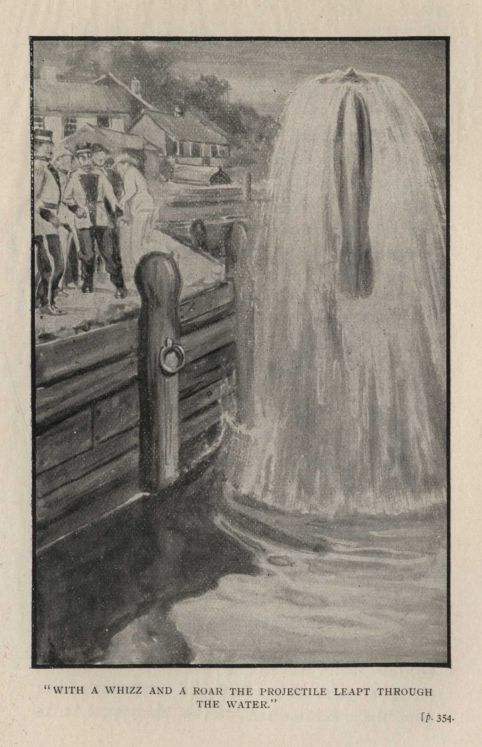
"WITH A WHIZZ AND A ROAR THE PROJECTILE LEAPT THROUGH THE WATER."
"Ah, that is what we want," remarked Captain Restronguet, pointing to a ship's whaler lying on the quay. "Under the circumstances, considering how extortionately we have been charged, I have no qualms in annexing yon craft."
The whaler was a heavy one, but a dozen men soon brought her on board. This done the "Aphrodite" cautiously made her way upstream, for mudbanks and shoals abounded, and only by the frequent use of the lead was the submarine, running light, able to keep to the main channel.
It was now within two hours of sunset, and the "Aphrodite" had to find a suitable berth in order to carry out the plans Captain Restronguet had suggested for the safeguarding of his crew.
The confiscated boat had been securely lashed down amidships. It was too large to be taken below through the hatchway, but in order that it would not burst its lashings as the submarine sank Mylor bored four fairly large holes in the garboards so that the water could easily make its way out. The holes could be plugged when the whaler was required for service afloat, and as Hythe remarked an additional washing would do a lot of good to a boat that had been left lying on the wharf of that malodorous and inhospitable town.
Fortunately a fairly deep and extensive hole was discovered in the bed of the river, the soundings giving ten fathoms. Being the rainy season the river was three or four feet higher than its normal level, a circumstance greatly in the favour of the submarine's voyage of exploration and retribution.
The night passed fairly quietly, the air within the submarine being perfectly clear. Looking through the observation scuttle the crew could see that the so-called fresh water was of a deep brown colour, while the full moon, shining through the miasmic mists looked like a ball of greenish yellow copper. Occasionally a crocodile would alight upon the deck of the "Aphrodite" and drag its armoured body over the metal plating with a dull metallic sound. Once a couple of hippopotami in their moonlight gambols brushed against the side of the conning-tower, the shock being distinctly felt by the men on watch.
In the morning the detector registered the position of the "Vorwartz" at eighty-five miles, which was precisely the same distance as it gave overnight.
Not until the mists had disappeared did Captain Restronguet order the "Aphrodite" to be brought to the surface and the hatchways opened. He would not risk the health of his crew by exposing them to the fever-laden atmosphere. Almost as far as the eye could reach the water extended, for being in flood the river, wide under ordinary circumstances, now resembled a vast lake.
Proceeding at twelve knots, that took her over the ground against the current at barely nine miles an hour, the submarine held steadily on her course, literally feeling her way between the shoals of loathsome black mud.
Just before noon a motor-launch manned by Portuguese passed, downward bound. In reply to a signal to close, the little craft ran alongside the "Aphrodite" without the faintest hesitation. Two of her crew who could speak French were interrogated by Hythe. They had neither seen nor heard anything of a vessel resembling the "Vorwartz" although they had come from Tete, a few miles below the limit for navigation. In reply to a request that one of their number should accompany the submarine as far as Sena, to act as a pilot, the Portuguese resolutely refused, saying that a qualified man could be obtained at Molonho, ten miles further up the river.
"What does the detector say, Mr. Kenwyn?" asked Captain Restronguet for the tenth time that morning.
"Eighty-three miles, sir."
"H'm; two gained. But it's very strange that that motor-boat should not have noticed the 'Vorwartz.' Perhaps the river is deeper, and Karl von Harburg took the precaution to run submerged."
"It is wide enough for a large craft to pass unnoticed," said Devoran.
"Not the actual channel; if we went half a mile to port or starboard we would be hard and fast aground."
"Is it likely that the 'Vorwartz' has taken to a backwater?" asked Hythe.
"By Jove! I hope not," exclaimed Captain Restronguet; then in a confident tone he added, "No matter, our detector will locate her. One thing we know, she hasn't ascended the Shiré--a tributary that drains Lake Nyassa. I almost wish she had, for I would like to see the final act take place in British waters."
To guard against the tropical heat awnings had been spread fore and aft, extending the whole length and breadth of the deck. Under this the officers and crew not on duty "stood easy," the former seated in deck-chairs brought from the cabins.
To Hythe the voyage seemed more like a pleasure trip than a mission of destruction. He and Kenwyn amused themselves by shooting at crocodiles and hippopotami that frequently came within a hundred yards of the "Aphrodite," while Captain Restronguet did a more practical act by bringing down a bird resembling a turkey, which, falling on the awning, was received as a welcome change to the menu.
Captain Restronguet was in high spirits, but his enthusiasm received a set-back when the "Aphrodite" ran full tilt upon a shoal. It was through no fault of the leadsman. The depth gave six fathoms but a few moments before. The discolouration of the water prevented any indication of the shoaling of the depth from being noticed. It was simply a case of sheer bad luck.
"Empty the reserve tanks," ordered Captain Restronguet, for the "Aphrodite" was now drawing ten feet for'ard and twelve aft. Quickly the foremost tank was emptied, but the after one, in spite of the action of the powerful pumps, refused to be discharged. Consequently the draught for'ard decreased while the submarine's stern sank lower into the slimy mud.
"Full speed astern," was the next order, but beyond churning up the brownish black ooze the propellers failed to do the slightest good.
"Lay out an anchor, Mr. Devoran," exclaimed his superior officer. "Be sharp, for the tide is falling."
Hastily the boat was lowered, the heaviest anchor slung underneath, and laid out a hundred yards astern. The stout hempen hawser was led to the motor capstan, but as the powerful machinery made it revolve it simply "walked home" with the anchor. The soft mud offered little or no resistance to its broad palm.
The "Aphrodite" seemed doomed to remain hard and fast for another ten hours. Night with all its terrors would envelop her ere the next tide was at its height, and to work in the germ-laden mists was to court the deadly fever.
"Can the ballast tank be got at from the inside, sir?" asked Hythe, struck by an inspiration.
"Not without flooding one of the sub-divisions of Number Three Platform," replied Captain Restronguet. "But why do you ask?"
"I thought perhaps I might put on a diving-dress, and enter the tank and examine the valves."
"It's feasible," observed Captain Restronguet. "If you attempt it and succeed I shall be still more indebted to you."
"Then I have your permission?"
"Certainly."
"Look here, Hythe," exclaimed Kenwyn. "If you tackle the job I'm with you."
"Thanks," replied the sub. "The sooner we start the better."
Donning their diving-suits and equipping themselves with brushes, spanners, rubber-sheeting for the valves, and an electric lamp each, the two men entered No. 4a compartment, as the subdivision was designated. As soon as the water-tight doors were shut they began unbolting the man-hole cover that gave access to the faulty ballast-tank, guided in their self-imposed task solely by the rays of the lamps.
Presently the water began to ooze between the partially removed cover and side of the tank, increasing in volume till the whole of the compartment was flooded with a liquid resembling thick pea-soup. It was only by the concentrated rays of the two lamps and by keeping his helmeted head within six inches of the metal lid that Hythe was able to complete the work of opening a means of communication with the ballast-tank.
As soon as this was done the sub squeezed through the manhole. His feet touched a thick layer of stiff mud on the floor of the tank. Bringing his lamp down he carefully examined the outlet valve. The secret of the defect was his: when the "Aphrodite" had been submerged by the side of the wharf at Marromea the inrush of water had brought with it a quantity of sediment sufficiently plastic to form a layer over the outlet valve and thus prevent its action.
For an hour Hythe toiled. He had neglected to bring anything of the nature of a spade, and had to recourse to his bare hands. Handful after handful of the noxious mud he scooped up and passed through the manhole into the compartment without, till the interior of the tank was perfectly free from anything of the nature to retard the action of the pumps.
After a lapse of two hours and a half from the time of entering the compartment the two men, their diving-dresses covered in slime, gave the pre-arranged signal to start the pumps. Ten minutes later both the compartment and the tank were emptied of water, and the task of replacing the cover was proceeded with.
But even then Hythe, nothing if not practical, refused to come on deck. He asked for a couple of buckets full of strong disinfectant fluid to be sent down, and, using a mop vigorously, he thoroughly scrubbed out the interior of the compartment, finishing up by mopping his companion's dress with the liquid, while Kenwyn performed the same office for him. Thus the risk of fever from the river-mud was entirely obviated.
"I would like a cold bath," exclaimed Kenwyn as the two officers rejoined their comrades.
"You jolly well won't, then," replied Hythe emphatically. "At least unless you wish to pay an indefinite visit to Davy Jones. Why, man, you are as warm as you can possibly be. Have a hot bath, if you like. I will, with plenty of disinfectant in it."
By this time the "Aphrodite," her draught aft considerately lessened, was afloat and resuming her voyage. Kenwyn had had his hot bath and foolishly sat in the fairly strong breeze to cool himself afterwards.
Before night he was lying unconscious in his bunk, prostrate with blackwater fever.
CHAPTER XXIX.
THE "PRIDE OF RHODESIA."
Kenwyn's serious illness was a source of anxiety and perplexity to his chief. Captain Restronguet was loath to leave him ashore in an unhealthy district where medical comforts were of a most primitive nature, while to keep the patient on board was undoubtedly detrimental to the health of the rest of the crew and consequently a stumbling-block to the success of the expedition.
Finally he compromised the difficulty. Kenwyn was to be isolated from the rest of the crew, Mylor and Lancarrow volunteering to act as nurses, until the "Aphrodite" entered the gorge through which the Zambezi flows. Here the patient was to be landed, placed in a tent and left in charge of the two men till the "Aphrodite's" return.
Just below the town of Kaira, where the Shiré River joins the Zambezi, definite news came to hand concerning the "Vorwartz." A large canoe, laden with millet, arrived the same day as the "Aphrodite." Her crew reported, through a Portuguese interpreter who spoke indifferent English, that they had passed a strange-looking vessel, somewhat resembling the "Aphrodite," four days up the river, and that it was hard aground at the mouth of a tributary known as the Zampa.
This report was confirmed by the detector which gave the "Vorwartz's" position as sixty-three miles to the north-west. Captain Restronguet noticed that he was gaining rapidly on his rival, and had been unable to account for the rapid decrease in the intervening distance unless Karl von Harburg had lighted upon an isolated spot that seemed to suit his requirements.
At Kaira Captain Restronguet was able to procure an old though fairly reliable Portuguese map of the course of the river, and on this the position of the rival submarine was carefully noted. If she succeeded in floating and proceeding up the Zampa River it was evident that the "Vorwartz" would soon be in British territory--the colony of Rhodesia.
That same evening a wireless message--the first for three days--was received from Captain Restronguet's English agent stating that the Foreign Office was in communication with the government of the Portuguese Republic, and an arrangement had been arrived at whereby three British sternwheeler gunboats that were used to patrol the Shiré River, were to be allowed to descend to the Zambezi and attempt to cut off the "Vorwartz" on her return.
"Evidently the British Navy wants to chip in at the death," commented Captain Restronguet. "We must look to our laurels. It would be hard lines to be searching for days amongst these unexplored backwaters without success, and to find that one of these little paddle-boats by a piece of sheer good luck had managed to blow the 'Vorwartz' to smithereens while she was lying helplessly stranded on a mud-flat."
Hythe did not reply. He was naturally anxious, now that he had been on board the "Aphrodite" for such a lengthy period and had faced perils in company with her crew, that Captain Restronguet should receive a just reward for his strenuous endeavours; yet he did not forget that he was still an officer of the great British Navy, whose policy is to be ready, aye ready, in the hour of triumph or in the hour of disaster alike.
Just then Carnon, who since Kenwyn's illness had been appointed solely for duties in connexion with the detector, approached and saluted.
"The detector, sir, has gone wrong," he reported.
"Gone wrong? What do you mean? Have you been tampering with the instrument?"
"No, sir. The last reading gave sixty-one miles. That was five minutes ago. When I looked again there was no record at all. The batteries are still working: I could get a spark an inch in length. The terminals are properly clamped."
Captain Restronguet, Devoran, and the sub hastened to the compartment in which the detector was fixed. The indicator board was absolutely blank.
"We're not having an easy time of it at all," remarked the captain. "Without the detector it is quite possible that the 'Vorwartz' may yet outwit us. All the same, I cannot understand it."
"We know her position up to ten minutes or a quarter of an hour ago, sir," said the first officer.
"Quite so, Mr. Devoran; and we must work on that. It will take us three hours, running at the highest speed compatible with prudence in this brute of a river, to arrive at the spot where the 'Vorwartz' was last reported. In three hours Karl von Harburg may have shifted a long distance off--or he may not."
"And there's Kenwyn to be taken into account."
"I haven't forgotten him. I think after all we had better keep him on board. It is too much of an undertaking for two men to have and tend him, provide for themselves, and be on their guard against the wild animals that abound, and a dozen other difficulties that a camp on shore would entail. However, pass the word for a speed of twenty-four knots. Allowing for the adverse current we ought to be at the confluence of the Zampa River well before sunset."
Just above the town of Shemba the Zambezi bifurcates, the two streams reuniting twenty miles higher up. It was just possible that the "Vorwartz," bound towards the sea, might be passing down one branch while the "Aphrodite" was proceeding up the other; but this time luck was in Captain Restronguet's favour, for above the junction the "Aphrodite" fell in with a trading steamboat, whose captain, by signs, made it clear that no vessel of any description approaching the "Vorwartz" had passed down the left-hand stream.
The river here was considerably narrower and deeper than nearer its mouth. Its width was still over half a mile, while the soundings gave a level bed of six fathoms. Here, also, the tide was no longer felt; but, owing to a cessation in the rainfall, the level of the river was gradually sinking.
During the course of the day several canoes passed at a respectful distance; but late in the afternoon a craft of some sort was sighted drifting down in mid-stream.
As the "Aphrodite" approached it was seen that the object was a raft composed of several slender spars supported by four barrels, to which were lashed four or five short planks. Lying on the platform thus formed were two human bodies.
"What do you make of it, Mr. Devoran?" asked Captain Restronguet. "A tragedy--not exactly on the high seas--but one of a very extraordinary nature. They look like Europeans."
"Shall I have the boat lowered to investigate, sir?"
"No, they're dead right enough. I've been watching them pretty carefully through my glass for some time. If it's a case of contagious disease we had better sheer off."
"Why, they're Chinese!" exclaimed Hythe.
"Chinese? Then they must be some of the crew of the 'Vorwartz'," said Captain Restronguet. "Evidently von Harburg has met with disaster."
As the submarine passed the aimlessly drifting raft a fairly close view could be obtained of the dead Chinamen. They were dressed in blue cotton suits after the style affected by Chinese seamen serving in European vessels, but there was no mistaking the Tartar features and the slanting eyes. That they were stone dead there could be no doubt, for there were several birds hovering around the raft in a manner that their natural timidity would not permit if the two bodies showed signs of life.
"Do you think that a catastrophe has occurred to the 'Vorwartz,' sir, or were these men merely attempting to escape?" asked the sub.
"Coupled with the fact that our detector has failed to give any indication of the 'Vorwartz,' I am inclined to favour the first theory," replied Captain Restronguet. "Since our apparatus is, as far as I can tell by careful examination, in perfect working order, I can only put its unresponsiveness down to the failure of the electric current on board the 'Vorwartz.' That, of course, would account for the failure of our detector."
"And the 'Vorwartz' could otherwise be capable of action?"
"To a certain extent. But without electricity she can have no means of compulsion, no means of offence, unless we except the use of fire-arms. However, before to-morrow is past we ought to discover her whereabouts. I am not proceeding further to-day as night is approaching. As soon as we find a suitable depth we'll descend till morning."
Another night passed without interruption. The detector was still silent, but the "Aphrodite" was now within a few miles of the spot where the "Vorwartz" had last given notice of her presence.
It was not a desirable day. Torrential rains were falling, while the atmosphere was too close to wear oilskins without the greatest discomfort. Consequently on the "Aphrodite" rising to the surface her crew save three had to remain below.
Captain Restronguet, Hythe, and Carclew were in the for'ard conning-tower, Devoran, Carnon the quartermaster, and Polglaze occupied the after conning-tower, so as to maintain a careful look out on all sides. Three men, braving the heavy downpour, were stationed for'ard, where they took turns in casting the lead.
The river here was considerably narrower--about thrice the width of the Thames at London Bridge. The banks on either hand were low and densely covered with thick scrub and extensive forests of tropical trees; while the skyline was broken on both sides by serrated ridges of lofty mountains.
"This must be the Zampa River," said Captain Restronguet, pointing to a fairly wide waterway that joined the Zambezi on its right bank. "Here the 'Vorwartz' was sighted by the natives. It would be well to explore the stream before going further."
"It looks too shallow to take anything more than a flat-bottomed light-draught vessel," remarked Hythe. "Still, as you say, sir, we ought to leave nothing unexplored behind us. If you wish I will take charge of the whaler and see what it is like."
"Very good, Mr. Hythe. I shall be obliged if you will. We'll remain here. Do not proceed further than there is depth for the 'Aphrodite' to follow. Should you require assistance fire three explosive rockets. If anything should necessitate your immediate return I will make a similar signal. Should you locate the 'Vorwartz,' endeavour to return without being seen."
It certainly required plenty of zeal to volunteer for a boating expedition on a tropical river in such torrential rains, but the men called upon for the service responded with alacrity.
Four rowers stripped to the waist sat on the thwarts, apparently quite indifferent to the rain. Hythe, Polglaze, and Carclew were in the stern sheets, partially protected by an awning, but before the whaler pushed off the canvas covering, sagging under the quantity of rain water, was found to be of more trouble than use, for a regular stream poured through the canopy upon the sub's head and shoulders. Since it was also likely to attract the attention of Karl von Harburg's men Hythe ordered it to be struck, and accepting the situation as well as he could, was soon soaked to the skin.
The tributary was found to be nearly twenty feet deep towards the right-hand bank. On both sides were belts of malodorous mud on which numerous crocodiles were lying as if enjoying the rain. Others, looking more like floating logs, were drifting in the channel, and careful steering was needed to avoid them. Hythe realized that he was not on a sporting expedition, and should any of the saurians become infuriated it would be necessary to fire at the reptile. The report of the rifle would give the alarm to the "Vorwartz" should she be within hearing, and the chances of locating her without being discovered would be very remote.
For more than a mile the rowers toiled manfully. The current was strong, the boat heavy, while Polglaze had to bale incessantly to prevent the rain from rising over the stern gratings. The "Aphrodite" was now lost to view by an intervening bend in the course of the stream.
The depth still continued regular, and afforded plenty of water for a craft like the "Vorwartz" to ascend if her ballast tanks were emptied, but as reach after reach was opened out no sign of the rival submarine was visible--only a monotonous stretch of coffee-coloured water enclosed on either hand by the soft stagnant mud that effectually prevented any attempt at landing.
"What's that, sir?" asked Polglaze, suddenly holding up his hand and listening attentively.
"Lay on your oars, men," ordered the sub.
Above the hissing of the rain Hythe could distinguish the deep purr of a powerful motor. Could it be that the "Vorwartz" was returning? If so, escape was impossible, for no cover of any sort was obtainable, and long before the whaler could return to the "Aphrodite" she would be overtaken by the swiftly moving submarine.
"It's that brute of a von Harburg coming downstream, sir," exclaimed Carclew. "We're fairly trapped."
In reply the sub ordered the boat to be turned and her head pointed down stream. Drawing the three detonating rockets from a locker under the stern sheets he rapidly lashed the sticks in position. Happen what may the "Aphrodite" must have warning of her enemy's approach. Perhaps, as the "Vorwartz" was now under way her electrical current would operate the detector onboard the "Aphrodite"; if so there was every reason to suppose that Captain Restronguet was already on his way to rescue his whaler's crew and engage his sworn foe. A chance of safety yet remained.
"Give way, men," ordered Hythe. "We may do it yet."
Nearer and nearer came the throb of the powerful motors. Hythe grasped the lanyard of the nearest rocket. He hesitated. There was something in the sound of the motors that could not be associated with a submarine, even allowing for the conductive properties of the water; it was more like the drone of an aerial propeller.
The next instant the snub nose of a large airship appeared round the bend of the river. The vessel was flying low; her two suspended cars were not forty feet above the surface. Her yellow silk envelope was literally streaming as the rain descended upon it in torrents, and this was why, Hythe reasoned, she was flying so low.
The sub ordered the whaler's crew to cease rowing and soon the airship was overhead. Her engines were reversed, and losing way she brought up just in front of the boat. Hythe saw with feelings of relief that aft the airship was flying a Blue Ensign with a yellow propeller--the badge of the recently constituted British Empire Aero-League--emblazoned on the flag. Half a dozen men were leaning over the rail of the platform connecting the two cars.
"What boat is that?" hailed a tall, sparsely-built man dressed in a white uniform.
"The 'Aphrodite' submarine, Captain John Restronguet," replied Hythe without hesitation. "What airship is that?"
"The 'Pride of Rhodesia,' of Salisbury. Is Captain Restronguet in the boat?"
"No," replied Hythe. "He is on board the 'Aphrodite' lying at the junction of this river with the Zambesi."
"And who are you, sir, might I ask?"
"Arnold Hythe, Sub-lieutenant of the Royal Navy."
"So you are the Mr. Hythe we've heard so much about? Glad to meet you. Sorry we can't shake hands; must delay that honour till a more convenient time. I'm Jones of Salisbury, Rhodesia, and we're having a chip-in with that villain, Karl von Harburg. I suppose we are not too late?"
"Seen anything of her?" asked Hythe. "We are exploring this river in the hope of finding her brought up."
"May as well give it a miss," replied Captain Jones of the "Pride of Rhodesia." "We've followed the whole of the navigable part of this ditch. We've also reconnoitred the Mali, the Tutti, and the Baraloo; the Zampa we didn't trouble about; it's too narrow to take a craft the size of the 'Vorwartz.'"
The sub felt like shaking hands with himself. The airship had purposely overlooked the river in which the "Vorwartz" had been reported. Captain Restronguet had made a mistake in thinking that this river was the Zampa.
"Well, I wish you luck," he said truthfully, for there can be various qualifying conditions to the subject of luck. "By the by, what's the name of this river?"
"The Pongo," replied Captain Jones. "It rises in Rhodesia not so very far from the frontier of the Portuguese territory. I reckon we've saved you a bit. We'll save you more yet if you wish. We'll tow you down stream. I'm curious to see the renowned 'Aphrodite.' Captain Restronguet won't object, I suppose. Will you come aboard--we'll drop a rope-ladder."
"No, thanks," replied Hythe. "We won't come on board. We cannot get much wetter if we stay here. All the same, we shall be glad of a tow."
The sub was cautious. He did not wish to be kidnapped a second time, and not knowing who Captain Jones was or whether the "Pride of Rhodesia" was a bona fide craft belonging to the British Empire Aero-League, he thought it advisable to decline the invitation to board the airship.
A coil of rope whizzed from the after platform of the overhead vessel. It was caught and made fast by the bowman, the "Pride of Rhodesia's" huge propellers began to revolve and soon the "Aphrodite's" whaler was being towed down the stream at a good ten knots.
"Pass that rope aboard the 'Aphrodite,' please," shouted Captain Jones as he brought the boat alongside the submarine. Captain Restronguet waved his hand in token of assent and soon the airship was riding head to wind with her nacelles just resting on the water.
Hythe hurriedly explained the circumstances under which he had fallen in with the airship, mentioning that he had found out by accident that it was not the Zampa River that he had explored after all.
"That's good," commented Captain Restronguet enthusiastically. "We can well afford to be disappointed. This Captain Jones told you he didn't mean to explore the Zampa, eh? Well, we'll have him on board, since he evidently desires it, but we must be careful not to drop the faintest hint concerning our information that the 'Vorwartz' was known to have entered that river."
The boat was dispatched to bring Captain Jones on board the "Aphrodite," and soon the owner and commander of the "Pride of Rhodesia" stood upon the deck of the submarine. He was a fairly young man, still under thirty, and full of almost boyish enthusiasm.
"We seem to be sort of friendly rivals," he remarked. "I don't want to boast, but I think I stand the better chance. Had that German scoundrel kept to the sea the odds would be in your favour, but since he is in comparatively limited and shallow waters he cannot submerge his 'Vorwartz.' But aloft I can command a vast extent of country, while you have to grope about, if I may say so."
"I quite see the point of your argument," replied Captain Restronguet drily. "But, might I ask, what do you propose to do when you find the 'Vorwartz'?"
"Oh, we are armed," said the Captain of the "Pride of Rhodesia." "We carry two bomb-dropping devices, besides four quick-firers. We are subsidized by the Government and authorized to carry offensive and defensive weapons. Directly we spot the 'Vorwartz' I shall have no hesitation in dropping a fifty pound charge of dynamite and blowing her to atoms."
"Dropping, you say? I understand that you cannot do otherwise than allow the bombs to fall simply by the action of gravity?"
"That is so," assented the owner of the airship. "But I think there is little possibility of their missing the mark. We took first prize at the Johannesburg Aero-Exhibition last year, placing six dummy bombs within a space eighty feet by twenty, and that from an altitude of five hundred feet."
"And your quick-firers?"
"Three-pounders."
"Not heavy enough to penetrate the plating of the 'Vorwartz,' I can assure you. Now, what do you think Karl von Harburg will be doing while you are manoeuvring to be in a position to drop one of your bombs immediately overhead?"
"I don't know," replied Captain Jones. "Why--do you?"
"Step below and I will show you a weapon that is almost identical with one carried by my rival. As you are probably aware, Karl von Harburg applied several of my inventions to his own use."
Captain Restronguet led the way below to where the aerial torpedo gun was housed.
"Here is a weapon capable of being trained fifteen degrees in any direction from a vertical," he explained. "Even when submerged to a depth of fifty feet I can discharge a projectile and hit an object a thousand feet in the air. The bursting charge throws out a shower of shrapnel with such force that no air-craft, within a radius of two hundred yards from the point of explosion, could possibly survive."
"By Jove!" ejaculated Captain Jones, his bronzed skin turning a lighter shade. "I didn't know the 'Vorwartz' carried anything like that. But no matter," he added cheerfully. "It is the fortune of war either way. I mean to do my duty in ridding the world of a pest, and if I fail it won't be for want of trying."
"Hear! hear!" exclaimed Hythe, while Captain Restronguet brought his hand down heavily upon his friendly rival's shoulder.
"That shows the British bull-dog spirit isn't dead yet," he remarked. "I am glad to hear you speak thus. You do your best: I'll do mine, and may the better man win."
The commander of the airship was shown over the "Aphrodite" and all except the essential details of her construction were minutely explained by his host. The inspection wound up with refreshments in Captain Restronguet's cabin, and in reply to an invitation Captain Restronguet, Hythe, Devoran, and Jenkins went on board the "Pride of Rhodesia." For an airship she was certainly a novelty, being built and engined in Rhodesia and of Rhodesian material--a striking testimony to the growth of one of Britain's youngest children.
Curiously enough the airship was subdivided into three compartments similar to the "Aphrodite." Thus, in the event of an accident to any two of the sections the third would be quite capable of supporting the crew and acting as a balloon; while, should the afterpart remain uninjured, it would still be able to be driven by the motors which were situated just abaft the division between the second and third sections.
"By the by, how do you combat with the deadly night airs?" asked Captain Restronguet.
"We ascend to about three thousand feet," replied the owner of the "Pride of Rhodesia." "It's a splendid climate up aloft; a guaranteed cure for all sorts of tropical fevers. How do you manage?"
"Oh, we dive," was the reply. "Our air supply is quite independent of outside atmosphere. But night is approaching, we must return."
Had there not been an element of danger should the airship attempt to combat the "Vorwartz" Captain Restronguet would have requested that Kenwyn should be temporarily accommodated on board so that the bracing air would aid his recovery, but under the circumstances he preferred to keep his second officer in the submarine.
Shaking hands Captain Restronguet and his companions bade their friendly rivals farewell and boarded their whaler. On the way back Hythe asked Jenkins what he thought of the "Pride of Rhodesia."
"Not much," replied the chief aviator to the Sultan of Zanzibar. "Not much. If I had my three-seater monoplane and a couple of hands I'd guarantee to knock spots off her as easy as kiss your hand."
"As Captain Jones said, the odds are in his favour," commented Captain Restronguet. "All the same I admire him. It will be a race for a coveted prize. Let the best man win by all means, but as sure as my name's what it is I'll do my level best to go one better than the 'Pride of Rhodesia.'"
CHAPTER XXX.
CAPTURED.
An hour after sunrise the "Aphrodite" came to the surface. The rain had ceased, the mists had rolled away, and the slanting rays of the sun, already powerful, beat fiercely down upon the coffee-coloured surface of the river. There was no sign of the "Pride of Rhodesia." She had taken herself off betimes.
"I hope she has continued her investigations down stream," said Captain Restronguet. "It was a lucky chance that Jones mentioned to you about not considering the Zampa worthy of his notice. We'll just have a look round and see if the 'Vorwartz' has found room enough to stow herself away in that little ditch."
"A wireless message has just come through, sir," said Devoran. "The 'Swallow,' 'Puffin,' and 'Sandpiper,' three stern-wheeler gunboats from Lake Nyassa, have descended the Shiré and were reported to the Admiralty as having reached Sena yesterday."
"The more the merrier," commented his superior grimly. "They ought to be here this afternoon if they kept under way all last night. We must bestir ourselves. I think before we do anything else we ought to put Kenwyn ashore. You see that knoll on our left, Devoran? It stands fairly high, and should be pretty healthy; in daytime, at all events. We'll land him and his two nurses and pick them up on our return."
Captain Restronguet spoke as calmly as if he were going on an excursion instead of about to engage in a desperate encounter with his implacable foe. Hythe understood his manner better by this time. He knew that when Captain Restronguet meant business he always adopted a resolute bearing. The magnetic personality of the man more than half won his battles.
An awning was rigged in the whaler, and under this, Kenwyn, lying in his cot, was placed. Mylor and Lancarrow accompanied him, while the boat's crew, thoroughly disinfected to prevent contagion, rowed them to the steep bank of the isolated hill the captain had pointed out. The ascent took some time, and the boat's crew had received instructions to rig up a tent and make everything snug for the patient before returning.
Looking through their binoculars Captain Restronguet and Hythe watched the tedious procession. At length Kenwyn was carried to the summit and placed in the shade of a solitary tree. Apparently this site did not suit, for Mylor was observed to be pointing to a clump of densely-foliaged trees on the north side of the knoll. The boat's crew raised objections, since time was precious, and the argument ended by Mylor and two others carrying the tent across to the clump and leaving the others with the sick man. Before Mylor gained the desired position the rest picked up the cot and followed.
"I can see the objection to Mylor's plan," remarked Captain Restronguet. "They will be hidden from the river everywhere except from this bearing. However, it is well to windward, and ought to be fairly pleasant under the shade of the trees. But I wish those fellows would bestir themselves a little more."
Presently Mylor disappeared from view behind the trees. He had not been gone very long before he returned to his companions running as hard as he could go. A few words passed and the whole crowd, leaving Kenwyn lying in the shade, doubled off behind the clump.
"Now what's up," muttered the captain impatiently. "I wish I had sent Devoran with them to keep them together. They are like a pack of schoolboys out of bounds."
Back came the men, never pausing till they reached the brink of the hill on the river side. Here Mylor, standing well apart, began to "call-up" the "Aphrodite" by semaphore.
"Acknowledge, Mr. Devoran," said Captain Restronguet.
Clambering on to the top of the conning-tower the first officer signalled that attention was being paid to the message.
"'Vorwartz' is lying on the other side of the hill," semaphored Mylor.
"What's that? Impossible!" exclaimed the captain, for both he and Hythe had read the message correctly. "Ask them to explain more fully."
"'Vorwartz' is in a river flowing behind this hill."
"Boat's crew to return instantly," ordered Devoran at Captain Restronguet's request. "Leave Kenwyn and his two men."
"I hope they didn't let those on the 'Vorwartz' see them," said Captain Restronguet. "If it be the 'Vorwartz'--and I have no reason to suppose that there is another submarine beside her and the 'Aphrodite' on the Zambezi--we have just saved ourselves from being nicely fooled. We might have been searching the tributaries on the right bank till Doomsday."
"And the 'Pride of Rhodesia' is devoting her attentions to the right bank also," added the sub.
"Let her," said Captain Restronguet with a hearty laugh. "This seems almost too good to be true."
Bending to their oars and heedless of the blazing sun the whaler's crew brought the boat back at breakneck speed. Almost before her way was checked as she came alongside Captain Restronguet, Hythe, and five of the crew leapt on board. They had taken the precaution to arm themselves, for it was quite possible that some of Karl von Harburg's men had gone ashore and had already sighted the "Aphrodite" lying in mid-stream.
Up the hill the landing party toiled, and crossing the plateau gained the clump of trees on the landward side. Here they hid, while Captain Restronguet and the sub reconnoitred by means of the binoculars.
Yes, there was no longer any cause for doubt. The twin conning-towers and a portion of the upper deck of the "Vorwartz" were just visible above the reeds that fringed the narrow river. She was floating high, all her ballast tanks having been started. Two of the hatches were flung back but no signs of any of the crew were to be seen.
"She's hard aground, I think," observed Hythe. "The river has fallen in spite of the rains, and she's fairly caught."