Front matter (continued 4)
Reading edition
"Here we are," exclaimed Captain Restronguet, running his finger over the chart of the Red Sea. "Ninety miles from Wadi Jemel; three hours run at our maximum speed. Keep her going for all she's worth, Kenwyn. I'll be with you in the conning-tower in less than ten minutes. Let the 'Noord Brabant' know we're on our way, and keep me informed of how she's progressing."
While the "Aphrodite" tore on her errand of mercy, Carclew was keeping vigilant watch upon the electric detector; but, to the disgust of all on board, instead of the "Vorwartz" making her presence felt more strongly the sensitive current grew more and more feeble. Was it possible, then, that the "Vorwartz" was able to attain a much greater speed than her rival, and in consequence slipping farther and farther from the doggedly-pursuing avenger?
Just as Captain Restronguet, accompanied by his guest, was about to proceed to the conning-tower, a final message came from the ill-fated "Noord Brabant"--"Sinking; are taking to the boats."
But the "Aphrodite" was not the only vessel hurrying to the rescue. The P. & O. Liner, "Persia," a magnificent internal-combustion propelled ship of 40,000 tons, that had been built to "knock spots off" the largest North German Lloyd boat on the Australian route, was returning on her maiden voyage. Warnings of the presence of the "Vorwartz" had been given her. Her cargo was a precious one; moreover she carried His Majesty's mails; but at the urgent call of distress all other considerations were set aside.
The officers of the "Persia" knew the risks they were running. It was recognized that Karl von Harburg would not attempt to attack or intercept the liner unless the "Vorwartz" were submerged, consequently the speed of the submarine would then be considerably lower than that of the liner. The "Persia" being a subsidized vessel under the recent Admiralty regulations, had a large percentage of Royal Naval Reserve officers and men in her crew; she was armed with light, quick-firing guns, and, in fact, was a powerful "protected" cruiser.
Owing to the danger the captain and the first officer were both on the "Persia's" bridge. Elaborate precautions had been taken to keep the news from the passengers, but, as is frequently the case, the intelligence was soon common property. That night no one went to bed; since it was within the bounds of possibility that in the event of being torpedoed by the ruthless "Vorwartz" it would be necessary to take to the boats. All lights were carefully screened; yet in spite of these preparations the "Persia" had the narrowest escape in her career.
Unseen and unheard by the officers of the watch, a torpedo discharged from the lurking "Vorwartz" glided within ten feet of her rudder. Just at daybreak the "Aphrodite" sighted the boats of the ill-fated "Noord Brabant." Towed by two motor pinnaces the life-boats, crowded with passengers, were slowly making their way northward. The "Aphrodite" had arrived in the very nick of time, for the sudden change from intense darkness to daybreak revealed the fact that three suspicious-looking Arab dhows were making ready to pounce down upon the unarmed boats.
"Red Sea pirates, by Jove!" exclaimed Captain Restronguet.
"Certainly looks like it, sir," replied the sub. "It's a curious fact, but our cruisers systematically search every little harbour on the Arabian coast and find nothing beyond a few dhows owned by Arab traders whose papers are quite in order. But once let a vessel go ashore or get into difficulties, armed dhows, manned by cut-throat Arabs, gather round like flies about a honey-pot. Goodness only knows where they come from."
"I'll tell you where they'll go to if they don't pretty soon sheer off," rejoined Captain Restronguet grimly.
"Are you standing in pursuit, sir?" asked Devoran.
"Impossible under present circumstances, Mr. Devoran. Look, those motor-boats cannot make headway against wind and sea. They have too much to tow. Another hour will see the whole swarm of boats smashed to firewood unless we do something."
The "Noord Brabant's" boats were indeed in a perilous position. Those provided with oars were two overcrowded to allow the rowers to materially assist; waves were repeatedly breaking over the deeply laden boats, and every available article that could be used as a baler was pressed into use. All the while the flotilla was slowly drifting shorewards, the rearmost boats being almost inside the broad expanse of broken water.
Bringing the "Aphrodite" head to wind Captain Restronguet ordered a heavy grass warp to be veered out by means of a barrel. This one of the motor launches secured and made fast, while the second slipped half of the boats and transferred them to the care of the first towing craft. With a reduced number of boats in tow the second pinnace was then able to make headway.
"Easy ahead!" ordered the "Aphrodite's" captain, and with a long string of boats straining at the hawser the submarine, still on the surface, forged ahead.
"Steady, sir," ejaculated Kenwyn. "We're pulling them under."
Such was the case. The speed of the "Aphrodite" was sufficient to cause sheets of solid water to fly over the bows of the Dutch boats. To reduce speed was impossible, since that would have meant a backward movement on to a lee shore.
"Have we any oil to spare on board?" asked the sub.
"We might manage a barrel of lubricating oil," answered Captain Restronguet. "A good idea of yours, Mr. Hythe."
To attempt to hoist a heavy barrel of oil with the "Aphrodite" rolling like a barge would be hazardous both to the barrel and the men engaged in sending it up the hatchway. Accordingly the barrel was tapped and the centrifugal pump, worked by one of the auxiliary motors, threw the heavy oil over the side. Soon, instead of a turmoil of white crested wind-swept waves a broad belt of sluggishly heaving water trailed in the wake of the "Aphrodite," and through this patch of comparatively calm sea the boats of the "Noord Brabant" were towed in safety.
Long before the barrel of oil was exhausted the flotilla was clear of the broken water close to the land, and the risk of being swamped was reduced to a minimum.
"Now what's to be done," asked Kenwyn of Hythe, as the two stood on the wake of the after conning-tower watching the procession of boats. "We must return to Port Ibrahim with this little mob, I suppose?"
"If we do we'll have our work cut out," replied the sub. "As soon as we make for that port the wind will be broadside on, and the boats will again be in danger of swamping. All the oil we have on board would not save them, since it would drift to lee'ard. No, the only way I can suggest--and Captain Restronguet is apparently of the same opinion--is that we plug head to wind until some vessel comes along and picks up the survivors."
Just then the "Aphrodite's" wireless picked up a general message sent out by the "Persia" to the effect that she was going at full speed to the scene of the disaster.
Captain Restronguet's face lighted up when he heard the good news.
"We shall now have a free hand," he remarked. "But at the same time it is a mystery to me how our detector has failed to record the presence of the 'Vorwartz.'"
"Perhaps she has cleared off due south, while we are heading due west," suggested the chief officer.
"That is the only explanation, Mr. Devoran. It is five hours since the apparatus, sensitive enough in all purpose, has recorded any movement. Well, Carnon?"
"'Persia' in sight, sir," replied the quartermaster, who had taken up his position, telescope in hand, on top of the fore conning-tower.
"Capital!" exclaimed Captain Restronguet. "She'll be close alongside within half an hour. Pass the word to the leading boat, Mr. Devoran, and tell them to stand by ready to cast off."
Rapidly the "Persia" approached, then, laying-to to windward of the string of boats, waited for them to be towed under her lee. Boat after boat discharged its band of passengers, the empty craft being turned adrift, and within half an hour of the liner's arrival five hundred Dutchmen had found shelter under the Blue Ensign.
Great though the attention was towards the rescued men the chief object of interest to the British passengers and crew of the "Persia" was the strangely unfamiliar outline of the "Aphrodite." Much had been heard of the mysterious submarine, the avowed rival of the piratical "Vorwartz," and now the liner's people had a unique opportunity of viewing her at close quarters.
When the work of transferring the rescued Dutchmen was completed Captain Restronguet took off his cap and saluted the captain of the huge liner. Simultaneously a tremendous burst of cheering came from throats of hundreds; and with the echoes of the prolonged chorus of welcome and approbation ringing in their ears, the crew of the "Aphrodite" quietly yet majestically disappeared beneath the waves.
CHAPTER XIX.
STRUCK BY LIGHTNING.
"It's a jolly fortunate thing that we fell in with the 'Persia,'" remarked Kenwyn, within two hours of parting company with the liner. "Otherwise it would have been a serious matter with those Dutchmen in the boats."
"You are right," assented Devoran. "It is going to be dirty weather. The glass is falling rapidly."
"It will soon be over," observed Hythe. "'Long foretold, long last; short notice, soon past.' That's how the rhyme goes, doesn't it?"
"And a brute of a business while it lasts," added the second officer.
The three officers were standing on the after deck of the "Aphrodite." The submarine had again risen to the surface and was plugging away in a southerly direction on her vague quest for the unbeatable "Vorwartz." Captain Restronguet remained below, absorbed in some abstruse problem.
The sea was smooth, but dark clouds, edged with bright, copper-tinted hues, were rapidly banking up against the westerly breeze, while the rumble of distant thunder was heard at frequent intervals. Even though it was close on midday the sun's light was greatly obscured; while, on the other hand, the far away Sudan coast stood up clearly under the effect of atmospheric refraction.
There was every indication of a sharp yet severe storm.
"Are you going to submerge her, Devoran?" asked the sub.
"Not on my own responsibility," replied the chief officer. "Until the captain gives the order--ah, here he is."
"I cannot understand how the detector is acting," said Captain Restronguet, as he gained the group of officers. "I have most carefully tested the currents and examined the platinum contact breakers. The instrument seems in order, yet it records nothing of the presence of the 'Vorwartz.' It is inexplicable."
"The 'Vorwartz' is doubtless beyond the field of electrical action, sir," remarked Kenwyn.
"So I have been told before," replied Captain Restronguet with asperity. "All the same that theory will not hold good. We ought to have had an intimation of that craft's presence when she torpedoed the 'Noord Brabant.' How can you explain that?"
"Don't you think, sir, we ought to submerge the ship?" asked Devoran, anxious to change the subject. "The glass is falling----"
"There is plenty of time," declared the captain, who was evidently not in his usual easy-going humour. "It certainly looks threatening, but at this moment the sea is as calm as glass. Look at those sharks, Devoran. Vicious looking brutes, aren't they? Suppose we give the men an opportunity at rifle practice."
The captain strolled off to watch the antics of the tigers of the deep, for four ferocious-looking sharks had been persistently following the "Aphrodite" as if anticipating a catastrophe.
The chief officer, although he would much rather have preferred to make all snug and dive to a depth of seven or eight fathoms, was not a man to quibble. He made his way to the hatch-way, to call up the small-arms party. Kenwyn stood a few paces from his superior, while Hythe, unwilling to say anything that might lead to his being snubbed, remained by the after conning-tower.
Suddenly the semi-gloom was rent by a vivid flash of lightning, that played upon the metal deck and upon the placid surface of the ominous sea. A deafening peal of thunder succeeded the flash. For a moment the sub was dazzled by the glare. When he looked aft, Kenwyn was lying on the deck, a portion of the stanchions and rails were shattered, and Captain Restronguet nowhere to be seen.
Raising a shout of "Man Overboard!" Hythe took a running dive and plunged into the sea. He struck the water heavily, for the "Aphrodite" was moving at a good speed. He might very well have broken his back but for the velocity with which he executed his dive. Not till he rose to the surface did he give one thought to the dreaded sharks: it was then too late to count the risk.
Fortunately the monsters, frightened by the flash of lightning, had for the time being disappeared. Hythe struck out to the spot where the bubbles indicated the captain's position, for, winded by the shock, the unfortunate man was sinking never to rise again.
Guided by the bubbles the sub dived. Eight powerful strokes he made ere he perceived Captain Restronguet's form slowly settling towards the bottom of the sea. Four more and his left hand grasped the unconscious man by his collar.
Striking out with his right, and his unimpeded legs, Hythe rose towards the surface. He had been almost winded by his plunge overboard, and had had no opportunity to recover his breath. His lungs felt as if they were on the point of bursting; his temples throbbed. It seemed ages before his head appeared above the surface, and he was able to take a deep draught of the sultry air. Turning on his back he kept himself afloat, at the same time supporting the unconscious captain.
The "Aphrodite" had already lost way and was going astern; in a few minutes a dark, triangular object cleaving the leaden-coloured water attracted the sub's attention. His whole senses momentarily deserted him. He realized that a shark was approaching.
His first instinct was to abandon the unconscious man and strike out madly towards the submarine; but in a moment the temptation passed. Lashing out with his legs Hythe churned up a column of water. The shark stopped, wheeled and retreated a few yards.
Another of these dreaded fish came up, and the pair, regaining confidence, began to approach, swarming towards the two men in ever-narrowing circles.
Hythe could hear the monsters snapping their triple lines of teeth in anticipation of a meal. He kicked the more, shouting at the top of his voice in the hope that the sharks would delay close investigation until it was too late for them to consummate their intentions.
The sub had heard tales of how native divers in the Pacific, knife in hand, boldly attacked the tigers of the deep. The recollection gave him but cold comfort. True he had a knife, but he lacked the marvellous aquatic agility of the Japanese and South Sea Islanders. Moreover, directly he released his hold his unfortunate captain would sink. He vaguely argued that it was but another instance of where theory does not always go hand in hand with practice.
With a sudden rush one of the sharks dashed straight towards the horrified man. The brute turned on its back in order to deliver a terrific bite. Then, apparently seized with a sudden panic, it brought its huge jaws together with a sickening snap and darted off. It was a narrow shave; so narrow that on turning the shark had rasped Hythe's hand with his rough skin.
Finding that nothing happened to hurt it, the shark returned to the charge; as it turned on its back the sub could see right into his capacious mouth. He gazed horror-stricken, too terrified even to kick out or utter a sound. Even as he looked the brute's head was literally shattered, dyeing the water with blood, while the sharp report of a rifle rang in Hythe's ears.
The coils of a rope hurtling through the air fell within his reach. He grasped the means of safety, yet was too exhausted to do more. Another shot, and yet another, rang out; then O'Shaunessey, leaping overboard with a bowline, passed the loop over his officer's shoulders.
"All right, sorr," exclaimed the Irishman cheerily. "Do you let go. I'll see to the cap'n, sure I will."
Pale and breathless Hythe was hauled upon the deck of the "Aphrodite." Captain Restronguet was also drawn into safety, and O'Shaunessey, without any attempt at haste, swarmed up the rope hand over hand.
Devoran and Kenwyn, handing their still smoking rifles to a seaman, hastened to where Captain Restronguet was lying.
"Is he dead?" asked the second officer.
"I am afraid so," replied Devoran gravely, then as the first blast of the approaching storm thrashed the hitherto placid water into sheets of foam he added:--
"Take them below. Secure the hatches. All ready, Mr. Kenwyn."
Gliding serenely deep beneath the surface the "Aphrodite" pursued her way, regardless of the storm that was now raging fiercely overhead. Flash after flash of vivid lightning played upon the angry water, the glare being plainly visible through the glass scuttles of the conning-towers, while the deep roar of the thunder literally shook the heavy metal structure of the submarine.
Gathered around the still unconscious form of the captain were Hythe, Devoran, Polglaze, and Mylor the second quartermaster, while without the cabin, anxiously awaiting the latest news of their leader, were all the crew who were not actually on duty.
Kenwyn was at his post in the after conning-tower, Lancarrow in the fore conning-tower was entrusted with keeping the "Aphrodite" on her course, while Carclew was stationed at the electric detector in order to catch the first intimation of the return of the "Vorwartz" to within the range of that instrument's action.
As soon as Captain Restronguet had been undressed the effect of the lightning stroke was apparent. From the nape of his neck to the lower rib was tattooed the image of part of the chain rails and the head of the stanchion. Whether the damage was merely superficial or whether the spine had been affected was still a matter of conjecture. His face was pale and pinched, his wide-open eyes dull, his pulse almost imperceptible. Only by holding a glass close to his mouth was Devoran able to pronounce that his chief was still alive, for there was absolutely no signs of respiration and circulation.
By careful treatment, and by giving the patient small doses of stimulants, the anxious men succeeded in bringing back the colour to Captain Restronguet's wan cheeks. The pupils of his eyes began to dilate, but although he looked at those who stood around him he gave no signs of recognition.
"You did not rescue a dead man, Hythe," remarked Devoran in a low tone. "But I'm afraid his brain is affected."
"It is too early to form a definite opinion," replied the sub, anxious to put a bold face upon the matter, although in his mind he had his doubts. "I remember on the old 'Velox,' we had a signal-man struck by lightning. He was unconscious for nearly three days; yet he recovered, and was passed for duty after a week in the sick bay."
"Yes, that's all very well," rejoined the chief officer, "but----"
A violent ringing of the bell of the "steering sentry" interrupted Devoran's remark. Both men crossed the cabin and consulted the tell-tale compass. The "Aphrodite" was fifteen degrees off her course, and the "steering sentry," an automatic instrument that gives a warning in the captain's cabin when the vessel deviates from the course set, was ringing incessantly, showing that the error in direction was a grave one.
"What are you up to, Lancarrow?" asked Devoran through the telephone communicating with the fore conning-tower. "Anything in the way?"
There was no reply.
The chief officer hailed again. Still an ominous silence.
"What's up now, I wonder," he muttered as he hastened towards the conning-tower. To his surprise he found Lancarrow huddled up on the floor, with his hands tightly clenched. Left to herself the "Aphrodite" was gradually describing a wide circle to starboard, and only the action of the automatic alarm had called attention to the fact.
Steadying the submarine on her course, Devoran shouted for a couple of hands to carry the unfortunate helmsman below. This done he told Carnon to take charge of the helm, while he made a tour of the vessel to make sure that all was in order. Devoran realized that he was now in command and that the responsibility was great. The mysterious striking down of the former steersman, whether by violence or by natural causes, could not be at present explained; but since a similar thing might happen to others who were on duty he felt it necessary that he should visit all the men at their stations and make sure that everything was in order.
Carclew was still at the detector. He had nothing to report. The instrument was as silent as the Sphinx. Kenwyn in charge of the horizontal rudders and the trimming tanks was attending strictly to his duty. He had been unaware of the affair in the other conning-tower, and since it was not his business to consult the compass and not knowing what course had been given to the helmsman, he had not remarked the erratic steering of the vessel.
"Do you think the lightning struck Lancarrow down?" asked Kenwyn.
"Bless my soul, I hope not!" ejaculated the first officer. "One affair of this sort is quite enough. Why did you ask?"
"The flashes have been terrific. They seemed to play upon the deck, even though we are nine fathoms down."
"Had Lancarrow been touched by the electric fluid it is reasonable to suppose that the electrical steering gear would be affected. As a matter of fact it isn't."
"Give it up, then," rejoined the second officer. "But how is Captain Restronguet?"
"Coming round, thank Heaven. But it's the after effects I am anxious about. By Jove! That's a flash."
It was indeed a vivid fork of dazzling blue light that seemed to corkscrew along the deck of the vessel and dart up over the for'ard conning-tower, till the submerged craft looked as if she were surrounded by a supernatural light. The phenomenon lasted only an instant, but that instant was enough for the chief officer to realize the "Aphrodite's" peril.
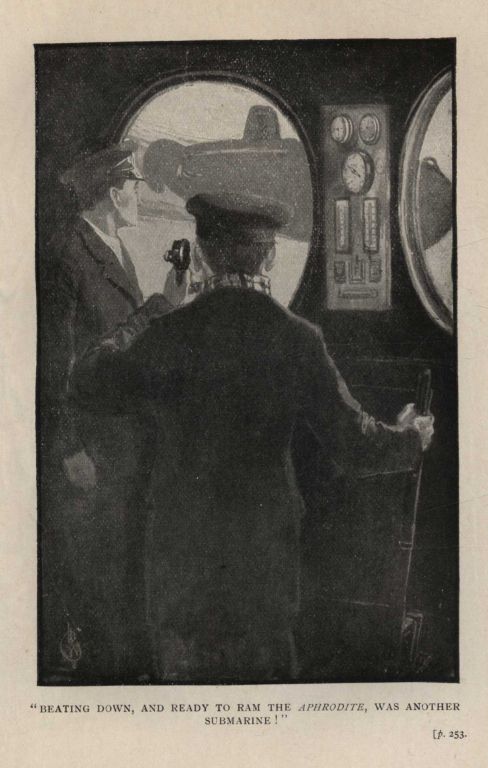
"BEATING DOWN, AND READY TO RAM THE APHRODITE, WAS ANOTHER SUBMARINE!"
Beating down, and ready to ram the "Aphrodite" amidships, was another submarine! But its similarity to the former Devoran had no doubt as to what it was. It was the "Vorwartz."
"Hard a-port!" he shouted through the telephone to the helmsman. At the same moment Kenwyn elevated the horizontal rudders in a vain endeavour to make the "Aphrodite" dive under the on-coming attacker. It was too late. With a rending crash the knife-like bows of the "Vorwartz" crashed into the 'midships compartment of her hitherto unsuspecting rival.
CHAPTER XX.
RAMMED AMIDSHIPS.
In the captain's cabin Hythe heard Devoran shouting for the helm to be put hard a-port. He felt the vessel begin to slew round, then a crash that shook the "Aphrodite" from stem to stern, sent him and the other occupants of the cabin reeling against the starboard side.
Simultaneously the watertight doors in the two principal transverse bulkheads were hermetically sealed, save a small emergency exit from Number Three Platform to the fore compartment. Through these those of the crew who were in the holed division made their hasty escape. They were not a moment too soon, for, although the "Vorwartz" made no attempt to back out, the fracture was ragged enough for the water under great pressure to pour in cascades into the midships compartment of the ill-starred submarine.
As soon as the men were safely in the fore part of the vessel Devoran gave orders for the remaining watertight doors to be closed. He knew that, although the danger was great, there still remained a chance of saving at least two-thirds of the "Aphrodite."
"If only I had been in the fore conning-tower," he thought, "I would have given that 'Vorwartz' something to remember us by. I'll try it, though."
And calling up Carnon, who was the senior hand in the now isolated fore part, he ordered him to stand by with electrical destructors, whereby a potential charge of electric fluid could be directed upon the "Vorwartz" as soon as she had backed a certain distance from the vessel she had rammed.
In answer Carnon replied: "I've tried the gadget, sir, and there's no current on."
"For goodness' sake try the supplementary current!" exclaimed the chief officer anxiously, but the result was the same. The apparatus by which the powerful means of offence was controlled was out of order. Either the lightning or the shock of the impact of the "Vorwartz's" stem had thrown the delicate mechanism out of gear. Nor could the torpedoes be used, for the tubes, having an arc of only four degrees on either side of the bows, could not be brought to bear upon the rival submarine.
This time Karl von Harburg had scored heavily, and stood every chance of getting clear without the "Aphrodite" being able to revenge herself upon the submarine that had caught her napping.
Meanwhile the crew of the "Aphrodite," after the first shock, had taken up their stations with consummate coolness. Every man knew that the damage was great, and that the "Vorwartz" was the cause of it. One chance yet remained for them to revenge themselves upon Karl von Harburg. Directly the "Vorwartz" backed out of the rent in her rival's side, the "Aphrodite" might be able to turn sufficiently to discharge a torpedo. At the same time steps must be taken to prevent the stricken craft from sinking into depth where the pressure of the water would literally crush their as yet undamaged sections of the submarine like an egg-shell under a hundred-ton hammer.
As soon as the water in the midship section rose to the level of the centre platform Devoran gave orders for the detachable keel of that compartment to be dropped. Kenwyn touched the emergency switch, and the massive dead weight fell. Relieved of this mass of iron the "Aphrodite" lurched in an effort to rise to the surface.
The sudden strain wrenched her free of the bows of the "Vorwartz." Instantly the water, pouring through the greatly enlarged aperture, filled the whole of the centre compartment, and before the submarine had a chance to turn and let fly a torpedo at her antagonist, the "Aphrodite" sank slowly and surely.
This, although serious, was a point in her favour, for Karl von Harburg, observing with savage glee the havoc he had wrought, concluded that his rival's craft was sinking for the last time to the bottom of the Red Sea. Accordingly, satisfied that he was now free to pursue his piratical acts, since the "Aphrodite" was the only submarine he feared, he backed astern, rose to the surface, and proceeded in a southerly direction towards the Straits of Bab-el-Mandeb. Hardly a word was spoken as the "Aphrodite" sank. Devoran, his eyes fixed upon the depth gauge, was waiting his time. He, too, realized that should the submarine rise to the surface it would merely be giving her antagonist a unique opportunity of holing another of the sections that as yet remained intact. On the other hand, he had to guard against the danger of descending too far.
Thirty fathoms; the "Aphrodite" was now in total darkness as far as the water was concerned. Within the electric lamps still burned brightly, save for a few that had been shattered at the moment of impact.
"Easy ahead!" he ordered, and as the partially flooded vessel forged slowly and laboriously ahead, the chief officer trimmed the horizontal rudders so that the resistance at a certain angle just corrected the tendency of the whole vessel to sink.
Devoran set a course due east, hoping to fetch the shallower water on the African shore. Twenty minutes later he ventured to switch on the parallel bow searchlights. Even these powerful rays failed to reveal anything more than fifty miles away. Huge fish, that are rarely seen in shallow water, flitted past the thick scuttles. They made no attempt to dart out of the way of the submarine; they were blind, since the gift of sight at these depths is useless to them.
"She's standing the strain all right," remarked the chief officer to Hythe in quite a cheerful tone.
The sub nodded appreciatively. Under similar conditions on board a British submarine the state of affairs would be hopeless. With a rent amidships, extending from the upper platform to the bilges she would have sunk instantly, and given her crew no possible chance of escape; but here was the "Aphrodite" still under control and with the odds greatly in her favour. Next to Captain Restronguet, Devoran was the most capable man in whom to trust.
"Bottom shoaling!" exclaimed the sub, as the head searchlights glimmered upon an expanse of ooze, so shapeless and ill-defined that it required a practised hand to distinguish it from the deep sea.
The chief officer instantly adjusted the planes, and the submarine, though lacking her usual sensitiveness to the action of the horizontal rudders, rose steadily.
At twenty fathoms the bottom ceased to shoal, and in place of the slimy mud appeared fantastic formation of coral; a sure sign that shallower water was not far off. Again the "Aphrodite" was brought nearer the surface, till the welcome sunlight could be faintly noticed.
"Ten fathoms," announced Devoran. "This is our limit. We must carry on till we ground. Look! what a rent, by Jove!"
He pointed out of the scuttle, and Hythe following his gaze saw the fracture that the "Vorwartz" bow had caused. Her comparatively straight stem had cut nearly five feet into the upper platform of the "Aphrodite" in addition to making a vertical gash nearly fifteen feet in length in the stricken vessel's side. As a result the whole of the centre compartment had become a dead weight, and the buoyancy of the submarine being imparted only by the fore and aft compartments the tendency of the whole vessel was to sag amidships. Already the upper platform was curving ominously. It would not take much more strain to buckle the "Aphrodite." Although her steel plating was badly cracked and jagged, the restronium sheathing was severed as evenly as if made of wax. This, no doubt, accounted for the fact that the inrush of water at the moment of impact was comparatively slight, and in consequence the men stationed in the midship compartment were able to make good their retreat long before the water completely filled the space between the two principal transverse bulkheads.
"Let her down gently, Carnon!" ordered Devoran, as the "Aphrodite" passed the broad belt of coral and a clear sandy bottom was visible on all sides.
The quartermaster in the fore conning-tower knew his business thoroughly, and with hardly a bump the submarine settled on the bed of the Red Sea.
"All ready to let go?" asked the chief officer, and from the for'ard compartment came the alert reply that everything was in order.
"It is almost like abandoning one's ship," remarked Hythe.
"Hardly so bad as that," replied Devoran. "But all the same we are shedding a large portion of her. Would you mind standing by that lever, and when I give the word push it hard down. No, not just yet. We will wait and watch the fore part shake itself clear."
It was indeed a strange sight. At one moment Hythe saw the slightly buckling deck and the fore conning-tower, the upper platform, except for the fracture caused by the collision, being all in one piece. The next instant the whole of the bow compartment, including the conning-tower, gave a sudden bound and darted upwards towards the surface. Hythe could see the bulkhead with its watertight doors securely fastened, and the bright copper electrical contacts with their surrounding belt of insulated material. It reminded him of a salmon cut clean in halves.
Already the ballast tanks of the freed section were being filled, till, the upward motion checked, the structure slowly sank and settled once more in the bottom of the sea a few yards to the left of the remaining portion of the submarine. There, cut off from all communication with the still intact after part, the compartment had to remain, till, worm-like, the third section was detached from the damaged portion and united to form a smaller yet still efficient submarine.
Kenwyn had meanwhile opened the scuttle in the bottom plates of the vessel in order to guide her on her descent. Since the after portion alone possessed propelling machinery it was necessary that the fore part should be disconnected first.
"Down with it!" exclaimed Devoran, at the same time operating a switch. Hythe instantly depressed the lever as he had been instructed. The motion following the action was similar to that experienced in the sudden rising of a lift.
The damaged midship section had been abandoned to its ocean grave.
Directly the sub liberated the after portion of the vessel the hiss of the inrushing water could be heard, and, as in the case of the fore part, the surface was still several fathoms off when the upward tendency was checked.
At a few feet from the bottom Kenwyn announced that the required depth was reached, and the chief officer gave the order for "Half speed ahead."
The best engine-driver in the kingdom could not have brought his locomotive up to a train of waiting carriages easier than Devoran manoeuvred the after part of the "Aphrodite" up to the fore compartment. There was no perceptible shock, in fact nothing to indicate the fact that the union had been accomplished except that telephonic communication was automatically reestablished in all parts of the reduced "Aphrodite."
Into the air locks next to each exterior bulkhead divers were quickly sent. As soon as the water was admitted into these spaces new locking bolts were passed through and secured, and within twenty minutes of being placed in position the two parts of the submarine were made one. But instead of her two hundred feet from stem to stern the new "Aphrodite" was reduced by about one third. Nearly seventy feet of valuable length had been sacrificed; but, as Devoran remarked, "It might have been worse."
"That is true," agreed Hythe. "But what will Captain Restronguet say?"
CHAPTER XXI.
CAPTAIN RESTRONGUET LEARNS THE NEWS.
For three whole days the "Aphrodite" lay on the floor of the Red Sea. Captain Restronguet was making steady progress towards recovery, but the news of the disaster had been studiously kept from him. All on board knew that sooner or later their leader must learn of the catastrophe; but every one was in favour of deferring the evil day, fearing what the consequences would be in the case of a highly strung man who was still suffering from a severe physical and mental shock.
But until Captain Restronguet did know Devoran stoutly refused to take any action in the navigation of the vessel. Nor would he open up wireless communication. It was desirable, nay imperative, that Karl von Harburg should think that his coup had been entirely successful, and on that account the danger of unauthorized news leaking out had to be strongly guarded against.
In her present state the "Aphrodite" was no better than her rival. Her state of partial invisibility was no more, her electrical detector, whereby the position of the "Vorwartz" could be determined was no longer in working order. It was mainly responsible for the dramatic appearance of the craft under Karl von Harburg's command. Her chief means of offence--the discharge of an electrical current that would detonate any explosives within a three-mile limit--had mysteriously failed; and only upon her powerful six-inch torpedoes could she implicitly rely. Nevertheless, all on board, from the chief officer downwards, had no doubts as to the issue of the struggle, even though so far things had gone in favour of the "Vorwartz." Herr Karl von Harburg's submarine must be destroyed; her power must be completely shattered; but until Captain Restronguet was in a position to once more take charge of affairs, Devoran advocated a campaign of non-activity.
Curiously enough no reason could be given for Lancarrow's sudden illness in the conning-tower. He had completely recovered before the rejoining operations of the fore and aft sections were completed, but could give no account of what had happened. He did not remember falling: for he stated that he glanced at the clock less than half a minute before the "sentry" began to ring, and up to the last moment his recollections were perfectly clear; he did not notice any particularly brilliant flashes of lightning about that time. He knew nothing till he returned to consciousness and found himself in a bunk in the fore part of the submarine, whither his companions had carried him when the men's quarters were flooded after the collision.
On the other hand Captain Restronguet was aware that he had been struck by lightning, although he had no recollection of falling into the sea. The story of how he had been rescued at the risk of the sub's life had been told him, and his gratitude was expressed by grasping his rescuer's hand. Not a word was exchanged between them on the subject, but the action was worth volumes of words.
"How are we progressing, Devoran?" asked the captain, on the morning of the fourth day of the submarine's sojourn on the bottom of the Red Sea. "Any indication of the presence of the 'Vorwartz,' eh?"
Devoran hesitated. It would be a nasty shock to have to confess that the progress was nil and that the presence of the rival submarine had been very pronounced.
Captain Restronguet looked up sharply. He saw the chief officer and the sub exchange significant looks.
"You have a pleasant surprise for me, then?" he continued. "I'll get up and find out for myself."
"But, sir----" began Devoran. The captain stopped him by an emphatic gesture.
Hythe never felt more uncomfortable. He would right willingly have given a month's pay to be out of the business.
Drawing a great-coat over his sleeping-suit Captain Restronguet walked out of the cabin. Hythe and Devoran looked at each other and by a common impulse followed.
At the end of the alley-way terminating at the watertight transverse bulkhead Captain Restronguet stopped as if he were about to ascend to the after conning-tower; but changing his mind he opened the watertight door. One glance was sufficient. Instead of the midship compartment he was looking down the passage of the fore part of the ship.
"Well, Devoran, we've had a mishap, I see," he remarked in a casual tone.
"Yes, sir; a very unfortunate----"
"But at the same time unavoidable accident, Devoran. Of that I feel sure. No, no, there is no need to apologize. If ever a man would do his best to save the situation, that man is my chief officer. But how did it occur?"
In a few words Devoran told the story--a plain unvarnished statement of actual facts, while Hythe stood mutely by, marvelling at the captain's calmness at the news.
"I am not surprised, Devoran," continued Captain Restronguet. "Not in the least. I had a presentiment that Karl von Harburg would score at one time. Besides, have I not prepared for such a contingency by providing three distinct compartments to the 'Aphrodite'? But after von Harburg's success my counter-stroke will hit the harder. I know it, Devoran. I feel certain that we shall score in the long run. Were any men lost or injured in the collision?"
"No, sir."
"Thank God for that!" ejaculated Captain Restronguet fervently. "And are all the electric circuits working properly?"
"No, sir. The detector is entirely out of gear, and so is the offensive apparatus."
"H'm, unfortunate, but we will set that right. And the wireless?"
"I have not used or tried it, sir. Until you were fit to command I preferred to remain here and make no communication whatsoever."
"An excellent policy, Devoran. Unfortunately we must resume our wireless communications otherwise we are in the dark as to the movements of the 'Vorwartz.' But our Highgate operator is to be implicitly trusted, and if all messages are sent in code it matters little whether they are picked up by other ships or stations. Get Kenwyn to send a message asking whether any news of von Harburg has been received, and let me know directly you have a reply. I am going to my cabin now. I want to be alone. But do not feel anxious on my account. I shall be perfectly fit for duty in a very short space of time."
"Didn't he take the news calmly?" remarked Hythe after Captain Restronguet had gone back to his cabin. "It was enough to drive a fellow off his head."
"It's his way," said Devoran slowly. "It is his way. Reverses that are seemingly overwhelming and would be so to almost every one else, only spur him to renewed activities. Believe me the fun is now about to commence."
Within an hour and twenty minutes of the despatch of the wireless message to London a reply was received that threw considerable light upon the movements of the modern buccaneer.
Karl von Harburg had caused a report to be sent to the news agencies to the effect that he had destroyed the only submarine that stood between him and his definite aim, and now he was at liberty to do what damage he wished to the naval and mercantile fleets of the world, irrespective of nationality or any other consideration. With this object in view he had sunk a French liner off Cape Guadafui, after ransacking her strong rooms. He had even been compelled to substitute gold ingots for the common metal ballast of his craft. Silver he would hardly look at.
This ultimatum was received with amazement and in dismay shipping circles. It seemed in vain to appeal for armed warships to destroy the "Vorwartz," since she could keep below the surface for days at a stretch, and could descend deeper than any submarine with the exception of the "Aphrodite." And Karl von Harburg believed that his rival was no longer in existence.
There was no doubt that Karl von Harburg was a madman. However successful his raids on shipping might be, however great his hoards of ill-gotten gold, he would never be able to make use of his wealth. He was a world-wide pariah. No civilized country would give him refuge. Even his base in the Island of Sumatra was closed against him, for the Dutch officials, aroused out of their customary lethargy, had seized his concession and had taken strong measures to prevent his return.
Thus, with a crew composed of renegade Germans, Dutchmen, Malays and Chinese, he was compelled to keep to the limits of his submarine until his career of wanton destruction was brought to a close either by an act of God or the missiles of one of the avenging craft that were ever on the look-out to rid the seas of a scourge.
Meantime Karl von Harburg was directing his attention to the Somali and Zanzibar coasts. Here he could, with little risk, replenish his stock of provisions, while he was within easy distance of the recognized tracks of vessels trading on the East coast of Africa.
"So our sphere of operations is pretty well defined," remarked Captain Restronguet when the message was brought him. "It is not altogether to my liking, for I have some unpleasant recollections of the Somali coast. Not quite so bad as the West Coast, of course, but quite bad enough."
"You have already visited this coast in the 'Aphrodite'?" asked the sub.
"No; it was in a tramp steamer. We were trading, and instead of getting a profit for the owners we lost half our crew by fever and the bulk of our cargo was seized by the Arabs. That was some years ago. The fever is still there, and no doubt the predatory instincts of the Swahilis and Somalis are as strong as ever. But in a submarine things may be very different."
Once more the quest was resumed, the "Aphrodite" keeping on the surface except when a passing vessel was sighted. As secrecy was an essential point Captain Restronguet took no risks, and the submarine was submerged several times during each day.
Early opportunity was taken to thoroughly overhaul the detector, and on taking the sensitive gear to pieces the fault was discovered. It was caused by a thin strand of the insulated copper wire protruding from the amalgam covering and thus setting up a short circuit. In a way that was a matter for congratulation, as it showed that the defect was no way due to magnetic disturbances caused by the heavy thunderstorm, as Captain Restronguet fully expected it to be.
On the other hand the apparatus controlling the potential current of electricity that could instantaneously destroy a hostile vessel by detonating her powder was for the time being beyond remedy. This was a grave business, but the belt of electric fluid that rendered the "Aphrodite" immune from torpedo attack was still in an efficient state. Had the current been in action when the "Vorwartz" rammed her rival the effect would have been fatal to the former, since, herself a huge torpedo, the submarine would have spontaneously exploded.
Shortly after rounding Cape Guadafui the "Aphrodite" once more came in touch with the "Vorwartz," the detector indicating that the latter was within eighty miles. Two hours later Kenwyn, who was keeping watch on deck, reported that he heard the distinct sound of small arms firing.
Captain Restronguet, Devoran, Hythe, and several of the crew were on deck as soon as they heard the news. The sound was apparently coming from a place about twenty miles to the west.
"That's nothing to do with the 'Vorwartz,' sir," suggested the chief officer.
"I am not so sure about that," replied the captain. "It may have some connexion with that scoundrel Marburg's villainies. We will run in and see what is amiss."
"Submerged, sir?"
"No; on the surface. Time and speed are to be considered."
As the "Aphrodite" came in sight of the coast--a low-lying expanse of sand dunes fringed with a belt of milk-white surf--the hull of a large vessel could be distinguished. Ere long those on the submarine made out that the ship was aground and was heeling at a dangerous angle. She was funnelless, being driven by internal combustion engines. Her masts were still standing, though threatening to go by the board as each sullen roller thrashed against her lofty sides.
Hoisted half way to her mainmast head was the Red Ensign--upside down--as a signal of distress.
Barely two hundred yards to starboard of the stranded vessel was a break in the line of surf and a corresponding break in the coast-line, where either a river gained the sea or the sea formed a narrow inlet. Drawn up on shore at the point formed by the entrance to the creek were three ship's boats, while a quantity of boxes and casks, apparently thrown overboard from the wrecked vessel, fringed the beach.
On a sandy hillock, standing well apart from the rest of the dunes and within fifty yards of the inlet, were several men in European clothes, who, kneeling behind a shallow embankment of sand, were firing at a foe invisible to the crew of the "Aphrodite."
Three or four had been hit, for they were lying on the sand to the rear of the defences, while, judging by the smoke and the louder reports, the crew of the stranded vessel were being attacked by a far more numerous body of men armed with rifles firing black powder.
"Arabs!" exclaimed Devoran laconically, without removing his binoculars from his eyes.
"Or Somalis," added Captain Restronguet. "Clearly we are in the nick of time, for as soon as it gets dark those fellows will rush the seamen and massacre every man-jack of them."
Hythe could not help wondering how the crew of the submarine could render any effective assistance. The canvas boat had been lost in the encounter with the "Vorwartz," since it was stowed under the midship hatchway.
Captain Restronguet touched him on the shoulder.
"Mr. Hythe, you have had experience with landing parties. I have had none. Will you, then, take charge of our automatic quick-firer? I am sending it ashore with nine men."
"Very good, sir," replied the sub unhesitatingly, although he was still at sea as to how the men could be landed.
"Blow all the ballast tanks!" ordered the Captain. "A leadsman for'ard."
Then the sub realized the plan of action. Captain Restronguet was going to take the "Aphrodite" across the bar.
With no more ballast than the two sections of iron bolted to her keel for use in emergencies, the "Aphrodite" drew but five feet for'ard and seven aft. The first soundings gave four fathoms: soon the depth decreased to three.
Yet unhesitatingly Captain Restronguet held the "Aphrodite" on her course, heading towards the smooth patch in the line of breakers that marked the entrance to the creek.
Suddenly the submarine gave a jerk that almost capsized every man on deck. She had stuck right in the centre of the bar, with threatening breakers only a few yards off on either hand.
Simultaneously came a hail of bullets from the opposite bank to which the crew of the tramp steamer were holding. A strong body of Somalis, seeing the helpless state of the "Aphrodite," had commenced to direct a heavy fire upon the stranded submarine.
CHAPTER XXII.
BESET BY SOMALIS.
"Take cover!" ordered Captain Restronguet calmly. "Down below, every man."
The order was promptly obeyed, for several of the leaden messengers were flying perilously close, some impingeing upon the metal sides and conning-towers, that offered a huge target.
"It is as well we afford those rascals something to fire at," he continued, as he entered the fore conning-tower and closed the scuttles on the starboard side. "Otherwise they would be firing into the rear of the position on shore. Serve out the rifles, Mr. Devoran. We must drive them off before we can attempt to land."
So saying the captain ordered full speed astern. For quite five minutes the twin screws ran at their greatest rate, causing the hull to vibrate and the sea to be discoloured with mud and sand churned up by the action of the propellers. Then, with a rasping sound, the "Aphrodite" glided off the bank and gained the slightly deeper water.
"Easy ahead!" This time the submarine was headed slightly to the left of the spot where she had just stranded. Another dull shock told all on board that once more she was held up, this time by her keel.
All the while bullets were flattening themselves against the submarine's plating, but in spite of the danger Hythe thought of something which he immediately put into action. Grasping the lead line he gained the upper platform, ran forward and made a cast. The lead touched bottom at twenty feet.
A bullet cut a gash through the sleeve of his coat, another grazed his shoe, but grimly the sub stuck to his task. Gathering in the line he made his way amidships and made another cast. Here the sounding gave ten feet. He had learnt enough.
"We're nearly over the bar, sir," he exclaimed, as he rejoined his companions in the fore conning-tower. "If we gave her full speed ahead I think she would do it. We're in quite deep water as far aft as the after conning-tower."
Without a word in reply Captain Restronguet telegraphed for full speed ahead. With barely ten seconds' hesitation the "Aphrodite" slipped over the bar and started off up the creek at a great speed till the motors were reversed. Losing way she brought up abreast of the sorry defences held by the shipwrecked crew.
"Here we are, then," exclaimed Captain Restronguet. "But how are we going to get out again? However, that problem can wait. All ready, Mr. Devoran?"
Under the fore hatchway every available man was waiting, armed with automatic rifles. The field gun was dismounted, in order to facilitate its transport ashore, tackles being in readiness to hoist it on deck. Up the hatchway the men swarmed, and taking advantage of every bit of cover afforded by the base of the conning-tower and other projections on deck, opened a rapid, well-aimed fire upon the Somalis.
So intent were the Englishmen on shore with the work they had in hand that hitherto they had not noticed the arrival of the "Aphrodite," but with the rattle of musketry so close to where they stood they could not fail to notice that help was at hand.
With a ringing cheer the shipwrecked men redoubled their fire, for hitherto they had been compelled, except when it became necessary to repel a rush, to husband their cartridge supply.
Soon the volleys from the submarine's deck became too much for the liking of the Somalis. The accurate fire bowled dozens of them over like rabbits, and the rest promptly bolted for the shelter of the sand-dunes, whence they began to work round to join their forces with their brethren on the other side of the creek, where the chances of sending a score of unbelievers to perdition were considerably greater.
Turning the "Aphrodite's" bows towards the shore Captain Restronguet ordered easy ahead till her forefoot grounded on the stiff clay soil that formed the banks of the creek. Polglaze and Mylor immediately jumped overboard, the water reaching almost to their chins, and walked ashore, dragging the end of a three-inch rope. This they fastened to a bolt passed through a hole in the forefoot of one of the stranded vessel's boats, and the "Aphrodite" going astern pulled the ponderous wooden craft down the beach into the water.
As soon as it was brought alongside the field gun was placed into it in sections. The gun's crew, under Hythe's orders, followed, and the boat was hauled ashore by Polglaze and Mylor, who had taken the precaution to bend a rope to the painter.
Although lacking the dash that characterizes the British bluejacket, the men of the "Aphrodite" ably supported their young commander; and Hythe was surprised at the resolute bearing of the submarine's crew immediately under his orders.
The moment the boat's keel touched the ground the brave fellows heaved the heavy portion of the gun over the side and upon the beach. In twenty-five seconds the wheels were placed upon the axles and the lynch-pins thrust home. The gun, its muzzle protected against damage by a piece of stout canvas, was raised in an almost vertical position by means of ropes and levers, while the carriage was backed close to the heavy steel cylinder. Then, with a crash, the gun was allowed to drop into its proper place, and within a minute the quick-firer was "assembled" and ready for action.
Up the soft, sloping sand dunes the men raised the gun, Hythe himself staggering under the weight of a wooden case filled with projectiles. Wheeling, the men brought the muzzle of the powerful weapon to bear upon the foe, and the first of the belt of shells was placed within the breech-block.
The "Aphrodite's" landing party were only just in time. Already the Somalis, reinforced by those who had vainly attempted to stop the approach of the submarine, were massing for a concentrated rush upon the handful of men from the stranded merchant-vessel. Under a heavy fire of Martini and other rifles--weapons discarded by various Governments and sold by unscrupulous tenders to the fierce and lawless Equatorial tribes--nearly two thousand spearmen were advancing stealthily, till, in spite of a steady fire maintained by the British seamen, the attackers were within two hundred yards. Here they paused, then giving vent to a terrific roar of defiance, they broke into a headlong rush, brandishing their broad-bladed spears and leather shields in order to demoralize the unbelievers who had been rash enough to land on that inhospitable shore.
Hythe raised his hand. The gunner pressed home a small lever with his thumb. The belt of projectiles in the capacious maw of the automatic gun, grew shorter and shorter, while the steam from the water-jacket soon outrivalled the haze from the smokeless powder.
It was no longer a fight: it was a massacre. The sub saw the Somalis mown down as though with a scythe, till, unable in spite of their fanatical bravery, to face the hail of death they fled, leaving the ground thickly covered with dead and dying.
"Cease fire!" ordered Hythe; then, "Carry on. Search the bush away on the right. There are hundreds of the enemy lurking there."
Round swept the muzzle of the gun; up went the sight to a thousand yards. "Pop, pop, pop," went the sharp detonation of the quick-firer, till half a dozen rounds had been fired. Then came an ominous silence.
"Carry on," repeated the sub in a loud voice. "I gave no orders to cease firing."
"Can't help it, sir," replied Polglaze, who was sitting across the trail and manipulating the firing-gear. "The blessed thing's jammed."
It was indeed fortunate that the mechanism had not gone wrong during the attack, but the danger was not yet over. It was imperative that the weapon should be rendered serviceable again before the rescued crew could be taken off.
As soon as the Somalis withdrew beyond range the wearied men of the stranded vessel hastened to greet their new-comer, while the master, a short, broad-shouldered, rubicund-visaged old salt, briefly explained to Hythe the circumstances under which the vessel went ashore.
It came as no surprise to the sub to learn that the ship--the two-thousand ton Diesel engined tramp, "Iticaba"--had been chased by the "Vorwartz." Scorning to surrender, the sturdy skipper served out rifles and ordered his men to fire at the submarine as she rose to the surface to hail the "Iticaba" to heave-to. The bullets had no more effect than peas rattling on a corrugated iron roof, but Karl von Harburg lost no time in retiring to the security of the conning-tower.
The chase was a long one, and although the "Vorwartz," fired three torpedoes only one hit the mark, exploding under the "Iticaba's" starboard quarter and destroying one of her twin propellers and buckling the rudder, while the steel plating of the hull was fractured sufficiently to cause the vessel to be in a sinking condition.
Still the old skipper stood doggedly on the bridge, refusing to surrender. His one hope was to run the ship ashore in shoal water where the submarine could not follow. Ordering every available pump to be worked to its utmost capacity the "old man" still found the leak gaining, and it was a question whether the "Iticaba" would or would not founder in deep water.
Apparently the "Vorwartz" was unwilling to waste another torpedo on a ship that was already doomed; and since her rascally crew could not hope to gain any plunder from a foundering ship, the submarine sheered off and made way to the south'ard. Unmolested the "Iticaba" managed to reach the shore, and on striking was cast broadside on upon the breakers.
Being unprovided with wireless, the stranded vessel could not call for assistance; nevertheless the skipper, trusting that the sound might be heard by passing ships, fired distress guns at the stipulated intervals. Loath to abandon his command he still held hopes that with the aid of another vessel and the rent of the hull temporarily patched up, the "Iticaba" might even yet be towed off and brought safely into port.
But the heavy ground-swell soon knocked this idea out of the skipper's head. Serious leaks, apart from those caused by the torpedo, appeared, and in less than an hour from the time of stranding the forehold was flooded. The first on-shore gale would complete the work of destruction, and as there were indications of the approach of bad weather, the skipper reluctantly decided, on he representations of his chief officer, to give orders to abandon ship. Fortunately the "Iticaba," broadside on, afforded a breakwater for the boats under her lee, and after carefully provisioning and manning two whalers, a cutter and a gig, the crew pulled for the shore.
It was the skipper's intention to camp ashore till the forecasted storm had blown itself out, and then to coast southwards to Mombassa or Zanzibar; but the plan was foredoomed to failure.
A keen-eyed Somali, hearing the report of the distress signals, had ridden his fleet camel to the landward side of the sand dunes fronting the shore. He could see that a ship was ashore, and that there was a most excellent opportunity for his fellow-tribesmen to enjoy the congenial task of massacring a handful of unbelievers and pillaging their goods. He returned at full speed to the encampment, and soon eighty swarthy Somalis were ready for the shore.
With seamen's true contempt for danger the crew of the "Iticaba" had neglected to make any preparations for defence against hostile tribesmen. They knew that they were cast ashore upon a district over which the Italians exercised something less then a nominal sway, and that the Somalis were noted for their excesses upon any strangers who had the misfortune to fall into their hands. Yet they suffered themselves to be surprised by eighty savages while they were straggling inland to find brushwood to light a fire.
The crew paid dearly for their rashness. Four men fell under the keen broad-bladed spears of the Somalis. The rest contrived to form up and open fire; and finding that their self-imposed task had already cost the lives of twenty of the Faithful, the Somalis beat a retreat in order to summon the neighbouring tribes to aid them.
From north, west and south the fanatical warriors assembled, till, with numbers sufficient to overwhelm the handful of Englishmen, they advanced to the second attack.
Profiting by experience the crew of the "Iticaba" had meanwhile constructed rough-and-ready defences. They realized that they were fairly trapped, for to attempt to put to sea in open boats with the probability of encountering a gale would be sheer madness. On the other hand it was possible that they might hold out against the attackers, until either the weather became fair or means of rescue were afforded them.
"Well, the sooner we get you out of this mess the better," said Hythe, when the master of the "Iticaba" had concluded his narrative.
"Strikes me you are no better off than we are," remarked the old skipper. "There's too much sea running on the bar for you to get out. What water d'ye draw?"
The sub told him.
"Suppose you are one of those new-fangled craft--all top-sides and no draught in a manner o' speaking," remarked the "old man" bluntly.
"Well, hardly," replied Hythe smiling. "You see yonder vessel is the submarine 'Aphrodite,' of which you may have heard."
The master of the "Iticaba" looked at the sub for a few seconds, then shrugging his shoulders he replied,
"Look here, sir, I'm grateful for your assistance, but Cap'n Nick Rees isn't a man to be bamboozled. I know for a fact that that cursed 'Vorwartz' destroyed the 'Aphrodite' some days ago. I heard the news from official sources while I was lying at Aden."
"News from official sources is apt to be misleading, Captain Rees. It is in this case. That vessel is the submarine 'Aphrodite' and there is Captain Restronguet standing abaft the after conning-tower. There is no doubt but that he may be able and willing to afford accommodation for you and your crew. The quarters will be somewhat cramped, I fear. But as soon as we can get out of the creek it will not take us very long to tow your boats to Mombassa or Zanzibar as you suggested. How are you getting on, Polglaze?"
"A fair brute of a job, sir," replied the man, as, streaming with perspiration, he struggled with the refractory mechanism of the gun.
"It's lucky for us they have not persisted in the attack," observed Hythe. "All the same, there's no time to be lost. Mylor and Gwennap, will you take the boat and row off to the 'Aphrodite.' Inform Captain Restronguet of the state of affairs, and how the position will be difficult to hold in the event of a night attack. Ask him if there is any objection to bringing off the survivors of the 'Iticaba'?"
While the two men were on their errand, and Polglaze, with two or three assistants, was endeavouring to get the automatic gun into working order, the rest of the landing-party assisted the crew of the "Iticaba" to launch the ship's boats. Within an hour they were afloat and moored a few feet from the bank of the creek, stern ropes and kedges having been laid out so as to haul them off into deep water should it be necessary to embark in a hurry.
Presently the quartermaster and Gwennap returned with the order that Captain Restronguet wished the landing party and the rescued men to embark at once, as the wind was rising and there was a heavy swell tumbling in over the bar.
The crew of the "Iticaba" received the communication with mixed feelings. They were glad to leave this inhospitable shore, but at the same time they had grave misgivings as to whether they ought to trust themselves on board a submarine. The majority of the men, although members of the Royal Naval Reserve, were blue water seamen, to whom a storm at sea had no perils providing they were at a safe distance from a lee shore. They were sufficiently conservative in their ideas to regard with obvious distrust the interior of a submarine as a haven of refuge.
"Are you going to dive, sir?" asked Captain Rees. "If so, I'd rather stick it ashore and chance my luck; and most of my men would too, I'm thinking."
"Please yourself, then," replied the sub brusquely. "I wouldn't give a rope's-end for your chances if you remain here. Now, then, Polglaze, hurry up. Limber up, there, we'll finish the repairs on board."
"Nearly finished, sir," answered Polglaze remonstratively.
"Can't help it. There'll be too much of a swell on the beach in a minute. Fall in, men."
Captain Rees glanced in the direction of the "Aphrodite," which was moored by a pair of stout chain cables, since her patent anchoring device was useless when afloat. He gave another look, this time at the slender mounds of sand that had been hastily heaped over the victims of the Somalis.
"Come along, men!" he exclaimed.
Quickly the landing-party and the crew of the "Iticaba" embarked. Polglaze, still lingering longingly over his array of spanners and other armourers' tools, accompanied the gun to the beach.
Just as the gun's crew were about to unmount the heavy weapon from its carriage a blood-curdling roar of mingled yells and shouts burst from a dense body of Somalis, who, observing the embarkation in progress, had crept up the remote side of the dunes, and barely a hundred yards from the shore.
Three of the seamen who had not yet embarked dropped on one knee, and using their rifles, strove to check the furious rush. Others in the boats joined in the firing, while from the deck of the "Aphrodite" every man left on board hastened to aid their comrades with well-aimed volleys.
Coolly Polglaze attempted to adjust the small pieces of mechanism necessary to make the automatic gun serviceable, while Gwennap stood ready to thrust the end of the ammunition belt into the breech-block feeder.
The next instant Polglaze dropped limply across the trail with a broad-bladed spear thrown at less than ten yards' distance sticking into his body. Gwennap, using the butt-end of his rifle, stood over his comrade till, desperately fighting, he fell. The gun was surrounded by a swarm of blood-thirsty foes.
Seeing this the men who still remained ashore made a wild scramble for the boats, and the fire in consequence slackened. Revolver in hand, Hythe called to them to make an effort to recover the gun. The call was promptly obeyed, and a dozen men, comprising several of the "Iticaba's" crew, in addition to those of the "Aphrodite" jumped ashore, pouring in a hot fire as fast as they could handle the bolts of their magazine rifles.
Unable to withstand so concentrated a fire the horde of Somalis melted away. The gun stood alone with a score or more of corpses to bear testimony to the efficacy of the rifle-fire.
But there was no time to be lost. Already a swarm of the enemy, four or five times as numerous as the crowd that had just been driven off, were racing like furies to renew the conflict.
As soon as Hythe gained the place where the quick-firer stood he realized that it was impossible to remove it. Even in the short interval during which it had remained in the enemy's possession the Somalis had taken good care to sever and remove the drag ropes.
Calling to his men to carry off the bodies of Polglaze and Gwennap, the sub removed the breech mechanism, and staggering under the heavy weight, he followed his men to the boats, where, under a heavy but ill-aimed rifle fire from the Somalis, they pushed off towards the "Aphrodite."
Under the lee of the submarine the men boarded their haven of refuge. One glance sufficed to show that poor Gwennap was no more. The Somalis, not content with slaying outright, had hacked his body in a most atrocious manner. Polglaze still showed signs of life, for protected by his comrade's body, he had escaped the demoniacal fury of the savages. Nevertheless the spear-thrust through his left shoulder looked very dangerous.
What had to be done must be done quickly, for night was approaching, and the Somalis were evidently making preparations to remove the gun which had been left in their hands. As long as daylight lasted the rifle fire from the deck of the submarine would effectually check any attempt in this direction, while an additional deterrent was provided in the form of a powerful rocket. This could only be fired at an angle of less than five degrees from the perpendicular, and in consequence could do no physical hurt to the Somalis. Nevertheless the moral fear it inspired served to make the natives clear off to a respectful distance, where they waited for nightfall.
It was obvious that the attempt to recapture the quick-firer must be made early for other reasons. The wind was now blowing strong from the east'ard, and with the rising sea landing would be a very difficult matter; while, floating light, the submarine stood a good chance of being blown from her anchorage.
As soon as night had fallen twenty men led by Hythe fell in on the upper platform. Rifles were discarded as encumbrances, but each of the party carried an automatic pistol in his belt, the weapon holding ten cartridges, while separate clips, each containing a similar number, were placed in their ammunition belts.
Into the stern-sheets of the "Iticaba's" cutter was stowed a coil of three inch rope--the "coil" measuring the orthodox one hundred and thirteen fathoms. One end of the rope was made fast to the "Aphrodite's" for'ard capstan, while to the other end was spliced a length of flexible steel wire rope.
With muffled oars the boat's crew gave way, Mylor the quartermaster paying out the rope as the boat stole shorewards. There was little need for silence, for the thunder of the surf on the reef drowned every other sound.
All went well till the cutter grounded on the shore, then from a distance of nearly two hundred yards along the bank the darkness was pierced by the flash of the Somalis rifles, while a swift rushing sound indicated that swarms of fierce foes were charging down upon the boat.
CHAPTER XXIII.
OVER THE BAR.
Although the air seemed alive with the screech of the bullets the Somalis fired so high that not a man was hit. At the first volley Hythe ordered the quartermaster to haul the cutter off, then bringing her broadside on, he gave the word to open fire.
It spoke volumes for the discipline of the men under his command that not one of them gave way to the temptation to discharge his pistol. The pressure of a few ounces on the trigger would be sufficient to send ten shots into the mob on shore, but in the dark there was the danger of the men in the boat accidentally hitting their comrades, but until the cutter swung round broadside on, the boat's crew resisted the almost overwhelming desire to return the fire.
But Captain Restronguet had taken precautions to counteract the surprise. Simultaneously the two starboard search-lights were switched on and swung abeam till the powerful rays flashed full in the faces of the astonished Somalis. To the latter it savoured of magic. Blinded by the glare, galled by the fusillade from the automatic pistols, and harassed by the fire from the deck of the "Aphrodite" they fled. Some, however, too terrified to move, flung themselves on the ground, which was already littered with the bodies of several of their comrades.
"Give way," ordered the sub.
Directly the boat touched shore all hands save two jumped out, and carrying the rope, dashed for the gun, that now stood revealed as if outlined in silver in the rays of the search-light.
In a trice Mylor had secured the steel wire rope to the trail. A long and a short blast on Hythe's whistle was the signal that this part of the task had been satisfactorily performed.
The electric capstan on the submarine's deck began to revolve, and the heavy gun with a succession of jerks was hauled through the yielding sand.
"Avast heaving!" shouted the sub, as the recovered weapon reached the water's edge.
"Look out, sir!" shouted O'Shaunessey, and raising his pistol the Irishman shot through the head a Somali who, feigning death, had allowed Hythe to approach within three yards of him ere, springing to his feet, he was about to hurl his spear at the sub's back
"Thanks, O'Shaunessey," exclaimed Hythe.
To the accompaniment of a desultory and erratic fire from a distance of over a thousand yards the gun was dismounted and "parbuckled" into the cutter. The carriage and limber followed piecemeal, and without a casualty beyond a few bruised knuckles and jammed fingers the landing party re-embarked.
It was tricky work transhipping the gun to the submarine, for the "Aphrodite," with nearly fifteen feet freeboard, was rolling heavily. The men were working in the dark since the searchlight could not be swung from off the shore without attracting the Somalis to closer range. Even as it was chance bullets were impingeing upon the submarine's plating, while one cut a clean hole through the side of the cutter, fortunately without hitting any of the men on her.
As soon as the gun was safely housed below steps were taken to spend the rest of the night in quietness. The boats of the "Iticaba" were heavily ballasted and their bungs removed, so that they sunk to the bottom of the creek. Thus they were immune from danger from the enemy's rifle bullets, while, when occasion arose, they could easily be raised and again pressed into service.
Reluctantly the survivors of the "Iticaba" went below. The men were temporarily quartered for'ard in one of the store compartments, their comrades of the "Aphrodite" making them as comfortable as they could; while Captain Rees and his first mate were accommodated in Kenwyn's cabin, that officer having to share Devoran's quarters.
But when the "Aphrodite" settled easily upon the bed of the creek and nothing alarming occurred, the rescued men's misgivings were set at rest, and before long, worn out with fatigue, exposure, and excitement they were sound asleep, regardless of the fact that thirty or forty feet above them the seas were tumbling wildly into the exposed inlet.
Throughout the rest of the night the Somalis wasted their ammunition in firing at the position where they last saw the submarine lying, and with the dawn the anchorage was bare. Their losses were made light of, for, according to their belief, they had rid the world of a shipload of unbelievers. No doubt they were a little disappointed that there were no trophies of their victory, but they contented themselves with removing the wreckage and stores washed ashore from the ill-fated "Iticaba," which had completely broken up during the gale.
Early on the morning of the second day of the "Aphrodite's" detention in the creek the men of the "Iticaba" were surprised to see nine men, clad in air-tubeless diving-suits, make their way through the compartment which had been allotted to them.
Half an hour later the nine returned. In that half hour the remains of poor Gwennap had been buried in the sand at the bottom of the creek. Captain Restronguet would have preferred to have given his faithful comrade a sailor's grave in the open sea, but since it was impossible to say how long it would be before the submarine could recross the bar, the corpse had to be removed by a funeral party in diver's dress.
During the day the detector, which had hitherto given plenty of indications of the "Vorwartz" gradually failed to record the movement of the submarine under Karl von Harburg's command. Either the vessel had been driven ashore in a gale or else she had gone many miles to the south'ard, and beyond the field covered by the electrical rays of the detector. In vain Captain Restronguet asked for information by wireless. No news came to hand; his quest had received a check, for cooped up within the creek he was unable to gain or even keep pace with his sworn enemy.
It was not until the third day that the gale moderated sufficiently for the "Aphrodite" to rise to the surface. Her appearance was the cause of a wild stampede by the Somalis still engaged in enriching themselves with the stranded cargo. To see a vessel that they confidently believed to have sunk suddenly rise from the deep was to them incomprehensible. They fled, never stopping till they had placed a good half day's journey between them and the sea. In future they regarded the vicinity of that inlet as a district frequented by djinns, or evil spirits, and for some time to come, at least, should the crews of any vessel have occasion to land upon that inhospitable shore, they would be spared the possibilities of a fight against overwhelming numbers of fanatical Somalis.
Two more precious days were wasted after the weather had moderated sufficiently to allow the "Aphrodite" to rise. Captain Restronguet began to get anxious, for provisions were running short. A considerable quantity of "emergency rations" had been lost with the central section of the submarine, and now, with a refugee crew to feed, the vessel's resources were severely strained.
Since there was little current in the inlet it was impossible to recharge the accumulators, and the reserve of electricity had to be carefully husbanded. Fortunately fairly fresh water for drinking purposes could be obtained on shore, and thus the necessity of using the condensers was for the time being no longer urgent.
After the storm the tide fell short of its customary height, for the gale occurring at the time of spring tides, there had been an abnormal rise on the bar. Careful soundings revealed the unpleasant fact that at the top of the tide there would be only a few inches under the keel of the submarine, while, with the ground swell still breaking, this margin was quite insufficient to attempt the passage with any chance of safety.
Then news arrived by wireless that the "Vorwartz" had been operating in the Mozambique Channel, a French liner bound for the ports on the west coast of Madagascar being ruthlessly sunk. In this instance there was no attempt by the modern buccaneer to plunder his prize. Without attempting to take possession of her he had sunk her in deep water, there being barely time for the passengers and crew to take to the boats.
Furthermore, it was announced that rewards totaling nearly a hundred and forty thousand pounds had been offered to whoever succeeded in capturing or destroying the "Vorwartz." Of this amount Lloyd's--already a heavy sufferer by these depredations--had guaranteed thirty thousand, the remainder being provided by the Governments of Great Britain, France, Germany and the United States of America.
Captain Restronguet fumed at the delay. It was not on account of the bounteous guerdon, but because he was unable to put a stop once and for all to his rival's insane acts, for without doubt Karl von Harburg was now nothing less than a dangerous maniac, who possessed sufficient cunning and authority to bend the will of his crew to suit his own aims. It seemed hard indeed that a vessel like the "Aphrodite," equipped with every appliance that human ingenuity could contrive, should be penned in by a narrow strip of sand and shingle on which the surf rolled incessantly.
"I'll have a shot at it at next high water," announced Captain Restronguet to his officers. "That will be at three o'clock! It is high water full and change on this part of the coast at a quarter past four, and as there is a new moon the day after to-morrow each tide until that day ought to be higher than the preceding one."
"Unless influenced by the wind, sir," added Hythe. "That is a great consideration."
"Undoubtedly," admitted the captain. "But the sooner we make our preparations the better. Pass the word for Captain Rees, and ask him to warn his men to bear a hand. Unless every one works with a will our chances of success will be severely threatened."
The sunken boats of the "Iticaba" were raised, baled out, and laden with movable stores from the submarine. Everything that could possibly be taken from the "Aphrodite" to lessen her already diminished draught was hoisted out, till the boats were laden as deeply as they could be in view of the fact that they would also have to pass the dangerous bar.
"We had a matter of three hundred barrels of heavy oil in the old 'Iticaba,' sir," announced Captain Rees. "It's just possible that those murdering rascals have not stove in the heads of every barrel that came ashore. They might be of service in keeping down the broken water."
"Might," remarked Captain Restronguet dubiously. "What do you say, Mr. Hythe?"
"I've had no experience under circumstances like the present, sir," replied the sub. "The Board of Trade officials state that in a surf, or waves breaking over a bar, the effect of the oil is uncertain."
"We'll try it, anyhow," said Captain Restronguet. "Tell Mr. Kenwyn to take a party ashore--see that they are well armed and keep a sharp look-out--and bring back any barrels of oil that may have come ashore."
In less than an hour Kenwyn's party returned, pushing five large barrels over the sand. These were placed in the cutter, which was immediately sent seawards, for it was now nearly the time of high water. As the boat gained the fringe of breakers one wave washed over her bows. From the deck of the "Aphrodite" it could be seen that they were baling furiously. It was a question whether this cutter would escape being swamped; but after a strenuous struggle the boat succeeded in drawing clear of the surf.
Anchoring, Kenwyn prepared to liberate the oil. Simultaneously the 'Aphrodite' weighed her anchors, and with the other boats of the 'Iticaba' in tow awaited the critical moment to attempt the risky passage.
"They're staving in the barrel, sir," announced Devoran. "There's one overboard."
"It makes a difference to the water already," observed Captain Restronguet. "But we'll wait till they heave the contents of another couple of barrels overboard, and then we'll see what we can do. By Jove, what's that?"
A sudden flash, vivid even in the strong sunlight, was followed by a dense cloud of smoke that completely hid the cutter from sight. Owing to the lack of wind the vapour hung about like a pall, but presently the heads of several men could be seen as they swam for all they were worth towards the shore.
There was a rush for the boats that still remained alongside the "Aphrodite," and heedless of the risk they ran in pulling the laden craft towards the bar the crews bent to their oars.
In a comparatively short space of time the swimmers were all picked up, several of them being slightly burned, while in some instances their hair and beards had been singed off.
"What has happened, Mr. Kenwyn?" demanded Captain Restronguet, as the unlucky boat's crew boarded the submarine.
"One of the barrels contained sodium carbide, sir, and we didn't know it till the head was knocked off. There was a lot of water in the bottom of the boat----"
"And what caused it to take fire; some one was smoking, eh?"
"Yes, sir," replied the second officer.
"Was it one of my men?"
"No, sir."
"Very well, I'll say no more. Had the culprit been one of the 'Aphrodite's' crew there would be trouble; but I do not want to exercise any jurisdiction over the men of the 'Iticaba.' At the same time, Mr. Kenwyn, it was your duty to keep order in the boat, and with an inflammable cargo of oil on board, you ought to have maintained the strictest vigilance."
Kenwyn did not reply. The captain's strictures were necessary, but the second officer was not a man to make lame excuses, even though one of the seamen from the "Iticaba" had quietly lit his pipe while Kenwyn's back was turned.
The carbide had by now burnt itself out, but patches of burning oil were still drifting shorewards. Nevertheless the object of the expedition was in the main successful, for the seas no longer broke heavily, but continued in a sullen roll right into the deeper water within the creek.
Ordering half speed ahead, Captain Restronguet stood by the quartermaster and gave directions as to the course. Gathering way the submarine started on her bid for freedom, the remaining boat of the "Iticaba" being towed astern. No one remained in the boats, while at the stern of the "Aphrodite" a man stood ready with a sharp axe to sever the towing hawser should any of the lumbering craft become swamped.
Nearer and nearer to the danger zone the "Aphrodite" headed. Suddenly there was a dull thud. She was aground aft. The boats in tow came surging alongside, only to be swept backwards with a tremendous jerk on the hawser as a roller came swinging by.
That wave did it. Lifting the "Aphrodite's" heel clear of the sand it enabled the submarine under the action of her powerful engines to glide into deep water, followed by the half water-logged flotilla of boats.
As soon as a safe distance had been placed between her and the inhospitable shore the submarine eased down; the "Iticaba's" boats were brought alongside and the work of bringing the "Aphrodite's" spare gear on board again was pushed forward with feverish energy.
All the boats save the largest whaler were cast adrift, as if kept in tow they would have made a great difference in the submarine's speed, and anxious to fall in with the piratical "Vorwartz," Captain Restronguet ordered a course to be shaped for Zanzibar at the utmost capacity of the "Aphrodite's" motors.
CHAPTER XXIV.
THE AERO-HYDROPLANE.
"I want you men to promise me," said Captain Restronguet, addressing the survivors of the "Iticaba's" crew, who were drawn up in the submarine deck--"I want you to give me your word of honour that on landing, and in a period of fourteen days from that time, you will make no mention whatsoever about the 'Aphrodite' being still capable of action. Mind, I do not bind you down by conditions, threats, or intimidation of any sort. I would not insult a body of true-hearted British seamen by so doing. I merely ask, in the interests of every vessel within range of the 'Vorwartz's' atrocities, that the presence of the 'Aphrodite' should not be revealed."
The submarine was now within ten miles of Ras Nungwe, the northernmost part of Zanzibar Island, and the "Iticaba's" people were about to be sent ashore. They had, through their skipper, expressed their most grateful thanks for their gallant rescue in the nick of time, and in replying Captain Restronguet had made this request with reference to the "Vorwartz."
"Strikes me very forcibly, sir," answered Captain Rees, "that you have made a very difficult request. You see, there's bound to be an inquiry by the Consul, and a report will have to be sent to Lloyd's before the owners can recover the insurance. And without I make a clean breast of it the Board of Trade will take away my ticket."
"By Jove, I hadn't thought of that!" exclaimed Captain Restronguet. "As you say, it is a very difficult point to take into consideration. Yet in an affair of this description, where so much depends upon the issue, the ordinary routine followed in cases of shipwreck ought to be put aside, at least for a few days."
"I could answer for my men," continued the old skipper, and a lusty chorus of "Ay, ay," that had a ring of sincerity in it, came from the survivors of the ill-fated tramp. "But, you see, sir, it's a ticklish business trying to bamboozle the Board."
"If I were to write a letter to the President of the Consular Court--no, I'll tell you what I'll do; I'll go myself," declared Captain Restronguet. "Mr. Devoran, keep an offing, will you? I'm going ashore in the 'Iticaba's' boat; I'll hire some sort of craft to get back, so keep a sharp look-out for me on the west side of Bawi Island, that's over yonder. It is on the north side of the Western Pass, as the approach of Zanzibar Town is called. Should any large craft come in sight, don't hesitate to dive. We must preserve our secret at all costs."
"Are you going alone, sir?" asked Hythe.
"I did think of so doing; but why? Would you like to accompany me ashore?"
"I should, sir. You see, I know the place fairly well. Spent three months in the East Indies flagship in these waters when I was a midshipman."
The whaler was manned, Captain Restronguet, the skipper of the "Iticaba," and Hythe sitting in the stern sheets. There was no wind, so the men had recourse to their oars, and a five mile pull under a blazing sun was no light task. Nevertheless, within an hour and a quarter of leaving the "Aphrodite" the whaler ran alongside the landing-slips at Zanzibar.
A crowd of Arabs, Zanzibaris, and negroes, with a sprinkling of Europeans, awaited the arrival of the boat, for since there was no large vessel lying outside the Western Pass, it was rightly conjectured that the men were survivors from some disaster.
Loyally the seamen maintained silence, and stolidly refused to be questioned by several of the seamen from other ships that happened to be lying in the roadstead, and in a body they marched to the British Consulate, where Captain Restronguet asked to be shown into the presence of His Majesty's representative.
"What name, sir?" asked the stalwart sergeant of marines, who was in charge of the guard.
"That I wish to withhold," replied the Captain. "At the same time I am convinced that the Consul will be more than willing to see me."
The sergeant demurred, but just then a dapper little man, whose snow-white hair and closely trimmed grey beard contrasted vividly with his brick-red complexion, came across the courtyard.
"What's this? Shipwrecked men?" he asked, scanning the somewhat dishevelled crowd of seamen, some of whom bore traces of hard knocks received in the struggle with the Somalis.
"These men are," replied Captain Restronguet. "I have not had that misfortune. Neither has my friend here. At the same time I wish to make an important communication to you in private."
"By all means," said the Consul. "This way. Simmons, will you please bring whisky and soda into the small study. I presume, gentlemen, you would like a peg?"
"Now," he continued, as Captain Restronguet, Captain Rees, and Hythe followed him into the room, "what can I do for you? Do you wish to make a statement on oath? If so, I must send for my secretary."
"The necessity for making a statement upon oath rests with you," replied Captain Restronguet. "Allow me to introduce myself as Captain John Restronguet, commanding the submarine 'Aphrodite,' which is now lying off the port."
The Consul stared at his informant for quite ten seconds, then recovering himself said stiffly, "This, sir, is neither the place nor occasion for a senseless joke."
"I agree with you."
"Then, why? The 'Aphrodite' was destroyed by that villain Karl von Harburg in the Red Sea more than a week ago."
"On whose authority did you hear this, might I ask?"
"On the word--if word it can be called--of Karl von Harburg himself."
"The report was false. I am he whom I claim to be. This gentleman, Mr. Arnold Hythe, an officer of the Royal Navy, will corroborate my statement."
"I am aware that Captain Arnold Hythe was in the 'Aphrodite,'" said the Consul, who was still unconvinced. He was an old Cambridge man, and as such had both participated and had been the victim of more than one elaborate hoax. Such episodes, utterly foolish as they appear to be, serve their purpose in after life. They impart a considerable amount of shrewdness into the human mind.
"Can you offer me definite proof?" continued the Consul. "If so I should be delighted, since it is my opinion that the only vessel capable of meeting the 'Vorwartz' on anything like even terms was, or perhaps is, the 'Aphrodite.'"
Captain Restronguet bowed. "Sir, I feel honoured," he replied. "But since you cannot accept the word of a gentleman, I can offer no other solution."
"It is part of my duty to investigate matters," said the Consul reprovingly. "If I remember rightly a photograph of Sub-Lieutenant Hythe appeared in the illustrated papers at the time he was supposed to have been lost in Plymouth Sound. I cannot admit that the gentleman resembles the portrait."
"Have you a Navy List, sir?" asked the sub, speaking for the first time during the interview.
The Consul walked across the room and took from a bureau a copy of the familiar blue paper-covered book, which he handed to the sub.