Front matter (continued 2)
Reading edition
"What do you mean?" asked Hythe.
"Simply that as soon as the vessel is outside the Breakwater I mean to take the 'Aphrodite' into the Hamoaze, and give you a chance to see that historic stretch of water under slightly different conditions from that which you have been accustomed to, Mr. Hythe. You were in the submarine service, I believe?"
"Yes," assented the sub. "But how do you know that?"
"Merely by a reference to the Navy List. But look ahead; see that object dead in line with our bows?"
"An electro-contact mine, by Jove!" exclaimed Hythe.
"Right again. Since the beginning of this German war-scare, which I venture to predict will pass away, unless my powers of reasoning play me false, the approaches to all British ports of any magnitude, especially the naval ones, have been strewn with these contrivances. Watch."
A slight touch on the switch controlling the helm and the "Aphrodite" swung away to starboard, clearing the deadly mine by less than twenty feet. Another loomed up ahead, only to be avoided by another touch of the helmsman's finger.
"I do not want to boast," remarked Captain Restronguet, "but I have enough electrical energy stored within this vessel to explode simultaneously every mine, be it a mechanical, observation, or electro-contact one, in Plymouth Sound, and even seriously imperil every fort and ship in the vicinity. Some day I may have to put the powers at my command to a stern test, but until the necessity actually arises I prefer to exploit the 'Aphrodite' solely as an example of what I am capable of producing in the interests of science. Look out of that scuttle on your left; what do you see?"
"A regular pile of huge stones," replied the sub.
"The eastern extremity of that wonderful work known as Plymouth Breakwater. We are now in only forty-five feet of water allowing for the state of the tide. The top of our conning-towers are but fifteen feet above the surface, yet I can assert with confidence that anyone standing on Staddon Heights and looking down upon this channel from an altitude of not less than three hundred and fifty feet would not see the faintest sign of the 'Aphrodite.'"
"What causes her to be almost invisible?" asked Hythe. "Are her plates made of or faced with glass?"
"Oh, no. Glass would not serve the purpose. The light would be reflected too much. In fact the 'Aphrodite' would be a huge heliograph, sending out rays of reflected sunlight in all directions. The composition placed over the steel plating of this submarine is a secret. All I can say at present is that it has the power to reflect the image of near objects only. It absorbs all brilliant rays of light, and is in consequence an almost perfect form of invisibility."
"What is that?" asked Hythe excitedly, pointing to a sudden turmoil in the water ahead.
"Only the action of the triple propellers of a torpedo-boat-destroyer. We are overhauling her. Ease down to ten knots, Carnon. She's off through the Asia Pass. There's not enough water for us; so let her come round to starboard."
The quartermaster telegraphed for speed to be reduced; the submarine turned towards the deeper Smeaton Pass, leaving the destroyer, in blissful ignorance of the proximity of the much-searched-for Captain Restronguet, to take the short cut into the Hamoaze.
"Now we can take things more easily," observed the captain after awhile. "The channel is now ninety feet deep, although we are but a few hundred yards from Plymouth Hoe. We are now approaching the Drake Channel, between the Victualling Yard and Drake's Island."
"However do you contrive to find your way about in a complicated waterway like this?" asked the sub, who was well acquainted with the above water navigation of that part of Plymouth Sound within the Breakwater. "You have no periscope?"
"A periscope would soon give the show away," observed his companion. "For the present, we simply rely upon the chart and compass, and look out for the sudden shelving of the bottom. See, there! Hard a starboard, quartermaster: there's the Vanguard Bank dead ahead."
From almost due south the "lubber's line" in the compass-bowl pointed to almost due north. The "Aphrodite" had reached the "Narrows" between the Devil's Point and Cremyll.
At a word from Captain Restronguet the quartermaster set the engine room telegraph indicator to stop; another movement, a gentle hiss betokened the admittance of water into one of the sub-compartments of the vessel. Then slowly and mysteriously the "Aphrodite" sank in twenty-two fathoms of water to the bed of the narrow channel.
At that depth, and owing to the swift-running tide, charged with the mud brought down by the River Tamar, the water was so thick that, till the electric lamps were switched on, the submarine was in total darkness.
"Prepare to anchor," ordered Captain Restronguet through a telephone.
"Good!" he ejaculated, after about a minute had elapsed. "Now, Mr. Hythe, you must be feeling hungry; so will you do me the honour of having lunch in my cabin?"
CHAPTER VIII.
EXPLANATIONS.
"By the by," observed Captain Restronguet, as he entered the cabin, "I have already sent a reassuring message concerning you to the British Admiralty."
"You have! How?" asked Hythe in astonishment. "You are not fitted with wireless?"
"And why not? As a matter of fact we are; with one of the latest type of Raldorf-Holperfeld instruments, which, as you know, do not require out-board aerials. The message is received by an automatic recorder."
"And, might I ask, with whom do you communicate?"
"That need not be kept a secret from you, Mr. Hythe."
"Why not, sir?"
"Because I wish to detain you on board the 'Aphrodite' until I have no further use for secret correspondents. My wish is law, Mr. Hythe, and please to remember that. At the same time I wish to make your period of enforced detention pass as pleasantly as possible, and you will have complete facilities, up to a certain point, of gaining valuable information that will in time to come amply recompense you for any slight inconvenience that might arise."
"But my career? Remember, sir, I'm a naval officer."
"Of course. That is one reason why I think fit to keep you. Had you been an ordinary or even an able seaman, I should have taken the first opportunity of putting you ashore, with hardly any chance of your seeing anything on board the vessel that might be put to my disadvantage. As soon as I learned that you were a naval sub-lieutenant I made up my mind to retain you as my guest for awhile."
"Then you are going to release O'Shaunessey?"
"Not at present. He, too, will serve a good purpose. He will be able to corroborate my statement that you will be honourably treated."
"But that will be unnecessary. Surely my word----"
"I have every confidence in the word of an officer and a gentleman, Mr. Hythe. But my proposals are rarely influenced by circumstances other than the workings of Providence. You asked me a question concerning my shore agents. The answer is this: so long as the Government bestows licences upon private individuals to dabble in wireless telegraphy experiments it is a simple matter to keep in touch with events ashore. My principal agent lives in Highgate. He is a skilled operator, but he has contrived to keep his capabilities masked under the role of a harmless amateur. By advancing or retarding the spark of the powerful coil of his instrument he can 'tap' any messages, whether from British or foreign warships, within seven hundred miles, while on occasions he has accurately read messages from Cape Race. Of course, most of the naval messages are in code, and are unintelligible to the uninitiated. Nevertheless I can learn all outside news from this particular agent even when in the Mediterranean. For short distances we make use of wireless telephony, and by this means I can communicate with trusty agents in Devonport, Portsmouth, Sheet-ness and Chatham, and under certain circumstances with Rosyth and Dundee."
"Why did you come to a standstill here?" asked the sub.
"To partially recharge our accumulators. Our motive power is electricity. My invention in that direction is a revolution in marine and submarine propulsion. We are now anchored."
"Anchored?" echoed Hythe. "How? I saw no anchors when I examined your vessel from the outside."
"Anchoring, as we understand the term, consists of allowing the 'Aphrodite' to settle on the bottom of the sea. By lowering four steel plates, inclined at an angle of forty-five degrees--the acute angle facing aft--an almost irresistible brake, something after the principle of the spade recoil brake of the French quick-firing field guns, is formed. At this moment the ebb tide is swirling past at four knots. The force of the current is turning our propellers, which, acting for the time being on subsidiary shafting, drive the dynamos that in turn replenish our accumulators."
"Then that means that every day you must recharge? How do you manage when there is not sufficient tide to actuate the propellers?"
"My dear sir," replied Captain Restronguet, "I ought to have said that we were partially replenishing our reserve of electricity. At this moment there is sufficient power on board to drive the 'Aphrodite' at a speed of thirty-five knots on the surface or twenty when submerged, for a continuous period of at least one hundred and twenty hours. We merely take advantage of the opportunity to increase our reserve. But you are not eating. Is my meagre fare not sufficiently tempting?"
"I am too interested to think about eating," replied Hythe. "But now you mention it I feel quite peckish."
"We are obliged to do without fresh meat," said Captain Restronguet apologetically. "Nevertheless I think you will find this dish of pilchards excellent. Here is seakale sauce that by the skill of the 'Aphrodite's' cook can hardly be distinguished from asparagus. Roast dog-fish, if you care to try it, you will find hard to believe anything but beef-steak. By a certain process, simple to apply, all taste of fish is eliminated."
Captain Restronguet helped his guest to a slice of dog-fish--a fish that fishermen not so many years back generally threw back into the sea as useless.
"Excellent," declared the sub. "However is this dish produced in this guise?"
"Also by electricity," said Captain Restronguet calmly. "By applying a certain form of current all the oily portions of the fish are destroyed, leaving only the red corpuscles in the flesh."
Just then came a knock at the door, and in response to the captain's permission to enter one of the crew appeared, holding an envelope in his hand.
"H'm! Message from the wireless room--excuse me," remarked Captain Restronguet, as he began to tear open the flap. "Shouldn't be surprised, Mr. Hythe, if this doesn't concern you. Yes, listen: 'Secretary of Admiralty acknowledges Captain Restronguet's message re safety of Sub-Lieutenant Arnold Hythe and Michael O'Shaunessey, A.B. If genuine a message from the naval officer detained is requested. Reasons are also desired why Captain Restronguet took forcible possession of two of His Majesty's subjects.' Ha! That is a reasonable message."
"Reasonable?"
"Yes. The Admiralty are beginning to realize that I, Captain Restronguet, am a person worthy of their consideration. That is more than they did a few years' back. As a matter of fact I have had a little quarrel with My Lords. Some day I will give you details; but meanwhile I am continuing my harmless yet disconcerting tactics that tend to prove how futile the defences of this country are against the latest product of modern science. Yes, Mr. Hythe, the Secretary of the Admiralty will have definite evidence before many hours have passed."
* * * * *
To go back to H.M.S. "Investigator": as soon as Hythe's appeal for help was received the attendants on the diving-party began to haul in the sub's life-line, but before five fathoms had been brought inboard a sudden relaxation of the strain told them that the rope had been severed.
"Be sharp, men! Blow him to the surface," ordered Egmont. "There's something up down there."
"Mr. Hythe's just signalled for more air, sir," announced the seaman who had charge of the telephone.
Rapidly the handles of the air-pump revolved. An increase in the number and size of the bubbles rising to the surface was the only result.
"See if the others are all right," ordered the lieutenant. "What's that? O'Shaunessey reports all correct; tell him to find out what's wrong with Mr. Hythe. Can't you get any reply from Mr. Hythe, Mr. Smithers?"
"No reply, sir," said the man laconically.
A paying out of the Irishman's life-line told them on deck that O'Shaunessey was on his way to look for his officer. Five minutes elapsed, then a confused jumble of ejaculations through the telephone betokened the unmistakable fact that the Hibernian diver was shouting at the top of his voice.
"Stow it, mate; what's the bloomin' use of shoutin' like that?" spoke the man on O'Shaunessey's telephone reprovingly. Then, after a short interval, he took the instrument from his ear and turned to Lieutenant Egmont.
"Wire's cut off, sir," he announced.
"And his life-line and air-tube cut, too, sir," added another seaman.
"Great heavens! what's up?" ejaculated the lieutenant. "Here, bring Price up before he's done for."
Hastily Egmont communicated this disquieting news to Captain Tarfag. The latter went for'ard and awaited Diver Price's re-appearance.
As soon as Price's helmet appeared above the surface his glass plate was unscrewed, revealing his features as pale as a sheet.
"What has happened?" demanded Captain Tarfag anxiously.
The man was incapable of speech. He could only raise one hand in a gesture of horror and despair.
"Help him over the side, men," ordered the captain. "Run aft, one of you, and ask the steward to give you a stiff glass of grog."
Quickly Price was divested of his helmet and dress. Shaking like a leaf he sat down upon a bollard. He drained the glass of whisky at one gulp, and the colour began to return to his face.
"Both done for!" he cried. "Saw my mate stabbed by the villains. Never caught a sight o' Mr. Hythe."
"By heavens, I'll not stand this!" thundered Captain Tarfag. "I want three men to go down--who will volunteer?"
"I will, sir!" came a chorus of voices. Every man qualified as a diver had offered to risk possibly certain death in the depths of the sea.
"You three," ordered the captain, indicating Moy, Banks, and Smithers. "Keep your knives in your hands and don't hesitate to use them. Take a charge of guncotton. If you've a chance place it under her bilges, and I'll take the risk of blowing this infernal submarine to Jericho."
Quickly the three dauntless divers prepared to descend, while a petty officer and two seamen hastened to bring the explosive from the magazine and the batteries for firing the charge.
But ere the divers were ready a sudden commotion on shore attracted the attention of Captain Tarfag and the crew of the "Investigator." The working party on the beach had discovered that the net entanglements no longer held. They were coming home with hardly any resistance, bringing with them the grapnels of the picquet-boats till the latter had to hastily cast off in order to prevent themselves being dragged ashore.
"She's given us the slip, by George!" ejaculated Mr. Egmont.
"Perhaps the nets have parted," suggested Captain Tarfag. "Look alive, men!"
One after another the divers disappeared over the side. Three distinct patches of bubbles indicated their course. They were, for mutual safety, keeping close together. To all inquiries on the telephone the answer was, "Nothing to be seen," until Moy reported that he had discovered distinct traces in the sand of the impression of a fairly flat-bottomed vessel of at least thirty foot beam.
"It's no go," exclaimed Captain Tarfag. "Order the men back, and report the loss of Mr. Hythe and O' Shaunessey to the Commander-in-Chief at Devonport. By smoke! All the fat is in the fire now."
Quickly the dispiriting news spread from ship to ship, and from boat to boat. A panic seemed to seize the spectators in private craft, for, as if by a sudden impulse, they made a wild stampede from the shelter of the shallow water of Cawsand Bay. But nothing happened to imperil their safety. No huge sea-monster, the work of human hands, appeared to scatter destruction broadcast upon those venturesome individuals who had gone forth to witness the capture of the mysterious Captain Restronguet. The elusive submarine had calmly stolen away, without a trace of the tragedy that every one imagined had been enacted beneath the waves, save for portions of the two life-lines and the disconnected air-tubes.
The "Investigator" and the rest of the Government vessels lost no time in putting into the Hamoaze. Captain Tarfag, accompanied by Lieutenant Egmont, immediately went on shore to report to the Commander-in-Chief. Already special editions of the papers were out, giving more or less accurate accounts of the futile operations in connexion with the attempt to capture the submarine, and all laid particular stress upon the fact that the lives of an officer and a seaman had been sacrificed on the altar of duty.
"You saw nothing, Tarfag?" asked the Admiral.
"Nothing, sir. The diver who escaped reported that the whole time he was below he saw no trace of the submarine, although he followed the line of netting for several yards. What he did see was his comrade, O'Shaunessey, beset by half a dozen men. He admitted he was terribly scared, but went to his fellow-diver's assistance. Before he could get close enough he saw that O'Shaunessey's life-line had been cut and his air-tube disconnected. Realizing that he could do nothing, and that he was in pressing danger, Price signalled to be hauled up."
"But how did the submarine contrive to get clear of the wire and rope entanglements? Surely you saw some signs of a commotion?"
"Nothing--not even a ripple. The first intimation we had was from the shore. The nets came home quite easily."
"H'm," ejaculated the Admiral. "Perhaps I----"
The entrance of an assistant secretary caused the Commander-in-Chief to pause abruptly. The newcomer held out a type-written document.
"Message through from the Admiralty, sir," he announced.
"By Jove! What's this?" exclaimed the astonished Admiral. "The Secretary to the Admiralty reports that a telephone message was received from a North London call-office, reporting that Mr. Hythe and O' Shaunessey are prisoners on the submarine. Furthermore, a telegram from Dantzic announces that Captain Restronguet--confound that fellow!--has destroyed the armoured cruiser 'Breslau.'"
"When was that, sir?" asked Captain Tarfag.
"The message from Dantzic is dated 8 a.m. this morning. Allowing for differences in Greenwich time----"
"Then, if the submarine we were after is under the command of Captain Restronguet, it is morally impossible for him to be in the Baltic at precisely the same hour----"
"Unless there are two of these blessed submarines."
"Or two captains of the name of Restronguet," added Captain Tarfag.
"I suppose this fellow means to hold Mr. Hythe to ransom, sir?" asked Mr. Egmont.
"There is no mention of that," replied the Admiral. "But, of course, that may be his intention. I wonder where the mysterious submarine will turn up next?"
"The Superintendent of Police, sir," announced the head-messenger.
"Ah, Richardson, what's the trouble now?" asked the Commander-in-Chief, as a tall, alert-looking man stepped briskly into the room.
"More evidence of Captain Restronguet, sir," replied the Superintendent of Police. "The rascal's actually in the Hamoaze. Our duty boat, whilst returning from Bull Point, picked up a green and white buoy, just abreast of Wilcove. Attached to the buoy, and protected by a water-proof covering, was this document."
The admiral took the paper--a foolscap sheet, with a crest and the words "Submarine 'Aphrodite'" embossed upon it. In silence he read it to the end, then--
"Well, of all the most confounded cheek!" he ejaculated. "Read that, Tarfag, and tell me what you think of it."
"I have the honour to acknowledge the receipt of the Admiralty's message of even date. In order to prove conclusively that this reply is authentic, I have taken steps to see that this document is placed in the hands of the Commander-in-Chief of the Devonport Command. Mr. Arnold Hythe and A.B. O'Shaunessey, official number K14,027, are on board my vessel 'Aphrodite.' In the interests of the Service, and also in my own, it is desirable that Mr. Hythe remain on board for a period not exceeding six months. Any information the officer in question may gain is entirely at the disposal of the British Admiralty, and since the possibilities of so doing are great, I would suggest that covering permission be given for Mr. Hythe's absence from his official duties. Incidentally I may mention that this suggested permission is merely formal, for in any case my guests will not be put ashore until I think fit.
"I am at present giving a series of demonstrations in British waters, but not with any aggressive intent. It is hopeless to attempt the capture of my submarine, and no useful purpose will be thereby served.
"I take this opportunity of explaining the cause of the hostile acts committed against an outwardly friendly State, in the hope that the calamity of a great war may be averted.
"The submarine in Baltic waters is the property of Karl von Harburg, a German renegade, who has certain motives in committing these excesses, which can neither be justifiable nor excusable. His submarine, itself a craft of great abilities, is but a feeble imitation of my 'Aphrodite.' It will not help matters to any great extent by explaining my reasons, but I can assure you that at the first available opportunity I mean to destroy the submarine owned and commanded by Karl von Harburg, as I regard the man as an unprincipled international scoundrel and a scourge to humanity.
"Will you kindly forward this document to the Secretary of the Admiralty, and inform him that my agent will receive his reply per telephone, at the hour of 10 a.m. to-morrow.
"I have the honour to be, Sir,
"Yours, etc., "JOHN RESTRONGUET."
CHAPTER IX.
THE FIRST DAY IN THE "APHRODITE."
A bell rang out sharply in the captain's cabin of the "Aphrodite," and one of the electric indicators oscillated rapidly.
"Accumulators charged," announced Captain Restronguet laconically.
"It is a revelation to me," said Hythe. "And when one comes to consider that at every hour of the day hundreds, nay thousands, of ships are straining idly at their moorings, it is certainly remarkable that no satisfactory attempt has hitherto been made to harness the tides."
"That's only one of the many lessons you will learn," remarked the Captain. "But we are getting under way once more. Perhaps you would like to see the mechanism on Number Three Platform?"
"Most certainly I should," replied the sub.
In the alley-way they encountered a short, broad-shouldered man who had to set his back against the metal wall in order to allow his captain to pass.
"All correct, sir," he said saluting.
"Right, Mr. Devoran. Who's in the conning-tower?"
"Mylor, sir."
"Good. I will take the 'Aphrodite' up the river. You need not turn out till midnight. I shall want you then."
"That is my chief mate, Mr. Devoran," remarked Captain Restronguet, after the man had gone to his cabin. "A truer-hearted comrade one could not possibly desire. He is the only man on board beside myself who thoroughly understands the whole of the complicated mechanism of my masterpiece. There are others who are capable of manoeuvring the 'Aphrodite,' but they do not understand how to handle her for offensive purposes."
Throwing back a watertight sliding-door in the port fore and aft bulkhead Captain Restronguet signed to the sub to enter. Hythe found himself in a small compartment on the walls of which were several articles and gear. No space was wasted on board the "Aphrodite."
In the centre of the floor was an oval-shaped aperture, sealed with a rubber-lined lid, that by means of double levers could be opened from either above or below. As the hatch opened Hythe saw a portion of the well-lighted interior of the lower deck, access to which being gained by means of a vertical steel ladder.
The for'ard compartment, extending the whole length and breadth of the foremost section of the submarine, with the exception of the space taken up by the diving-exit, was as far unlike the forehold of a ship as the sub could possibly imagine. The cement-cased walls were distempered a pale green; thick corticene--a kind of linoleum used in the Navy--covered the floors; alongside the after bulkhead were two arms-racks filled with automatic rifles and pistols, and other modern small-arms. Secured to the deck was an automatic one-pounder field-gun. Towards the bows were two long narrow tubes, the external diameter by less than seven inches, while a seemingly complicated arrangement of double-locking doors, electric wires, trippers and gauges suggested to the sub that these instruments were torpedo tubes.
"Quite right," said Captain Restronguet in reply to Hythe's question. "A pair of six-inch tubes firing electrically directed torpedoes. They will never miss their target, I can assure you, even at five miles range, if controlled from a lofty station. Here we are limited, but so long as we can see our target by means of our flexibly attached periscope, there is a million chances to one on the weapon striking the mark. But listen!"
The hiss of a powerful water jet was just audible through the double plating of the submarine's hull.
"Merely a precautionary measure to clear the holding plates of mud and seaweed," explained Captain Restronguet. "If the spades, as I might term them, do not fold absolutely flush with the vessel's bottom, there's bound to be a tremendous resistance to the water and consequently a serious loss of speed. Now the jet is turned off. Listen again and you will hear the anchor plates come home."
"That they are!" exclaimed the sub, as a distinct thud shook the plates under his feet. "I suppose they are lifted by metal rods working in water-tight glands?"
"Oh, no; merely by the attraction of electromagnets. Every valve and door in this vessel is electrically controlled, although in some cases, such for instance the hatch by which we gained this compartment, manual power can be used. When next an opportunity serves I will show you the engine-room, but we are about to rise now. I must go to the for'ard conning-tower. You may come, too, if you feel inclined, or if you prefer there is a private cabin at your disposal."
"How does the submarine rise, might I ask? By means of horizontal rudders?"
"Yes and no," replied Captain Restronguet. "But before I explain perhaps this might interest you."
Stepping over to where three levers stood in the centre of the compartment the captain thrust one hard down. Instantly a portion of the floor opened. Another lever caused a corresponding part of the outer plating to slide back, revealing an observation plate of about three feet by two through the double skins of the starboard bilge-plates.
"I can see nothing," said Hythe, as he strove to peer through the glass. "It is perfectly dark."
"There ought to be sufficient light at this depth to see fairly well, but since the 'Aphrodite' is still on or nearly on the bottom of The Narrows, the hull intercepts what little light there is to penetrate the water. Now look!"
Touching a switch Captain Restronguet caused a strong search-light to shine vertically downwards. About a fathom of water lay between her keel and the floor of the sea. She was slowly moving under the influence of the young flood tide. The bed was shelving steeply from one hundred and twenty feet to less than ninety. Hythe could see the seaweed waving in the current and the fash, mostly of the flat-fish tribe, darting rapidly towards the dazzling light.
"What's that?" he asked, as two objects, resembling barnacle-covered pipes passed slowly across the field of light.
"Telephone cables between the Victualling Yard and Mount Edgcumbe," replied his companion. "If I felt inclined, what is to prevent me from sending out a man and tapping those wires? All submarine cables are entirely at my mercy. If I wished I could create a greater panic than the Stock Exchange, the Bourse, or Wall Street ever yet experienced. But I must switch off the light and close the panels now. I am wanted in the conning-tower."
As the sub followed his companion he could not help noticing the freshness of the atmosphere. Compared with the nauseating reek of the submarines he had served in the interior of the "Aphrodite" was as wholesome as could be. There was, moreover, a sting in the atmosphere that recalled the health-giving breezes of the Scottish moors.
"All right, Mylor, you carry on," exclaimed the captain to the helmsman in the conning-tower. "Starboard your helm a bit--go!"
Forty feet beneath the surface the submarine swung round the sharp band formed by the high ground of Cremyll and Mount Edgcumbe. Close to the heavy mooring-chains to the south of the Rubble Bank she glided, till her course, almost due north, lay right up the land-locked Hamoaze.
"Why, we're going up the River Tamar!" exclaimed Hythe, glancing at the compass. His knowledge of the intricacies of Plymouth Harbour and the Hamoaze, and the compass course told him that, for nothing was to be seen through the conning-tower scuttles save an expanse of pale green water.
"Yes, that is so. I am just running up to Saltash in order to pick up a man returning from leave," replied Captain Restronguet with a laugh. He spoke as casually as if he were the coxswain of a British battleship's liberty-boat. "We are now passing the South Yard of Devonport Dockyard. But excuse me, I have something to attend to in the after conning-tower. You won't mind remaining here, I trust? Keep her as she is, Mylor; I am going to reduce speed to five knots or even less."
Hythe sat down on a folding seat fixed below the port scuttle, whence he could see either ahead or on his left. The helmsman's head and shoulders obstructed the view to starboard.
It was fascinating work watching the sea swirl past, and noting the changes as the "Aphrodite" passed through patches of various coloured water, for the tide was beginning to stir up the dark brown sediment brought down from the Devonian Hills by the swift-running Tamar, and the result was a constant kaleidoscope. But after a while, finding that nothing else was visible, the sub transferred his attention to the interior of the conning-tower.
Presently a bell gave forth a warning note and the helmsman promptly touched a lever. The depth according to the gauge diminished to less than thirty-five feet.
"Is that an automatic sounding machine?" asked Hythe.
Mylor, still keeping his eyes fixed in front of him, shut his lips tightly, and Hythe, thinking that he had not caught what had been said, repeated the question.
"Cannot say, sir," said the helmsman decidedly. "It's against orders. For any information ask the cap'n."
"That's a staggerer," thought the sub. "One thing about it the fellow's true to his master."
Meanwhile Captain Restronguet had retired to his cabin, where he drafted a communication to the Commander-in Chief of the Devonport Command. This done, he ascended to the after conning-tower where two seamen were on duty.
"Ship the periscope, Carclew. Directly you sight any small Government craft bearing down this way let me know. And Gwennap, get this letter ready for delivery."
The periscope consisted of a double-wedge shaped instrument connected to the top of the after conning-tower by means of a flexible armoured insulated wire. Carclew, by switching off the current from an electro-magnet, allowed the float to rise to the surface, where, owing to the comparatively slow rate of the submarine, it was towed without being dragged under. As soon as this was done another switch was manipulated, and instantly a reproduction of the surrounding objects was faithfully projected by an advanced form of telephotography upon a dull white board fixed to the wall of the conning-tower.
"There's a black pinnace with a yellow awning coming down stream, sir," announced Carclew. "She's got the letters M.P. on her bows."
"Police launch evidently," said Captain Restronguet. "Now Gwennap, stand by. Are we right under her course, Carclew?"
The man Gwennap had meanwhile placed the document in an oiled covering which in turn he lashed to a globular white and green buoy. This he placed in an ejector, made on the principle of a submerged torpedo tube.
"All ready, sir," he announced.
Captain Restronguet held up his hand, and receiving an affirmative gesture from the seaman at the periscope-board, nodded his head. There was a slight, almost inaudible hiss and the buoy with the message attached, was ejected out of the conning-tower, rising to the surface within fifty yards of the on-coming launch.
"They've picked it up, sir," declared Carclew, after half a minute had elapsed.
"That's well," murmured the captain, as he descended the conning-tower ladder. "I wonder if the reply will be in a similar strain to the one I received five years ago. Ah! I wonder."
And with a grave smile on his resolute features Captain Restronguet returned to his cabin.
"Send Mr. Hythe to me," he ordered, when a seaman appeared in answer to his summons. "And tell the diving-party detailed for duty to have the boat ready for launching; warn Polglaze and Lancarrow to stand by at eleven to-night."
"Now, Mr. Hythe," said Captain Restronguet, when the sub was shown into the cabin, "I may as well tell you that I have reported your presence and that of the able seaman to the Commander-in-Chief, and doubtless I shall have a reply before noon to-morrow. If you would like to see our periscope in working order now is a good opportunity. We are travelling dead slow, and there is plenty to be seen here--more so than at sea."
"It is a picture," exclaimed the sub enthusiastically, as he gazed upon the electrically-depicted panorama. "The whole horizon is included; but how do you know in what direction an object is lying?"
"Simply by the position of this board. It revolves by the same magnetic influence that causes the compass card always to point to the magnetic-north, only here we have made corrections for the variation of the compass. The only drawback is that objects to the south are shown inverted on the board, but with a little practice one soon gets accustomed to this. It is like the inverted image on the ground glass of a camera, and to an experienced photographer that state of affairs presents no difficulty. Here we are: right abeam on the starboard hand you can see Bull Point, the ordnance depot. When were you last up the river Tamar, might I ask?"
"Quite two years ago."
"And it is more than seven since last I saw Saltash Bridge. There have been vast changes, and I suppose had you been at the periscope all the way up the Hamoaze you would have noticed a difference in the aspect of the place."
"I see that they've covered in the magazines with earth," said Hythe. "That's for protection against attack from aerial craft."
"And it is the same in Devonport and Keyham Yards. There's no doubt the British nation has developed an air-invasion panic. For instance: years ago all the building slips in the Royal Dockyards were roofed in. I can remember the huge sloping roofs with their skylights arranged after the manner of the ports of an old three-decker man-of-war. Early in the present century these roofs were removed, and the slips were left entirely open and uncovered. Now what do I see? Every dock, every slip, every Government workshop of importance is housed in with a bomb-proof steel roof. And with one touch of my little finger I could do more damage, and without being seen, to that place yonder than the combined aerial fleets of Germany and Austria. But see, we are in sight of Saltash Bridge. Just below that structure I mean to bring up for the night. I regret, Mr. Hythe, I cannot give you an opportunity to stretch your legs upon Devon or Cornish soil, but I trust that you will realize that circumstances prevent my so doing."
The "Aphrodite" sank to the bed of the river between the lofty bridge and the chains of the floating-bridge plying between the village of Saltash and the left bank of the Tamar. Here in fifty-six feet of water she was in absolute safety, and since there was no occasion to recharge her accumulators, she had chosen a berth where she was partially protected from the full force of the tide by water-pipes that are laid across the bed of the river by the side of the Albert Bridge.
Just before dinner Hythe asked if he could see his man, O'Shaunessey, and to this request Captain Restronguet made no objection. The sub could, of course, have had the Irishman sent to the cabin allotted to his personal use, but somehow he preferred to see the man in the crew's quarters. With so many mechanical and electrical contrivances about her Hythe fought shy of conversing with O'Shaunessey in his cabin; there might, he thought, be some device whereby the captain could overhear every word.
The men's living-room presented quite an animated scene when Hythe entered. Tea had just been finished, and the crew who were on "watch below" were playing cards, dominoes, and billiards, or else reading or talking. A large electric gramophone was reproducing the latest songs, interspersed with the old-time seamen's chanties that seemed utterly out of place within a submarine. Captain Restronguet, recognizing the demoralizing effect of ennui, had taken every safeguard to maintain a cheerful demeanour amongst his men.
Although nearly every one was smoking there was hardly any sign of fumes. Overhead three electric fans were expelling the smoke, but how the vapour was ejected from the vessel Hythe could not imagine.
O'Shaunessey was sitting at a table, eagerly conversing with two of the crew. The Irishman's sense of humour appealed to his new comrades, and with an adaptability that contrasted forcibly with his belligerent attitude earlier in the day, O'Shaunessey was cracking jokes right and left.
As the young officer entered, the crew stood up--not with the alacrity of naval men, but all the same with a sense of respect towards their superiors in rank.
"Carry on, men," exclaimed Hythe, and crossing over to where O'Shaunessey stood he asked him how he fared.
"Sure, an' I've fallen on me fate this time, sorr," replied the Irishman with a grin. "They are feeding me up like O'Leary's pig, an' it's a drap o' the old cratur they serve out at eight bells, which is more to me loikin' than navy rum--after the steward's wathered it."
The men to whom O'Shaunessey had been talking smiled broadly at this, and considerately moved away so that the sub and the seaman could converse in private. Hythe was beginning to be afraid that the Irishman was too contented to make an effort to obtain his liberty should occasion arise; but lowering his voice O'Shaunessey continued,
"All the same, sorr, it's to be back aboard the 'Investigator' that I'm wanting. 'Ave you any idea wan they'll let us out o' this?"
"Not in the least, O'Shaunessey. Nevertheless we must try to get clear as soon as possible, unless I receive definite orders to the contrary."
"Definite orders to the contrary, sorr? From where, may Oi make so bold as to ask?"
In a few words the sub imparted the information that news of their presence within the submarine had been sent to the Admiralty.
"St. Pathrick and the rest of the Saints be prised, sorr!" exclaimed O'Shaunessey fervently. "Sure, 'tis a load off me mind, for 'tis me ould mother in Ballydonfin, County Wexford, that might be lamentin' for her only son."
"They haven't asked you to join the crew?"
"Bad luck be on their heads if they did, by Jabers!" ejaculated the Irishman. "Sure, I'm thrue to me salt."
"Ssh," muttered Hythe warningly, then in a louder tone he added, "Well, I am pleased to learn that you are being well looked after, O'Shaunessey. I'll look in again soon, and see how you are getting on."
On returning to the captain's cabin Hythe found that dinner was about to be served, and Captain Restronguet and Devoran, the chief officer, were in evening dress.
"I am sorry I had no opportunity of bringing my mess-jacket," said the sub, half-humorously, half-apologetically. "But you see I came on short notice."
"Don't let that trouble you, Mr. Hythe," replied Captain Restronguet. "As a matter of fact, we invariably make it a practice of dressing for dinner. It recalls old times, doesn't it, Devoran?"
"Rather," replied the chief officer. Hythe noticed that for the time being all traces of differences in rank were set aside. Captain Restronguet and Mr. Devoran were more like staunch friends than superior and subordinate officers; but on all other occasions the latter's attitude was strictly conformable to etiquette afloat.
The dinner passed pleasantly. The three men, by an unspoken yet mutual consent, studiously avoided "shop," their conversation dwelling on ordinary every-day topics. All the same Hythe could not help noticing how conversant they both were with the latest plays, books, and the events that afford interest to the Man-about-Town.
After dinner Devoran left the cabin. The captain busied himself with writing, while Hythe, selecting a book from a small library, and lighting a cigar, sought the comfort of an easy chair.
For an hour Captain Restronguet wrote steadily. He seemed quite indifferent to his guest's presence. Presently the sub found himself nodding over the book. He had been up early, and had had a trying and exciting day.
"What, nearly asleep!" exclaimed Captain Restronguet, as he set aside his papers and writing material. "But I forgot; you must be tired. Your bed is quite ready, so you can retire as soon as you wish."
Nothing loth Hythe bade his host good-night, and ten minutes later he was sound asleep in a comfortable bunk, ten fathoms beneath the surface of the River Tamar.
CHAPTER X.
THE SECOND OFFICER RETURNS.
Captain Restronguet remained in his cabin till nearly ten o'clock, then, going into an adjoining dressing-room, he changed into his "duty clothes," donned a thick coat and india-rubber boots, and made his way for'ard to the diving-room in the fore compartment.
Here the men had unshipped the collapsible boat, but as yet it had not been unfolded.
"Are you going to bring her to the surface, sir?" asked Polglaze, seeing that his captain was in his great coat.
"Yes, I have decided to do so," replied Captain Restronguet. "Bring the boat under the upper hatchway, Lancarrow, and you, Gwennap, I want you to lay out a kedge up stream. See that the flukes engage in the rubble-work in the base of the centre-pier of the bridge, and run out another kedge aft."
Lancarrow and Gwennap promptly donned their diving suits and entered the "water-lock," taking with them the anchors and a length of stout Manila rope. Twenty minutes later they returned, the water dripping from their glistening garb.
"All correct, sir," reported Lancarrow, as soon as his headdress was removed. "Nothing short of the rope parting will set us adrift, and there's precious little tide running now. I took good care to ram the fluke of the kedges well home."
"What is it like up above--dark?"
"I went up to have a look round, sir," announced Gwennap. "It is a pitch-dark night, the stars are in, and there's hardly a breath of wind."
"Good!" exclaimed Captain Restronguet approvingly. "Pass the word to Mr. Devoran to bring the vessel awash."
The water in two of the buoyancy tanks was quickly expelled, and majestically the huge submerged hull rose from the bed of the river, till with her deck just a few inches above the surface she fretted gently at her mooring-rope.
Being immediately below the massive pier of the Tubular Bridge there was no danger of a passing vessel--should one be under way at that hour--colliding with the "Aphrodite"; while owing to the darkness and the light-absorbing powers of her hull she was absolutely invisible at a boat's length off.
Rapidly yet silently the hatch on deck was unfastened and slid back. The collapsible boat, weighing less than sixty pounds, was passed through, extended, and kept in position by means of stretchers.
Carclew and Gwennap tossed the oars into the frail craft, and holding the painter launched her over the side.
"Ready, sir," whispered the latter.
Captain Restronguet immediately came on deck and stepped agilely into the boat; the bowman pushed off, the oars dipped, and the canvas cockleshell darted in the direction of Coombe Bay, a tidal indentation just south of the town of Saltash.
"Thank goodness it is a fairly black night," muttered Captain Restronguet. Beyond the pontoon lights at Saltash, the signal lamps of the railway, and the riding lights of a few vessels lying at the buoys on the west side of the river, all was in darkness. To gain the entrance to Coombe Bay it was necessary to pass between two cruisers, whose anchor lamps glimmered fitfully, throwing scintillating reflections on the placid water.
"Boat ahoy!" challenged the look-out on the nearest vessel.
The captain of the "Aphrodite" was equal to the occasion.
"Passing!" he roared, using the shibboleth laid down in the Naval Regulations for this contingency.
This reply apparently satisfied the look-out, and without further interruption the canvas boat drew into the shallow waters of Coombe Bay. Fortunately the tide was nearly at the full, and still rising, and hence no danger of being stranded on the mud was likely to occur.
"Easy, men," cautioned Captain Restronguet, as the gaunt outlines of the railway bridge spanning the creek loomed up against the darkness. Then, "Lay on your oars."
Gradually losing way the boat drifted on till it grounded on the shingle hard at the foot of the bridge. The boat's crew listened intently; beyond the distant rumble of a belated train, and the faint hoot of a liner's syren away out in the Sound, all was still.
Ten minutes passed. Captain Restronguet knitted his brows in perplexity.
"There's some one, sir," whispered Gwennap, as the cautious scrunching of a man's boots upon the shingle could be faintly heard. Then a dark figure appeared out of the night.
"Is that you, Kenwyn?" demanded the Captain in a low voice.
"Ay, ay, sir."
"Then jump in; I thought you had missed us."
"Couldn't get here any sooner, sir," said the man apologetically. "I was stopped and questioned by a patrol as I came down from the station. There are launches up and down the river, I am told, looking for us."
"The deuce there are!" exclaimed Captain Restronguet; then in a calmer tone he added, "We must risk it. Perhaps it is my fault; but I don't think they'll look for the 'Aphrodite' so close to the bridge. Give way, men."
On gaining the main stream, greatly to the relief of all in the boat, no red and green lights of patrolling launches were to be seen. Boldly Captain Restronguet steered across the bows of the cruiser that had hailed him on the outward trip. To lurk inshore would be courting suspicion.
"Boat ahoy!" came the hail from the lookout.
Captain Restronguet replied as before, but this time the look-out was not satisfied.
"What boat is that?" he shouted.
"Customs!" roared the captain with a lucky inspiration.
Muttering a malediction on all custom-house officials, especially on those in this particular boat, the seaman resumed his walk up and down the fo'c'sle deck. He remembered a certain half a pound of tobacco that had got him into trouble with His Majesty's Customs, and the incident still rankled in his manly bosom.
Without further interruption the boat ran alongside the deck of the "Aphrodite." Her crew jumped aboard the parent vessel, hauled the collapsible on deck and folded it.
"Look sharp, sir!" exclaimed Gwennap. "There's a steam-boat bearing right down upon us."
There was no time to be lost. Hastily the folded boat was dropped through the hatchway, her crew quickly followed and the hatch was reclosed. One touch and the emergency chambers were flooded, and the submarine began to sink to the bed of the river. It was a close thing for the picquet boat. Had she been a quarter of a minute earlier they would have stove her bows in against the massive plating of the elusive vessel. As it was she passed over the after-conning-tower with less than half a fathom of water to spare, utterly ignorant of the narrow escape she had had.
"Welcome home once more, Kenwyn!" said Mr. Devoran cordially, extending his hand, which the new arrival gripped like a vice and shook like a pump-handle.
Had the chief officer of Southsea Coast Guard Station, or P.C. 445 of the A Division of the Borough of Portsmouth Police been present at this reunion, they would have had no difficulty in recognizing Mr. Kenwyn as the quiet and very retiring unknown who had landed under most unusual circumstances on Southsea Beach.
"I had to abandon my diving-suit, sir," explained Kenwyn, who served on board the submarine in the capacity of second officer.
"That I have already learnt from Press reports," replied Captain Restronguet. "And I was glad to know that you took particular pains to get rid of the air reservoir. That did the authorities nicely; they are welcome to the dress, and if they can analyse the metal it is composed of they are also at liberty to make use of the secret. It has not been patented. But how came you to get out of your bearings, Kenwyn? I notice you had to concoct a cock and bull yarn about walking from the beach at Gosport."
"I never tell a lie, sir, under any conditions. As a matter of fact, after I left the 'Aphrodite' I did go ashore at Gosport, somewhere behind a yacht yard. No one saw me. I then tried to cross to the Portsmouth side of the harbour to try and recover the submarine welding tool that Carnon, you may remember, dropped when we examined the entrance to No. 5 Shipbuilding Slip. Before I realized it the ebb tide caught me, and I was whisked off down the harbour at a rate of at least seven knots. As soon as I felt the current slacken I took compass bearings and came ashore, and the rest you know."
"You have, of course, heard that we have a naval officer on board?"
"Heard? Rather. The papers are full of it, sir, and every one is talking about it. At Exeter Station and again at Millbay, on my journey down, it was the sole topic of conversation on the platform."
"And how does the Great British Public like it?"
"In a general sense they are thankful it is no worse, so to speak. It is recognized that you are a power that cannot lightly be ignored, and your magnanimity (that is the way they put it) has created quite a favourable impression. Even in the House it was suggested that it would be a master-stroke in world supremacy if you could be induced to hand over the 'Aphrodite'----"
"Never!" declared Captain Restronguet vehemently, and bringing his fist down heavily upon the table. "Never! They had their chance, but foolishly threw it away. Now, gentlemen, it is nearly one o'clock. I, for one, will be glad to have a few hours' rest," and with an inclination of his head Captain Restronguet retired to his sleeping quarters.
CHAPTER XI.
CONCERNING CAPTAIN RESTRONGUET'S RIVAL.
It was broad daylight when Arnold Hythe awoke. He was surprised to find the "Aphrodite" lifting to the heave of the open sea, and the sunlight pouring in through a small circular scuttle above his bunk. Hastily springing out of bed he looked out. As far as his limited vision extended he could see nothing but blue water--a sure sign that the submarine was far from land. Judging by the apparent motion of the waves the "Aphrodite" was running at a bare ten knots--possibly less. And a few hours previously she had been lying motionless on the bed of the River Tamar.
Slung to the beams overhead was a metal bath, of a similar pattern to those supplied for officers' use in the Royal Navy, while in the bulkhead were two taps marked "hot" and "cold." On a chair by his bunk were his clothes, brushed and folded, while quite a large stock of new under-garments were lying on a folding table.
Hythe always prided himself upon being a sound sleeper, yet able to arouse at the slightest sound, but for once at least his faith in his capabilities received a rude shock. Some one had certainly entered whilst he slept, and also the "Aphrodite" had made a lengthy trip without his being aware of it.
The astonished young officer quickly tubbed and dressed. Then it occurred to him that he had not shaved. Lying on the dressing-table was a safety razor, also brand-new. Evidently his host had left nothing undone to contribute to the comfort of his guest.
His toilet completed Hythe stepped out into the alley-way. At the fore-end, and hitherto unnoticed by him, was a hatchway. It was now open and a ladder had been shipped under it.
An appetizing odour came from the captain's cabin. It made the sub feel hungry; but curiosity conquered, and he made his way on deck, or on Platform Number One as Captain Restronguet preferred to call it.
Hythe found himself on a flat deck nearly two hundred feet in length, and unbroken save for the low coamings of three hatchways and the fore and aft conning-towers. Metal stanchions and rails had been placed in position round the sides to prevent anyone from slipping overboard. As the sub looked down on the deck he noticed that, like the sides, it reflected his own image and those of other persons and objects on deck, but there was no dazzling glare from the sun that was now high in the heavens.
Clustered for'ard between the bows and the foremost conning-tower were nearly every member of the crew: twenty-five stalwart men all dressed in plain but serviceable rig. Pacing up and down between the two conning-towers were Mr. Devoran and some one whom Hythe had not previously seen--the Second Officer Kenwyn.
As they turned at the end of their promenade the two men caught sight of the sub.
"Good morning, Mr. Hythe," said the chief mate genially. "Quite a fine day after our sample of the English climate, eh? By the by, I don't think you know Kenwyn, our second officer? He only rejoined last night."
The three engaged in conversation of general interest for a few minutes, then Mr. Devoran asked Hythe if he had seen the captain that morning.
"Not yet," replied the sub. "I came straight on deck. It was a surprise to find myself at sea. Where are we?"
"Nearly twenty miles S.W. of Ushant," replied the chief mate. "We shall be cruising about here for a few days, as we expect to fall in with a certain vessel. We have left English waters for a time, at all events, but you need not worry about that, for the captain informed me that he received a reply to his note at four this morning. You are officially 'lent' to the 'Aphrodite' until further orders. But breakfast is ready, and Captain Restronguet will explain matters more fully."
The captain greeted Hythe with great affability, and both thoroughly hungry did justice to a good breakfast. Very little was said, and when the meal was over Captain Restronguet left the sub to his own devices while he made the customary rounds of the vessel under his command.
Accordingly Hythe went on deck once more. The "Aphrodite" was slowly forging ahead at a bare five knots, her course being N.N.W ¼ W. That meant although not actually retracing her course she was heading at an acute angle to it. It was a sort of "wash-and-mend clothes day," a function resembling the time-honoured custom of keeping Thursday afternoon on board the ships of His Majesty's Navy.
The French coast was still invisible, but less than five miles off the sky line was broken by curiously cut tanned sails of the Concarneau fishing fleet. Away to the north-west a huge liner, looking without masts and funnels more like an exaggerated Noah's Ark than anything else, was pelting through the water at a modest thirty-three knots. Perhaps had her officer of the watch chanced to direct his telescope in the direction of the "Aphrodite" he would at once conclude that he had sighted the sea serpent, for, owing to the invisible hue of her hull only the seated figures of the men on deck would come within the field of vision.
The submarine was floating fairly high out of the water. More than half of her ballast tanks had been "started," and consequently there was sufficient freeboard to allow the side scuttles to be opened. With considerable buoyancy she rolled a good deal, but with a true-born sailor's delight Hythe revelled in the motion.
At noon Captain Restronguet appeared on deck. Kenwyn had just "shot the sun" and was working out the vessel's position.
"It's about time she was here, Devoran," remarked the captain. "That is, if the report is authentic. Has the submarine detector given no warning?"
"No, sir, I've stationed Polglaze by it, and he won't be caught napping. She couldn't have passed before we arrived, sir?"
"I made due allowances, giving her ten knots above her estimated speed. But we must exercise patience. Ah! Mr. Hythe, no doubt you are wondering why we are dodging about here instead of playing harmless little tricks upon His Britannic Majesty's ships and naval establishments? Well, I think I ought to give you some explanation, so if you will kindly step below we can talk without interruption."
"By the by," continued Captain Restronguet, as the two men made their way to the cabin, "you asked me how the 'Aphrodite' is manoeuvred to bring her to the surface and vice versa. We have three distinct methods. The first is by means of horizontal rudders, there being a pair at both bow and stern; the second is by means of expelling water ballast, which is all very well so long as the ejecting pumps work properly. Hitherto we have had no trouble in this direction, but it is well to be prepared. Consequently we employ a third method--one for use in emergencies only. I make no secret of the fact that I borrowed the idea from the French. I prefer to be original, but at the same time in the interests of my crew I do not hesitate to adopt well-established devices. To each of the three sections of this vessel is fixed a detachable iron keel. The bolts are secured on the keelson by a single yet effective looking device. One thrust of a lever and a section of this keel is dropped. Should a compartment be half full of water there is sufficient buoyancy gained by the release of this dead-weight to lift the vessel to the surface."
"Isn't there a chance of the 'Aphrodite' buckling her plates in a heavy sea with that dead-weight split into three separate sections?" asked Hythe.
"As far as the 'Aphrodite' is concerned there are no heavy seas," replied his host. "At the first suspicion of bad weather we dive to eight fathoms, or more if necessary. Since, even in mid-Atlantic the waves rarely exceed forty feet in height, and the depth maintained by the submarine is regulated by the vertical height of water over her, there is nothing to be feared as far as the 'hogging' and 'sagging' stresses are concerned."
At Captain Restronguet's invitation the sub threw himself into an easy chair. He was eager to hear everything about this mysterious man and his marvellous vessel, and the fact that the Admiralty had given a formal consent for him to remain on board as an official observer relieved him of all anxiety.
"You may have noticed," said Captain Restronguet, "that I hinted that I had had a quarrel with the Admiralty. First let me tell you my real name is not Restronguet. What it is is outside the question."
"The name is French, I believe?"
"No, Cornish. Had you been well acquainted with the district around Falmouth you would have recognized the names of Restronguet, Kenwyn, Devoran and the rest of my crew as those of places in what I consider the foremost county in England. Of course that is a matter of opinion, but that opinion is shared by every Cornishman.
"Some years back my father owned several copper mines, or wheals as we call them, in the neighbourhood of Redruth, and as, in time, I would have control of them, had articled me to an electrical engineer in order that I might get an insight into that branch before I took over the mining supervision. Hardly was my apprenticeship complete when the wheals failed and my father was a ruined man. He died shortly afterwards and I was thrown utterly on my own resources, and although I was very sore about it at the time I have since realized that misfortune is often the purifying fire of a man's strength of mind.
"Just about that time the South African War broke out. I volunteered for the front, and was accepted. There I saw enough of war--although supposed to be conducted under the most humane principles--to make me hate it. You may look astonished, Mr. Hythe, but I mean what I say. War might be a necessary evil, but all the same it must be avoided if possible. You do not know how thankful I am that the present crisis between Great Britain and Germany is over. It may sound paradoxical, but with this powerful instrument of destruction under my control I hope to be a deterrent to any Power that attempts to dispute the supremacy of the sea with the country that is mine by birth.
"But to proceed. On my return to England I was down on my luck, and as a final resource I joined the electrical department of Devonport Dockyard as a fitter. It was not long before I saw that there was little chance of bettering myself. I had ability and energy, but no influence. Profiting by the experience gained in my apprenticeship I devised an improved method of electrical welding. It saved hundreds, possibly thousands of pounds, and I was rewarded with a paltry bonus of forty shillings.
"Needless to say I was very sick about it. Then an opportunity came. The copper boom revived the Cornish mining industry. The 'wheals' that my father had left me became prosperous, and I was able to throw up my employment with an unsympathetic State Employer. Arguing that a wave of failure might once more return over the mining industry I sold those under my control to a Company; took all my best workmen and one or two of my special friends--Devoran and Kenwyn amongst them--and bought a concession in the Island of Sumatra.
"Sumatra is a Dutch colony, as you doubtless know. The Dutch officials lack the energy of their fellow-countrymen at home and the consequence is that the whole of the Dutch East Indies stagnates. For years past the Germans have had an eye on those islands, but my belief is that Japan will be the future master of them. Possibly that accounts for numbers of Germans who settle in Sumatra and Java.
"Personally I rather like the German, when free from the excessive officialdom that pervades in the German Empire. They are good colonists, hard-working and law-abiding, in every foreign possession save their own, for in the latter the blighting effect of the be-uniformed official is fatal to individual success. We got on very well with our neighbours on the adjoining concessions, with one exception. That exception was a German named Karl von Harburg."
Captain Restronguet paused as if he feared that the growing excitability would overmaster him. He was evidently labouring under a strong recollection of bygone insults. Hythe had the sense to keep silence, he realized that the listener is the one who hears most.
"But before I say anything more about Karl von Harburg," continued the Captain, "I must mention another incident. The concession I had acquired paid beyond all expectations, for not only were copper and tin found in abundance but also gold. We were all rich men. Some of my workmen went back to Redruth; others, having no home ties, and liking the free open life, stayed on. Since I was naturally fond of electrical engineering and the allied sciences, I spent a great deal of my time experimenting. One day, almost by accident, I discovered an alloy--as light as aluminium, absolutely showing no traces of corrosion when exposed to the action of salt water, as proof against acids as pure gold, and possessing the strength and resilience of steel. It was also as non-porous as a metal can possibly be. Under pressure that would cause water to 'weep' through a steel vessel, a cylinder made of this metal showed no sign of moisture. I realized that I had made a discovery that would prove of inestimable value in the construction of air-ships, and as at that time the Admiralty were 'tied up in knots' over the utter failure of the naval airship 'Mayfly,' I sent a sheet of the metal to a trusted agent in London with instructions to submit it to My Lords.
"Believe me from that day to this, beyond a curt acknowledgment and a bald statement that the subject was under consideration, I have heard nothing further of the matter. I was angry--disgusted because the powers that be had bluntly shut their eyes to an actual discovery that would give Great Britain the command of the air.
"Since airmanship did not appeal to me I resolved to make use of my discovery in another direction. By further experiments I found that my metal 'Restronium,' I have been ambitious enough to call it, could be made capable of absorbing bright light, yet at close distance would act as a reflector. The result was that I devised a submarine, steel-clad, and cased with restronium. It was constructed by native workmen under the supervision of my comrades and myself.
"The craft was a success. It prompted me to attempt another on a more ambitious scale, but ere it was completed Karl von Harburg appeared on the scene.
"This fellow is as crafty as a rogue can possibly be. By his German co-colonists he was cordially hated. He had ability but was lazy. His factory did not do so well as the others; instead of working harder he sulked. In the Fatherland he had once held a high diplomatic position. He it was who a few years back tried to force a quarrel upon Holland in order that a pretext might be found for Germany to acquire a longer coast-line on the shores of the North Sea. He failed, and since failure is not tolerated in Teutonic diplomatic circles, he was disgraced. He came to Sumatra, ostensibly with the idea of working a concession, but in reality looking for an opportunity of recovering his lost prestige by smoothing the way for a German annexation of the Dutch East Indies. Again he failed--how and why I need not now mention; but rightly or wrongly he formed the idea that I had a say in the matter.
"He had his revenge. He stole the secret of my new alloy. He obtained possession of the plans of my latest submarine, the 'Aphrodite,' and set himself to build a vessel that would be more powerful than mine. But he had not mastered one important idea--the secret of the defensive and offensive powers of my vessel.
"It was a case of war to the knife. His idea was to take his submarine--the 'Vorwartz' he named her--into British waters and deliberately do as much destruction to British ships of war and merchantmen as he possibly could; this with the idea of giving the Fatherland an advantage in the coming naval war that has been so long anticipated and which has not yet, thank God, caused untold misery and disaster to two nations who could be rivals yet friends.
"That is where I stepped in. I sent word and told the fellow plainly that the 'Aphrodite' was also bound for British waters, and that I would take the first opportunity of smashing up the 'Vorwartz' should one hostile act be committed against British property. That frightened him, for at heart he is a coward. Accordingly Karl von Harburg, knowing that the 'Aphrodite' had left for the Atlantic, concocted a truly diabolical plot. He deliberately navigated his 'Vorwartz' to German waters and committed outrages against his own country."
"Whatever for?" asked the Sub. "It is inconceivable."
"To a Briton, yes!" assented Captain Restronguet. "But Karl von Harburg had no compunction. He had a spite against his Government, he had a grudge against me; and whatever the issue he had nothing to lose by being the means of a terrible conflict between Great Britain and Germany. Thus he impersonated me, and by committing these outrages upon the German fleet and harbours he very nearly provoked the war he wished to engineer.
"It was time for me to dissociate myself with the authorship of these acts of piracy. Although I have registered a solemn oath never to hand my 'Aphrodite' over to the British Government (yet there are times when I feel tempted to perjure myself) I am still an Englishman. Should the Empire require my aid I for my part will do my best. And thus, having succeeded in demonstrating that I could not possibly be responsible for the work of destruction at Wilhelmshaven, Kiel, and elsewhere, I mean to lay in wait for the 'Vorwartz' and destroy her as ruthlessly as I would a venomous reptile. For this purpose, Mr. Hythe, is the 'Aphrodite' now cruising off Cape Ushant, for according to fairly reliable information the 'Vorwartz,' with Karl von Harburg on board, has passed through the straits of Dover bound west."
CHAPTER XII.
THE "VORWARTZ" IS SIGHTED.
"Then there is a great possibility of a scrap, sir?" asked Hythe, his face flushing and his eyes glistening at the prospect.
"Undoubtedly von Harburg will do his best to annihilate the 'Aphrodite,'" replied Captain Restronguet. "Perhaps, after all, I ought to have landed you. It is hardly fair to expose you to danger on my account. But it is not too late. We can put you aboard one of those fishing-luggers."
"I am not afraid, sir," exclaimed Hythe, rather indignantly, for the suggestion was not one that he could bear without more than a formal protest.
"I never for one moment had that idea," remarked Captain Restronguet. "The point I raised is that it would hardly do for me to place you in a dangerous situation while you are my guest on board. It is also unfair to your employers--the Admiralty. Good, bad or indifferent though a naval officer may be he has cost the country a large sum for his professional education, and it seems inconsistent that you should be given a chance of being knocked out in a petty feud."
"From what you have just told me the business is more than a private feud," objected the sub. "In order to carry out my part and learn all I can about the vessel it is only reasonable that I should see her under every possible condition. Therein I am doing my duty to My Lords. If I am to be killed in action, well, there's an end of it."
"A bit of a fatalist, eh?"
"In a limited sense. I believe in taking care of myself. For instance----"
A telephone bell ringing loudly interrupted Hythe's remark. Captain Restronguet took up the receiver and held it to his ear; then without replying replaced the instrument.
"I thought we should not be mistaken," he announced. "The 'Vorwartz' is bowling along in our direction. Our detectors make it appear that she's less than ten miles off and running beneath the surface. There is no time to be lost if we want to clear for action."
So saying Captain Restronguet hastened to the fore conning-tower. Whether he meant to take the sub with him or otherwise Hythe did not know; so pending directions he remained in the cabin.
Every officer and man of the "Aphrodite's" crew knew exactly what had to be done. As if by magic the stanchions and rails were cleared away, the "week's washing" bundled down the fore-hatch and placed in a compartment artificially heated. In two minutes the Upper Platform was deserted, and the water-tight hatches placed in position and properly secured. One touch of an electric push and all the circular scuttles in the vessel's side were simultaneously closed and covered with metal plates.
A bell tinkled in the after conning-tower, where Mr. Devoran was in charge. It was the signal that all was in readiness for diving.
"How is she lying?" asked Captain Restronguet of his chief officer by means of the telephone.
"Less than two miles due north, sir," replied Devoran, after giving a hasty glance at the electric detector that by means of two indicators automatically recorded the course of the "Vorwartz."
Captain Restronguet waited no longer. The time had arrived for the "Aphrodite" to dive and intercept Karl von Harburg's submarine, and only by the fact that the gentle rolling of the vessel had ceased did Hythe realize that she no longer floated on the surface.
Left to himself the sub was beginning to get "jumpy." It was a feeling akin to the sensation he experienced on the occasions when he saw the submarine at Spithead and in Cawsand Bay--not fear but nervous excitability. Had he been in the conning-tower he would no doubt have been as cool as a cucumber, being able to see what the others were doing and what was going on outside, as far as the limited range of vision would permit. But to be cooped up in a cabin, utterly alone, and with the possibility of the "Aphrodite" coming off second-best in the encounter that was to ensue did not at all suit the young naval officer.
Suddenly he staggered and only saved himself by grasping a corner of the table. The "Aphrodite," running at great speed, had ported her helm. So sensitive was she to the action of the rudder that she turned round almost on her heel, and the effect upon Hythe was similar to that of a man standing in a railway carriage when the train takes a sharp curve.
The sub braced himself together. He realized that in his opinion he ought to be taking part in the fun instead of remaining cooped up in a cabin, incapable of raising a finger to save himself should anything occur. He had no doubt as to the justifiability of his resolve; had there been only a private feud between Captain Restronguet and Karl von Harburg he would have hesitated, but the German had been guilty of international outrages. He had actually committed damage to the property of a foreign Government, and by so doing had very nearly succeeded in drawing Great Britain into a dreadful war. On that account Karl von Harburg was a pirate, a national enemy, and as such might be captured or destroyed.
Having quickly made up his mind Hythe left the cabin and hurried along the alley-way; but before he had traversed half its length a dull thud seemed to strike the port side of the submarine. The "Aphrodite" staggered under the blow and heeled over to starboard. For some moments the vessel showed no signs of recovering, then slowly she righted and swung over to port, ere she settled in her normal position.
At first Hythe thought the "Aphrodite" had been hulled in the for'ard compartment. He expected to see the submarine settling by the bows, and it was to his surprise and relief to find that such a catastrophe had not occurred.
When he came to the after bulkhead watertight door he found it secured. To attempt to open it would probably jeopardize the safety of the vessel, and Hythe was too good a sailor to tamper with the securing bars.
"Might have known that," he growled. "Now, what's to be done."
Another thud, this time to starboard, made the "Aphrodite" tremble again, but there was no disconcerting heel following the shock. Hythe had no doubt about it; the concussions were caused by explosions, either of torpedoes or floating mines, outside the vessel.
"I wonder how many of these she'll stand?" he muttered, clambering up three or four rungs of a ladder and trying a manhole above his head. "Well, here goes. I'll try this hatchway. The cover isn't locked."
Back slid the metal slab, and the sub saw that he had opened a means of communication with the after conning-tower. The place was in semi-darkness, only the subdued light from the pale green water filtering in through the observation scuttles. As the electric-light from the alley-way flashed upwards one of the occupants of the conning-tower glanced down and gave an exclamation of annoyance, adding:--
"Hurry up and cover that hatchway. How can you expect me to see ahead with that glare under my eyes?"
"Sorry, Devoran," replied the sub, hastily skipping up the remaining portion of the ladder and replacing the cover.
"Oh, it's you, is it?" said the chief officer. "Sorry, I thought it was Polglaze. Can't talk now. Stand here, if you will."
Devoran indicated a place on his left, so that Hythe could see out of the for'ard and port scuttles. It was some time before his eyes grew accustomed to the half-light; then by degrees he saw that the "Aphrodite" was tearing through the water at a great speed. A hundred feet in front of him he could discern the fore-conning-tower, and beyond that nothing but water that faded into extensive gloom. No sign of the "Vorwartz" was to be seen.
Hythe stood and waited. Without doubt the "Aphrodite" was in chase of the rival submarine, so that the latter had attempted strong measures to beat off her pursuer, but the absence of anything to be seen came somewhat like a disappointment to the young naval officer.
Suddenly there was a wild disturbance in the water less than twenty yards abeam. Again the sickening concussion even more noticeable within the conning-tower than down below.
"Torpedo!" ejaculated Devoran. He had no time for further explanation, and Hythe was at a loss to understand how the dangerous missile had exploded without actually coming into contact with the metal plating of the submarine.
"What's that, by smoke!" ejaculated the chief officer, as in place of the almost inaudible purr of the motors came a most discordant clanging, jawing, and groaning of machinery, while by observing the compass Hythe saw that the "Aphrodite" was describing a wide circle to starboard.
"You've buckled one of your propeller shaftings," said the sub. "I've had some before. I know what those noises mean."
"I hope not, by Jove!" replied Devoran, and almost at that moment the telephone bell operator from the motor room rang. "You're right," continued the chief officer. "It is the propeller shaft; we're knocked out for the time being."
Captain Restronguet remained in the fore conning-tower till the indicator of the detector showed that the "Vorwartz" had put a safe distance between her and her pursuer; then leaving the course in the hands of a quartermaster, he gave orders for the "Aphrodite" to be brought to the surface.
Hythe would have forborne to question the captain at such an anxious time, but to the former's surprise Captain Restronguet hailed him quite genially and in a manner that showed no trace of his annoyance at being temporarily baffled.
"Well, Mr. Hythe, wherever have you been?" he asked. "I thought you were following me when I left the cabin, and never missed you till ten minutes ago. You see, I had to keep all my attention on what was going on."
"You said nothing about my accompanying you, sir," replied the sub. "As a matter of fact I took the liberty of going up into the after conning-tower."
"That was better than remaining below," agreed Captain Restronguet. "Only there was not so much to be seen. From the for'ard tower we caught sight of the 'Vorwartz' on two occasions."
"I should have thought you had her in sight the whole time, sir," remarked Hythe. "Otherwise I cannot see how you kept in her track."
"By means of the detectors. I can fix the position of the 'Vorwartz' to a nicety, and no doubt that scoundrel of a von Harburg can do the same, thanks to my invention, of which he basely availed himself. I suppose you know he let loose four torpedoes?"
"Yes; but it puzzled me to know why they exploded so far from the ship."
"The 'Aphrodite' can, when desired, be protected by a belt, as it were, of electric fluid, so long as she remains under water. Any explosion brought within that zone would be spontaneously ignited. It was a weak current that knocked all the stuffing out of you, when you were nearly run down at Spithead."
"Then, this submarine is practically invulnerable?"
"When submerged, yes. A mine or a torpedo cannot harm her, and at a depth of fifty feet she is out of all danger of being run down. On the surface she might, if perceived, be a target for a quick-firing gun, or she might be cut in two by a large, swiftly-moving steamer. Von Harburg, did he but know it, has a unique opportunity now our propeller shafting is gone; he might wait till we rose to the surface and then ram us."
"But why didn't you torpedo his 'Vorwartz'?" asked Hythe. "Your torpedoes would easily overtake that vessel."
"It was in my power to do so," replied Captain Restronguet calmly. "But I refuse to do so in the interests of humanity. It is part of my creed that human life is sacred, and should not be sacrificed unless absolutely necessary."
"But you vowed you would destroy the 'Vorwartz'?"
"Most certainly. What I wanted to do, and what I will, I hope, eventually be able to do, is to play with that wretched counterfeit of my submarine, and drive von Harburg into a state of panic. Then as soon as I can pursue the 'Vorwartz' into comparatively shallow water I will sink her--but if humanly possible, I will save her crew. Come on deck, Mr. Hythe. You will then be able to see how we tackle repairs of this description."
The sub followed his host on deck, where about half of the crew were engaged in rigging up a pair of sheer-legs over the stern. At the same time the water ballast was being ejected from the ballast tanks in the sternmost section of the vessel, while the bow compartment tanks correspondingly filled.
Lower and lower sank the for'ard portion of the "Aphrodite," while the after end rose out of the water till the blades of the polished propellers were exposed to view. From the head of the sheer-legs a double block was fixed, the tackle being brought to bear upon the damaged shafting.
"We're in luck, sir," shouted Kenwyn, who had lowered himself over the stern. "The metal is not fractured; it's a length of tarred rope wound round and round the boss of the propeller."
"Take axes and cut the rope through," ordered Captain Restronguet, addressing Carclew and Gwennap. "We'll soon clear that."
Hythe was not so sanguine. He had known rope to baffle the efforts of half a dozen men working for two hours in a similar case, for the strain is so great that the entanglement is compressed into a solid mass almost as hard as steel.
"Might I suggest a hack-saw?" he said. "That will do better, since there is less danger of harming the metal than with an axe. If you have no objection, sir, I will bear a hand."
"Certainly," replied Captain Restronguet.
Glad of an opportunity of doing something the sub borrowed a working suit, and with a bowline under his arms was lowered over the stern, where the two men were already astride the propeller brackets.
Hitherto the sea had been fairly calm, but with provoking suddenness the wind piped up, and vicious little wavelets began to splash over the energetic toilers. Desperately they hacked at the stubborn rope, removing the coils piece-meal. Higher and higher rose the waves, till the work became hazardous.
"Pass me that long marline-spike, Gwennap," exclaimed Hythe. The man leant forward with the pointed piece of steel in his hand. As he did so a sea swept over him; he dropped the marline-spike and grabbed frantically at one blade of the propeller; missed it, and the next instant was struggling in the sea.
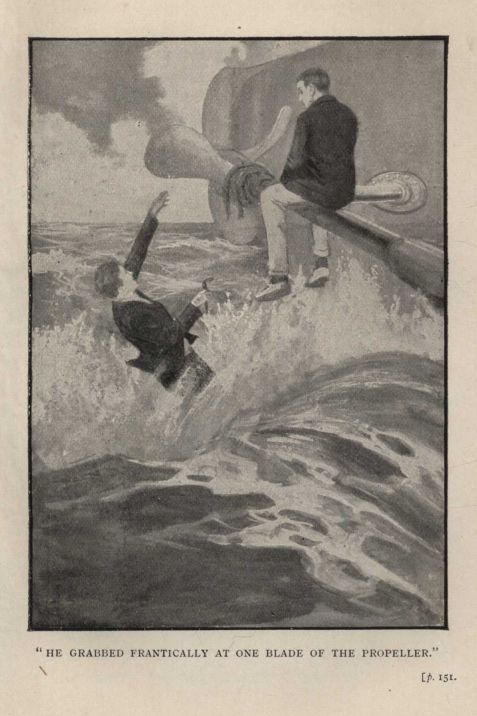
"HE GRABBED FRANTICALLY AT ONE BLADE OF THE PROPELLER."
One glance sufficed to show the sub that the unfortunate man could not swim a stroke. However competent he was underneath the sea in his diver's dress it was a certainty that he was absolutely helpless when it came to keeping on the surface. He raised his hands above his head, and in consequence sank. By the time he came to the surface again, the submarine, now light and high in the water, had been blown ten yards astern. The officers and men on deck were all equipped in heavy working-suits and sea-boots, while the dinghy, the only above-water life-saving appliance on board, was down below. There was not even a rope handy that was long enough.
Captain Restronguet, Devoran, and several others were struggling to cast off their cumbersome clothing and boots, but they were too late, for Hythe, slipping out of the bowline, dived into the water. Although more than fully clad, since he had donned overalls over his uniform, he fortunately was not wearing sea boots.
Striking out vigorously he gained the spot where Gwennap had sunk just as the man appeared for the second time. Bearing in mind the instructions laid down in official directions for saving life Hythe used a fair amount of precious breath in bawling in a loud voice that the drowning man was safe. Gripping Gwennap by the collar he jerked him on to his back, the man struggling furiously the while. Hythe, realizing that once the frantic and powerful fellow gripped him, it would be "all up," had his work cut out to avoid the man's arms. One glance showed him that the "Aphrodite" was drifting fairly fast to leeward; his assurance that the drowning man was safe seemed a hollow mockery.
"Don't struggle, you idiot!" spluttered Hythe, as the crest of a wave broke over his head. "Don't you see you'll do for the pair of us?"
But Gwennap evidently did not see, for if anything he struggled the more.
The sub came to the conclusion that the situation was a desperate one. He was rapidly becoming weaker; his clothes, now thoroughly waterlogged, seemed like leaden weights. He had lost all sense of direction; he knew not where the "Aphrodite" lay. It seemed as if he were left with a frantic, drowning man in the lone sea. But not for one moment did Hythe intend to abandon the man he had so gallantly attempted to rescue. If only he could prevail on Gwennap to keep fairly still a chance yet remained; but the man showed no signs of ceasing to struggle.
"Let go!" shouted Hythe, as loudly as he could, as Gwennap's huge fist seized him by the shoulder, followed by an iron grip on his coat-sleeve. In his effort to shake himself clear the sub sank. As he did so Gwennap's grip became a close embrace. Down, down, down; it seemed as if Hythe had sunk a full twenty feet ere the downward motion ceased. His lungs seemed ready to burst with the pressure. Even if he would he could not now free himself from the relentless grasp.
Once more his head appeared above the surface. He drew in a deep, reviving draught of air, even though it was salt-laden; then with a sudden effort he wrenched his right arm clear, drew back his fist, and planted a tremendous blow upon Gwennap's temple, and his struggles ceasing he was now practically harmless.
"Pity I didn't think of that before," thought Hythe dimly. "I wonder if I've killed him, but there was no other way."
"Cheer up, Hythe!" exclaimed a hearty voice that the sub recognized as Devoran's. Turning his head the well-nigh exhausted rescuer saw close to him the chief officer and O'Shaunessey, who, having divested themselves of the greater portion of their clothing, had dived overboard to aid their comrades.
"That's right, you hang on to me," continued Devoran, "O' Shaunessey will look after that lubber. The captain will give him a dressing-down when we get aboard again."
Hythe was too done up to inquire why Gwennap should be reprimanded. He was only too glad to rest his hand upon Devoran's brawny shoulder.
"We'll be all right in a brace of shakes," said the chief officer encouragingly. "The water's quite warm, and we are fresh enough. They are turning the 'Aphrodite' and will bring her to windward of us."
Ten minutes later, the submarine, with her upper platform barely three feet out of water, glided slowly up to the group of immersed men. Ropes were thrown and caught by Devoran and O' Shaunessey, and by this means Gwennap and Hythe were hauled on board. Captain Restronguet was waiting to congratulate his guest upon his heroic action, but instead he sprang forward and grasped Hythe by the arms, just in time to prevent the sub from falling helplessly to the deck.
CHAPTER XIII.
THE MISSING SUBMARINE.
When Arnold Hythe recovered consciousness he found himself lying on his bunk in the cabin that had been appropriated to his use. The scuttle was closed, an electric light was burning, and by the slight and peculiar oscillation of the vessel he knew that the "Aphrodite" was running submerged.
He was not alone. Sitting at the head of his bunk was Kenwyn, the second officer. He was reading a book, but hearing the sub move he replaced the volume on a shelf and asked Hythe how he felt.
"Not quite up to the mark, thanks. But what am I doing here? Ah, I remember. Have you got Gwennap safe on board?"
"Yes, thanks chiefly to you. He's still unconscious. Devoran told me he saw you knock the nonsense out of him, By Jove! I shouldn't like a blow like that."
"I hope I didn't hit him too hard?" asked the sub anxiously.
"Too hard? Not much. He's as tough as nails, and he thoroughly deserved to have his figure-head damaged. He is the only member of the ship's company who cannot swim, and the captain has been trying to get the fellow to learn for a long time past. But you are a plucky fellow, Hythe."
"Where are we making for now?" asked Hythe, seeking to change an embarrassing subject. "Has the propeller-shafting been cleared yet?"
"We're making for the North coast of Spain: Machichaco Bay, to be exact--a place a short distance to the east'ard of Cape Villano. You see, the rising sea and Gwennap's accident interrupted the work in hand, so Captain Restronguet, rather than put into any of the harbours on the French Biscayan coast, has decided to make for Machichaco Bay, where there are excellent facilities for repairing the damage without fear of interruption. We are running with only the port propeller, that gives us barely twelve knots when submerged, and at that rate we expect to sight land about mid day on Thursday."
"Is Captain Restronguet going to beach the 'Aphrodite' at half tide?" asked Hythe.
"Rather not. No, our repairs will be carried out on the floor of the bay, where we shall be unseen by every one. But don't talk any more at present. Drink this and try to go to sleep."
"But I don't want to go to sleep," expostulated Hythe.
"Very well, then, don't, only drink this. It will buck you up."
The sub took the glass proffered by the wily Kenwyn, and drained it at a gulp. Within three minutes he was sleeping peacefully.
When Hythe awoke again after an eight hour's sleep all traces of his strenuous exertions had vanished. He tubbed, dressed in his own clothes, which had meanwhile been dried and pressed, and went down to breakfast in the captain's cabin.
Captain Restronguet greeted his guest warmly, until Hythe felt quite uncomfortable at the praises bestowed upon him for his act of gallantry. Once more he succeeded in changing the subject, this time by asking if any news had been received of the "Vorwartz."
"Nothing that will give us definite information as to where she is making for," replied Captain Restronguet. "But from my British agent I have had news that Karl von Harburg has been declared a pirate by the Great Powers and by several lesser maritime states as well, and that war vessels are authorized to capture or destroy the 'Vorwartz' without compunction. I fancy, however, that that part of the business will be left to us."
"You mean to track him down?"
"Through the five oceans, if needs must. But for the time being we are put out of the running. Have you ever been to the north coast of Spain, Mr. Hythe?"
"Yes, to Bilbao, Santander, and Coruña; but it was two years ago, when I was in the old 'Alacrity.'"
"Then you don't know Machichaco Bay?"
"Never heard of it until Mr. Kenwyn mentioned the name to me, sir."
"H'm. Do you remember the disaster to 'La Flamme'?"
"The French submarine that was supposed to have been run down on her way from Rochefort to Toulon?"
"Yes, the Dutch liner 'Huitzens' arrived at Rotterdam about that time with several of her bow plates buckled, and reported she had been in collision with an unknown object thirty miles off Cape Finisterre. The theory was advanced and generally accepted that the liner ran down the French submarine."
"And didn't she? Do you know anything about it?" asked Hythe interestedly.
"I think I can show you certain evidence before many more days are passed. Ha, Devoran, what is it?"
"Cape Machichaco in sight, sir."
"Very good. We'll go to the fore conning-tower, Mr. Hythe. You will then be able to see how we con the 'Aphrodite' into this somewhat intricate roadstead."
The submarine was now running at a little less than eight knots and at thirty-five feet below the surface. The electrically operated periscope with its flexible attachments was in operation, and by looking at the object-board the sub could discern what appeared to be a range of hills, above which a remarkably-shaped peak towered to a considerable height. Close to the edge of the cliffs could be seen a circular lighthouse and the keeper's house, both painted white. Some little distance from the cape two forbidding looking rocks reared their gaunt black heads above the sea, while between these rocks and the shore was a tumbling mass of white foam.