Front matter (continued 3)
Reading edition
"Is that the cape? Where, then, is the bay?" asked Hythe.
"It is hardly recognizable from the distance. There it lies--away to the east'ard. A point to starboard, quartermaster--gently does it--so."
Slowly and steadily the "Aphrodite" approached the desired anchorage. Through the starboard observation scuttle the sub saw vicious-looking rocks more than once, rising boldly from the bottom of the sea at less than twenty yards off. Between them were cavernous depths that could only be compared to an American canyon suddenly submerged in a tremendous flood.
While the quartermaster kept the "Aphrodite" on her course Captain Restronguet directed all his attention to the submarine cliffs. Hythe could hear him counting as the dangerous rocks appeared to slip by.
"Hard a port."
Round swung the "Aphrodite" till her bows pointed straight for a narrow gap in the rocks. The sub stood aghast. Surely it was courting disaster to plunge into a submarine defile, so dark and so narrow that it seemed an impossibility for her to pass without touching the jagged pinnacles on either hand?
The gauge now showed a depth of fifty-five feet. At a sign from the captain, Kenwyn touched a switch and instantly two parallel beams of brilliant light flashed from the sides of the conning-tower. As far as the beams penetrated nothing but water could be seen, but in the reflected light on either hand the ghost-like rocks flitted past in a seemingly endless procession. The "Aphrodite" was threading an intricate passage between the dangerous shoals of Machichaco Bay.
Suddenly a weed-covered crag, looking like a pillar of glistening silver, came within the zone of the port search-light. A slight touch at the helm and the "Aphrodite" swung round, clearing the danger with comparative ease. On and on she went, literally crawling and smelling her way through that forbidding channel.
Presently Captain Restronguet touched Hythe upon the shoulder.
"Look!" said he, at the same time switching on a supplementary search-light that, instead of playing in a fore and aft direction, threw its beam at right angles to the submarine's course. For less than ten seconds the captain kept the light switched on, but in that short interval the sub saw something that made the blood run cold in his veins.
Perched upon a flat rock so insecurely that it seemed as if the faint "wash" from the "Aphrodite" would topple it over, was a regularly-shaped mass literally covered with barnacles and plentifully festooned with trailing seaweed. But even these disguises Hythe could penetrate: there was no mistaking the tapering stern, the horizontal and vertical rudders, and the twin screws of a standard type of submarine.
"'La Flamme,'" announced Captain Restronguet, at the same time raising his right hand to the salute in honour of the brave dead, an example that Hythe promptly followed.
A little farther and the twin search-lights played upon a solid barrier of rock, extending from side to side of the submerged gulley.
Placing the engine-room indicator to half-speed astern Captain Restronguet waited till the "Aphrodite's" way was checked; then turning to Mr. Devoran he nodded his head significantly.
Immediately the chief officer opened the valves of the subsidiary ballast tanks and the "Aphrodite" sank vertically to a depth of sixty-five feet beneath the surface, and rested firmly upon the sand on the bed of Machichaco Bay.
The sub glanced at his watch. Notwithstanding the fact that he had been wearing it when he dived overboard to the rescue of the man Gwennap it had sustained no damage whatsoever from its immersion. He was surprised to find that it was nine o'clock. Nearly an hour had elapsed since the submarine had first entered the tortuous defile.
"We cannot do more until daylight," announced Captain Restronguet, as soon as the patent anchors had obtained a firm hold in the sand. During the navigation of the "Aphrodite" through the dangerous channel he had been constrained; his whole attention had to be concentrated on his work, but now his usual willingness to impart information returned.
The search-lights, now no longer necessary, were switched off, so that no belated fishing-boat might have occasion to report the presence of a mysterious phosphorescence in the depths of the bay; and having received reassuring reports from various parts of the vessel the captain intimated that the somewhat long-delayed dinner would prove acceptable.
"I discovered this channel quite by accident," said the captain, during the progress of the meal. "We put in here on our way north, since the nautical directories state that here the currents run with great velocity. This step was necessary since our accumulators were rather run down and I particularly wished to have a good reserve of power for our run across the bay and up the English Channel. Of course, in a 'blind alley' such as we are in now, there are no eddies or currents to trouble us. I was looking for a good sheltered berth, for as far as we could see through the observation plate in the bottom of the vessel there was nothing but jagged rocks. We were moving very slowly, at twenty feet below the surface, when Mylor shouted that we were passing over a submarine. I at once thought that we were about to be attacked by the 'Vorwartz,' but Mylor promptly supplemented his first assertion by saying that the craft was a wreck."
"You say it is 'La Flamme,' sir"? asked Hythe. "How, then, is the fact to be accounted for that she was run down off Cape Finisterre?"
"She never was," replied Captain Restronguet calmly. "That was a statement based upon suggestions made by the liner's crew. No doubt they cut something down. The state of her bows proved that; but it was more likely that of a derelict or else perhaps an unfortunate fishing-vessel. Well, we found the channel, and by carefully feeling our way out, came to the current that served our purpose admirably."
"It is a tricky piece of navigation," remarked the sub.
"Not so much as one would think. You observed the two forward search-lights? Their beams are not exactly parallel, but slightly diverging. So long as the water illuminated by them is unobstructed I know that the 'Aphrodite' is safe. Directly any dangerous object comes within the field of light I know that it lies in the vessel's course, and have to alter helm accordingly."
"Did you examine the wrecked submarine?" asked Hythe.
"Yes; a brief external examination, but enough to satisfy me that it was 'La Flamme,' and also the manner in which she met her fate. To-morrow, while the repairs are being undertaken, I propose to make a fairly lengthy examination, both external and internal. Perhaps you would like to accompany me."
"I should, sir, with pleasure," replied Hythe.
"I warn you that the sight will not be a pleasant one. In fact, were it not for a definite purpose, I would hesitate to undertake the interior examination."
"I have seen a few gruesome things during the comparatively short time I have been in the Service, sir."
"Very well, then. I mean to write out a report and forward it to the French Government. Perhaps you will be so kind as to endorse it with your signature and rank? I have already mentioned that I regard myself as a humanitarian. I hope the report and the suggestions I make will go a long way towards abolishing submarine warfare."
"Abolish submarine warfare?" exclaimed Hythe, astonished at the suggestion, that to him--a naval officer, who had qualified in submarine work--was utterly absurd.
"Certainly," resumed his host. "With all due respect to the Geneva Convention its work is performed in a very slipshod manner. You are not allowed by international restrictions to poison wells, or use explosive bullets; yet you are permitted to employ enormous shells, mines, torpedoes, submarines, bombs from aircraft and a host of the most devilish ingenuities that civilized men can devise for the destruction of their fellow-beings. Which would you prefer, Mr. Hythe, to be quickly and painlessly poisoned when slaking your thirst on the field of battle, or to be horribly mutilated by fragments of a shell, and remain, perhaps for years, a misery to yourself and your fellows?"
The sub shook his head.
"By eliminating certain means of offence you reduce the limits of the horrors of war."
"Of the means only, the horrors of war will never be mitigated until the ban upon explosive shells, submarine, and aerial offence and defence is imposed. Thus I maintain that the Geneva Conference has only taken a middle course. Better by far to place no limitations and make war so horrible that no nation will dare draw the sword; or else restrict the weapons of offence to solid armour-piercing shells for naval warfare, small calibre rifle bullets and cold steel. To my mind submarine warfare, including torpedo work, is a despicable form of destruction."
"Yet you yourself are bent upon an errand of destruction by means of your submarine."
"Precisely. And it is the same in international warfare, because A builds a submarine, B must do likewise, in order to fight upon equal terms. But wait until to-morrow. When you have explored 'La Flamme' perhaps you may see eye to eye with me."
"What caused the disaster, sir?" asked Hythe.
"For the present I prefer not to answer that question," was the reply. "To-morrow I think I can explain more clearly."
After breakfast on the following morning a strong working-party, under the direction of the chief officer, prepared to tackle the task of freeing the propeller. Clad in their diving suits the men entered the air-lock and thence slipped out into the sea. Soon the hull resounded to the rasping of the hack-saws as the men attacked the hempen rope that was coiled tightly round the shafting.
"Are you ready, Mr. Hythe?" asked the captain.
The sub assented, and Captain Restronguet led the way for'ard to the divers' dressing-room. On the way he stopped, and asked his companion to accompany him to the after-conning-tower.
The sun was now shining brightly, and even at that depth the luminosity was sufficient to enable the interior of the conning-tower to be seen without the aid of artificial light.
"It is now nine o'clock," remarked Captain Restronguet. "On what quarter ought the sun to be visible at this hour?"
"South-east," replied Hythe promptly.
"Now look at its bearing according to our standard compass."
"Why, it bears south-west."
"Exactly. Now that explains the loss of 'La Flamme.' Practically the whole of this coast contains vast quantities of iron ore, and the deviation of the compass at this particular spot amounts to as much as ninety degrees. The north-west coast of Spain is bad enough in this respect. You may have heard of the loss of the 'Serpent,' several years ago. That was attributed to magnetic influence of the iron ore upon the ship's compass. Here the error is still greater. It is easy to understand that the unfortunate submarine, getting within the fatal influence of the magnetic attraction, ran full tilt upon the rocks in a heavy sea and on a pitch-dark night. But we will now prepare for our submarine walk."
In the dressing-room were Kenwyn, Carnon the quartermaster, and O'Shaunessey, who were also to form the party. The Irishman was somewhat doubtfully examining the dress and helmet served out to him. Anything that was not "regulation" he regarded with suspicion.
"Buck up, O'Shaunessey!" said the quartermaster. "Here's the cap'n; and you're not ready yet."
"Sure, I'm ready," replied the Irishman. "But can't I have me own dress?"
"You'll be sorry for yourself if you do," said Captain Restronguet who had overheard O'Shaunessey's remark. "Before you've gone fifty yards you will feel as if you're squashed between the jaws of a vice."
"You see," he added, turning to Hythe, "the air in a diving-dress fitted with an air-tube is kept under a fairly good pressure; with ours, the air supply being self-contained, only a very slight pressure is maintained. We rely upon the stiffening bands in the flexible metal fabric to withstand the exterior pressure of the water."
Having donned their diving garb, Polglaze served out to each man a small electric lamp. Captain Restronguet and Hythe both carried a steel crowbar, Kenyon a long adjustable spanner, while Carnon and O'Shaunessey took axes. The quartermaster was also equipped with a slate for writing messages, that being the only form of definite communication under water.
As soon as the five men entered the air-lock the water was admitted. When the compartment was full Captain Restronguet thrust back a couple of levers and a portion of the exterior plating of the hull was pushed aside. From the sill of this aperture to the bed of the sea was a drop of nearly ten feet. Unhesitatingly the captain leapt and sank upon a sandy floor, where he was joined by his companions.
Hythe found that walking in this form of dress was far easier than plodding along in the orthodox diving-suit in use in the British Navy. The absence of life-line and air-tube, with their attendant drag upon the diver, was particularly noticeable.
A short halt was made to examine the progress of the work upon the damaged propeller. Already the men had made a fair show with the job, but, as the sub had predicted, every strand had to be carefully cut through and prised up. Under the best conditions it would require another three hours of arduous labour to free the shafting from the obstruction.
At that depth the light was strong enough to see nearly twenty yards ahead, and Hythe was struck with the peculiar formation of the submarine gorge. It was as if human hands had hewn out a deep and narrow passage through the solid rock, here and there cutting side tunnels that faded away in the distant gloom. Fantastic marine growths occurred in patches that had to be carefully avoided, for some of the tendrils were armed with crooked spikes, sufficiently strong and sharp to do untold damage to any diver who was incautious enough to get into their toils. At other places fern-like weeds growing to a height of ten feet made the floor of the bay resemble a tropical-forest. Sponges grew in profusion; oyster-shells, a yard in diameter, were occasionally met with. Once O'Shaunessey's foot narrowly escaped being seized by the gaping jaws of one of these bivalves. A second later and his limb would have been crushed to a pulp.
As the five advanced crabs large and small swarmed sideways across their path to seek shelter amongst the rocks; fish in shoals darted from the unwonted sight of the diving-dresses, although a few, bolder or more stupid than the rest, swam quite close to the submarine pedestrians.
Presently the passage bifurcated, both arms shooting off at a very narrow angle. Unhesitatingly Captain Restronguet took the left. All the same Hythe wondered what would happen if they lost their way, for there was nothing whereby he could distinguish one way from another.
Stopping at one of the branch passages Captain Restronguet pointed towards it, then switching on his lamp began to clear away through the seaweed that grew to a height of nearly twenty feet. Hythe followed, tit was like pushing aside a Japanese curtain, for the flexible tendrils closed behind him.
The belt of weed was comparatively narrow; less than five yards brought the men to a close sandy space. Here the sub stopped. Right in front of him, and hidden from the natural light by a thick canopy of weeds, were the jagged, barnacle-encrusted timbers of a ship.
She was lying slightly over to starboard, but the list was enough to cause her double tier of guns to fall through the rotting planks. Her bowsprit had been carried away close to the gammoning; of her masts only two shattered stumps remained. Waterlogged cordage and sails trailed dolefully over her sloping deck, while her figurehead--that of a woman holding a rod--was just recognizable in its decay.
At each step, careful though they were, Hythe and his companions kicked up a cloud of iron rust, till the scene of desolation was almost blotted out. Of the ship's guns those that were of iron had almost crumbled into flakes of rust, but the brass cannon were in almost as good condition as they were when the wreck was a noble ship. The sub stooped and examined one of the brass pieces of ordnance. Close to the touch hole were the letters L.R. and the date 1692.
"A Frenchman: time of Louis XIV, by Jove!" said the sub to himself. "I wonder what her name is?"
He was on the point of walking towards the stern of the wreck when Captain Restronguet laid a detaining hand on his shoulder and flashed his light upon the rust-discoloured sand. Hythe instantly drew back. Almost under his feet yawned a hole full of trailing weeds that looked for all the world like a pit full of loathsome serpents.
Evidently understanding the reason for his companion's curiosity the captain beckoned to Carclew to approach. Then taking the quartermaster's slate he wrote in bold characters "La Sybille, French treasure-ship, sunk in action, 1695."
CHAPTER XIV.
"LA FLAMME."
Holding up his hand Captain Restronguet gave the signal for the party to retrace their footsteps to the main channel. It was about time, for the disturbed sediment from the crumbling wreck had obliterated every object beyond a distance of a yard.
The order of the procession was consequently reversed, Kenwyn leading and the captain bringing up the rear. Half way through the barrier of weed Hythe suddenly became aware that the man immediately in front of him had stopped and was stepping backwards. The next instant the sub was knocked sideways by a tremendous blow. Owing to the resistance of the water his fall was considerably broken, but he found himself lying in a veritable net of tendrils, while above him was some huge moving creature that was lashing out with almost irresistible force. Prudence counselled him to lie still, a sense of duty to his companions urged him to disentangle himself from the clutch of the weeds.
He chose the latter course, and contriving to free himself from the serpent-like tendrils he regained his feet, this time on the right side of the barrier of weeds.
It was a fearsome sight that met his gaze. Lying at full length upon the sand, and with his hands held in front of his helmet to protect the glass plate, was one of the divers whom the sub recognized as Kenwyn. Over him, and ready to spring upon another victim, was an enormous conger, more than eight feet in length and as thick round as a man's thigh.
Standing ready to lunge with his crowbar was Captain Restronguet, while with axes held ready in a position of attack were Carnon and O'Shaunessey.
Recovering his steel bar Hythe, though giddy with the effect of his fall, ranged alongside his friends.
The eel darted forwards. Captain Restronguet delivered a thrust and missed.
The next moment he, too, was capsized while the conger, darting over his body, retreated to the shelter of a hole in the rocks.
The captain was on his feet in an instant, while Kenwyn was assisted to rise. As no bubbles came from his dress it was evident that the attack had not seriously injured his diving-gear. Had the conger used its teeth instead of his tail the flexible metal fabric would have been bitten through as easily as if made of paper.
Kenwyn, however, walked unsteadily. The attack had not left him uninjured, but by a gesture he showed that he was quite able to continue the submarine excursion.
Once again the march was resumed, but ere they had gone another five paces O'Shaunessey happened to turn and look in the direction of the eel's retreat. He had just time to warn his comrades, for the conger, viewing the departing invaders as a sign of defeat, was preparing to renew the attack.
Like an arrow the snake-like monster darted forward! This time Captain Restronguet succeeded in thrusting his crowbar down the conger's throat, and by an almost superhuman effort pinned it to the sandy bed. Right and left the brute writhed its powerful tail. To withdraw the crowbar would be imprudent, to keep it there was obviously beyond the captain's strength in spite of his muscular powers.
Marking his opportunity Hythe planted his crowbar fairly through the eel's back. To any creature but a member of the fish tribe such a blow would have proved instantly fatal, but the conger only fought the more, till O'Shaunessey and Carnon cut its body into four pieces with their axes. Even then the severed portions continued to writhe. But the victory had been won, and once again Captain Restronguet led the way towards the lost submarine.
Half an hour's steady walking--the pace being about two miles an hour--brought the explorers to the ledge on which the ill-fated "La Flamme" lay. Bending his knees Captain Restronguet gave a rapid upward spring that took him nearly ten feet from the level of the channel, and sufficient for his outstretched hand to obtain a grip upon the edge of the rocky shelf. The sub, the quartermaster, O'Shaunessey, and lastly Kenwyn followed and gained the upper part of the rock, the only accident being that O'Shaunessey incautiously grasped the bracket of the sunken vessel's propeller shafting, with the result that his bare hands were badly lacerated by the knife-like edges of the barnacles.
To all outward appearance "La Flamme" was intact, but by removing the coating of molluscs and seaweed Captain Restronguet was able to point out a fracture about two feet from the bows.
Carclew and the Irishman next attacked the hatch abaft the conning-tower. Constructed to resist enormous pressure from without it was nevertheless comparatively easy to wrench up the steel covering that was held only in position by a gun-metal securing-bolt. The hatch was swung back and the cavity, within which the tragedy of two years' standing had hitherto been carefully guarded, lay open to inspection. But somehow even those strong-minded men--nerved to face hourly dangers beneath the surface of the fickle sea--hesitated. They stood around the open hatchway, looking at the repellent aperture, and at each other, till overcoming his repugnance the captain switched on his electric lamp, turned his face to the rusted steel ladder and descended.
Although now thoroughly loathing the task he had taken in hand Hythe felt compelled to follow. Not so the others: they remained on the slippery, weed-garbed deck.
The sub had steeled himself to see a gruesome sight, but his anticipations were excelled. In the pale light of the electric lamps he saw a scene so ghastly that his cast-iron nerve wellnigh broke down.
Every portion of the metal work of the interior bore traces of the corrosive action of the sulphuric acid, which escaping from the batteries had spread from end to end of the doomed craft. Luckily for the two adventurers the acid had long since exhausted its energies, otherwise their metallic dresses would have been eaten through by the powerful corrosive.
Almost the first compartment Hythe examined was the air-lock--that vaunted contrivance by which it was stoutly asserted that the crew of a disabled and waterlogged submarine could escape. Here were the skeletons of two men both overpowered in the act of attempting to draw the life-saving helmets over their heads. By the contortions of their bones it was fairly evident that they had struggled hard. Of the fifteen helmets only three had been removed from their places; twelve of the crew had been unable even to reach the place where safety had been promised, but where the promise had utterly failed.
Lying across the crank case of one of the motors was another body, blackened by sea water and petrol. Apparently this was one of the mechanicians who had by the impact been thrown across the powerful machinery, for his vertebra had been completely fractured. Grasped in the grisly hand was an oil-can. The poor fellow had literally died at his post. A clock on the motor-room bulkhead had stopped at a quarter to five.
Aft, the scene was even more horrible. Huddled together, some locked in each other's arms, others still in the act of vainly trying to raise themselves from their steel tomb, were nine corpses. Apparently as "La Flamme" sank she plunged bows foremost. These men had contrived to make their way aft, where the imprisoned air, compressed to several atmospheres, had been sufficient to prolong life for several minutes--literally periods of physical and mental torture.
Captain Restronguet flashed his lamp upon that awful group, then swiftly turning made his way down the steeply sloping deck, and gained the base of the ladder leading to the conning-tower. Here he waited for the sub to rejoin him, and again the pair hung back.
Hythe was visibly trembling. Within his diving dress the perspiration poured from him. This was the sort of danger that he had courted day after day with comparative equanimity.
Captain Restronguet flashed his lamp upwards. The rays revealed a pair of men's sea-boots jammed against an open steel grating. These boots were not empty--in them were the bones of a human leg. The rest of the poor creature lay huddled against the binnacle. By the tarnished uniform it was evident that the victim was either the lieutenant or the sous-lieutenant of the ill-fated craft.
As Hythe gained the upper platform a crab glided away from the heap of clothing--then another, and yet another. Overcoming his repugnance the sub grasped the end of a gold chain and pulled a watch from the unfortunate officer's pocket. It had stopped at seven o'clock. Allowing that both the motor-room clock and this timepiece were accurate until stopped by the water, one hour and three quarters had elapsed ere the air confined in the conning-tower had failed to support life. One hour and three quarters, imprisoned in a steel tomb without the faintest hope of rescue--this is but one of the risks men run in the race for sea supremacy!
In the upper story of the conning-tower they found yet another corpse--also an officer. He was untouched by water, for even after the lapse of time since the disaster there was still a considerable amount of air trapped in the steel citadel. He had found time to write, even in that awful impenetrable darkness, for across the open chart, written in lines that frequently overlapped each other, was the commencement of a fairly coherent report of the disaster.
After that the poor victim had been seized with a form of frenzy, for he had endeavoured to open the manhole in the conning-tower--failing that in his despair had tried to end his misery by shooting himself with his revolver, for the weapon, with all chambers empty, lay on the grating beside him. Even a swift and merciful death had been denied him, for in the darkness he had been unable to find the cartridges.
Hythe turned and descended the ladder as fast as he could. Captain Restronguet took the chart on which the course and the fragment of the report had been pencilled out and also the officer's rough log-book, and followed his companion. But the captain's investigations were not yet complete.
He made his way for'ard to where the two bow torpedo tubes were placed. This part of the submarine was deserted, save for a shoal of small fish of the sardine tribe. Their mode of entry was now apparent, for besides the rent in the plating, gaps the width of a man's finger were visible in the seams. The huge metal cylinder, which for dead-weight far exceeded a vessel of the same dimensions, had been hurled by the continued power of the twin propellers, and the irresistible force of the mountainous waves, at a tremendous pace upon the solid rocks--and the shock had not been sufficient to stun the unfortunate victims who formed the crew.
The two explorers having performed their duty, hastened to the open hatch. There with a common impulse they both stood stiffly erect and saluted. It was a tribute from men who had faced perils under the sea and who yet survived to those who, similarly situated, had sealed their devotion to duty with their lives.
"Well, Mr. Hythe, what did you think of that ghastly spectacle?" asked Captain Restronguet after their return to the "Aphrodite."
The sub was deadly pale. Hitherto he had looked only on the bright side of a submarine officer's life, now he had seen----
"It is simply horrible, sir."
"It is. And there are persons--experts they call themselves--who boldly maintain that death under these circumstances comes swiftly and painlessly. Would to heaven those men had been with us, and had seen what we have seen. Submarine work is a dangerous game."
"Yet you yourself----" began Hythe.
"Exactly. I know what you were about to observe. But my submarine is far in advance of the comparatively crude contrivances in which men seek to destroy their enemies. Possibly, in the interests of humanity, I ought to give my secret to the world. Has not that sight quenched all desire on your part to descend in an ordinary type of submarine again?"
Hythe rose from his chair.
"Sir," he replied stiffly, yet without any trace of grandiloquence, "it is my place to obey orders, and at times to withhold my opinion. But then I can safely say: so long as duty to King and Country calls, Britons will never be found wanting in the hour of peril, be it on, above, or under the sea."
CHAPTER XV.
A VISIT TO GIBRALTAR.
Breakfast on the following morning was a kind of solemn feast, for although Devoran and Kenwyn were present, hardly a word was spoken. The gloom of the previous day's exploration seemed to penetrate everything, yet the subject was, by mutual consent, studiously avoided.
The meal was nearly over when Lancarrow, the wireless man, knocked and entered the cabin.
"Message just received, sir," he announced unconcernedly.
Captain Restronguet opened the envelope and scanned its contents. Although his eyes lightened with satisfaction he said not a word till the man had retired.
"News of the 'Vorwartz,' gentlemen," he exclaimed. "She is reported to be operating off the entrance to Valetta Harbour, Malta. Holed the torpedo-boat-destroyer 'Tamar,' did considerable damage to the oil-tank vessel 'Petrolia,' so that the ship had to be beached in Bighi Bay. After that she slipped off. An aero-hydroplane followed her for an hour in an easterly direction. The 'Vorwartz' then dived much deeper and was lost sight off."
"What is she doing in the Mediterranean, sir?" asked Devoran. "That doesn't look as if she's returning to Sumatran waters."
"Unless she goes through the Suez Canal," added Kenwyn.
"She won't try that game," said Captain Restronguet. "There's not enough water in the canal. If she does we have been saved an unpleasant task, for the authorities will blow her to atoms."
"Now what is to be done, sir?" asked the chief officer.
Captain Restronguet paused a few moments before replying.
"The shafting is now all right, Mr. Devoran?"
"Yes, sir, I remained till the work was completed. That was at half past one in the morning."
"Excellent!" commented the captain. "There is now only one course left open to us. We must proceed to the eastern part of the Mediterranean and continue our search for this modern pirate. I'll send a message to the Admiralties at London, Paris, and Berlin informing them of my whereabouts and of my intentions. We may have a chance of sending the relics of 'La Flamme' ashore at Gibraltar, Mr. Hythe. Perhaps you would care to hand them over to the proper authorities?"
"With pleasure," replied the sub.
"There is no time to be lost," continued the captain, rising from his chair. "What is the weather like, Mr. Devoran?"
"Hazy, sir."
"Excellent! We may have a run on the surface; the extra ten knots may be of extreme importance."
"Must we go astern through this channel?" asked the sub, as he followed his host to the fore conning-tower. "There is not enough width to turn."
"Oh, no; we rise vertically to the surface," replied Captain Restronguet. "Coming here it was different. I could not depend upon sinking the 'Aphrodite' immediately over the gulley. Besides, I had reasons for bringing the craft in while submerged."
The discharging pumps were soon at work, and with hardly a jerk the heavy mass of water-tight metal casing rose majestically from the sandy bed of Machichaco Bay. When just awash her fore hatch was opened and the rails and stanchions shipped.
Hythe went on deck. The haze was sufficiently dense to prevent objects from being seen at a distance of more than a cable's length ahead. The cliffs and the lighthouse were invisible. Although there was hardly any wind and the "Aphrodite" was lying almost motionless on a perfectly calm sea, the noise of the sullen rollers breaking in-shore showed how dangerous this exposed bay was to any craft that attempted to send a boat ashore.
Beyond that ceaseless roar no sound disturbed the quietude. As far as the crew of the submarine were concerned they might have been floating peacefully in the midst of the wide Atlantic instead of almost within hailing distance of the Iberian shore.
The centre scuttle of the "Aphrodite's" for'ard conning-tower was opened so that the quartermaster could take verbal directions from his superior officer. Captain Restronguet stood just in front of the conning-tower, while two men, detailed for special duty as look-outs, were stationed in the bows, clad in oil-skins to protect them from the spray that was bound to come inboard as soon as the vessel gathered way. Abaft the after conning-tower Mr. Devoran had taken his stand, while right aft were more men whose duty it was to report the presence of any vessel that, of swifter speed than the submarine, might overtake her.
These precautions were additional to the use of the submarine detector that indicated the approach of any craft at a distance; for when travelling at high speed the swish of the waves against her lean bows was apt to be misconstrued by the men stationed at that electrically recording device.
Giving a glance at the standard compass to assure himself that he had made due allowance for the abnormal deviation Captain Restronguet gave the order for half speed ahead. Like a greyhound the "Aphrodite" leapt forward at a reduced speed of eighteen knots.
Within ten minutes the belt of haze had been left astern, and the sun shone brilliantly upon the clear blue water.
Hythe remained on deck some hours till the rounded point of Cape Ortegal hove in sight. Here the sea in calm weather is always agitated by a long heavy swell, while in gales the waves are dangerously steep. As a precautionary measure Captain Restronguet ordered the look-out men to make themselves fast with life-lines and the open hatches to be battened down. Although he suggested to the sub the advisability of going below, the captain, for some reason that he did not think fit to communicate, remained on deck. Scorning to make use of oilskins he stood grasping the handrail surrounding the conning-tower, and gazed fixedly at the horizon on the starboard bow. Whatever he expected to see his hopes in that direction were unfulfilled, and at five o'clock, after the tumultuous water had been left astern, he rejoined his guest in the cabin.
"We are so far fortunate in being able to keep on the surface," he remarked. "We are now off Cape Finisterre and right in the regular mail and ordinary trading routes. But up to the time I left the deck we had not sighted a single sail."
Twice during the day the "Aphrodite" had to dive to avoid being sighted by passing vessels, for although Captain Restronguet made no secret of his whereabouts he did not think fit to allow the submarine to be seen.
Just before midnight the captain called to Hythe as the latter was about to turn in.
"We are going to dive to eight fathoms," he announced. "It is advisable since we are approaching the Straits of Gibraltar. Perhaps you would care to have a look on deck before going to bed?"
On gaining the upper platform Hythe found that the "Aphrodite" was running nearly awash, with no navigation lights. Even the lamps in the conning-towers were screened. It was a pitch-dark night, although the atmosphere was clear. The water was exceptionally smooth for the Atlantic seaboard of the coast of Spain and Portugal.
Away on the starboard hand were several large vessels, each showing their green navigation lights, denoting that they were bound north. One, brilliantly illuminated, was evidently a liner on which the passengers were keeping a late night, for the distant strains of a string band were just audible above the subdued noise of her powerful engines.
"You know this coast, I suppose?" asked Captain Restronguet. "Do you recognize yonder light?"
The sub looked intently in the direction indicated. Through the darkness shone a fixed white light which increased and diminished in intensity, attaining its maximum glare every thirty seconds.
"Yes, Cape Trafalgar," he replied. "And we are within twelve miles of it."
"Otherwise it would appear to be a flashing light," added Captain Restronguet. "I see your knowledge of the various lights is exceptionally good. Had it been daylight we might have found time to let you have a sight of some of Nelson's relics, for we are passing over the scene of that ever-memorable victory. The bottom of the sea here is strewn with the remains of the French and Spanish vessels that were either sunk in action or foundered in the storm that arose after the fight was over."
"I have seen enough of naval disasters for the time being," remarked Hythe.
"You will soon get used to sights of that description," said the captain with a shrug of his shoulders. "Some day, all being well, I hope to visit the remains of the Russian vessels sunk at Tshushima. Not simply for idle curiosity, but with a definite motive. But it blows cold, so I think we may as well descend."
When Hythe awoke next morning the "Aphrodite" was at rest. Throwing back the metal slide over his cabin scuttle he looked out. The submarine was below the surface and in a fairly crowded anchorage, for dimly in the sunlit water he could distinguish more than one mooring chain and a mushroom anchor deeply embedded in the ooze.
"This must be Gib.," he thought, as he prepared to dress.
Although breakfast was laid, Captain Restronguet was busy writing as Hythe entered the cabin.
"Excuse me while I finish," said the former apologetically. "Here is a copy of this week's 'Gibraltar Herald'; it was published only yesterday, so it is fairly recent. Perhaps you might care to look at it?"
Hythe took the journal wonderingly. How could it have come into Captain Restronguet's possession? He sat down and opened the pages. Most of the news consisted of matter interesting only to the members of the colony, such as descriptions of social functions of such minor importance that the edition of the smallest weekly at home would scorn to make use of; but about one half of the back sheet was devoted to general news.
Three quarters of a column were occupied by a more or less accurate account of Karl von Harburg's doings at Malta. Since Captain Restronguet had exposed the fellow's identity the owner of the "Vorwartz" no longer attempted to screen himself by attributing his illegal acts to his rival; on the other hand the dénouement seemed to have emboldened him, for hitherto he had confined his active attentions solely to German national property. Now he was fast developing into a pirate, attacking all nations without any consideration. Yet, curiously enough, he never attempted to take booty, and on this account his motives were the subject of the keenest discussion.
Already international squadrons, representing Great Britain, France, Germany, Italy, Austria, Russia, and Greece were co-operating with a view of exterminating the modern buccaneer, while from Cape Tarifa to Centa a powerful flotilla of the latest type of submarines formed a cordon at the maximum depth attainable with safety beneath the surface. These in turn were supported by a number of destroyers and protected cruisers, while overhead aero-hydroplanes flew by day and naval airships soared by night, the latter keeping their searchlights playing vertically downwards in the hope of locating and annihilating the vampire of the seas.
The tension between England and Germany had, according to the paper, been considerably relaxed, and both the Atlantic Fleet and the High Seas Fleet had returned to their respective ports; but at the same time the British Prime Minister had spoken strongly in the House, urging the oft neglected precept that "A nation armed is a nation at peace."
The only other item of news that interested Hythe was a report that there had been seismic disturbances in the Mediterranean, and that Malta had experienced two severe shocks. The sub knew Malta well; besides, he had relations living there, his maternal uncle holding a shore appointment under the Admiralty. Although the effects of the tremor were felt at Bizerta, Tripoli, Syracuse, Messina, Reggio, and even as far north as Rome, Vesuvius and Etna showed no signs of increased activity, while Stromboli had ceased for several days to emit smoke. This phenomenon had been debated upon by men of science, but no satisfactory explanation had been arrived at.
"Have you found anything sufficiently interesting to make you forget my rudeness, Mr. Hythe?" asked Captain Restronguet, as he put his writing materials into his desk and locked it up. "I had to finish this dispatch, as you so kindly consented to take it ashore for me."
"I have been wondering how you obtained the paper, sir?"
"Easily done. We arrived in the bay about four this morning. Carclew immediately left the 'Aphrodite' and walked ashore, landing on the Neutral Ground about four hundred yards beyond the Advance Lines. He divested himself of his diving-dress and hid it, and as soon as the gun went--the signal for the gates of the fortress to be opened, as you know--he mingled with the crowd of locked-out Scorps, Spanish traders and pedlars, and walked unceremoniously into the town. Coming back, however, he had a nasty time, for the sentries had their suspicions, taking him for a smuggler, and it was as much as he could do to slip into the water without being seen."
"How do you propose to set me ashore?" asked Hythe.
"Perfectly openly," replied his host calmly. "I have the Governor's permission to send a representative ashore. You will land at the steps on the inner side of the New Mole at ten this morning. Kenwyn and Gwennap will accompany you as far as the landing in order to help you off with your gear. They will then return, so that no inquisitive individual will have an opportunity of examining or possibly stealing my patent helmet. At six p.m. sharp, Kenwyn and Gwennap will meet you at the same place. By the by, would you like O'Shaunessey to go with you?"
The sub hesitated for a moment before replying. Captain Restronguet had made no conditions regarding his trip ashore. He trusted entirely to the honour of the young officer. There was nothing to prevent Hythe and O'Shaunessey from remaining at Gib. if they felt inclined. The sub knew O'Shaunessey to be a sharp and diligent man, but unfortunately he had a great failing. Had it not been for a few delinquencies in the shape of overstaying his leave the Irishman might have been a petty officer by this time. Consequently, since the man might get into one of the numerous grog-shops and fail to return to time, Hythe decided not to take him.
"Very good, Mr. Hythe," replied Captain Restronguet in even tones, although the sub detected a glint of satisfaction in his eyes. "I quite understand, and I think your judgment is good in this respect. Now let us fall to; breakfast will be getting quite cold, and I do not want my emissary to start on a journey with discomfort."
"Where are we lying now?" asked Hythe, in the course of the meal.
"In the Commercial Anchorage, on a line with the Devil's Tower open of the North Front," replied the captain. "I thought it best to do so, rather than trespass within the limits of the Admiralty Anchorage. You will have more than a mile to walk, but the tides close inshore are weak, and by keeping close to the Old Mole you will find little inconvenience.
"Here are the documents," he continued, as soon as breakfast was over. "This one, to which is attached the chart from 'La Flamme,' is for the French Minister of Marine. It will be safely forwarded. This is for the Governor; the others are of a private nature, and will be sent in by post in the ordinary way."
"I heard say you are going ashore, sir," said O'Shaunessey, who was standing in the diving-gear compartment. "Wud ye take this letther for me? Sure, 'tis for me ould mother."
"I will, O'Shaunessey," replied Hythe. He almost wavered in his resolution not to take the A.B. with him; but since the Irishman did not seem at all anxious to enjoy a spell on land the sub adhered to his former plans.
Guided by a watertight compass held by the chief officer, Hythe, with his dispatches in a weighted metal case, set out on his lengthy submarine walk. Without a hitch the three men gained the base of the northernmost Mole, and walking under the keels of several merchant vessels made fast alongside, they arrived at the landing indicated by Captain Restronguet.
As soon as Hythe emerged from the water, greatly to the interest of a swarm of bluejackets and civilians who had been apprised of the arrival of the mysterious submarine, Kenwyn and Gwennap divested him of his diving suit, and, being unable to speak by reason of their helmets, raised their right hands in token of farewell.
Being ashore seemed quite unfamiliar to the young officer, although he was well acquainted with that landing place. Briskly he ran up the steps, made his way through the admiring and attentive crowd, and shaped a course for the Governor's Palace.
"So you are returning to the submarine?" asked the Governor, when the interview was at an end. "I believe the Admiralty have telegraphed that you can exercise your discretion in the matter."
"Yes," replied Hythe. "I think it necessary to do so, both from an official and a private sense. I can assure you, sir, that anything approaching the craft in mechanism and scientific wonder has never yet been seen."
"My Lords are naturally anxious for details," remarked the Rear Admiral in charge of the Naval Establishments at Gibraltar, who had made it a point of being with the Governor on the occasion of Hythe's visit. "In fact, speaking in a strictly confidential manner, I may as well tell you that they would like to open negotiations with Captain Restronguet for the purchase of the vessel. Could you approach him on this matter?"
"I am afraid it will be of no use, sir," replied the sub. "But, of course, I will do my best. Captain Restronguet is a man of iron resolution, and he has more than once told me that he has sworn to sink the 'Aphrodite' rather than hand her over to the Admiralty."
"That is a pity," said the Governor. "Why is this? He is an Englishman?"
"Yes, a native of Cornwall; but he is labouring under the impression that he has been slighted by the Admiralty. He offered his invention some years ago and was, he informs me, shabbily treated."
"Unfortunately that is not the only case," said the Admiral. "The mistake--for mistake it undoubtedly is--was possibly the work of some petty official at Whitehall. I've known plenty of instances of that description. However, Mr. Hythe, do your best in that direction, and find means to communicate Captain Restronguet's decision as soon as possible. He will not, I hope, sell the submarine to a foreign power?"
"No, sir; I think with all his prejudices Captain Restronguet does not forget he's an Englishman. Otherwise he would not be so open in explaining a host of details connected with his vessel to me."
"Well, we must hope for the best," declared the Governor.
"And if Captain Restronguet succeeds in destroying this rascally German's submarine--the 'Vorwartz,' is it not?--we shall have something to be thankful for."
Hythe made good use of the rest of the time allowed him ashore. Several of his brother officers, whom he had known on previous commissions, soon had him "in tow," but the sub strenuously declined to go aboard any of the ships. There might be some mistake, he might forget how the hours sped, and to miss his appointment at the New Mole was not to be thought of. He found an opportunity, however, of replenishing his scanty stock of clothing, and by means of a small "tip" enlisted the services of a "Scorp" to purchase a supplementary kit for O'Shaunessey. These he had placed in a small tin trunk, the lid of which was securely soldered down, and engaging a porter he told the man to follow him to the landing.
It was now close on the hour fixed for his return, but a sudden obstacle was thrown in his way; he had forgotten the Customs.
An alert Customs Officer, who was no respecter of persons even though they were in naval officer's uniform, peremptorily demanded to see what the trunk contained.
"Clothing only," replied Hythe, with considerable annoyance. "Value Five Pounds; here is my bill."
"Must see what's inside, sir," replied the man. "Please to order your porter to carry this box to the office. You will also step this way, sir."
"Look here, this is all rot!" exclaimed Hythe indignantly. "I'll pay up, even though it's a blind rush; but I've an appointment to keep."
The Customs official was obdurate. The sub glanced at his watch. It had stopped. He had forgotten to wind it. By a neighbouring clock it wanted five minutes to six.
Hythe hesitated no longer. Turning he set off at full speed towards the Governor's palace, the Customs man pelting at his heels and shouting to the bystanders to stop him. The sub was a good sprinter, even though considerably out of practice by being cooped up in the limited quarters of a submarine. Dashing past the astonished sentry at the entrance to the palace, before the soldier had time to salute, Hythe literally thrust his way into the Governor's presence and hastily told him of his irritating and serious encounter with the officious Customs man.
"He is undoubtedly within his rights, Mr. Hythe," replied the Governor. "But, at the same time, he is over zealous. That will clear you," and sitting down he wrote out and signed an order to pass Mr. Arnold Hythe's baggage.
One minute to six. With almost indecent haste the sub once more bade the Governor farewell and resumed his headlong pace.
Just outside the Dockyard Gate he overtook the Customs official, who was puffing and blowing after his exertions on a fruitless chase.
"Very good, sir," exclaimed the man apologetically, "but you see dooty's dooty. I'll clear your trunk in a jiffy."
Bubbling over with impatience Hythe set off at a rapid rate, with the wellnigh exhausted official at his heels. A fresh catastrophe confronted him, for upon arriving at the place where he had left the porter with his trunk neither was to be seen.
"He's a wrong 'un, sir," exclaimed the Customs man. "You had better inform the police."
"Haven't time," exclaimed Hythe savagely, and without another word he ran towards the steps at the New Mole. When he arrived it was ten minutes past six, and no signs of Kenwyn and Gwennap were to be seen.
"That's done it!" ejaculated the sub. "And Captain Restronguet said six o'clock sharp."
CHAPTER XVI.
OVER A VOLCANO.
If ever a man felt like kicking himself it was Arnold Hythe at that moment. He had missed his appointment; and in Captain Restronguet's eyes he would be regarded as a waster devoid of any sense of honour or gratitude.
"Have you seen anything of two divers?" he asked, addressing the crowd that lingered about the landing; for, though the time fixed for his departure had been kept a secret, a curious throng had loitered there nearly all day.
"Yes," shouted a dozen voices in chorus, and amid a babel of vociferations the sub contrived to gain the information that they had appeared quite half an hour ago, had waited ten minutes and had disappeared.
"Are you quite sure they went before six?" asked Hythe.
"Perfectly sure, sir, it was exactly ten minutes to six when they went down," replied a sailor confidently.
Then the thought flashed across his mind, perhaps Captain Restronguet had purposely marooned him? An instant later he banished the suggestion, yet why should Kenwyn and Gwennap have returned before the appointed time?
Hythe resolved to wait and see if anything fresh transpired. The crowd increased, several naval officers and dockyard officials mingling in the throng. Presently the Admiral came down and asked if he should order anything to be done to attract the "Aphrodite's" attention.
"They may come back even yet, sir," replied the sub. "I'll wait a little longer."
"If you hear nothing by seven you may as well have dinner at Admiralty House, Mr. Hythe," observed the Admiral.
Just at that moment two men in uniform arrived carrying Hythe's trunk. The thief had been caught and was under lock and key.
"That's something to be thankful for," soliloquized the sub. "To lose one's belongings and one's ship at one time is a bit too thick."
A sudden shout of exclamations from the crowd caused him to turn and look towards the slide of the Mole. Like a huge porpoise the twin conning-towers and flat deck of the "Aphrodite" appeared upon the surface, the water pouring in cascades from her smooth substance. As easily as a ship's pinnace she ran alongside the steps, her after-hatch was thrown open and Captain Restronguet appeared.
"Come on, Mr. Hythe!" he exclaimed.
The sub waited for no second bidding. With a bound he gained the Upper Platform, and turned and saluted the astonished Admiral. Having seen his belongings passed on board he followed his host below.
Fifty seconds later the dense crowd of spectators were gazing dumfounded at the unbroken wavelets. For the first time had human eyes, other than those of her crew, seen the redoubtable "Aphrodite" at close quarters above the surface of her natural element.
* * * * *
"Yes, I was certainly surprised when Kenwyn returned with the news that you were not at the rendezvous, Mr. Hythe," said Captain Restronguet. "Then the thought suddenly struck me."
"What thought, sir?"
"Might I ask what time you went by?"
"The local time; my watch had stopped. By Jove! I see what happened. Gib. time is 21 minutes 28 seconds slower than Greenwich."
"Just so. I guessed the mistake arose that way; so, as a considerable amount of precious time would be wasted in sending Kenwyn and Gwennap ashore again, I took the unusual course of bringing the 'Aphrodite' right alongside the New Mole. It will give the Scorpions something to talk about."
"And the naval authorities as well, sir. The Admiral was there."
"Now we are off as hard as we can pelt for the Eastern Mediterranean. I mean to keep at good depth till clear of the patrols of the Straits. The 'Vorwartz' is reported in the Black Sea, so I suppose the Russians will get excited. Anyway, I hope to be able to arrive in the Ægean Sea and intercept Herr Karl von Harburg as he returns through the Dardanelles."
Night had fallen ere the "Aphrodite" rounded Europa Point, and with the favouring east-going current was well beyond the cruising ground of the British submarines.
Two days later she was between Cape Bon on the Tunisian shore and the western extremity of Sicily. Captain Restronguet had, in view of recent developments, decided not to touch at Malta, but proceed as fast as he could to Grecian waters, where he hoped to be able to replenish his accumulators and be in a state of readiness for his hated rival.
Hythe had retired to his bunk. He had had a heavy day in the conning-tower, where, in reply to his host's invitation, he had stood a watch in order to acquaint himself with the delicate organization of electrical mechanism that controlled the submarine.
The "Aphrodite" had been running on the surface during the day, but to obviate the risk of being struck by passing vessels she was submerged to nine fathoms at sunset.
Suddenly the sub found himself struggling on the steeply listing floor of his cabin. The place was in utter darkness. All around him were weird noises caused by various articles breaking adrift, mingled with the shouts of the alarmed crew, while from without came an awe-inspiring rumble.
Struggling to his feet the sub groped for the electric light switch. The current was off. More and more became the list till his feet slipped from under him, and he fell into the angle formed by the floor and the fore and aft bulkhead of the cabin. Above the noise he could distinguish the captain's voice shouting for the emergency ballast tanks to be emptied.
"Good heavens! She's been struck. We're done for this time," exclaimed Hythe, with lively recollections of the ill-fated "La Flamme" fresh in his memory. He gained his feet and made for the door, but ere he could fling it open the "Aphrodite" spun round as if pivoted amidships. Full length went the sub once more, his hands grasping the knob of the door, which had come off in the strain. The racket of the shifting gear was redoubled. Every moment Hythe expected the enormous pressure of water, since he was fully certain that the vessel was plunging downwards, would burst in the sides of the submarine.
Another nerve-racking twist and the "Aphrodite" began to dip her bows till this time the sub found his sliding movement checked by the fore and aft bulkhead. Then, with a rattle and clank of her complicated machinery, the propellers began to race, while the vessel danced about like a gigantic cork. Instead of plunging down the submarine had been raised to the surface, and was being tossed about on the crests of an angry sea.
After considerable trouble Hythe succeeded in opening the door. Outside in the alley-way all was in darkness. He groped his way towards the fore conning-tower, staggering against the metal wall with each abnormal heave of the vessel. Before he had traversed many feet he came into violent contact with a man whom he recognized by his voice as the chief officer.
"What's up, Devoran?" he asked.
"Heaven only knows, Mr. Hythe. Until we get the light switched on it will be difficult to find out. One thing, we are afloat, and riding easily."
"Much too easily for my liking," remarked Hythe, although he felt considerably reassured that the "Aphrodite" had risen.
"Where are you going?" asked Devoran.
"To the for'ard conning-tower."
"No use," replied the chief officer laconically. "All principal watertight doors are closed. Captain's for'ard. Best to go to the after conning-tower if you want to see anything. I left Kenwyn there."
The sub made for the steel ladder communicating with Kenwyn's post, and as he did so he heard Devoran raise the flap of the hatchway to the motor-room and ask Carclew what in the name of Pontius Pilate's grandmother was the matter with the light?
"Plug fused, sir. I am replacing it," shouted Carclew.
"Then for goodness' sake hurry up!" replied the chief officer.
Hythe found Kenwyn staring out of the scuttle at nothing. It was so pitch dark that without the conning-tower everything seemed an impenetrable mass of darkness--sea and sky a chaos of invisibility. All the while the submarine was pitching and tossing like an empty barrel.
"That you, Mr. Hythe," exclaimed the second officer, unmistakably glad to have some one to speak to. "Isn't this a set-to? I don't know what can be happening."
Just then a brilliant flash of lightning played upon the turmoil of broken water without. In the pale-blue glare it seemed as if the surface of the angry sea was one expanse of tall, steep waves--an exaggerated tidal race.
"Ah, that's better," ejaculated Hythe, as the hiss of incoming water could be faintly distinguished above the hammering of the waves against the "Aphrodite's" sides and upon her deck. "We're diving once more."
At twelve fathoms the motion, though still erratic, became less marked, and the condition of things was vastly improved when the electric light was once more connected up.
Every available search-light was switched on, and as the powerful beams were directed through the scuttles Hythe and Kenwyn gave a simultaneous exclamation of surprise. Eddying through the water as far as the rays of light could penetrate were columns of smoke mingled with bubbles full of gaseous vapour. Now and again dark masses would shoot upwards with the velocity of a meteor.
"A submarine eruption, by Jove!" declared Hythe. "We're over the mouth of a submerged crater. That accounts for the earthquake shocks in Malta and elsewhere. Those black objects we see whizzing by must be lumps of lava."
Kenwyn placed his hand upon the side of the conning-tower. The metal felt quite warm to his touch. The thermometer registered eighty-five degrees.
"We'll be boiled alive if this lasts," he exclaimed. "The sea must be quite hot. Ah! that's better," he added, as the propellers began to revolve. "We ought to get out of this natural saucepan as soon as possible."
Just then Captain Restronguet's voice was heard at the telephone inquiring if Mr. Hythe were in the conning-tower.
"He is, sir," replied Kenwyn.
"Ask him to step this way. The watertight doors are now open."
"Have you noticed the sudden rise of temperature, Mr. Hythe?" asked the captain when the sub reached the fore conning-tower. "You have? I thought you would. We've had a most unusual experience; we have passed almost over the mouth of a submarine volcano at the moment of an eruption. The 'Aphrodite' was almost drawn into the vortex caused by the rush of water to fill the cavity formed by the expelled lava from the crater."
"I wonder if another island has been created, sir?"
"If there has been the 'Aphrodite' has narrowly escaped being left high and dry upon it, Mr. Hythe. It was in the last century that an island suddenly appeared almost in this latitude and longitude. The British, I believe, claimed it and so did the Italians; but before the question of ownership was decided the island settled the matter by disappearing. If----"
"Look ahead, sir!" exclaimed the quartermaster in horrified tones.
The water was now slightly less smoke-laden, and the two for'ard search-lights made a tolerable clear path for nearly a hundred yards ahead. Into that double ray of light came the hull of a sinking vessel. It was sinking stern foremost with a slight list to starboard. Hythe recognized the type of craft, a Sicilian fishing-boat. Her mast had snapped off about three feet above the deck, while her lateen sail, extended by the upward tendency of the wooden yard was almost as rigid as a sheet of metal. Lashed to the tiller was the helmsman--a dark-skinned, curly-haired Italian. The sub could even distinguish his gold ear-rings. The poor fellow was still struggling desperately yet aimlessly, for he made no effort to cast off the rope that bound him to his post of duty. His hands clutched wildly at the yielding water. Amidships were two other men, similarly secured, but they were evidently already drowned since they were making no attempt to save themselves.
But for a brief instant did the distressing vision last, for with a quick movement the quartermaster placed the helm hard over, the "Aphrodite" swerved, and the parallel beams shone upon a waste of unbroken water.
Captain Restronguet muttered something under his breath.
"Can nothing be done to save them?" asked Hythe.
The captain shook his head.
"Nothing," he replied deliberately. "Nothing. Had there been a ghost of a chance we would have taken the risk."
For several moments the occupants of the conning-tower stood in silence, gazing fixedly at the chaos of water before their eyes. By this time the "Aphrodite" had passed the influence of the eruption, for she no longer rolled and plunged on her submarine course.
"The danger is now over, Mr. Hythe," said Captain Restronguet at length. "Perhaps you would care to resume your bed? I am afraid that everything is in a fearful mess 'tween decks, though."
"It is lucky for us it is no worse, sir. For the moment I----"
A dull thud upon the deck of the submarine caused the sub's remarks to remain incompleted. The shock literally caused the "Aphrodite" to reel.
"Bring her up, sir, bring her up!" exclaimed Devoran's voice at the telephone. Captain Restronguet did not wait for an explanation. Ordering the quartermaster to trim the horizontal rudders he himself pressed the lever controlling the emergency ballast tanks. Up rose the submarine, though not with her accustomed rapidity, and soon she was pounding sluggishly in the still agitated sea that swept her fore and aft and washed over on all sides.
"A craft of sorts has foundered right on top of us, sir," continued the chief officer. "There are men still alive in her--or, at least, I fancy so."
Captain Restronguet and Hythe waited to hear no more. Leaving the conning-tower in charge of the quartermaster they rushed off to where Devoran was stationed. The fore-scuttle of the rearward conning-tower was obstructed by the bulky quivering hull of a large fishing-vessel. She was lying on her port bilges, her keel being wedged in between the deck and the base of the conning-tower, but so insecure was her balance that every movement of the "Aphrodite" in the furious sea threatened to slide her once more into the depths.
"Are the men still there?" asked Captain Restronguet.
"They were, sir, when she settled on our deck."
The sound of the concussion had brought the rest of the crew aft, and in a crowd they stood at the foot of the steps leading to the tower. The captain leant over the circular aperture and hailed them.
"Men," said he, "who will take the risk and venture outside?"
A dozen voices replied in the affirmative, even that of Gwennap, the non-swimmer.
"You, Polglaze, and you, Lancarrow. A couple of life-lines there, and two men to tend them."
Quickly Polglaze and Lancarrow sprang up the ladder and entered the conning-tower.
"There's a boat or small craft lying across our deck," explained Captain Restronguet. "I believe there are some of her crew still aboard. I want you to investigate, and should there be any men bring them back."
Deftly the two members of the "Aphrodite's" crew secured the life-lines round their waists. Devoran unlocked the lid of the aperture in the conning-tower. As the hatch opened a wave burst through, flooding the floor to a depth of two inches--the height of the coaming round the trap-door leading to the Number Two Platform. Before a second wave had time to add to the mischief already Polglaze and Lancarrow were battling their way up the shelving, slippery sides of the stranded vessel. To gain her deck there were no other means, for her keel extended far beyond the side of the submarine. Twice Lancarrow slipped, but aided by his companion, who was already astride the fishing-boat's shattered bulwarks he succeeded in scaling the wall of wood.
Just then a heavy sea came inboard. The wrecked craft rocked, seemed on the point of lurching once more into the depths, when a correcting heel of the "Aphrodite" saved the situation and the lives of the two heroes.
Peering through the almost closed hatch Devoran and Hythe saw Polglaze slide down the boat's hull, grasping what looked like a bundle of clothing in his arms.
"Keep a strain on the life-line," ordered the chief officer. "Smartly now--haul away."
Another sea flooded the deck and swirled past the base of the conning-tower. The strain on Polglaze's life-line was enormous, but fortunately the rope was a sound one. As the smother of foam subsided Polglaze's face appeared at the almost closed hatchway.
"Here you are, sir," he exclaimed breathlessly. Hythe and the first officer instantly opened the lid, and the bundle--the body of a boy about ten years of age--was thrust into their arms. Ere another wave hurled itself upon the rescuer Polglaze was safe within the conning-tower.
And now Lancarrow's burly form appeared sitting astride the fishing-craft's bulwarks. He evidently had a weightier burden, for in spite of his efforts the powerful Cornishman could not at first raise it clear of the sides. Thrice he essayed the task and the third time was successful. His burden was the padrone or master of the wrecked craft.
Just then a formidable sea, higher than the rest, came hissing and foaming down upon the submarine. Lancarrow with his back turned to it was unaware of the danger, but both Hythe and Devoran saw it and shouted a warning. Their voices were drowned in the howling and shrieking of the gale.
With a smother of hissing foam the wave burst. Lancarrow, still grasping his burden, was hurled from the bulwarks and thrown upon the "Aphrodite's" deck. The same wave sent the fishing-boat back into the depths, thus depriving Lancarrow of the slight shelter hitherto afforded by the hull, and hurled him across the slippery deck. Fortunately he was not stunned by the impact and did not relinquish his hold of the man he had rescued, while the life-line saved both from being washed overboard.
Realizing the danger Hythe fastened round his own waist the rope that Polglaze had cast off, and bidding Kenwyn and Devoran to open the hatch, he dashed to the aid of the rescuer and rescued.
Another wave flung him back just as he was on the point of gripping Lancarrow round the chest. The rush of water swept all three against the conning-tower. The slack of the life-lines were hauled in, and the receding water left them close to the hatchway.
"I've got him," spluttered the sub, as he laid hold of the unconscious Italian. "You look after yourself, Lancarrow."
With a heave Hythe lifted the padrone within reach of those within the conning-tower, the Cornishman followed, and by a display of remarkable yet undignified agility the sub succeeded in gaining safety ere a tremendous breaker hurled itself in vain against the massive metal plating.
The "Aphrodite" was quickly submerged to a depth of nine fathoms and driven ahead at a modest seven knots, while steps were taken to restore the rescued man and boy to life. It did not take long for the latter to open his eyes, but in the case of the old man three hours of unremitting toil failed to give any sign of success. More than once Hythe shook his head doubtfully, but Captain Restronguet had no intention of admitting defeat. As fast as one of the operators showed signs of fatigue another took his place in their efforts to restore the action of breathing.
After exactly three hours and ten minutes' steady work the old Italian showed signs of respiration.
"We've managed it," exclaimed Kenwyn joyfully, in the tone of a man who has fought a hard struggle and has won the victory.
"Avast there!" ordered the captain to Gwennap who was still pressing and relaxing the pressure on the patient's body. "Watch him carefully."
But in less than a minute the natural breathing ceased, and the efforts to restore respiration had to be renewed. It was not until half an hour later that the padrone was able to be put to bed and allowed to sleep, Kenwyn and Hythe volunteering to stand by and keep a watch over the patient.
It was now daylight. The fury of the waves had abated, and only a long sullen roll served as a reminder of the terrific agitation of the sea a few hours previously.
Captain Restronguet, therefore, decided to bring the "Aphrodite" to the surface, so that the loss of time during the period when the submarine was in the zone of the volcanic disturbance could be made good.
"The deck looks different to me, sir," remarked the quartermaster when Captain Restronguet entered the conning-tower. "I've noticed it ever since it grew light."
"How do you mean different?" asked the captain going towards one of the scuttles. A moment later he shouted to the chief officer.
"Hurry up and open the fore-hatch, Mr. Devoran, if you please. We're in for a run of bad luck, it seems."
Well might Captain Restronguet exclaim thus, for instead of the protective garb of light absorbing metal the submarine from stem to stern and from the top of the conning-tower to the keel was as black as a lump of coal.
CHAPTER XVII.
THE RESCUED ITALIANS.
As soon as the fore-hatch cover had been unshipped Captain Restronguet, accompanied by Devoran and Kenwyn, hastened on deck. Hythe, hearing the captain's exclamation, hurried after him.
The sky was now perfectly clear, the motion of the sea had almost subsided. But instead of the stinging, ozone-laden breeze a faint odour resembling that of rotten eggs seemed to pervade the air.
"H'm," ejaculated Captain Restronguet. "In spite of my faith in the high qualities of restronium the metal has played me false!"
"How so, sir?" asked the chief officer.
"It is not proof against the action of sulphur. Even now the air reeks of sulphur, and it was a sea highly charged with sulphur that the 'Aphrodite' passed through when she was in the immediate vicinity of the submarine volcano. Thus the silver in the alloy has been affected, and in place of a light-absorbing metal we have a dead-black surface."
"It is a serious look-out, sir," observed the sub.
"Serious. Serious isn't the word for it. We have lost a great factor in our means of offence and defence. We are no longer practically invisible."
"Can the defect be remedied?"
"Only by subjecting the plating to a fresh treatment, and that can only be done at our base in Sumatra. But be that as it may I mean to continue my search for the 'Vorwartz'. Possibly the margin of superiority lies with her, but, without boasting, I venture to assert that John Restronguet will prove a match for Karl von Harburg. I hope the wireless is intact, Kenwyn?"
"It is, sir," replied the second officer. "We have just tapped a message from the P. & O. liner, 'Coghlania,' seventy miles south of Brindisi."
"Anything of importance?"
"No, sir; merely on a matter of ordinary routine."
"Very good, Mr. Kenwyn. By the by, you might let me know the state of your accumulators. Have we sufficient power to take us to the Ægean?"
"I'll ascertain, sir," replied the second officer.
Before noon the man and boy rescued from the fishing-boat had recovered sufficiently to sit up. Their story was a thrilling one. Hythe's knowledge of Italian enabled him to follow the patois without much difficulty. They had, in company with seven other craft, put out of Porto Empedocle, on the south coast of Sicily. It was a fine night with a light off-shore breeze, the weather being fair. Thus tempted they ventured farther from land than they were accustomed to. Shortly after midnight a strange phenomenon was observed. The stars were shining through a blood-red haze, while a strong sulphurous odour was noticed. The superstitious fishermen, frightened more by omens than by bad weather, prepared to return homewards, but the wind died completely away. At two in the morning a strong nor'easterly breeze sprang up, which soon developed into a cyclonic gale. Hastily reducing their canvas the fishing fleet drove at the mercy of wind and wave, till after ten minutes of great peril they found themselves once more becalmed in an agitated sea. Once more sail was hoisted, in anticipation of a favouring breeze.
Suddenly the water seemed to be rent in twain. A deep trough appeared less than a hundred yards from the sternmost boat, and horror-stricken the terrified Italians found that their frail vessels were being sucked into the abyss. Then the cavity in the sea closed and instead a column of water, stones, mud, steam, and smoke was thrown up with tremendous force. The starlight gave place to inky blackness, and the next thing the padrone of the "Favarganna"--that being the name of the craft belonging to the rescued man--realized that the doomed vessel was on her beam ends. She righted, though half filled with water. The old man had barely time to lash his grandson and himself to the rudder head, ere a huge wave swept the boat from stem to stern and down in the depths she plunged.
Nor was old Beppo's awe any the less when he heard from Hythe of the manner of his almost miraculous escape. Devoutly crossing himself the Italian burst into a torrent of thanks to his preservers, and finished up by asking where they thought of landing him?
"I had thought of that," said Captain Restronguet when the sub interpreted the padrone's request. "Since there is now no real necessity for concealment, I think we might hail the first vessel we come across that is proceeding to Messina--if Messina still stands after the eruption."
An opportunity presented itself late in the afternoon. The "Aphrodite" was about two hundred miles S.S.E. of Cape Passaro, and running on the surface, when a tramp steamer hove in sight steering N.W. "We'll stop that fellow, Devoran," exclaimed the captain. "What does she look like?"
"I cannot make out, sir, she flies no ensign," replied the chief officer, after a lengthy survey through his telescope.
Still unperceived by the oncoming vessel the "Aphrodite" stood out in order to intercept her. At a request from Captain Restronguet two of the seamen shipped a light mast abaft the fore-conning-tower, and on this was hoisted the International Code signal--flags indicating "I wish to communicate--heave to."
As soon as the signal was observed the tramp's helm was ported as if she meditated flight, but ordering full speed ahead Captain Restronguet soon made it evident that the "Aphrodite" could go two knots to the steamer's one. The tramp's engines were set at half-speed astern and simultaneously the affirmative pendant fluttered from her stumpy foremast, while the Greek mercantile flag was hoisted on her ensign-staff.
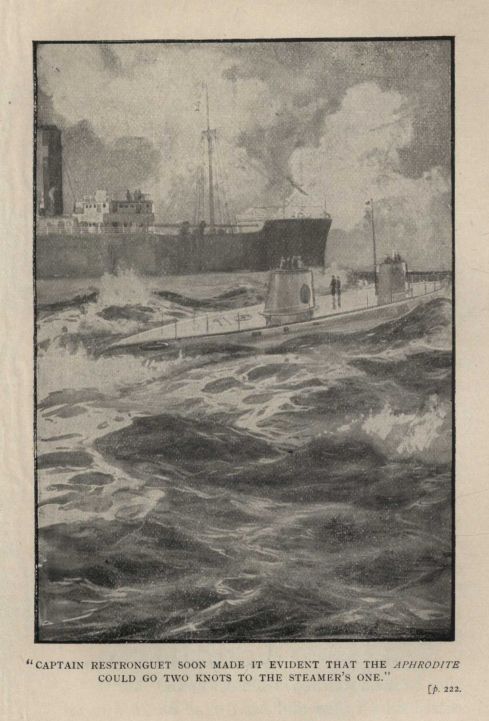
"CAPTAIN RESTRONGUET SOON MADE IT EVIDENT THAT THE APHRODITE. COULD GO TWO KNOTS TO THE STEAMER'S ONE."
"The 'Eleusis' of the Piraeus," announced Captain Restronguet, who was able to decipher with ease the modern Greek characters on her stern.
Gracefully the "Aphrodite" was brought to a stand-still within fifty yards of the Greek tramp, over whose red-leaded bulwarks appeared the heads of about twenty nondescripts who formed her crew.
"'Eleusis' ahoy!" hailed Captain Restronguet in stentorian tones.
"What ship's dat?" asked the Grecian master, who spoke English by reason of several years' service in the British Mercantile Marine.
"Submarine 'Aphrodite,'" replied her captain.
Evidently the fame of Captain Restronguet had already reached the ears of the master of the "Eleusis," for he gave a dramatic gesture of surprise.
"What want, eh? Me peaceful."
"So are we," rejoined Captain Restronguet. "We have just picked up a man and a boy from an Italian fishing-boat. Where are you bound?"
"Messina, Napoli an' Civita Vecchia, sar."
"Will you take these two men as far as Messina?"
The Greek hesitated. His natural cupidity, now that the submarine had shown no hostile intentions, returned.
"Can dey pay passage-monnaire?"
"Passage-money, you white-livered swab!" roared Captain Restronguet. "Is that the way you would treat poor shipwrecked mariners? Send a boat instantly, and take these people to Messina. If I fail to hear of their safe arrival from the Consul of that port I will take good care to obtain satisfaction from you on your homeward voyage. Do you understand?"
"Yas, captain," replied the fellow, thoroughly cowed. "Me send boat."
"If that Greek scoundrel had not been so jolly mean I would have paid him well for his assistance," remarked Captain Restronguet to the sub. "As it is, not a penny will he get from me. Excuse me a few minutes, Mr. Hythe?"
So saying the captain went below; but hardly had his head and shoulders disappeared down the hatchway when he reappeared.
"Would you mind coming with me, Mr. Hythe?" he asked. "I am about to give that poor fisherman a small present to set him up after his severe loss. I prefer to perform little acts of this nature in private, but since I am unable to speak a word of their lingo I realize I must enlist your services. But, please, no mention of this to anyone on board."
Upon entering the cabin in which old Beppo and his grandson were, Captain Restronguet produced a leather pouch and took from it thirty English sovereigns. These he gave to the padrone and bestowed another gold coin upon the lad, whereupon the rescued Italians' thanks were so profuse and pantomimic that their benefactor asked the sub to tell them peremptorily to "shut up."
"And let them know that the British Consul at Messina will arrange for them to have the gold changed into the national currency," he added. "Here is a note explaining that this man came by the money honestly. I think His Britannic Majesty's Consul will recognize that the signature is genuine. Also tell Beppo that he is on no account to pay the Greek skipper anything for his passage beyond a fair price for all meals supplied."
So saying Captain Restronguet strode out of the cabin leaving the sub to explain matters to the bewildered padrone, to whom the gold was a sum greater than he could hope to amass in ten years' hard toil.
"Boat alongside, sir," announced Polglaze.
Followed by Beppo and his grandson, who, radiant with pleasure, had now almost forgotten the perils they had undergone, Hythe went on deck. Here were gathered almost every one of the officers and crew of the submarine, while in a gig made fast on the "Aphrodite's" starboard quarter were four disreputable-looking Greek seamen.
The "Aphrodite's" men gave the departing Italians a rousing cheer, then as soon as the boat returned to the "Eleusis," Captain Restronguet gave orders for general quarters.
Ere the Greek vessel's propeller began to revolve the submarine disappeared beneath the surface, only to reappear on the port side of the tramp. Then, hoisting and dipping Captain Restronguet's green and white ensign, a compliment that the skipper of the "Eleusis" grudgingly returned, the "Aphrodite" resumed her voyage on her quest of the desperado, Karl von Harburg.
CHAPTER XVIII.
THE RIVALS PASS THROUGH THE SUEZ CANAL.
Four days later, with her accumulators charged to their fullest capacity, the "Aphrodite" arose from her anchorage in the Dardanelles.
During that period, although wireless messages were being received with almost monotonous regularity, no definite news had come to hand with reference to the movements of the "Vorwartz."
True, the captain of the Russian battleship, "Imperator Pavel," sent a wireless message to Sevastopol, which was in turn transmitted to St. Petersburg and thence to the world in general, to the effect that at eight a.m. on the morning of the 6th he had sighted a submarine eighty miles S.S.W. of that Crimean port. Having orders to sink the "Vorwartz" without warning, the Russian officer caused a heavy fire to be opened upon the submarine with the "Imperator Pavel's" twelve and three-pounder quick-firers. Every one of these guns that could be brought to bear--eighteen out of forty--joined in the racket, and confident of having destroyed the modern buccaneer, the Russian battleship returned to Sevastopol.
Captain Restronguet received this intelligence with mixed feelings. He had his doubts. He knew that the rapid firing of the Russian fleet was notoriously ill-aimed and inaccurate; he knew also that with a battleship in the vicinity Karl von Harburg would hesitate to bring his craft to the surface. If, however, the news was correct he was saved a lot of trouble, and was now at liberty to return to his base in the Dutch East Indies. Nevertheless he regretted, in no small measure, the fact that he had not been able to achieve the distinction of sinking the "Vorwartz" under conditions favourable to the lives of her crew.
An hour or so later the stalwart Cornishman executed a dance in his cabin, much to the astonishment of Hythe and Kenwyn who happened to be present.
The report of the captain of the "Imperator Pavel" was replied to by a demand from the Bulgarian Government to know why the Russians had fired upon one of their vessels. It appeared that a submarine had been ordered and built at Ansaldo's Works at Sestri, Italy, for the new Bulgarian Navy, and having finished her acceptance trials was returning to Varna. She was running on the surface and made no attempt to alter her course, or to act in any way that might be regarded as suspicious; but when passing the "Imperator Pavel" at a distance of two miles, the Russians greeted her with a sudden and totally unexpected volley of quick-firing shells.
The Bulgarian submarine quickly dived. According to the estimate of the Italian contractors' representative who was on board, not less than one hundred and twenty shells were fired, of which not one did the slightest damage beyond cutting away the ensign-staff.
"Those Bulgarians will make a fine business of this, Hythe!" exclaimed Captain Restronguet. "With Russia on bad terms with Austria and Germany the Balkan States can pull the Bear's tail as much as they like. And trust any of the Balkan States for that; they would draw blood out of a stone if they could. But some day the Powers will settle down harmoniously, and the successors to the Turkish Empire in Europe will have to knuckle under somewhat."
"You don't seem very partial to the Balkan States, sir," remarked the sub.
"Partial? By Jove, I wish I could be! We had a very good specimen the other day in the person of that rascally skipper of the Greek tramp. The stalwarts of ancient Greece would turn in their graves could they but realize to what depths their so-called descendants have fallen. Well, Kenwyn, what is it now? Another purposeless message?"
"I think not, sir," replied the second officer, handing his chief the latest "wireless" received on board.
This time, instead of executing a dance, Captain Restronguet very nearly lost his temper.
"That rogue von Harburg has done me very neatly this time, Hythe!" he exclaimed. "He never was in the Black Sea, that's my belief. Here's a message announcing that the 'Vorwartz' has passed through the Suez Canal."
"Surely that's impossible!"
"Well, then, there's the message. It is from an exceptionally trustworthy agent. I say, Mr. Kenwyn, just reply, will you? And ask to be kept in touch with events."
"Very good, sir," replied the second officer, withdrawing.
"I am anxious to know how a submarine could pass through the Canal without being detected and stopped," remarked the sub, who entertained grave doubts as to the authenticity of the wireless message, especially after the "Imperator Pavel" affair.
"So am I, Mr. Hythe," rejoined Captain Restronguet, who had now recovered his customary coolness of mind. "So am I, since where the 'Vorwartz' can go the 'Aphrodite can go also."
"You mean to traverse the Suez Canal?"
"By fair means, or failing that by foul. Otherwise it would mean that we have to circumnavigate the African Continent, and in the time we were so occupied what would Karl von Harburg be doing?"
Within twenty minutes of the receipt of the momentous news the "Aphrodite" was abreast of the classic Isle of Tenedos, bound for Port Said. All the while she had remained in the Dardanelles, although within a few miles of the seaport of Gallipoli, she had refrained from giving any signs of her presence. But at the moment of departure Captain Restronguet could not resist leaving his card in the shape of one of his green and white buoys on which were painted his customary compliments.
During the run across from Gallipoli to Port Said a complete text of Karl von Harburg's feat, as reported in the Egyptian Monitor, was transmitted by Captain Restronguet's agent for the information of his employer.
It was indeed a daring coup on the part of the German renegade.
Early one morning the "Vorwartz," running light, brought up between the breakwaters that, extending nearly two miles from shore, mark the Mediterranean entrance to the Canal. Here, landing a party of armed men, he took possession of the two lighthouses, and terrified the lightkeepers into submission. He compelled them to ascertain by telegraph what vessels had entered the canal during the previous twenty-four hours and what were expected. Finding that there were no armed ships between Port Said and Suez, and none within easy steaming distance of the latter port, he resolved upon the desperate enterprise of passing through at full speed. To keep submerged would mean loss of time and possibilities of running aground in the Bitter Lakes.
Thus, almost before the Canal authorities at Port Said recovered from their astonishment that a strangely-constructed vessel should have passed into the Canal at several knots above the regulation speed and without paying the customary dues, the "Vorwartz" was well on her way to Ismalia.
In the Little Bitter Lake her luck deserted her, for in attempting to pass a lumbering Dutch tramp steamer, the "Vorwartz" struck upon the sand on the west side of the Canal.
Meanwhile the telegraph had not been idle. It was rightly conjectured that the mysterious craft was that of the modern buccaneer, and a battery of Egyptian artillery had been ordered from Cairo. The artillerymen were sent by train, the route being so roundabout that several hours elapsed before the men and guns detrained at the nearest station, where they were separated by a fresh water canal and a stretch of desert from the spot where the "Vorwartz" had grounded.
It was fortunate for the 'Gippy artillery that Karl von Harburg did not possess the same potential means of offence as did the captain of the "Aphrodite," otherwise the charged shells in the limbers might have exploded with disastrous results. Eventually, after great exertion, the blacks got their guns into position and prepared to hull the helpless submarine. Just then a heavy sandstorm swept down. The breech-blocks of the quick-firers had to be promptly covered up to prevent the ill-effects of the sand upon the delicate mechanism. When the storm ceased the "Vorwartz" was once more afloat and hidden by the sand hills.
Only one course remained for the British officer in charge of the Artillery to take. That was to regain the railway and entrain for Suez, where another chance of cutting off the submarine's retreat was left. But once again the troops were foiled, for before they reached Suez, the "Vorwartz" had passed Port Ibrahim, the Red Sea entrance to the Canal.
Now was Karl von Harburg's opportunity to enrich himself with the plunder from helpless liners and merchantmen. The Red Sea was practically denuded of men-of-war. A pair of obsolete gunboats lay off Suakin. They were not capable of doing more than twelve knots, and could be regarded with contempt. A British third-class cruiser, one of the units of the East Indies squadron, was stationed at Aden, while the remainder of the squadron was at Bombay, with the exception of a second-class cruiser that could not well be withdrawn from the Persian Gulf, without the risk of allowing dangerous cargoes of rifles to be "run" by the Arab dhows that were ever awaiting their opportunity for the hazardous yet profitable business.
Upon the arrival of the "Aphrodite" at Port Said, Captain Restronguet was literally received with open arms by the harassed and distracted Canal officials. The presence of the "Vorwartz" in the Red Sea meant a far greater loss to them in due and tolls than while she was in the Levant, and even then there had been an appreciable falling off in the receipts. Without the faintest delay Captain Restronguet received permission to take his wonderful submarine through the hundred miles of artificial waterway, special facilities being granted so that no undue delay would be experienced. It was generally recognized that if anyone had the honour and distinction of ridding the seas of a danger and a pest that man was Captain Restronguet.
The "Aphrodite" made the journey on the surface and by night. She was twelve hours behind her rival. Fortunately it was bright moonlight, and aided by the powerful search-light on board and the electric arc lamps that had recently been placed on the banks of the canal, the passage was performed most expeditiously. At every town and village crowds assembled to cheer the modern magician. At Ismalia the Khedive's band, sent specially from the palace at Cairo, serenaded the "Aphrodite"; the shipping at Port Ibrahim hailed her approach with a deafening salute upon their syrens; and just as dawn was breaking the submarine, having accomplished the trip in less than seven hours, slipped gracefully under the waters of the Gulf of Suez.
Captain Restronguet's spirits rose. He was flattered with the reception accorded him by the Canal authorities. He realized that, instead of being regarded with suspicion, the world was beginning to appreciate his services to mankind.
"We'll have him right enough," he remarked confidentially to Devoran. "There's a faint tremor noticeable on the detector that cannot mean anything but the presence of the 'Vorwartz.' I have been officially informed that no Government submarine is within a thousand miles of us."
"How far do you think the vessel is, sir?" asked Hythe.
"The detector is sensitive to anything of that nature within a hundred and twenty miles, but, of course, the actual position of the chase cannot be fixed with any degree of accuracy at that distance. But as soon as we approach within twenty miles of von Harburg's counterfeit presentment of my submarine, the position of the 'Vorwartz' will be accurately recorded on the chart controlled by the electric detector."
During lunch the wireless room reported that a vessel was sending out calls for urgent aid, and in response to a request for further details came the startling news that the Dutch liner, "Noord Brabant," had been forcibly boarded by the crew of the "Vorwartz" fifteen miles due east of Wadi Jemel. Several of the Dutchmen had been wounded when attempting to resist; the strong-room had been forced, and nearly ten thousand pounds worth of gold had been removed. Not satisfied with this, Karl von Harburg discharged a torpedo at the ill-fated "Noord Brabant," which, exploding under her starboard quarter, completely flooded the after compartments. Leaking badly, for the shock had strained the water-tight bulkheads, the liner headed slowly for Sherm Sheikh, an inlet in the mainland, where her captain hoped to run her aground on the mud and sand that form the bottom of the cove.