REDCLIFFE CHURCH AND BASIN, BRISTOL.
Reading edition
The church of St Mary Redcliffe's, Bristol, was founded in 1249, and not completed till 1375, an interval of a hundred and twenty-six years. The founder was Simon de Burton, mayor of Bristol. It is pronounced by Camden as "on all accounts the first parish church in England." It has, of course, undergone, in the long lapse of generations, many changes, repairs, and perhaps improvements. In the middle of the fifteenth century, after having been seriously damaged in a storm, it was repaired by William Cannynge the mayor; and, owing to the extent of these repairs, he has established a just claim to the gratitude of posterity as the second founder, and to commemorate the restoration thus effected, two beautiful monumental statues were erected to the memory of himself and his wife in the church. This patriotic and pious individual was five times mayor of Bristol, and makes a prominent figure in the Chatterton controversy. It is to be regretted, however, that the spire was never restored, which, with the tower, was originally two hundred and fifty feet high. So great was the beauty of this sacred edifice, that it was celebrated over the whole country as a masterpiece of art, and attracted numerous visitors; nor has that admiration diminished with the lapse of time, for there are very few individuals, curious in the mystery of ecclesiastical architecture, who have not visited or studied the specimen here preserved.
The church is built in the form of a cross; and the nave, which rises above the aisles in the manner of a cathedral, is lighted by a series of lofty windows on each side, and supported by flying-buttresses. The tower is large and richly ornamented, like the remaining part of the spire, with carved work, niches, and statues. The principal entrance is from the west front; but there are porches both to the northern and southern sides. Of the first of these the interior is very beautiful; and it was over this porch that the room was situated in which Chatterton, whose father was sexton of the church, pretended to have found the poems which he attributed to Rowley. The length of the church is two hundred and thirty-nine feet, that of the transept one hundred and seventeen feet. It is remarkable that the transept consists of three divisions or aisles, like the body of the church; and the effect thus produced is fine and striking, when the spectator places himself in the centre and looks around him. The breadth of the nave and aisles is fifty-nine feet; the height of the nave is fifty-four feet, and that of the aisles twenty-five feet. The roof, which is nearly sixty feet in height, is arched with stone, and ornamented with various devices. Although externally this church has all the appearance of a massive structure, it has nevertheless, from its loftiness and the peculiar beauty of its masonry, a light and airy appearance both within and without; and justifies the high eulogium, which we have already quoted, as pronounced upon it by Camden. Among the sepulchral treasures contained in this church, is the tomb of Sir William Penn, father of the celebrated founder of Pennsylvania.
The business of shipbuilding is carried on to a very considerable extent in Bristol; and stimulated by that spirit which has always characterized the magistrates and merchants of Bristol, added to the vast improvements which have been so recently affected, it is confidently believed, that this ancient city and port are now entering upon a fresh epoch in their commercial prosperity.
The principal exports are derived from the neighbouring manufactures; and the imports consist chiefly of sugar, rum, wine, wool, tobacco, coffee, turpentine, hemp, and timber. The quay extends upwards of a mile along the banks of the rivers Frome and Avon. Owing to the serious inconvenience and frequent damage sustained by large vessels, when lying at low water in the river, a floating harbour was formed here at great expense in 1804. To accomplish so important a design the course of the Avon was changed; the old channel was dammed up to form the new harbour, which, communicating with the river, is accessible at all times, with sufficient depth of water for vessels of the largest size. This great work, comprising the elegant iron bridges over the Avon, was the result of five years' labour, and an enormous expenditure; and, although much benefit has accrued to the port from the success of so spirited an undertaking, still the expectations to which it naturally gave rise, as to the extension of commerce, have not been realized. This is attributable to various local causes.
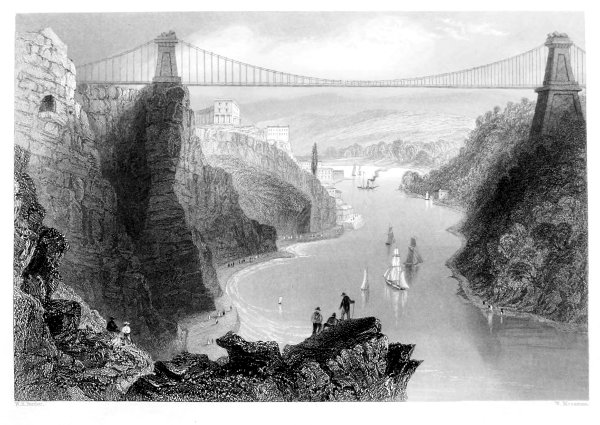
SUSPENSION BRIDGE AT CLIFTON. (near Bristol.)