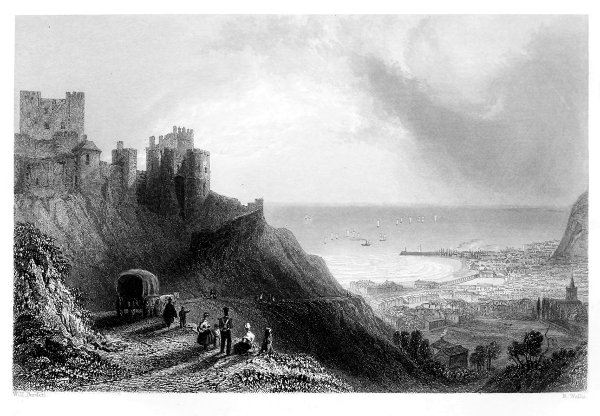
DOVER, FROM THE RAMSGATE ROAD.
Reading edition
The most favourable point of view for an artist who is desirous of obtaining a general view of Dover, is certainly that portion of the Ramsgate Road of which Mr. Bartlett has availed himself on the present occasion. Placed at a sufficient elevation to enable him to embrace a wide extent of land and water, he is still sufficiently near the town to secure that distinctness of detail which adds so much to the effect of a landscape. One of the chief points of attraction in Dover must always be the Castle, but as we shall have another opportunity of referring to that structure, in connection with our view of Dover from the Beach, we purpose now to devote our attention to the town itself.
At the period of the Conquest, Dover was unquestionably a place of considerable note. It is mentioned, with Sandwich and Romney, in the Domesday-book, as a privileged port; and is said to have enjoyed, from an earlier period, sundry privileges and immunities in common with those two towns, on consideration of supplying a certain number of ships and mariners for the defence of the adjacent coast. In the reign of King John, Dover received a charter as one of the Cinque Ports; and in several succeeding reigns, its shipping and mariners were frequently employed in the fleets assembled to convey English armies to France. As it was considered the key of England, it was surrounded with walls and strongly fortified; and as it was the principal port in the kingdom for persons taking shipping in proceeding to France, acts were passed in the reign of Edward III. and Richard II., appointing the rate of passage. Henry VIII. expended large sums in the improvement of the harbour, the entrance of which had been much choked up by shingle washed in by the sea. A pier was commenced, and carried on at a great expense, but he died before it was completed; and in the reign of his successor, the work appears to have been almost wholly suspended. In the reign of Elizabeth, further attempts were made to improve the harbour; and in 1606 an act was passed appointing eleven commissioners, who were empowered to receive certain rates, and employ the money in repairing the pier and improving the harbour. In succeeding times various plans have been tried to prevent the increase of the bar, which, after a gale of wind from the seaward, is sometimes increased so much, as to prevent all vessels, except those that are of very light draught of water, from entering or leaving the port. It is high water at Dover pier at sixteen minutes past eleven on the full and change of the moon; and the rise of the water at spring-tides is about twenty feet. Dover is much frequented in summer as a watering-place; and for the convenience which it affords, and the beautiful and interesting scenery in its neighbourhood, it is surpassed by no other town on the coast.
At a short distance from the entrance to Dover Castle is mounted the long brass gun, usually called Queen Elizabeth's pocket-pistol, which was presented to her Majesty by the United Provinces. It is twenty-four feet long; but is so much "honey-combed," that, were it fired, it would be certain to burst. Popular tradition says that it contains an inscription to this effect:—
"Sponge me well, and keep me clean, And I'll throw a ball to Calais green."
There is, indeed, an inscription on it in the Dutch language, but though it commemorates the destructive power of this long piece of ordnance, it says nothing which implies that its range was so extraordinary. The distance from Dover Castle to the church of Notre-Dame, at Calais, is rather more than twenty-six miles. This gun was cast at Utrecht in 1544, by James Tolkys, and the verses inscribed on its breech have been translated as follows:—
"O'er hill and dale I throw my ball; Breaker, my name, of mound and wall."
About a mile to the southward of the town is the celebrated cliff which is supposed to have been described by Shakspeare in King Lear.
"Gloster.—Dost thou know Dover? Edgar.—Ay, master. Gloster.—There is a cliff, whose high and bending head Looks fearfully in the confined deep: Bring me to the very brim of it. * * * * * Edgar.—Come on, sir; here's the place:—stand Still.—How fearful And dizzy 'tis, to cast one's eye so low! The crows, and choughs, that wing the midway air, Show scarce so gross as beetles: halfway down Hangs one that gathers samphire; dreadful trade! Methinks he seems no bigger than his head: The fishermen that walk upon the beach Appear like mice; and yon tall anchoring bark, Diminished to her cock; her cock, a buoy Almost too small for sight: the murmuring surge, That on the unnumber'd idle pebbles chafes, Cannot be heard so high. I'll look no more, Lest my brain turn, and the deficient sight Topple down headlong."
DOVER. KENT.