PORTSMOUTH. ENTRANCE TO THE HARBOUR.
Reading edition
In the front of this view, and towards the right, a man-of-war cutter is seen running out of the harbour; and, from her heel to leeward, and the agitated state of the water, we may perceive that it is blowing a stiff breeze. Vessels of her class are chiefly employed in the coast-guard service and as admirals' tenders, or as packets on short voyages, or in communicating between one naval depôt and another. In the distance, to leeward of her, the Dock-yard semaphore is perceived; and more to the right, but nearer to the eye of the spectator, is seen the Round Tower; from which, in former times, an immense chain used to extend to the Block-house at Gosport, on the opposite side of the channel, for the purpose of protecting the entrance to the harbour, in the event of its being assailed by the ships of an enemy. Towards the centre of the engraving a broad-side view is presented of the Port-Admiral's flag-ship, a first-rate, which, from the flags at her mast-head, appears to be making a signal; ahead of her, in the distance, the hulls are perceived of two ships of war, laid up in ordinary; and further to the left is seen part of the Block-house Fort, at Gosport, with a beacon, to direct vessels in making the harbour.
Portsmouth harbour is one of the most secure and commodious in the kingdom; and from the depth of water, both within it and at its mouth, ships of the line can enter or depart at all times of the tide. From the narrowness of its entrance,—which, between the old Round Tower at Portsmouth and the Block-house Fort at Gosport, is not wider than the Thames at London-bridge,—it is protected from the swell of the sea; while it is sheltered from the violence of winds blowing off the land, by the range of hills to the northward. Immediately above its entrance the harbour begins to expand, and about a mile and a half above the old Round Tower it is nearly two miles in breadth. It then branches off into three principal creeks, or leats, as they are frequently called; one of which runs up to Fareham, another to Porchester Castle, and the third to Portsbridge. In these creeks most of the men-of-war in ordinary are moored. As those ships, when laid up, are each covered over with a large wooden roof, to protect them from the effects of the weather, they appear, when seen from Portsdown Hill, which commands an excellent view of the harbour, not so much like floating castles as like immense floating barns—ample garners, which would contain more corn than the swords and cutlasses of their former gallant crews, beat into reaping-hooks, will ever cut down!
At Portsmouth the tide flows about seven hours and ebbs about five; and the velocity with which the ebb tide runs out effectually scours the channel at the mouth of the harbour, and prevents the accumulation of sand. It is high water in the harbour at half-past 11 o'clock at the full and change of the moon; and the rise of spring tides is about eighteen feet, and of neaps about twelve. In the months of March and April the specific gravity of the water in Portsmouth harbour becomes so much increased, that ships lying there are observed to float about two inches lighter than at other times of the year. The latitude of the Observatory in the Dock-yard is 50° 48' 3" north; longitude 1° 5' 59" west.
Though Portsmouth does not appear to have been a place of much consideration as a naval station previous to the reign of Henry VIII., who may be regarded as the first English King that established a permanent royal navy, it was yet undoubtedly a town of some consequence long before that time. In 1194, Richard I. granted a charter to the inhabitants, wherein, after declaring that he retains the town of "Portsmue" in his own hands, he establishes an annual fair to be held therein for fifteen days, to which all persons of England, Normandy, Poictou, Wales, Scotland, and all others, either foreigners or his own people, might freely resort, and enjoy the same privileges as at the fairs of Winchester, Hoiland, or elsewhere in his dominions. The burgesses of "Portsmue," as the place was then called, were also allowed to have a weekly market, with the same privileges and immunities as those of Winchester and Oxford; with freedom from all tolls of portage, passage, and stallage, and exemption from suit and service at hundred and county courts.[9] This charter was confirmed in 1201 by King John, and in 1230 by Henry II.; and in 1256 the latter monarch granted another charter, establishing a guild of merchants at Portsmouth. The privileges of the burgesses were at several different times confirmed by succeeding kings; and, in 1627, Charles I. granted them a charter, whereby a mayor and twelve aldermen were appointed for the civil government of the town. This charter, which was renewed by Charles II., has since been modified by the Municipal Reform Bill of 1835, which directs that the borough shall be divided into six wards, which shall elect a town council of forty-two members. In 1298 the borough was summoned to send two members to Parliament, a privilege which it continues to enjoy.
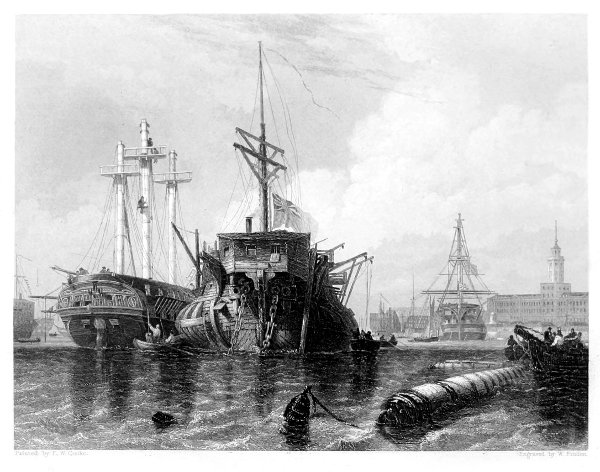
RIGGING HULK AND FRIGATE, PORTSMOUTH.