PORTSMOUTH. RIGGING-HULK, WITH A NEW FRIGATE ALONGSIDE.
Reading edition
In this engraving we have a view of a new frigate, with only her lower masts in, lying alongside of the Topaze rigging-hulk. The latter vessel—which now presents so clumsy an appearance, from her bows and sides being sheathed with a stout doubling of timber, and from a wooden house being built over her stem—was formerly a French frigate, and, when she first came into our possession, she was much admired by nautical men for the beauty of her build. Further in the distance, to the right, is seen a first-rate lying off the Dockyard Quay, partly rigged; and, beyond her, are perceived the immense wooden roofs which cover the building-slips. The line of building to the right is the rigging-house, and the tower erected above it is the Dockyard Semaphore. On the extreme right, towards the front, is seen the forepart of a mooring-lighter, with one of the numerous spar-booms lying afloat near the Common Hard. The original picture was exhibited in the Gallery of the British Institution, where it excited general admiration.
The great naval depôt at Portsmouth is partially described in connection with other engravings in this work, and we have therefore thought it might be interesting to occupy our present space with some details respecting the peculiar mode in which one very important portion of the rigging is manufactured in this yard, and which forms a principal object of curiosity to all persons visiting it. We allude to the machinery for manufacturing blocks, invented by Mr. Brunel, the celebrated engineer.
After the wood—generally elm—for the shell of the block is cut into proper sizes by circular-saws, its complete formation, including the pin and the sheave, is effected by means of several different machines, all contrived with the greatest mechanical skill, and put in motion by a steam-engine. The first process is that of the boring-machine, which, by means of a centre-bit, pierces a hole to receive the pin, and at the same time, according as the block is intended to be single or double, forms one or two similar holes, at right angles to the former, to receive the first stroke of the chisel which cuts out the space for the sheave. By the second, called the mortising-machine, this space is cut out by a chisel acting vertically, and making about a hundred and twenty strokes a minute, and under which the block is caused to move gradually, so that at each stroke a thin piece of the wood is cut away. After this the block is taken to a circular-saw, which cuts off the corners, and reduces it to the form of an octagon. The shaping-machine, to which it is next taken, consists of two equal and parallel wheels moving on the same axis, to which one of them is permanently fixed, while the other is moveable in the line of the axis, so that, by sliding it nearer to the former, or more apart, as may be required, the shells of blocks of all sizes may be fixed between their two parallel rims. Ten shells of the same size being firmly fixed at regular intervals between those rims, the wheels are put into motion with extreme velocity, and the shells are rounded by striking against a cutting instrument, which at the same time moves in such a manner as to give to each block its proper shape and curvature. When one half of the side has thus been finished, the motion of the wheels is reversed, and the other half finished in the same manner. When one side has been rounded, the shells are reversed, and the other side completed as above. The last process which the shell undergoes consists in scooping out the groove for the strap, or "strop," as the rope is called, which goes round the block. The shell is now completed, and the visitor is next shown the different processes in forming the sheave and the pin.
The sheaves are generally made of lignum-vitæ; and the first operation is performed by a circular-saw, which cuts the wood into pieces of a proper thickness. By a second machine the holes for the pins are bored, and they are formed into perfect circles by means of a crown-saw. The third, called the coaking-machine, is an admirable specimen of mechanical ingenuity. By its operation, a small cutter drills out round the pin-hole—to a certain depth from the flat surface of the sheave—three semicircular grooves, for the reception of the metal coak, or bush, which sustains the friction of the pin. So truly are those grooves formed, that the slight tap of a hammer is sufficient to fix the coak in its place. The fourth operation consists in casting the coaks. By a fifth, after being fitted in the grooves, holes are drilled in the coaks, for the reception of the pins which fasten them to the sheaves; and by a sixth the pins are rivetted. By the seventh operation, the central hole in the coak for the pin, on which the sheave turns, is drilled out. By the eighth, the groove for the rope is turned round the circumference of the sheave, and its sides polished. In the ninth, the iron pins, on which the sheaves revolve, are cast, turned, and polished; and on their being inserted, the block is complete and ready for use.
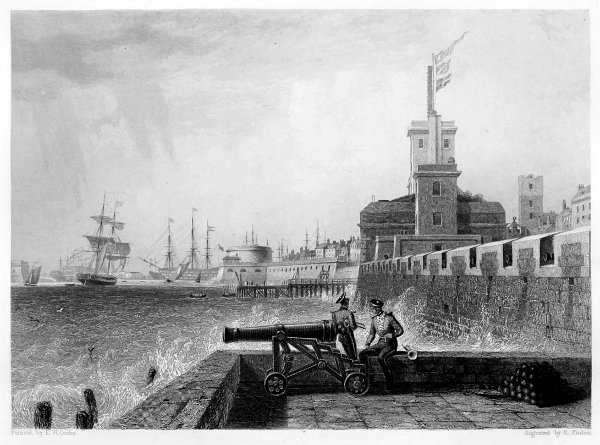
VIEW FROM THE SALUTING PLATFORM, PORTSMOUTH.