VI HUMAN HISTORY
Reading edition
1. As a further preliminary to the separate inquiries into the two parts of the problem, we have to sketch the main outlines of history in its broadest aspect. The facts will in themselves form an important element in the subject-matter when we come in the second part of the book to discuss the qualitative problem. They also form, as explained in the third chapter, a framework into which such knowledge as we have of primitive races may be fitted with all the necessary qualifications and safeguards. The procedure will be in the first place to glance at the main subdivisions of the sedimentary deposits, and to ask how far they can be dated. In this fashion alone can we arrive at any chronological basis with regard to human evolution. We have then to refer to the evolution of the Primate branch of the mammals to which man belongs, and afterwards to the evolution of the bodily form of man. As the fossils upon which the evidence is based are connected with certain geological strata, some vague indication of their date, or at least of their relative appearance in time, can be arrived at, in any case with regard to the later forms. We can then refer to the evidence of the cultural remains of man and correlate this evidence with that derived from the fossil remains. In this fashion some indication can be obtained of the evolution of culture and of the physical form of man anterior to the last three or four thousand years. For the last period written records are available, and supplement the evidence derived from cultural remains. Finally we have to discuss the manner in which we can use the evidence derived from primitive races to fill in the gaps in our knowledge.
2. The deposition of the sedimentary strata is usually divided into four main periods, each of which is subdivided into smaller eras. The following table shows the divisions most commonly adopted.
107
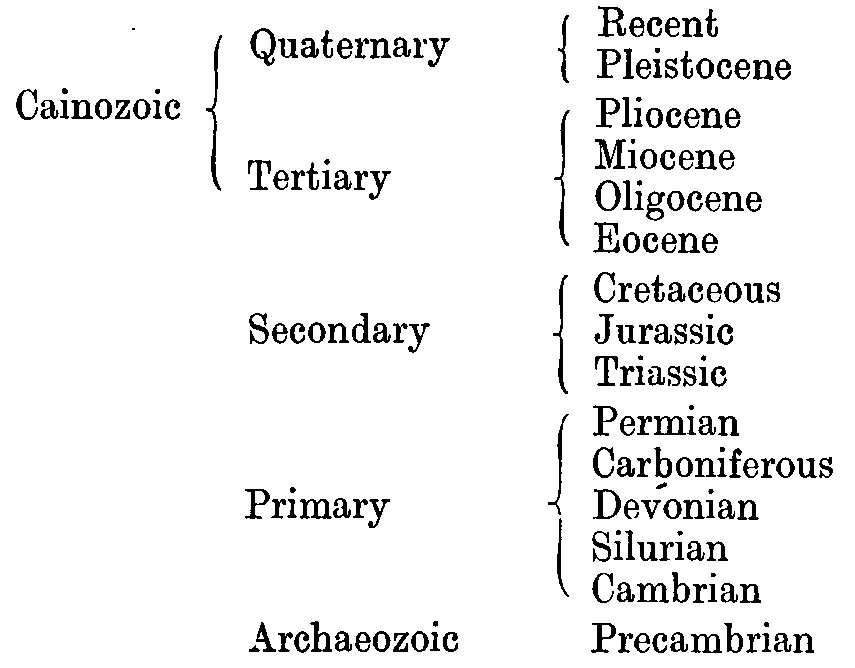
It is with the Cainozoic period that we are alone concerned, and chiefly with the Pleistocene and Recent subdivisions of that period. Before we consider the Quaternary epoch, one or two facts with regard to the dating of the other periods may be mentioned. However long it is supposed that the deposition of the sedimentary deposits has occupied, it is usually held that the Archaeozoic period occupied at least half of the whole length of time. This supposition is rendered necessary by the fact that already in the Cambrian era organisms of a high degree of complexity are found; thus in this era Crustaceans, Brachiopods, and Worms are common; Echinoderms, Coelenterates, and Sponges are also known. In the Silurian most of the classes of the animal kingdom are represented, the exceptions being amphibians, reptiles, birds, and mammals. The presence of fish shows that by this time vertebrates had already been evolved. Amphibians first appear in the Carboniferous and reptiles in the Permian. Birds first occur in the Upper Jurassic and mammals towards the close of the Triassic. The estimates as to the time occupied by the deposition of all these strata taken together vary very greatly—the average being about 100,000,000 years, though it should be mentioned that as long a period as 1,000,000,000 years has been proposed.[163] With regard to the length of time 108which it is supposed that the later subdivisions of the Cainozoic period have covered, it may be noticed that Penck estimates the length of the Pliocene and Miocene periods at about two and three million years respectively.
It is the dating of the subdivisions of the Pleistocene epoch that is of interest here. This era is also known as the glacial epoch. During this period large areas both in the northern and southern hemispheres were covered by the formation of glaciers or by the advance of previously-existing glaciers. It is now almost universally admitted that in Europe at least there were four separate advances of the ice. After reaching on each occasion a point of maximum extension, the ice retreated, and there were thus three inter-glacial or genial epochs, while the period since the fourth glaciation is known as the Recent period. The limit of the extension of the ice varied in each glaciation, and was at its maximum in the second glaciation. These separate glaciations and intervening genial periods serve to subdivide the Pleistocene era, and when fossil and cultural remains are discovered an attempt is made to ascertain in which of these subdivisions they occur.
Nothing more than guesses can be made as to the length of the glacial period as a whole and of the subdivisions, and these guesses differ very widely. Osborn gives the following list of estimates:[164]
1863. C. Lyell 800,000 years
1874. J. D. Dana 720,000 „
1893. C. D. Walcott 400,000 „
1893. W. Upham 100,000 „
1894. A. Heim 100,000 „
1900. W. J. Sollas 400,000 „
1909. A. Penck 520,000–800,000 years
1914. J. Geikie 620,000 (minimum) years
Osborn adopts the more conservative estimate of Penck for the duration of the whole period, and gives a subdivision of the period, which is as follows:[165]
109
Period. Relative Duration. Grand Totals.
Recent 25,000 25,000
Pleistocene Fourth Glacial 25,000 50,000
Third Genial 100,000 150,000
Third Glacial 25,000 175,000
Second Genial 200,000 375,000
Second Glacial 25,000 400,000
First Genial 75,000 475,000
First Glacial 25,000 500,000
3. With man are associated among mammals more or less closely five groups of animals—the Anthropoid apes, the Platyrrhini or Old World monkeys, the Catarrhini or New World monkeys, the Lemurs, and the Tarsii. It is clear that all these groups diverged from a common stem; the first divergence, however, must have occurred not later than the Eocene. To ascertain the interrelationship of these groups and the order of their divergence we have to rely chiefly upon the evidence provided by fossils. This evidence is very incomplete and, so far as the definitely pre-human ancestor is concerned, is lacking entirely until we come to a form known as Pithecanthropus, found in Java in a deposit attributed either to the late Pliocene or early Pleistocene. With regard to the evolution of the Primate stock it is usual to assume that the Lemurs[166] and the Tarsii branched off from the main stem very early, and that the Catarrhini followed by the Platyrrhini branched off in the Eocene. It is usual, therefore, to assume that in Oligocene times there was existing a Primate stock ancestral both to the anthropoid apes and to man. It is possible that Propliopithecus from the Fayum is a representative of this common stock from which the gibbons branched off in the Miocene in one direction, and the orang, chimpanzee, gorilla, and man in another. Man, it is imagined, branched off from this latter stock in the early Miocene and the orang shortly afterwards, the separation of the chimpanzee and gorilla occurring somewhat later. Various ancestral gibbons (Pliopithecus and Pliohylobates) and ancestral anthropoids (Dryopithecus, Neopithecus, and Palaeopithecus) are known from the Miocene and Pliocene, but nothing has come to light as yet of the distinctively pre-human stock in these times.
110Apart from the question as to how the distinctively human stock is related to the rest of the primate stock, there is much to be said for the view that the pre-human ancestor of Miocene times was a small arboreal primate which probably lived in a restricted area. But of the mode of life we have of course no direct knowledge. It is possible, however, that the mode of life of the anthropoid apes may give some indication of the conditions under which the pre-human ancestor lived. That they are all confined to warm climates in the Old World is suggestive when it is remembered that Pithecanthropus was found in Java. They are all more or less arboreal. The orang seldom comes to the ground; the chimpanzee, though more arboreal than the gorilla, is less so than the orang, while the gorilla is the least arboreal of all. The first two species construct nests in the trees, and the same is asserted of the gorilla, though this appears to be doubtful. They all adopt in varying degrees a semi-erect attitude from time to time. They exhibit a certain development of the social instinct; the gorilla is seen in bands, the gibbons congregate in the evening in groups. It seems certain that marriage in the sense in which Westermarck employs the term exists among them; it is asserted that they are all polygamous, though the chimpanzee may be monogamous. In any case they are not promiscuous in their sexual relations.
If a guess is to be made at all as to the mode of life of the pre-human ancestor, it is most reasonable to assume that it was something after the same kind. But whereas the apes are powerful specialized animals, the pre-human ancestor must have been a weaker and more generalized primate, having specialized only in the increase of the brain. It was this character which undoubtedly enabled him to maintain himself, and which compensated for the relative absence of other means of defence. The apes, on the other hand, are well able to look after themselves. ‘The orang, as Selenka informs us, is more than a match for the dangerous carnivora with which he has to contend, and the gorilla is monarch of the woods.’[167]
When we survey the Tertiary period as a whole we see that there was a rapid and varied evolution of the mammalian stock in Eocene and Oligocene times which culminated in the Miocene. 111All classes of mammals were in process of rapid evolution. After this epoch of evolution, specialization, and adaptation, the way was opened to the taking of the lead by a species which exceeded others rather in intelligence than in bodily superiority. The pre-human ancestor, we must suppose, had somewhat fallen behind in this contest to achieve adaptation by means of specialization, and could not then have taken a prominent place among mammalian species. Nevertheless, somehow he managed to maintain himself, and ultimately, as we shall point out later on, the retention of a generalized bodily form became of a very distinct advantage in that it enabled the best use to be made of his growing intellect.
4. The fossil remains of man from the Pleistocene are few and incomplete. It is a matter of great interest to observe in what subdivision of the Pleistocene these fossils occur, in which glacial or genial epoch, that is to say, they are found, as in this manner some indication can be gained, if not of their absolute, then of their relative, distance from the present epoch in time. As already mentioned, abundant evidence of human cultural remains are also found in the Pleistocene, and these remains likewise can be associated with the subdivisions of the period. Various names have been given to these cultural periods, and we shall glance later at the evidence upon which these periods are based. But it will be of assistance now to give a table showing how the cultural periods are connected with the subdivisions of the epoch, as it will thus be apparent how the fossil remains stand in relation not only to the glacial and genial periods, but also to the cultural periods.[168]
With regard to this table, except in respect to epochs of the later post-glacial period, the dates are only intended to give an idea of relative distance in time.[169] Some approximation to accuracy can be obtained for the Neolithic, Bronze, and Iron ages. In the case of the latter two epochs, different dates have been given for the beginning of the period in the Orient and in Europe. The remaining dates refer to Europe only. As many cultures, so far as can be deduced from the evidence, came from the Orient, the beginnings of such culture periods in the Orient are doubtless to be dated some considerable time before they first appeared in 112Europe. The names of the cultural periods, it may be remarked, are taken from the places where either specimens of the culture were first found, or where they are seen at their best. Thus Chellean is derived from Chelles—a palaeolithic station close to Paris—Acheulean from St. Acheul in the valley of the Somme, Mousterian from Le Moustier on the right bank of the Vézère, and so on.
Period. Date. Culture. Racial Type.
Post-Glacial 1,000 B.C. Iron Europe
1,800 „ Orient
2,000 „ Bronze Europe
4,000 „ Orient
5,000 „ Neolithic Copper
7,000 „ Swiss Lake Modern racial types.
10,000 „ Early
12,000 „ Upper Palaeolithic Azilian
16,000 „ Magdalenian Brünn and other races.
20,000 „ Solutrian
25,000 „ Aurignacian Cro-Magnon and Grimaldi.
Fourth Glacial 50,000 „ Middle Palaeolithic Mousterian H. neanderthalensis.
Third Genial 150,000 „ Lower Palaeolithic Acheulean
Chellean
Third Glacial 175,000 „ Pre-Chellean Eoanthropus.
Second Genial 375,000 „ H. heidelbergensis.
Second Glacial 400,000 „
First Genial 475,000 „
First Glacial 500,000 „
Beginning of Pleistocene 525,000 „ Pithecanthropus.
5. Turning to the fossil remains of man we have first to deal with Pithecanthropus. In September 1891 Dr. Eugene Dubois of Amsterdam discovered at Trinil in Java certain fossil remains; he continued to excavate for some two years, and succeeded in finding other remains, all of which he attributed to the same individual. To this individual he gave the name of Pithecanthropus erectus.[170] Dubois considered that the strata in which 113Pithecanthropus was found belonged to the Pliocene. Very great interest naturally attaches to this question; Dubois’s view has been challenged: subsequent visitors to Trinil have very carefully considered the matter, and the weight of scientific opinion now favours the attribution of the strata to the early Pleistocene.[171]
The scantiness of the remains renders a reconstruction of the individual a difficult and doubtful matter. Nevertheless, after some twenty years of discussion there is a very general agreement that Pithecanthropus was in many respects intermediate in type between modern man and the hypothetical pre-human ancestor. The bones of the cranium are fused, the brow ridges massive, and there is a marked narrowing behind the orbit—all ape-like features. Further the cranium is flattened somewhat as among the apes, but not to so great a degree; the altitudinal index is 34·2; of the average European it is 52; of Neanderthal man 40·4. The cranial capacity is about 855 c.c., or 250 c.c. greater than the largest known skull of any of the Simiidae, whereas the average cranial capacity of the Australian, the lowest living race, is about 1190 c.c. The femur has only a slight curvature, and is decidedly human, indicating that its possessor was some 1650–1700 mm. in height, and probably walked upright. The teeth are simian rather than human, the roots diverge and the crowns are large; they exhibit, nevertheless, certain human features.
If we attempt to reconstruct Pithecanthropus, we must picture a creature half ape, half man, which was probably terrestrial and erect. His body weight must have been about 70 kilograms. If this fact is correct, it provides a very useful method of estimating the relation of Pithecanthropus to the apes on one hand and to man on the other. We know roughly what proportion brain weight bears to body weight. If Pithecanthropus had been human—given the brain weight deduced from the cranial capacity—the body weight should be 19 kilograms. If Pithecanthropus had been simian, the body weight should be 230 kilograms. We have in fact reason to think that it was about 70 kilograms, 114which emphasizes the intermediate position of Dubois’s famous discovery.
It is further probable that Pithecanthropus had free use of the arms, the legs having become specialized for progression. It is quite possible that he may have employed tools of wood or of stone, though there is no evidence to this effect. It is further possible that some rudimentary form of speech may have been employed. The motor centre for speech is found in a particular area of the brain known as Broca’s area. This area can be identified in the brain cast of Pithecanthropus, and it is stated to be twice as great as in the apes, but only half as large as in man. ‘The undeveloped forehead of Pithecanthropus and the diminutive frontal area of the brain indicate that the Trinil race had a limited faculty of profiting by experience and accumulated tradition, for in this prefrontal area of the brain are located the powers of attention and of control of the activities of all other parts of the brain. In the brain of the ape the sensory areas of touch, taste, and vision predominate, and these are well developed in Pithecanthropus. The central area of the brain, which is the storehouse of the memory of action and the feelings associated with them, is also well developed, but the prefrontal area, which is the seat of the faculty of profiting by experience or of recalling the consequences of previous responses to experience, is developed to a very limited degree.’[172]
Pithecanthropus is thus a form of the highest interest in the history of man. Provisionally, it may be put at the dawn of the Pleistocene. Uncertainty also surrounds the position of the next human remains to be mentioned, which consist of a lower jaw from the Mauer Sands near Heidelberg.[173] It is generally agreed that these sands were deposited in a genial epoch, and opinion now inclines to associate them with the second genial epoch. The jaw itself is very simian, scarcely showing any approach to human characters. The teeth, however, are remarkably human, and it is said that in some respects the teeth of existing primitive races approach the simian condition more nearly than do the teeth of the Heidelberg race. The relation of this form to Pithecanthropus and to those which follow may be left for consideration until we have completed our sketch of human fossil types.
115There remains a third early form to be mentioned—Eoanthropus dawsoni from Piltdown near Lewis.[174] The gravel in which Eoanthropus was found was certainly deposited in a warm period. It probably dates from either the second or the third genial epoch, but great uncertainty attaches to the correlation of these gravels with the phases of the glacial period. Some implements found near the bones have been referred to the pre-Chellean culture period, which would indicate the third genial epoch. The mammalian fauna seems also to favour the reference of these strata to the same period.
The remains of Eoanthropus consist of the greater part of the brain case and part of the right mandible with the first and second molars in situ. The canine tooth was found later. The skull has been reconstructed from several fragments. There has been much controversy as to the correct method of performing this reconstruction. The first estimate of the cranial capacity put it at about 1,100 c.c. Woodward has later revised his estimate, and arrived at a figure approaching 1,300 c.c. Keith has suggested a higher figure. The bones of the skull are very thick, brow ridges are almost absent, and the forehead is very steep. The jaw, on the other hand, is even more ape-like than the jaw of Heidelberg man; it slopes away with scarcely any vestige of a chin, the pre-molar series of teeth is parallel, and the molars do not decrease in size backwards. It is owing to the simian features of the jaw that the authors felt justified in creating a new species for these remains. Although the absence of brow ridges and the presence of a steep forehead are characters which mark the higher human types, they are also found among all young apes. It is thus possible that Eoanthropus may represent in the general form of the skull the missing Miocene and Pliocene ancestor more nearly than Pithecanthropus. The brain, though very primitive, was decidedly human; there was a moderate development of those areas connected with speech.
6. It is a matter of doubt to what subdivisions of the Pleistocene the types hitherto mentioned should be assigned and with what cultures, if any, they should be connected. At this point we come to a region of less uncertainty. Associated with Mousterian implements and with the deposits of the fourth glacial period we find a distinct type of man whom we may call Mousterian or 116Neanderthal; for it was in the Neanderthal near Düsseldorf that the first specimen of this race was discovered in 1856.[175] Since that date several other examples of this type have been found. Some of the specimens have been preserved almost complete, and Professor Boule has been able to make a detailed study of the skeleton from La Chapelle-aux-Saints.[176] In the course of his memoir he institutes a comparison between this and other examples of Neanderthal man, and shows that they all agree in the possession of certain features of importance. Neanderthal man was small but massive; the facial portion of the head was much developed in comparison with the cranial; the head was low and narrow, the forehead receding, the occiput protruding, the orbits large, and the brow ridges heavy. The lower jaw was strong, the chin rudimentary, and the hinder molar teeth primitive. The vertebral column indicates a less upright posture than that of modern man. With regard to one feature—the cranial capacity—there is great variability. The cranial capacity of the Gibraltar skull is only 1,296 c.c., whilst that of the Chapelle-aux-Saints specimen is 1,620 c.c. According to Boule, however, this variation is no greater than that found among modern European skulls. He makes out the average capacity of Neanderthal man as 1,400 c.c.; this estimate is far lower than that usually given; it is often said that the average capacity approaches 1,600 c.c.
The Neanderthal race forms a very distinct type. It is found only in the Middle Palaeolithic period.[177] Of its origin there will be something to be said later; it appears that it died out before the Upper Palaeolithic age began, for, as we shall see, apparently none of the types which occurs later descended from this race.
7. The Upper Palaeolithic culture is associated with the end of the fourth glacial epoch. In place of the remains of Neanderthal man we find the remains of several types, none of which shows any affinity to Neanderthal man. On the contrary they all approximate more or less closely to modern man. At one bound we seem, when looking at the fossil remains from this epoch in 117Europe, to have passed into the modern period so far as human bodily form is concerned. As we shall see later, it is probable that the various types entered Europe from the East, and probably originated somewhere in Western Asia. The most important of these types is known as Cro-Magnon man. It is found throughout the Late Palaeolithic period. The first specimen was found at Cro-Magnon in the valley of the Vézère. Other specimens have been found in the Grotte de Grimaldi and assigned to the beginning of the Aurignacian, the first subdivision of the Upper Palaeolithic, and others again at Obercassel, and assigned to the Magdalenian, or last subdivision of the Upper Palaeolithic. In modern France in the region of Périgueux there is existing at the present day a type which in so many features resembles Cro-Magnon man that it may be a survival from Upper Palaeolithic times.
The general features of the chief types of the Upper Palaeolithic may be very briefly indicated. The skull of Cro-Magnon man was narrow, the face low and broad; the brow ridges project slightly; the orbits are low and rectangular; the nose is long and narrow and the root broad. Cro-Magnon man was tall, approaching an average of 6 ft. in height; the cranial capacity was large, being somewhere about 1,600 c.c.[178]
In the Grotte de Grimaldi were also found two skeletons of what has been called the Grimaldi race. No other skeletons of this type have been found in Europe. There are two points to notice about this type; first it is not relatively speaking a low type; the cranial capacity was, for instance, 1,580 c.c.; secondly, it shows undoubted resemblance to the Negroid type. The skull is narrow, the face large and low, and prognathism is marked. The orbits are large and of low vertical height, the nose broad and flat.
The third type is that found at Brünn and again at Brux in connexion with Solutrian culture (middle of Upper Palaeolithic). The skull is very long and generally of a lower type than the Cro-Magnon skull. In certain respects there is a slight resemblance 118to the Neanderthal type. Finally from deposits at the close of the late Palaeolithic period at Offnet two further types are known. One of them is a long-headed race not unlike the Mediterranean type of European at the present day. The other is a broad-headed race, which is not unlike the Alpine type of modern European.
In a general sketch further details need not be added. There is no essential difference between the physical type existing in Neolithic times and that of modern man. Leaving the discussion of the interrelationship and origin of these types until after we have spoken of the evolution of culture, what we have found so far is that in the beginning of the Pleistocene and in the early Palaeolithic there are three primitive types of man known, and that in the Middle Palaeolithic there is a peculiar type with many primitive features, whereas in the Upper Palaeolithic we are in the presence of types which for the most part differ but little from modern races, and even show affinity to certain modern races in particular cases.[179]
8. We have now to give some account of the evolution of culture as shown by the implements and other remains left by primitive man. The story of the first identification of stone implements by Boucher de Perthes is well known. Gradually a succession of periods has been recognized, and the names given to them have already been introduced in the preceding pages. Of the two main periods—Palaeolithic and Neolithic—the first is distinguished by the facts that stone implements were not polished, agriculture was not practised, pottery was not made,[180] and animals were not domesticated. Within the Palaeolithic period several successive types of culture can be distinguished, but before we deal with them something must be said regarding the so-called Eolithic period.
There are found in many places stones supposed to exhibit a very primitive form of human workmanship. To them the name of eoliths has been given. They have been described from the
119Oligocene, Miocene, and Pliocene. Many archaeologists believe that they are the remains of a primitive form of culture which preceded the Palaeolithic form of culture. The matter is still under debate.
We may note that eoliths exhibit very little variation. The same types appear from the Oligocene onwards, and if there was an eolithic culture it must have lasted some millions of years and been accompanied by little or no progress in the fashioning of implements. An exception must be made in the case of the so-called ‘rostro-carinate’ implements described by Mr. Reid Moir, and attributed to the late Pliocene.[181] These stones are of a distinctive type, and apparently do not occur in the Oligocene and the Miocene.[182] There are several considerations which make it difficult to accept eoliths as genuine remains of an early culture; some of these considerations do not apply to the rostro-carinate type, and some apply with less force, (a) Breuil has pointed out that as good eoliths occur in the Eocene as in the later strata.[183] Apart from this, the occurrence of eoliths in the Oligocene, taken together with the immense length of the period during which no progress in skill was made, is almost incompatible with what we must suppose to have been the course of human evolution. The various classes of mammals were in rapid evolution at this time, and it is difficult to understand how, before this period of mammalian expansion, man alone could have evolved to something akin to the type of the early Pleistocene, and then for so long a period have failed to progress.[184] If indeed Propliopithecus, 120or any similar form in the Oligocene, is a type from or near the line of human ascent, then we cannot allow Oligocene eoliths to be genuine artefacts, and there is no reason why, if we reject Oligocene eoliths, we should consider Miocene or Pliocene eoliths to be genuine. (b) Numerous observations have been made showing that stones similar to eoliths are formed under natural conditions of pressure, wave action, and so on. It is of particular interest to note that even the rostro-carinate type can be thus formed.[185] (c) Upon the whole eoliths are only found where other stones of the same composition are found, whereas palaeoliths may be found anywhere—the deduction, of course, being that eoliths, inasmuch as they are formed under natural agencies, remain associated with other stones of the same composition whereas palaeoliths were widely distributed by those who used them. The question of eoliths is very far from being settled. Lest it be thought that the difficulties in the way of accepting eoliths as genuine have been exaggerated owing to some bias, it may be mentioned that the chief deduction we shall draw from human history as a whole would be considerably strengthened if eoliths could be regarded as genuine artefacts. If we cannot accept eoliths as without question genuine, it does not mean that before the Palaeolithic period man did not make and use stone implements. Undoubtedly he did so. But it may be from the nature of the case that it is impossible to recognize these instruments.[186]
9. In a warm period of the Pleistocene, now almost universally identified with the third genial epoch, occur the first implements 121of undoubted human workmanship. Within this early Palaeolithic epoch three phases of culture are distinguished, the pre-Chellean, Chellean, and Acheulean. It is worth while observing that M. Rutot, who is a foremost supporter of the eolithic theory, remarks, on arriving in a general review of the evidence at this pre-Chellean period, that there can be observed the ‘apparition subite d’objets nouveaux’.[187] It is precisely these ‘objets nouveaux’ which many authorities consider as the first genuine artefacts, and not as mere improvements of a more primitive type of implement.
The typical instrument of the Chellean period was the hand axe—a stone shaped to fit the hand, and used for striking blows.[188] Knives and scrapers were also common. In the Acheulean or latest period of the Palaeolithic there is seen a general improvement in workmanship. The hand axe is lighter and more carefully worked. There is a great variety of small implements, often showing a considerable degree of care and skill. For the first time there is in the Acheulean era evidence that man employed fire. It does not appear that bone was yet used for making implements. It can be shown that early Palaeolithic implements represent a steady and continual advance in skill with the improvement of old types and the development of new types.
During the late Acheulean period it was becoming colder, and the succeeding stage, or Middle Palaeolithic era, falls almost wholly within the fourth glacial period. Man began to make his home in caves, and we are well acquainted with the physical type under the name of Neanderthal man, described above. There are again traces of fire. Some kind of ceremonial burial was employed. A skeleton found at La Chapelle-aux-Saints showed that the body had been carefully disposed for burial; implements had been placed close to the body, one fine implement lying within reach of the left hand. There is a marked difference as regards the stone implements between this and the preceding period. A different method of shaping implements was employed. There is some inclination to regard the Mousterian stone industry as of a lower grade than the stage previously attained. With regard to this stage in general we may note that it is the first in 122which we have a detailed knowledge of the physical type and in which we have some indication of the stage of psychical development as shown by the employment of ceremonial burial.
This stage is sharply divided from that which follows it. So far as is known, Neanderthal man disappears at the end of the Middle Palaeolithic, and Mousterian industry is replaced by the Aurignacian, a wholly new type of culture, presumably introduced by some new racial element. As we have seen, there are several racial types in the Upper Palaeolithic, and the Cro-Magnon type, which occurs from the beginning of this period, may have brought the new culture into Europe. The art of stone implement making reached a height during the Aurignacian never previously approached; knives and scrapers were especially finely shaped. In the Solutrian, or middle period of the Upper Palaeolithic, stone implement making reached the highest point to which it attained in the Palaeolithic period. The workmanship exhibited in the well-known willow and laurel leaf lance-heads is very fine. Bone tools are first found in the Upper Palaeolithic. It is clear from the disposition of the skeletons that burials were again employed, and indicate, if not a belief in a future life in our meaning of the phrase, at least the presence of a body of tradition regarding the state of the deceased. It is not certain whether man at this stage possessed the bow and arrow. Nothing can, of course, be known with certainty regarding the degree to which perishable substances were manufactured; it can only be said that in all probability skins and furs were used as clothing, that basketwork was understood, and nets constructed. The most remarkable remains which have been preserved from this period are the drawings and paintings on the walls of caverns. They are found throughout the Upper Palaeolithic period, and indicate a high degree of skill and taste.[189]
That the Solutrian Age shows an improvement upon the Aurignacian from the point of view of stone implement making has been indicated. It also shows a similar improvement as regards bone implements; bone needles with perforated eyes, for instance, occur for the first time. There is a distinct improvement in the drawings and paintings. In the next or Magdalenian period of 123the Upper Palaeolithic there is a loss of skill so far as stone implements are concerned; there is no general decadence, however, as the making of implements from bone, horn, and ivory shows a considerable advance. Further, drawing and painting reached their highest development. The remains from this era are very abundant and well known, and exhibit a vast number of types of implements giving a general impression of a considerable degree of material wealth relatively to the fact that agriculture was not practised.
At the very end of the Upper Palaeolithic the Magdalenian culture is succeeded by a rather obscure stage known as the Azilian-Tardenoisian. There is again a sudden and very distinct break in the evolution of culture. In nearly all respects there is a failure to reach the previous level of skill. Both flint and bone implements are of inferior workmanship. The artistic spirit vanishes. Little is known about this culture; possibly man at this period was not so unskilled, as at first sight seems to have been the case, for he had apparently domesticated the dog.[190]
10. Neolithic culture is marked by the practice of agriculture, the domestication of animals,[191] the polishing of stone implements, and the making of pottery.[192] Though it is strongly contrasted with the preceding culture, there is considerable evidence of a transition period. This evidence, however, is generally interpreted as indicating the infiltration of the new culture from the East, and not the evolution of the new culture in Europe. Even at this relatively recent period in history the chronology is vague. The Swiss Lake Dwellings (Robehausian period) represent the typical fully developed European Neolithic culture, and are dated about 8000 to 7000 B.C. Farther East there is evidence of a far greater antiquity. Montelius on the basis of De Morgan’s 124observations at Susa calculated that the Neolithic Age began there about 20,000 years ago.[193] Sir Arthur Evans estimates that at least 14,000 years have elapsed since the beginning of the Neolithic period at Cnossus.[194] All that can be said is that the Neolithic culture was flourishing in the eighth millennium B. C. in many parts of Europe, having been brought from farther East, where it had originated at a considerably earlier date. It has proved very difficult to subdivide the Neolithic epoch into successive periods. In the Palaeolithic period superimposed deposits containing relics of various cultures are not infrequently found, thus enabling the succession of culture periods to be made out. In the Neolithic period evidence of this kind is for the most part lacking. It is not proposed to enter upon the subject here beyond saying that three stages are recognized by French archaeologists, the Campignienne, the Chasséo-Robenhaussienne, and the Carnacéenne. The first of these stages is markedly more primitive than the succeeding stages. The second is that of the Swiss Lake Dwellings, and the third that of Megalithic monuments—Dolmens, Menhirs, Cromlechs, Allées Couvertes, stone circles, and so on.[195]
What has been said regarding culture periods in general—namely, that they are not definite periods in time in the history of mankind as a whole, but epochs through which different races have passed at different times—is well illustrated in the case of the Neolithic. The Neolithic culture had existed some thousands of years in Western Asia before it penetrated into Europe, and was practised in some parts of Europe, in Britain, for instance, up to about 2000 B. C. or later, for thousands of years after metals had been taken into use elsewhere. In general the Neolithic period has to be regarded as a period of great advance in material wealth. Relatively to Palaeolithic men, Neolithic men were rich, and often lived in villages of some size. Several animals were domesticated, several varieties of cereals cultivated, linen was manufactured, and the vine as well as a large number of fruit-trees known. It appears that many at least of the well-known trading routes used in the Bronze Age were open in the Neolithic Age. Some of these routes brought the Baltic into communication with the Mediterranean, one began at Venice, passed over the 125Brenner, and reached the Danube by means of the Inn; thence it traversed the Bohemian forest to the Moldau, and thus reached the Elbe, which was followed to its mouth. Another began at Trieste, and passing through Laibach and Grätz reached the Danube by means of the Leitha; thence it followed the March, traversed Moravia, passed through Silesia along the Oder, while the Vistula was reached by striking across Posen, the principal terminus being Danzig.[196]
11. Obscurity surrounds the location and date of the first use of metal.[197] Gold was probably the first metal known to man; it is found in the pure state in many countries, and would attract attention owing to its lustre. It was not, however, of economic importance until much later. In all probability man learnt the art of metal working from the accidental reduction of ore that formed one of the ring of stones round the camp fire. Copper may have been first used where it appears at the surface in a pure state, having been beaten into implements, as was done by the Indians near Lake Superior; the use of this metal is, however, until heat is employed, to be regarded merely as a variation of the art of stone implement making, and does not form the first step in the art of metal working for which knowledge of reduction by heat is required. It is frequently said that an age of copper preceded the age of bronze, and in many places copper implements were used before bronze implements. Probably the occurrence of a Copper Age in any one place was dependent upon the nature of the ore found there. Copper is frequently associated with tin and other metals in a state of nature. We may suppose that the first metal workers were simply trying to get metal—being aware that metal could be obtained by heating certain kinds of stone—and that in some places they got copper and in other places bronze. Later they learnt to add a definite percentage of tin or some other metal, and thus to produce an alloy of definite composition. Thus a true Bronze Age followed either a Copper Age or an accidental Bronze Age. It is somewhat curious that iron was not taken sooner into use, for less heat is required than in the case of copper for reduction—700° C. to 800° C. as against 1,100° C.
126Whether there was more than one place of origin of the use of any metal in the Old World is not known. Copper was independently taken into use in the New World, and the use of copper may have originated independently in North and South America.[198] Bronze was known in Peru. Heat was certainly employed for hammering and annealing copper, and casting may have been employed. Iron was sometimes used in North America to make ornaments. With regard to the Old World a claim is made for many countries as the original home of metal working. Reisner found copper daggers, spear heads, harpoons, pins, needles, and bracelets in the graves of the middle pre-Dynastic period of Egypt; by the time of the first dynasty the Egyptians were ‘in possession of a full equipment of copper weapons’.[199] In the early pre-Dynastic period metallic pigments containing copper were in use, and it is possible that the reduction of copper may have been first suggested by some accidental fusion of these substances. It is further claimed that there is evidence of the local evolution of copper implements since the earliest forms imitate stone implements, and the later forms are merely improvements of pre-existing types.[200] Reisner concludes that there is no reason to assume that the invention came from beyond the frontiers of Egypt.[201] The Sumerians, on the other hand, when we first meet them at a very early date, must have been using copper for some considerable time. All that can be said with certainty is that the use of metals originated in the Orient, probably before 4000 B. C.—possibly some two or three thousand years earlier. Copper, it may be noticed, occurs in Armenia, in the upper basin of the Tigris and in Sinai amongst other places. The use of bronze gradually spread over Europe. It is found in Crete about 3000 B. C., in Southern Thessaly about 2500 B. C., and seems to have reached England about 2000 B. C. or somewhat later. Generally speaking, we can connect the taking into use of metals with the rise of the first civilizations. These civilizations reached their greatest development before the introduction of iron. The whole Minoan civilization, the Mycenean survival of Minoan civilization on the mainland,[202] the most glorious period of Egyptian history up to 127and including the greater part of the Second Empire, the Sumerian kingdom, the earlier periods of Babylonia and Assyria, all fall within the Bronze Age.
Though it is clear that a great advance took place in the Bronze Age, it is not evident how far this advance is attributable to the taking of metals into use and how far to other discoveries which were made about the same time. The first use of the wheel and of the plough, for instance, dates from this period, and very considerable importance without question is attributable to the plough. Still greater importance is in all probability to be attributed to writing, which again was first used about this time. At a far earlier period various methods of marking sticks had doubtless been employed as aids to memory, as they are still employed by the Australians, and some progress may have been made towards such a system as that of the use of knotted cords in Peru. But the invention of writing properly speaking came much later. By the time of the fourth dynasty Egyptian writing had reached its final form, and the Sumerians, when we first meet them, were using cuneiform writing. This invention of such great import, whether it arose independently or not in Egypt, Mesopotamia, and China, was evidently roughly coincident with the first use of metals.
Estimates as to the date of the first use of iron in the Mesopotamian region vary considerably; 1500 B. C. to 1300 B. C. is the date most usually given. In Egypt the earliest known iron weapon dates from 1200 B. C. By 900 B. C. the use of iron had spread over most of Europe. It reached Scandinavia about 500 B. C. It was introduced into Greece by the Thresprotian invasion, which put an end to the Mycenean period, and inaugurated the Homeric Age. It is possible that the Etruscans brought the knowledge of iron to Italy where they arrived during the eleventh century B. C. Upon the whole, opinion inclines to the view that the use of iron originated in Western Asia. Claims have also been made for Europe (neighbourhood of Hallstatt) as the place of origin,[203] for Egypt, and for Africa south of Egypt.[204] With regard to Egyptian claims it may be noticed that iron does not become common until after 1200 B. C. But four examples of iron have been found in Egypt from periods before this date—some 128of them belonging to very early times. The finding of these pieces of iron presents a rather difficult problem, of which the solution seems to be that iron was very occasionally used, and probably only for ornamental purposes, long before 1200 B. C. in Egypt; it was not, however, brought into general use at this early date.
It is not necessary to carry this sketch of cultural evolution any farther. The Bronze Age marks a turning-point in history. The outline at least of the subsequent course of events is sufficiently familiar. One point may be noticed. We have found reason to place the centre of progress somewhere in the Orient. After metal has been taken into use the centre of progress begins to shift westwards. Once metals had been introduced into Crete, for instance, Minoan civilization was in any case largely an autochthonous growth. Speaking of Crete, Hall says: ‘We have nothing to show any intrusion of any other culture system which in any way suddenly modifies or alters the course of this development, which is that of the civilization of a single people raising itself on its own lines from Neolithic barbarism. Its first development from the static condition in which it had existed for many centuries in the Neolithic stage was sudden, and the dynamic influence which was given by the acquisition of metal speedily carried it to the great height of cultivation which we have seen.’[205] Hitherto—before, that is to say, the taking into use of metal—the centre of progress has been looked for in Central Asia.[206] There had been progress in Europe within the culture periods, but the great steps in progress were made in the East.
12. Let us now review what has so far been said in this chapter. Such indications as the evidence provides point to the origin of man in the eastern portion of the Old World, and probably in a warm climate. The principal facts in favour of this view are the distribution of the anthropoids, the occurrence of Pithecanthropus in Java, and the failure to find any evidence of the antiquity of man in the New World.[207] Unless Pithecanthropus is to be 129attributed to the Pliocene, we have no knowledge of man before the Pleistocene. It would seem that the pre-human ancestor of the Miocene and Pliocene was probably rather an obscure member of the primate stock retaining generalized features. Somehow without specialization he managed to survive—possibly in some very limited area. When the rapid evolution of bodily form among the mammals had slowed down, the only specialization in which the pre-human ancestor had indulged began to stand him in good stead. That it carried him as far as it did—to the dominion over all living things—was made possible by the fact that his bodily form was not specialized, but was capable of being turned into an instrument of the mind. The evidence seems to indicate the late Pliocene or early Pleistocene as the era when man began to develop along this path.
Just as the East was probably the place of man’s origin, so it remained the seat of both bodily and cultural evolution. There is no sign of the evolution of human physical form in Europe, nor is there any evidence of the evolution of the main stages of culture in Europe until after the taking of metals into use, though there is evidence both of progress and of decay within the culture periods. The evidence points to the conclusion that successive waves of immigrants brought with them new cultures from the East. Some may have entered Europe from Africa, as perhaps did the Cro-Magnons, bringing the Aurignacian culture. These waves of migration are not, however, to be regarded as comparable to migrations within the historical period—the Islamic migrations of the Arabs, for instance. These earlier movements were rather of the nature of slow driftings of peoples. They may have been connected with climatic changes and have occupied long periods of time. Quite possibly when we appear to see the extinction of one culture and the sudden replacement of it by another, what in fact happened was that, owing to climatic changes, those who practised the earlier culture had shifted elsewhere before the newcomers occupied the area in question.
With regard to the bodily evolution of man the first detailed knowledge we have is of the Neanderthal race. We know that Neanderthal man lived in the fourth glacial period. Before this epoch we know nothing of human bodily evolution except from three imperfect specimens which we cannot assign definitely to 130any period in the Pleistocene beyond placing them before the Middle Palaeolithic. No definite conclusions can be drawn as to the relation of these three forms one to another, or to the forms which follow.
Pithecanthropus may or may not be on the direct line leading to all the higher races. There is some probability that Heidelberg man is a forerunner of Neanderthal man, whereas Eoanthropus would seem to be related on the one hand to the hypothetical Pliocene ancestor, and on the other hand to the Late and not to the Middle Palaeolithic races. It is quite possible that, as Europe was not the scene of human evolution, Piltdown and Heidelberg men represent varieties which have died out, and not stages from the main line of human evolution. This is certainly the case with the Neanderthal race. In the Upper Palaeolithic we find races of as high a physical type as those of the present day, but we have no certain knowledge of their direct ancestors.
By far the most remarkable feature of the whole process has been the speeding up of the rate of progress of the evolution of culture. This speeding up would be very much emphasized if we could accept eoliths as genuine, as indicating, that is to say, the existence of an eolithic culture before the Palaeolithic culture extending over an immense period of time. As it is, the acceleration of the rate of progress is striking enough. The whole Palaeolithic period probably lasted at least 100,000 years. Regarding this period as a whole, we can observe a noteworthy speeding up of progress in the last part of the period. A few thousand years only separate the early from the late divisions of the Upper Palaeolithic and the progress exhibited is very considerable, whereas but relatively little progress is visible during the huge length of time which the Lower Palaeolithic must have occupied. The whole progress made, however, up to the opening of the Bronze Age is insignificant compared with that made since. Nevertheless, progress has not been uniform within the historical era. There have been periods of stagnation and even of decadence. Little progress in command over nature was made between the time of the later Egyptian civilization and the later Middle Ages as compared with the progress made in the last hundred years. Progress in skill gathered speed in the thirteenth century, and the speeding up became very marked in the eighteenth century. There has been a similar lack of uniformity in the evolution of 131culture where culture is judged by standards other than command over nature.
13. How far can we employ our knowledge of primitive races to fill in this framework? Some reference has been made in the fourth chapter to the position which these races occupy. It was pointed out that they represent ‘relicts’ of stages of culture through which the civilized races have passed, due allowance being made for the fact that they have developed to some degree on specialized lines of their own since their separation from the main stream of progress. In some few cases, as in the example of the Seri Indians, there may have been decadence.
Broadly speaking, these races fall into two groups. There are the hunting and fishing races, and there are those which practise a primitive form of agriculture. The former, it is to be presumed, ceased to be in any important manner influenced by, if they were not wholly cut off from, the main current of cultural evolution before the end of the Palaeolithic Age. The latter may have remained more or less in contact with the main stream of evolution until late Neolithic times, or they may have lost touch earlier and have acquired independently the art of agriculture, as was presumably the case with those American Indians who practise agriculture. The chief hunting and fishing races are the Tasmanians, Australians, Bushmen, Eskimos, and certain of the American Indians. Professor Sollas has drawn up a comparison between the culture of some of these races and that of certain epochs in the Palaeolithic era. He has shown that Tasmanian and Australian culture may be compared with early and late phases respectively of the Middle Palaeolithic. A very striking similarity indeed can be shown between the Aurignacian culture and that of the Bushmen on the one hand and between the Magdalenian culture and that of the Eskimo on the other. When we consider the osteological evidence, however, we do not find any striking similarity between Neanderthal man and Australians and Tasmanians. The existence of the negroid skeleton of Grimaldi is suggestive, but the likeness between it and the Bushmen type is not close. The skull found at Chancelade, however, and generally considered as an aberrant type of Cro-Magnon man does show a very curious resemblance to the Eskimo skull. Thus though we cannot think of the Tasmanians and Australians as actual relicts of the Neanderthal racial type, which we know in 132Europe, we may think of Australian culture in its broad general features as representative of the Middle Palaeolithic.[208]
As has been already indicated in the fourth chapter, it is not proposed to attempt to carry the method so far as to attribute to peoples of different Palaeolithic cultures peculiarities of certain primitive hunting and fishing races. All that it is proposed to do is to look into the general conditions which obtain among hunting and fishing races with the object of throwing light upon the conditions in the Palaeolithic era as a whole. Similarly it is proposed to throw light upon the Neolithic period by an inquiry into the conditions obtaining among primitive agricultural races. This method is clearly legitimate. It may nevertheless be said at once that as a matter of fact, so far as the most important conclusions are concerned, we shall find no reasons for thinking that hunting and fishing races differ from agricultural races. The legitimacy of the method is therefore not strictly relevant. It follows from this that the splitting up of the data and the consideration separately of hunting and of agricultural races is in reality only a matter of convenience.
14. Before we embark upon this attempt to throw light upon such general characteristics of prehistoric races as are relevant to our particular purpose, there is another point to be considered. One supposition regarding the mode of life of man in early days is that he lived in groups of polygamous families. As monogamy occurs among some of the lowest of existing primitive races, he may have been monogamous. In any case it seems that early man was not promiscuous in his sexual relations. Whatever his primitive mode of life may have been, man gradually rose to the recognition of common bonds and to the observation in common of certain rules and restrictions. Primitive social organization in fact gradually came into being, and this step, slowly and painfully achieved as it no doubt was, represents one of the most important steps ever achieved by man. Then for the first time he began to reap the benefits of co-operation. Clearly we must imagine a primitive form of social organization to have existed in the late Palaeolithic; the attainment to so relatively high 133a degree of skill and achievement is not otherwise comprehensible. The achievements of late Palaeolithic man indicate the presence of a considerable body of tradition, and the presence of tradition in any considerable amount indicates social organization. It is difficult to come to any conclusion with regard to early and Middle Palaeolithic times. The mode of life of Neanderthal man is perhaps apt to be considered as more primitive than was in fact the case, owing to the somewhat brutal form attributed to his bodily features. It has to be remembered that he practised ceremonial burial, and was acquainted with the use of fire—very significant facts which render it on the whole probable that social organization of a kind existed. Possibly we may have to suppose that social organization existed among lower Palaeolithic men. They too employed fire, and it may well be that their mode of life was not very different from that of the Tasmanians.
Among all primitive races we find a form of social organization, and unless it has been achieved more than once they are all ‘relicts’ of the periods succeeding that in which men wandered in family groups. In the first place, therefore, primitive races are only comparable with prehistoric races which have achieved this great step forward. They throw little or no light upon the conditions anterior to the taking of this step. Further, when we look into the life of these races, we find that the form of social organization is rigid. Men are bound hand and foot by custom.[209] It has been suggested that the peculiarly rigid nature of the social organization among these races—the fact that they are soaked in tradition—is due to their having been left out of the main stream of progress. It has been suggested in fact that, while other races have gone forward, they have more or less stagnated, and that—this is what is important—the relative stagnation has been the cause of the rigidness of the organization. It follows that, to the extent to which this is so, primitive races are not properly comparable with prehistoric races. But it may be doubted if the facts are altogether as sometimes alleged. Doubtless the earliest social organization was far less rigid than it afterwards became, and we must beware of attributing to those early races, which first became socially organized, the features characteristic of primitive races, at least in many aspects. But we must date back the origin of social organization in all probability 134nearer 100,000 than 50,000 years ago. In other words, later Palaeolithic races must have had some thousands of years of social organization behind them. Is then the peculiar rigidity of the organization of primitive races altogether to be regarded as an acquirement attained during the 15,000, 20,000, 30,000 years, or whatever the period may have been, since they have been out of the main stream of progress? It can scarcely be so. A hardening of the system may have taken place, but not to such an extent as to render it impossible to make comparisons between primitive races and prehistoric races, and, what concerns us, to render unacceptable the attribution to prehistoric races of those general conditions of life found among primitive races, which will form the subject-matter of the next two chapters.
135