Sonnets.
Reading edition
AUTUMN.
Thou comest, Autumn, heralded by the rain, With banners, by great gales incessant fanned, Brighter than brightest silks of Samarcand, And stately oxen harnessed to thy wain! Thou standest, like imperial Charlemagne,[45] Upon thy bridge of gold; thy royal hand Outstretched with benedictions o’er the land, Blessing the farms through all thy vast domain. Thy shield is the red harvest moon suspended So long beneath the heaven’s o’erhanging eaves; Thy steps are by the farmer’s prayers attended; Like flames upon an altar shine the sheaves; And, following thee, in thy ovation splendid, Thine almoner, the wind, scatters the golden leaves!
GIOTTO’S TOWER.
How many lives, made beautiful and sweet By self-devotion and by self-restraint, Whose pleasure is to run without complaint On unknown errands of the Paraclete, Wanting the reverence of unshodden feet, Fail of the nimbus which the artists paint Around the shining forehead of the saint, And are in their completeness incomplete! In the old Tuscan town stands Giotto’s tower, The lily of Florence blossoming in stone,— A vision, a delight, and a desire, The builder’s perfect and centennial flower, That in the night of ages bloomed alone, But wanting still the glory of the spire.
DANTE.
Tuscan, that wanderest through the realms of gloom, With thoughtful pace, and sad majestic eyes, Stern thoughts and awful from thy soul arise, Like Farinata from his fiery tomb. Thy sacred song is like the trump of doom; Yet in thy heart what human sympathies, What soft compassion glows, as in the skies The tender stars their clouded lamps relume! Methinks I see thee stand, with pallid cheeks, By Fra Hilario in his diocese, As up the convent-walls, in golden streaks, The ascending sunbeams mark the day’s decrease; And, as he asks what there the stranger seeks, Thy voice along the cloisters whispers, “Peace!”
TO-MORROW.
’Tis late at night, and in the realm of sleep My little lambs are folded like the flocks; From room to room I hear the wakeful clocks Challenge the passing hour, like guards that keep Their solitary watch on tower and steep; Far off I hear the crowing of the cocks, And through the opening door that time unlocks Feel the fresh breathing of To-morrow creep To-morrow! the mysterious, unknown guest, Who cries to me: “Remember Barmecide, And tremble to be happy with the rest.” And I make answer: “I am satisfied; I dare not ask; I know not what is best; God hath already said what shall betide.”
THE EVENING STAR.
Lo! in the painted oriel of the West, Whose panes the sunken sun incarnadines Like a fair lady at her casement shines The Evening Star, the star of love and rest! And then anon she doth herself divest Of all her radiant garments, and reclines Behind the sombre screen of yonder pines, With slumber and soft dreams of love oppressed. O my beloved, my sweet Hesperus! My morning and my evening star of love! My best and gentlest lady! even thus, As that fair planet in the sky above, Dost thou retire unto thy rest at night, And from thy darkened window fades the light.
DIVINA COMMEDIA.
I.
Oft have I seen at some cathedral door A labourer, pausing in the dust and heat, Lay down his burden, and with reverent feet Enter and cross himself, and on the floor Kneel to repeat his pater-noster o’er; Far off the noises of the world retreat, The loud vociferations of the street Become an undistinguishable roar. So, as I enter here from day to day, And leave my burden at this minster gate, Kneeling in prayer, and not ashamed to pray, The tumult of the time disconsolate To inarticulate murmurs dies away, While the eternal ages watch and wait.
II.
How strange the sculptures that adorn these towers! This crowd of statues, in whose folded sleeves Birds build their nests; while canopied with leaves Parvis and portal bloom like trellised bowers, And the vast minster seems a cross of flowers! But fiends and dragons on the gargoyled eaves Watch the dead Christ between the living thieves, And, underneath, the traitor Judas lowers! Ah! from what agonies of heart and brain, What exultations trampling on despair, What tenderness, what tears, what hate of wrong, What passionate outcry of a soul in pain, Uprose this poem of the earth and air, This mediæval miracle of song!
III.
I enter, and I see thee in the gloom Of the long aisles, O poet saturnine! And strive to make my steps keep pace with thine, The air is filled with some unknown perfume; The congregation of the dead make room For thee to pass; the votive tapers shine; Like rooks that haunt Ravenna’s groves of pine, The hovering echoes fly from tomb to tomb. From the confessionals I hear arise Rehearsals of forgotten tragedies, And lamentations from the crypts below; And then a voice celestial, that begins With the pathetic words, “Although your sins As scarlet be,” and ends with “as the snow.”
IV.
I lift mine eyes, and all the windows blaze With forms of saints and holy men who died, Here martyred and hereafter glorified; And the great Rose upon its leaves displays Christ’s Triumph, and the angelic roundelays With splendour upon splendour multiplied; And Beatrice again at Dante’s side No more rebukes, but smiles her words of praise. And then the organ sounds, and unseen choirs Sing the old Latin hymns of peace and love, And benedictions of the Holy Ghost; And the melodious bells among the spires O’er all the house-tops and through heaven above Proclaim the elevation of the Host!
V.
O star of morning and of liberty! O bringer of the light whose splendour shines Above the darkness of the Apennines, Forerunner of the day that is to be! The voices of the city and the sea, The voices of the mountains and the pines, Repeat thy song, till the familiar lines Are footpaths for the thought of Italy! Thy fame is blown abroad from all the heights, Through all the nations, and a sound is heard, As of a mighty wind, and men devout, Strangers of Rome, and the new proselytes, In their own language hear thy wondrous word, And many are amazed and many doubt.
ON MRS. KEMBLE’S READINGS FROM SHAKESPEARE.
O precious evenings! all too swiftly sped! Leaving us heirs to amplest heritages Of all the best thoughts of the greatest sages, And giving tongues unto the silent dead! How our hearts glowed and trembled as she read, Interpreting by tones the wondrous pages Of the great poet who foreruns the ages, Anticipating all that shall be said! O happy Reader! having for thy text The magic book, whose Sibylline leaves have caught The rarest essence of all human thought! O happy Poet! by no critic vexed! How must thy listening spirit now rejoice To be interpreted by such a voice!
NATURE.
As a fond mother when the day is o’er, Leads by the hand her little child to bed, Half willing, half reluctant to be led, And leave his broken playthings on the floor, Still gazing at them through the open door, Nor wholly reassured and comforted By promises of others in their stead, Which, though more splendid, may not please him more; So Nature deals with us, and takes away Our playthings one by one, and by the hand Leads us to rest so gently, that we go, Scarce knowing if we wished to go or stay, Being too full of sleep to understand How far the unknown transcends the what we know.
IN THE CHURCHYARD AT TARRYTOWN.
Here lies the gentle humourist, who died In the bright Indian summer of his fame! A simple stone, with but a date and name, Marks his secluded resting-place beside The river that he loved and glorified. Here in the autumn of his days he came, But the dry leaves of life were all aflame With tints that brightened and were multiplied. How sweet a life was his; how sweet a death! Living, to wing with mirth the weary hours, Or with romantic tales the heart to cheer; Dying, to leave a memory like the breath Of summers full of sunshine and of showers, A grief and gladness in the atmosphere.
ELIOT’S OAK.
Thou ancient oak! whose myriad leaves are loud With sounds of unintelligible speech, Sounds as of surges on a shingly beach, Or multitudinous murmurs of a crowd; With some mysterious gift of tongues endowed, Thou speakest a different dialect to each; To me a language that no man can teach, Of a lost race, long vanished like a cloud. For underneath thy shade, in days remote, Seated like Abraham at eventide Beneath the oaks of Mamre, the unknown Apostle of the Indians, Eliot, wrote His Bible in a language that hath died And is forgotten, save by thee alone.
THE DESCENT OF THE MUSES.
Nine sisters, beautiful in form and face, Came from their convent on the shining heights Of Pierus, the mountain of delights, To dwell among the people at its base. Then seemed the world to change. All time and space, Splendour of cloudless days and starry nights, And men and manners, and all sounds and sights, Had a new meaning, a diviner grace. Proud were these sisters, but were not too proud To teach in schools of little country towns Science and song, and all the arts that please; So that while housewives span, and farmers ploughed, Their comely daughters, clad in homespun gowns, Learned the sweet songs of the Pierides.
VENICE.
White swan of cities, slumbering in thy nest So wonderfully built among the reeds Of the lagoon, that fences thee and feeds, As sayeth thy old historian and thy guest! White water-lily, cradled and caressed By ocean streams, and from the silt and weeds Lifting thy golden filaments and seeds, Thy sun-illumined spires, thy crown and crest! White phantom city, whose untrodden streets Are rivers, and whose pavements are the shifting Shadows of palaces and strips of sky; I wait to see thee vanish like the fleets Seen in mirage, or towers of cloud uplifting In air their unsubstantial masonry.
THE TWO RIVERS.
I.
Slowly the hour-hand of the clock moves round; So slowly that no human eye hath power To see it move! Slowly in shine or shower The painted ship above it, homeward bound, Sails, but seems motionless, as if aground; Yet both arrive at last; and in his tower The slumbrous watchman wakes and strikes the hour, A mellow, measured, melancholy sound. Midnight! the outpost of advancing day! The frontier town and citadel of night! The watershed of Time, from which the streams Of Yesterday and To-morrow take their way, One to the land of promise and of light, One to the land of darkness and of dreams!
II.
O River of Yesterday, with current swift Through chasms descending, and soon lost to sight, I do not care to follow in thy flight The faded leaves, that on thy bosom drift! O River of To-morrow, I uplift Mine eyes, and thee I follow, as the night Wanes into morning, and the dawning light Broadens, and all the shadows fade and shift! I follow, follow, where thy waters run Through unfrequented, unfamiliar fields, Fragrant with flowers and musical with song; Still follow, follow; sure to meet the sun, And confident, that what the future yields Will be the right, unless myself be wrong.
III.
Yet not in vain, O River of Yesterday, Through chasms of darkness to the deep descending, I heard thee sobbing in the rain, and blending Thy voice with other voices far away. I called to thee, and yet thou wouldst not stay, But turbulent, and with thyself contending, And torrent-like thy force on pebbles spending, Thou wouldst not listen to a poet’s lay. Thoughts, like a loud and sudden rush of wings, Regrets and recollections of things past, With hints and prophecies of things to be, And inspirations, which, could they be things, And stay with us, and we could hold them fast, Were our good angels,—these I owe to thee.
IV.
And thou, O River of To-morrow, flowing Between thy narrow adamantine walls, But beautiful, and white with waterfalls, And wreaths of mist, like hands the pathway showing; I hear the trumpets of the morning blowing, I hear thy mighty voice, that calls and calls, And see, as Ossian saw in Morven’s halls, Mysterious phantoms, coming, beckoning, going! It is the mystery of the unknown That fascinates us; we are children still, Wayward and wistful; with one hand we cling To the familiar things we call our own, And with the other, resolute of will, Grope in the dark for what the day will bring.
CHAUCER.
An old man in a lodge within a park; The chamber walls depicted all around With portraitures of huntsman, hawk, and hound, And the hurt deer. He listeneth to the lark, Whose song comes with the sunshine through the dark Of painted glass in leaden lattice bound; He listeneth and he laugheth at the sound, Then writeth in a book like any clerk. He is the poet of the dawn, who wrote The Canterbury Tales, and his old age Made beautiful with song; and as I read I hear the crowing cock, I hear the note Of lark and linnet, and from every page Rise odours of ploughed field or flowery mead.
WOODSTOCK PARK.
Here in a little rustic hermitage Alfred the Saxon King, Alfred the Great, Postponed the cares of kingcraft to translate The Consolations of the Roman sage. Here Geoffrey Chaucer in his ripe old age Wrote the unrivalled Tales, which soon or late The venturous hand that strives to imitate Vanquished must fall on the unfinished page. Two kings were they, who ruled by right divine, And both supreme; one in the realm of Truth, One in the realm of Fiction and of Song. What prince hereditary of their line, Uprising in the strength and flush of youth, Their glory shall inherit and prolong?
ST. JOHN’S, CAMBRIDGE.
I stand beneath the tree, whose branches shade Thy western window, Chapel of St. John! And hear its leaves repeat thy benison On him, whose hand thy stones memorial laid; Then I remember one of whom was said In the world’s darkest hour, “Behold thy son!” And see him living still, and wandering on And waiting for the advent long delayed. Not only tongues of the apostles teach Lessons of love and light, but these expanding And sheltering boughs with all their leaves implore, And say in language clear as human speech, “The peace of God, that passeth understanding, Be and abide with you for evermore!”
BOSTON.
St. Botolph’s Town! Hither across the plains And fens of Lincolnshire, in garb austere, There came a Saxon monk, and founded here A Priory, pillaged by marauding Danes, So that thereof no vestige now remains; Only a name, that, spoken loud and clear, And echoed in another hemisphere, Survives the sculptured walls and painted panes. St. Botolph’s Town! Far over leagues of land And leagues of sea looks forth its noble tower, And far around the chiming bells are heard: So may that sacred name for ever stand A landmark, and a symbol of the power That lies concentred in a single word.
THE BURIAL OF THE POET.[46]
April 1879.
In the old churchyard of his native town, And in the ancestral tomb beside the wall, We laid him in the sleep that comes to all, And left him to his rest and his renown. The snow was falling, as if Heaven dropped down White flowers of Paradise to strew his pall;— The dead around him seemed to wake, and call His name, as worthy of so white a crown. And now the moon is shining on the scene, And the broad sheet of snow is written o’er With shadows cruciform of leafless trees, As once the winding-sheet of Saladin With chapters of the Koran; but ah! more Mysterious and triumphant signs are these.
THE THREE SILENCES OF MOLINOS.
TO JOHN GREENLEAF WHITTIER.
Three Silences there are; the first of speech, The second of desire, the third of thought; This is the lore a Spanish monk, distraught With dreams and visions, was the first to teach. These Silences, commingling each with each, Made up the perfect Silence that he sought And prayed for, and wherein at times he caught Mysterious sounds from realms beyond our reach. O thou, whose daily life anticipates The life to come, and in whose thought and word The spiritual world preponderates, Hermit of Amesbury! thou too hast heard Voices and melodies from beyond the gates, And speakest only when thy soul is stirred!
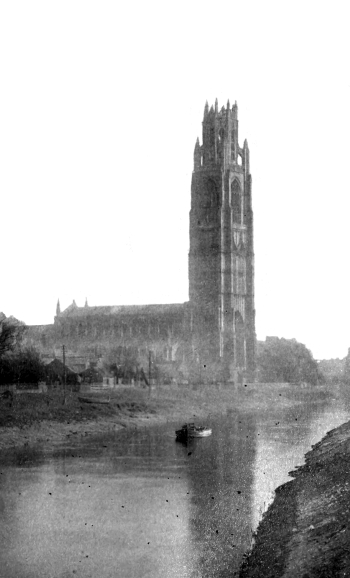
“St. Bodolph’s Town! Far over leagues of land And leagues of sea looks forth its noble tower, And far around the charming bells are heard.”
MY CATHEDRAL.
Like two cathedral towers these stately pines Uplift their fretted summits tipped with cones; The arch beneath them is not built with stones, Not Art but Nature traced these lovely lines, And carved this graceful arabesque of vines; No organ but the wind here sighs and moans, No sepulchre conceals a martyr’s bones, No marble bishop on his tomb reclines. Enter! the pavement carpeted with leaves Gives back a softened echo to thy tread! Listen! the choir is singing; all the birds, In leafy galleries beneath the eaves, Are singing! Listen ere the sound be fled, And learn there may be worship without words.
TO THE RIVER RHONE.
Thou Royal River, born of sun and shower In chambers purple with the Alpine glow, Wrapped in the spotless ermine of the snow, And rocked by tempests!—at the appointed hour Forth, like a steel-clad horseman from a tower, With clang and clink of harness dost thou go To meet thy vassal torrents, that below Rush to receive thee and obey thy power. And now thou movest in triumphal march, A king among the rivers! On thy way A hundred towns await and welcome thee; Bridges uplift for thee the stately arch, Vineyards encircle thee with garlands gay, And fleets attend thy progress to the sea!
WAPENTAKE.
To Alfred Tennyson.
Poet! I come to touch thy lance with mine; Not as a knight who on the listed field Of tourney touched his adversary’s shield In token of defiance, but in sign Of homage to the mastery, which is thine, In English song; nor will I keep concealed, And voiceless as a rivulet frost-congealed. My admiration for thy verse divine. Not of the howling dervishes of song, Who craze the brain with their delirious dance, Art thou, O sweet historian of the heart! Therefore to thee the laurel-leaves belong, To thee our love and our allegiance, For thy allegiance to the poet’s art.
THE BROKEN OAR.
Once upon Iceland’s solitary strand A poet wandered with his book and pen, Seeking some final word, some sweet Amen, Wherewith to close the volume in his hand. The billows rolled and plunged upon the sand, The circling sea-gulls swept beyond his ken, And from the parting cloud-rack now and then Flashed the red sunset over sea and land. Then by the billows at his feet was tossed A broken oar; and carved thereon he read, “Oft was I weary, when I toiled at thee;” And like a man who findeth what was lost, He wrote the words, then lifted up his head, And flung his useless pen into the sea.
AGASSIZ.
I stand again on the familiar shore, And hear the waves of the distracted sea Piteously calling and lamenting thee, And waiting restless at thy cottage door. The rocks, the sea-weed on the ocean floor, The willows in the meadow, and the free Wild winds of the Atlantic welcome me; Then why shouldst thou be dead and come no more! Ah! why shouldst thou be dead when common men Are busy with their trivial affairs, Having and holding? Why, when thou hadst read Nature’s mysterious manuscript, and then Wast ready to reveal the truth it bears, Why art thou silent? Why shouldst thou be dead?