MEMOIR.
Reading edition
Henry Wadsworth Longfellow was born at Portland, Maine, on the 27th of February, 1807. His father, Mr. Stephen Longfellow, a native of Gorham, Maine, then a District of Massachusetts, was a descendant of William Longfellow, of Newbury, in the same state, who was born in Yorkshire, England, in 1651, and emigrated to America in early youth. He married Miss Anne Sewell, and after a married life of fourteen years was drowned at Anticosti, a large desert island in the estuary of the St. Lawrence. Mr. Stephen Longfellow, a descendant in the fourth generation of this gentleman, was born in the year in which the colonies declared their independence of the mother country. He graduated at Harvard College in his twenty-second year, and devoted himself to the law, removing to Portland at the beginning of the present century. He was a good jurist, as the Massachusetts and Maine Reports testify, and was a member of the national Congress when it was an honour to belong to that body. He was also the president of the Maine Historical Society. He was the father of our poet, whose mother was a descendant of John Alden: who must have been a prolific old Puritan, for his descendants have produced two American poets, William Cullen Bryant and Henry Wadsworth Longfellow.
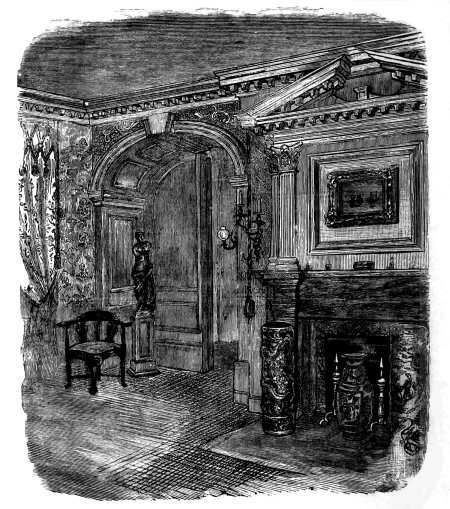
LONGFELLOW’S DRAWING-ROOM.
The first school the young poet attended was kept by a Mrs. Fellows, in a small house in Spring Street. Later he went to the town school, and soon after to the private school of Nathaniel H. Carter. Afterwards he attended the Portland Academy under the same master, and also under the mastership of Bezaleel Cushman. He entered Bowdoin College at the age of fourteen. It was a remarkable class in which he found himself for it contained, among other men who have arrived at eminence in literature, Nathaniel Hawthorne, George B. Cheever, and J. S. C. Abbott: and he must have distinguished himself, or he would not have received—as he did—the appointment of professor of modern languages and literatures, shortly after he graduated, in 1825. He accepted this appointment, with the privilege of going abroad for three years, in order to qualify himself fully for his duties, and the following year saw him travelling on the Continent.
During his last years at college, the future professor of modern literature contributed in a modest way to the poetry of his native land. There was no American poet at the time worth speaking of, except Bryant; and there were no periodicals in the states, to which young aspirants could send their contributions. Attempts had been made to establish them, but without success, for they either died after a few months’ struggle, or were merged in others, which were threatened with dissolution. There was in New York a “Literary Gazette” (for which Griswold says Sands wrote); then an “Atlantic Monthly”; and then the “New York Review and Athenæum Magazine,” of which Bryant was the first editor. This became, by the process of merging, the “New York Literary Gazette and American Athenæum,” which culminated in the “United States Literary Gazette.” It was in the pages of this last publication, which was issued simultaneously in New York and Boston, that the early poems of the young Bowdoin student were given to the world.
With rare exceptions, early poems are imitative, either of one or more poets whom their writers have read and admired, or of what is most marked in the poetry of the period. A careful reading of the “United States Literary Gazette” would show, I have no doubt, that Mr. Longfellow was not the only American singer, young and old, whose work bore the impress of the Author of “Thanatopsis.” It is legible in “Autumn,” “Sunrise on the Hills,” and “The Spirit of Poetry” (I am writing of Mr. Longfellow’s early poems), and it is present, in suggestion, in “An April Day,” “Woods in Winter,” and “The Burial of the Minnesink.” Description of nature is the motive of these pieces, which are written from books rather than from observation. They show an apt ear for versification, and a sensitive temperament, which makes its own individuality felt in the midst of alien poetic influences. Clearly, a new poet had appeared in the “United States Literary Gazette.”
European travel was not common among Americans fifty years ago; nor were the places to be visited always determined beforehand. A certain amount of originality was allowed to the tourist, and if he wrote a book about what he saw it was not expected that he should cram it with information. He could be desultory, scholarly, whimsical,—he might even be a little dull: what was wanted were his impressions. The time allotted to Mr. Longfellow by his alma mater was passed in France, Spain, Italy, Germany, Holland, and England. We have glimpses of what he saw in the first three of these countries, and, in a measure, of his studies and meditations therein. He has not enabled us to follow his itinerary with any certainty.
Mr. Longfellow returned to America, and to his duties at Brunswick, and took to himself a wife in his twenty-fourth year.
His first volume, which was published in Boston, in his twenty-sixth year (1833), is a translation of the “Coplas de Don Jorge Manrique,” a thin little twelvemo of eighty-nine pages, which opens with an “Introductory Essay on the Moral and Devotional Poetry of Spain.” This scholarly paper contains all that the average reader of forty-five years ago would care to read in regard to the comprehensive subject which it discussed. The preface briefly dismissed the original writer by saying that he followed the profession of arms, as did most Spanish poets of any eminence; that he fought beneath the banner of his father Roderigo Manrique, Conde de Parades, and Maestre de Santiago, and that he died on the field of battle near Cañavete, in the year 1479. This young soldier has rendered imperishable the memory of his father, in an ode which is a model of its kind, and which ranks among the world’s great funeral hymns. It is admirably translated by Mr. Longfellow, other of whose Spanish studies follow it in the little volume of which I have spoken in the shape of seven moral and devotional sonnets; two of which are by Lope de Vega, two by Francisco de Aldana, two by Francisco de Medrano, the last, “The Brook,” being by an anonymous poet. The sonnets of Medrano, “Art and Nature,” and “The Two Harvests,” were omitted in the later editions of Mr. Longfellow’s works, but have been restored to their proper place in this volume.
The fruits of Mr. Longfellow’s three years’ residence in Europe were given to the world two years later. If Bryant had been unconsciously his model in his early poems he cannot be said to have had a model in “Outre-Mer.” It has reminded certain English critics of Washington Irving; I fail to see in what respect. It is more scholarly than “The Sketch Book,” and the style is sweeter and mellower than obtains in that famous collection of papers,—the writer warbling, like Sidney, in poetic prose. France receives the largest share of his attention, and is most lovingly observed, partly for its old-fashioned picturesqueness, but more, perhaps, because it happened to hit his fancy. In the ninth chapter or section, which glances at “The Trouvères,” we have the first French translations by Mr. Longfellow. One is a song in praise of “Spring” by Charles d’Orleans, the other is a copy of verses upon a sleeping child by Clotilde de Surville. They are elegantly translated, but we feel in reading them that the subtle aroma of their originals has somehow escaped. They do not suggest the fifteenth but the nineteenth century.
“Outre-Mer” is interesting to the student of American literature as an excellent example of a kind of prose—half essay and half narrative—which ranks among the things that were. It could not flourish now, nor can it flourish hereafter, but it delighted a literary and sympathetic class of readers forty years ago, to whom it was a pleasant revealment of Old World places, customs, stories, and literatures. It was quietly humorous, it was prettily pathetic, and it was pensive and poetical. Sentimental readers were attracted to the little sketch of “Jacqueline,” humorous readers to “Martin Franc and the Monk of Saint Anthony,” and “The Notary of Périgueux,” and literary readers to “The Trouvères,” “Ancient Spanish Ballads,” and “The Devotional Poetry of Spain.” (The last paper, by the way, was a reprint of the introduction to the “Coplas de Don Jorge Manrique”)
The publication of “Outre-Mer,” and his growing reputation as a poet, pointed out Mr. Longfellow as the successor of Mr. George Ticknor, who in 1835 resigned his professorship of modern languages and literature in Harvard College. He was elected to fill the place of the erudite historian of Spanish Literature, and resigning his chair at Brunswick, he went abroad a second time in order to complete his studies in the literature of Northern Europe. He remained abroad a little over a year, passing the summer in Denmark and Sweden and the autumn and winter in Germany. The sudden death of his wife at Rotterdam arrested his travel and his studies until the following spring and summer, which were spent in the Tyrol and Switzerland. He returned to the United States in November, 1836, and entered upon his duties at Cambridge which he discharged for eighteen years.
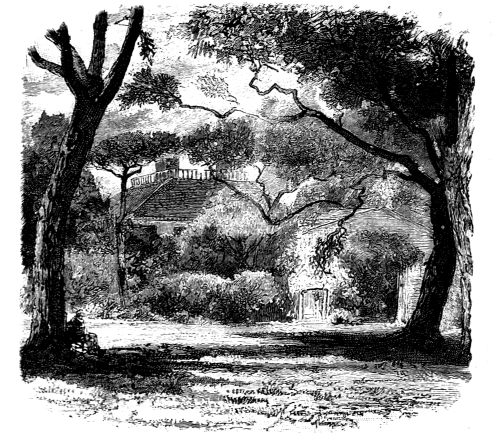
THE REAR LAWN LOOKING TOWARD LONGFELLOW’s HOUSE.
(ALL THIS PART OF THE LAWN IS COVERED WITH GIGANTIC ELM-TREES. THE HOUSE IS NEARLY HIDDEN BY THE TREES AND LILAC BUSHES.)
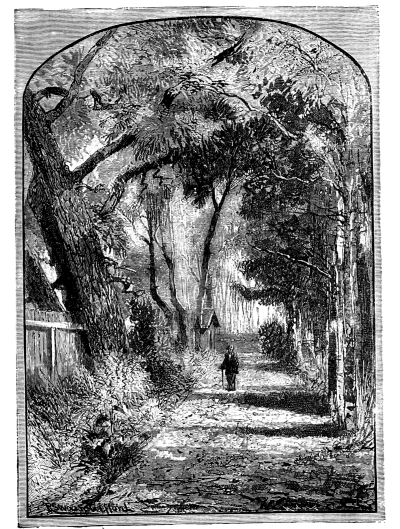
THE AVENUE NORTH OF THE HOUSE.
Mr. Longfellow’s house at Cambridge is one of the few American houses to which pilgrimages will be made in the future. It was surrounded with historic associations before he entered it, and it is now surrounded with poetic ones,—a double halo encircling its time-honoured walls. It is supposed to have been built in the first half of the last century by Colonel John Vassal, who died in 1747, and whose ashes repose in the churchyard at Cambridge under a freestone tablet, on which are sculptured the words Vas-sol, and the emblems a goblet and sun. He left a son John, who lived into Revolutionary times, and was a royalist, as many of the rich colonists were. The house passed from his hands, and came into the hands of the provincial government, who allotted it to General Washington as his head-quarters after the battle of Bunker’s Hill. Its next occupant was a certain Mr. Thomas Tracy, of whom tradition says that he was very rich, and that his servants drank his costly wines from carved pitchers. He appears to have sent out privateers to scour the seas in the East and West Indies, and to worry the commerce of England and Spain; though why he should include the galleons of Spain in his free-booting voyages is not clear. He failed one day, and the hundred guests who had been accustomed to sit down at the banquets of Vassal house, were compelled to find other hosts. Bankrupt Tracy was succeeded by Andrew Craigie, apothecary-general of the northern provincial army, who amassed a fortune in that office, which fortune took to itself wings, though not before it had enlarged Vassal house, and built a bridge over the Charles River connecting Cambridge with Boston and still bearing his name.
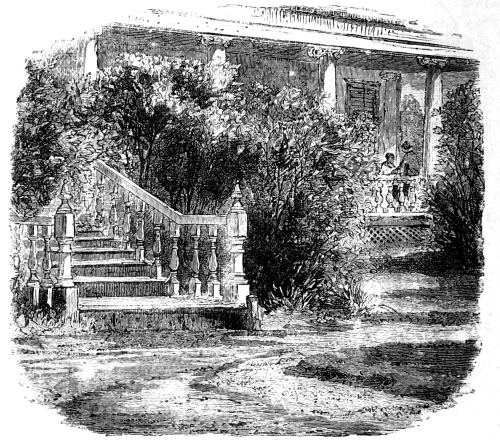
THE WESTERN ENTRANCE.
(FROM THE PIAZZA THERE IS A VIEW OF THE RIVER CHARLES, BRIGHTON, AND THE DISTANT HILLS.)
In the summer of 1837, a studious young gentleman of thirty might have been seen wending his way down the elm-shaded path which led to the Craigie house. He lifted the huge knocker, which fell with a brazen clang, and inquired for Mrs. Craigie. The parlour door was thrown open, and a tall, erect figure, crowned with a turban, stood before him. It was the relict of Andrew Craigie, whilome apothecary-general of the dead and gone northern provincial army. The young gentleman inquired if there was a room vacant in her house.
“I lodge students no longer,” she answered gravely.
“But I am not a student,” he remarked. “I am a professor in the University.”
“A professor?” she inquired, as if she associated learning with age.
“Professor Longfellow,” said the would-be lodger.
“Ah! that is different. I will show you what there is.”
She then proceeded to show him several rooms, saying, as she closed the door of each, “You cannot have that.” At last she opened the door of the south-east corner room of the second story, and said that he could have it. “This was General Washington’s chamber.” So Professor Longfellow became a resident of this old historic house, which had been occupied before him by Edward Everett and Jared Sparks, and which was occupied with him by Joseph E. Worcester, the lexicographer. Truly, his lines had fallen in pleasant places.
Professor Longfellow’s collegiate duties left him leisure for literary pursuits, and he turned it to advantage by writing a paper on “Frithiof’s Saga,” and another on the “Twice-told Tales” of his fellow-collegian, Hawthorne, whose rare excellence he was among the first to perceive. These papers were published in the “North American Review,” in 1837. They were followed during the next year by other papers: among them one on “Anglo-Saxon Literature,” and another on “Paris in the Seventeenth Century,” which were contributions to the same periodical.
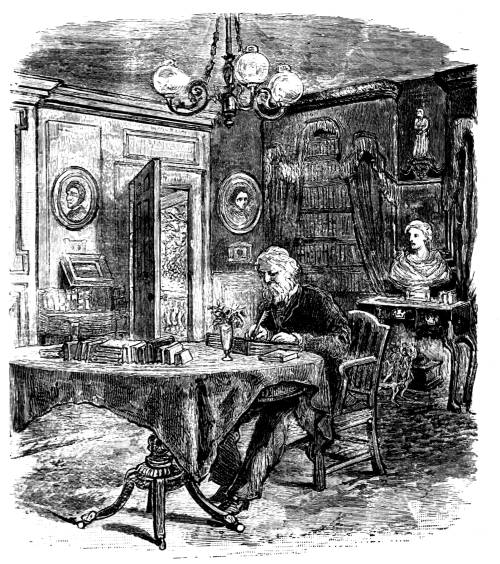
THE STUDY.
The papers mentioned, or some of them, were written in the chamber which Washington had occupied, as well as a series of papers of which European travel in Germany and Switzerland, and European experience and legend, were the chief themes. Through these, like a silken string through a rosary of beads, ran a slight personal narrative which may have been real, and may have been imaginary, but which was probably both. This narrative concerned itself with the life-history of Paul Flemming, a tender-hearted and rather shadowy young gentleman who had lost the friend of his youth, and who had gone abroad that the sea might be between him and the grave. “Alas, between him and his sorrow there could be no sea, but that of time!” He wandered from place to place,—noting what struck his sensitive fancy and discoursing of men and books,—student at once and pilgrim. The hand that penned “Outre-Mer” was visible on every page of “Hyperion,” but the hand had grown firmer in the Craigie house than it was at Brunswick; and the scholarly sympathies of the writer had embraced a richer literature than that of old Spain and old France. Dismissing the romantic element of “Hyperion” for what it is worth (and there must have been genuine worth in it, for it was the cause of its immediate popularity), the chief and permanent value of the book lay in the new element which it introduced into American literature—the element of German fantasy and romanticism. It would have come in time, no doubt, but to Mr. Longfellow belongs the honour of having hastened the time, and ushered in the dawn. He was the herald of German poetry in the New World. The second book of “Hyperion” contains Mr. Longfellow’s first published translation from the German poets—the “Whither?” of Müller (“I heard a brooklet gushing”); the third book contains the “Song of the Bell” (“Bell, thou soundest merrily!”); “The Black Knight” (“’Twas Pentecost, the Feast of Gladness”); “The Castle by the Sea” (“Hast thou seen that lordly castle?”); “The Song of the Silent Land” (“Into the Silent Land”), and “Beware!” (“I know a maiden fair to see”). Besides these translations in verse, there is, in the first book, a dissertation or chapter on “Jean Paul, the Only One,” and in the second book a chapter on “Goethe,” whom Mr. Paul Flemming, by the way, does not greatly admire. His friend the Baron defends the old heathen by saying that he is an artist and copies nature. “So did the artists who made the bronze lamps of Pompeii. Would you hang one of those in your hall? To say that a man is an artist and copies nature is not enough. There are two great schools of art, the imitative and the imaginative. The latter is the more noble and the more enduring.”
The dignity of the literary profession was earnestly maintained by Mr. Longfellow. “I do not see,” remarked the Baron in one of his conversations with Paul Flemming, “I do not see why a successful book is not as great an event as a successful campaign, only different in kind, and not easily compared.” The lives of literary men are melancholy pictures of man’s strength and weakness, and, on that very account, he thought were profitable for encouragement, consolation, and warning. “The lesson of such lives,” continued Flemming, “is told in a single word—wait! Therefore should every man wait—should bide his time. Not in listless idleness, not in useless pastime, not in querulous dejection; but in constant, steady, cheerful endeavours, always willing, and fulfilling and accomplishing his task, that, when the occasion comes, he may be equal to the occasion. And if it never comes, what matters it? What matters it to the world whether I or you or another man did such a deed, or wrote such a bock, so that the deed and book were well done? It is the part of an indiscreet and troublesome ambition to care too much about fame—about what the world says of us; to be always looking in the faces of others for approval; to be always anxious for the effect of what we do and say; to be always shouting, to hear the echo of our own voices.” “Believe me,” he concluded, “the talent of success is nothing more than doing what you can do well, and doing well whatever you do, without a thought of fame. If it come at all, it will come because it is deserved, and not because it is sought after. And, moreover, there will be no misgivings, no disappointment, no hasty, feverish, exhausting excitement.”
If fame comes because it is deserved, it certainly comes to some men much sooner than to others; why, their contemporaries and rivals do not perceive as clearly as those who come after them. Mr. Edgar Allan Poe, for example, could never understand why Mr. Henry Wadsworth Longfellow was a more successful writer than himself.
We hardly know how to characterize the seed which Mr. Longfellow began to sow in “The Voices of the Night.” Romanticism does not describe it, for there is nothing romantic in “The Hymn to the Night,” nor does morality describe it, except, perhaps, as it bourgeoned in “A Psalm of Life.” The lesson of the poem last named and of “The Light of Stars,” was the lesson of endurance and patience and cheerfulness. It had been taught by other poets, but not as this one taught it, not inverse that set itself to music in the memory of thousands, and in words that were pictures. The young man who wrote “A Psalm of Life” possessed the art of saying rememberable things, and a very rare art it is. Shakespeare possessed it in a supreme degree, and Pope and Gray in a greater measure than greater poets. Merciless critics have pointed out flaws in the literary workmanship of “A Psalm of Life,” but its readers never saw them, or, seeing them, never cared for them. They found it a hopeful, helpful poem. “Footsteps of Angels” is to us the most satisfactory of all these “Voices of the Night.” There is an indescribable tenderness in it, and the vision of the poet’s dead wife gliding into his chamber with noiseless footsteps, taking a vacant chair beside him, and laying her hand in his, is very pathetic. “The Beleaguered City” is a product of poetic artifice of which there are but few examples in English poetry. It appears to have been compounded after a recipe which called for equal parts of outward fact and inward meaning. Given a material city, a river, a fog, and so on, the poet sets his wits to work to discover what corresponds, or can be made to correspond, with them spiritually. If he is skilful, he constructs an ingenious poem, of doubtful intellectual value. “Midnight Mass for the Dying Year” is a medley of mediæval suggestion and Shakespearean remembrance, which demands a large and imaginative appreciation. The Shakespearean element appears somewhat out of place, though it adds to the impressiveness and effectiveness as a whole. It is a medley, however, and it must be judged by its own fantastic laws. Whatever faults disfigured “The Voices of the Night” were lost sight of or forgiven for the sake of their beauties and the admirable poetic spirit which they displayed. A healthful poet was singing, and his song had many tones.
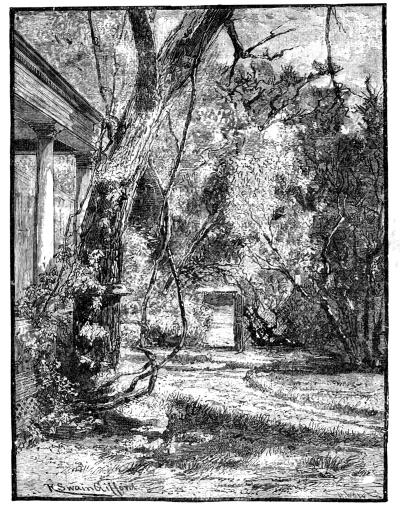
VIEW FROM THE REAR PIAZZA.
(THE OPEN GATE-WAY LEADS TO THE LAWN, A BROAD AND SPLENDID STRETCH RUNNING TOWARD THE NORTH.)
“Hyperion” and “The Voices of the Night,” which were published in the same year (1839), established the reputation of Mr. Longfellow as a graceful prose writer, and a poet who resembled no poet of the time, either in America or England. His scholarship was evident in both, and was not among the least of the charms which they exercised over their readers.
Mr. Bryant was the only American poet of any note who had enriched the literature of his native land with translations. They showed his familiarity with other languages, and were well thought of by scholars, but they added nothing to his fame, for famous he was from the day he published “Thanatopsis.” It was otherwise with the translations of Mr. Longfellow, which brought him many laurels, and were in as great demand as his original poems. There were twenty-three of them in the little volume which contained “The Voices of the Night,” culled from “Hyperion,” “Outre-Mer,” his review articles, not forgetting the great ode of Don Jorge Manrique, and they represented six different languages. They were well chosen, with the exception of the two versions from the French; the subjects being in themselves poetical, and the words in which they were clothed, characteristic of the originals. The highest compliment that can be paid to Mr. Longfellow is to say that they read like original poems. The most felicitous among them are “The Castle by the Sea,” “Whither?” “The Bird and the Ship,” and the exquisite fragment entitled “The Happiest Land.” Nearly forty years have passed since they were collected in “The Voices of the Night,” and these years have seen no translator equal to Mr. Longfellow.
Mr. Longfellow’s second poetical venture, “Ballads and Other Poems,” determined his character as a poet. It was more mature, not to say more robust, than “The Voices of the Night,” and its readers felt sure of its author hereafter, for he felt sure of himself. The opening ballad, “The Skeleton in Armour,” was the most vigorous poem that he had yet written,—a striking conception embodied in picturesque language, and in a measure which had fallen into disuse for more than two centuries—the measure of Drayton’s “Ballad of Agincourt.” I do not see that a line or a word could be spared. There were two elements in this collection not previously seen in Mr. Longfellow’s poetry, one being the power of beautifying common things, the other, the often renewed experiment of hexameter verse. What I mean by beautifying common things is the making a village blacksmith a theme, and a legitimate theme, too, for poetry. Mr. Longfellow has certainly done this. More purely poetical than “The Village Blacksmith” is “Endymion” and “Maidenhood.” The sentiment of the last is very refined and spirited. “It is not always May,” “The Rainy Day,” and “God’s Acre,” are each perfect of its kind, and the kinds are very different. “The Rainy Day,” for instance, is in the manner of “The Beleaguered City,” which for once has produced a good poem,—I suspect, because it is a short one. “To the River Charles” is a pleasant glimpse of Mr. Longfellow’s early Cambridge life, and the art of it is perfect.
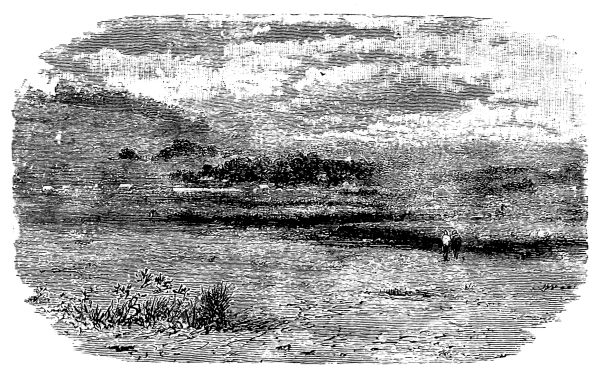
CHARLES RIVER.
The most popular poem in Mr. Longfellow’s second collection—“Excelsior”—has more moral than poetical value. The conception of a young man carrying a banner up a mountain, suggests a set scene in a drama, and the end of this imaginary person does not affect us as it should, his attempt to excel being so fool-hardy. That he would be frozen to death was a foregone conclusion. The most important of the translations here (all of which are excellent) was “The Children of the Lord’s Supper,” from the Swedish of Tegnér. It renewed, as I have said, the often baffled attempt to naturalize hexameters in English poetry,—an attempt which Mr. Longfellow had made four years before, in his paper on “Frithiof’s Saga,” when he translated the description of Frithiof’s ancestral estate at Framnäs into this measure. The poets and poetasters of the Elizabethan era tried in vain to revive it. Gabriel Harvey, the friend of Spenser, projected a reform of English poetry,—a reform which, if it had succeeded, would have caused “a general surceasing of rhyme” and a return to certain, or uncertain, rules of quantity. “Spenser suffered himself to be drawn into this foolish scheme,” says Professor Child, “and for a year worked away at hexameters and iambic trimeters quite seriously.” (The year in question, I take it, was 1580.) Harvey’s project was taken up with zeal by a coterie over which Sidney and Dyer presided; but the wits, notably Nash, ridiculed it, the latter saying (in substance) that the hexameter was a gentleman of an ancient house, but that the English language was too craggy for him to run his long plough in it. And Ascham wrote of it, about fifteen years before, that it rather trotted and hobbled than ran smoothly “in our English tong.” So thought not Master Abraham Fraunce, who, in 1587, published a translation of the “Aminta” of Tasso, in hexameters, and in the following year a work entitled “Lawier’s Logicke,” wherein he stowed away a version of Virgil’s Eclogue of Alexis, in the same measure. Less than a century from this date, Edward Phillips, the nephew of Milton, paid his respects and disrespects to the ancient and modern poets in his “Theatrum Poetarum” (1675),—a curious little book, which is thought to reflect the opinions of his illustrious uncle. He sums up the unlucky translator of Tasso in a few lines: “Abraham Fraunce, a versifier of Queen Elizabeth’s time, who, imitating Latin measure in English verse, wrote his ‘Ivy Church’ and some other things in hexameter, some also in hexameter and pentameter; nor was he altogether singular in this way of writing for Sir Philip Sidney, in the pastoral interludes of his ‘Arcadia,’ uses not only those, but all other sorts of Latin measure, in which no wonder he is followed by so few, since they neither become the English nor any other modern language.” Winstanley expressed the same unfavourable opinion of Fraunce’s hexameters twelve years later (1687), stealing the very words of Phillips for that purpose.
Langbaine, in his “Account of the English Dramatick Poets” (1691), adds four separate works, not mentioned by Winstanley and Phillips, to the list of Fraunce’s productions (all in hexameters), and records the disuse of quantitive experiments in English versification. “Notwithstanding Mr. Chapman in his translation of Homer, and Sir Philip Sydney in his Eclogues, have practised this way of writing, yet this way of imitating the Latin measures of verses, particularly the hexameter, is now laid aside, and the verse of ten syllables, which we style heroic verse, is most in use.” The next attempt to revive hexameters on any scale was made by that metrical experimentalist, Southey, in his “Vision of Judgment,” in 1821,—a piece of obsequious profanity which richly deserved the ridicule that Byron cast upon it. Such, so far as I know, is the history of this alien measure in English poetry. Mr. Longfellow thought well of it, as we have seen, and was justified in so thinking by the excellence of his own practice therein. “The Children of the Lord’s Supper” is a charming poem, to which its antique setting is very becoming.
Mr. Longfellow made a third voyage to Europe after publishing his “Ballads and other Poems,” and passed the summer on the Rhine. He returned after a few months, bringing with him a number of poems which were written at sea, and in which he expressed his detestation of slavery. “Poems on Slavery” were published in 1843, and dedicated to W. E. Channing, who did not live to read the poet’s admiration of his character and his work. This dedication, which is spirited, contains a noble stanza:
“Well done! Thy words are great and bold, At times they seem to me Like Luther’s, in the days of old, Half battles for the free.”
“The Slave’s Dream” is one of the few rememberable poems of which the “peculiar institution” was the inspiration. It is exceedingly picturesque, and its versification is masterly. The harmony of sound and sense,—the movement of the fourth stanza is very fine:
“And then at furious speed he rode Along the Niger’s bank, His bridle-reins were golden chains, And, with a martial clank, At each leap he could feel his scabbard of steel Smiting his stallion’s flank.”
The fertility of Mr. Longfellow’s mind, and the variety of his powers, were manifested in his thirty-sixth year, when he published the “Poems on Slavery,” of which I have just spoken, and “The Spanish Student,”—a dramatic poem, the actors in which were the antipodes of the dusky figures which preceded them. Judged by the laws of its construction, and by the intention of its creator, “The Spanish Student” is a beautiful production. It should be read for what it is,—a poem, and without the slightest thought of the stage, which was not in the mind of the author when he wrote it. So read, it will be found radiant with poetry, not of a passionate or profound kind, which would be out of place; for the plot is in no sense a tragic one, but of a kind that suggests the higher walks of serious poetic comedy. The characters of the different actors in this little closet play are sketched with sufficient distinctness, and the conversation, which is lively and bustling, is suited to the speakers and their station in life. The gipsy dancing girl, Preciosa, is a lovely creation of the poet’s fancy.
In 1843, Mr. Longfellow was married for the second time, and became the possessor of the Craigie house. Three years later he published “The Belfry of Bruges and other Poems.” Traces of his early manner, as unsuccessfully manifested in “The Beleaguered City,” appear in “Carillon,” the prologue to the volume, and in “The Arrow and the Song,” which is perhaps the most perfect of all his smaller pieces. “The Belfry of Bruges” is a picturesque description of that quaint old city, as seen from the belfry-tower in the market-place one summer morning, and an imaginative remembrance of its past history, which passes like a pageant before the eyes of the poet. Everything is clearly conceived and in orderly succession, and in no poem that he had previously written had the hand of the artist been so firm. “Nuremberg,” a companion-piece in the same measure, is distinguished by the same precision of touch and the same broad excellence. There is an indescribable charm, a grace allied to melancholy, in “A Gleam of Sunshine,” which is one of the few poems that refuse to be forgotten. “The Arsenal at Springfield” is in a certain sense didactic, I suppose, but I do not quite see how it could be otherwise, and be a poem at all. A poet should be a poet first, but he should also be a man, and a man who concerns himself with the joys and sorrows of his fellow-creatures. There was a great lesson in the burnished arms at Springfield, and a lesser poet than Mr. Longfellow would not have guessed it.
“Were half the power that fills the world with terror, Were half the wealth bestowed on camps and courts, Given to redeem the human mind from error, There were no need of arsenals and forts: The warrior’s name would be a name abhorred, And every nation that should lift again Its hand against a brother, on its forehead Should wear for evermore the curse of Cain!”
“The Norman Baron” is a study of the mediæval age, and “Rain in Summer,” a fresh and offhand description of a country shower.
Not many English-writing poets, good fathers as most of them were, have addressed poems to their children. Ben Jonson wrote some lines about his first daughter, who died in infancy. Coleridge sang a serious cradle-song over his son Hartley, in “Frost at Midnight.” Shelley bewailed the early death of his son William; and Leigh Hunt celebrated two of his children in two characteristic poems, the most natural of which he inscribed to his son John, “A Nursery Song for a Four-Year-Old Romp.” These are some of the best-known English poets, to whom childhood was a source of inspiration. Mr. Longfellow distanced all of them, and apparently without an effort, in the volume under consideration. His poem “To my Child,” has no superior of its kind in the language. We have a glimpse of the poet’s house for the first time in verse, and of the chamber in which he wrote so many of his poems, which had now become the child’s nursery. Its chimney was adorned with painted tiles, among which he enumerates:
“The lady with the gay macaw, The dancing girl, the grave bashaw With bearded lip and chin; And, leaning idly o’er his gate, Beneath the imperial fan of state, The Chinese mandarin.”
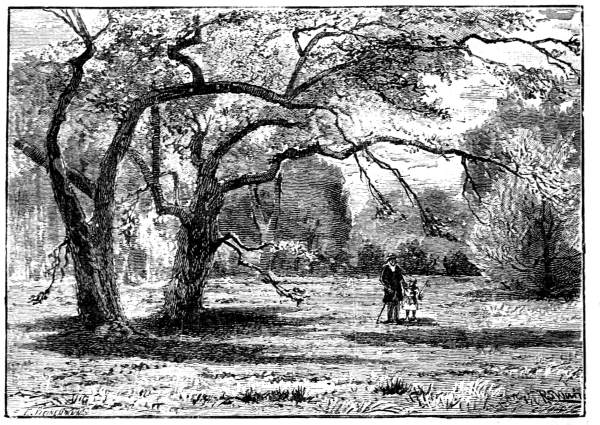
VIEW ACROSS THE LAWN, NORTH-WEST OF THE HOUSE.
The child shakes his coral rattle with its silver bells, and is content for the moment with its merry tune. The poet listens to other bells than these, and they tell him that the coral was growing thousands of years in the Indian seas, and that the bells once reposed as shapeless ore in darksome mines, beneath the base of Chimborazo or the overhanging pines of Potosi.
“And thus for thee, O little child. Through many a danger and escape, The tall ships passed the stormy cape; For thee, in foreign lands remote, Beneath a burning, tropic clime, The Indian peasant, chasing the wild goat, Himself as swift and wild, In falling, clutched the frail arbute, The fibres of whose shallow root, Uplifted from the soil, betrayed The silver veins beneath it laid The buried treasures of the miser Time.”
He turns from the child to the memory of one who formerly dwelt within the walls of his historic mansion:
“Up and down these echoing stairs Heavy with the weight of cares, Sounded his majestic tread: Yes, within this very room Sat he, in those hours of gloom, Weary both in heart and head.”
These grave thoughts are succeeded by pictures of the child at play, now in the orchard and now in the garden-walks, where his little carriage-wheels efface whole villages of sand-roofed tents that rise above the secret homes of nomadic tribes of ants. But, tired already, he comes back to parley with repose, and, seated with his father on a rustic seat in an old apple-tree, they see the waters of the river, and a sailless vessel dropping down the stream:
“And like it, to a sea as wide and deep, Thou driftest gently down the tides of sleep.”
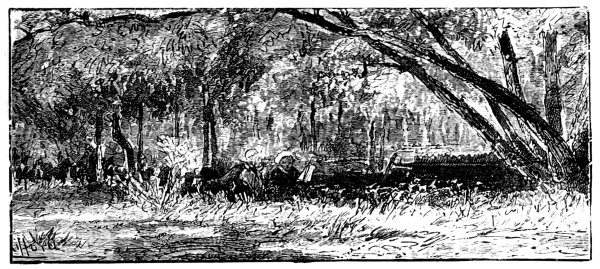
THE OLD WILLOW.
The poet speculates gravely on the future of his child, and bids him remember that if his fate is an untoward one, even in the perilous hour
“When most afflicted and oppressed From labour there shall come forth rest.”
In this poem, and in “The Occultation of Orion,” Mr. Longfellow has reached a table-land of imagination not hitherto attained by his Muse. “The Bridge” is a revealment of his personality, and a phase of his genius which has never ceased to charm the majority of his readers. The train of thought which it suggests is not new, but what thought that embraces mankind is new? Enough that it is natural, and sympathetic, and tender. The lines to “The Driving Cloud” are an admirable specimen of hexameters, and a valuable addition to America’s scanty store of aboriginal poetry—the forerunner of an immortal contribution not yet transmuted into verse.
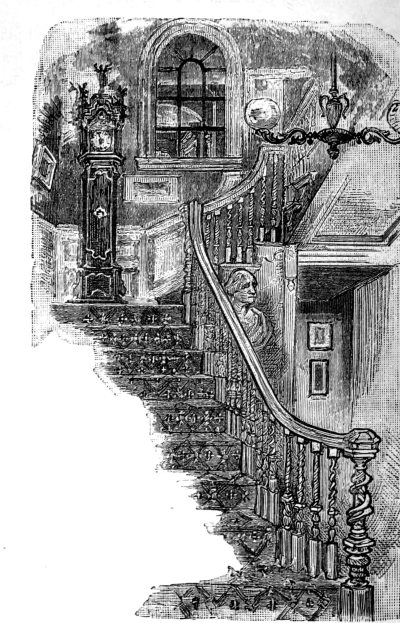
“THE OLD CLOCK ON THE STAIRS.”
Under the head of “Songs” we have eight poems, two of which are modelled after a fashion that Mr. Longfellow had succeeded in making his own. I refer to “Sea-weed” and “The Arrow and the Song,” two charming fantasies in which the doctrine of poetic correspondence (if I may be allowed the phrase) works out a triumphant excuse for its being. “The Day is Done” belongs to a class of poems which depend for their success upon the human element they contain, or suggest, and to which they appeal. “The Old Clock on the Stairs” is an illustration of what I mean, and as good a one as can be found in the writings of any modern poet. The humanities (to adapt a phrase) were never long absent from Mr. Longfellow’s thoughts. We feel their presence in “The Old Clock on the Stairs,” in “The Bridge,” and in the unrhymed stanzas “To an Old Danish Song-book.” This volume introduced Mr. Longfellow in a species of composition in which we have not hitherto seen him—the sonnet, of which there are three specimens here, neither of the strictest Italian form; the best, perhaps, being the one on “Dante,” of whom, by the way, we had three translations, all from the “Purgatorio,” in the “Voices of the Night.”
Mr. Longfellow’s next volume was, in a certain sense, the gift of Hawthorne, to whom he was indebted for its theme. It is stated briefly in the first volume of his “American Note-books,” in a cluster of memoranda written between October 24th, 1838, and January 4th, 1839. Voilá: “H. L. C—— heard from a French Canadian a story of a young couple in Acadie. On their marriage day, all the men of the province were summoned to assemble in the church to hear a proclamation. When assembled, they were all seized and shipped off to be distributed through New England, among them the new bridegroom. His bride set off in search of him, wandered about New England all her lifetime, and at last, when she was old, she found her bridegroom on his death-bed. The shock was so great that it killed her likewise.” This forcible deportation of a whole people occurred in 1755, when the French, to the extent of eighteen thousand souls, were seized by the English, in the manner stated. History, which excuses so much, has perhaps excused the act; but humanity never can. It is as indefensible as the Inquisition.
“Evangeline,” which was published in 1847, disputed the palm with “The Princess,” which was published in the same year. The two volumes are so unlike that no comparison can, or should, be made between them. Each shows its writer at his best, as a story-teller, and if the mediæval medley surpasses the modern pastoral in richness of colouring, it is surpassed, in turn, by the tender human interest of the latter. Evangeline, loving, patient, sorrowful wanderer, has taken a permanent place, I think, among the heroines of English song; but, whether the picturesque hexameters in which her pathetic story is told will hereafter rank among the standard measures of the language, can only be conjectured. That the poets have fancied them is certain, for the year after the publication of “Evangeline” saw Clough writing them in “The Bothie of Tober-na-Vuolich,” and ten years later saw Kingsley writing them in his “Andromeda.” Matthew Arnold maintains that the hexameter is the only proper measure in which to translate Homer; and already two versions of the Iliad in this measure have been made, one by Herschel (1866) and another by Cochrane (1867).
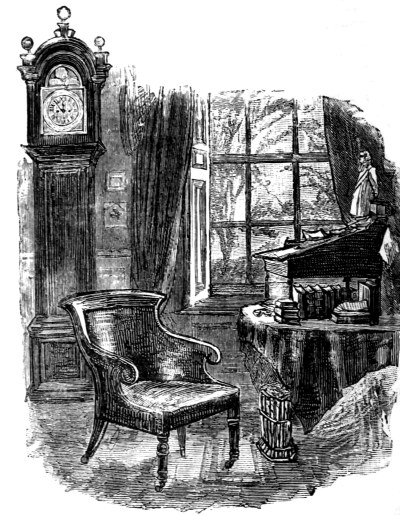
A CORNER OF THE STUDY
Two years before the publication of “Evangeline” (1845), Mr. Longfellow conferred a scholarly obligation upon the admirers of foreign poetry by editing “The Poets of Europe,” a closely printed octavo of nearly eight hundred pages, containing specimens of European poets in ten different languages, representing the labours of upward of one hundred translators, including himself. Four years later (1849) he published a tale, entitled “Kavanagh.” It has no plot to speak of, but its sketches of character are bright and amusing, and its glimpses of New England village life are pleasantly authentic.
The five years which included the publication of the next three volumes of his poetical writings—“The Seaside and the Fireside” (1850), “The Golden Legend” (1851), and “The Song of Hiawatha” (1855),—added largely to his reputation as a man of varied attainments, to whom poetry was an art in which he was perpetually discovering new possibilities. There are twenty-three poems in “The Seaside and the Fireside” (including the dedication and the translations), no two of which are alike, though they all disclose the skilful hand by which they were wrought. The most important of them, as a work of art, is the best poem, of which Schiller’s “Song of the Bell” was the model—“The Building of the Ship.”
“The Golden Legend” transports us back to the Middle Ages, of which we have had transitory gleams in the earlier writings of Mr. Longfellow. The poetic atmosphere of that remote period envelops a lovely story, which turns, like that of “Evangeline,” upon the love and devotion of woman, that in this instance is happily rewarded.
The figure of Elsie, the peasant girl, who determines to sacrifice her life to restore her prince to happiness, is worthy of an exalted place in any poet’s dream of fair women. The charm of the poem, apart from its poetry, is the thorough and easy scholarship of the writer, who contrives to conceal the evidences of his reading,—an art which few poets have possessed in an equal degree, and which Moore did not possess at all. Mr. Ruskin reflected, I think, the judgment of most scholarly readers of this poem, when he wrote in his “Modern Painters” that its author had entered more closely into the temper of the monk, for good and for evil, than ever yet theological writer or historian, though they may have given their life’s labour to the analysis.
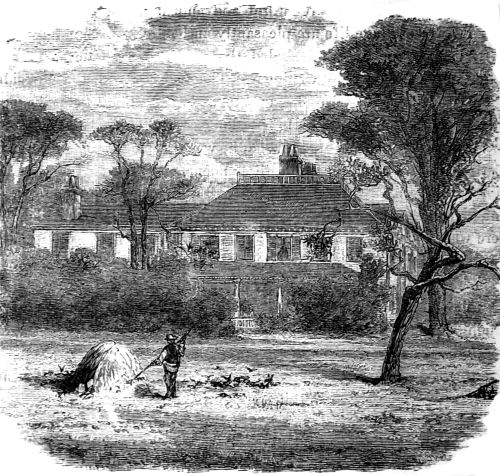
WEST SIDE OF LONGFELLOW’S HOUSE.
(TAKEN FROM A POINT NEAR THE OLD WILLOW.)
That there was a poetic element in the North American Indian several American poets had believed, and, so believing, had striven to quicken their verse with its creative energies. Sands and Eastburn wrote together the ponderous poem of “Yamoyden.” Hoffmann wrote a “Vigil of Faith;” Seba Smith a “Powhattan;” Street a “Frontenac.” They were unanimous in one thing,—they all failed to interest their readers. The cause of this was not far to seek, we can see, since success has been achieved, but it demanded a vision which was not theirs, and which, it seemed, only one American poet had. He saw that the Indian himself, as he figures in our history, was not capable of being made a poetic hero, but he saw that there might be a poetic side to him, and that it existed in his legends, if he had any. That he had many, and that they were remarkable for a certain primitive imagination, was well known. They were brought to light by the late Henry R. Schoolcraft who heard of their existence among the Odjibwa Nation, inhabiting the region about Lake Superior in 1822.
Specimens of these aboriginal fictions were published by Mr Schoolcraft in his “Travels in the Central Portions of the Mississippi Valley” (1825), and his “Narrative of the Expedition to Itaska Lake” (1834), but they were not given to the world in their entirety until 1839 in his “Algic Researches.” They were as good as manuscript for the next sixteen years, though one American poet had mastered them thoroughly. This was Mr. Longfellow, who, in 1855, turned this Indian Edda, as he happily called it, into “The Song of Hiawatha.” The great and immediate success of this poem, and the increase of reputation which it brought its author, recalled the early years of the present century when Scott and Byron were sure of thousands of readers whenever it pleased them to write a metrical romance. It was eagerly read by all classes, who suddenly found themselves interested in the era of flint arrow-heads, earthen pots, and skin clothes, and in its elemental inhabitants, who, dead centuries ago, if they ever existed, were now living the everlasting life of poetry. Everybody read “The Song of Hiawatha,” which passed through many editions. Its intellectual value was universally admitted, but its form was questioned, as all new forms are sure to be. For the form was new to most readers, though not to scholars in the literatures of Northern Europe. It is original with Mr. Longfellow, his friends declared. No, his enemies answered, he has borrowed it from the Finnish epic, “The Kalewala.” The temporary novelty of its form led to innumerable parodies, but to nothing serious, that I remember; which I take to be a silent verdict against its permanency in English versification.
Mr. Longfellow added, three years later, to the laurels he had won by “Evangeline,” by a second narrative poem in hexameters,—“The Courtship of Miles Standish.” It lacks the pathetic interest which is the charm of the earlier poem, but it possesses the same merit of picturesqueness, and a firmer power of delineating character. Priscilla is a very vital little Puritan maiden, who sees no impropriety in asking the man she loves why he does not speak for himself, and not for Miles Standish, who might find time to attend to his own wooing. The Puritan atmosphere here is as perfect of its kind as the Catholic atmosphere of “Evangeline,” and is thoroughly in keeping with the grim old days in which the story is laid. The versification of the poem is more vigorous than that of the sister poem, the hexameters having a sort of martial movement about them.
We do not see that the poetry of Mr. Longfellow has changed much in the last twenty years, except that it has become graver in its tone and more serious in its purpose. Its technical excellence has steadily increased. He has more than held his own against all English-writing poets, and in no walk of poetry so positively as that of telling a story. In an age of story-tellers he stands at their head, not only in the narrative poems I have mentioned, but in the lesser stories included in his “Tales of a Wayside Inn,” for which he has laid all the literatures of the world under contribution.
The most distinctive of Mr. Longfellow’s poems are probably those which he entitles “Birds of Passage,” and which he has from time to time published as portions of separate volumes. They were inspired by many literatures, and are in many measures, among which, however, that of “The Song of Hiawatha” does not reappear, though the hexameter does. He has the art of finding unwritten poems in the most out-of-the-way books, and in every-day occurrences. A great man dies,—the Duke of Wellington, for example,—and he hymns his departure in “The Warden of the Cinque Ports,” which many prefer to the Laureate’s scholarly ode. His good friend Hawthorne dies, and he embalms his memory and his unfinished romance in imperishable verse.
“Ah! who shall lift that wand of magic power, And the lost clew regain? The unfinished window in Aladdin’s tower Unfinished must remain!”
Sumner dies, and he drops a melodious tear upon his grave.
“Were a star quenched on high, For ages would its light, Still travelling downward from the sky, Shine on our mortal sight. “So when a great man dies, For years beyond our ken, The light he leaves behind him lies Upon the paths of men.”
And again he bids him farewell in a touching sonnet, with a pathetic and unexpected ending:
“Good-night! good-night! as we so oft have said Beneath this roof at midnight, in the days That are no more, and shall no more return. Thou hast but taken thy lamp and gone to bed: I stay a little longer, as one stays To cover up the embers that still burn.”
A child is born to him, and his friend Lowell’s wife dies on the same night, and he commemorates both in “The Two Angels,” one of his perfect poems.
Mr. Longfellow published few translations while he was writing his more important works, such as the “Tales of a Wayside Inn” and “The Story of Hiawatha.” That he had not forgotten his cunning, however, was evident in his “Three Books of Song” (1872), where he printed several translations of Eastern Songs, and in “Keramos, and other Poems,” which contains two hexameter translations from Virgil and Ovid, and twelve translations from French, German, and Italian poets. The volume last mentioned is remarkable in many ways. It not only shows no diminution of mental vigour, which one might naturally expect in a poet whose years have exceeded the allotted age of man, but it recalls the young poet who wrote “The Skeleton in Armour,” and “The Slave’s Dream.” I know not where to look for more fire than I find in “The Leap of Roushan Beg,” nor more delicious picturesqueness than in “Castles in Spain.” “Keramos” belongs to the same class of poems as “The Building of the Ship,” and is as perfect a piece of poetic art as that exquisite poem. That the making of pottery could be so effectively handled in verse reminds us of what Stella said of Swift, viz. that he could write beautifully about a broom-stick.
Mr. Longfellow’s friendliness, not to say generosity, to his brother authors, is not the least among his poetic virtues. He sends a greeting to Lowell in “The Herons of Elmwood,” and honours the memory of Irving in a tender sonnet, “In the Churchyard at Tarrytown.” In “The Three Silences of Molinos” (which are those of Speech, Desire, and Thought), he recognizes the excellence of the poet whom New England delights to honour next to himself:
“O thou, whose daily life anticipates The world to come, and in whose thought and word The spiritual world preponderates, Hermit of Amesbury! thou too hast heard Voices and melodies from beyond the gates, And speakest only when thy soul is stirred.”
If there was any doubt before that Mr. Longfellow was the first of living sonneteers it is settled by “A Book of Sonnets” in this collection, the workmanship of which is simply perfect.
Mr. Longfellow’s translation of Dante’s “Divina Commedia” is highly thought of by scholarly readers. I state, however, as a fact, that he was not engaged upon it over twenty-five years, as we are told in the “Life and Letters of George Ticknor”; nor more than thirty years, as we are told in Richardson’s “Primer of American Literature.” It was executed in less than two years.
It has not been given to many poets to carry out the ideal of a poetic life as he has done, and to win a great reputation at an early age,—a reputation which has not lessened or suffered from any fluctuation of public taste. The singer of “Keramos” addresses a different public from the one that welcomed “The Voices of the Night,” but he holds it nevertheless. In looking back upon his long literary career, one can see that he has been true to himself as he was manifested to us in his early prose and verse; that he has fulfilled his scholarly intentions; and that he has created and satisfied a taste for a literature which did not exist in America until he began to write,—a literature drawn from the different languages of Europe, now in the shape of direct translation, and now in the shape of suggestions, alien to the mass of English and American readers, but gladly received by both as new intellectual possessions. He has broadened American culture in completing his own, and has enlarged American sympathies until they embrace all other peoples,—the sturdy Norseman, the simple Swede, the patient Acadien, and the marvel-believing red man of prehistoric times.
Cardinal Wiseman delivered a lecture some years ago on the “Home Education of the Poor.” In the course of this lecture he commented upon the fact that England has no poet who is to its labouring classes what Goethe is to the peasant of Germany, and said: “There is one writer who approaches nearer than any other to this standard, and he has already gained such a hold on our hearts that it is almost unnecessary for me to mention his name. Our hemisphere cannot claim the honour of having brought him forth, but he still belongs to us, for his works have become as household words wherever the English language is spoken. And whether we are charmed by his imagery, or soothed by his melodious versification, or elevated by the high moral teachings of his pure muse, or follow with sympathetic hearts the wanderings of Evangeline, I am sure that all who hear my voice will join with me in the tribute I desire to pay to the genius of Longfellow.”
The Rev. Lyman Abbott, also recently in the “Christian Union,” remarks that “There are many persons who regard Christianity as a new form or a new philosophy, and one might read Longfellow’s songs ‘from beginning to end,’ and not guess with what form he worshipped or of what philosophy he is a disciple. But if the Master knew aright His own mission, He came that we might have life, and have it more abundantly; and if Paul comprehended the tenour of that life aright, its fruits are ‘love, joy, peace, long-suffering, gentleness, goodness, faith, meekness, temperance.’ This life pulsates through all Longfellow’s words; of these fruits the orchard of his song is full indeed. I do not recall a single hymn of his which has become a favourite voice of worship in our churches; but worship has gone up from thousands of hearts, lowlier and holier for his singing. He does not swing the censer, but he fills it with his aromatic incense.” ... “Submission never sang a sweeter song in the night than ‘Resignation;’ devout love to God never breathed a more Christly petition than in Elsie‘s prayer; never more unaffected reverence bowed its head than in ’Christus.’”
The Christianity of Longfellow is as simple as that of the New Testament, and as catholic; his creed, his worship, and his life are love.
“My work is finished; I am strong In faith and hope and charity; For I have written the things I see, The things that have been and shall be. Conscious of right, nor fearing wrong Because I am in love with Love, And the sole thing I hate is Hate; For Hate is death; and Love is life. A peace, a splendour from above; And Hate a never-ending strife, A smoke, a blackness from the abyss Where unclean serpents coil and hiss! Love is the Holy Ghost within; Hate the unpardonable sin! Who preaches otherwise than this Betrays his Master with a kiss.”
The poet died on the 24th March 1882, at Cambridge, Massachusetts and was buried in the Mount Auburn Cemetery, amidst public and private evidences of the grief of many thousands of the American people; and in the United Kingdom his death has been felt as the loss of a familiar friend, almost irreparable.
THE POETICAL WORKS OF HENRY WADSWORTH LONGFELLOW.