THE PIRATES' WHO'S WHO (continued 5)
Reading edition
We first hear of Roberts as sailing, in honest employ, as master of the Princess (Captain Plumb), from London in November, 1719, bound for the coast of Guinea to pick up a cargo of "black ivory" at Anamaboe. Here his ship was taken by the Welsh pirate Howel Davis. At first Roberts was disinclined for the pirate life, but soon changed his mind.
On the death of Davis there were several candidates for the post of commander, all brisk and lively men, distinguished by the title of "Lords," such as Sympson, Ashplant, Anstis, and others. One of these "Lords," Dennis, concluded an eloquent harangue over a bowl of punch with a strong appeal for Roberts to be the new chief. This proposal was acclaimed with but one dissenting voice, that of "Lord" Sympson, who had hopes of being elected himself, and who sullenly left the meeting swearing "he did not care who they chose captain so it was not a papist." So Roberts was elected after being a pirate only six weeks; thus was true merit quickly appreciated and rewarded amongst them.
CAPTAIN BARTHOLOMEW ROBERTS.
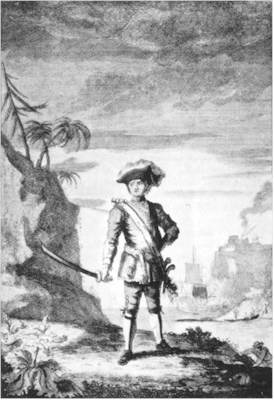
Roberts's speech to his fellow-pirates was short but to the point, saying "that since he had dipped his hands in muddy water, and must be a pyrate, it was better being a commander than a common man," not perhaps a graceful nor grateful way of expressing his thanks, but one which was no doubt understood by his audience.
Roberts began his career in a bright manner, for to revenge the perfectly justifiable death of their late captain he seized and razed the fort, bombarded the town, and setting on fire two Portuguese ships so as to act as torches, sailed away the same night. Sailing to Brazil they found in the Bay of Bahia a fleet of forty-two Portuguese ships ready laden and on the point of leaving for Lisbon, and Roberts, with the most astounding boldness, sailed right in amongst them until he found the deepest laden, which he attacked and boarded, although his was a much smaller ship. He sailed away with his prize from the harbour. This prize, amongst the merchandise, contained 40,000 moidors and a cross of diamonds designed for the King of Portugal.
He then took a Dutch ship, and two days later an English one, and sailed back to Brazil, refitting and cleaning at the Island of Ferdinando.
In a work such as this is, it is impossible to recount all, or even a few, of the daring adventures, or the piratical ups and downs of one pirate. Roberts sailed to the West Indies devastating the commerce of Jamaica and Barbadoes. When things grew too hot there, he went north to Newfoundland, and played the very devil with the English and French fishing fleets and settlements.
His first ship he called the Fortune, his next, a bigger ship, the Royal Fortune, another the Good Fortune.
On two occasions Roberts had been very roughly handled, once by a ship from Barbadoes and once by the inhabitants of Martinica, so when he designed his new flag, he portrayed on it a huge figure of himself standing sword in hand upon two skulls, and under these were the letters A.B.H. and A.M.H., signifying a Barbadian's and a Martinican's head.
In April, 1721, Roberts was back again on the Guinea Coast, burning and plundering. Amongst the prisoners he took out of one of his prizes was a clergyman. The captain dearly wished to have a chaplain on board his ship to administer to the spiritual welfare of his crew, and tried all he could to persuade the parson to sign on, promising him that his only duties should be to say prayers and make punch. But the prelate begged to be excused, and was at length allowed to go with all his belongings, except three prayer-books and a corkscrew—articles which were sorely needed aboard the Royal Fortune.
The end of Roberts's career was now in sight. A King's ship, the Swallow (Captain Chaloner Ogle), discovered Roberts's ships at Parrot Island, and, pretending to fly from them, was followed out to sea by one of the pirates. A fight took place, and after two hours the pirates struck, flinging overboard their black flag "that it might not rise in Judgement over them." The Swallow returned in a few days to Parrot Island to look for Roberts in the Royal Fortune. Roberts being at breakfast, enjoying a savoury dish of solomongundy, was informed of the approach of the ship, but refused to take any notice of it. At last, thoroughly alarmed, he cut his cables and sailed out, but most of his crew being drunk, even at this early hour, the pirates did not make as good a resistance as if they had been sober. Early in the engagement Roberts was hit in the throat by a grape-shot and killed; this being on February 10th, 1722. His body, fully dressed, with his arms and ornaments, was thrown overboard according to his repeated request made during his lifetime. Thus the arch-pirate died, as he always said he wished to die, fighting. His motto had always been "A short life and a merry one." One good word can be said for Roberts, that he never forced a man to become a pirate against his wish.
ROBERTS, Owen. Welsh pirate.
Carpenter in the Queen Ann's Revenge, and killed on November 22nd, 1718, off the North Carolina Coast.
ROBINSON, Edward.
Of Newcastle-upon-Tyne.
Hanged at Charleston, South Carolina, in 1718.
ROCHE, Captain Philip, alias John Eustace.
In company with three other mariners—Cullen, Wife, and Neale—this Irish pirate shipped himself on board a French snow at Cork in November, 1721, for a passage to Nantes. Owing to Roche's briskness, genteel manners, and knowledge of navigation, the master used occasionally to place him in charge of the vessel. One night a few days out a pre-arranged mutiny took place, the French crew being butchered and thrown overboard. The captain, who pleaded for mercy, was also thrown into the sea. Driven by bad weather to Dartmouth, the new captain, Roche, had the ship repainted and disguised, and renamed her the Mary. Then sailing to Rotterdam he sold the cargo of beef and took on a fresh cargo with the owner, Mr. Annesly. The first night out of port they threw Mr. Annesly overboard, and he swam alongside for some while pleading to be taken in. On going into a French port, and hearing that an enquiry was being made about his ship, Roche ran away. The crew took the ship to Scotland, and there landed and disappeared, and the ship was seized and taken to the Thames.
Later on Roche was arrested in London and committed to Newgate Prison, found guilty of piracy, and hanged on August 5th, 1723, at Execution Dock, at the age of 30. The hanging was not, from the public spectators point of view, a complete success, for the culprit "was so ill at the time that he could not make any public declaration of his abhorrence of the crime for which he suffered."
RODERIGO, Peter.
A "Flanderkin."
Commanded a Dutch vessel, the Edward and Thomas, that sailed from Boston in 1674, and took several small English vessels along the coast of Maine. Tried for piracy at Cambridge, Massachusetts, and condemned to be hanged, but was afterwards pardoned.
ROGERS, Captain Thomas.
Commanded a ship, the Forlorn. Routed the Spaniards at Venta Cruz in 1671. One of Morgan's captains in his attack on Panama.
ROGERS, Captain Woodes.
As the life of this famous navigator and privateer is, very justly, treated fully in the "Dictionary of National Biography" it is unnecessary to mention more than a few incidents in his adventurous career. Woodes Rogers was not only a good navigator, for on many occasions he showed a remarkable gift for commanding mutinous crews in spite of having many officers on whom he could place little reliance. On leaving Cork in 1708, after an incompetent pilot had almost run his ship on two rocks off Kinsale called "The Sovereigne's Bollacks," Rogers describes his crew thus: "A third were foreigners, while of Her Majestie's subjects many were taylors, tinkers, pedlars, fiddlers, and hay-makers, with ten boys and one negro." It was with crews such as these that many of the boldest and most remarkable early voyages were made, and they required a man of Woodes Rogers stamp to knock them into sailors. Rogers had a gift for inspiring friendship wherever he went. On arriving at the coast of Brazil, his boat was fired on when trying to land at Angre de Reys. This settlement had but lately received several hostile visitors in the way of French pirates. But before a week was passed Woodes Rogers had so won the hearts of the Portuguese Governor and the settlers that he and his "musick" were invited to take part in an important religious function, or "entertainment," as Rogers calls it, "where," he says, "we waited on the Governour, Signior Raphael de Silva Lagos, in a body, being ten of us, with two trumpets and a hautboy, which he desir'd might play us to church, where our musick did the office of an organ, but separate from the singing, which was by the fathers well perform'd. Our musick played 'Hey, boys, up go we!' and all manner of noisy paltry tunes. And after service, our musicians, who were by that time more than half drunk, march'd at the head of the company; next to them an old father and two fryars carrying lamps of incense, then an image dressed with flowers and wax candles, then about forty priests, fryars, etc., followed by the Governor of the town, myself, and Capt. Courtney, with each of us a long wax candle lighted. The ceremony held about two hours; after which we were splendidly entertained by the fathers of the Convent, and then by the Governour. They unanimously told us they expected nothing from us but our Company, and they had no more but our musick."
What a delightful picture this calls to the mind—the little Brazilian town, the tropical foliage, the Holy Procession, "wax figure" and priests, followed by the Governor with an English buccaneer on either side, and headed by a crew of drunken Protestant English sailors playing "Hey, boys, up go we!"
Rogers, not to be outdone in hospitality, next day entertained the Governor and fathers on board the Duke, "when," he says, "they were very merry, and in their cups propos'd the Pope's health to us. But we were quits with 'em by toasting the Archbishop of Canterbury; and to keep up the humour, we also proposed William Pen's health, and they liked the liquor so well, that they refused neither." Alas! the good Governor and the fathers were not in a fit state to leave the ship when the end came to the entertainment, so slept on board, being put ashore in the morning, "when we saluted 'em with a huzza from each ship, because," as Rogers says, "we were not overstocked with powder."
It was in March, 1710, that Rogers brought his little fleet into the harbour of Guam, one of the Ladrone Islands. Although at war with Spain, the captain soon became on his usual friendly terms with the Governor of this Spanish colony, and gave an entertainment on board his ship to him and four other Spanish gentlemen, making them "as welcome as time and place would afford, with musick and our sailors dancing." The Governor gave a return party on shore, to which Rogers and all his brother officers were invited, partaking of "sixty dishes of various sorts." After this feast Rogers gave his host a present, consisting of "two negro boys dress'd in liveries." One other instance of Woodes Rogers adaptability must suffice. In the year 1717 he was appointed Governor to the Bahama Islands, at New Providence, now called Nassau. His chief duty was to stamp out the West India pirates who had made this island their headquarters for many years, and were in complete power there, and numbered more than 2,000 desperadoes, including such famous men as Vane and Teach. Rogers's only weapon, besides the man-of-war he arrived in, was a royal proclamation from King George offering free pardon to all pirates or buccaneers who would surrender at once to the new Governor. At first the pirates were inclined to resist his landing, but in the end the tactful Rogers got his own way, and not only landed, but was received by an armed guard of honour, and passed between two lines of pirates who fired salutes with their muskets.
Most of the pirates surrendered and received their pardons, but some, who reverted shortly afterwards to piracy and were captured and brought back to New Providence, were tried and actually hanged by Rogers's late buccaneer subjects.
Woodes Rogers eventually died in Nassau in the year 1729.
He was the author of a delightful book entitled "A Cruising Voyage Round the World, begun in 1708 and finish'd in 1711, by Captain Woodes Rogers, Commander-in-Chief on this Expedition, with the ships Duke and Duchess of Bristol."
This was published in London in 1712.
ROLLSON, Peter.
Captain Gow's gunner in the Revenge. Hanged at Execution Dock, Wapping, in June, 1725.
ROSS, George, or Rose.
Of Glasgow.
One of Major Stede Bonnet's crew of the Royal James. Was hanged at Charleston, South Carolina, on November 8th, 1718, and buried in the marsh below low-water mark.
ROSSOE, Francis.
In June, 1717, in company with four other Carolina pirates, was placed on trial for his life. Convicted with De Cossey, De Mont, and Ernandos, of piratically taking the vessels the Turtle Dove, the Penelope, and the Virgin Queen in July of the previous year, and, after being sentenced to death by Judge Trott, Rossoe and his fellow-pirates were promptly executed.
ROUNDSIVEL, Captain George.
Of the Bahama Islands.
He refused to avail himself of King George's pardon to all pirates in 1717, and went off again on the "main chance" till captured.
ROW, Captain. Buccaneer.
In 1679, at the Boca del Toro, was with the buccaneer fleet that attacked and sacked Santa Maria. Row commanded a small vessel of twenty tons, a crew of twenty-five men, and no guns.
RUIZ.
One of Captain Gilbert's crew in the pirate schooner Panda, which plundered the Salem brig Mexican in 1834. Tried in Boston and condemned to be hanged. Pleading insanity, he was respited for sixty days and then hanged on September 12th, 1835.
RUPERT. Prince of the Rhine.
After an adventurous life as a soldier on the Continent, he sailed from Ireland in 1648 with seven ships. His own ship was the Swallow. He was a man of boundless energy, who was never happy if not engaged in some enterprise, and as legitimate warfare gave him few opportunities he turned pirate. He spent five years at sea, largely in the West Indies, meeting with every kind of adventure.
In 1653 he was caught in a storm in the Virgin Islands, and his fleet was wrecked. His brother, Prince Maurice, was lost with his ship, the Defiance, the only ship saved being the Swallow. Prince Rupert returned in the Swallow to France in the same year. Hitherto the prince had been a restless, clever man, "very sparkish in his dress," but this catastrophe to his fleet and the loss of his brother broke his spirit, and he retired to England, where he died in his bed in 1682 at Spring Gardens.
le SAGE, Captain. French filibuster.
In 1684 was at San Domingo, in command of the Tigre, carrying thirty guns and a crew of 130 men.
SALTER, Edward.
Hanged in Virginia in 1718 with the rest of Captain Teach's crew.
SAMPLE, Captain Richard. Buccaneer.
Was at New Providence Island in 1718, and received the royal pardon from King George, offered to those pirates who surrendered themselves to Governor Woodes Rogers. Like many another, he fell again into his former wicked ways, and ended his life by being hanged.
SAMPLE, Captain Robert.
One of England's crew in the Royal James. In 1720 they took a prize, the Elizabeth and Katherine, off the coast of West Africa. Fitting her out for a pirate, they named her the Flying King, and Sample was put in command. In company with Captain Low, he sailed to Brazil and did much mischief amongst the Portuguese shipping. In November of the same year the two pirate ships were attacked by a very powerful man-of-war. Lane got away, but Sample was compelled to run his ship ashore on the coast. Of his crew of seventy men, twelve were killed and the rest taken prisoners, of whom the Portuguese hanged thirty-eight. Of these, thirty-two were English, three Dutch, two French, and one Portuguese.
SANDERS, Thomas.
An Elizabethan mariner who was taken prisoner by the Moors. He wrote a narrative of his life as a slave on a Barbary pirate galley.
"I and sixe more of my fellowes," he wrote, "together with four-score Italians and Spaniards, were sent foorth in a Galeot to take a Greekish Carmosell, which came into Africa to steale Negroes. We were chained three and three to an oare, and we rowed naked above the girdle, and the Boteswaine of the Galley walked abaft the masts, and his Mate afore the maste ... and when their develish choller rose, they would strike the Christians for no cause. And they allowed us but halfe a pound of bread a man in a day without any other kind of sustenance, water excepted.... We were then so cruelly manackled in such sort, that we could not put our hands the length of one foote asunder the one from the other, and every night they searched our chains three times, to see if they were fast riveted."
SAWKINS, Captain Richard. Buccaneer.
We know little of the early career of this remarkable buccaneer. He was loved by his crew, and had great influence over them. It is recorded that one Sunday morning, finding some of his men gambling, he threw the dice overboard, saying "he would have no gambling aboard his ship."
We know that on one occasion he was caught in his vessel by H.M.S. Success and brought to Port Royal, Jamaica, and that on December 1st, 1679, he was in prison awaiting trial for piracy. Apparently he got off, for this brilliant young buccaneer is soon afterwards heard of as commanding a small vessel of sixteen tons, armed with but one gun and a crew of thirty-five men. He was one of a party of 330 buccaneers who, under the leadership of Coxon and Sharp, landed on the coast of Darien and marched through the jungle to attack and plunder the town of Santa Maria. The remainder of the journey across the isthmus was done in canoes, in which the pirates travelled down the Santa Maria River until they found themselves in the Pacific. On this expedition each captain had his company and had his own colours, Sawkins's flag being a red one with yellow stripes. Arrived at the sea, they captured two small Spanish vessels, and, the rest of the company being in the canoes, they boldly sailed towards Panama City. Meeting with the Spanish fleet of eight ships, the buccaneers attacked it, and, after a most furious battle, came off victorious. This was one of the most gallant episodes in the whole history of the "brethren of the coast," and was afterwards known as the Battle of Perico. Sawkins fought in the most brave and desperate manner, and took a large share in the successful enterprise. After this action some quarrelling took place, which ended by Captain Coxon going off with some seventy men, to return across the isthmus on foot. The company that remained in the Pacific elected Sawkins to be their leader, as Captain Sharp, a much older man, was away in his ship.
The buccaneers, ever since they defeated the Spanish fleet, had blockaded the harbour, and a correspondence took place between the Governor of Panama and Sawkins, the former wishing to know what the pirates had come there for. To this message Sawkins sent back answer "that we came to assist the King of Darien, who was the true Lord of Panama and all the country thereabouts. And that since we were come so far, there was no reason but that we should have some satisfaction. So that if he pleased to send us five hundred pieces of eight for each man, and one thousand for each commander, and not any farther to annoy the Indians, but suffer them to use their own power and liberty, as became the true and natural lords of the country, that then we would desist from all further hostilities, and go away peaceably; otherwise that we should stay there, and get what we could, causing to them what damage was possible."
This message was just bluff on Sawkins's part, but having heard that the Bishop of Santa Martha was in the city, Sawkins sent him two loaves of sugar as a present, and reminded the prelate that he had been his prisoner five years before, when Sawkins took that town. Further messengers returned from Panama next day, bringing a gold ring for Sawkins from the well-disposed Bishop, and a message from the Governor, in which he inquired "from whom we had our commission and to whom he ought to complain for the damage we had already done them?" To this Sawkins sent back answer "that as yet all his company were not come together; but that when they were come up we would come and visit him at Panama, and bring our commissions on the muzzles of our guns, at which time he should read them as plain as the flame of gunpowder could make them."
After lying off Panama for some while without meeting with any plunder, and their victuals running short, the crews began to grumble, and persuaded Sawkins to sail south along the coast. This he did, and, arriving off the town of Puebla Nueva on May 22nd, 1679, Sawkins landed a party of sixty men and led them against the town. But the Spaniards had been warned in time, and had built up three strong breastworks.
Sawkins, who never knew what fear meant, stormed the town at the head of his men, but was killed by a musket-ball.
Basil Ringrose, the buccaneer who wrote the narrative of this voyage, describes Sawkins as being "a man who was as valiant and courageous as any man could be, and the best beloved of all our company"; and on another occasion he speaks of him as "a man whom nothing on earth could terrifie."
SAWNEY, Captain.
A pirate of New Providence Island in the Bahamas. In this pirate republic this old man lived in the best hut, and was playfully known as "Governor Sawney."
de SAYAS, Francisco.
A Spanish pirate hanged at Kingston, Jamaica, in 1823.
SCOT, Lewis.
Distinguished as being the first pirate to carry on the trade on land as well as at sea. Before this time pirates were never known to be anything but harmless drunkards when on shore, whatever they might be on board their ships. Scot changed all this when he sacked and pillaged the city of Campeachy. So successful was he that his example was quickly followed by Mansfield, John Davis, and other pirates.
SCOT, Roger.
Born at Bristol.
One of Captain Roberts's crew. Tried for piracy in April, 1722, at Cape Coast Castle, West Africa, after the great defeat of the pirates by H.M.S. Swallow. On this occasion no less than 267 pirates were accounted for. The finding of the Honourable the President and Judges of the Court of Admiralty for trying of pirates was as follows:
Acquitted74
Executed52
Respited2
To Servitude20
To the Marshallsea17 for tryal
The rest were accounted for as follows:
Killed {In the Ranger10
In the Fortune3
Dy'd {In the passage to Cape Corso15
Afterwards in the castle4
Negroes in both ships70
——
267
——
A number of the prisoners signed a "humble petition" begging that, as they, being "unhappily and unwisely drawn into that wretched and detestable Crime of Piracy," they might be permitted to serve in the Royal African Company in the country for seven years, in remission of their crimes. This clemency was granted to twenty of the prisoners, of which Scot was one.
A very impressive indenture was drawn up, according to which the prisoners were to become the slaves of the Company for seven years, and this was signed by the prisoners and by the President.
SCOTT, William.
One of Major Stede Bonnet's crew in the Royal James. Tried for piracy in 1718 at Charleston, South Carolina, and hanged at White Point on November 8th.
SCUDAMORE, Christopher.
One of Captain John Quelch's crew. Tried for piracy at the Star Tavern in Hanover Street, Boston, in 1704, and hanged on Charles River, Boston Side, on June 30th. A report of the trial and execution of these pirates, describing Scudamore's conduct on the gallows, says: "He appeared very Penitent since his Condemnation, was very diligent to improve his time going to, and at the place of Execution."
SCUDAMORE, Peter.
Belonging to Bristol.
Surgeon in the Mercy galley, and taken by Captain Roberts in 1721. It was a rule on all pirate vessels for the surgeon to be excused from signing the ship's articles. When the next prize was taken, if she carried a surgeon, he was taken in place of their present one, if the latter wished to leave. But when Scudamore came on board the Royal Fortune he insisted on signing the pirate articles and boasted that he was the first surgeon that had ever done so, and he hoped, he said, to prove as great a rogue as any of them.
When the African Company's Guinea ship, the King Solomon, was taken, Scudamore came aboard and helped himself to their surgeon's instruments and medicines. He also took a fancy for a backgammon board, but only kept it after a violent quarrel with another pirate. It came out at his trial that on a voyage from the Island of St. Thomas, in a prize, the Fortune, in which was a cargo of slaves, Scudamore had tried to bring about a mutiny of the blacks to kill the prize crew which was on board, and he was detected in the night going about amongst the negroes, talking to them in the Angolan language. He said that he knew enough about navigation to sail the ship himself, and he was heard to say that "this were better than to be taken to Cape Corso to be hanged and sun dried."
The same witness told how he had approached the prisoner when he was trying to persuade a wounded pirate, one James Harris, to join him in his scheme, but fearing to be overheard, Scudamore turned the conversation to horse-racing.
Scudamore was condemned to death, but allowed three days' grace before being hanged, which he spent in incessant prayers and reading of the Scriptures. On the gallows he sang, solo, the Thirty-first Psalm. Died at the age of 35.
SEARLES, Captain Robert.
In 1664 he brought in two Spanish prizes to Port Royal, but as orders had only lately come from England to the Governor to do all in his power to promote friendly relations with the Spanish islands, these prizes were returned to their owners. To prevent Searle's doing such things again, he was deprived of his ship's rudder and sails. In 1666, Searle, in company with a Captain Stedman and a party of only eighty men, took the Island of Tobago, near Trinidad, from the Dutch, destroying everything they could not carry away.
SELKIRK, Alexander. The original Robinson Crusoe.
Born in 1676 at Largo in Fifeshire, he was the seventh son of John Selcraig, a shoemaker. In 1695 he was cited to appear before the Session for "indecent conduct in church," but ran away to sea. In 1701 he was back again in Largo, and was rebuked in the face of the congregation for quarrelling with his brothers. A year later Selkirk sailed to England, and in 1703 joined Dampier's expedition to the South Seas. Appointed sailing-master to the Cinque Ports, commanded by Captain Stradling.
In September, 1704, he arrived at the uninhabited island of Juan Fernandez, in the South Pacific. Selkirk, having quarrelled with the captain, insisted on being landed on the island with all his belongings. He lived alone here for nearly four years, building himself two cabins, hunting the goats which abounded, and taming young goats and cats to be his companions.
On the night of January 31st, 1709, seeing two ships, Selkirk lit a fire, and a boat was sent ashore. These ships were the Duke and Duchess of Bristol, under the command of Captain Woodes Rogers, while his old friend Dampier was acting as pilot. Selkirk was at once appointed sailing-master of the Duchess, and eventually arrived back in the Thames on October 14th, 1711, with booty worth £800, having been away from England for eight years. While in England he met Steele, who described Selkirk as a "man of good sense, with strong but cheerful expression." Whether Selkirk ever met Defoe is uncertain, though the character of Robinson Crusoe was certainly founded on his adventures in Juan Fernandez. In 1712 he returned to Largo, living the life of a recluse, and we must be forgiven for suspecting that he rather acted up to the part, since it is recorded that he made a cave in his father's garden in which to meditate. This life of meditation in an artificial cave was soon rudely interrupted by the appearance of a certain Miss Sophia Bonce, with whom Selkirk fell violently in love, and they eloped together to Bristol, which must have proved indeed a sad scandal to the elders and other godly citizens of Largo. Beyond the fact that he was charged at Bristol with assaulting one Richard Nettle, a shipwright, we hear no more of Selkirk until his first will was drawn up in 1717, in which he leaves his fortune and house to "my loving friend Sophia Bonce, of the Pall Mall, London, Spinster." Shortly after this, Alexander basely deserted his loving friend and married a widow, one Mrs. Francis Candis, at Oarston in Devon.
In 1720 he was appointed mate to H.M.S. Weymouth, on board of which he died a year later at the age of 45.
Selkirk is immortalized in literature, not only by Defoe, but by Cowper in his "Lines on Solitude," beginning: "I am monarch of all I survey."
SHARP, Rowland.
Of Bath Town in North Carolina.
One of Major Stede Bonnet's crew. Tried for piracy at Charleston in 1718 and found "not guilty."
SHASTER, Roger.
One of Captain Heidon's crew of the pirate ship John of Sandwich, which was wrecked on the coast of Alderney. Shaster was arrested and hanged at St. Martin's Point, Guernsey, in 1564.
SHAW, John.
One of Captain Lowther's crew. Hanged at St. Kitts on March 11th, 1722.
SHERGALL, Henry, or Sherral. Buccaneer.
A seaman with Captain Bartholomew Sharp in his South Sea voyage. One October day he fell into the sea while going into the spritsail-top and was drowned. "This incident several of our company interpreted as a bad omen, which proved not so, through the providence of the Almighty."
SHIRLEY, Sir Anthony.
In January, 1597, headed an expedition to the Island of Jamaica. He met with little opposition from the Spaniards, and seized and plundered St. Jago de la Vega.
SHIVERS, Captain.
This South Sea pirate cruised in company with Culliford and Nathaniel North in the Red Sea, preying principally on Moorish ships, and also sailed about the Indian Ocean as far as the Malacca Islands. He accepted the royal pardon to pirates, which was brought out to Madagascar by Commodore Littleton, and apparently gave up his wicked ways thereafter.
SHUTFIELD, William.
Of Lancaster.
Hanged at Rhode Island in July, 1723, at the age of 40.
SICCADAM, John.
Of Boston.
One of Captain Pound's crew. Found guilty of piracy, but pardoned.
SIMMS, Henry, alias "Gentleman Harry." Pickpocket, highwayman, pirate, and Old Etonian.
Born in 1716 at St. Martin's-in-the-Fields. Sent while quite young to school at Eton, where he "shewed an early inclination to vice," and at the age of 14 was taken from school and apprenticed to a breeches-maker. No Old Etonian, either then or now, would stand that kind of treatment, so Simms ran away, becoming a pickpocket and later a highwayman. After numerous adventures and escapes from prison, he was pressed on board H.M.S. Rye, but he deserted his ship at Leith. After an "affair" at Croydon, Simms was transplanted with other convicts to Maryland, in the Italian Merchant. On the voyage he attempted, but without success, to raise a mutiny. On his arrival in America he was sold to the master of the Two Sisters, which was taken a few days out from Maryland by a Bayonne pirate. Carried to Spain, Simms got to Oporto, and there was pressed on board H.M.S. King Fisher. Eventually he reached Bristol, where he bought, with his share of booty, a horse and two pistols, with which to go on the highway.
Hanged on June 17th, 1747, for stealing an old silver watch and 5s. from Mr. Francis Sleep at Dunstable.
SKIPTON, Captain.
Commanded a pirate ship, in which he sailed in company with Captain Spriggs. Being chased by H.M.S. Diamond off the coast of Cuba, Skipton ran his sloop on to the Florida Reef. Escaping with his crew to an island, they were attacked by the Indians, and many of them were captured and eaten. The survivors, embarking in a canoe, were caught by the man-of-war and taken prisoner.
SKYRM, Captain James. Welsh pirate.
Hanged at the advanced age—for a pirate—of 44.
Commanded the Ranger, one of Captain Roberts's ships that cruised in 1721 and 1722 off the West Coast of Africa. In the fight with the King's ship that took him he was very active with a drawn sword in his hand, with which he beat any of his crew who were at all backward. One of his legs was shot away in this action, but he refused to leave the deck and go below as long as the action lasted. He was condemned to death and hanged in chains.
SMITH, George. Welsh pirate.
One of Captain Roberts's pirates. Hanged at the age of 25.
SMITH, John.
One of the mutinous crew of the Antonio. Hanged at Boston in 1672.
SMITH, John Williams.
Of Charleston, Carolina.
Hanged in 1718 for piracy, at Charleston.
SMITH, Major Samuel. Buccaneer.
At one time a buccaneer with the famous Mansfield.
In 1641 he was sent, by the Governor of Jamaica, with a party to reinforce the troops which under Mansfield had recaptured the New Providence Island from the Spanish. In 1660 he was taken prisoner by the Spanish and carried to Panama and there kept in chains in a dungeon for seventeen months.
de SOTO, Bernado.
One of the crew of the schooner Panda that took and plundered the Salem brig Mexican. The crew of the Panda were captured by an English man-of-war and taken to Boston. De Soto was condemned to death, but eventually fully pardoned owing to his heroic conduct in rescuing the crew of an American vessel some time previously.
de SOTO, Captain Benito.
A Portuguese.
A most notorious pirate in and about 1830.
In 1827 he shipped at Buenos Ayres as mate in a slaver, named the Defenser de Pedro, and plotted to seize the ship off the African coast. The pirates took the cargo of slaves to the West Indies, where they sold them. De Soto plundered many vessels in the Caribbean Sea, then sailed to the South Atlantic, naming his ship the Black Joke. The fear of the Black Joke became so great amongst the East Indiamen homeward bound that they used to make up convoys at St. Helena before heading north.
In 1832 de Soto attacked the Morning Star, an East Indiaman, and took her, when he plundered the ship and murdered the captain. After taking several more ships, de Soto lost his own on the rocky coast of Spain, near Cadiz. His crew, although pretending to be honest shipwrecked sailors, were arrested, but de Soto managed to escape to Gibraltar. Here he was recognized by a soldier who had seen de Soto when he took the Morning Star, in which he had been a passenger. The pirate was arrested, and tried before Sir George Don, the Governor of Gibraltar, and sentenced to death. He was sent to Cadiz to be hanged with the rest of his crew. The gallows was erected at the water's edge, and de Soto, with his coffin, was conveyed there in a cart. He died bravely, arranging the noose around his own neck, stepping up into his coffin to do so; then, crying out, "Adios todos," he threw himself off the cart.
This man must not be confused with one Bernado de Soto, who was tried for piracy at Boston in 1834.
SOUND, Joseph.
Of the city of Westminster.
Hanged, at the age of 28, at Newport, Rhode Island, in 1723.
SPARKS, James.
A Newfoundland fisherman.
In August, 1723, with John Phillips and three others, ran away with a vessel to go "on the account." Sparks was appointed gunner.
SPARKES, John.
A member of Captain Avery's crew, and described by one of his shipmates as being "a true cock of the game." A thief, he robbed his fellow-shipmates, and from one, Philip Middleton, he stole 270 pieces of gold.
Hanged at Execution Dock in 1696.
SPRATLIN, Robert.
Was one of Dampier's party which in 1681 crossed the Isthmus of Darien, when he was left behind in the jungle with Wafer. Spratlin was lost when the little party attempted to ford the swollen Chagres River. He afterwards rejoined Wafer.
SPRIGGS, Captain Francis Farrington.
An uninteresting and bloody pirate without one single redeeming character.
He learnt his art with the pirate Captain Lowther, afterwards serving as quartermaster with Captain Low and taking an active part in all the barbarities committed by the latter.
About 1720 Low took a prize, a man-of-war called the Squirrel. This he handed over to some of the crew, who elected Spriggs their captain. The ship they renamed the Delight, and in the night altered their course and left Low. They made a flag, bearing upon it a white skeleton, holding in one hand a dart striking a bleeding heart, and in the other an hourglass. Sailing to the West Indies, Spriggs took several prizes, treating the crews with abominable cruelty. On one occasion the pirates chased what they believed to be a Spanish ship, and after a long while they came alongside and fired a broadside into her. The ship immediately surrendered, and turned out to be a vessel the pirate had plundered only a few days previously. This infuriated Spriggs and his crew, who showed their disappointment by half murdering the captain. After a narrow escape from being captured by a French man-of-war near the Island of St. Kitts, Spriggs sailed north to the Summer Isles, or Bermudas. Taking a ship coming from Rhode Island, they found her cargo to consist of horses. Several of the pirates mounted these and galloped up and down the deck until they were thrown. While plundering several small vessels of their cargo of logwood in the Bay of Honduras, Spriggs was surprised and attacked by an English man-of-war, and the pirates only escaped by using their sweeps. Spriggs now went for a cruise off the coast of South Carolina, returning again to Honduras. This was a rash proceeding on Spriggs's part, for as he was sailing off the west end of Cuba he again met the man-of-war which had so nearly caught him before in the bay. Spriggs clapped on all sail, but ran his ship on Rattan Island, where she was burnt by the Spence, while Captain Spriggs and his crew escaped to the woods.
SPRINGER, Captain.
He fought gallantly with Sawkins and Ringrose in the Battle of Perico off Panama on St. George's Day in 1680. He gave his name to Springer's Cay, one of the Samballoes Islands. This was the rendezvous chosen by the pirates, where Dampier and his party found the French pirate ship that rescued them after their famous trudge across the Isthmus of Darien.
STANLEY, Captain. Buccaneer.
With a few other buccaneers in their stronghold at New Providence Island in 1660, withstood an attack by a Spanish fleet for five days. The three English captains, Stanley, Sir Thomas Whetstone, and Major Smith, were carried to Panama and there cast into a dungeon and bound in irons for seventeen months.
STEDMAN, Captain. Buccaneer.
In 1666, with Captain Searle and a party of only eighty men, he took and plundered the Dutch island of Tobago. Later on, after the outbreak of war with France, he was captured by a French frigate off the Island of Guadeloupe. Stedman had a small vessel and a crew of only 100 men, and found himself becalmed and unable to escape, so he boldly boarded the Frenchman and fought for two hours, being finally overcome.
STEPHENS, William.
Died on January 14th, 1682, on board of Captain Sharp's ship a few days before their return to the Barbadoes from the South Seas. His death was supposed to have been caused by indulging too freely in mancanilla while ashore at Golfo Dulce. "Next morning we threw overboard our dead man and gave him two French vollies and one English one."
STEPHENSON, John.
Sailed as an honest seaman in the Onslow (Captain Gee) from Sestos. Taken in May, 1721, by the pirate Captain Roberts, he willingly joined the pirates. When Roberts was killed on board the Royal Fortune, Stephenson burst into tears, and declared that he wished the next shot might kill him. Hanged in 1722.
STILES, Richard.
Hanged in Virginia in 1718 with the rest of Captain Teach's crew.
STOREY, Thomas.
One of William Coward's crew which stole the ketch Elinor in Boston Harbour. Condemned to be hanged on January 27th, 1690, but afterwards reprieved.
ST. QUINTIN, Richard.
A native of Yorkshire.
One of M'Kinlie's crew that murdered Captain Glass and his family in the Canary ship. Afterwards arrested at Cork and hanged in chains near Dublin on March 19th, 1765.
STURGES, Captain.
An Elizabethan pirate, who had his headquarters at Rochelle. In company with the notorious pirate Calles, he in one year pillaged two Portuguese, one French, one Spanish, and also a Scotch ship. His end is not known.
O'SULLIVAN, Lord. Receiver of pirate plunder.
The Sulivan Bere, of Berehaven in Ireland.
A notorious friend of the English pirates, he bought their spoils, which he stored in his castle. He helped to fit out pirate captains for their cruises, and protected them when Queen Elizabeth sent ships to try and arrest them.
SUTTON, Thomas.
Born at Berwick in 1699.
Gunner in Roberts's ship the Royal Fortune. At his trial he was proved to have been particularly active in helping to take a Dutch merchantman, the Gertruycht. Hanged in chains at Cape Coast Castle in April, 1722, at the age of 23.
SWAN, Captain.
Commanded the Nicholas, and met Dampier when in the Batchelor's Delight at the Island of Juan Fernandez in 1684. The two captains cruised together off the west coast of South America, the Nicholas leaving Dampier, who returned to England by way of the East Indies.
SWAN, Captain. Buccaneer.
Of the Cygnet. Left England as an honest trader. Rounded the Horn and sailed up to the Bay of Nicoya, there taking on a crew of buccaneers who had crossed the Isthmus of Darien on foot. Dampier was appointed pilot or quartermaster to the Cygnet, a post analogous to that of a navigating officer on a modern man-of-war, while Ringrose was appointed supercargo. Swan had an adventurous and chequered voyage, sometimes meeting with successes, but often with reverses. Eventually he sailed to the Philippine Islands, where the crew mutinied and left Swan and thirty-six of the crew behind. After various adventures the Cygnet, by now in a very crazy state, just managed to reach Madagascar, where she sank at her anchorage.
SWITZER, Joseph.
Of Boston in New England.
Tried for piracy at Rhode Island in 1723, but found to be "not guilty."
SYMPSON, David.
Born at North Berwick.
One of Roberts's crew. Tried and hanged at Cape Coast Castle in 1722. On the day of execution Sympson was among the first six prisoners to be brought up from the ship's hold to have their fetters knocked off and to be fitted with halters, and it was observed that none of the culprits appeared in the least dejected, except Sympson, who "spoke a little faint, but this was rather imputed to a Flux that had seized him two or three days before, than Fear." There being no clergyman in the colony, a kindly surgeon tried to take on the duties of the ordinary, but with ill-success, the hardened ruffians being quite unmoved by his attempts at exhortation. In fact, the spectators were considerably shocked, as indeed they well might be, by Sympson, suddenly recognizing among the crowd a woman whom he knew, calling out "he had lain with that B——h three times, and now she was come to see him hanged."
Sympson died at the age of 36, which was considerably above the average age to which a pirate might expect to live.
TAYLOR, Captain.
This formidable South Sea pirate must indeed have looked, as well as acted, the part, since his appearance is described by Captain Johnson as follows: "A Fellow with a terrible pair of Whiskers, and a wooden Leg, being stuck round with Pistols, like the Man in the Almanack with Darts."
This man Taylor it was who stirred up the crew of the Victory to turn out and maroon Captain England, and elect himself in his place. He was a villain of the deepest dye, and burnt ships and houses and tortured his prisoners.
The pirates sailed down the West Coast of India from Goa to Cochin, and returned to Mauritius. Thence sailing to the Island of Mascarine they found a big Portuguese ship, which they took. In her they discovered the Conde de Eviceira, Viceroy of Goa, and, even better, four million dollars worth of diamonds.
Taylor, now sailing in the Cassandra, heard that there were four men-of-war on his tracks, so he sailed to Delagoa Bay and spent the winter of the year 1722 there. It was now decided that as they had a huge amount of plunder they had better give up piracy, so they sailed away to the West Indies and surrendered themselves to the Governor of Porto Bello. The crew broke up and each man, with a bag of diamonds, went whither he would; but Captain Taylor joined the Spanish service, and was put in command of a man-of-war, which was sent to attack the English logwood cutters in the Bay of Honduras.
TAYLOR, William.
One of Captain Phillips's crew. Wounded in the leg while attempting to desert. There being no surgeon on board, a consultation was held over the patient by the whole crew, and these learned men were unanimous in agreeing that the leg should be amputated. Some dispute then arose as to who should act the part of surgeon, and at length the carpenter was chosen as the most proper person. "Upon which he fetch'd up the biggest saw, and taking the limb under his Arm, fell to Work, and separated it from the Body of the Patient in as little Time as he could have cut a Deal Board in two." This surgeon-carpenter evidently appreciated the importance of aseptics, for, "after that he had heated his Ax red hot in the Fire, cauteriz'd the Wound but not with so much Art as he perform'd the other Part for he so burnt the Flesh distant from the Place of Amputation that it had like to have mortify'd." Taylor was tried and condemned to death at Boston on May 12th, 1714, but for some reason not explained was reprieved.
TEACH, Captain Edward, or Thatch, or Thach, alias Drummond, alias Blackbeard. Arch-pirate.
A Bristol man who settled in Jamaica, sailing in privateers, but not in the capacity of an officer.
In 1716, Teach took to piracy, being put in command of a sloop by the pirate Benjamin Hornigold. In 1717, Hornigold and Teach sailed together from Providence towards the American coast, taking a billop from Havana and several other prizes. After careening their vessels on the coast of Virginia, the pirates took a fine French Guineaman bound to Martinico; this ship they armed with forty guns, named her the Queen Ann's Revenge, and Blackbeard went aboard as captain. Teach now had a ship that allowed him to go for larger prizes, and he began by taking a big ship called the Great Allen, which he plundered and then set fire to. A few days later, Teach was attacked by H.M.S. Scarborough, of thirty guns, but after a sharp engagement lasting some hours, the pirate was able to drive off the King's ship.
The next ship he met with was the sloop of that amateur pirate and landsman, Major Stede Bonnet. Teach and Bonnet became friends and sailed together for a few days, when Teach, finding that Bonnet was quite ignorant of maritime matters, ordered the Major, in the most high-handed way, to come aboard his ship, while he put another officer in command of Bonnet's vessel. Teach now took ship after ship, one of which, with the curious name of the Protestant Cæsar, the pirates burnt out of spite, not because of her name, but because she belonged to Boston, where there had lately been a hanging of pirates.
Blackbeard now sailed north along the American coast, arriving off Charleston, South Carolina. Here he lay off the bar for several days, seizing every vessel that attempted to enter or leave the port, "striking great Terror to the whole Province of Carolina," the more so since the colony was scarcely recovered from a recent visit by another pirate, Vane.
Being in want of medicines, Teach sent his lieutenant, Richards, on shore with a letter to the Governor demanding that he should instantly send off a medicine chest, or else Teach would murder all his prisoners, and threatening to send their heads to Government House; many of these prisoners being the chief persons of the colony.
Teach, who was unprincipled, even for a pirate, now commanded three vessels, and he wanted to get rid of his crews and keep all the booty for himself and a few chosen friends. To do this, he contrived to wreck his own vessel and one of his sloops. Then with his friends and all the booty he sailed off, leaving the rest marooned on a small sandy island. Teach next sailed to North Carolina, and with the greatest coolness surrendered with twenty of his men to the Governor, Charles Eden, and received the Royal pardon. The ex-pirate spent the next few weeks in cultivating an intimate friendship with the Governor, who, no doubt, shared Teach's booty with him.
A romantic episode took place at this time at Bath Town. The pirate fell in love, not by any means for the first time, with a young lady of 16 years of age. To show his delight at this charming union, the Governor himself married the happy pair, this being the captain's fourteenth wife; though certain Bath Town gossips were heard to say that there were no fewer than twelve Mrs. Teach still alive at different ports up and down the West India Islands.
In June, 1718, the bridegroom felt that the call of duty must be obeyed, so kissing good-bye to the new Mrs. Teach, he sailed away to the Bermudas, meeting on his way half a dozen ships, which he plundered, and then hurried back to share the spoils with the Governor of North Carolina and his secretary, Mr. Knight.
For several months, Blackbeard remained in the river, exacting a toll from all the shipping, often going ashore to make merry at the expense of the planters. At length, things became so unbearable that the citizens and planters sent a request to the Governor of the neighbouring colony of Virginia for help to rid them of the presence of Teach. The Governor, Spotswood, an energetic man, at once made plans for taking the pirate, and commissioned a gallant young naval officer, Lieutenant Robert Maynard, of H.M.S. Pearl, to go in a sloop, the Ranger, in search of him. On November 17, 1718, the lieutenant sailed for Kicquetan in the James River, and on the 21st arrived at the mouth of Okerecock Inlet, where he discovered the pirate he was in search of. Blackbeard would have been caught unprepared had not his friend, Mr. Secretary Knight, hearing what was on foot, sent a letter warning him to be on his guard, and also any of Teach's crew whom he could find in the taverns of Bath Town. Maynard lost no time in attacking the pirate's ship, which had run aground. The fight was furious, Teach boarding the sloop and a terrific hand-to-hand struggle taking place, the lieutenant and Teach fighting with swords and pistols. Teach was wounded in twenty-five places before he fell dead, while the lieutenant escaped with nothing worse than a cut over the fingers.
Maynard now returned in triumph in his sloop to Bath Town, with the head of Blackbeard hung up to the bolt-spit end, and received a tremendous ovation from the inhabitants.
During his meteoric career as a pirate, the name of Blackbeard was one that created terror up and down the coast of America from Newfoundland to Trinidad. This was not only due to the number of ships Teach took, but in no small measure to his alarming appearance. Teach was a tall, powerful man, with a fierce expression, which was increased by a long, black beard which grew from below his eyes and hung down to a great length. This he plaited into many tails, each one tied with a coloured ribbon and turned back over his ears. When going into action, Teach wore a sling on his shoulders with three pairs of pistols, and struck lighted matches under the brim of his hat. These so added to his fearful appearance as to strike terror into all beholders. Teach had a peculiar sense of humour, and one that could at times cause much uneasiness amongst his friends. Thus we are told that one day on the deck of his ship, being at the time a little flushed with wine, Blackbeard addressed his crew, saying: "Come let us make a Hell of our own, and try how long we can bear it," whereupon Teach, with several others, descended to the hold, shut themselves in, and then set fire to several pots of brimstone. For a while they stood it, choking and gasping, but at length had to escape to save themselves from being asphyxiated, but the last to give up was the captain, who was wont to boast afterwards that he had outlasted all the rest.
Then there was that little affair in the cabin, when Teach blew out the candle and in the dark fired his pistols under the table, severely wounding one of his guests in the knee, for no other reason, as he explained to them afterwards, than "if he did not shoot one or two of them now and then they'd forget who he was."
Teach kept a log or journal, which unfortunately is lost, but the entries for two days have been preserved, and are worth giving, and seem to smack of Robert Louis Stevenson in "Treasure Island." The entries, written in Teach's handwriting, run as follows:
"1718. Rum all out—Our Company somewhat sober—A damn'd Confusion amongst us!—Rogues a plotting—great Talk of Separation—so I look'd sharp for a Prize.
"1718. Took one, with a great deal of Liquor on Board, so kept the Company hot, damned hot, then all Things went well again."
TEAGUE, Robert.
A Scotch pirate, one of Captain Gow's crew. On May 26th, 1725, the crew were tried in London and found guilty and sentenced to death, except Teague and two others who were acquitted.
TEMPLETON, John.
One of Captain John Quelch's crew of the ship Charles. Tried for piracy at Boston in 1704, but, being discovered to be not yet 14 years of age and only a servant on board the pirate ship, was acquitted.
TEW, Captain Thomas, or Too.
A famous pirate, whose headquarters were at Madagascar. He was mentioned by name in King William III.'s Royal Warrant to Captain Kidd to go hunting for pirates, as a specially "wicked and ill-disposed person."
He sailed with Captain Dew from the Barbadoes with a Commission from the Governor to join with the Royal African Company in an attack on the French factory at Goori, at Gambia. Instead of going to West Africa, Tew and his crew turned pirates, and sailed to the Red Sea. Here he met with a great Indian ship, which he had the hardiness to attack, and soon took her, and each of his men received as his share £3,000, and with this booty they sailed to Madagascar. He was already held in high esteem by the pirates who resided in that favourite stronghold. At one time he joined Misson, the originator of "piracy-without-tears" at his garden city of Libertatia. A quarrel arose between Misson's French followers and Tew's English pirates. A duel was arranged between the two leaders, but by the tact of another pirate—an unfrocked Italian priest—all was settled amicably, Tew being appointed Admiral and the diplomatic ex-priest suitably chosen as Secretary of State to the little republic. Such a reputation for kindness had Tew that ships seldom resisted him, but on knowing who their assailant was they gave themselves up freely. Some of Tew's men started a daughter colony on their own account, and the Admiral sailed after them to try and persuade them to return to the fold at Libertatia. The men refused, and while Tew was arguing and trying to persuade them to change their minds, his ship was lost in a sudden storm. Tew was soon rescued by the ship Bijoux with Misson on board, who, with a few men, had escaped being massacred by the natives. Misson, giving Tew an equal share of his gold and diamonds, sailed away, while Tew managed to return to Rhode Island in New England, where he settled down for a while. To show the honesty of this man, being now affluent, he kept a promise to the friends in Bermuda who originally set him up with a ship, by sending them fourteen times the original cost of the sloop as their just share of the profits.
At last, Tew found the call of the sea and the lure of the "grand account" too great to resist, and he consented to take command of a pirate ship which was to go on a cruise in the Red Sea. Arrived there, Tew attacked a big ship belonging to the Great Mogul, and during the battle was mortally wounded.
His historian tells us "a shot carried away the rim of Tew's belly, who held his bowels with his hands for some space. When he dropped, it struck such terror to his men that they suffered themselves to be taken without further resistance." Thus fell fighting a fine sailor, a brave man, and a successful pirate, and one who cheated the gallows awaiting him at Execution Dock.
THOMAS, Captain, alias Stede Bonnet.
THOMAS, John.
Of Jamaica.
This Welsh pirate was one of Major Stede Bonnet's crew of the Royal James. Hanged at Charleston, South Carolina, in 1718.
THOMPSON, Captain.
A renegade pirate who joined the Barbary corsairs, becoming a Mohammedan. Commanded a pirate vessel, and was taken prisoner off the coast of Ireland by an Elizabethan ship. Hanged at Wapping.
THURBAR, Richard.
Tried for piracy at Boston in 1704.
THURSTON, Captain. Buccaneer.
Of Tortuga Island.
Refused to accept the Royal offer of pardon of 1670, when all commissions to privateer on the Spanish were revoked. Thurston, with a mulatto, Diego, using obsolete commissions issued by the late Governor of Jamaica, Modyford, continued to prey upon Spanish shipping, carrying their prizes to Tortuga.
THWAITES, Captain Joseph.
Coxswain to Captain Hood, he was promoted in 1763 to be a midshipman in H.M.S. Zealous, cruising in the Mediterranean. Putting into Algiers, Thwaites was sent ashore by the captain to buy some sheep, but did not return to the boat and, it being supposed he had been assassinated, the ship sailed without him. The fact was that young Thwaites, who spoke Turkish and Greek, had accepted an invitation to enter the Ottoman service. Embracing the Mohammedan religion, Thwaites was put in command of a forty-four gun frigate.
His first engagement was with the flagship of the Tunisian Admiral, which he took and carried to Algiers. He soon brought in another prize, and so pleased the Dey that he presented him with a scimitar, the hilt of which was set with diamonds.
Thwaites, having soiled his hands with blood, now became the pirate indeed, taking vessels of any nation, and drowning all his prisoners by tying a double-headed shot round their necks and throwing them overboard.
He stopped at no atrocity—even children were killed, and one prisoner, an English lieutenant and an old shipmate of his, called Roberts, he murdered without a second thought. When Thwaites happened to be near Gibraltar, he would go ashore and through his agents, Messrs. Ross and Co., transmit large sums of money to his wife and children in England. But Thwaites had another home at Algiers fitted with every luxury, including three Armenian girls.
For several years this successful pirate plundered ships of all nations until such pressure was brought to bear on the Dey of Algiers that Thwaites thought it best to collect what valuables he could carry away and disappear.
Landing at Gibraltar in 1796, dressed in European clothes, he procured a passage to New York in an American frigate, the Constitution. Arriving in the United States, he purchased an estate not far from New York and built himself a handsome mansion, but a year later retribution came from an unlooked-for quarter, for he was bitten by a rattlesnake and died in the most horrible agonies both of mind and body.
TOMKINS, John.
Of Gloucestershire.
Hanged at the age of 23 at Rhode Island in 1723. One of Charles Harris's crew.
TOPPING, Dennis.
He shipped on board the sloop Buck at Providence in 1718, in company with Anstis and other famous pirates. Was killed at the taking of a rich Portuguese ship off the coast of Brazil.
TOWNLEY, Captain. Buccaneer.
A buccaneer who in the year 1684 was one of the mixed English and French fleet blockading Panama. On this occasion, he commanded a ship with a crew of 180 men. By the next year the quarrels between the English had reached such a pitch that Townley and Swan left Davis and sailed in search of their French friends. In May, 1685, Townley was amongst the company that took and sacked Guayaquil. In January, 1686, Townley rescued the French pirate Grogniet and some 350 Frenchmen who, when attacking the town of Quibo, were surprised by a Spanish squadron, which burnt their vessels while the crews were on shore. Townley then sailed north with his French comrades and sacked Granada.
His next adventure was to take the town of Lavelia, near to Panama, where he found a rich cargo which the Viceroy had placed on shore because he was afraid to send it to sea when so many pirates were about.
In August of the same year, Townley's ship was attacked by three Spanish men-of-war. A furious fight took place, which ended by two of the Spanish ships being captured and the third burnt. In this action the gallant Townley was gravely wounded, and died shortly afterwards.
TRISTRIAN, Captain. French buccaneer.
In the year 1681 Dampier, with other malcontents, broke away from Captain Sharp and marched on foot across the Isthmus of Darien. After undergoing terrible hardships for twenty-two days, the party arrived on the Atlantic seaboard, to find Captain Tristrian with his ship lying in La Sounds Cay.
The buccaneers bought red, blue, and green beads, and knives, scissors, and looking-glasses from the French pirates to give to their faithful Indian guides as parting gifts.
TRYER, Matthew.
A Carolina pirate, accused and acquitted on a charge of having captured a sloop belonging to Samuel Salters, of Bermuda, in 1699.
TUCKER, Robert.
Of the Island of Jamaica.
One of Major Stede Bonnet's crew. Tried, condemned, and hanged at Charleston, South Carolina, on November 8th, 1718. The prisoners were not defended by counsel, because the members of the South Carolina Bar still deemed it "a base and vile thing to plead for money or reward." We understand that the barristers of South Carolina have since persuaded themselves to overcome this prejudice. The result was that, with the famous Judge Trott, a veritable terror to pirates, being President of the Court of Vice-Admiralty, the prisoners had short and ready justice, and all but four of the thirty-five pirates tried were found guilty.
TUCKERMAN, Captain.
Sailed with Captain Porter in the West Indies. Captain Johnson gives an account of the meeting between these two pirate novices and the great Captain Roberts at Hispaniola.
TURNLEY, Captain Richard.
A New Providence pirate who received the general pardon from Captain Woodes Rogers in 1718. When, a little later, the scandal of Captain Rackam's infatuation for Anne Bonny was causing such gossip among the two thousand ex-pirates who formed the population of the settlement, it was Turnley who brought news of the affair to the notice of the Governor. In revenge for this action, Rackam and his lady, one day hearing that Turnley had sailed to a neighbouring island to catch turtles, followed him. It happened that Turnley was on shore hunting wild pigs and so escaped, but Rackam sank his sloop and took his crew away with him as prisoners.
TYLE, Captain Ort Van.
A Dutchman from New York.
A successful pirate in the days of the Madagascan sea-rovers. For some time he sailed in company with Captain James, taking several prizes in the Indian Ocean.
Van Tyle had a plantation at Madagascar and used to put his prisoners to work there as slaves, one in particular being the notorious Welsh pirate, David Williams, who toiled with Van Tyles's other slaves for six months before making his escape to a friendly tribe in the neighbourhood.
UPTON, Boatswain John.
Born in 1679 of honest parents at Deptford.
Apprenticed to a waterman, he afterwards went to sea, serving on different men-of-war as a petty officer. Until July, 1723, when 40 years of age, Upton lived a perfectly honest life, but his wife dying, Upton found she had contracted various debts and that he was in danger of being arrested by the creditors. Leaving his four orphans, Upton hurried to Poole in Dorsetshire, and was taken on as boatswain in the John and Elizabeth (Captain Hooper), bound for Bonavista in Newfoundland. He seems to have continued to sail as an honest seaman until November 14th, 1725, when serving as boatswain in the Perry galley, on a voyage between Barbadoes and Bristol, the vessel was taken by a pirate, Cooper, in the Night Rambler. At his subsequent trial witnesses declared that Upton willingly joined the pirates, signed their articles, and was afterwards one of their most active and cruel men.
Upton kept a journal, which was his only witness for his defence, in which he described how he was forced to sign the pirates' articles under threats of instant death. If his journal is to be believed, Upton escaped from the pirates at the first opportunity, landing on the Mosquito coast. After being arrested by the Spaniards as a spy, he was sent from one prison to another in Central America, at last being put on board a galleon at Porto Bello, to be sent to Spain. Escaping, he got aboard a New York sloop and arrived at Jamaica in December, 1726. While at Port Royal he was pressed on board H.M.S. Nottingham, serving in her for more than two years as quartermaster, until one day he was accused of having been a pirate. Under this charge he was brought a prisoner to England in 1729, tried in London, and hanged, protesting his innocence to the last.
URUJ. See Barbarossa.
VALLANUEVA, Captain.
A Dominican.
Commanded in 1831 a small gaff-topsail schooner, the General Morazan, armed with a brass eight-pounder and carrying a mixed crew of forty-four men, French, Italian, English, and Creoles of St. Domingo.
VANCLEIN, Captain Moses. Dutch filibuster.
Was serving with L'Ollonais's fleet off the coast of Yucatan when a mutiny broke out, of which Vanclein was the ringleader. He persuaded the malcontents to sail with him along the coast till they came to Costa Rica. There they landed and marched to the town of Veraguas, which they seized and pillaged. The pirates got little booty, only eight pounds of gold, it proving to be a poor place.
VANE, Captain Charles.
Famous for his piratical activities off the coast of North America, specially the Carolinas.
In 1718, when Woodes Rogers was sent by the English Government to break up the pirate stronghold in the Bahama Islands, all the pirates at New Providence Island surrendered to Rogers and received the King's pardon except Vane, who, after setting fire to a prize he had, slipped out of the bay as Rogers with his two men-of-war entered. Vane sailed to the coast of Carolina, as did other West Indian pirates who found their old haunts too warm for them.
Vane is first heard of as being actively engaged in stealing from the Spaniards the silver which they were salving from a wrecked galleon in the Gulf of Florida. Tiring of this, Vane stole a vessel and ranged up and down the coast from Florida to New York, taking ship after ship, until at last the Governor of South Carolina sent out a Colonel Rhet in an armed sloop to try and take him. On one occasion Vane met the famous Blackbeard, whom he saluted with his great guns loaded with shot. This compliment of one pirate chief to another was returned in like kind, and then "mutual civilities" followed for several days between the two pirate captains and their crews, these civilities taking the form of a glorious debauch in a quiet creek on the coast.
Vane soon had a change of fortune, when, meeting with a French man-of-war, he decided to decline an engagement and to seek safety in flight, greatly to the anger of his crew. For this he was obliged to stand the test of the vote of the whole crew, who passed a resolution against his honour and dignity, and branded him a coward, deprived him of his command, and packed him off with a few of his adherents in a small sloop. Vane, not discouraged by this reverse of fortune, rose again from the bottom rung of the ladder to success, and quickly increased in strength of ships and crew, until one day, being overcome by a sudden tornado, he lost everything but his life, being washed up on a small uninhabited island off the Honduras coast. Here he managed to support life by begging food from the fishermen who occasionally came there in their canoes.
At last a ship put in for water, commanded by one Captain Holford, who happened to be an old friend of Vane's. Vane naturally was pleased at this piece of good fortune, and asked his dear old friend to take him off the island in his ship, to which Holford replied: "Charles, I shan't trust you aboard my ship, unless I carry you as a prisoner, for I shall have you caballing with my men, knock me on the head, and run away with my ship a-pirating." No promises of good behaviour from Vane would prevail on his friend to rescue him; in fact, Captain Holford's parting remark was that he would be returning in a month, and that if he then found Vane still on the island he would carry him to Jamaica to be hanged.
Soon after Holford's departure another ship put in for water, none of the crew of which knew Vane by sight, and he was too crafty to let them find out the notorious pirate he was. They consented to take off the shipwrecked mariner, when, just as all seemed to be going well, back came the ship of friend Holford. Holford, who seems to have been a sociable kind of man, was well acquainted with the captain who was befriending Vane, and Holford was invited to dine on board his ship. As the guest was passing along the deck of his host's ship on his way to the great cabin he chanced to glance down the open hold, and there who should he see but his dear old friend Vane hard at work; for he had already won his new master's good graces by being a "brisk hand." Holford at once informed his host that he was entertaining a notorious pirate, and with his consent clapped Vane in irons, and removed him to his own ship, and when he arrived in Jamaica handed his old friend to the justices, who quickly tried, convicted, and hanged him.
VANHORN, Captain Nicholas. A Dutch filibuster.
Of Hispaniola.
Sailed from England in 1681 in command of the Mary and Martha, alias the St. Nicholas, a merchant ship. Vanhorn soon showed his hand by putting two of his merchants ashore at Cadiz and stealing four Spanish guns. Next he sailed to the Canary Islands, and then to the Guinea coast, plundering ships and stealing negroes, until November, 1682, when he arrived at the city of San Domingo. In April, 1683, he picked up some 300 buccaneers at Petit Goave, and joined the filibuster Laurens in the Gulf of Honduras with six other buccaneer captains, who were planning an attack on the rich city of Vera Cruz. The fleet arrived off the city in May, and the pirates, hearing that the Spaniards were expecting the arrival of two ships from Caracas, they crowded a landing party of 800 men into two ships, and, displaying Spanish colours, stood in boldly for the city. The inhabitants, imagining these were the ships they were expecting, actually lit bonfires to pilot them into the harbour. Landing on May 17th two miles away, they soon found themselves masters of the town and forts, all the sentinels being asleep. For four days they plundered the churches, convents, and houses, and threatened to burn the cathedral, in which they had put all the prisoners, unless more booty was forthcoming. An Englishman found the Governor hiding in some hay in a loft, and he was ransomed for 70,000 pieces of eight. While this was taking place a Spanish fleet of fourteen ships had arrived from Cadiz, and anchored just outside the harbour, but would not venture to land nor to attack the buccaneer ships. The buccaneers, feeling it was time to depart, sailed right past the fleet without opposition to a cay not far off, and there divided the spoils; each of the 1,000 sailors getting 800 pieces of eight as his share, while Vanhorn's own share, was 24,000 pieces of eight. This division of the spoil did not take place without some bickering, and the two leaders, Vanhorn and Laurens, came to blows, and Vanhorn was wounded in the wrist. Although the wound was little more than a scratch, he died of gangrene a fortnight later.
It is significant that Vanhorn had originally been sent out by the Governor of Hispaniola to hunt for pirates, but once out of sight of land and away from authority the temptation to get rich quickly was too great to resist, so that he joined the pirates in the expedition to sack Vera Cruz.
VEALE, Captain.
On July 1st, 1685, he arrived at New London in a sloop, but was compelled to hurry away, being recognized as a pirate by one of the crew of a ship he had previously taken in Virginia.
VEALE, Thomas.
One of four New England pirates who in the middle of the seventeenth century rowed up the Saugus river and landed at a place called Lynn Woods. The boat contained, besides the pirates, a quantity of plunder and a beautiful young woman. They built a hut on Dungeon Rock, dug a well, and lived there until the woman died. Three of the pirates were captured, and ended their days on the gallows in England.
Thomas Veale escaped and went to live in a cave, where he is supposed to have hidden his booty, but he continued to work as a cordwainer. In the earthquake of 1658 the cave was blocked up by pieces of rock, and Veale was never seen again.
VERPRE, Captain. French filibuster.
His ship Le Postillion carried a crew of twenty-five men and was armed with two guns.
VIGERON, Captain. French filibuster.
Of San Domingo.
Commanded a bark, La Louse, thirty men and four guns.
VILLA RISE.
In the year 1621 this Moorish pirate commanded a small squadron of five vessels which took an English ship, the George Bonaventure (Captain John Rawlins, Plymouth), in the Straits of Gibraltar. One of the finest deeds ever achieved by English sailors was the escape of Rawlins and some of his crew from the Moors at Alexandria in a stolen ship.
van VIN, Moses. Buccaneer.
One of L'Ollonais's officers. After burning Puerto Cavallo and torturing and murdering the inhabitants, L'Ollonais marched away to attack the town of San Pedro with 300 of his crew, leaving van Vin as his lieutenant to govern the rest of his men during his absence.
VIRGIN, Henry.
Of Bristol.
One of Major Stede Bonnet's crew of the Royal James. Hanged for piracy at White Point, Charleston, South Carolina, on November 8th, 1718, and buried in the marsh below low-water mark.
VIVON, Captain M. La. French filibuster.
Commanded the Cour Valant of La Rochelle. In December, 1668, his ship was seized by Captain Collier for having robbed an English ship of provisions.
WAFER, Lionel. Surgeon, buccaneer, and author.
Believed to have been born about the year 1660.
He could speak Gaelic and also Erse, which languages he had learnt during his childhood, which was spent partly in the Highlands of Scotland and partly in Ireland.
In 1677 he sailed as mate to the surgeon of the Great Ann, of London (Captain Zachary Browne), bound for Java.
Two years later, he again sailed as surgeon's mate on a voyage to the West Indies. He deserted his ship at Jamaica and set himself up as a surgeon at Port Royal, but one day meeting with two noted buccaneers, Captain Linch and Captain Cook, he agreed to sail with them as ship's surgeon.
Wafer's subsequent adventures are recounted by Basil Ringrose in his "Dangerous Voyage and Bold Assaults of Captain Bartholomew Sharp and Others," and by William Dampier in his "New Voyage Round the World." After taking part in 1679 in the futile expedition of the buccaneers to Panama, Wafer joined the party of malcontents who left Captain Sharp and returned on foot across the Isthmus of Darien. Wafer was accidentally wounded in the knee by an explosion of gunpowder on May 5th, 1681, which he recounts in his narrative as follows: "I was sitting on the ground near one of our Men, who was drying of Gunpowder in a Silver Plate: But not managing it as he should, it blew up and scorch'd my knee to that degree, that the bone was left bare, the Flesh being torn away, and my Thigh burnt for a great way above it. I applied to it immediately such Remedies as I had in my knapsack: and being unwilling to be left behind by my companions, I made hard shift to jog on."
The whole story of these adventures is told by Wafer in a book he wrote, and which was published in London in 1699. It is called "A New Voyage and Description of the Isthmus of America, giving an Account of the Author's Abode there," and is illustrated by some quaint copperplates.
Wafer and his companions suffered extreme hardships as they struggled through the dense tropical jungle during the wettest season of the year.
On one occasion when in danger of his life, Wafer was spared by the Indians owing to his skill as a phlebotomist, after he had been allowed to exhibit his skill to an Indian chief called Lacentra, when he bled one of his wives so successfully that the chief made Wafer his inseparable companion, to the no little discomfort of the buccaneer, who wished to reach the Atlantic and rejoin his companions who had left him behind.
Wafer described the birds, animals, fishes, and insects with considerable minuteness, although it is obvious that he had no special training in, or great gift for, natural history. Wafer eventually reached Philadelphia, where he availed himself of King James's general pardon to pirates.
WAKE, Captain Thomas.
A notorious pirate, one of those particularly named in the Royal Warrant issued in 1695 to Captain Kidd, authorizing him to go in search of the American pirates.
WALDEN, John, alias "Miss Nanney."
Born in Somersetshire.
Taken in the Blessing, of Lymington, by Roberts in Newfoundland, he joined the pirates, and was later on hanged at the age of 24 in West Africa. Walden was one of Captain Roberts's most active men. On taking Captain Traher's ship, Walden carried a pole-axe with which he wrenched open locked doors and boxes. He was a bold and daring man, of violent temper, and was known amongst his shipmates by the nickname of Miss Nanney. He lost a leg during the attack on the Swallow. After the pirates took the King Solomon, Walden had to get up the anchor, but he cut the cable, explaining to the captain that the weather was too hot to go straining and crying "Yo Hope," and he could easily buy another anchor when he got to London.
WANSLEY, Thomas.
A negro steward on the brig Vineyard, he mutinied and assisted to murder the captain and mate, afterwards becoming one of Captain Charles Gibbs's crew. Hanged at New York in February, 1831.
WANT, Captain.
A Carolina pirate who was referred to at the trial of Captain Avery's crew at London in 1696.
WARD.
One of the first English pirates to establish himself on the Barbary coast in North Africa. By the year 1613 some thirty others had their headquarters at the mouth of the Sebu River.
WARD, Captain.
As a poor English sailor he went to Barbary, turned Mohammedan, offered his services to the Moors, and became captain of a galley. He grew to be very rich, and "lived like a Bashaw in Barbary."
WARREN, William.
Joined Captain Pound's crew from Lovell's Island.
WATERS, John.
Of Devonshire.
Quartermaster to Captain Charles Harris. Tried and hanged at Newport, Rhode Island, on July 19th, 1734. Aged 35.
WATKINS, John.
An English soldier stationed at Fort Loyal, Falmouth, Maine. Deserted and sailed with the pirate Pound. Killed at Tarpaulin Cove in 1689.
WATLING, Captain John. Buccaneer.
When Bartholomew Sharp's crew mutinied on New Year's Day in 1681 on the Most Holy Trinity, they clapped their captain in irons and put him down below on the ballast, and elected an old pirate and a "stout seaman," John Watling, in his place. One of the reasons for the revolt was said to be the ungodliness of Captain Sharp.
Watling began his command by giving orders for the strict keeping of the Sabbath Day, and on January 9th the buccaneers observed Sunday as a day apart, the first for many months. One of the first acts of this godly Captain Watling was to cruelly shoot an old man, a prisoner, whom he suspected, quite wrongly, of not telling the truth.
On January 30th Watling headed a surprise attack on the town of Arica in North Chile, but it turned out later that the Spaniards had three days' warning of the intended attack, and had gathered together no less than 2,000 defenders. A furious attack was made, with great slaughter of the Spanish defenders and considerable loss amongst the pirates. In one attack Watling placed 100 of his prisoners in front of his storming party, hoping this would prevent the enemy firing at them. After taking the town, the buccaneers were driven out owing to the arrival of a number of Lima soldiers. During the retreat from the town Watling was shot in the liver and died. Perhaps he gave his name to Watling Island in the Bahama Islands, the first spot of America that Christopher Columbus ever saw, and a great resort of the buccaneers.
WATSON, Henry.
One of Captain Lowther's crew in the Happy Delivery. Hanged at St. Kitts on March 11th, 1722.
WATTS, Edward.
Born at Dunmore.
One of Captain Roberts's crew. Hanged in 1722 at the age of 22.
WATTS, Samuel.
Of Lovell's Island.
One of Captain Pound's crew.
WATTS, William.
An Irishman.
Hanged, at the age of 23, along with the rest of Roberts's crew.
WAY, John.
Tried at Boston in 1704 for piracy with the rest of the crew of the Charles brigantine.
WEAVER, Captain Brigstock.
Of Hereford, England.
One of Captain Anstis's crew in the Good Fortune when he took the Morning Star. After the prize had been converted for Anstis's use, Weaver was given command of the Good Fortune. He proved himself to be a capable pirate captain, taking between fifty and sixty sailing ships in the West Indies and on the Banks of Newfoundland.
Here are particulars of a few of his prizes:
In August, 1722, he took a Dutch ship, and out of her got 100 pieces of holland, value £800, and 1,000 pieces of eight. On November 20th in the same year he plundered the Dolphin, of London (Captain William Haddock), of 300 pieces of eight and forty gallons of rum.
Out of the Don Carlos (Lot Neekins, master) he stole 400 ounces of silver, fifty gallons of rum, 1,000 pieces of eight, 100 pistols, and other valuable goods.
Out of the Portland, ten pipes of wine valued at £250.
This period of prosperity came to an end, for in May, 1723, Weaver, dressed in rags, was begging charity at the door of a Mr. Thomas Smith in Bristol, telling a plausible tale of how he had been taken and robbed by some wicked pirates, but had lately managed to escape from them. The kindly Mr. Smith, together with a Captain Edwards, gave Weaver £10 and provided him with a lodging at the Griffin Inn. Being now dressed in good clothes, Weaver enjoyed walking about the streets of Bristol, until one day he met with a sea-captain who claimed former acquaintance and invited him into a neighbouring tavern to share a bottle of wine with him. Over this the captain reminded the pirate that he had been one of his victims, and that Weaver had once stolen from him a considerable quantity of liquor; but at the same time he had not forgotten that the pirate had used him very civilly, and that therefore, if he would give him four hogsheads of cider, nothing further would be said about the matter. Weaver would not, or could not, produce these, and was apprehended, brought to London, and there tried and sentenced to death, and hanged at Execution Dock.
WELLS, Lieutenant Joseph.
An officer on board Captain John Quelch's Charles galley. Attempted to escape at Gloucester, Massachusetts, in the Larimore, but was captured by Major Sewell and brought to Salem, and there secured in the town gaol until tried for piracy at Boston in June, 1704.
WEST, Richard.
One of Captain Lowther's crew. Hanged at St. Kitts in March, 1722.
WETHERLEY, Tee.
A Massachusetts pirate, with only one eye. Captured in 1699 with the pirate Joseph Bradish and put in prison. They escaped two months later. A reward of £200 was offered for the recapture of Wetherley, which was gained by a Kennekeck Indian called Essacambuit, who brought him back to prison. He was taken, in irons, to England in H.M.S. Advice in 1700, and tried and hanged in London.
WHETSTONE, Sir Thomas, or Whitstone. Buccaneer.
In 1663 he commanded a ship, a Spanish prize, armed with seven guns and carrying a crew of sixty men. In August, 1666, Sir Thomas was with a small English garrison of some sixty men in the buccaneer stronghold of New Providence in the Bahama Islands. Suddenly a Spanish fleet arrived from Porto Bello, and after a siege of three days the garrison capitulated. The three English captains were carried prisoners to Panama and there cast into a dungeon and bound in irons for seventeen months.
WHITE, Captain Thomas. South Sea pirate. An Englishman. Born at Plymouth.
As a young man he was taken prisoner by a French pirate off the coast of Guinea. The French massacred their prisoners by painting targets on their chests and using them for rifle practice. White alone was saved by an heroic Frenchman throwing himself in front of him and receiving the volley in his own body. White sailed with the French pirates, who were wrecked on the coast of Madagascar. White himself managed to escape, and found safety with a native, King Bavaw, but the French pirates were all massacred. White not very long afterwards joined another pirate ship, commanded by a Captain Read, with whom he sailed, helping to take several prizes, amongst others a slave ship, the Speaker. White soon found himself possessed of a considerable fortune, and settled down with his crew at a place called Methelage in Madagascar, marrying a native woman, and leading the peaceful life of a planter. The call of piracy at length proving irresistible, he sailed before the mast with Captain Halsey, then returned to his native wife and home, shortly afterwards to die of fever.
In his will, he left legacies to various relatives and friends, and appointed three guardians for his son, all of different nationalities, with instructions that the boy should be taken to England to be educated, which was duly done.
White was buried with the full ceremonies of the Church of England, his sword and pistols being carried on his coffin, and three English and one French volley fired over his grave.
WHITE, James.
Hanged in Virginia in 1718 along with the rest of Captain Edward Teach's crew.
WHITE, Robert.
One of Captain George Lowther's crew. Hanged on March 22nd, 1722, at St. Kitts.
WHITE, William.
A Newfoundland fish-splitter. With John Phillips and three others, he stole a fishing-boat at St. Peter's Harbour in Newfoundland in August, 1723. The other four were made officers in the pirate craft, White having the distinction of being the only private man in the crew of five. He appears to have been a man lacking in ambition, as he never showed any desire to become even a petty officer amongst the pirates; in fact, we hear no more of William until June 2nd, 1724, when he was hanged at Boston and "dy'd very penitently, with the Assistance of two grave Divines that attended him."
WHITTING, William.
One of Captain Quelch's crew. In 1704 we read that he "lyes sick, like to dye, not yet examined" in the gaol at Marblehead, when awaiting trial for piracy.
WIFE, Francis.
An unwilling mutineer with Philip Roche in a French vessel sailing from Cork in 1721.
WILES, William.
One of John Quelch's crew of the brigantine Charles. Tried at Boston in 1704.
WILGRESS, Captain. Buccaneer.
Of Jamaica.
Sent by the Governor of Jamaica in 1670 to search for, and capture or sink, a Dutchman called Captain Yallahs, who had entered the Spanish service to cruise against the English logwood cutters. But Wilgress, instead of carrying out his orders, went a-buccaneering on his own account, chasing a Spanish vessel ashore, stealing logwood, and burning Spanish houses along the coast.
WILLIAMS, Captain John, alias "Yanky." Buccaneer.
In 1683, when the pirate Hamlin in his famous ship, La Trompeuse, was playing havoc with the English shipping around Jamaica, Governor Lynch offered Williams a free pardon, men, victuals, and naturalization, and £200 as well if he would catch the Frenchman.
WILLIAMS, Captain Morris. Buccaneer.
In November, 1664, he applied to Governor Modyford to be allowed to bring into Port Royal, Jamaica, a rich prize of logwood, indigo, and silver, and, in spite of the Governor's refusal, he brought the ship in. The goods were seized and sold in the interest of the Spanish owner. At this time the English Government was doing all it could to stamp out the pirates and buccaneers.
WILLIAMS, Captain Paul.
A Carolina pirate, who began as a wrecker with the pirate Bellamy in the West Indies. He later on took to piracy and ended a not too glorious career by being hanged at Eastman, Massachusetts. Williams was one of the pirates who accepted King George's offer of pardon at New Providence Island in 1718.
WILLIAMS, David.
This son of a Welsh farmer was a poor pirate but a born soldier. He was described by one who knew him as being morose, sour, unsociable, and ill-tempered, and that he "knew as little of the sea or of ships as he did of the Arts of Natural Philosophy." But it is recorded to his credit that he was not cruel. He started life in a merchant ship bound for India, and was accidentally left behind in Madagascar. Taken care of by friendly natives, he fought so well on the side of his benefactors in an inter-tribal battle that the King made him his intimate friend. A little later this tribe was wiped out and Williams taken prisoner. The King of this hostile tribe, knowing Williams to be a brave man, put him in charge of his army, for his success as a leader was known far and wide. He was next seized by a very powerful King, Dempaino, who made him Commander-in-Chief over his army of 6,000 men, and supplied him with slaves, clothes, and everything he could want. After several years as commander of Dempaino's army, a pirate ship, the Mocha (Captain Culliford), arrived on the coast, and Williams escaped in her and went for a cruise. He was afterwards captured by the Dutch pirate Ort Van Tyle of New York, and made to work as a slave on his plantation. After six months he escaped and sought safety with a Prince Rebaiharang, with whom he lived for a year. He next joined a Dutchman, Pro, who had a small settlement, to be again taken prisoner by an English frigate. In a skirmish between the crew and some natives, Williams and Pro managed to escape, and, procuring a boat, joined Captain White's pirates at Methalage, in Madagascar.
Williams now spent his time pirating, unsuccessfully, until one day in a sloop he attempted a raid on an Arab town at Boyn. This attempt proved a fiasco, and Williams was caught by the Arabs, cruelly tortured, and finally killed by a lance thrust. He was so loved and admired by the Madagascar natives that his friend and benefactor, King Dempaino, seized the Arab chief of Boyn and executed him in revenge for the death of Williams. Williams seems to have been as much beloved by the natives as he was hated by men of his own colour. As a pirate he was a failure, but as a soldier of fortune with the native tribes he was a great success.