THE PIRATES' WHO'S WHO (continued 4)
Reading edition
He returned in June, 1665, to Port Royal, with a rich booty. For this inexcusable attack on a country at peace with England, Governor Modyford mildly reproved him!
Mansfield, now an old man, died suddenly at the Island of Tortuga, off Hispaniola, when on a visit to the French pirates there. Another account says that he was captured by the Spaniards and taken by them to Porto Bello, and there put to death.
MARTEEN, Captain David. Buccaneer.
In 1665 he had his headquarters in Jamaica.
MARTEL, Captain John.
An old Jamaican privateer. After the Peace of Utrecht, being out of employment, he took to piracy. His career as a pirate was very successful so long as it lasted. Cruising off Jamaica, Cuba, and other islands, he continued taking ship after ship, with one particularly rich prize, a West African ship containing gold-dust, elephants' teeth, and slaves. His original command was a sloop of eight guns and a crew of eighty men, but after a short while he commanded a small fleet consisting of two ships (each armed with twenty guns), three sloops, and several armed prizes. With these Martel entered a bay in a small island called Santa Cruz, near Porto Rico, to careen and refit. This was in December, 1716, but news had leaked out of the pirate's whereabouts, and soon there arrived on the scene Captain Hume, of H.M.S. Scarborough. Martel tried to escape, but his ship ran aground, and many of the pirates were killed, but a few, with Martel, got ashore and hid on the island. None of them were heard of again except Martel, and it was supposed that they had died of hunger. In the space of three months Martel took and plundered thirteen vessels, all of considerable size. Two years later he was back in New Providence Island, when Governor Rogers arrived with King George's offer of pardon to the pirates, and Martel was one of those who surrendered.
MARTIN, John.
Hanged in Virginia in 1718 with the rest of Blackbeard's crew.
MASSEY, Captain John.
As a lieutenant, he "served with great applause" in the army in Flanders, under the command of the Duke of Marlborough.
He afterwards sailed from the Thames in the Gambia Castle, a ship of the African Company, in command of a company of soldiers which was being sent to garrison the fort. The merchants of Gambia were supposed to victual this garrison, but the rations supplied were considered by Massey to be quite insufficient. He quarrelled with the Governor and merchants, and took his soldiers back on board the ship, and with Lowther, the second mate, seized the ship and turned pirate. Lowther and Massey eventually quarrelled, for the latter, being a soldier, "was solicitous to move in his own sphere"—that is, he wanted to land his troops and plunder the French West Indian settlements. In the end Massey and a few followers were permitted to go off in a captured sloop, and in this sailed for Port Royal, Jamaica. Arrived there, "with a bold countenance he went to the Governor" and told a long and plausible tale of how he had managed to escape from the pirates at the first opportunity. He deceived the sympathetic Governor, and was sent with Captain Laws to hunt for Lowther. Returning to Jamaica without finding Lowther, he was granted a "certificate of his surrender," and came to England as a passenger.
On reaching London, he wrote a narrative of the whole affair—or as much as he deemed wise—to the African Company, who, receiving the story with far less credulity than the Governor of Jamaica, returned him answer "that he should be fairly hanged," and very shortly afterwards he was, at Tyburn on July 26th, 1723.
MAY, William.
A London mariner. One of Captain Avery's crew, left behind in Madagascar very sick. A negro, hearing that an Englishman was there, came to him and nursed and fed him. This negro spoke good English, having lived at Bethnal Green.
May was promoted afterwards to be captain of a ship in the Red Sea. He was described by a shipmate as being "a true cock of the Game and an old sportsman." Hanged at London in 1696.
MAZE, Captain William, or Mace, or Maise.
A notorious pirate; particularly mentioned in the royal warrant authorizing Captain Kidd to go and capture certain "wicked and ill-disposed persons."
Arrived in command of a big ship at New York in 1699, loaded with booty taken in the Red Sea.
McCARTHY, Captain Dennis.
Of New Providence, Bahama Islands.
This pirate and prize-fighter was one of those who refused King George's pardon in 1717, and was eventually hanged by his late fellow-pirates. On the gallows he made the following dying speech:
"Some friends of mine have often said I should die in my shoes, but I would rather make them liars." And so, kicking off his shoes, he was hanged.
MEGHLYN, Hans van.
A pirate of Antwerp, who owned a vessel of forty-five tons, painted black with pitch, and carried a crew of thirty. In 1539 he was cruising off Whitstable, on the lookout for vessels entering or leaving the Thames. Cromwell had been warned by Vaughan to look out for this pirate ship.
de MELTON.
A well-known pirate in the sixteenth century. Was with Kellwanton when he was captured in the Isle of Man in 1531, but de Melton managed to escape with some of the crew and get away in their ship to Grimsby.
MELVIN, William.
This Scotch pirate was hanged, with other members of Gow's crew, at Wapping in June, 1725.
MENDOZA, Antonio.
A Spaniard from San Domingo.
Mention is made of this unlucky mariner in a very interesting document which Mr. A. Hyatt Verrill was fortunate enough to acquire quite recently in the island of St. Kitts. It runs as follows:
"An assize and generall Gaole delivrie held at St. Christophers Colonie from ye nineteenthe daye of Maye to ye 22n. daye off ye same Monthe 1701 Captaine Josias Pendringhame Magustrate &c. The Jurye of our Soveraigne Lord the Kinge Doe presente Antonio Mendoza of Hispaniola and a subjecte of ye Kinge of Spain for that ye said on or about ye 11 Daye of Apryl 1701 feloneousely delibyrately and malliciousley and encontrarye to ye laws off Almightie God and our Soveraigne Lord the Kinge did in his cuppes saucely and arrogantyly speak of the Governour and Lord the Kinge and bye force and armies into ye tavernne of John Wilkes Esq. did entre and there did Horrible sware and cursse and did felonoslye use threatteninge words and did strike and cutte most murtherouslye severalle subjects of our Soveraigne Lord the Kinge. Of w'h Indictment he pleadeth not Guiltie butte onne presente Master Samuel Dunscombe mariner did sware that said Antonio Mendoza was of his knowenge a Blood-thirste piratte and Guiltie of diabolicalle practises & ye Grande Inquest findinge yt a trewe bill to be tryd by God and ye Countrye w'h beinge a Jurie of 12 men sworne finde him Guiltie & for the same he be adjuged to be carryd to ye Fort Prison to have both his earres cutt close by his head and be burnet throughe ye tongue with an Hot iron and to be caste chained in ye Dungon to awaitte ye plesyure of God and Our Soveraigne Lord the Kinge."
MEYEURS.
A South Sea pirate, killed when taking part with Captain Williams in a raid against an Arab settlement at Bayu.
MICHEL, Capitaine. Filibuster.
His ship, La Mutine, was armed with forty-four guns and carried a crew of 200 men.
MICHEL LE BASQUE. A French filibuster.
In company with the butcher L'Onnais and 650 other buccaneers, he pillaged the town of Maracaibo in Venezuela, in the year 1667. A very successful but ruthless buccaneer.
don MIGUEL.
In 1830 commanded a squadron of small pirate vessels off the Azores. After seizing a Sardinian brig off St. Michael's, was himself captured by a British frigate.
MIGUEL, Francesco.
Hanged at Kingston, Jamaica, in 1823.
MILLER, John.
One of Captain John Quelch's crew. Hanged at Boston on June 30th, 1704. A broadsheet published at the time, describing the scenes at the execution, tells us that Miller "seemed much concerned, and complained of a great Burden of Sins to answer for, expressing often: 'Lord, what shall I do to be Saved?'"
MILLER, Thomas.
Quartermaster on the pirate ship Queen Ann's Revenge, and killed on November 22nd, 1718.
MISNIL, Sieur du.
A French filibuster who commanded a ship, La Trompeuse (one hundred men and fourteen guns).
MISSON, Captain.
This unique pirate came of an ancient French family of Provence. He was the youngest of a large family, and received a good education. At the age of 15 he had already shown unusual distinction in the subjects of humanity and logic, and had passed quite tolerably in mathematics. Deciding to carve a fortune for himself with his sword, he was sent to the Academy at Angiers for a year, and at the conclusion of his military studies his father would have bought him a commission in a regiment of musketeers. But young Misson had been reading books of travel, and begged so earnestly to be allowed to go to sea that his father got him admitted as a volunteer on the French man-of-war Victoire, commanded by Monsieur Fourbin. Joining his ship at Marseilles, they cruised in the Mediterranean, and the young volunteer soon showed great keenness in his duties, and lost no opportunity of learning all he could about navigation and the construction of ships, even parting with his pocket-money to the boatswain and the carpenter to receive special instruction from them.
Arriving one day at Naples, Misson obtained permission from the captain to visit Rome, a visit that eventually changed his whole career.
It happened that while in Rome the young sailor met a priest, a Signor Caraccioli, a Dominican, who held most unclerical views about the priesthood; and, indeed, his ideas on life in general were, to say the least, unorthodox. A great friendship was struck up between these two, which at length led the priest to throw off his habit and join the crew of the Victoire. Two days out from port they met and fought a desperate hand-to-hand engagement with a Sallee pirate, in which the ex-priest and Misson both distinguished themselves by their bravery. Misson's next voyage was in a privateer, the Triumph, and, meeting one day an English ship, the Mayflower, between Guernsey and Start Point, the merchantman was defeated after a gallant resistance.
Rejoining the Victoire, Misson sailed from Rochelle to the West Indies, and Caraccioli lost no opportunity of preaching to young Misson the gospel of atheism and communism, and with such success that the willing convert soon held views as extreme as those of his teacher. These two apostles now began to talk to the crew, and their views, particularly on the rights of private property, were soon held by almost all on board. A fortunate event happened just then to help the new "cause." Meeting with an English man-of-war, the Winchester, off the island of Martinique, a smart engagement took place between the two ships, at the very commencement of which Captain Fourbin and three of the officers on the French ship were killed. The fight ended by the English ship blowing up, and an era of speech-making may be said to have now begun.
Firstly, Signor Caraccioli, stepping forward, made a long and eloquent address to Misson, inviting him to become captain of the Victoire, and calling upon him to follow the example of Alexander the Great with the Persians, and that of the Kings Henry IV. and VII. of England, reminding him how Mahomet, with but a few camel-drivers, founded the Ottoman Empire, also how Darius, with a handful of companions, got possession of Persia. Inflamed by this speech, young Misson showed what he could do, when, calling all hands up on deck, he made his first, but, as events proved, by far from last, speech. The result was a triumph of oratory, the excited French sailors crying out: "Vive le Capitaine Misson et son Lieutenant le Scavant Caraccioli!" Misson, returning thanks in a few graceful words, promised to do his utmost as their commander for their new marine republic. The newly elected officers retiring to the great cabin, a friendly discussion began as to their future arrangements. The first question that arose was to choose what colours they should sail under. The newly elected boatswain, Mathew le Tondu, a brave but simple mariner, advised a black one, as being the most terrifying. This brought down a full blast of eloquence from Caraccioli, the new lieutenant, who objected that "they were no pirates, but men who were resolved to affect the Liberty which God and Nature gave them," with a great deal about "guardians of the Peoples Rights and Liberties," etc., and, gradually becoming worked up, gave the wretched boatswain, who must have regretted his unfortunate remark, a heated lecture on the soul, on shaking "the Yoak of Tyranny" off their necks, on "Oppression and Poverty" and the miseries of life under these conditions as compared to those of "Pomp and Dignity." In the end he showed that their policy was not to be one of piracy, for pirates were men of no principle and led dissolute lives; but their lives were to be brave, just, and innocent, and their cause the cause of Liberty; and therefore, instead of a black flag, they should live under a white ensign, with the motto "For God and Liberty" embroidered upon it.
The simple sailors, debarred from these councils, had gathered outside the cabin, but were able to overhear this speech, and at its conclusion, carried away by enthusiasm, loud cries went up of "Liberty! Liberty! We are free men! Vive the brave Captain Misson and the noble Lieutenant Caraccioli!" Alas! it is impossible in the space of this work to do justice to the perfectly wonderful and idealistic conditions of this pirate crew. Their speeches and their kind acts follow each other in fascinating profusion. We can only recommend those who feel disposed to follow more closely the history of these delightful pirates, to read the account printed in English in 1726, if they are fortunate enough to come by a copy.
The first prize taken by these pirates under the white flag was an English sloop commanded by one Captain Thomas Butler, only a day's sail out from St. Kitts. After helping themselves to a couple of puncheons of rum and a few other articles which the pirates needed, but without doing any unkindness to the crew, nor stripping them, as was the usual custom of pirates on such occasions, they let them go, greatly to the surprise of Captain Butler, who handsomely admitted that he had never before met with so much "candour" in any similar situation, and to further express his gratitude he ordered his crew to man ship, and at parting called for three rousing British cheers for the good pirate and his men, which were enthusiastically given.
Sailing to the coast of Africa, Misson took a Dutch ship, the Nieuwstadt, of Amsterdam. The cargo was found to consist of gold dust and seventeen slaves. In the latter Captain Misson recognized a good text for one of his little sermons to his crew, so, calling all hands on deck, he made the following observations on the vile trade of slavery, telling his men:
"That the Trading for those of our own Species, cou'd never be agreeable to the Eyes of divine Justice. That no Man had Power of the Liberty of another; and while those who profess a more enlightened Knowledge of the Deity, sold Men like Beasts; they prov'd that their Religion was no more than Grimace, and that they differ'd from the Barbarians in Name only, since their Practice was in nothing more humane. For his Part, and he hop'd he spoke the Sentiments of all his brave Companions, he had not exempted his Neck from the galling Yoak of Slavery, and asserted his own Liberty, to enslave others. That however, these Men, were distinguished from the Europeans by their Colour, Customs, or religious Rites, they were the Work of the same omnipotent Being, and endued with equal Reason. Wherefore, he desired they might be treated like Freemen (for he wou'd banish even the Name of Slavery from among them) and be divided into Messes among them, to the end they might the sooner learn their language, be sensible of the Obligations they had to them, and more capable and zealous to defend that Liberty they owed to their Justice and Humanity." This speech was met with general applause, and once again the good ship Victoire rang with cries of "Vive le Capitaine Misson!" The negroes were freed of their irons, dressed up in the clothes of their late Dutch masters, and it is gratifying to read that "by their Gesticulations, they shew'd they were gratefully sensible of their being delivered from their Chains." But alas! a sad cloud was creeping insidiously over the fair reputation of these super-pirates. Out of the last slave ship they had taken, a number of Dutch sailors had volunteered to serve with Misson and had come aboard as members of his crew. Hitherto no swearword was ever heard, no loose or profane expression had pained the ears of Captain Misson or his ex-priestly lieutenant. But the Dutch mariners began to lead the crew into ways of swearing and drunkenness, which, coming to the captain's notice, he thought best to nip these weeds in the bud; so, calling both French and Dutch upon deck, and desiring the Dutch captain to translate his remarks into the Dutch language, he told them that—
"Before he had the Misfortune of having them on Board, his Ears were never grated with hearing the Name of the great Creator profaned, tho' he, to his Sorrow, had often since heard his own Men guilty of that Sin, which administer'd neither Profit nor Pleasure, and might draw upon them a severe Punishment: That if they had a just Idea of that great Being, they wou'd never mention him, but they wou'd immediately reflect on his Purity, and their own Vileness. That we so easily took Impression from our Company, that the Spanish Proverb says: 'Let a Hermit and a Thief live together, the Thief wou'd become Hermit, or the Hermit thief': That he saw this verified in his ship, for he cou'd attribute the Oaths and Curses he had heard among his brave Companions, to nothing but the odious Example of the Dutch: That this was not the only Vice they had introduced, for before they were on Board, his Men were Men, but he found by their beastly Pattern they were degenerated into Brutes, by drowning that only Faculty, which distinguishes between Man and Beast, Reason. That as he had the Honour to command them, he could not see them run into these odious Vices without a sincere Concern, as he had a paternal Affection for them, and he should reproach himself as neglectful of the common Good, if he did not admonish them; and as by the Post which they had honour'd him, he was obliged to have a watchful Eye over their general Interest; he was obliged to tell them his Sentiments were, that the Dutch allured them to a dissolute Way of Life, that they might take some Advantage over them: Wherefore, as his brave Companions, he was assured, wou'd be guided by reason, he gave the Dutch Notice, that the first whom he catch'd either with an Oath in his Mouth or Liquor in his Head, should be brought to the Geers, whipped and pickled, for an Example to the rest of his Nation: As to his Friends, his Companions, his Children, those gallant, those generous, noble and heroick Souls he had the Honour to command, he entreated them to allow a small Time for Reflection, and to consider how little Pleasure, and how much Danger, might flow from imitating the Vices of their Enemies; and that they would among themselves, make a Law for the Suppression of what would otherwise estrange them from the Source of Life, and consequently leave them destitute of his Protection."
This speech had the desired effect, and ever afterwards, when any one of the crew had reason to mention the name of his captain, he never failed to add the epithet "Good" before it.
These chaste pirates soon took and plundered many rich merchant ships, but always in the most gentlemanly manner, so that none failed to be "not a little surprised at the Regularity, Tranquillity and Humanity of these new-fashioned Pyrates." From out of one of these, an English vessel, they took a sum of £60,000, but during the engagement the captain was killed. Poor Captain Misson was broken-hearted over this unfortunate mishap, and to show as best he could his regret, he buried the body on shore, and, finding that one of his men was by trade a stonecutter, raised a monument over the grave with, engraved upon it, the words: "Here lies a gallant English-Man." And at the conclusion of a very moving burial service he paid a final tribute by "a triple Discharge of 50 small Arms and fired Minute Guns."
Misson now sailed to the Island of Johanna in the Indian Ocean, which became his future home. Misson married the sister of the local dusky queen, and his lieutenant led to the altar her niece, while many of the crew also were joined in holy wedlock to one or more ladies of more humble social standing.
Already Misson has received more space than he is entitled to in a work of reference of this kind, but his career is so full of charming incidents that one is tempted to continue to unseemly length. Let it suffice to say that for some years Misson made speeches, robbed ships, and now and again, when unavoidably driven to it, would reluctantly slaughter his enemies.
Finally, Misson took his followers to a sheltered bay in Madagascar, and on landing there made a little speech, telling them that here they could settle down, build a town, that here, in fact, "they might have some Place to call their own; and a Receptacle, when Age or Wounds had render'd them incapable of Hardship, where they might enjoy the Fruits of their Labour, and go to their Graves in Peace."
This ideal colony was called Libertatia, and was run on strictly Socialistic lines, for no one owned any individual property; all money was kept in a common treasury, and no hedges bounded any man's particular plot of land. Docks were made and fortifications set up. Soon Misson had two ships built, called the Childhood and the Liberty, and these were sent for a voyage round the island, to map and chart the coast, and to train the released slaves to be efficient sailors. A Session House was built, and a form of Government arranged. At the first meeting Misson was elected Lord Conservator, as they called the President, for a term of three years, and during that period he was to have "all the Ensigns of Royalty to attend him." Captain Tew, the English pirate, was elected Admiral of the Fleet of Libertatia, Caraccioli became Secretary of State, while the Council was formed of the ablest amongst the pirates, without distinction of nation or colour. The difficulty of language, as French, English, Portuguese, and Dutch were equally spoken, was overcome by the invention of a new language, a kind of Esperanto, which was built up of words from all four. For many years this ideally successful and happy pirate Utopia flourished; but at length misfortunes came, one on top of the other, and a sudden and unexpected attack by the hitherto friendly natives finally drove Misson and a few other survivors to seek safety at sea, but, overtaken by a hurricane, their vessel foundered, and Misson and all his crew were drowned; and thus ended the era of what may be called "piracy without tears."
He was the mildest-manner'd man That ever scuttled ship or cut a throat.
Byron.
MITCHELL, Captain.
An English buccaneer of Jamaica, who flourished in 1663.
MITCHELL, John.
Of Shadwell Parish, London.
One of the crew of the Ranger. Condemned to death, but reprieved and sold to the Royal African Company.
M'KINLIE, Peter. Irish pirate.
Boatswain in a merchant ship which sailed from the Canaries to England in the year 1765. On board were three passengers, the adventurous Captain Glass and his wife and daughter. One night M'Kinlie and four other mutineers murdered the commander of the vessel, Captain Cockeran, and Captain Glass and his family, as well as all the crew except two cabin-boys. After throwing their bodies overboard, M'Kinlie steered for the coast of Ireland, and on December 3rd arrived in the neighbourhood of the harbour of Ross. Filling the long-boat with dollars, weighing some two tons, they rowed ashore, after killing the two boys and scuttling the ship. On landing, the pirates found they had much more booty than they could carry, so they buried 250 bags of dollars in the sand, and took what they could with them to a village called Fishertown. Here they regaled themselves, while one of the villagers relieved them of a bag containing 1,200 dollars. Next day they walked into Ross, and there sold another bag of dollars, and with the proceeds each man bought a pair of pistols and a horse and rode to Dublin. In the meanwhile the ship, instead of sinking, was washed up on the shore. Strong suspicion being roused in the countryside, messengers were sent post-haste to inform the Lords of the Regency at Dublin that the supposed pirates were in the city. Three of them were arrested in the Black Bull Inn in Thomas Street, but M'Kinlie and another pirate, who had already taken a post-chaise for Cork, intending to embark there on a vessel for England, were arrested on the way.
The five pirates were tried in Dublin, condemned and executed, their bodies being hung in chains, on December 19th, 1765.
MONTBARS, The Exterminator.
A native of Languedoc. He joined the buccaneers after reading a book which recorded the cruelty of the Spaniards to the American natives, and this story inspired him with such a hatred of all Spaniards that he determined to go to the West Indies, throw in his lot with the buccaneers, and to devote his whole life and energies to punishing the Spaniards. He carried out his resolve most thoroughly, and treated all Spaniards who came into his power with such cruelty that he became known all up and down the Spanish Main as the Exterminator. Eventually Montbars became a notorious and successful buccaneer or pirate chief, having his headquarters at St. Bartholomew, one of the Virgin Islands, to which he used to bring all his prisoners and spoils taken out of Spanish ships and towns.
MONTENEGRO.
A Columbian. One of Captain Gilbert's crew in the pirate schooner Panda. Hanged at Boston in 1835.
de MONT, Francis.
Captured in South Carolina in 1717. Tried at Charleston, and convicted of taking the Turtle Dove and other vessels in the previous July. Hanged in June, 1717.
MOODY, Captain Christopher.
A notorious pirate. Very active off the coast of Carolina, 1717, with two ships under his command. In 1722 was with Roberts on board the Royal Fortune, being one of his chief men or "Lords." Taken prisoner, and tried at Cape Coast Castle, and hanged in chains at the age of 28.
MOORE. Gunner.
A gunner aboard Captain Kidd's ship the Adventure. When Kidd's mutinous crew were all for attacking a Dutch ship, Kidd refused to allow them to, and Moore threatened the captain, who seized a bucket and struck Moore on the head with it, the blow killing him. Kidd was perfectly justified in killing this mutinous sailor, but eventually it was for this act that he was hanged in London.
MORGAN, Captain.
This pirate must not be confused with the buccaneer, Sir Henry Morgan. Little is known about him except that he was with Hamlin, the French pirate, in 1683, off the coast of West Africa, and helped to take several Danish and English ships. Soon the pirates quarrelled over the division of their plunder and separated into two companies, the English following Captain Morgan in one of the prizes.
MORGAN, Colonel Blodre, or Bledry.
This buccaneer was probably a relation of Sir Henry Morgan. He was an important person in Jamaica between 1660 and 1670. At the taking of Panama by Henry Morgan in 1670 the Colonel commanded the rearguard of 300 men. In May, 1671, he was appointed to act as Deputy Governor of Providence Island by Sir James Modyford.
MORGAN, Lieut.-Colonel Edward. Buccaneer.
Uncle and father-in-law of Sir Henry Morgan.
In 1665, when war had been declared on Holland, the Governor of Jamaica issued commissions to several pirates and buccaneers to sail to and attack the Dutch islands of St. Eustatius, Saba, and Curacao. Morgan was put in command of ten ships and some 500 men; most of them were "reformed prisoners," while some were condemned pirates who had been pardoned in order to let them join the expedition.
Before leaving Jamaica the crews mutinied, but were pacified by the promise of an equal share of all the spoils that should be taken. Three ships out of the fleet slipped away on the voyage, but the rest arrived at St. Kitts, landed, and took the fort. Colonel Morgan, who was an old and corpulent man, died of the heat and exertion during the campaign.
MORGAN, Lieut.-Colonel Thomas.
Sailed with Colonel Edward Morgan to attack St. Eustatius and Saba Islands, and after these were surrendered by the Dutch, Thomas Morgan was left in charge.
In 1686 he sailed in command of a company of buccaneers to assist Governor Wells, of St. Kitts, against the French. The defence of the island was disgraceful, and Morgan's company was the only one which displayed any courage or discipline, and most of them were killed or wounded, Colonel Morgan himself being shot in both legs.
Often these buccaneer leaders altered their titles from colonel to captain, to suit the particular enterprise on which they were engaged, according if it took place on sea or land.
MORGAN, Sir Henry. Buccaneer.
This, the greatest of all the "brethren of the coast," was a Welshman, born at Llanrhymmy in Monmouthshire in the year 1635. The son of a well-to-do farmer, Robert Morgan, he early took to the seafaring life. When quite a young man Morgan went to Barbadoes, but afterwards he settled at Jamaica, which was his home for the rest of his life.
Morgan may have been induced to go to the West Indies by his uncle, Colonel Morgan, who was for a time Deputy Governor of Jamaica, a post Sir Henry Morgan afterwards held.
Morgan was a man of great energy, and must have possessed great power of winning his own way with people. That he could be absolutely unscrupulous when it suited his ends there can be little doubt. He was cruel at times, but was not the inhuman monster that he is made out to be by Esquemeling in his "History of the Bucaniers." This was largely proved by the evidence given in the suit for libel brought and won by Morgan against the publishers, although Morgan was, if possible, more indignant over the statement in the same book that he had been kidnapped in Wales and sold, as a boy, and sent to be a slave in Barbadoes. That he could descend to rank dishonesty was shown when, returning from his extraordinary and successful assault on the city of Panama in 1670, to Chagres, he left most of his faithful followers behind, without ships or food, while he slipped off in the night with most of the booty to Jamaica. No doubt, young Morgan came to Jamaica with good credentials from his uncle, the Colonel, for the latter was held in high esteem by Modyford, then Governor of Barbadoes, who describes Colonel Morgan as "that honest privateer."
Colonel Morgan did not live to see his nephew reach the pinnacle of his success, for in the year 1665 he was sent at the head of an expedition to attack the Dutch stronghold at St. Eustatius Island, but he was too old to stand the hardships of such an expedition and died shortly afterwards.
By this time Morgan had made his name as a successful and resolute buccaneer by returning to Port Royal from a raiding expedition in Central America with a huge booty.
In 1665 Morgan, with two other buccaneers, Jackman and Morris, plundered the province of Campeachy, and then, acting as Vice-Admiral to the most famous buccaneer of the day, Captain Mansfield, plundered Cuba, captured Providence Island, sacked Granada, burnt and plundered the coast of Costa Rica, bringing back another booty of almost fabulous wealth to Jamaica. In this year Morgan married a daughter of his uncle, Colonel Morgan.
In 1668, when 33 years of age, Morgan was commissioned by the Jamaican Government to collect together the privateers, and by 1669 he was in command of a big fleet, when he was almost killed by a great explosion in the Oxford, which happened while Morgan was giving a banquet to his captains. About this time Morgan calmly took a fine ship, the Cour Volant, from a French pirate, and made her his own flagship, christening her the Satisfaction.
In 1670 the greatest event of Morgan's life took place—the sacking of Panama. First landing a party which took the Castle of San Lorenzo at the mouth of the Chagres River, Morgan left a strong garrison there to cover his retreat and pushed on with 1,400 men in a fleet of canoes up the river on January 9th, 1671. The journey across the isthmus, through the tropical jungle, was very hard on the men, particularly as they had depended on finding provisions to supply their wants on the way, and carried no food with them. They practically starved until the sixth day, when they found a barn full of maize, which the fleeing Spaniards had neglected to destroy. On the evening of the ninth day a scout reported he had seen the steeple of a church in Panama. Morgan, with that touch of genius which so often brought him success, attacked the city from a direction the Spaniards had not thought possible, so that their guns were all placed where they were useless, and they were compelled to do just what the buccaneer leader wanted them to do—namely, to come out of their fortifications and fight him in the open. The battle raged fiercely for two hours between the brave Spanish defenders and the equally brave but almost exhausted buccaneers. When at last the Spaniards turned and ran, the buccaneers were too tired to immediately follow up their success, but after resting they advanced, and at the end of three hours' street fighting the city was theirs. The first thing Morgan now did was to assemble all his men and strictly forbid them to drink any wine, telling them that he had secret information that the wine had been poisoned by the Spaniards before they left the city. This was, of course, a scheme of Morgan's to stop his men from becoming drunk, when they would be at the mercy of the enemy, as had happened in many a previous buccaneer assault.
Morgan now set about plundering the city, a large part of which was burnt to the ground, though whether this was done by his orders or by the Spanish Governor has never been decided. After three weeks the buccaneers started back on their journey to San Lorenzo, with a troop of 200 pack-mules laden with gold, silver, and goods of all sorts, together with a large number of prisoners. The rearguard on the march was under the command of a kinsman of the Admiral, Colonel Bledry Morgan.
On their arrival at Chagres the spoils were divided, amidst a great deal of quarrelling, and in March, 1671, Morgan sailed off to Port Royal with a few friends and the greater part of the plunder, leaving his faithful followers behind without ships or provisions, and with but £10 apiece as their share of the spoils.
On May 31st, 1671, the Council of Jamaica passed a vote of thanks to Morgan for his successful expedition, and this in spite of the fact that in July, a year before, a treaty had been concluded at Madrid between Spain and England for "restraining depredations and establishing peace" in the New World.
In April, 1672, Morgan was carried to England as a prisoner in the Welcome frigate. But he was too popular to be convicted, and after being acquitted was appointed Deputy Governor of Jamaica, and in November, 1674, he was knighted and returned to the West Indies. In 1672 Major-General Banister, who was Commander-in-Chief of the troops in Jamaica, writing to Lord Arlington about Morgan, said: "He (Morgan) is a well deserving person, and one of great courage and conduct, who may, with His Majesty's pleasure, perform good public service at home, or be very advantageous to this island if war should again break forth with the Spaniards."
While Morgan was in England he brought an action for libel against William Crooke, the publisher of the "History of the Bucaniers of America." The result of this trial was that Crooke paid £200 damages to Morgan and published a long and grovelling apology.
Morgan was essentially a man of action, and a regular life on shore proved irksome to him, for we learn from a report sent home by Lord Vaughan in 1674 that Morgan "frequented the taverns of Port Royal, drinking and gambling in unseemly fashion," but nevertheless the Jamaican Assembly had voted the Lieutenant-Governor a sum of £600 special salary. In 1676 Vaughan brought definite charges against Morgan and another member of the Council, Robert Byndloss, of giving aid to certain Jamaica pirates.
Morgan made a spirited defence and, no doubt largely owing to his popularity, got off, and in 1678 was granted a commission to be a captain of a company of 100 men.
The Governor to succeed Vaughan was Lord Carlisle, who seems to have liked Morgan, in spite of his jovial "goings on" with his old buccaneer friends in the taverns of Port Royal, and in some of his letters speaks of Morgan's "generous manner," and hints that whatever allowances are made to him "he will be a beggar."
In 1681 Sir Thomas Lynch was appointed to be Governor, and trouble at once began between him and his deputy. Amongst the charges the former brought against Morgan was one of his having been overheard to say, "God damn the Assembly!" for which he was suspended from that body.
In April, 1688, the King, at the urgent request of the Duke of Albemarle, ordered Morgan to be reinstated in the Assembly, but Morgan did not live long to enjoy his restored honours, for he died on August 25th, 1688.
An extract from the journal of Captain Lawrence Wright, commander of H.M.S. Assistance, dated August, 1688, describes the ceremonies held at Port Royal at the burial of Morgan, and shows how important and popular a man he was thought to be. It runs:
"Saturday 25. This day about eleven hours noone Sir Henry Morgan died, & the 26th was brought over from Passage-fort to the King's house at Port Royall, from thence to the Church, & after a sermon was carried to the Pallisadoes & there buried. All the forts fired an equal number of guns, wee fired two & twenty & after wee & the Drake had fired, all the merchant men fired."
Morgan was buried in Jamaica, and his will, which was filed in the Record Office at Spanish Town, makes provision for his wife and near relations.
MORRICE, Humphrey.
Of New Providence, Bahama Islands.
Hanged at New Providence in 1718 by his lately reformed fellow-pirates, and on the gallows taxed them with "pusillanimity and cowardice" because they did not rescue him and his fellow-sufferers.
MORRIS, Captain John.
Of Jamaica.
A privateer until 1665, he afterwards became a buccaneer with Mansfield. Took part in successful raids in Central America, plundering Vildemo in the Bay of Campeachy; he also sacked Truxillo, and then, after a journey by canoe up the San Juan River to take Nicaragua, surprised and plundered the city of Granada in March, 1666.
MORRIS, Captain Thomas.
One of the pirates of New Providence, Bahamas, who, on pardon being offered by King George in 1717, escaped, and for a while carried on piracy in the West Indian Islands. Caught and hanged a few years afterwards.
MORRIS, John.
One of Captain Bartholomew Roberts's crew. When the Royal Fortune surrendered to H.M.S. Swallow, Morris fired his pistol into the gunpowder in the steerage and caused an explosion that killed or maimed many of the pirates.
MORRISON, Captain.
A Scotch pirate, who lived on Prince Edward Island.
For an account of his career, see Captain Nelson.
MORRISON, William.
Of Jamaica.
One of Major Stede Bonnet's crew. Hanged at White Point, Charleston, South Carolina, on November 8th, 1718, and buried in the marsh below low-water mark.
MORTON, Philip.
Gunner on board "Blackbeard's" ship, the Queen Ann's Revenge. Killed on November 22nd, 1718, in North Carolina, during the fight with Lieutenant Maynard.
MULLET, James, alias Millet.
Of London.
One of the crew of the Royal James, in which vessel Major Stede Bonnet played havoc with the shipping along the coasts of South Carolina and New England. Hanged at Charleston in 1718.
MULLINS, Darby.
This Irish pirate was born in the north of Ireland, not many miles from Londonderry. Being left an orphan at the age of 18, he was sold to a planter in the West Indies for a term of four years.
After the great earthquake at Jamaica in 1691, Mullins built himself a house at Kingston and ran it as a punch-house—often a very profitable business when the buccaneers returned to Port Royal with good plunder. This business failing, he went to New York, where he met Captain Kidd, and was, according to his own story, persuaded to engage in piracy, it being urged that the robbing only of infidels, the enemies of Christianity, was an act, not only lawful, but one highly meritorious.
At his trial later on in London his judges did not agree with this view of the rights of property, and Mullins was hanged at Execution Dock on May 23rd, 1701.
MUMPER, Thomas.
An Indian of Mather's Vineyard, New England.
Tried for piracy with Captain Charles Harris and his men, but found to be "not guilty."
MUNDON, Stephen.
Of London.
Hanged for piracy at Newport, Rhode Island, on July 19th, 1723, at the age of 20.
MUSTAPHA. Turkish pirate.
In 1558 he sailed, with a fleet of 140 vessels, to the Island of Minorca. Landed, and besieged the fortified town of Ciudadda, which at length surrendered. The Turks slew great numbers of the inhabitants, taking the rest away as slaves.
NAU, Captain Jean David, alias Francis L'Ollonais.
A Frenchman born at Les Sables d'Ollone.
In his youth he was transported as an indented labourer to the French Island of Dominica in the West Indies. Having served his time L'Ollonais went to the Island of Hispaniola, and joined the buccaneers there, living by hunting wild cattle and drying the flesh or boucan.
He then sailed for a few voyages as a sailor before the mast, and acted with such ability and courage that the Governor of Tortuga Island, Monsieur de la Place, gave him the command of a vessel and sent him out to seek his fortune.
At first the young buccaneer was very successful, and he took many Spanish ships, but owing to his ferocious treatment of his prisoners he soon won a name for cruelty which has never been surpassed. But at the height of this success his ship was wrecked in a storm, and, although most of the pirates got ashore, they were at once attacked by a party of Spaniards, and all but L'Ollonais were killed. The captain escaped, after being wounded, by smearing blood and sand over his face and hiding himself amongst his dead companions. Disguised as a Spaniard he entered the city of Campeachy, where bonfires and other manifestations of public relief were being held, to express the joy of the citizens at the news of the death of their terror, L'Ollonais.
Meeting with some French slaves, the fugitive planned with them to escape in the night in a canoe, this being successfully carried out, they eventually arrived back at Tortuga, the pirate stronghold. Here the enterprising captain stole a small vessel, and again started off "on the account," plundering a village called De los Cagos in Cuba. The Governor of Havana receiving word of the notorious and apparently resurrected pirate's arrival sent a well-armed ship to take him, adding to the ship's company a negro executioner, with orders to hang all the pirate crew with the exception of L'Ollonais, who was to be brought back to Havana alive and in chains.
Instead of the Spaniards taking the Frenchman, the opposite happened, and everyone of them was murdered, including the negro hangman, with the exception of one man, who was sent with a written message to the Governor to tell him that in future L'Ollonais would kill every Spaniard he met with.
Joining with a famous filibuster, Michael de Basco, L'Ollonais soon organized a more important expedition, consisting of a fleet of eight vessels and 400 men. Sailing to the Gulf of Venezuela in 1667, they entered the lake, destroying the fort that stood to guard the entrance. Thence sailing to the city of Maracaibo they found all the inhabitants had fled in terror. The filibusters caught many of the inhabitants hiding in the neighbouring woods, and killed numbers of them in their attempts to force from the rest the hiding-places of their treasure. They next marched upon and attacked the town of Gibraltar, which was valiantly defended by the Spaniards, until the evening, when, having lost 500 men killed, they surrendered. For four weeks this town was pillaged, the inhabitants murdered, while torture and rape were daily occurrences. At last, to the relief of the wretched inhabitants, the buccaneers, with a huge booty, sailed away to Corso Island, a place of rendezvous of the French buccaneers. Here they divided their spoil, which totalled the great sum of 260,000 pieces of eight, which, when divided amongst them, gave each man above one hundred pieces of eight, as well as his share of plate, silk, and jewels.
Also, a share was allotted for the next-of-kin of each man killed, and extra rewards for those pirates who had lost a limb or an eye. L'Ollonais had now become most famous amongst the "Brethren of the Coast," and began to make arrangements for an even more daring expedition to attack and plunder the coast of Nicaragua. Here he burnt and pillaged ruthlessly, committing the most revolting cruelties on the Spanish inhabitants. One example of this monster's inhuman deeds will more than suffice to tell of. It happened that during an attack on the town of San Pedros the buccaneers had been caught in an ambuscade and many of them killed, although the Spaniards had at last turned and fled. The pirates killed most of their prisoners, but kept a few to be questioned by L'Ollonais so as to find some other way to the town. As he could get no information out of these men, the Frenchman drew his cutlass and with it cut open the breast of one of the Spaniards, and pulling out his still beating heart he began to bite and gnaw it with his teeth like a ravenous wolf, saying to the other prisoners, "I will serve you all alike, if you show me not another way."
Shortly after this, many of the buccaneers broke away from L'Ollonais and sailed under the command of Moses van Vin, the second in command. L'Ollonais, in his big ship, sailed to the coast of Honduras, but ran his vessel on a sand-bank and lost her. While building a new but small craft on one of the Las Pertas Islands, they cultivated beans and other vegetables, and also wheat, for which they baked bread in portable ovens which these French buccaneers carried about with them. It took them six months to build their long-boat, and when it was finished it would not carry more than half the number of buccaneers. Lots were drawn to settle who should sail and who remain behind. L'Ollonais steered the boat towards Cartagena, but was caught by the Indians, as described by Esquemeling. "Here suddenly his ill-fortune assailed him, which of a long time had been reserved for him as a punishment due to the multitude of horrible crimes, which in his licentious and wicked life he had committed. For God Almighty, the time of His divine justice being now already come, had appointed the Indians of Darien to be the instruments and executioners thereof."
These "instruments of God," having caught L'Ollonais, tore him in pieces alive, throwing his body limb by limb into the fire and his ashes into the air, to the intent "no trace nor memory might remain of such an infamous inhuman creature."
Thus died a monster of cruelty, who would, had he lived to-day, have been confined in an asylum for lunatics.
NEAL.
A fisherman of Cork.
Mutinied in a French ship sailing from Cork to Nantes in 1721, and, under the leadership of Philip Roche, murdered the captain and many of the crew and became a pirate.
NEFF, William.
Born at Haverhill, Massachusetts, in 1667.
A soldier, one of the guard at Fort Loyal, Falmouth, Maine. Deserted in 1689 and went to sea with the pirate Captain Pound.
NELSON, Captain.
Born on Prince Edward Island, where his father had a grant of land for services rendered in the American war. He was a wealthy man, a member of the Council and a Colonel of the Militia. In order to set his son up in life he bought him a captaincy in the Militia and a fine farm, where young Nelson married and settled down. Buying a schooner, he used to sail to Halifax with cargoes of potatoes and fruit. He seems to have liked these trips in which he combined business with pleasure, for we learn that on these visits to Halifax he "was very wild, and drank and intrigued with the girls in an extravagant manner." Getting into disgrace on Prince Edward Island, and losing his commission, he went to live near Halifax, and became a lieutenant in the Nova Scotia Fencibles, while his wife remained on the island to look after his estates, which brought him in £300 a year. Meeting with a Scotchman called Morrison, together they bought a "pretty little New York battleship," mounting ten guns. Manning this dangerous toy with a crew of ninety desperate characters, the partners went "on the account," and began well by taking a brig belonging to Mr. Hill, of Rotherhithe, which they took to New York, and there sold both ship and cargo.
They next cruised in the West Indies, taking several English and Dutch ships, the crews of which they treated with the greatest brutality.
Landing on St. Kitts Island, they burnt and plundered two Dutch plantations, murdering the owners and slaves. Sailing north to Newfoundland they took ten more vessels, which they sold in New York. After further successful voyages in the West Indies and off the coast of Brazil, Nelson felt the call of home ties becoming so strong that he ventured to return to Prince Edward Island to visit his wife and family, where no one dared to molest him.
By this time Nelson had been a pirate for three years and had, by his industry, won for himself a fortune worth £150,000, but his Scotch partner, Morrison, being a frugal soul, had in the meantime saved an even larger sum. Eventually their ship was wrecked in a fog on a small barren island near Prince Edward Island, and Morrison and most of the crew were drowned, but Nelson and a few others were saved. At last he reached New York, where he lived the rest of his life in peaceful happiness with his wife and family.
NICHOLLS, Thomas, alias Nicholas.
Of London.
One of Major Stede Bonnet's crew in the Royal James. Tried for piracy at Charleston on November 8th, 1718, and found "not guilty."
NONDRE, Pedro.
Hanged at Kingston, Jamaica, in February, 1823. At the time of execution it was observed that he was covered with the marks of deep wounds. On the scaffold he wept bitterly. An immensely heavy man, he broke the rope, and had to be hanged a second time.
NORMAN, Captain. Buccaneer.
Served under Morgan in 1670, and after the fall of Chagres Fort, Norman was left in charge with 500 men to hold it, while Morgan crossed the isthmus to attack Panama. Norman soon "sent forth to sea two boats to exercise piracy." These hoisted Spanish colours and met a big Spanish merchant ship on the same day. They chased the ship, which fled for safety into the Chagres River, only to be caught there by Norman. She proved a valuable prize, being loaded with all kinds of provisions, of which the garrison was in sore need.
NORTH, Captain Nathaniel.
Born in Bermuda, and by profession a lawyer, Captain North was a man of remarkable ability, and in his later calling of piracy he gained great notoriety, and was a born leader of men. His history has been written fully, and is well worth reading. He had many ups and downs in his early seafaring life in the West Indies; being no less than three times taken by the pressgang, each time escaping. He served in Dutch and Spanish privateers, and eventually rose to being a pirate captain, making his headquarters in Madagascar. From here he sailed out to the East Indies, and preyed on the ships of the East India Company. Several times he was wrecked, once he was the only survivor, and swam ashore at Madagascar stark naked. The unusual sight of a naked Englishman spread terror amongst the natives who were on the beach, and they all fled into the jungle except one, a woman, who from previous personal experience knew that this was but a human being and not a sea devil. She supplied him with clothes, of a sort, and led him to the nearest pirate settlement, some six miles away. On another occasion when the pirates were having a jollification ashore, having left their Moorish prisoners on the ship at anchor, North gave the prisoners a hint to clear off in the night with the ship, otherwise they would all be made slaves. This friendly hint was acted upon, and in the morning both ship and prisoners had vanished. The pirates having lost their ship took to the peaceful and harmless life of planters, with North as their ruler. He won the confidence of the natives, who abided by his decision in all quarrels and misunderstandings. Occasionally North and his men would join forces with a neighbouring friendly tribe and go to war, North leading the combined army, and victory always resulted. The call of piracy was too strong in his bones to resist, and after three years planting he was back to sea and the Jolly Roger once more. On one occasion he seized the opportunity, when in the neighbourhood of the Mascarenhas Islands, to go ashore and visit the Catholic priest and confess, and at the same time made suitable arrangements for his children to be educated by the Church. North evidently truly repented his former sins, for he returned to resume his simple life on his plantation. On arriving home he found the settlement in an uproar. He soon settled all the disputes, appeased the natives, and before long had this garden-city of pirates back in its previous peaceful and happy state. Beyond an occasional little voyage, taking a ship or two, or burning an Arab village, North's career as a pirate may be considered to have terminated, as, indeed, his life was shortly afterwards, being murdered in his bed by a treacherous native. North's friends the pirates, shocked at this cold-blooded murder, waged a ruthless war on the natives for seven years: thus in their simple way thinking to revenge the loss of this estimable man, who had always been the natives' best friend.
NORTON, George.
One of Captain John Quelch's crew. Tried for piracy in June, 1704, at the Star Tavern at Boston.
NUTT, John.
One of Captain John Phillip's original crew of five pirates in the Revenge in 1723. Nutt was made master or navigator.
OCHALI. Barbary renegade.
In 1511 he sailed from Algiers with a fleet of twenty-two vessels and 1,700 men to raid Majorca. The Moors landed at Soller and pillaged it. Before they could get back to their ship, the pirates were attacked by the Majorcans, headed by Miguel Angelats, and completely routed, 500 of them being killed.
ODELL, Samuel.
Taken prisoner by the pirate Captain Teach on November 21st, 1718, and on the very next day retaken by Lieutenant Maynard. Odell received no less than seventy wounds in the fight, but recovered, and was carried to Virginia to stand his trial for piracy, and was acquitted.
OUGHTERLAUNEY, Thomas.
Acted as pilot in the Royal Fortune. Took an active part in taking and plundering the King Solomon on the West Coast of Africa in 1721.
Was tried for piracy with the rest of Roberts's crew, when one witness, Captain Trahern, deposed that the prisoner dressed himself up in the captain's best suit of clothes, his new tye wig, and called loudly for a bottle of wine, and then, very arrogantly, gave orders as to the steering of the captured ship.
Hanged at Cape Coast Castle in 1722.
PAIN, Captain.
A Bahaman privateer who in 1683 turned pirate and attacked St. Augustine in Florida under French colours. Being driven off by the Spaniards, he had to content himself with looting some neighbouring settlements. On returning to New Providence, the Governor attempted, but without success, to arrest Pain and his crew. Pain afterwards appeared in Rhode Island, and when the authorities tried to seize him and his ship, he got off by exhibiting an old commission to hunt for pirates given him a long while before by Sir Thomas Lynch. When the West Indies became too hot for him, Pain made the coast of Carolina his headquarters.
PAINE, Captain Peter, alias Le Pain. A French buccaneer.
He brought into Port Royal in 1684 a merchant ship, La Trompeuse. Pretending to be the owner, he sold both ship and cargo, which brought about great trouble afterwards between the French and English Governments, because he had stolen the ship on the high seas. He was sent from Jamaica under arrest to France the same year, to answer for his crimes.
PAINTER, Peter.
This Carolina pirate retired and lived at Charleston. In August, 1710, he was recommended for the position of public powder-receiver, but was rejected by the Upper House. "Mr. Painter Having committed Piracy, and not having his Majesties Pardon for the same, Its resolved he is not fit for that Trust." Which only goes to show how hard it was for a man to live down a thing like piracy.
PARDAL, Captain Manuel Rivero.
Known to the Jamaicans as "the vapouring admiral of St. Jago," because in July, 1670, he had nailed a piece of canvas to a tree on the Jamaican coast with this curious challenge written both in English and Spanish:
"I, Captain Manuel Rivero Pardal, to the chief of the squadron of privateers in Jamaica. I am he who this year have done that which follows. I went on shore at Caimanos, and burnt 20 houses and fought with Captain Ary, and took from him a catch laden with provisions and a canoe. And I am he who took Captain Baines and did carry the prize to Cartagena, and now am arrived to this coast, and have burnt it. And I come to seek General Morgan, with 2 ships of 20 guns, and having seen this, I crave he would come out upon the coast and seek me, that he might see the valour of the Spaniards. And because I had no time I did not come to the mouth of Port Royal to speak by word of mouth in the name of my king, whom God preserve. Dated the 5th of July, 1670."
PARKER, Captain William. Buccaneer.
Just after the city of Porto Bello had been made, as the Spanish thought, impregnable, by the building of the massive stone fort of San Jerome, the daring Parker, with but 200 English desperadoes, took the place by storm, burning part of the town and getting quickly and safely away with a huge amount of booty.
PARKINS, Benjamin.
One of Captain John Quelch's crew in the brigantine Charles. Tried at Boston for piracy in 1704.
PARROT, James.
One of Quelch's crew, who turned King's evidence at the trial at Boston in 1704, and thus escaped hanging.
PATTERSON, Neal.
Of Aberdeen.
One of Major Stede Bonnet's crew in the Royal James. Hanged at Charleston, South Carolina, on November 8th, 1718, and buried in the marsh.
PATTISON, James.
Tried for piracy at Boston in 1704.
PEASE, Captain.
A low down, latter-day South Sea pirate. Arrived in an armed ship with a Malay crew at Apia in Samoa in June, 1870, and rescued the pirate Bully Hayes, who was under arrest of the English Consul. He pleased the British inhabitants of the island by his display of loyalty to Queen Victoria by firing a salute of twenty-one guns on her Majesty's birthday.
PELL, Ignatius.
Boatswain of the Royal James, Major Stede Bonnet's ship. Turned King's evidence at trial of Bonnet and his crew at Charleston, Carolina, in 1718.
PENNER, Major.
We have been able to find out nothing of this pirate except that he was at New Providence Island in 1718 and took the King's pardon for pirates. He seems to have returned to the old life and was killed soon after, though how this came about is not recorded.
PERKINS, Benjamin.
One of Quelch's crew. Captured at Marblehead in 1704.
PERRY, Daniel.
Of Guernsey.
Tried for piracy in 1718 at Charleston, South Carolina, and found guilty. Hanged on November 8th at White Point. Buried in the marsh below low-water mark.
PETERSON, Captain.
Of Newport, Rhode Island.
In 1688 he arrived at Newport in a "barkalonga" armed with ten guns and seventy men. The Governor prosecuted him for piracy, but the grand jury, which consisted of friends and neighbours of Peterson, threw out the bill. Among other charges, Peterson was accused of selling some hides and elephants' teeth to a Boston merchant for £57, being part of the booty he had previously taken out of prizes in the West Indies.
PETERSON, Erasmus.
Tried for piracy with the rest of Captain Quelch's crew at Boston. Was hanged there on June 30th, 1704. When standing on the gallows "He cryed of injustice done him and said, 'It is very hard for so many lives to be taken away for a little Gold.' He said his peace was made with God, yet he found it extremely hard to forgive those who had wronged him. He told the Executioner 'he was a strong man and Prayed to be put out of his misery as soon as possible.'"
PETERSON, John.
A Swedish pirate, one of Gow's crew. He was hanged at Wapping in June, 1725.
PETIT, Captain. French filibuster.
Of San Domingo.
In 1634 was in command of Le Ruze, crew of forty men and four guns.
PETTY, William.
Born at Deptford.
A sailmaker in Captain Roberts's Royal Fortune when the King Solomon was taken and plundered in West Africa. Petty, as sailmaker, had to see that all the sails and canvas aboard the prizes were removed to the pirate ship. Hanged at the age of 30.
PHELIPP, Captain William.
In 1533 a Portuguese merchant, Peter Alves, engaged Phelipp to pilot his ship, the Santa Maria Desaie, from Tenby to Bastabill Haven. Off the Welsh coast the ship was attacked by a pirate vessel called the Furtuskewys, with a crew of thirty-five pirates. Alves was put ashore on the Welsh coast, and the two ships then sailed to Cork, where the ship and her cargo were sold to the mayor for 1,524 crowns.
Alves complained to the King of England, and orders were sent to the Mayor of Cork, Richard Gowllys, to give up the ship, which he refused to do, but by way of excusing his actions he explained that he thought the ship was a Scotch one and not a Portuguese.
PHILLIPS, Captain.
In 1723 this noted pirate took a sloop, the Dolphin, of Cape Ann, on the Banks of Newfoundland. The crew of the Dolphin were compelled by Phillips to join the pirates. Amongst the prisoners was a fisherman, John Fillmore. Finding no opportunity to escape, Fillmore with another sailor, Edward Cheesman, and an Indian, suddenly seized and killed Phillips and the two other chief pirates. The rest of the crew agreeing, the ship was taken to Boston.
PHILIPS, James.
Of the Island of Antigua.
Formerly of the Revenge, and afterwards in the Royal Fortune (Captain Roberts). When the Royal Fortune surrendered in 1722 to H.M.S. Swallow, Philips seized a lighted match and attempted to blow up the ship, swearing he would "send them all to Hell together," but was prevented by the master, Glasby. Hanged at the age of 35.
PHILLIPS, John.
A carpenter by trade, he sailed from the West Country for Newfoundland in a ship that was captured by the pirate Anstis in the Good Fortune. Phillips soon became reconciled to the life of a pirate, and, being a brisk fellow, he was appointed carpenter to the ship. Returning to England he soon found it necessary to quit the country again, and he shipped himself on board a vessel at Topsham for Newfoundland. On arriving at Peter Harbour he ran away, and hired himself as a splitter to the Newfoundland cod fishery.
On the night of August 29th, 1723, with four others, he stole a vessel in the harbour and sailed away. Phillips was chosen captain. Articles were now drawn up and were sworn to upon a hatchet, because no Bible could be found on board. Amongst other laws was the punishment of "40 stripes lacking one, known as Moses's law, to be afflicted for striking a fellow-pirate." The last law of the nine casts a curious light on these murderers; it runs: "If at any time you meet with a prudent Woman, that Man that offers to meddle with her, without her Consent, shall suffer present Death." The pirates, fortified by these laws, met with instant success, taking several fishing vessels, from which they augmented their small crew by the addition of several likely and brisk seamen. Amongst these they had the good fortune to take prisoner an old pirate called John Rose Archer, who had served his pirate apprenticeship under the able tuition of the famous Blackbeard, and who they at once promoted to be quartermaster. This quick promotion caused trouble afterwards, for some of the original crew, particularly carpenter Fern, resented it. The pirates next sailed to Barbadoes, that happy hunting ground, but for three months never a sail did they meet with, so that they were almost starving for want of provisions, being reduced to a pound of dried meat a day amongst ten of them.
At last they met with a French vessel, a Martinico ship, of twelve guns, and hunger drove them to attack even so big a ship as this, but the sight of the Black flag so terrified the French crew that they surrendered without firing a shot. After this, they took several vessels, and matters began to look much brighter. Phillips quickly developed into a most accomplished and bloody pirate, butchering his prisoners on very little or on no provocation whatever. But even this desperate pirate had an occasional "qualm of conscience come athwart his stomach," for when he captured a Newfoundland vessel and was about to scuttle her, he found out that she was the property of a Mr. Minors of that island, from whom they stole the original vessel in which they went a-pirating, so Phillips, telling his companions "We have done him enough injury already," ordered the vessel to be repaired and returned to the owner. On another occasion, they took a ship, the master of which was a "Saint" of New England, by name Dependance Ellery, who gave them a pretty chase before being overhauled, and so, as a punishment, the "Saint" was compelled to dance the deck until he fell down exhausted.
This pirate's career ended with a mutiny of his unruly crew, Phillips being tripped up and then thrown overboard to drown off Newfoundland in April, 1724.
During the nine months of Phillips's command as a pirate captain, he accounted for more than thirty ships.
PHILLIPS, Joseph.
One of Teach's crew. Hanged in Virginia in 1718.
PHILLIPS, William.
Born at Lower Shadwell.
Boatswain in the King Solomon, a Guinea merchant ship. This ship, while lying at anchor in January, 1721, was attacked by a boatful of pirates from Bartholomew Roberts's ship, the Royal Fortune. The captain of the King Solomon fired a musket at the approaching boat, and called upon his crew to do the same, but Phillips called for quarter and persuaded the rest of the crew to lay down their arms and surrender the ship. Phillips eagerly joined the pirates and signed the articles, and was "very forward and brisk" in helping to rob his own ship of provisions and stores.
At his trial at Cape Coast Castle, he pleaded, as nearly all the prisoners did, that he was compelled to sign the pirates' articles, which were offered to him on a dish, on which lay a loaded pistol beside the copy of the articles.
Found guilty and hanged in April, 1722, within the flood marks at Cape Coast Castle, in his 29th year.
PHIPS, Richard.
An English soldier who deserted from Fort Loyal, Falmouth, Maine, in 1689. Wounded by a bullet in the head at Tarpaulin Cove. Taken to Boston Prison, where he died.
PICKERING, Captain Charles.
Commanded the Cinque Ports galley, sixteen guns, crew of sixty-three men, and accompanied Dampier on his voyage in 1703. Died off the coast of Brazil in the same year.
PIERSE, George.
Tried for piracy along with the rest of the crew of the brigantine Charles, at Boston, in 1704.
PITMAN, John.
One of Captain Quelch's crew. Tried for piracy at Boston in 1704.
POLEAS, Pedro. Spanish pirate.
Co-commander with Captain Johnson of a pirate sloop, the Two Brothers. In March, 1731, took a ship, the John and Jane (Edward Burt, master), south of Jamaica, on board of which was a passenger, John Cockburn, who afterwards wrote a book relating his adventures on a journey on foot of 240 miles on the mainland of America.
PORTER, Captain.
A West Indian pirate, who commanded a sloop, and, in company with a Captain Tuckerman in another sloop, came one day into Bennet's Key in Hispaniola. The two captains were but beginners at piracy, and finding the great Bartholomew Roberts in the bay, paid him a polite visit, hoping to pick up a few wrinkles from the "master." This scene is described by Captain Johnson, in his "Lives of the Pirates," when Porter and his friend "addressed the Pyrate, as the Queen of Sheba did Solomon, to wit, That having heard of his Fame and Achievements, they had put in there to learn his Art and Wisdom in the Business of pyrating, being Vessels on the same honourable Design with himself; and hoped with the Communication of his Knowledge, they should also receive his Charity, being in want of Necessaries for such Adventures. Roberts was won upon by the Peculiarity and Bluntness of these two Men and gave them Powder, Arms, and what ever else they had Occasion for, spent two or three merry Nights with them, and at parting, said, he hoped the L—— would Prosper their handy Works."
POUND, Captain Thomas.
On August 8th, 1689, this pirate, with five men and a boy, sailed out of Boston Harbour as passengers in a small vessel. When off Lovell's Island, five other armed men joined them. Pound now seized the craft and took command, and declared his intention of going on a piratical cruise. The first vessel they met with they decided to take. It was a fishing boat. Pound ran his craft alongside, but at the last moment his heart failed him, and he merely bought eight penn'o'th of mackerel from the surprised fishermen.
He then sailed to Falmouth, Maine, where the corporal and soldiers of the guard at the fort deserted in the night and sailed off with Pound and his crew. Fortified by this addition to his crew, the pirate attacked a sloop, the Good Speed, off Cape Cod, and a brigantine, the Merrimack, and several other prizes. By this time, the Governor at Boston had heard of Pound's escapades, and sent an armed sloop, the Mary, to search for him. The pirate was discovered in Tarpaulin Cove, and a fierce and bloody fight took place before the pirates struck their "Red flagg." The prisoners were cast into Boston Gaol to await their trial. Pound had been wounded, being shot in the arm and side. The trial took place on January 13th, 1690. Pound was found guilty, but reprieved, and was sent to England, but was later on liberated. Afterwards he got command of a ship. He died in England in 1703.
POWELL, Thomas.
Of Connecticut, New England.
One of Captain Charles Harris's crew. Hanged at Newport, Rhode Island, on July 19th, 1723, at the age of 21.
POWER, John.
Born in the West of England.
Served in a slave vessel, the Polly (Captain Fox, commander), on a voyage to the coast of West Africa. While the captain was on shore, the crew ran away with the ship, turned pirates, called their vessel the Bravo, and elected Power to be captain and sailed to the West Indies. Arrived there, he tried to sell his cargo of slaves, but being suspected of having stolen them, he thought it best to sail to New York. Here the pirates got ashore, but the ship's surgeon informed the authorities, and Power was arrested and sent to England, where he was tried, and hanged at Execution Dock on March 10th, 1768.
PRICE, Thomas.
Of Bristol.
Hanged at Charleston, South Carolina, on November 8th, 1718. One of Major Stede Bonnet's crew.
PRIMER, Matthew.
One of Captain Quelch's crew. Turned King's evidence at the trial for piracy held at the Star Tavern, Boston, in June, 1704.
PRINCE, Captain Lawrence.
In 1760 this buccaneer sacked the city of Granada in company with Captains Harris and Ludbury. Late in the same year, Prince, with the rank of Lieut.-Colonel, led the vanguard in the attack on Panama.
PRO, Captain.
This Dutch South Sea pirate owned a small plantation in Madagascar, and was joined there by the pirate Williams after he had escaped from slavery. Both were taken prisoner by an English frigate. In a fight with the natives, the pirate crew was defeated, but Pro and Williams managed to escape and to reach some friendly natives. Procuring a boat, they sailed away to join some other pirates at Methulage in Madagascar.
PROWSE, Captain Lawrence.
A Devon man, a noted sea captain, and a terror to the Spaniards. Was imprisoned by King James I. at the instance of the King of Spain for piracy and was to have been executed, but English public feeling ran so high that Prowse was discharged.
PULLING, Captain John.
Commanded the Fame, which set out in 1703 in company with Dampier in the St. George on a plundering expedition to the South Seas. Their commissions were to attack only Spanish and French ships. The two captains quarrelled at the very beginning of the voyage, while lying off the Downs, and Pulling slipped away by himself to go a-pirating amongst the Canary Islands.
PURSSER, Captain.
In the sixteenth century this pirate became notorious for his piracies off the coast of Wales, and with Calles and Clinton, two other pirates, "grew famous, till Queene Elizabeth of blessed memory, hanged them at Wapping."
QUELCH, Captain John.
A native of Massachusetts Colony.
In 1703 was one of the crew of the brigantine Charles, eighty tons, owned by some leading citizens of Boston, and fitted out to go privateering off the coasts of Arcadia and Newfoundland. On leaving Marblehead the crew mutinied, locked the captain in his cabin, and elected Quelch their commander. They sailed to the south, and shortly afterwards threw the captain overboard. They hoisted a flag, the "Old Roger," described as having "in the middle of it an Anatomy with an Hourglars in one hand and a dart in the Heart with three drops of Blood proceeding from it in the other." They took nine Portuguese vessels off the coast of Brazil, out of which they took plunder of very great value.
Quelch now had the audacity to sail back to Marblehead, where his crew landed and quickly scattered with their plunder. Within a week Quelch was in gaol, and was taken to Boston, where his trial began on June 17th, 1704, and he was found guilty. The days between the sentence and the execution must have, indeed, been trying for the prisoner. We read in a pamphlet published at the time: "The Ministers of the Town used more than ordinary Endeavours to Instruct the Prisoners and bring them to Repentance. There were Sermons Preached in their hearing Every Day, and Prayer daily made with them. And they were Catechised, and they had many occasional Exhortations. And nothing was left that could be done for their Good."
On Friday, June 30th, 1704, Quelch and his companions marched on foot through the town of Boston to Scarlil's Wharf with a strong armed guard of musketeers, accompanied by various officials and two ministers, while in front was carried a silver oar, the emblem of a pirate's execution. Before the last act the minister gave a long and fervent harangue to the wretched culprits, in all of whom were observed suitable signs of repentance except Quelch, who, stepping forward on the platform, his hat in his hand, and bowing left and right to the spectators, gave a short address, in which he warned them "They should take care how they brought Money into New England to be Hanged for it."
QUITTANCE, John.
One of Captain Quelch's crew of the brigantine Charles. Tried with the rest of that crew at the Star Tavern at Boston in June, 1704.
RACKAM, Captain John, alias Calico Jack.
Served as quartermaster in Captain Vane's company. On one occasion Vane refused to fight a big French ship, and in consequence was dismissed his ship and marooned on an uninhabited island off the coast of America, while the crew elected Rackam to be their captain in his place. This was on November 24th, 1718, and on the very first day of his command he had the good fortune to take and plunder several small vessels.
Off the Island of Jamaica they took a Madeira ship, and found an old friend on board as a passenger—a Mr. Hosea Tisdell, who kept a tavern in the island, and they treated him with great respect.
Christmas Day coming, the pirates landed on a small island to celebrate this festival in a thorough manner, carousing and drinking as long as the liquor lasted, when they sailed away to seek more. Their next prize was a strange one. On coming alongside a ship, she surrendered, and the pirates boarding her to examine her cargo, found it to consist of thieves from Newgate on their way to the plantations. Taking two more vessels, Rackam sailed to the Bahama Islands, but the Governor, Captain Woodes Rogers, sent a sloop, which took away their prizes.
Rackam now sailed his ship to a snug little cove he knew of in Cuba, where he had more than one lady acquaintance. Here the pirates were very happy until all their provisions and money was spent. Just as they were about to sail, in comes a Spanish Guarda del Costa with a small English sloop which they had recently taken. Rackam was now in a very awkward position, being unable to get past the Spaniard, and all he could do was to hide behind a small island. Night came on, and when it was dark Rackam put all his crew into a boat, rowed quietly up to the sloop, clambered aboard, threatening instant death to the Spanish guards if they cried out, then cut the cables and sailed out of the bay. As soon as it was light the Spanish ship commenced a furious bombardment of Rackam's empty vessel, thinking he was still aboard her.
In the summer of 1720 he took numbers of small vessels and fishing boats, but nothing very rich, and was not above stealing the fishermen's nets and landing and taking cattle. In October Rackam was chased near Nigril Bay by a Government sloop commanded by a Captain Barret. After a short fight Rackam surrendered, and was carried a prisoner to Port Royal.
On November 16th Rackam and his crew were tried at St. Jago de la Vega, convicted and sentenced to death. Amongst the crew were two women dressed as men, Anne Bonny and Mary Read. The former was married, in pirate fashion, to Rackam.
On the morning of his execution Rackam was allowed, as a special favour, to visit his Anne, but all the comfort he got from her was "that she was sorry to see him there, but if he had fought like a man, he need not have been hanged like a Dog."
Rackam was hanged on November 17th, 1720, at Gallows Point, at Port Royal, Jamaica.
RAPHAELINA, Captain.
Much dreaded by the merchant sailors navigating the South Atlantic. In 1822 he controlled a fleet of pirate vessels in the vicinity of Cape Antonio.
RAYNER, Captain.
In a letter to the Lords of Trade, dated from Philadelphia, February 28th, 1701, William Penn mentions that several of Captain Kidd's men had settled as planters in Carolina with Rayner as their captain.
RAYNOR, William.
One of Captain John Quelch's crew. Tried at Boston in 1704.
READ, Captain.
Commanded a brigantine which had its headquarters at Madagascar. Rescued the pirate Thomas White. Read died at sea.
READ, Mary. Woman pirate.
Born in London of obscure parentage; all that is known for certain is that her mother was a "young and airy widow." Mary was brought up as a boy, and at the age of 13 was engaged as a footboy to wait on a French lady. Having a roving spirit, Mary ran away and entered herself on board a man-of-war. Deserting a few years later, she enlisted in a regiment of foot and fought in Flanders, showing on all occasions great bravery, but quitted the service to enlist in a regiment of horse. Her particular comrade in this regiment was a Fleming, with whom she fell in love and disclosed to him the secret of her sex. She now dressed as a woman, and the two troopers were married, "which made a great noise," and several of her officers attended the nuptials. She and her husband got their discharge and kept an eating house or ordinary, the Three Horseshoes, near the Castle of Breda. The husband died, and Mary once again donned male attire and enlisted in a regiment in Holland. Soon tiring of this, she deserted, and shipped herself aboard a vessel bound for the West Indies. This ship was taken by an English pirate, Captain Rackam, and Mary joined his crew as a seaman.
She was at New Providence Island, Bahama, when Woodes Rogers came there with the royal pardon to all pirates, and she shipped herself aboard a privateer sent out by Rogers to cruise against the Spaniards. The crew mutinied and again became pirates. She now sailed under Captain Rackam, who had with him another woman pirate, Anne Bonny. They took a large number of ships belonging to Jamaica, and out of one of these took prisoner "a young fellow of engaging behaviour" with whom Mary fell deeply in love. This young fellow had a quarrel with one of the pirates, and as the ship lay at anchor they were to go to fight it out on shore according to pirate law. Mary, to save her lover, picked a quarrel with the same pirate, and managed to have her duel at once, and fighting with sword and pistol killed him on the spot.
She now married the young man "of engaging behaviour," and not long after was taken prisoner with Captain Rackam and the rest of the crew to Jamaica. She was tried at St. Jago de la Vega in Jamaica, and on November 28th, 1720, was convicted, but died in prison soon after of a violent fever.
That Mary Read was a woman of great spirit is shown by her reply to Captain Rackam, who had asked her (thinking she was a young man) what pleasure she could find in a life continually in danger of death by fire, sword, or else by hanging; to which Mary replied "that as to hanging, she thought it no great Hardship, for were it not for that, every cowardly Fellow would turn Pirate and so unfit the Seas, that Men of Courage must starve."
READ, Robert.
Tried for piracy with Gow's crew at Newgate in 1725, and acquitted.
READ, William.
Of Londonderry, Ireland.
One of Captain Harris's crew. Was hanged at Newport, Rhode Island, in 1723, at the age of 35.
READHEAD, Philip.
One of Captain Heidon's crew of the pirate ship John of Sandwich, wrecked on Alderney Island in 1564. Was arrested and hanged at St. Martin's Point, Guernsey, in the same year.
ANN BONNY AND MARY READ, CONVICTED OF PIRACY, NOVEMBER 28, 1720, AT A COURT OF VICE-ADMIRALTY HELD AT ST. JAGO DE LA VEGA IN THE ISLAND OF JAMAICA.
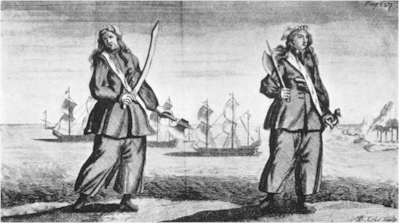
RHOADE, Captain John.
A Dutch coasting pilot of Boston.
In 1674 appointed chief pilot to the Curacao privateer Flying Horse, and sailed along the coast of Maine and as far north as the St. John River. Afterwards attacked and plundered several small English craft occupied in bartering furs with the Indians. Condemned to be hanged at Cambridge, Massachusetts, in June, 1675.
RICE, David. Welsh pirate.
Of Bristol.
Taken out of the Cornwall galley by Captain Roberts, he served in the Royal Fortune. Tried and found guilty of piracy and condemned to death, but was reprieved and sold to the Royal African Company to serve for seven years in their plantations.
RICE, Owen. Welsh pirate.
Of South Wales.
Hanged at the age of 27 at Rhode Island in 1723. One of Captain Charles Harris's crew.
RICHARDS, Lieutenant.
Lieutenant to Blackbeard on board the Queen Ann's Revenge. Cruised in the West Indies and along the coast of Carolina and Virginia.
In 1717 Teach blockaded the harbour at Charleston and sent Richards with a party of pirates to the Governor to demand a medicine chest and all necessary medical supplies, with a threat that if these were not forthcoming he would cut the throats of all his prisoners, many of them the leading merchants of the town. While waiting for the Governor's reply, Richards and his companions scandalized the towns-folk of Charleston by their outrageous and swaggering conduct.
RICHARDSON, John.
His father was a goldsmith at New York. John, tiring of the trade of cooper, to which he was apprenticed, ran away to sea. For many years he served both in men-of-war and in merchant ships. Although an unmitigated blackguard, he did not commit piracy nor murder until some years later, when, being at Ancona, he met a Captain Benjamin Hartley, who had come there with a loading of pilchards. Richardson was taken on board to serve as ship's carpenter, and sailed for Leghorn. With another sailor called Coyle, Richardson concocted a mutiny, murdered the captain in the most brutal manner, and was appointed mate in the pirate ship. As a pirate Richardson was beneath contempt. His life ended on the gallows at Execution Dock on January 25th, 1738.
RICHARDSON, Nicholas.
One of Captain Quelch's crew. Taken out of the brigantine Charles, and tried for piracy at Boston in 1704.
RIDGE, John.
Of London.
One of Major Stede Bonnet's crew. Hanged in 1718 at Charleston, South Carolina.
RINGROSE, Basil. Buccaneer, pirate, and author.
Sailed in 1679 to the West Indies. A year later Ringrose had joined the buccaneers at their rendezvous in the Gulf of Darien, where they were preparing for a bold enterprise on the Spanish Main. They landed and marched to the town of Santa Maria, which they plundered and burnt. Thence they travelled in canoes down the river to the Bay of Panama. After attacking the Spanish fleet and laying siege to the city, the buccaneers cruised up and down the West Coast of South America for eighteen months, sacking towns and attacking Spanish ships. All this while Ringrose kept a very full and graphic journal, in which he recorded not only their exploits, but also their hardships and quarrels, and gave descriptions as well of the various natives and their customs, and drew charts and sketches.
In 1681 Ringrose was still with Captain Sharp, and sailed through the Straits of Magellan, and on January 30th of the same year anchored off Antigua. Here he got a passage in a ship to England, landing safely at Dartmouth on March 26th.
A year later he published an account of his voyage, as a second volume to Esquemeling's, "Bucaniers of America." In 1684 he went to sea again in the Cygnet (Captain Swan), to traffic with the Spanish colonies. But the Spaniards refused to trade with them. In October, 1684, they met the famous Captain Edward Davis at that favourite haunt of the buccaneers, the Isle of Plate. The two captains agreed to join forces and to go together "on the account," so all the cargo was thrown overboard the Cygnet, and the ships set out to make war on any Spanish ships they might meet with.
In February, 1686, Ringrose with one hundred men took the town of Santiago in Mexico, but while returning with the plunder to their ship were caught by the Spaniards in an ambush, and Ringrose was killed.
Ringrose never attained any rank among the buccaneers beyond occasionally being put in charge of a boat or a small company on shore, but as a recorder of the doings of his companions he proved both careful and painstaking. Dampier had a great regard for him, and in his book he writes: "My ingenious friend Ringrose had no mind to this voyage, but was necessitated to engage in it or starve."
The title of Ringrose's book, first published in 1685, is "The Dangerous Voyage and Bold Assaults of Captain Bartholomew Sharp and Others."
Written by Mr. Basil Ringrose.
Printed for William Crooke, 1685.
ROACH, Peter.
When Captain Quelch was captured with his crew, Roach escaped near the Cape by Snake Island. He was afterwards captured and thrown into the gaol at Salem. Tried for piracy at the Star Tavern at Boston, and on June 30th, 1704, was hanged. At the place of execution Roach disappointed the onlooking crowd, as, instead of the expected and hoped-for repentant speech, "he seemed little concerned, and said but little or nothing at all."
ROB, Alexander.
One of Captain Gow's crew. Hanged at Execution Dock, Wapping, in June, 1724. He was not one of the original crew of the George galley, but was taken out of a prize and joined the pirates of his own free-will.
ROBBINS, James.
Hanged in Virginia in 1718 along with the rest of Captain Teach's crew.
ROBBINS, James.
Of London.
One of the crew of the Royal James. Hanged in 1718 at Charleston, South Carolina.
ROBERTS, Captain Bartholomew. Welsh pirate.
Born 1682. Died 1722.
If a pirate is to be reckoned by the amount of damage he does and the number of ships he takes there can be no doubt that Captain Roberts should be placed at the very head of his profession, for he is said to have taken over 400 vessels. The only man who can be said to rival him is Sir Henry Morgan, but Morgan, although in some ways an unmitigated blackguard, was a man of much greater breadth of outlook than Roberts ever was, and, moreover, was a buccaneer rather than a pirate.
Roberts, like many other successful pirates, was born in Wales, not far from Haverfordwest. He is described as being "a tall black man," and was about 40 years of age at the time of his death. He was remarkable, even among his remarkable companions, for several things. First of all, he only drank tea—thus being the only total abstainer known to the fraternity. Also he was a strict disciplinarian, and on board his ships all lights had to be extinguished by 8 p.m., any of the crew who wished to continue drinking after that hour had to do so on the open deck. But try as he would this ardent apostle of abstemiousness was unable to put down drinking. If Roberts had lived to-day, no doubt he would have been on the council of the local vigilance committee. He would allow no women aboard his ships, in fact he made it a law that any man who brought a woman on board disguised as a man was to suffer death. Roberts allowed no games at cards or dice to be played for money, as he strongly disapproved of gambling. He was a strict Sabbatarian, and allowed the musicians to have a rest on the seventh day. This was as well, for the post of musician on a pirate ship was no sinecure, as every pirate had the right to demand a tune at any hour of the day or night. He used to place a guard to protect all his women prisoners, and it is sadly suspicious that there was always the greatest competition amongst the worst characters in the ship to be appointed sentinel over a good-looking woman prisoner. All quarrels had to be settled on shore, pirate fashion, the duellists standing back to back armed with pistol and cutlass. Roberts would have no fighting among the crew on board his ship.
Bartholomew must have looked the very part of a pirate when dressed for action. A tall, dark man, he used to wear a rich damask waistcoat and breeches, a red feather in his cap, a gold chain round his neck with a large diamond cross dangling from it, a sword in his hand, and two pairs of pistols hanging at the end of a silk sling flung over his shoulders.