THE PIRATES' WHO'S WHO (continued 3)
Reading edition
GRANGE, Roger.
One of Captain Lowther's crew of the Happy Delivery. Tried for piracy at St. Kitts in 1722, but acquitted.
de GRAVES, Captain Herbert.
This Dutch pirate sailed as captain of his own merchant vessel during the reign of King Charles II. He took to landing his crew on the south coast of England and raiding gentlemen's houses. The first he ever pillaged was that of a Mr. Sturt, in Sussex. In those days, when banks were almost unknown, the houses of the rich often contained great sums of money. De Graves was wont to sail along the Devonshire coast, sometimes landing and robbing a house, sometimes taking a ship, which he would carry to Rotterdam and sell. He made several daring raids into Cowes and Lowestoft, getting off with valuable plunder.
In the war between England and the Dutch, Graves was given command of a fire-ship. This vessel he handled very capably, and in the action off the Downs he ran her on board the Sandwich, setting her on fire. James, Duke of York, escaped from the Sandwich with great difficulty, while the Earl of Albemarle and most of the crew perished. At the conclusion of the war, De Graves returned to piracy, but his ship was wrecked in a storm close to Walmer Castle. The captain and a few of his crew were saved, and, being made prisoners, were hanged on a tree.
GREAVES, Captain, alias "Red Legs." West Indian pirate.
Born in Barbadoes of prisoners who had been sent there as slaves by Cromwell. Most of these slaves were natives of Scotland and Ireland, and, owing to their bare knees, generally went by the name of Red Legs. Young Greaves was left an orphan, but had a kind master and a good education. His master dying, the lad was sold to another and a cruel one. The boy ran away, swam across Carlisle Bay, but by mistake clambered on to the wrong ship, a pirate vessel, commanded by a notoriously cruel pirate called Captain Hawkins. Finding himself driven to the calling of piracy, Greaves became very efficient, and quickly rose to eminence. He was remarkable for his dislike of unnecessary bloodshed, torture of prisoners, and killing of non-combatants. These extraordinary views brought about a duel between himself and his captain, in which the former was victorious, and he was at once elected commander.
Greaves now entered a period of the highest piratical success, but always preserved very strictly his reputation for humanity and morality. He never tortured his prisoners, nor ever robbed the poor, nor maltreated women.
His greatest success of all was his capture of the Island of Margarita, off the coast of Venezuela.
On this occasion, after capturing the Spanish Fleet, he turned the guns of their warships against the forts, which he then stormed, and was rewarded by a huge booty of pearls and gold.
Red Legs then retired to the respectable life of a planter in the Island of Nevis, but was one day denounced as a pirate by an old seaman. He was cast into a dungeon to await execution, when the great earthquake came which destroyed and submerged the town in 1680, and one of the few survivors was Greaves. He was picked up by a whaler, on board of which he served with success, and later on, for his assistance in capturing a gang of pirates, he received pardon for his earlier crimes.
He again retired to a plantation, and was noted for his many acts of piety and for his generous gifts to charities and public institutions, eventually dying universally respected and sorrowed.
GREENSAIL, Richard.
One of Blackbeard's crew in the Queen Ann's Revenge. Hanged in Virginia in 1718.
GREENVILLE, Henry.
Hanged at Boston in 1726 with Captain Fly and Samuel Cole.
GRIFFIN, Jack.
Chief mate of a Bristol vessel. One of the chief mutineers on board the Bird galley in 1718, off Sierra Leone, when he befriended the captain of the Bird, with whom he had been at school. Took part in a feast to celebrate the success of the mutiny, the meal being cooked in a huge caldron in which the slaves' food was prepared. In this caldron were boiled, on this occasion, fowls, ducks, geese, and turkeys, which were unplucked; several Westphalian hams were added, and a "large sow with young embowled." The health of King James III., the Pretender, was drunk with full honours.
GRIFFIN, John.
Of Blackwall, Middlesex.
Taken out of the Mercy galley and appointed carpenter on board the Royal Fortune by Captain Roberts. Condemned to be hanged at Cape Coast Castle, but pardoned and sold to the Royal African Company as a slave for seven years.
GRIFFIN, Richard.
A gunsmith of Boston.
Sailed with Captain Pound. Wounded in a fight at Tarpaulin Cove, a bullet entering his ear and coming out through his eye.
GROGNIET, Captain.
A French buccaneer who in 1683 was in company with Captain L'Escayer, with a crew of some 200 French and 80 English freebooters. He joined Davis and Swan during the blockade of Panama in 1685, and was in the unsuccessful attempt in May, 1685, on the Spanish treasure fleet from Lima. In July of the same year Grogniet, with 340 French buccaneers, parted company from Davis at Quibo, plundered several towns, and then, foolishly, revisited Quibo, where they were discovered by a Spanish squadron in January, 1686, and their ship was burnt while the crew was on shore. They were rescued by Townley, with whom they went north to Nicaragua, and sacked Granada. In May, 1686, Grogniet and half the Frenchmen crossed the isthmus. In the January following, Grogniet reappeared, and, joining with the English, again plundered Guayaquil, where he was severely wounded, and died soon afterwards.
GULLIMILLIT, Breti.
Taken with other South American pirates by H.M. sloop Tyne, and hanged at Kingston, Jamaica, in 1823.
GUTTEREZ, Juan.
Hanged at Kingston, Jamaica, on February 7th, 1823.
GUY, Captain.
Commanded the frigate James (fourteen guns, ninety men). Belonged to Tortuga Island and Jamaica in 1663.
HAINS, Richard.
One of Captain Low's crew. When Low took a Portuguese ship at St. Michael's in the Azores in 1723, he, with unusual kindness, simply burnt the ship and let the crew go to shore in a boat. While the prisoners were getting out the boat, Richard Hains happened to be drinking punch out of a silver tankard at one of the open ports, and took the opportunity to drop into the boat among the Portuguese and lie down in the bottom, so as to escape with them. Suddenly remembering his silver tankard, he climbed back, seized the tankard, and hid again in the boat, somehow, by great good fortune, being unobserved by those on the ship, and so escaped almost certain death both for himself and the Portuguese sailors.
HALSEY, Captain John.
This famous South Sea pirate was born on March 1st, 1670, at Boston, and received a commission from the Governor of Massachusetts to cruise as a privateer on the Banks. No sooner was he out of sight of land than Halsey turned pirate. Taking a ship or two, he sailed to the Canary Islands, picking up a rich Spanish ship there. He next doubled the Cape of Good Hope, and paid a call on the "brethren" at Madagascar. He then sailed to the Red Sea, another happy hunting ground of the pirates, and met a big Dutch ship armed with sixty guns. Halsey astounded his men by announcing his sudden determination to attack only Moorish ships in the future. The indignant crew mutinied, threw Captain Halsey and his chief gunner in irons, and proceeded to attack the Dutchman. The mutinous pirates got the worst of the encounter, and released Halsey, who only just managed to get his ship away. Luck seems to have deserted Halsey for a while, for not a Moorish ship could he meet with, so much so that his scruples against taking Christian ships eased enough to permit him to bag a brace of English ships, the Essex and the Rising Eagle.
The captain of the former proved to be a very old and dear friend of Halsey's quartermaster, and to show a friendly feeling, Halsey allowed the captain to keep all his personal belongings. Nevertheless, they took a comfortable booty, comprising some fifty thousand pounds in English gold, out of the Essex, and another ten thousand out of the Rising Eagle.
The pirates, being strict business men, produced invoices and sold the two ships back to their legal owners for cash, and having settled this affair to everybody's satisfaction, Halsey and his consort returned to Madagascar. Here they were visited by the captain of a Scotch ship, the Neptune, which had come to trade liquor, probably rum, but possibly whisky, with the pirates. A sudden hurricane arose, destroying both the pirate ships and damaging the Neptune. Halsey, ever a man of resource, thereupon seized the Scotch ship, and, with even greater enterprise, at once attacked a ship, the Greyhound, which lay at anchor, which was loaded with stolen merchandise which the pirates had only just sold to the captain of the Greyhound, and for which they had been paid.
The end was now drawing near, for in 1716 Captain Halsey was taken ill of some tropical fever and died. He was a popular commander, respected, ever loved by his men, for he was a humane man, never killing his prisoners unless necessity compelled. A contemporary eyewitness of his funeral rites leaves the following account of his burial:
"With great solemnity, the prayers of the Church of England being read over him and his sword and pistols laid on his coffin, which was covered with a ship's Jack. As many minute guns were fired as he was old—viz., 46—and three English vollies and one French volley of small arms." The chronicler continues: "His grave was made in a garden of watermelons and fenced in to prevent his being rooted up by wild pigs."
This last a truly touching thought on the part of the bereaved.
HAMAN, Captain John.
He lived all alone with his wife and family on a small and otherwise uninhabited island in the Bahamas.
About the year 1720, he sailed into New Providence Harbour in his 40-ton sloop, intending to settle there. Captain Rackam and Anne Bonny stole this vessel and eloped in her.
Writing of Captain Haman, Johnson tells us "his Livelihood and constant Employment was to plunder and pillage the Spaniards, whose Sloops and Launces he had often surprised about Cuba and Hispaniola, and sometimes brought off a considerable Booty, always escaping by a good Pair of Heels, insomuch that it became a Bye-Word to say, 'There goes John Haman, catch him if you can.' His Business to Providence now was to bring his Family there, in order to live and settle, being weary, perhaps, of living in that Solitude, or else apprehensive if any of the Spaniards should discover his Habitation, they might land, and be revenged of him for all his Pranks."
HAMLIN, Captain Jean.
A famous French filibuster who turned pirate.
Set out in 1682 from Jamaica in a sloop with 120 other desperadoes in pursuit of a French ship that was "wanted" by the Jamaican Governor. Having overtaken the ship, La Trompeuse, he seized her, fitted her up as a man-of-war, and then started out on a wild piratical cruise, taking eighteen Jamaican vessels, barbarously ill-treating the crews, and completely demoralizing the trade of the island. Two other ships were now sent to find and destroy the new La Trompeuse, but Hamlin escaped and sailed to the Virgin Islands, and was most hospitably received by the Governor of the Danish Island of St. Thomas, one Adolf Esmit, who was himself a retired pirate. Using this island as his headquarters Hamlin cruised about and took several English ships.
In May, 1683, he appeared on the West Coast of Africa disguised as an English man-of-war. Off the coast of Sierra Leone, he took seventeen Dutch and English ships, returning to Dominica in July, 1683, finally reaching the friendly St. Thomas Island, being warmly welcomed back by the pirate Governor. Three days afterwards, H.M.S. Francis arrived on the lookout for pirates, and attacked and burnt Hamlin's ship. Hamlin, with the help of the Governor, managed to escape with his life.
HANDS, Israel, also known as Basilica Hands.
Sailing-master with the famous Teach or Blackbeard. One day when Teach was entertaining a pilot and Hands in his cabin, after they had been drinking and chatting awhile seated round the cabin table, on which stood a lighted candle, Blackbeard suddenly drew his pistols, blew out the candle, and crossing his arms, fired both his pistols under the table. Hands was shot in the knee, and crippled for life. Teach's explanation to the angry demands of his guests as to the reason for this extraordinary conduct produced the reply that "if he did not shoot one or two of them now and then, they'd forget who he was." Hands after this deserted, but was captured at Bath in Carolina by Brand. Hands, probably in revenge for being wantonly shot by Teach, turned King's evidence at the inquiry held at Charleston, and brought very serious accusations against one of the most prominent men in the colony, Knight, who was secretary to the Chief Justice, and a deputy collector of Customs.
Hands was tried for piracy in Virginia in December, 1718, but pardoned. When last heard of was seen begging his bread in London.
HANSEL, Captain.
He behaved himself so courageously at the taking of Porto Bello in 1669, that a party of some 400 men, in four ships, chose Hansel to be their admiral in an attempt on the town of Comana, near Caracas. This attack was a most complete failure, the pirates being driven off "with great loss and in great confusion." When Hansel's party arrived back at Jamaica, they found the rest of Morgan's men had returned before them, who "ceased not to mock and jeer at them for their ill success at Comana, after telling them, 'Let us see what money you brought from Comana, and if it be as good silver as that which we bring from Maracaibo.'"
HARDING, Captain Thomas.
In 1653 he captured a rich prize, a Barbadoes vessel. For this he was tried for piracy at Boston.
HARDY, Richard.
One of Captain Bartholomew Roberts's crew. Hanged at Cape Coast Castle, West Coast of Africa, on April 6th, 1722, at the age of 25 years.
It is recorded that, owing to the lack of expert knowledge in the niceties of carrying out executions, Hardy was led to the scaffold with his hands tied behind him. This annoyed Hardy very much, and it is mentioned in the official account of his execution that the prisoner indignantly declared "that he had seen many a Man hang'd, but this Way of the Hands being ty'd behind them, he was a Stranger to, and never saw before in his Life."
HARPER, Abraham.
Born at Bristol.
He was cooper on board Captain Roberts's Royal Fortune. When the pirates took a prize, it was Harper's duty to see that all the casks and coopers' tools were removed from the prize to the pirate craft.
Hanged at the age of 23, with the rest of the crew, in 1722.
HARRIS, Captain.
Joined the Barbary corsairs during the reign of Queen Elizabeth, turned Mohammedan, and rose to command a Moorish pirate vessel. Cruised off the coast of Ireland, was taken prisoner by an English ship, and hanged at Wapping.
HARRIS, Hugh.
Of Corfe Castle, Dorsetshire.
One of Roberts's crew; tried and condemned to be hanged in 1722, but reprieved and sold to the Royal African Company to serve for seven years in their plantations.
HARRIS, James.
One of Roberts's crew.
HARRIS, Peter.
Born in Kent.
This buccaneer was known amongst the brethren of the coast as "a brave and Stout Soldier."
In 1680 he took a leading part in the march of the buccaneers across the Isthmus of Darien, but during the attack on the Spanish Fleet off Panama he was shot in both legs, and died of his wounds.
HARRIS, Richard.
A Cornishman.
One of Captain Roberts's crew and the oldest, being 45 years of age when he was hanged, an unusually advanced age to reach in this most "unhealthy" profession.
HARRISON, Captain.
Sailed in October, 1670, in company with Captains Prince and Ludbury, into Port Royal, after a successful expedition with 170 men up the San Juan River in Nicaragua, when they plundered the unfortunate city of Granada. This city had suffered so much from previous attacks from the buccaneers that the plunder came to only some £20 per man on this occasion.
Modyford, the Governor of Jamaica, "reproved the captains for acting without commissions, but did not deem it prudent to press the matter too far"; in fact, instead of arresting Harrison and his crew, he sent them to join Morgan the Buccaneer, who was then gathering together a great fleet of buccaneers at the Isle of Vache.
HARVEY, Captain.
Arrived at New London in 1685 in company with another pirate, Captain Veale; posed as an honest merchant, but, being recognized, left in great haste.
HARVEY, William.
Tried for piracy with the rest of Gow's crew at Newgate in 1725, and acquitted.
HARWOOD, John.
Tried for piracy at Boston in 1704. One of the crew of the brigantine Charles (Captain John Quelch, Commander).
HATTSELL, Captain.
This buccaneer served as an officer with Mansfield in his successful and daring night attack on the Island of Providence, when, with only 200 men, the fort was captured and the Spanish Governor taken prisoner. Captain Hattsell was left behind with thirty-five men to hold the island, while Mansfield sailed to the mainland with his prisoners, who had surrendered on condition that they should be safely conducted there.
HAWKINS, Captain.
A seventeenth-century Barbadoes pirate. Notorious for his cruelty, which led to his fighting a duel with one of his crew, Greaves, alias Red Legs, by whom he was defeated, his victor being elected captain in his place.
HAWKINS, Sir John.
Born in 1532.
This famous Elizabethan seaman sailed in 1561 to the Canary Islands, and traded in negro slaves between Africa and Hispaniola. Afterwards became an officer in the Royal Navy. Died at sea off Porto Bello, in 1595, when serving with Drake in the West Indies.
HAWKINS, Captain Thomas.
In the year 1689 cruised off the coast of New England, burning and plundering the shipping. The Bay colony sent out an armed sloop, the Mary (Samuel Pease, commander), in October of that year, to attempt to capture Hawkins. Pease found the pirate in Buzzard's Bay. Hawkins ran up a red flag and a furious engagement began. The crew of the Mary at last boarded the pirates, and the captain, Pease, was so severely wounded that he died.
HAWKINS, Thomas.
Born at Boston.
Turned pirate and cruised with Captain Pound. Tried for piracy at Boston in 1690, but reprieved. Sent to England, but on the voyage was killed in a fight with a French privateer.
HAYES, Captain, nicknamed "Bully Hayes." A South Sea pirate.
In 1870 was arrested by the English Consul at Samoa for piracy. There being no prison in this delightful island, the Consul ran Hayes's ship on shore, and waited for a man-of-war to call and take his prisoner away. Hayes spent his time, while under open arrest, attending native picnic parties, at which he was the life and soul, being, when off duty, a man of great charm of manner and a favourite with the ladies. Presently another pirate arrived, one Captain Pease, in an armed ship with a Malay crew. Hayes and Pease quarrelled violently, and the Consul had great trouble to keep the two pirates from coming to blows. This animosity was all a sham to throw dust in the Consul's eyes, for one night Pease sailed away with Hayes, whom he had smuggled on board his ship.
HAZEL, Thomas.
Of Westminster.
Hanged in Rhode Island in 1723 at the advanced age, for a pirate, of 50. This is one of the longest lived pirates we have been able to hear of.
HEAMAN, Peter, alias Rogers.
A French pirate, born in 1787.
Sailed from Gibraltar in May, 1821, as mate on board the schooner Jane (Captain Thomas Johnson), bound for Bahia, Brazil, with a very rich cargo of beeswax, silk, olives, and other goods, as well as eight barrels of Spanish dollars.
When about seventeen days out, in the middle of the night, Heaman attacked one of the crew, James Paterson, and beat him to death. On the captain coming up on deck to find out what all the noise was about, Heaman beat him to death with a musket, being assisted by the cook, Francis Gautier, also a Frenchman. The two conspirators then proceeded to imprison the rest of the crew in the forecastle, and threw the dead bodies of the captain and the sailor overboard. For two days the murderers tried to suffocate the crew by burning pitch and blowing the smoke into the forecastle. Failing to accomplish this they let the crew out after each had sworn on the Bible not to inform on them. The course was now altered, and they sailed towards Scotland. The barrels of dollars were broken open and the coins placed in bags. In June they reached the Island of Barra, where Gautier went ashore, wearing the late captain's green coat, and bought a large boat. Next, they sailed to Stornoway, where they arrived in July, and here they sank their schooner. The crew rowed ashore in the long-boat, sharing out the dollars as they went, using an old tin as a measure, each man getting 6,300 dollars as his share. Their boat was smashed on the rocks when landing, but they got their plunder safely ashore and hid it amongst the stones on the beach. Early next morning the mutineers were visited by the Customs officer. After he had left, the cabin boy, a Maltese, ran after him and told him the true story of the murders and robbery. A party of islanders was got together, the mutineers arrested and taken to Edinburgh, where Heaman and Gautier were tried for piracy and murder, and on November 27th found guilty and condemned to death. They were both hanged on January 9th, 1822, on the sands of Leith, within the flood mark, and afterwards their bodies were delivered to Dr. Alexander Munro, Professor of Anatomy in the University of Edinburgh, to be publicly dissected by him.
HEATH, Peleg.
One of William Coward's crew. Condemned to be hanged at Boston in 1690, but afterwards reprieved.
HEIDON, Captain.
Arrested for piracy in 1564 for having captured a Flemish ship. This vessel he manned with thirteen Scotchmen in addition to his own crew, and sailed off the coast of Spain. Here he took a prize containing a cargo of wine, which he carried to the Island of Bere in Bantry Bay. The wine was sold to Lord O'Sullivan. Heidon now fitted up another ship, the John of Sandwich. Was wrecked in her on the Island of Alderney and Heidon was arrested, but managed to escape in a small boat with some others of the pirates.
HENLEY, Captain.
In 1683 sailed from Boston "bound for the Rack," afterwards going to the Red Sea, where he plundered Arab and Malabar ships.
HERDUE, Captain. Buccaneer.
Commanded a frigate of four guns, crew of forty men, at Tortuga Island, in 1663.
HERNANDEZ, Augustus.
Hanged at Kingston, Jamaica, in 1823.
HERNANDEZ, Juan.
Captured with nine other pirates by H.M. sloop-of-war Tyne and taken to Jamaica. Hanged on February 7th, 1823, at Kingston.
HERRIOTT, David.
Master of the Adventure, from Jamaica, taken by Teach in 1718. He joined the pirates, and later, when Major Stede Bonnet separated from Teach, he took Herriott to be his sailing-master. Taken prisoner with Bonnet and his crew of the Royal James by Colonel Rhet, at Cape Fear, North Carolina, September 27th, 1718. Herriott and the boatswain, Ignatius Pell, turned King's evidence at the trial of the pirates held at Charleston. On October 25th, Bonnet and Herriott escaped from prison, in spite of the fact that the latter had turned King's evidence. Herriott was shot on Sullivan Island a few days later.
HEWETT, William, or Hewet, or Hewit.
Of Jamaica.
One of Major Stede Bonnet's crew. Tried for piracy at Charleston in 1718, and hanged at White Point on November 8th, and buried in the marsh below low-water mark.
HIDE, Daniel.
Of Virginia.
One of the crew of Captain Charles Harris, who, with Captain Low, played havoc on the shipping off the American coast from New York to Charleston. Hanged at Newport, Rhode Island, in July, 1723, at the age of 23.
HILL, Corporal John.
In charge of the guard at Fort Royal, Falmouth, Maine, which all deserted one night, and went to sea with the pirate Captain Pound. Killed at Tarpaulin Cove in 1689.
HILLIARD, John.
Was "chief man" of the company of Captain Bartholomew Sharp on his "dangerous voyage" to the South Seas. Died on January 2nd, 1681, of dropsy; buried at sea with the usual buccaneers' honours.
HINCHER, Dr. John.
Of Edinburgh University.
Tried for piracy in July, 1723, at Newport, Rhode Island, but acquitted. This young doctor, his age was only 22, was taken off a prize by Captain Low against his will, to act as ship's surgeon with the pirates.
HIND, Israel, or Hynde.
Of Bristol.
One of Captain Roberts's crew. Hanged at Cape Coast Castle in 1722, at the age of 30.
HINGSON, John.
One of Wafer's party left behind and lost in the forest when Dampier crossed the Isthmus of Darien on foot in 1681.
HITCHENS, Robert.
A Devonshire man, born in the year 1515.
Took to piracy early in life. Sailed with the pirate Captain Heidon, and was wrecked on Alderney in the year 1564. Arrested and tried for piracy, and was hanged in chains at low-water mark at St. Martin's Point, Guernsey, in 1564, at the age of 50.
HOLDING, Anthony.
One of John Quelch's crew of the brigantine Charles. Tried for piracy at Boston in 1704.
HOLFORD, Captain. Buccaneer.
Of Jamaica.
An old friend of the notorious pirate Vane. In 1718 he happened to arrive in his ship at a small uninhabited island in the Bay of Honduras to find Vane on shore and destitute. Vane thought he would be saved by Holford, but the latter was quite frank in refusing, saying: "I shan't trust you aboard my ship unless I carry you a prisoner, for I shall have you caballing with my men, knock me on the head, and run away with my ship a-pyrating." It was owing to Holford that Vane was eventually taken a prisoner to Jamaica and there hanged.
HOLLAND, Captain Richard.
An Irishman.
Commanded a Spanish pirate vessel in the West Indies in 1724. The crew consisted of sixty Spaniards, eighteen French, and eighteen English sailors. Holland had originally belonged to the Royal Navy, but deserted from the Suffolk at Naples, and took shelter in a convent in that city. In August, 1724, Holland's ship took as prizes the John and Mary, the Prudent Hannah of Boston, and the Dolphin, of Topsham, all on their way to Virginia. From out of the John and Mary he took thirty-six men slaves, some gold dust, the captain's clothes, four great guns and small arms, and 400 gallons of rum.
HOPKINS, Mr. Buccaneer and apothecary.
First lieutenant to Captain Dover (a doctor of physic) on board the Duchess privateer, of Bristol. Mr. Hopkins was an apothecary by profession, not a sailor, but being a kinsman to the captain, no doubt was given promotion. He sailed from Bristol on August 2nd, 1708.
HORE, Captain.
About 1650 Hore turned from a privateer into a pirate, and was very active and successful in taking prizes between New York and Newport, occasionally sailing to Madagascar to waylay ships of the East India Company.
HORNIGOLD, Captain Benjamin.
Commanded a sloop in 1716 and cruised off the Guinea coast with Teach, taking a big French Guinea ship. He then sailed to the Bahama Islands, where, in 1718, Woodes Rogers had just arrived with the offer of a pardon to all pirates who surrendered themselves. Teach went off again "on the account," but Hornigold surrendered. Shortly afterwards Hornigold was wrecked on a reef and drowned.
HOW, Thomas.
A native of Barnstaple in Devon.
One of Captain Bartholomew Roberts's crew. Condemned to death for piracy, but reprieved and sold to the Royal African Company to work on their plantations for seven years.
HOWARD, Thomas.
Born in London, the son of a Thames lighterman. Sailing to Jamaica, he deserted his ship and, with some companions of a like mind, stole a canoe and set off to the Grand Cayman Islands, and there met with some 200 buccaneers and pirates. Joining with these, they took several vessels, lastly a well-armed Spanish ship. In her they cruised off the coast of Virginia, taking a large New England brigantine, of which Howard was appointed quartermaster. Their next prize was a fine Virginian galley, twenty-four guns, crowded with convicts being transplanted to America. These passengers were only too willing to join the pirates.
Next, they sailed away to Guinea, where they took numerous prizes. Here they were attacked by a big Portuguese ship of thirty-six guns, which they defeated. Having by now got together a well appointed pirate fleet, they sailed round the Cape of Good Hope to Madagascar, the happy home of the South Sea pirates. Their ship, the Alexander, was wrecked and lost on a reef, and Howard, together with the English and Dutch members of the crew, seized the treasure, and drove off the Portuguese and Spanish sailors and also the captain, and got to shore in a boat. They then broke up their ship, and lived for a while by fishing and hunting. On one of these hunting parties, the men ran away and left Howard behind.
Howard was found by the King of Anquala, who took care of him until he was picked up by a ship. Later on, Howard became captain of a fine vessel, the Prosperous, thirty-six guns, which he and some other pirates had seized at Madagascar. In her, Howard went cruising, eventually in company with Captain Bowen, attacking a Moorish fleet off St. John's Island. Howard followed the Moorish ships up a river, and, after a fierce fight, seized the largest and richest prize, a ship containing upward of a million dollars worth of goods. Howard, having now made a considerable fortune, retired from the piratical life and went to India, and there married a native woman and settled down. Howard, who was a morose, sour kind of man, ill-treated his wife, and he was at length murdered by some of her relations.
HUGGIT, Thomas.
Of London.
Hanged at Newport, Rhode Island, in July, 1723. Age 30.
HULL, Captain Edward.
Commanded the Swallow "frigott" in which he sailed from Boston in 1653, and captured several French and Dutch ships. He afterwards sold his vessels and went with his share of the plunder to England, where he settled down.
HUNTER, Andrew.
One of Captain Lowther's crew. Hanged at St. Kitts on March 11th, 1722.
HUSK, John.
One of Blackbeard's crew in the Queen Ann's Revenge. Killed off North Carolina in 1718.
HUTNOT, Joseph.
One of the crew of the notorious brigantine Charles, commanded by Captain Quelch. Tried for piracy at the Star Tavern, Boston, in 1704.
HUTT, Captain George, or Hout. Buccaneer.
An Englishman who succeeded Captain Townley when the latter was killed during a gallant fight with three Spanish galleons in 1686 near Panama.
INGRAM, Gunner William.
Was one of Captain Anstis's crew in the Good Fortune when that pirate took the Morning Star. After the prize had been converted to the pirates' use, Ingram was appointed gunner. Later, when Ingram came to be tried for piracy, evidence was produced to prove that he had joined the pirates of his own free will, and, in fact, had on all occasions been one of the forwardest in any action, and altogether "a very resolute hardened Fellow." He was hanged.
IRELAND, John. Pirate.
"A wicked and ill-disposed person," according to the royal warrant of King William III. granted to "our truly and dearly beloved Captain William Kidd" to go in the year 1695 to seize this and other pirates who were doing great mischief to the ships trading off the coast of North America.
IRVINE, Captain.
One of the last pirates in the Atlantic. Very active in the early part of the nineteenth century.
JACKMAN, Captain. Buccaneer.
In 1665 took part with Morris and Morgan in a very successful raid on Central America, ascending the river Tabasco in the province of Campeachy with only 107 men. Led by Indians by a detour of 300 miles, they surprised and sacked the town of Villa de Mosa. Dampier describes this small town as "standing on the starboard side of the river, inhabited chiefly by Indians, with some Spaniards." On their return to the mouth of the river, Jackman's party found the Spaniards had seized their ship, and some three hundred of them attacked the pirates, but the Spaniards were easily beaten off.
The freebooters next attacked Rio Garta, and took it with only thirty men, crossed the Gulf of Honduras to rest on the Island of Roatan, and then proceeded to the Port of Truxillo, which they plundered. They next sailed down the Mosquito coast, burning and pillaging as they went.
Anchoring in Monkey Bay, they ascended the San Juan River in canoes one hundred miles to Lake Nicaragua. The pirates described the Lake of Nicaragua as being a veritable paradise, which, indeed, it must have been prior to their visit. Hiding by day amongst the many islands and rowing by night, on the fifth night they landed near the city of Granada, just one year after Mansfield's visit. The buccaneers marched right into the central square of the city without being observed by the Spaniards, who were taken completely by surprise, so that the English were soon masters of the city, and for sixteen hours they plundered it. Some 1,000 Indians, driven to rebellion by the cruelty and oppression of the Spaniards, accompanied the marauders and wanted to massacre the prisoners, particularly "the religious," but when they understood that the buccaneers were not remaining in Granada, they thought better of it, having, no doubt, a shrewd inkling of what to expect in the future when their rescuers had left.
JACKSON, Captain William. Buccaneer.
In 1642 he gathered together a crew of more than a thousand buccaneers in the Islands of St. Kitts and Barbadoes, and sailed with these in three ships to the Spanish Main, plundering Maracaibo and Truxillo.
On March 25th, 1643, Jackson's little fleet dropped anchor in the harbour, what was afterwards to be known as Kingston, in the Island of Jamaica, which was then still in the possession of Spain. Landing 500 of his men, he attacked the town of St. Jago de la Vega, which he took after a hard fight and with the loss of some forty of his men. For sparing the town from fire he received ransom from the Spaniards of 200 beeves, 10,000 pounds of cassava bread, and 7,000 pieces of eight. The English sailors were so delighted by the beauty of the island that in one night twenty-three of them deserted to the Spaniards.
JACKSON, Nathaniel.
One of Captain Edward Teach's crew. Killed at North Carolina in 1718.
JAMES, Captain. Buccaneer.
Belonged to Jamaica and Tortuga. In 1663 was in command of a frigate, the American (six guns, crew of seventy men).
JAMES, Captain.
A buccaneer captain who was in 1640 temporarily appointed "President" of Tortuga Island by the Providence Company, while their regular Governor, Captain Flood, was in London, clearing himself of charges preferred against him by the planters.
JAMES, Captain.
About 1709 commanded a pirate brigantine off Madagascar. Sailed for some time in company with a New York pirate called Ort Van Tyle.
JAMES, Charles.
One of Captain John Quelch's crew taken in the Larimore galley at Salem. Tried for piracy at Boston in 1704.
JAMISON, alias Monacre Nickola.
Born at Greenock in Scotland, the son of a rich cloth merchant, he received a polite education, spoke several languages, and was described as being of gentlemanly deportment.
He served as sailing-master to Captain Jonnia when he took the schooner Exertion. The captain and crew were eventually saved by Nickola. Years afterwards Nickola went to Boston, and lived with Captain Lincoln of the Exertion, and made a living by fishing for mackerel in the warm season, and during the winter by teaching navigation to young gentlemen.
JANQUAIS, Captain.
A French filibuster of San Domingo.
His ship, La Dauphine, carried thirty guns and a crew of 180 men.
JEFFERYS, Benjamin.
Of Bristol.
Taken by Roberts in the Norman galley in April, 1721. Roberts allowed those of the crew who did not wish to join the pirates to return to the Norman, but Jefferys had made such friends on the pirate ship that he was too drunk to go, and also was abusive in his cups, telling his hosts there was not one man amongst them. For this he received six lashes with the cat-o'-nine-tails from every member of the crew, "which disordered him for some weeks." But Jefferys eventually proved himself a brisk and willing lad, and was made bos'on's mate. He was hanged a year later at the age of 21.
JENNINGS.
A Welshman who in 1613 was settled on the Barbary coast with some thirty other British pirates.
JENNINGS, Captain.
This Welsh pirate had been a man of good position, education, and property before he took to piracy, which he did for the love of the life and not from necessity. He was held in high esteem by his fellow-pirates at their stronghold in the Bahamas. When notice was brought of King George's pardon in 1717, a meeting was held of all the pirates at which Jennings presided. After much discussion, Jennings boldly gave out that he himself meant to surrender, whereupon some hundred and fifty other pirates declared their intention of doing likewise. On the new Governor's arrival from England they received their certificates, though the greater part of them soon went back to piracy, or, to quote the expressive Captain Johnson, "returned again like the Dog to the Vomit."
JOBSON, Richard, or Cobson or Gopson.
His original calling was that of a druggist's assistant in London. He combined piracy with the study of divinity. He was one of Dampier's party which crossed the Isthmus of Darien in 1681, and was left behind with Wafer, who tells us in his book that Gopson "was an ingenious man and a good scholar, and had with him a Greek testament which he frequently read and would translate extempore into English to such of the company as were disposed to hear him."
After great sufferings in the tropical jungle in the wet season, Jobson and his friends reached the "North Sea" to find an English buccaneer vessel lying at anchor off the shore. On rowing out to the ship the canoe upset, and Jobson and his gun were thrown overboard, but the former was rescued, though he died a few days later on board the vessel owing to the exposure he had been subjected to. He was buried in the sand at Le Sounds Cay with full honours—that is, a volley of guns and colours flown at half-mast.
JOCARD, Le Capitaine.
A French filibuster who in 1684 had his headquarters in San Domingo.
He commanded the Irondelle, a ship armed with eighteen guns and a crew of 120 men.
JOHNSON, Captain. A successful and very bloody pirate.
Of Jamaica.
Immediately after the publication of peace by Sir Thomas Lynch, Governor of Jamaica in 1670, which included a general pardon to all privateers, Johnson fled from Port Royal with some ten followers, and shortly after, meeting with a Spanish ship of eighteen guns, managed to take her and kill the captain and fourteen of the crew. Gradually collecting together a party of a hundred or more English and French desperadoes he plundered many ships round the Cuban coast. Tiring of his quarrelsome French companions he sailed to Jamaica to make terms with the Governor, and anchored in Morant Bay, but his ship was blown ashore by a hurricane. Johnson was immediately arrested by Governor Lynch, who ordered Colonel Modyford to assemble the justices and to proceed to trial and immediate execution. Lynch had had bitter experiences of trying pirates, and knew that the sooner they were hanged the better. But Modyford, like many other Jamaicans, felt a strong sympathy for the pirates, and he managed to get Johnson acquitted in spite of the fact that Johnson "confessed enough to hang a hundred honester persons." It is interesting to read that half an hour after the dismissal of the court Johnson "came to drink with his judges." Governor Lynch, now thoroughly roused, took the matter into his own hands. He again placed Johnson under arrest, called a meeting of the council, from which he dismissed Colonel Modyford, and managed to have the former judgment reversed. The pirate was again tried, and in order that no mistake might happen, Lynch himself presided over the court. Johnson, as before, made a full confession, but was condemned and immediately executed, and was, writes Lynch, "as much regretted as if he had been as pious and as innocent as one of the primitive martyrs." This second trial was absolutely illegal, and Lynch was reproved by the King for his rash and high-handed conduct.
JOHNSON, Captain Ben.
When a lad he had served as a midshipman in an East Indiaman, the Asia, but having been caught red-handed robbing the purser of brandy and wine, he was flogged and sent to serve as a sailor before the mast. In 1750, while in the Red Sea, he deserted his ship and entered the service of the Sultan of Ormus. Finding Johnson to be a clever sailor, the Sultan appointed him admiral of his pirate fleet of fourteen vessels. The young admiral became a convert to Brahminism, and was ceremoniously blessed by the arch-priests of the Temple. Amongst his crew Johnson had some two hundred other Englishmen, who also became followers of Brahmin, each of whom was allowed, when in port, a dancing girl from the Temple.
Johnson proved a most capable and bloodthirsty pirate, playing havoc with the shipping of the Red Sea, taking also several towns on the coast, and putting to death his prisoners, often after cruel tortures. His boldest exploit was to attack the fortified town of Busrah. This he did, putting the Sheik and most of the inhabitants to death, and taking back to his master, the Sultan, vast plunder of diamonds, pearls, and gold.
On another occasion Johnson landed his crews on the Island of Omalee, at the entrance to the Persian Gulf, a favourite place of pilgrimage, and raided the temples of the Indian God Buddha. Putting to death all the two thousand priests, he cut off the noses and slit the upper lips of seven hundred dancing girls, only sparing a few of the best looking ones, whom he carried away with him along with plunder worth half a million rupees.
On their way back to the Red Sea the pirates met with an English East Indiaman, which they took and plundered, and Johnson, remembering his previous sufferings in the same service, murdered the whole crew.
Shortly afterwards Johnson and ten of his English officers contrived to run away from their master, the Sultan, in his best and fastest lateen vessel, with an enormous booty. Sailing up to the head of the Persian Gulf, Johnson managed to reach Constantinople with his share of the plunder, worth £800,000. With this as an introduction, he was hospitably received, and was made a bashaw, and at the end of a long life of splendour died a natural death.
JOHNSON, Captain Henry, alias "Henriques the Englishman."
A West Indian pirate, born in the North of Ireland.
Commanded the Two Brothers, a Rhode Island-built sloop, eighteen guns, crew of ninety, mostly Spaniards. On March 20th, 1730, he took the John and Jane (Edward Burt, master), from Jamaica, off Swan Island. The John and Jane was armed with eight carriage and ten swivel guns, and a crew of only twenty-five men. After a gallant resistance for five hours the pirates boarded and took the English ship. The few survivors were stripped naked, and preparations made to hang them in pairs. This was prevented by Captain Johnson and an English pirate called Echlin. There was a Mrs. Groves, a passenger, in the John and Jane, whose husband and the English surgeon had both been killed at the first onslaught of the pirates. This poor lady was hidden in the hold of the ship during the action, and was only informed afterwards of the death of her husband. The pirates now dragged her on deck, "stript her in a manner naked," and carried her as a prize to the Spanish captain, Pedro Poleas, who immediately took her to the "great cabin and there with horrible oaths and curses insolently assaulted her Chastity." Her loud cries of distress brought Captain Johnson into the cabin, who, seeing what was on hand, drew his pistol and threatened to blow out the brains of any man who attempted the least violence upon her. He next commanded everything belonging to Mrs. Groves to be returned to her, which was done—including her clothing. The gallant conduct of Johnson is the more surprising and pleasing since he had the reputation of being as bloody and ruthless a pirate as ever took a ship or cut an innocent throat. He only had one hand, and used to fire his piece with great skill, laying the barrel on his stump, and drawing the trigger with his right hand.
In all the American "plantations" there were rewards offered for him alive or dead.
The end of this "penny-dreadful" pirate is unrecorded, but was probably a violent one, as this type of pirate seldom, if ever, died in his bed.
JOHNSON, Isaac.
One of Captain Quelch's crew. Tried for piracy at the Star Tavern at Boston in 1704.
JOHNSON, Jacob.
Taken prisoner by Captain Roberts out of the King Solomon, he joined the pirates.
JOHNSON, John, or Jaynson.
Born "nigh Lancaster."
Taken out of the King Solomon. One of Roberts's crew. Hanged in 1722 at the age of 22.
JOHNSON, Marcus.
One of Captain Roberts's crew. Hanged in 1722. Stated in his death warrant to be a native of Smyrna. Died at the age of 21.
JOHNSON, Robert.
From Whydah in West Africa.
Tried for piracy with the rest of Captain Roberts's crew, and hanged in 1722 at the age of 32. At his trial he pleaded that he did not enter with the pirates of his own free will, and called witnesses to prove that at the time he was captured he was so very drunk that he had to be hoisted out of his own ship, the Jeremiah and Ann, into the pirate ship in tackles.
JOHNSTON, Thomas.
Of Boston.
Known as "the limping privateer." Sailed with Captain Pound. Wounded in the jaw in the fight at Tarpaulin Cove. Tried for piracy at Boston, and hanged on January 27th, 1690.
JONES, Captain Paul.
Probably few persons, even in Great Britain, would to-day call Paul Jones a pirate, but this was not always the case. In all books on pirates written shortly after the American war, Paul Jones figured as a notorious character.
This famous privateer, let us call him, was born at Kirkcudbright in Scotland in 1728, the son of Mr. Paul, head gardener to Lord Selkirk, and was christened John Paul. So much has been written about this man in books, easily procurable for reference, that little need be said about him here.
Starting life as a sailor before the mast, he quickly showed abilities which led to his promotion to the rank of mate in an English ship trading in the West India Islands, and later he was made master. On the declaration of war with America, Jones joined the rebels, and was given command of a privateer, and from 1777 he became a terror to English shipping around the British Isles.
One of his most startling exploits was his surprise visit in his ship, the Ranger, to his old home with the object of kidnapping his former employer, Lord Selkirk.
On September 23rd, 1779, he fought his famous action off Scarborough against a British convoy from the Baltic under the command of Captain Pearson, in the Serapis, and Captain Piercy in the Countess of Scarborough. Jones had left the Ranger for a frigate called the Bonne Homme Richard of forty guns and a crew of three hundred and seventy men, and had also under his command four other ships of war. A furious engagement took place, the utmost bravery being shown on either side; the English ships at last being compelled to surrender, but not until the enemy had themselves suffered fearful damage to both their crews and ships. After the conclusion of peace, Paul Jones, once the darling of two continents, faded into obscurity and even poverty, and died in Paris in the year 1792 at the age of 64.
JONES. Seaman.
A mariner. "A brisk young fellow" who served with Captain Bartholomew Roberts's crew. On one occasion Captain Roberts had reason to think that one of his men had spoken disrespectfully to him, so, as a warning to the rest, he killed him. The dead man's greatest friend was Jones, who, hearing what had happened, had a fierce fight with Roberts. This severe breach of discipline was punished by Jones receiving two lashes on the back from every man on board. Jones after this sailed with Captain Anstis in the Good Fortune.
JONES, Thomas.
Found to be "not guilty" at a trial for piracy at Newport, Rhode Island, in 1723. One of Captain Charles Harris's crew. Age 17.
JONES, William.
Tried for piracy at Boston, 1704.
JONES, William.
Of London.
Age 28. Hanged at Rhode Island, 1723.
JONNIA, Captain.
A Spaniard.
Commanded in 1821 a fast schooner, carrying a crew of forty men, armed with muskets, cutlasses, blunderbusses, long knives, dirks, two carronades—one a twelve, the other a six-pounder. They had aboard with them three Mexican negresses. The pirates took and plundered the Boston schooner Exertion, on December 17th, 1821, the crew being considerably drunk at the time. The plunder they took to Principe in the Island of Cuba. The pirates took everything from their prisoners, even their clothes, but as a parting gift sent the captain a copy of the "Family Prayer Book" by the Rev. Mr. Brooks. The prisoners were marooned on a small mangrove quay, but they eventually escaped. Jonnia and some of his crew were afterwards captured by an English ship and taken to Kingston, Jamaica, and there hanged.
JOSE, Miguel.
Hanged at Kingston, Jamaica, in February, 1823. This old man's last words on the scaffold were: "No he robado, no he matado ningune, muero innocente."
JUDSON, Randall.
One of Captain Roderigo's crew. Tried for piracy at Cambridge, Massachusetts, in June, 1675, and sentenced to be hanged; "presently after the lecture," which was delivered by the Rev. Increase Mather. Afterwards pardoned, but fined and banished from the colony.
KELLWANTON.
A notorious pirate in the sixteenth century. Was captured in the Isle of Man in 1531.
KENNEDY, Captain.
Began life as a pickpocket and housebreaker in London. He was Captain Roberts's lieutenant, and was afterwards given command of a prize, the Rover.
Kennedy could never, even when a captain, forget his old trade. It is recorded that he stole a black suit of clothes from the captain of the Bird at Sierra Leone in 1718. These he put on with the captain's best wig and sword. He then swaggered about on board in these till his fellow-pirates drenched him with buckets of claret, so that he had to disrobe and throw the garments overboard.
Owing to a quarrel with Captain Roberts, Kennedy went off in his ship, the Rover, and sailed to Barbadoes. His first prize, a Boston ship, was a distinct novelty, being commanded by one Captain Knot, a Quaker, who lived up to the principles of his sect by allowing no pistol, sword, or cutlass, or other weapon aboard his vessel. The crew, finding Kennedy had no knowledge whatever of navigation, threatened to throw him overboard, but because he was a man of great personal courage they did not in the end carry out their threat. The crew next decided to give over piracy and to set sail for Ireland. This island they altogether missed through bad navigation, and they ran the ship ashore on the north of Scotland. The crew landed and passed themselves off as shipwrecked mariners, but owing to their drinking and rioting in each village they came to, the whole countryside was soon roused. Kennedy slipped away and reached Ireland. Having soon spent all his ill-gotten gains in Dublin, he came to Deptford and set up a house of ill-fame, adding occasionally to his income from this source by a little highwaymanry. One of the ladies of his house at Deptford, to be revenged for some slight or other, gave information to the watch, and Kennedy was imprisoned at Marshalsea and afterwards tried for robbery and piracy. Kennedy turned King's evidence against some of his old associates, but this did not save his neck, for he was condemned and hanged at Execution Dock.
KHEYR-ED-DIN. Corsair.
Brother of the famous Barbarossa. When the latter was defeated and killed by the Spaniards, Kheyr-ed-din sent an ambassador to Constantinople, begging for help to protect Algiers. He was appointed Governor of Algiers by the Sultan of Turkey in 1519. Now greatly increased both in ships and power, he scoured the whole Mediterranean for Italian and Spanish prizes. He raided the Spanish coast and carried off slaves from the Balearic Islands. He next took and destroyed the fortress of Algiers, and employed 7,000 Christian slaves to build a new one and also a great mole to protect the harbour. Invited by Solyman the Magnificent to help him against the Christian Admiral Andria Doria, in August, 1533, he sailed from Algiers with his fleet, being joined on the way by another noted corsair, Delizuff.
A year afterwards, at the age of 73, Kheyr-ed-din set out from Constantinople with a vast fleet, sacking towns and burning all Christian ships that were so unfortunate as to fall in his way. He returned to the Bosphorus with huge spoil and 11,000 prisoners. He sacked Sardinia, then sailed to Tunis, which he vanquished.
Charles V. of Spain now began to collect a large fleet and an army of 25,000 men and sailed to Tunis. A fierce fight followed; the Christians broke into the town, massacred the inhabitants and rescued some 20,000 Christian slaves. Kheyr-ed-din escaped with a few followers, but soon was in command of a fleet of pirate galleys once more. A terrific but undecisive naval battle took place off Prevesa between the Mohammedans and the Christians, the fleet of the latter being under the command of Andrea Doria; and Kheyr-ed-din died shortly afterwards at Constantinople at a great age.
KIDD, Captain William, sometimes Robert Kidd or Kid.
In the whole history of piracy there is no name that has so taken the world's fancy than has that of William Kidd. And yet, if he be judged by his actions as a pirate, he must be placed amongst the second- or even third-rate masters of that craft. He took but two or three ships, and these have been, after two hundred years, proved to be lawful prizes taken in his legal capacity as a privateer.
Kidd was born at Greenock in Scotland about the year 1655, and was the son of the Rev. John Kidd. Of his early life little record is left, but we know that in August, 1689, he arrived at St. Nevis in the West Indies, in command of a privateer of sixteen guns. In 1691, while Kidd was on shore, his crew ran away with his ship, which was not surprising, as most of his crew were old pirates. But that Kidd was an efficient seaman and a capable captain is shown by the number of times he was given the command of different privateer vessels, both by the Government of New York and by privateer owners.
In 1695 Kidd was in London, and on October 10th signed the articles which were to prove so fatal for him. In January, 1696, King William III. issued to his "beloved friend William Kidd" a commission to apprehend certain pirates, particularly Thomas Tew, of Rhode Island, Thomas Wake, and William Maze, of New York, John Ireland, and "all other Pirates, Free-booters, and Sea Rovers of what Nature soever."
This privateer enterprise was financed chiefly by Lord Bellomont, but the other adventurers (on shore and in safety) were the Lord Chancellor; the Earl of Orford, the First Lord of the Admiralty; the Earl of Romney and the Duke of Shrewsbury, Secretaries of State; Robert Livingston, Esq., of New York; and lastly, Captain Kidd himself.
The ship the Adventure galley was bought and fitted up, and Kidd sailed away in her to suppress piracy, particularly on the coast of America. Nothing was heard of him till August, 1698, when ugly rumours began to get about of piracies committed by Kidd in the Indian Ocean. In December of the same year a general pardon was offered to all pirates who should surrender themselves, with two exceptions—namely, Captain Avery and Captain Kidd. In May, 1699, Kidd suddenly appeared in a small vessel at New York, with rich booty. His chief patron, Lord Bellomont, was now Governor, and was placed in the most awkward position of having to carry out his orders and arrest Kidd for piracy and send him in chains to England in H.M.S. Advice, which ship had been sent specially to New York to carry back Kidd, Bradish, and other pirates to England.
The trial of Kidd proved a scandal, for someone had to suffer as scapegoat for the aristocratic company privateers, and the lot fell to the luckless Kidd. Kidd was charged with piracy and with murder. The first charge of seizing two ships of the Great Mogul could have been met by the production of two documents which Kidd had taken out of these ships, and which, he claimed, proved that the ships were sailing under commissions issued by the French East India Company, and made them perfectly lawful prizes. These commissions Kidd had most foolishly handed over to Lord Bellomont, and they could not be produced at the trial, although they had been exhibited before the House of Commons a little while previously.
It is an extraordinary and tragic fact that these two documents, so vital to Kidd, were discovered only lately in the Public Records Office—too late, by some 200 years, to save an innocent man's life.
As it happened, the charge of which Kidd was hanged for was murder, and ran thus: "Being moved and seduced by the instigations of the Devil he did make an assault in and upon William Moore upon the high seas with a certain wooden bucket, bound with iron hoops, of the value of eight pence, giving the said William Moore one mortal bruise of which the aforesaid William Moore did languish and die." This aforesaid William Moore was gunner in the Adventure galley, and was mutinous, and Kidd, as captain, was perfectly justified in knocking him down and even of killing him; but as the court meant Kidd to "swing," this was quite good enough for finding him guilty. The unfortunate prisoner was executed at Wapping on May 23rd, 1701, and his body afterwards hanged in chains at Tilbury.
A PIRATE BEING HANGED AT EXECUTION DOCK, WAPPING.
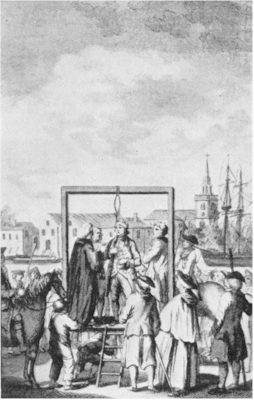
A popular ballad was sung to commemorate the life and death of Kidd, who, for some reason, was always called Robert Kidd by the populace. It consists of no less than twenty-four verses, and we here give fifteen of them:
THE BALLAD OF CAPTAIN KIDD
My name was Robert Kidd, when I sailed, when I sailed, My name was Robert Kidd, when I sailed, My name was Robert Kidd, God's laws I did forbid, And so wickedly I did, when I sailed. My parents taught me well, when I sailed, when I sailed, My parents taught me well, when I sailed, My parents taught me well, To shun the gates of hell, But 'gainst them I rebelled, when I sailed. I'd a Bible in my hand, when I sailed, when I sailed, I'd a Bible in my hand, when I sailed, I'd a Bible in my hand, By my father's great command, And sunk it in the sand, when I sailed. I murdered William Moore, as I sailed, as I sailed, I murdered William Moore, as I sailed, I murdered William Moore, And laid him in his gore, Not many leagues from shore, as I sailed. I was sick and nigh to death, when I sailed, when I sailed, I was sick and nigh to death, when I sailed, I was sick and nigh to death, And I vowed at every breath, To walk in wisdom's ways, as I sailed. I thought I was undone, as I sailed, as I sailed, I thought I was undone, as I sailed, I thought I was undone, And my wicked glass had run, But health did soon return, as I sailed. My repentance lasted not, as I sailed, as I sailed, My repentance lasted not, as I sailed, My repentance lasted not, My vows I soon forgot, Damnation was my lot, as I sailed. I spyed the ships from France, as I sailed, as I sailed, I spyed the ships of France, as I sailed, I spyed the ships from France, To them I did advance, And took them all by chance, as I sailed. I spyed the ships of Spain, as I sailed, as I sailed, I spyed the ships of Spain, as I sailed, I spyed the ships of Spain, I fired on them amain, 'Till most of them was slain, as I sailed. I'd ninety bars of gold, as I sailed, as I sailed, I'd ninety bars of gold, as I sailed, I'd ninety bars of gold, And dollars manifold, With riches uncontrolled, as I sailed. Thus being o'er-taken at last, I must die, I must die, Thus being o'er-taken at last, I must die, Thus being o'er-taken at last, And into prison cast, And sentence being passed, I must die. Farewell, the raging main, I must die, I must die, Farewell, the raging main, I must die, Farewell, the raging main, To Turkey, France and Spain, I shall n'er see you again, I must die. To Execution Dock I must go, I must go, To Execution Dock I must go, To Execution Dock, Will many thousands flock, But I must bear the shock, and must die. Come all ye young and old, see me die, see me die, Come all ye young and old, see me die, Come all ye young and old, You're welcome to my gold, For by it I've lost my soul, and must die. Take warning now by me, for I must die, for I must die, Take warning now by me, for I must die, Take warning now by me, And shun bad company, Lest you come to hell with me, for I die.
KILLING, James.
One of Major Stede Bonnet's crew, who gave evidence against him at his trial at Charleston in 1718.
KING, Charles.
Attempted to escape in the Larimore galley, but was captured and brought into Salem. Tried at Boston with the rest of Quelch's crew in June, 1704.
KING, Francis.
One of Captain Quelch's crew captured in the Larimore galley by Major Sewall, and brought into Salem Harbour on June 11th, 1704. Tried at Boston and condemned to be hanged. Was reprieved while standing on the gallows.
KING, John.
One of Captain Quelch's crew taken out of the Larimore galley. Tried at Boston in June, 1704.
KING, Matthew.
Of Jamaica.
One of Major Stede Bonnet's crew. Was hanged at Charleston, South Carolina, on November 8th, 1718, and buried in the marsh below low-water mark.
KNEEVES, Peter.
Of Exeter in Devon.
Sailed with Captain Charles Harris, and was tried for piracy with the rest of his crew at Rhode Island in 1723. Hanged at Newport at the age of 32.
KNIGHT, Captain W. Buccaneer.
In 1686 Knight was cruising off the coast of Peru and Chile with Swan, Townley, and Davis. At the end of that year, having got a fair quantity of plunder, he sailed round the Horn to the West Indies.
KNIGHT, Christopher.
One of Captain Coward's crew. Tried for piracy at Boston in January, 1690, and found guilty, but afterwards reprieved.
KNOT, Captain.
An old Massachusetts pirate who retired from the sea and was settled in Boston in 1699. His wife gave information to the Governor, the Earl of Bellomont, of the whereabouts of a pirate called Gillam, who was "wanted."
KOXINGA. His real name was Kuo-hsing Yeh, Koxinga being the Portuguese version.
The son of a Chinese pirate, Cheng Chih-lung, by a Japanese mother, he was born in 1623.
From early youth Koxinga was inspired with a hatred of the Manchus, who had imprisoned his father.
The young pirate soon became so successful in his raids along the coast of China that the Emperor resorted to the extraordinary expedient of ordering the inhabitants of more than eighty seaboard towns to migrate ten miles inland, after destroying their homes.
There can be no doubt that Koxinga was a thorough-going cut-throat pirate, worked solely for his own ambitious ends and to satisfy his revengeful feelings, but the fact that he fought against the alien conquerors, the Dutch in Formosa, and defeated them, caused him to be regarded as a hero pirate.
His father was executed at Peking, which only increased his bitterness against the reigning house. Koxinga made himself what was, to all intents and purposes, the ruler of Formosa, and the island became, through him, part of the Chinese Empire.
After his death, which took place in 1662, he received official canonization.
The direct descendant of Koxinga, the pirate, is one of the very few hereditary nobles in China.
LACY, Abraham.
Of Devonshire.
Hanged at the age of 21 at Rhode Island in 1723.
du LAERQUERAC, Captain John.
This Breton pirate was captured in 1537 by a Bristol seaman called John Wynter. Du Laerquerac, with other pirates from Brittany, had been holding up ships on their way to the great fair of St. James at Bristol. On being arrested, he denied that he had "spoiled" any English ships, but on being further pressed to confess, admitted that he had taken a few odds and ends, such as ropes, sailors' clothes, some wine, fish, a gold crown in money and eleven silver halfpence, as well as four daggers and a "couverture."
LAFITTE, Captain Jean.
Jean and his brother first appeared in New Orleans in the year 1809. Though blacksmiths by profession, they soon took to smuggling goods brought by privateersmen and pirates. The headquarters of this trade was on the Island of Grande Terre in Barataria Bay. This island was inhabited and governed by ex-pirates; one Grambo being the acknowledged chief, until he was shot by Jean Lafitte.
In 1813, the Baratarians were denounced by the Governor of Louisiana as pirates. This made no difference to the pirate smugglers, who grew more and more rich and insolent. The Governor then secured an indictment against Jean and his brother, Pierre, who retained the very best and most expensive lawyers in the State to defend them, and they were acquitted. In 1814, war was declared with England, and Jean was invited by the English to fight on their side, with the offer of a commission in the navy and a large sum of money. He refused this, and eventually General Jackson accepted his offer of the services of himself and his Baratarians, who proved invaluable in the Battle of Orleans, serving the guns. He disappeared completely after the war until 1823, when a British sloop of war captured a pirate ship with a crew of sixty men under the command of the famous Lafitte, who was amongst those who fell fighting.
LAGARDE, le Capitaine.
A French filibuster of San Domingo, who in 1684 commanded a small ship, La Subtille (crew of thirty men and two guns).
LAMBERT, John.
One of Captain John Quelch's crew. Hanged on Charles River, Boston Side, on Friday, June 30th, 1704. In a broadside published at Boston in July of the same year, Lambert's conduct on the gallows is described thus: "He appeared much hardened and pleaded much on his Innocency. He desired all men to beware of Bad Company and seemed to be in great Agony near his Execution."
LANDER, Daniel.
One of Captain Pound's crew.
LANDRESSON, Captain Michel, alias Breha.
Filibuster.
Accompanied Pain in his expedition against St. Augustine in 1683. He was a constant source of annoyance to the Jamaicans. His ship was called La Trompeuse, but must not be confused with the famous ship of that name belonging to Hamlin. Landresson, when he had got a good booty of gold, jewels, cocoa, etc., would go to Boston to dispose of it to the godly merchants of New England. In 1684 a Royal proclamation was published in Massachusetts, warning all Governors that no succour or aid was to be given to any of the outlaws, but, in spite of this, Landresson was received with open arms and the proclamations in the streets torn down.
In 1684 he was at San Domingo, in command of La Fortune (crew of 100 men and fourteen guns). At this time the filibuster was disguised under the alias of Le Capitaine Breha.
Captured in 1686 by the Armada de Barlorento, and hanged with several of his companions.
LANE, Captain.
In 1720 Lane was one of Captain England's crew when he took the Mercury off the coast of West Africa. The Mercury was fitted up as a pirate ship, named the Queen Ann's Revenge, and Lane was voted captain of her. Lane left Captain England and sailed to Brazil, where he took several Portuguese ships and did a great deal of mischief.
LARIMORE, Captain Thomas, or Larramore.
Commanded the Larimore galley. In 1704 was with the pirate Quelch and several other pirates, and, among other prizes, seized a Portuguese ship, the Portugal, from which they took gold dust, bar and coined gold, and other treasure, and at the same time "acted divers villainous Murders." For these Larimore was tried, condemned and hanged at Boston, June 11th, 1704.
LAWRENCE, Nicholas.
Tried for piracy with the rest of Quelch's crew at Boston in 1704.
LAWRENCE, Richard.
One of Captain John Quelch's crew. Tried for piracy at Boston in 1704.
LAWSON, Edward.
Born in the Isle of Man.
One of Captain Harris's crew. Hanged at Newport, Rhode Island, in July, 1723, at the age of 20.
L'ESCAYER. A French filibuster.
In 1685, in company with Grogniet, Davis, and Swan, sacked Paita and Guayaquil and blockaded Panama. Afterwards sailed with Townley and his English pirates and again plundered Guayaquil. Suffered a severe defeat at the hands of the Spaniards at Quibo, afterwards being rescued by Townley, with whom he and his crew of buccaneers sacked Granada in Nicaragua.
LESSONE, Captain. French filibuster.
In 1680 he joined Sharp, Coxon, and other English buccaneers in an attack on Porto Bello. Putting 300 men into canoes, they landed some sixty miles from the city and marched for four days, arriving in a weak state through hardship and lack of food, but in spite of this they took the city on February 17th, 1680.
LEVERCOTT, Sam.
Hanged in 1722 at the Island of St. Kitts, with the rest of Captain Lowther's crew.
LEVIT, John.
Of North Carolina.
One of Major Stede Bonnet's crew. Hanged at White Point, Charleston, South Carolina, on November 8th, 1723.
LEWIS, James.
After being a prisoner in France, he managed to reach Spain, and was with Avery when he seized the ship Charles the Second. Tried for piracy at the Old Bailey in 1696 and hanged.
LEWIS, Nicholas.
One of Captain George Lowther's crew. Hanged at St. Kitts on March 11th, 1722.
LEWIS, William.
The greatest triumph and most important exploit of this pirate was the attacking, and eventually taking, of a powerful French ship of twenty-four guns.
Lewis enjoyed a longer career than most of the brethren, and by 1717 he was already one of the leading piratical lights of Nassau, and his end did not come till ten years later. In 1726, he spent several months on the coast of South Carolina and Virginia, trading with the inhabitants the spoils he had taken from vessels in the Atlantic. He learnt his trade under the daring pirate Bannister, who was brought into Port Royal, hanging dead from his own yard-arm. On this occasion, Lewis and another boy were triced up to the corvette's mizzen-peak like "two living flags."
Lewis, amongst other accomplishments, was a born linguist, and could speak with fluency in several languages, even the dialect of the Mosquito Indians. He was once captured by the Spaniards, and taken to Havana, but escaped with a few other prisoners in a canoe, seized a piragua, and with this captured a sloop employed in the turtle trade, and by gradually taking larger and larger prizes, Lewis soon found himself master of a fine ship and a crew of more than fifty men. He renamed her the Morning Star, and made her his flagship.
On one occasion when chasing a vessel off the Carolina coast, his fore and main topmasts were carried away. Lewis, in a frenzy of excitement, clambered up the main top, tore out a handful of his hair, which he tossed into the wind, crying: "Good devil, take this till I come." The ship, in spite of her damaged rigging, gained on the other ship, which they took. Lewis's sailors, superstitious at the best of times, considered this intimacy of their captain with Satan a little too much, and soon afterwards one of the Frenchmen aboard murdered Lewis in his sleep.
LEYTON, Francis.
One of Captain Charles Harris's crew. Hanged for piracy at Newport, Rhode Island, on July 19th, 1723. Age 39.
LIMA, Manuel.
Taken by H.M. sloop Tyne, and hanged at Kingston, Jamaica, in February, 1823.
LINCH, Captain. Buccaneer.
Of Port Royal, Jamaica.
In 1680 Lionel Wafer, tiring of the life of a civil surgeon at Port Royal, left Jamaica to go on a voyage with Captains Linch and Cook to the Spanish Main.
LING, Captain William.
A notorious pirate of New Providence. Captured and hanged shortly after accepting King George's pardon of 1718.
LINISLER, Thomas.
Of Lancashire.
One of Captain Charles Harris's crew. Hanged at Rhode Island in 1723 at the age of 21.
LITHGOW, Captain.
Famous in his day for his activities in the West Indies, this pirate had his headquarters at New Providence in the Bahamas.
LIVER, William, alias Evis.
One of Major Stede Bonnet's crew. Hanged for piracy at Charleston, South Carolina, in 1718.
LO, Mrs. Hon-cho.
This Chinese woman pirate was the widow of another noted pirate who was killed in 1921. She took command after the death of her husband, and soon became a terror to the countryside about Pakhoi, carrying on the work in the best traditions of the craft, being the Admiral of some sixty ocean-going junks. Although both young and pretty, she won a reputation for being a thorough-going murderess and pirate.
During the late revolution, Mrs. Lo joined General Wong Min-Tong's forces, and received the rank of full Colonel. After the war, she resumed her piracies, occasionally for the sake of variety, surprising and sacking a village or two, and from these she usually carried away some fifty or sixty girls to sell as slaves.
Her career ended quite suddenly in October, 1922.
LODGE, Thomas. Poet, buccaneer, and physician.
Born about 1557, he was the son of Sir Thomas Lodge, grocer, and Lord Mayor of London in 1563. He was educated at Merchant Taylors' School and Trinity College, Oxford. The poet engaged in more than one freebooting expedition to Spanish waters between 1584 and 1590, and he tells us that he accompanied Captain Clarke in an attack on the Azores and the Canaries. "Having," he tells his friend Lord Hunsdon, "with Captain Clarke made a voyage to the Islands of Terceras and the Canaries, to beguile the time with labour, I writ this book, rough, as hatched in the storms of the ocean, and feathered in the surges of many perilous seas." On August 26th, 1591, Lodge sailed from Plymouth with Sir Thomas Cavendish in the Desire, a galleon of 140 tons. The freebooters sailed to Brazil and attacked the town of Santa, while the people were at Mass. They remained there from December 15th until January 22nd, 1592. Some of the Englishmen, of whom Lodge was one, took up their quarters in the College of the Jesuits, and this literary buccaneer spent his time amongst the books in the library of the Fathers.
Leaving Brazil, the small fleet sailed south to the Straits of Magellan. While storm-bound amongst the icy cliffs of Patagonia, Lodge wrote his Arcadian romance "Margarite of America."
From the point of view of plunder, this expedition was a dismal failure, and the Desire returned and reached the coast of Ireland on June 11th, 1593. The crew had been reduced to sixteen, and of these only five were even in tolerable health.
At the age of 40, Lodge deserted literature and studied medicine, taking his degree of Doctor of Physics at Avignon in 1600. His last original work was a "Treatise on the Plague," published in 1603. After practising medicine with great success for many years, Thomas Lodge died, it is said, of the plague, in the year 1625, at the age of 68.
LONG, Zachariah.
Of the Province of Holland.
One of Major Stede Bonnet's crew. Hanged at White Point, Charleston, in 1718, and buried in the marsh below low-water mark.
LOPEZ, John.
Of Oporto.
This Portuguese pirate sailed in the Royal James, and was hanged with the rest of the crew at Charleston, South Carolina, on November 8th, 1718.
LORD, John.
A soldier. Deserted from Fort Loyal, Falmouth, Maine. Killed at Tarpaulin Cove in 1689.
LOW, Captain Edward, or Loe.
Born in Westminster, he began in very early life to plunder the boys of their farthings, and as he grew bigger used to gamble with the footmen who waited in the lobby of the House of Commons. While still quite small one of his elder brothers used to carry little Edward hidden in a basket on his back, and when in a crowd the future pirate would, from above, snatch the hats and even the wigs off the heads of passing citizens and secret them in the basket and so get away with them. The Low family were the originators of this ingenious and fascinating trick, and for a time it was most successful, until the people of the city took to tying on their hats and wigs with bands to prevent their sudden removal. When he grew up, Ned went to Boston and earned an honest living as a rigger, but after a while he tired of this and sailed in a sloop to Honduras to steal log-wood. Here Low quarrelled with his captain, tried to shoot him, and then went off in an open boat with twelve other men, and the very next day they took a small vessel, in which they began their "war against all the world." Low soon happened to meet with Captain Lowther, the pirate, and the two agreed to sail in company. This partnership lasted until May 28th, 1722, when they took a prize, a brigantine from Boston, which Low went into with a crew of forty-four men. This vessel they armed with two guns, four swivels, and six quarter-casks of powder, and saying good-bye to Lowther, sailed off on their own account. A week later a prize fell into their hands, which was the first of several. Things soon became too hot for Low along the American coast and the West Indies, as several men-of-war were searching for him; so he sailed to the Azores, taking on his way a big French ship of thirty-four guns, and later, in the harbour of St. Michael, he seized several vessels which he found at anchor there. Here they burnt the French ship, but let the crew all go, except the cook, who, they said, "being a greasy fellow would fry well in the fire, so the poor man was bound to the main mast and burnt in the ship to the no small derision of Low and his Mirmidons."
Low and his crew now began to treat their prisoners with great brutality. However, on one occasion the biter was bitten. It happened that one of the drunken crew, playfully cutting at a prisoner, missed his mark and accidentally slashed Captain Low across his lower jaw, the sword opening his cheek and laying bare his teeth. The surgeon was called, who at once stitched up the wound, but Low found some fault with the operation, as well he might, seeing that "the surgeon was tollerably drunk" at the time. The surgeon's professional pride was outraged by this criticism of his skill by a layman, and he showed his annoyance in a ready, if unprofessional, manner, by striking "Low such a blow with his Fists, that broke out all the Stitches, and then bid him sew up his Chops himself and be damned, so that the captain made a very pitiful Figure for some time after." Low took a large number of prizes, but he was not a sympathetic figure, and the list of his prizes and brutalities soon becomes irksome reading. Low, still in the Fancy, and accompanied by Captain Harris in the Ranger, then sailed back to the West Indies, and later to South Carolina, where he took several prizes, one the Amsterdam Merchant (Captain Willard), belonging to New England, and as Low never missed an opportunity of showing his dislike of all New Englanders, he sent the captain away with both his ears cut off and with various other wounds about his body.
Low and Harris now made a most unfortunate mistake in giving chase to a ship which on close quarters proved to be not a merchant vessel, but H.M.S. Greyhound. After a short fight, the coward Low slipped away, and left his consort, Harris, to carry on an unequal contest until he was compelled to surrender his ship.
Low's cruelties became more and more disgusting, and there can be little doubt that he was really by this time a lunatic.
In July, 1723, Low took a new ship for himself, naming himself Admiral, and sporting a new black flag with a red skeleton upon it. He again cruised off the Azores, the Canaries, and the Guinea coast, but what the end was of this repulsive, uninteresting, and bloody pirate has never been known.
LOWTHER, Captain George.
Sailed as second mate from the Thames in the Gambia Castle, a ship belonging to the African Company, sixteen guns and a crew of thirty men. On board as passengers were Captain Massey and a number of soldiers. Arriving at their destination, Massey quarrelled with the merchants on shore, and, a few days later, with Lowther, seized the ship, which he renamed the Delivery. They now went a-pirating, their first prize being a Boston ship, and cruising about off the Island of Hispaniola, several more were taken, but nothing very rich. Lowther quarrelled with Captain Massey, who, being a soldier, wished to land on some island to plunder the French settlements, but this was not agreed to, and Massey and his followers were sent away in a sloop. Life for Lowther now became a series of successes, prizes being taken, and visits to land being occasionally made for the crew to enjoy a drunken revel.
Having met with Captain Low, for a while the two sailed together, and took the Greyhound, a merchantman, and several more rich prizes. Lowther now commanded a small pirate fleet, and styled himself Admiral, his flagship being the Happy Delivery. While careening their ships in the Gulf of Matigue, they were suddenly attacked by the natives, and the pirates barely escaped in a sloop with their lives. Lowther soon improved himself by seizing a brigantine, and in her shaped his course to the coast of South Carolina, a favourite resort for the pirates. Here he attacked an English ship, but was so roughly handled that he was glad to run his ship ashore and escape.
In 1723 he steered for Newfoundland, taking many small vessels there, and returning to the West Indies. While cleaning his ship at the Isle of Blanco, he was suddenly attacked by a South Sea Company's ship, the Eagle, and the pirates were compelled to surrender. Lowther and a dozen of his crew escaped by climbing out of the cabin window, and, reaching the island, hid themselves in the woods. All were caught except Lowther and three men and a boy. He was shortly afterwards found lying dead with a pistol by his side, and was supposed to have shot himself. Three of his crew who were caught were carried to St. Christopher's, and there tried for piracy and hanged.
LUDBURY, Captain. Buccaneer.
Sailed in company with Captains Prince and Harrison in October, 1670, ascended the San Juan River in Nicaragua with a party of 170 men, and surprised and plundered the city of Granada.
LUKE, Captain Matthew.
This Italian pirate had his headquarters at Porto Rico, and specialized in attacking English ships. In 1718 he took four of these and murdered all the crews. In May, 1722, Luke made a terrible mistake. Perceiving what he thought to be a merchant ship, he attacked her, to find out all too late that she was an English man-of-war, the Lauceston. Luke and his crew were taken to Jamaica and hanged. One of his crew confessed to having killed twenty English sailors with his own hands.
LUSHINGHAM, Captain.
In 1564 this pirate was at Berehaven in the South of Ireland, having just sold a cargo of wine out of a Spanish prize to the Lord O'Sullivan, when some of Queen Elizabeth's ships arrived in the bay in search of pirates. By Lord O'Sullivan's help the pirates escaped, but Lushingham was killed "by a piece of ordnance" as he was in the act of waving his cap towards the Queen's ships.
LUSSAN, Le Sieur Raveneau de.
This French filibuster was a man of much better birth and education than the usual buccaneer. Also, he was the author of a most entertaining book recording his adventures and exploits as a buccaneer, called "Journal du Voyage fait a la Mer de sud avec les Flibustiers de l'Amerique en 1684."
Pressure from his creditors drove de Lussan into buccaneering, as being a rapid method of gaining enough money to satisfy them and to enable him to return to the fashionable life he loved so well in Paris. De Lussan was, according to his own account, a man of the highest principles, and very religious. He never allowed his crew to molest priests, nuns, or churches. After taking a Spanish town, the fighting being over, he would lead his crew of pirates to attend Mass in the church, and when this was done—and not until then—would he allow the plundering and looting to begin.
De Lussan was surprised and grieved to find that his Spanish prisoners had a most exaggerated idea of the brutality of the buccaneers, and on one occasion when he was conducting a fair young Spanish lady, a prisoner, to a place of safety, he was overwhelmed when he discovered that the reason of her terror was that she believed she was shortly to be eaten by him and his crew. To remedy this erroneous impression, it was the custom of the French commander to gather together all his prisoners into the church or the plaza, and there to give them a lecture on the true life and character of the buccaneers.
The student who wishes to learn more about the adventures of de Lussan can do so in his book. There he will read, amongst other interesting events, particulars about the filibuster's surprising and romantic affair with the beautiful and wealthy Spanish widow who fell so violently in love with him.
It happened on one occasion that Raveneau and his crew, having taken a town on the West Coast of South America after a somewhat bloody battle, had, as usual, attended Mass in the Cathedral, before setting out to plunder the place.
Entering one of the chief houses in the town, de Lussan discovered the widow of the late town treasurer dissolved in tears, upon which the tender buccaneer hastened, with profound apologies, discreetly to withdraw, but calling again next day to offer his sympathy he found the widow had forgotten all about the late treasurer, for she had fallen violently in love with her gallant, handsome, and fashionably dressed visitor.
After various adventures, de Lussan arrived safely back in Paris with ample means in his possession not only to satisfy his creditors, but also to enable him to live there as a gentleman of fortune and fashion.
MACHAULY, Daniel, or Maccawly, or McCawley.
A Scotch pirate. One of Captain Gow's crew. Hanged at Execution Dock at Wapping on June 11th, 1725.
MACKDONALD, Edward.
One of Captain George Lowther's crew in the Happy Delivery. Hanged at St. Kitts on March 11th, 1722.
MACKET, Captain, or Maggott.
On March 23rd, 1679, Macket, who commanded a small vessel of fourteen tons, with a crew of twenty men, was at Boca del Toro with Coxon, Hawkins, and other famous buccaneers, having just returned from the sacking of Porto Bello.
Shortly afterwards the fleet sailed to Golden Island, off the coast of Darien, and from thence set out to attack Santa Maria and Panama.
MACKINTOSH, William.
Of Canterbury in Kent.
One of Captain Roberts's crew. Hanged at Cape Coast Castle in 1722 at the age of 21.
MAGNES, William, or Magnus.
Born at Minehead in Somersetshire in 1687. Quartermaster of the Royal Fortune (Captain Bartholomew Roberts). Tried for piracy at Cape Coast Castle, and hanged in chains in 1718, for taking and plundering the King Solomon.
MAIN, William.
One of Captain Roberts's crew. Hanged in April, 1722, at the age of 28 years.
MAIN, William.
Boatswain to Captain Bartholomew Roberts in the Royal Fortune. Was blown up, the explosion being caused by one of the crew firing his pistol into some gunpowder when the ship was taken by H.M.S. Swallow in 1722.
MAINTENON, Marquis de.
Arrived in the West Indies from France in 1676. In 1678 commanded La Sorcière, a frigate, and, in company with other French filibusters from Tortuga Island, cruised off the coast of Caracas. He ravaged the islands of Margarita and Trinidad. He met with but little success, and soon afterwards his fleet scattered.
MAINWARING, Captain Henry.
A notorious Newfoundland pirate.
On June 4th, 1614, when off the coast of that island, in command of eight vessels, he plundered the fishing fleet, stealing what provisions and stores he was in need of, also taking away with him all the carpenters and mariners he wanted for his own fleet.
It was his custom, when taking seamen, to pick one out of every six. In all he took 400 men, some of whom joined him willingly, while others were "perforstmen." Sailing across the Atlantic to the coast of Spain, Mainwaring took a Portuguese ship and stole from out of her a good store of wine, and out of a French prize 10,000 dried fish. A few years later this pirate was pardoned and placed in command of a squadron and sent to the Barbary coast in an unsuccessful attempt to drive out the pirates who were settled there. Here he may well have met with his old friend Captain Peter Easton, who had also been a Newfoundland pirate, but in 1613 had joined the Barbary corsairs.
el MAJORCAM, Captain Antonio.
At one time an officer in the Spanish Navy. Became a notorious West Indian pirate, but about 1824 he retired from the sea to become a highwayman on shore.
MANSFIELD, Jo.
One of Captain Bartholomew Roberts's men. Must not be confused with Edward Mansfield, the famous buccaneer.
A native of the Orkney Islands. At one time was a highwayman. Later on deserted from the Rose, man-of-war. Volunteered to join the pirates at the island of Dominica, and was always keen to do any mischief. He was a bully and a drunkard.
When Roberts's ship was attacked by H.M.S. Swallow and had surrendered after a sharp fight, Mansfield, who had been below all the while, very drunk, came staggering and swearing up on deck, with a drawn cutlass in his hand, crying out to know who would go on board the prize with him, and it was some time before his friends could persuade him of the true condition of things.
At his trial at Cape Coast Castle he said little in his defence, but pleaded that the cause of his backsliding was drunkenness. Hanged in the year 1722 at the age of 30.
MANSFIELD, Captain Edward, or Mansvelt.
A Dutchman born in the Island of Curacao.
He was the chief of the buccaneers, and at his death was succeeded by Henry Morgan. He was the first buccaneer to cross the Isthmus of Darien to the Pacific Ocean. Noted for his charm of manner, he was very popular with the buccaneers of all nationalities. In 1663 he commanded a brigantine carrying four guns and a crew of sixty men. Was chosen admiral of the fleet of buccaneers that gathered at Bleufields Bay in Jamaica in November, 1665, at the invitation of Modyford, the Governor, when he appointed young Henry Morgan to be his vice-admiral. This fleet was to sail and attempt to seize the Island of Curacao, and consisted of fifteen ships and a mixed crew of 500 buccaneers. On the way there they landed in Cuba, although England was at peace with Spain, and marched forty miles inland, to surprise and sack the town of Sancti Spiritus, from which they took a rich booty.
Mansfield, "being resolved never to face the Governor of Jamaica until he had done some service to the King," next made a very daring attack on the Island of Old Providence, which the Spaniards had fortified and used as a penal settlement. This was successful, and Mansfield, with great humanity, landed all the prisoners on the mainland of America. For a long while it had been Mansfield's dream to make this island a permanent home of the buccaneers, as it was close to the Spanish Main, with the towns of Porto Bello and Vera Cruz, and on the trade route of the Spanish galleons, taking their rich cargoes to Spain.
Mansfield's next exploit was to ascend the San Juan River and to sack Granada, the capital of Nicaragua. From there he coasted south along Costa Rica, burning plantations, smashing the images in the churches, ham-stringing cows and mules, and cutting down fruit-trees.