THE PIRATES' WHO'S WHO (continued 2)
Reading edition
COOPER, Captain.
Commanded a pirate sloop, the Night Rambler. On November 14th, 1725, he took the Perry galley (Captain King, commander), three days out from Barbadoes, and the following day a French sloop, and carried both prizes to a small island called Aruba, near Curaçao, where they plundered them and divided the spoil amongst the crew. The crews of the two prizes were kept on the island by Cooper for seventeen days, and would have starved if the pirate's doctor had not taken compassion on them and procured them food.
Upton, boatswain in the Perry, joined the pirates, and was afterwards tried and hanged in England.
COOPER, Captain.
On October 19th, 1663, he brought into Port Royal, Jamaica, two Spanish prizes, one the Maria of Seville, a royal azogue carrying 1,000 quintals of quicksilver for the King of Spain's mines in Mexico, besides oil, wine, and olives. Also a number of prisoners were taken, including several friars on their way to Campeachy and Vera Cruz. The buccaneers always rejoiced at capturing a priest or a friar, and these holy men generally experienced very rough treatment at the hands of the pirates.
Cooper's ship was a frigate of ten guns, and a crew of eighty men.
CORBET, Captain.
Sailed with Captain Heidon from Bantry Bay in the John of Sandwich in 1564 to search for a good prize in which he might go a-pirating on his own account. The ship was wrecked on the Island of Alderney, and all the crew arrested. Corbett and several others escaped in a small boat.
CORNELIUS, Captain.
A contemporary of Howard Burgess North and other Madagascar pirates.
de COSSEY, Stephen James.
With three other pirates was tried and convicted in June, 1717, before the Vice-Admiralty Court at Charleston. The President of the Court was Judge Trot, a terror to all pirates, as he never failed to hang a guilty one. De Cossey and the other prisoners were found guilty of piratically taking the vessels Turtle Dove, Penelope, and the Virgin Queen.
COWARD, William.
In November, 1689, with three men and a boy he rowed out to the ketch Elinor (William Shortrigs, master), lying at anchor in Boston Harbour, and seized the vessel and took her to Cape Cod. The crew of the ketch could make no resistance as they were all down with the smallpox. The pirates were caught and locked up in the new stone gaol in Boston. Hanged on January 27th, 1690.
COWLEY, Captain C.
M.A. Cantab.
A man of high intelligence and an able navigator. In the year 1683 he sailed from Achamach or Cape Charles in Virginia for Dominica as sailing master of a privateer, the Revenge (eight guns and fifty-two men), in company with Dampier and Captain John Cooke. As soon as they were away from the land, they turned buccaneers or pirates, and sailed to Sierra Leone in West Africa. Thence to the coast of Brazil, round the Horn, where Cowley mentions that owing to the intense cold weather the crew were able, each man, to drink three quarts of burnt brandy a day without becoming drunk.
On February 14th the buccaneers were abreast of Cape Horn, and in his diary Cowley writes: "We were choosing valentines and discoursing on the Intrigues of Woman, when there arose a prodigious storm," which lasted till the end of the month, driving them farther south than any ship had ever been before; "so that we concluded the discoursing of Women at sea was very unlucky and occasioned the storm." Cowley, who was addicted to giving new names to islands, not only named one Pepys Island, but when he arrived at the Galapagos Islands, he rechristened them most thoroughly, naming one King Charles Island, while others he named after the Dukes of York, Norfolk, and Albemarle, and Sir John Narborough. Feeling, no doubt, that he had done enough to honour the great, and perhaps to have insured himself against any future trouble with the authorities when he returned home, he named one small island "Cowley's Enchanted Isle."
The Earl of Alington, Lord Culpepper, Lord Wenman, all had islands in this group christened with their names and titles.
In September, 1684, Cowley, now in the Nicholas, separated from Davis, and sailed from Ampalla for San Francisco, and then started west to cross the Pacific Ocean. On March 14th, 1685, at seven o'clock in the morning, after a voyage of 7,646 miles, land was at last seen, which proved to be the Island of Guan.
The Spanish Governor was most friendly to the visitors, and when complaint was made to him that the buccaneers had killed some of his Indian subjects he "gave us a Toleration to kill them all if we would." Presents were exchanged, Cowley giving the Governor a valuable diamond ring, one, no doubt, taken off the hand of some other loyal subject of the King of Spain. Here the pirates committed several atrocious cruelties on the Indians, who wished to be friends with the foreigners.
In April they arrived at Canton to refit, and while there, thirteen Tartar ships arrived laden with Chinese merchandise, chiefly valuable silks. Cowley wanted to attack and plunder them, but his crew refused to do so, saying "they came for gold and silver, and not to be made pedlars, to carry packs on their backs," to Cowley's disgust, for he complains, "had Reason but ruled them, we might all have made our Fortunes and have done no Christian Prince nor their subjects any harm at all." Thence they sailed to Borneo, the animals and birds of which island Cowley describes. Sailing next to Timor, the crew mutinied, and Cowley and eighteen others bought a boat and sailed in her to Java, some 300 leagues. Here they heard of the death of King Charles II., which caused Cowley to get out his map of the Galapagos Islands, and to change the name of Duke of York Island to King James Island. At Batavia Cowley procured a passage in a Dutch ship to Cape Town. In June, 1686, he sailed for Holland after much health drinking and salutes of 300 guns, arriving in that country in September, and reaching London, "through the infinite Mercy of God," on October 12th, 1686.
COX, Captain John. Buccaneer.
Born in New England, and considered by some of his fellow buccaneers "to have forced kindred upon Captain Sharp"—the leader of the fleet—"out of old acquaintance, only to advance himself." Thus he was made Vice-Admiral to Captain Sharp, in place of Captain Cook, whose crew had mutinied and refused to sail any longer under his command. Cox began his captaincy by getting lost, but after a fortnight rejoined the fleet off the Island of Plate, on the coast of Peru, "to the great joy of us all." This island received its name from the fact that Sir Francis Drake had here made a division of his spoils, distributing to each man of his company sixteen bowlfuls of doubloons and pieces of eight. The buccaneers rechristened it Drake's Island.
Cox took part in the attack on the town of Hilo in October, 1679, sacked the town and burnt down the large sugar factory outside. He led a mutiny against his relative and benefactor, Captain Sharp, on New Year's Day, 1681, being the "main promoter of their design" to turn him out. Sharp afterwards described his old friend as a "true-hearted dissembling New-England Man," who he had promoted captain "merely for old acquaintance-sake."
COXON, Captain John. Buccaneer.
One of the most famous of the "Brethren of the Coast."
In the spring of 1677, in company of other English buccaneers, he surprised and plundered the town of Santa Marta on the Spanish Main, carrying away the Governor and the Bishop to Jamaica.
In 1679 Coxon, with Sharp and others, was fitting out an expedition in Jamaica to make a raid in the Gulf of Honduras, which proved very successful, as they brought back 500 chests of indigo, besides cocoa, cochineal, tortoiseshell, money, and plate.
Coxon was soon out again upon a much bolder design, for in December, 1679, he met Sharp, Essex, Allinson, Row, and other buccaneer chiefs at Point Morant, and in January set sail for Porto Bello. Landing some twenty leagues from the town, they marched for four days, arriving in sight of the town on February 17th, "many of them being weak, being three days without any food, and their feet cut with the rocks for want of shoes." They quickly took and plundered the town, hurrying off with their spoils before the arrival of strong Spanish reinforcements. The share of each man in this enterprise came to one hundred pieces of eight. A warrant was issued by Lord Carlisle, the Governor of Jamaica, for the apprehension of Coxon for plundering Porto Bello, and another was issued soon after by Morgan, when acting as Governor, but nothing seems to have resulted from these. Sailing north to Boca del Toro, they careened their ships, and were joined by Sawkins and Harris. From this place the buccaneers began, in April, 1680, to land and cross the Isthmus of Darien, taking the town of Santa Maria on the way. Quarrels took place between Coxon, who was, no doubt, a hot-tempered man, and Harris, which led to blows. Coxon was also jealous of the popular young Captain Sawkins, and refused to go further unless he was allowed to lead one of the companies. After sacking the town of Santa Maria, the adventurers proceeded in canoes down the river to the Pacific. Seizing two small vessels they found there, and accompanied by a flotilla of canoes, they steered for Panama, and, with the utmost daring, attacked, and eventually took, the Spanish fleet of men-of-war—one of the most remarkable achievements in the history of the buccaneers.
Coxon now quarrelled again with his brother leaders, and began a march back across the isthmus; his party of seventy malcontents including Dampier and Wafer, who each published accounts of their journey. By 1682 Coxon seems to have so ingratiated himself with the Jamaican authorities as to be sent in quest of a troublesome French pirate, Jean Hamlin, who was playing havoc with the English shipping in his vessel, La Trompeuse.
Later in the same year Coxon procured letters of marque from Robert Clarke, the Governor of New Providence Island, himself nothing better than a pirate, to go cruising as a "privateer." Coxon was continually being arrested and tried for piracy, but each time he managed to escape the gallows. We do not know the name of the ship Coxon commanded at this date, but it was a vessel of eighty tons, armed with eight guns, and carrying a crew of ninety-seven men.
COYLE, Captain Richard.
Born at Exeter in Devonshire.
An honest seafaring man until, when sailing as mate with Captain Benjamin Hartley, they arrived at Ancona with a cargo of pilchards. Here the captain took on board a new carpenter, called Richardson, who soon became a close friend of the mate's. These two brought about a mutiny, attacked the captain, and threw him, still alive, over the side to drown. Coyle was elected captain, and they sailed as pirates, in which capacity they were a disgrace to an ancient calling. After a visit to Minorca, which ended with ignominy, they sailed to Tunis, where Coyle told such a plausible yarn as to deceive the Governor into believing that he had been the master of a vessel lost in a storm off the coast of Sardinia. The pirates were supplied with money by the British Consul in Tunis; but Coyle, while in his cups, talked too freely, so that the true story of his doings got to the Consul's ears, who had him arrested and sent to London to be lodged in the Marshalsea Prison. Tried at the Old Bailey, he was sentenced to death, and was hanged at Execution Dock on January 25th, 1738.
CRACKERS, Captain.
A retired pirate who settled at Sierra Leone, and was living there in 1721. He had been famous in his day, having robbed and plundered many a ship. He owned the best house in the settlement, and was distinguished by having three cannons placed before his door, which he was accustomed to fire salutes from whenever a pirate ship arrived or left the port. He was the soul of hospitality and good fellowship, and kept open-house for all pirates, buccaneers, and privateersmen.
CRISS, Captain John, alias "Jack the Bachelor."
A native of Lorne in the North of Ireland.
His father was a fisherman, and little Jack used to go out with him, and then help him sell his fish at Londonderry. The lad grew up into a bold and handsome young fellow, "and many a girl cocked cap at him and he had great success amongst the ladies, and intrigued with every woman that gave him any encouragement."
Tiring of the monotony and low profits of a fisherman's calling, Jack turned smuggler, carrying cargoes of contraband goods from Guernsey to Ireland. Making a tidy sum at this, he bought himself a French galliot, and sailing from Cork, he began to take vessels off the coast of France, selling them at Cherbourg. The young pirate took no risks of information leaking out, for he drowned all his prisoners. Cruising in the Mediterranean, Criss met with his usual success, and, not content with taking ships, he plundered the seaport of Amalfi on the coast of Calabria. Calling at Naples, Criss put up at the Ferdinand Hotel, where one morning he was found dead in his bed. It was discovered afterwards that, in spite of his nickname, he was married to three wives.
CULLEN, Andrew.
Of Cork in Ireland.
Brother of Pierce Cullen. One of the crew of Captain Roche's ship. After the crew had mutinied and turned pirate he posed as the supercargo.
CULLEN, Pierce.
Of Cork in Ireland.
One of Captain Philip Roche's gang.
CULLIFORD, Captain, of the Mocha.
A Madagascar pirate.
Little is known of him except that one day in the streets of London he recognized and denounced another pirate called Burgess.
CUMBERLAND, George, Third Earl of, 1558-1605.
M.A., Trinity College, Cambridge.
After taking his degree at Cambridge he migrated to Oxford for the purpose of studying geography.
So many books have been written about this picturesque and daring adventurer that it is not necessary to do more than mention his name here, as being perhaps the finest example of a buccaneer that ever sacked a Spanish town.
He led twelve voyages to the Spanish Main, fitting them out at his own expense, and encountering the same dangers and hardships as his meanest seaman.
He married in 1577 at the age of nineteen, and sailed on his first voyage in 1586. Cumberland was greatly esteemed by Queen Elizabeth, and always wore in his hat a glove which she had given him.
There is sufficient evidence to show that the Earl was not prompted to spend his life and fortune on buccaneering voyages merely by greed of plunder, but was chiefly inspired by intense love of his country, loyalty to his Queen, and bitter hatred of the Spaniards.
CUNNINGHAM, Captain William.
Had his headquarters at New Providence Island, in the Bahamas. Refused the royal offer of pardon to the pirates in 1717, and was later caught and hanged.
CUNNINGHAM, Patrick.
Found guilty at Newport in 1723, but reprieved.
CURTICE, Joseph.
One of Captain Teach's crew in the Queen Ann's Revenge. Killed on November 22nd, 1718, off the coast of North Carolina.
DAMPIER, Captain William. Buccaneer, explorer, and naturalist.
Born at East Coker in the year 1652.
Brought up at first to be a shopkeeper, a life he detested, he was in 1669 apprenticed to a ship belonging to Weymouth, and his first voyage was to France. In the same year he sailed to Newfoundland, but finding the bitter cold unbearable, he returned to England. His next voyage, which he called "a warm one," was to the East Indies, in the John and Martha, and suited him better.
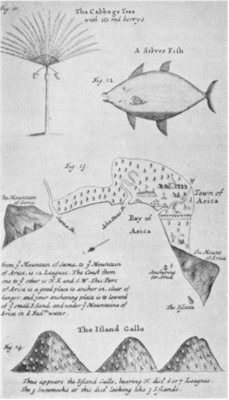
Many books have been written recounting the voyages of Dampier, but none of these are better reading than his own narrative, published by James and John Knapton in London. This popular book ran into many editions, the best being the fourth, published in 1729, in four volumes. These volumes are profusely illustrated by maps and rough charts, and also with crude cuts, which are intended to portray the more interesting and strange animals, birds, fishes, and insects met with in his voyages round the globe.
In 1673 Dampier enlisted as a seaman in the Royal Prince, commanded by the famous Sir Edward Spragge, and fought in the Dutch war.
A year later he sailed to Jamaica in the Content, to take up a post as manager of a plantation belonging to a Colonel Hellier. His restless spirit soon revolted against this humdrum life on a plantation, and Dampier again went to sea, sailing in a small trading vessel amongst the islands.
Dampier's first step towards buccaneering was taken when he shipped himself on a small ketch which was sailing from Port Royal to load logwood at the Bay of Campeachy. This was an illegal business, as the Spanish Government claimed the ownership of all that coast, and did their best to prevent the trade. Dampier found some 250 Englishmen engaged in cutting the wood, which they exchanged for rum. Most of these men were buccaneers or privateers, who made a living in this way when out of a job afloat. When a ship came into the coast, these men would think nothing of coming aboard and spending thirty and forty pounds on rum and punch at a single drinking bout.
Dampier returned afterwards to take up logwood cutting himself, but met with little success, and went off to Beef Island. He had by this time begun to take down notes of all that appeared to him of interest, particularly objects of natural history. For example, he described, in his own quaint style, an animal he found in this island.
"The Squash is a four-footed Beast, bigger than a Cat. Its Head is much like a Foxes, with short Ears and a long Nose. It has pretty short Legs and sharp Claws, by which it will run up trees like a Cat. The flesh is good, sweet, wholesome Meat. We commonly skin and roast it; and then we call it pig; and I think it eats as well. It feeds on nothing but good Fruit; therefore we find them most among the Sapadillo-Trees. This Creature never rambles very far, and being taken young, will become as tame as a Dog, and be as roguish as a Monkey."
Dampier's first act of actual piracy was when he joined in an attack on the Spanish fort of Alvarado, but although the fort was taken, the townspeople had time to escape with all their valuables before the pirates could reach them. Returning to England in 1678, he did not remain long at home, for in the beginning of 1679 he sailed for Jamaica in a vessel named the Loyal Merchant. Shortly after reaching the West Indies, he chanced to meet with several well-known buccaneers, including Captains Coxon, Sawkins, and Sharp. Joining with these, he sailed on March 25th, 1679, for the Province of Darien, "to pillage and plunder these parts." Dampier says strangely little about his adventures for the next two years, but a full description of them is given by Ringrose in his "Dangerous Voyage and Bold Adventures of Captain Sharp and Others in the South Sea," published as an addition to the "History of the Buccaneers of America" in 1684.
This narrative tells how the buccaneers crossed the isthmus and attacked and defeated the Spanish Fleet off Panama City. After the death of their leader, Sawkins, the party split up, and Dampier followed Captain Sharp on his "dangerous and bold voyage" in May, 1680.
In April, 1681, after various adventures up and down the coast of Peru and Chile, further quarrels arose amongst the buccaneers, and a party of malcontents, of which number Dampier was one, went off on their own account in a launch and two canoes from the Island of Plate, made famous by Drake, and landed on the mainland near Cape San Lorenzo. The march across the Isthmus of Darien has been amusingly recounted by the surgeon of the party, Lionel Wafer, in his book entitled "A New Voyage and Description of the Isthmus of America," published in London in 1699.
A PAGE FROM THE LOG-BOOK OF CAPTAIN DAMPIER.
On reaching the Atlantic, Dampier found some buccaneer ships and joined them, arriving at Virginia in July, 1682. In this country he resided for a year, but tells little about it beyond hinting that great troubles befell him. In April, 1683, he joined a privateer vessel, the Revenge, but directly she was out of sight of land the crew turned pirates, which had been their intention all along. Two good narratives have been written of this voyage, one by Dampier, and the other by Cowley, the sailing-master. This venture ended in the famous circumnavigation of the world, and Dampier described every object of interest he met with, including the country and natives of the north coast of Australia, which had never been visited before by Europeans. Dampier must have found it very difficult to keep his journal so carefully and regularly, particularly in his early voyages, when he was merely a seaman before the mast or a petty officer. He tells us that he carried about with him a long piece of hollow bamboo, in which he placed his manuscript for safe keeping, waxing the ends to keep out the sea water.
After almost endless adventures and hardships, he arrived back in England in September, 1691, after a voyage of eight years, and an absence from England of twelve, without a penny piece in his pocket, nor any other property except his unfortunate friend Prince Jeoly, whom he sold on his arrival in the Thames, to supply his own immediate wants. Dampier's next voyage was in the year 1699, when he was appointed to command H.M.S. Roebuck, of twelve guns and a crew of fifty men and boys, and victualled for twenty months' cruise. The object of this voyage was to explore and map the new continent to the south of the East Indies which Dampier had discovered on his previous voyage. Had he in this next voyage taken the westward course, as he originally intended, and sailed to Australia round the Horn, it is possible that Dampier would have made many of the discoveries for which James Cook afterwards became so famous, and by striking the east coast of Australia would very likely have antedated the civilisation of that continent by fifty years. But he was persuaded, partly by his timid crew, and perhaps in some measure by his own dislike of cold temperatures, to sail by the eastward route and to double the Cape of Good Hope. The story of this voyage is given by Dampier in his book, published in 1709, "A Voyage to New Holland, etc., in the Year 1699."
After spending some unprofitable weeks on the north coast of Australia, failing to find water or to make friends with the aboriginals, scurvy broke out amongst his somewhat mutinous crew, and he sailed to New Guinea, the coast of which he saw on New Year's Day, 1700.
By this time the Roebuck was falling to pieces, her wood rotten, her hull covered with barnacles. Eventually, using the pumps day and night, they arrived, on February 21st, 1701, at Ascension Island, where the old ship sank at her anchors. Getting ashore with their belongings, they waited on this desolate island until April 3rd, when four ships arrived, three of them English men-of-war.
I was told, only the other day, by a friend who lives in the Island of St. Helena, and whose duties take him at least once each year to Ascension Island, that a story still survives amongst the inhabitants of these islands that there is hidden somewhere in the sandhills a treasure, which Dampier is believed to have put there for safe keeping, but for some reason never removed. But poor Dampier never came by a treasure in this or any other of his voyages, and though the legend is a pleasant one, it is a legend and nothing more. Dampier went on board one of the men-of-war, the Anglesea, with thirty-five of his crew. Taken to Barbadoes, he there procured a berth in another vessel, the Canterbury, in which he sailed to England.
Dampier had now made so great a name for himself by his two voyages round the globe that he was granted a commission by Prince George of Denmark to sail as a privateer in the St. George, to prey on French and Spanish ships, the terms being: "No purchase, no pay." Sailing as his consort was the Cinque Ports, whose master was Alexander Selkirk, the original of Robinson Crusoe. This voyage, fully recounted in Dampier's book, is a long tale of adventure, hardship, and disaster, and the explorer eventually returned to England a beggar. However, his travels made a great stir, and he was allowed to kiss the Queen's hand and to have the honour of relating his adventures to her.
Dampier's last voyage was in the capacity of pilot or navigating officer to Captain Woodes Rogers in the Duke, which sailed with another Bristol privateer, the Duchess, in 1708. The interesting narrative of this successful voyage is told by Rogers in his book, "A Cruising Voyage Round the World," etc., published in 1712. Another account was written by the captain of the Duchess, Edward Cooke, and published in the same year. This last voyage round the world ended at Erith on October 14th, 1711, and was the only one in which Dampier returned with any profit other than to his reputation as an explorer and navigator.
Dampier was now fifty-nine years of age, and apparently never went to sea again. In fact, he henceforth disappears from the stage altogether, and is supposed to have died in Colman Street in London, in the year 1715. Of Dampier's early life in England little is known, except that he owned, at one time, a small estate in Somersetshire, and that in 1678 he married "a young woman out of the family of the Duchess of Grafton." There is an interesting picture of Dampier in the National Portrait Gallery, painted by T. Murray, and I take this opportunity to thank the directors for their kind permission to reproduce this portrait.
One other book Dampier wrote, called a "Discourse of Winds," an interesting work, and one which added to the author's reputation as a hydrographer. There is little doubt that Defoe was inspired by the experiences and writings of Dampier, not only in his greatest work, "Robinson Crusoe," but also in "Captain Singleton," "Colonel Jack," "A New Voyage Round the World," and many of the maritime incidents in "Roxana" and "Moll Flanders."
DAN, Joseph.
One of Avery's crew. Turned King's witness at his trial in 1696, and was not hanged.
DANIEL, Captain. A French filibuster.
The name of this bloodthirsty pirate will go down to fame as well as notoriety by his habit of combining piracy with strict Church discipline. Harling recounts an example of this as follows, the original account of the affair being written by a priest, M. Labat, who seems to have had rather a weak spot in his heart for the buccaneer fraternity:
"Captain Daniel, in need of provisions, anchored one night off one of the 'Saintes,' small islands near Dominica, and landing without opposition, took possession of the house of the curé and of some other inhabitants of the neighbourhood. He carried the curé and his people on board his ship without offering them the least violence, and told them that he merely wished to buy some wine, brandy and fowls. While these were being gathered, Daniel requested the curé to celebrate Mass, which the poor priest dared not refuse. So the necessary sacred vessels were sent for and an altar improvised on the deck for the service, which they chanted to the best of their ability. As at Martinique, the Mass was begun by a discharge of artillery, and after the Exaudiat and prayer for the King, was closed by a loud 'Vive la Roi!' from the throats of the buccaneers. A single incident, however, somewhat disturbed the devotions. One of the buccaneers, remaining in an indecent attitude during the Elevation, was rebuked by the captain, and instead of heeding the correction, replied with an impertinence and a fearful oath. Quick as a flash Daniel whipped out his pistol and shot the buccaneer through the head, adjuring God that he would do as much to the first who failed in his respect to the Holy Sacrifice. The shot was fired close by the priest, who, as we can readily imagine, was considerably agitated. 'Do not be troubled, my father,' said Daniel; 'he is a rascal lacking in his duty and I have punished him to teach him better.'" A very efficacious means, remarks Labat, of preventing his falling into another like mistake. After the Mass the body of the dead man was thrown into the sea, and the curé was recompensed for his pains by some goods out of their stock and the present of a negro slave.
DANIEL, Stephen.
One of Captain Teach's crew. Hanged for piracy in Virginia in 1718.
DANSKER, Captain.
A Dutch pirate who cruised in the Mediterranean in the sixteenth century, using the North African coast as his base. He joined the Moors and turned Mohammedan. In 1671 Admiral Sir Edward Spragge was with a fleet at Bougie Bay, near Algiers, where, after a sharp fight, he burnt and destroyed a big fleet of the Moorish pirates, amongst those killed being the renegade Dansker.
DARBY, John.
A Marblehead fisherman, one of the crew of the ketch Mary, of Salem, captured by Captain Pound. He joined the pirates, and was killed at Tarpaulin Cove.
DAVIS, Captain Edward. Buccaneer and pirate.
Flourished from 1683-1702. According to Esquemiling, who knew Davis personally, his name was John, but some authorities call him Edward, the name he is given in the "Dictionary of National Biography."
In 1683 Davis was quartermaster to Captain Cook when he took the ship of Captain Tristian, a French buccaneer, of Petit Guave in the West Indies. Sailed north to cruise off the coast of Virginia. From there he sailed across the Atlantic to West Africa, and at Sierra Leone came upon a Danish ship of thirty-six guns, which he attacked and took. The pirates shifted their crew into this ship, christening her the Bachelor's Delight, and sailed for Juan Fernandez in the South Pacific, arriving there in March, 1684. Here they met with Captain Brown, in the Nicholas, and together sailed to the Galapagos Islands. About this time Captain Cook died, and Davis was elected captain in his place. Cruising along the coasts of Chile and Peru, they sacked towns and captured Spanish ships. On November 3rd Davis landed, and burnt the town of Paita. Their principal plan was to waylay the Spanish Fleet on its voyage to Panama. This fleet arrived off the Bay of Panama on May 28th, 1685, but the buccaneers were beaten and were lucky to escape with their lives. At the Gulf of Ampalla, Davis had to put his sick on shore, as spotted fever raged amongst the crew. Davis then cruised for a while with the buccaneer Knight, sacking several towns.
Deciding to return to the West Indies with their plunder, several of the crew, who had lost all their share by gambling, were left, at their own request, on the Island of Juan Fernandez. Davis then sailed round the Horn, arriving safely at Jamaica with a booty of more than 50,000 pieces of eight, besides quantities of plate and jewels.
At Port Royal, after he had accepted the offer of pardon of King James II., Davis sailed to Virginia and settled down at Point Comfort. We hear no more of him for the next fourteen years, until July 24th, 1702, when he sailed from Jamaica in the Blessing (Captain Brown; twenty guns, seventy-nine men), to attack the town of Tolu on the Spanish Main, which was plundered and burnt. Davis next sailed to the Samballoes, and, guided by the Indians, who were friendly to the buccaneers, but hated the Spaniards, they attacked the gold-mines, where, in spite of most cruel tortures, they got but little gold. The crew next attacked Porto Bello, but found little worth stealing in that much harassed town.
Davis is chiefly remarkable for having commanded his gang of ruffians in the Pacific for nearly four years. To do this he must have been a man of extraordinary personality and bravery, for no other buccaneer or pirate captain ever remained in uninterrupted power for so long a while, with the exception of Captain Bartholomew Roberts.
DAVIS, Captain Howel.
This Welsh pirate was born at Milford in Monmouthshire. He went to sea as a boy, and eventually sailed as chief mate in the Cadogan snow, of Bristol, to the Guinea Coast. His ship was taken off Sierra Leone by the pirate England, and the captain murdered. Davis turned pirate, and was given command of this old vessel, the Cadogan, in which to go "on the account." But the crew refused to turn pirate, and sailed the ship to Barbadoes, and there handed Davis over to the Governor, who imprisoned him for three months and then liberated him. As no one on the island would offer him employment, Davis went to New Providence Island, the stronghold of the West India pirates.
Arrived there, he found that Captain Woodes Rogers had only lately come from England with an offer of a royal pardon, which most of the pirates had availed themselves of. Davis got employment under the Governor, on board the sloop, the Buck, to trade goods with the French and Spanish settlements. The crew was composed of the very recently reformed pirates, and no sooner was the sloop out of sight of land than they mutinied and seized the vessel, Davis being voted captain, on which occasion, over a bowl of punch in the great cabin, the new captain made an eloquent speech, finishing by declaring war against the whole world. Davis proved himself an enterprising and successful pirate chief, but preferred, whenever possible, to use strategy and cunning rather than force to gain his ends. His first prize was a big French ship, which, although Davis had only a small sloop and a crew of but thirty-five men, he managed to take by a bold and clever trick. After taking a few more ships in the West Indies, Davies sailed across the Atlantic to the Island of St. Nicholas in the Cape Verde Islands. Here he and his crew were a great social success, spending weeks on shore as the guests of the Governor and chief inhabitants. When Davis reluctantly left this delightful spot, five of his crew were missing, "being so charmed with the Luxuries of the Place, and the Conversation of some Women, that they stayed behind."
Davis now went cruising and took a number of vessels, and arrived eventually at St. Jago. The Portuguese Governor of this island did not take at all kindly to his bold visitor, and was blunt enough to say he suspected Davis of being a pirate. This suspicion his crew took exception to, and they decided they could not let such an insult pass, so that very night they made a sudden attack on the fort, taking and plundering it.
Davis sailed away next morning to the coast and anchored off the Castle of Gambia, which was strongly held for the African Company by the Governor and a garrison of English soldiers. Davis, nothing daunted, proposed to his merry men a bold and ingenious stratagem by which they could take the castle, and, the crew agreeing, it was carried out with so much success that they soon had the castle, Governor, and soldiers in their possession, as well as a rich spoil of bars of gold; and all these without a solitary casualty on either side. After this brilliant coup, many of the soldiers joined the pirates. The pirates were attacked shortly afterwards by a French ship commanded by Captain La Bouse, but on both ships hoisting their colours, the Jolly Roger, they understood each other and fraternized, and then sailed together to Sierra Leone, where they attacked a tall ship they found lying there at anchor. This ship also proved to be a pirate, commanded by one Captain Cocklyn, so the three joined forces and assaulted the fort, which, after a sharp bombardment, surrendered. Davis was then elected commander of the pirate fleet, but one night, when entertaining the other captains in his cabin, all having drunk freely of punch, they started to quarrel, and blows were threatened, when Davis, with true Celtic eloquence, hiccupped out the following speech:
"Hearke ye, you Cocklyn and La Bouse. I find by strengthening you I have put a rod into your Hands to whip myself, but I'm still able to deal with you both; but since we met in Love, let us part in Love, for I find that three of a Trade can never agree." Alone once more, Davis had prodigious success, taking prize after prize, amongst others the Princess, the second mate in which was one Roberts, soon to become a most famous pirate. Off Anamaboe he took a very rich prize, a Hollander ship, on board of which was the Governor of Accra and his retinue, as well as £15,000 sterling and rich merchandise. Arriving next at the Portuguese Island of Princes, Davis posed as an English man-of-war in search of pirates, and was most warmly welcomed by the Governor, who received him in person with a guard of honour and entertained him most hospitably. Davis heard that the Governor and the chief persons of the island had sent their wives to a village a few miles away, so the pirate and a few chosen spirits decided to pay a surprise visit on these ladies. However, the ladies, on perceiving their gallant callers, shrieked and ran into the woods and, in fact, made such a hullabaloo that the English Don Juans were glad to slink away, and "the Thing made some noise, but not being known was passed over."
Davis, ever a cunning rogue, now formed a pretty scheme to take the Governor and chief inhabitants prisoners and to hold them for a big ransom. This plan was spoilt by a Portuguese slave swimming to shore and telling the Governor all about it, and worse, telling him about the little affair of Davis and his visit to the ladies in the wood. The Governor now laid his plans, and with such success that Davis walked unsuspecting into the trap, and was "shot in the bowels," but it is some consolation to know that he "dyed like a game Cock," as he shot two of the Portuguese with his pistols as he fell.
Thus died a man noted during his lifetime by his contemporaries for his "affability and good nature," which only goes to show how one's point of view is apt to be influenced by circumstances.
DAVIS, Gabriel.
Tried for piracy at the Star Tavern in Boston, Massachusetts, in 1704.
DAVIS, William.
A Welshman.
Arrived at Sierra Leone in honest employ in the Ann galley. Quarrelling with the mate, whom he beat, he deserted his ship and went to live ashore with the negroes, one of whom he married, with whom he settled down. One evening, the weather being hot, and Davis being very thirsty, he sold his bride for some punch. His wife's relations, being indignant, seized Davis, who told them, being, perhaps, still a little under the influence of the punch, that he did not care if they took his head off. But his "in-laws" knew a more profitable way of being revenged than that, and sold him to Seignior Joffee, a Christian black. Soon afterwards Captain Roberts, in the Royal Fortune, arrived in the bay, and Davis ran away and joined the pirates.
Hanged at the age of 23.
DAWES. Corsair.
An English renegade.
When Roberts was cast away on June 12th, 1692, in Nio, a small island in the Grecian Archipelago, in His Majesty's hired ship the Arcana galley, most of the crew escaped in a French prize they had taken. Roberts remained behind, hoping to save some of his valuables, which were in the Arcana. But on June 15th a crusal, or corsair, appeared in the harbour, which Roberts's five companions went on board of. Various designs were made by the corsair captain to induce Roberts to come aboard. Eventually an Englishman named Dawes (a native of Saltash in Cornwall) was sent ashore. He had served for eight years in the corsair until taken out of her a short time previously by the Arcana. Roberts writes, in his frank style: "But Dawes, like a Dog returning to his Vomit, went on Board again." Eventually a party of the corsair's landed under the leadership of Dawes, and captured Roberts and carried him on board the pirate craft, where for many years he worked as a slave.
DAWES, Robert.
One of the mutineers on the brig Vineyard in 1830. It was the full confession of Dawes that brought about the conviction and execution of the ringleader, Charles Gibbs.
DAWSON, Joseph.
One of Captain Avery's crew of the Charles the Second. Tried at the Old Bailey in 1696 for piracy, and convicted. He pleaded to be spared and to be sent to servitude in India, but was hanged at Execution Dock.
DEAL, Captain Robert.
Mate to Captain Vane in 1718. He was very active off the coast of Carolina and New England, taking many prizes. In November, 1718, when cruising between Cape Meise and Cape Nicholas, on the lookout for ships, he met with and fired on a vessel that appeared to be a merchantman, at the same time running up the Jolly Roger. The apparently peaceful merchantman replied with a broadside, and proved to be a French man-of-war. A quarrel took place amongst the pirates, Vane and some of the crew, including Deal, being for running away for safety, while the rest, headed by Rackam, were in favour of fighting it out. Vane insisted on their escaping, which they did, but next day he, Deal, and some others were turned out of the ship and sent away on their own in a small sloop. Deal was put in command of this sloop, but was soon afterwards captured by an English man-of-war and brought to Jamaica, where he was tried, convicted, and hanged.
DEANE, Captain John. Buccaneer.
Commanded the St. David. He was accused by the Governor of Jamaica in 1676 of having held up a ship called the John Adventure and of taking out of her several pipes of wine and a cable worth £100, and of forcibly carrying the vessel to Jamaica. Deane was also reported for wearing Dutch, French, and Spanish colours without commission, and was tried and condemned to suffer death as a pirate. Owing to various legal, or illegal, quibbles, Deane was reprieved.
DEDRAN, Le Capitaine. A French filibuster of French Domingo.
Commanded, in 1684, the Chasseur (120 men, 20 guns).
DEIGLE, Richard.
An Elizabethan pirate. Wrecked in the John of Sandwich at Alderney in 1564, when he was arrested, but escaped in a small boat.
DELANDER, Captain. Buccaneer.
Commanded a chatas, or small coasting craft. He was sent by Morgan ahead of the main body when, in January, 1671, he marched from San Lorenzo on his great assault on Panama.
DELIZUFF. Barbary corsair.
In 1553, while Barbarossa was sailing from Algiers to Constantinople, he was joined by Delizuff with a fleet of eighteen pirate vessels.
Delizuff was killed in an affair at the Island of Biba, and, the crews of the two corsairs quarrelling, the ships of Delizuff stole away one dark night.
DELVE, Jonathan.
One of Captain Lowther's crew in the Happy Delivery. Was hanged at St. Kitts in 1722.
DEMPSTER, Captain. Buccaneer.
In 1668 he was in command of several vessels and 300 men, blockading Havana.
DENNIS, Henry.
Of Bideford in Devonshire.
At first a pirate with Captain Davis, he afterwards joined Captain Roberts's crew. Was tried for piracy at Cape Coast Castle in 1722, and found guilty, but for some reason was reprieved and sold for seven years to serve the Royal African Company on their plantations.
DERDRAKE, Captain John, alias Jack of the Baltic. A Danish pirate, of Copenhagen.
When a carpenter in the King's Dockyard at Copenhagen he was dismissed for drunkenness. After making a few voyages to London as a ship's carpenter, his parents died and left their son a fortune of 10,000 rix-dollars. With this money Derdrake built himself a fast sailing brig sheathed with copper, and for a while traded in wood between Norway and London. Becoming impatient of the smallness of the profits in this trade, he offered his services and ship to Peter the Great. This monarch, as was his custom, examined the ship in person, and, approving of her, bought her, and at the same time appointed Derdrake to be a master shipwright in the royal dockyards on the Neva. The carpenter, always a man of violent temper, one day quarrelled with one of his superiors, seized an axe, and slew him. His ship then happening to be in the roads, Derdrake hurried on board her and made sail, and went off with the cargo, which he sold in London. Arming his vessel with twelve guns, he sailed for Norway, but on the way he was attacked by a big Russian man-of-war. The Russian was defeated and surrendered, and Derdrake went into her in place of his own smaller ship, giving his new craft the ominous name of the Sudden Death. With a fine, well-armed ship and a crew of seventy desperadoes, one-half English, and the rest Norwegian and Danish, he now definitely turned pirate. Lying in wait for English and Russian ships carrying goods to Peter the Great, the pirates took many valuable prizes, with cargoes consisting of fittings for ships, arms, and warm woollen clothing. For these he found a ready market in Sweden, where no questions were asked and "cash on delivery" was the rule.
Derdrake drowned all his prisoners, and was one of the very few pirates, other than those found in works of fiction, who forced his victims to "walk the plank." Not long afterwards the pirates met with and fought an armed Swedish vessel, which was defeated, but the captain and crew escaped in the long-boat, and, getting to shore, spread the tidings of the pirates' doings. On hearing the news, the Governor of St. Petersburg, General Shevelling, sent out two ships to search for and take the pirates, offering a reward of 4,000 rix-dollars for Derdrake's head. The pirates had just heard of this when they happened to take a Russian vessel bound for Cronstadt, on board of which was a passenger, a sister of the very General Shevelling. This poor lady, after being reproached by the pirates for her brother's doings, was stabbed to death in the back by Derdrake. At this time there was aboard the Sudden Death a Danish sailor, who, having been severely flogged for being drunk at sea, shammed sickness and pretended to have lost the use of his limbs. The captain was deceived, and sent the sailor, well supplied with money, to a country house at Drontheim in Sweden, to recover. No sooner had Jack of the Baltic left than the Danish sailor set off post-haste for St. Petersburg, where he saw the Governor and told him of his sister's murder, and also that the pirates were to be found at Strothing in Sweden. Two well-armed vessels were immediately despatched, which, finding the Sudden Death at anchor, fought and sunk her, though unfortunately Derdrake was on shore and so escaped; but the whole crew were hung up alive by hooks fixed in their ribs and sent to drift down the Volga. Derdrake, who had a large sum of money with him, bought an estate near Stralsund, and lived there in luxury for fourteen years, until one day, a servant having robbed him of a sum of money, Derdrake followed him to Stockholm, where he was recognized by the captain of the Swedish ship who had first given information against him, and the pirate was at once arrested, tried, and hanged.
DEW, Captain George.
Of Bermuda.
He commanded a Bermuda ship and sailed in company with Captain Tew, when they were caught in a storm off that island, and Captain Dew, having sprung his mast, was compelled to put back to the island for repairs. Captain Tew continued his journey to Africa, but what became of Captain Dew is not known.
DIABOLITO.
A Central American pirate who became very famous in the early part of the last century. Commanded the Catalina in 1823 off the coast of Cuba.
DIEGO, or Diego Grillo.
A mulatto of Havana.
After the general amnesty to pirates, given in 1670, Diego, Thurston, and others continued to attack Spanish ships and to carry their prizes to their lair at Tortuga Island. Diego commanded a vessel carrying fifteen guns. He succeeded in defeating three armed ships in the Bahama Channel, which had been sent to take him, and he massacred all the Spaniards of European birth that he found among the crews. He was caught in 1673 and hanged.
DIPPER, Henry.
One of the English soldiers who deserted from the Fort Loyal, Falmouth, Maine, and joined Captain Pound, the pirate. Killed in the fight at Tarpaulin Cove in 1689.
DOLE, Francis.
Was one of Hore's crew. Lived with his wife, when not "on the account," at his house at Charleston, near Boston. The pirate Gillam was found hiding there by the Governor's search-party on the night of November 11th, 1699. Dole was committed to gaol at Boston.
DOROTHY, John.
One of Captain John Quelch's crew. Tried for piracy at Boston in June, 1704.
DOVER, Doctor Thomas.
Born 1660; died 1742.
This many-sided character was educated at Caius College, Cambridge, where he took the degree of Bachelor of Medicine. Many years afterwards, in 1721, the Royal College of Physicians made him a licentiate. For many years Dover practised as a physician at Bristol, until the year 1708, when he sailed from Bristol as "second captain" to Captain Woodes Rogers, with the Duke and the Duchess, two privateer ships fitted out for a South Sea cruise by some Bristol merchants. Dover had no knowledge whatever of navigation, but, having a considerable share in the adventure, he insisted on being given a command. Sailing round the Horn, the two ships arrived, on the night of February 1st, 1709, off the Island of Juan Fernandez, where they observed a light. Next morning Dover went ashore in a boat, to find and rescue the solitary inhabitant of the island, Alexander Selkirk, the original of Robinson Crusoe. Sailing north, a Spanish ship was taken and rechristened the Bachelor, and Dover was put in command of her. He sacked Guayaquil in April, 1709, many of the crew contracting plague from sleeping in a church where some bodies had recently been buried. Dover undertook to treat the sick with most heroic measures, bleeding each sick man and drawing off 100 ounces of blood.
He also took the famous Acapulco ship, with a booty worth more than a million pounds sterling. Dover returned to Bristol in October, 1711, with a prize of great value, after sailing round the world.
Giving up piracy, he settled in practice in London, seeing his patients daily at the Jerusalem Coffee-house in Cecil Street, Strand. He wrote a book called "The Ancient Physician's Legacy to His Country," which ran into seven or eight editions, in which he strongly recommended the administration of large doses of quicksilver for almost every malady that man is subject to. This book won him the nickname of the "Quicksilver Doctor." He invented a diaphoretic powder containing ipecacuanha and opium, which is used to this day, and is still known as Dover's powder.
Dover died at the age of 82, in the year 1742, and should always be remembered for having invented Dover's powders, commanded a company of Marines, rescued Alexander Selkirk, written a most extraordinary medical book, and for having been a successful pirate captain.
DOWLING, Captain William.
Of New Providence, Bahamas.
Hanged for piracy in the early part of the eighteenth century.
DRAGUT. Barbary corsair.
Started life as a pirate, and was eventually put in command of twelve large galleys by Kheyr-ed-din. Pillaged and burnt many towns on the Italian coast, and destroyed ships without number. Was taken prisoner by the younger Doria, and condemned to row in the galleys for four years until ransomed for 3,000 ducats by Kheyr-ed-din. Appointed Admiral of the Ottoman Fleet. Ended a bloodthirsty but very successful career in 1565 by being killed at the Siege of Malta.
DRAKE, Sir Francis.
Born about 1540.
The life of the famous Admiral is too well known to require more than a bare notice in these pages. Although the Spaniards called him "the Pirate," he was more strictly a buccaneer in his early voyages, when he sailed with the sole object of spoiling the Spaniards. His first command was the Judith, in John Hawkins's unfortunate expedition in 1567. Drake made several voyages from Plymouth to the West Indies and the Spanish Main.
In 1572 he burnt Porto Bello, and a year later sacked Vera Cruz. He served with the English Army in Ireland under Lord Essex in 1574 and 1575. In 1578 he sailed through the Straits of Magellan, plundered Valparaiso, and also captured a great treasure ship from Acapulco. Sailing from America, he crossed the Pacific Ocean, passed through the Indian Archipelago, rounded the Cape of Good Hope, and arrived at Deptford in England in 1581. At the conclusion of this voyage he was knighted by Queen Elizabeth, being the first Englishman to sail round the world. Drake's voyages after this were sailed under commission and letters of marque, and so lose any stigma of being buccaneering adventures.
Drake died at Porto Bello in the year 1596.
DROMYOWE, Peter. A Breton pirate.
One of the crew of Captain du Laerquerac, who in 1537 took several English ships in the Bristol Channel.
DRUMMOND, alias Teach, Thatch, or Blackbeard.
DUNBAR, Nicholas. Pirate.
One of the crew of the brigantine Charles (Captain Quelch). Tried for piracy at Boston in 1704.
DUNKIN, George.
Of Glasgow.
One of Major Stede Bonnet's crew. Hanged at Charleston, South Carolina, in November, 1718. Buried in the marsh below low-water mark.
DUNN, William.
One of Captain Pound's crew.
DUNTON, Captain.
A citizen of London, taken prisoner by the Sallee pirates in 1636. Being a good navigator and seaman, and the Moorish pirates being as yet inexperienced in the management of sailing ships, Dunton was put into a Sallee ship as pilot and master, with a crew of twenty-one Moors and five Flemish renegadoes. He was ordered to go to the English coast to capture Christian prisoners. When off Hurst Castle, near the Needles in the Isle of Wight, his ship was seized and the crew carried to Winchester to stand their trial for piracy. Dunton was acquitted, but he never saw his little son of 10 years old, as he was still a slave in Algiers.
EASTON, Captain.
Joined the Barbary pirates in the sixteenth century, succeeding so well as to become, according to John Smith, the Virginian, a "Marquesse in Savoy," whatever that may have been.
EASTON, Captain Peter.
One of the most notorious of the English pirates during the reign of James I.
In the year 1611 he had forty vessels under his command. The next year he was on the Newfoundland coast, where he plundered the shipping and fishing settlements, stealing provisions and munitions, as well as inducing one hundred men to join his fleet.
A year later, in 1613, he appears to have joined the English pirates who had established themselves at Mamora on the Barbary coast.
EATON, Edward.
Of Wrexham in Wales.
One of Captain Harris's crew. Hanged at Newport, Rhode Island, on July 19th, 1723. Age 38.
ECHLIN.
An English pirate, of the Two Brothers, a Rhode Island built vessel, commanded in 1730 by a one-armed English pirate called Captain Johnson.
EDDY, William.
Of Aberdeen.
One of Major Stede Bonnet's crew. Hanged at White Point, Charleston, South Carolina, on November 8th, 1718, and buried in the marsh below low-water mark.
ENGLAND, Captain.
Sailing in 1718 as mate in a sloop from Jamaica, he was taken prisoner by the pirate Captain Winter. England joined the pirates, and was given the command of a vessel. In this ship he sailed to the coast of West Africa, and the first prize he took was the Cadogan snow (Captain Skinner), at Sierra Leone. Some of England's crew knew Skinner, having served in his ship, and, owing to some quarrel, had been handed over to a man-of-war, and deprived of the wages due to them. These men afterwards deserted the man-of-war and joined the pirates. On Captain Skinner coming aboard England's ship, these men took him and bound him to the windlass, and then pelted him with glass bottles, after which they whipped him up and down the deck, eventually one of them shooting him through the head. This brutal treatment was none of England's doing, who was generally kind to his prisoners.
England's next prize was the Pearl, which he exchanged for his own sloop; fitted her up for the "pyratical Account," and christened her the Royal James. Captain England was most successful, taking a number of prizes, which he plundered. One ship he captured so took the eye of England that he fitted her up and changed into her, naming her the Victory. This he did in the harbour at Whydah, where he met with another pirate, called la Bouche. The two pirates and their crews spent a holiday at this place where, according to the well-informed Captain Johnson, "they liv'd very wantonly for several Weeks, making free with the Negroe Women and committing such outrageous Acts, that they came to an open Rupture with the Natives, several of whom they kill'd and one of their Towns they set on Fire." Leaving here, no doubt to the great relief of the negroes, it was put to the vote of the crew to decide where they should go, and the majority were for visiting the East Indies. Rounding the Cape of Good Hope, they arrived at Madagascar early in 1720, where they only stopped for water and provisions, and then sailed to the coast of Malabar in India. Here they took several country ships, and one Dutch one, but soon returned to Madagascar, where they went on shore, living in tents, and hunting hogs and deer. While on this island they looked for Captain Avery's crew, but failed to discover them. While the pirates were here they managed to take a ship commanded by a Captain Mackra, but not without a desperate fight. The pirates were for killing Mackra, but, owing to the efforts of Captain England, he managed to escape.
The pirates had several times complained of the weakness, or humanity, of their commander towards his prisoners, and they now turned him out and elected a new captain, and marooned England and three others on the Island of Mauritius. The captain and his companions set about building a small boat of some old staves and pieces of deal they found washed up on the beach. When finished they sailed to Madagascar, where, when last heard of, they were living on the charity of some other pirates.
ERNADOS, Emanuel.
A Carolina pirate who was hanged at Charleston in 1717.
ESMIT, Adolf.
A Danish buccaneer, who afterwards became Governor of the Danish island of St. Thomas, one of the Virgin Islands. The population of this island consisted of some 350 persons, most of whom were English. Esmit did all he could to assist the pirates, paid to fit out their ships for them, gave sanctuary to runaway servants, seamen, and debtors, and refused to restore captured vessels. Adolf had taken advantage of his popularity with the inhabitants to turn out his brother, who was the rightful Governor appointed by the Danish Government.
ESSEX, Captain Cornelius. Buccaneer.
In December, 1679, he met with several other well-known buccaneers in four barques and two sloops at Point Morant, and on January 7th set sail for Porto Bello. The fleet was scattered by a terrible storm, but eventually they all arrived at the rendezvous. Some 300 men went in canoes and landed about twenty leagues from the town of Porto Bello, and marched for four days along the sea-coast.
The buccaneers, "many of them were weak, being three days without any food, and their feet cut with the rocks for want of shoes," entered the town on February 17th, 1680. The buccaneers, with prisoners and spoil, left the town just in time, for a party of 700 Spanish soldiers was near at hand coming to the rescue. The share to each man came to one hundred pieces of eight. In 1679 Essex was brought a prisoner by a frigate, the Hunter, to Port Royal, and tried with some twenty of his crew for plundering on the Jamaican coast. Essex was acquitted, but two of his crew were hanged.
EUCALLA, Domingo.
A negro. Hanged at Kingston, Jamaica, on February 7th, 1823. Made a moving harangue to the spectators from the gallows, ending with a prayer. Of the ten pirates executed this day, Eucalla showed the greatest courage.
EVANS, Captain John. Welsh pirate.
Was master of a sloop belonging to the Island of Nevis. Afterwards being in Jamaica and out of employment, and berths being scarce, he decided to go "on the account," and in September, 1722, rowed out of Port Royal in a canoe with a few chosen companions. They began piracy in a small way, by paddling along the coast and landing at night to break into a house or two and robbing these of anything they could carry away.
At last at Dun's Hole they found what they were looking for, a small Bermuda sloop lying at anchor. Evans stepped aboard and informed the crew of the sloop that he was captain of their vessel, "which was a piece of news they knew not before." Going on shore, Evans stood treat to his crew at the village inn, spending three pistols on liquid refreshment. He so took the fancy of the publican by his open-handed ways that he was invited to call again. This Evans and his companions did, in the middle of the same night, and rifled the house and took away all they could carry aboard their sloop.
Mounting four guns and christening their little vessel the Scowerer, they set sail for Hispaniola. Good luck immediately followed, as on the very next day they took their first prize, a Spanish sloop, an extraordinarily rich prize for her size, for the crew were able to share a sum of £150 a man. For a while all was coleur de rose, prize after prize simply falling into their hands. But an unhappy accident was soon to bring an end to Evans's career. The boatswain was a noisy, surly fellow, and on several occasions the captain had words with him about his disrespectful behaviour. The boatswain on one of these occasions so far forgot himself as not only to use ill language to his captain but to challenge him to a fight on the next shore they came to with pistol and sword. On reaching land the cowardly boatswain refused to go ashore or to fight, whereupon the captain took his cane and gave him a hearty drubbing, when the boatswain, all of a sudden drawing a pistol, shot Evans through the head, so that he fell down dead. Thus was brought to a tragic and sudden end a career that showed early signs of great promise. The boatswain jumped overboard and swam for the shore, but a boat put off and brought him back to the vessel. A trial was at once held, but the chief gunner, unable to bear with the slow legal procedure any further, stepped forward and shot the prisoner dead.
The crew of thirty men now shared their plunder of some £9,000 and broke up, each going his own way.
EVERSON, Captain Jacob, alias Jacobs.
In January, 1681, Sir Henry Morgan, then Lieutenant-Governor of Jamaica, received information that a famous Dutch buccaneer, Everson, was anchored off the coast in an armed sloop, in company with a brigantine which he had lately captured. This was more than the ex-pirate Governor could tolerate, so he at once set out in a small vessel with fifty picked men. The sloop was boarded at midnight, but Everson and a few others escaped by leaping overboard and swimming to the shore. Most of the prisoners were Englishmen, and were convicted of piracy and hanged.
EXQUEMELIN, Alexander Olivier, or Esquemeling in English, Œxmelin in French. Buccaneer.
A surgeon with the most famous buccaneers, Exquemelin will always be known as the historian who recorded the deeds of the buccaneers in his classic book, "Bucaniers of America, or a true account of the assaults committed upon the coasts of the West Indies, etc.," published by W. Cooke, London, 1684. This book was first published in Dutch at Amsterdam in 1678, then in German in 1679, in Spanish in 1681. Since then almost innumerable editions and reprints have appeared.
The author was a Fleming, who arrived at Tortuga Island in 1666 as an engagé of the French West India Company. After serving for three years under an inhuman master he became so ill that he was sold cheaply to a surgeon. By the kind treatment of his new master Exquemelin soon regained his health, and at the same time picked up the rudiments of the craft of barber surgeon. He was in all the great exploits of the buccaneers, and writes a clear, entertaining, and apparently perfectly accurate first-hand account of these adventures. He returned to Europe in 1674, and shortly afterwards published his book.
FALL, John.
This buccaneer was one of Captain Sharp's crew. On the death of John Hilliard, the ship's master, Fall was promoted to the larboard watch. Nothing further is known of this man.
FARRINGTON, Thomas.
One of John Quelch's crew on the brigantine Charles. Tried for piracy at Boston in June, 1704, at the Star Tavern.
FENN, Captain John.
In the year 1721 Captain Anstis took prize a stout ship, the Morning Star, bound from Guiney to Carolina. This ship the pirates armed with thirty-two pieces of cannon, manned her with a crew of one hundred men, and placed Fenn in command, who had until then been gunner in Anstis's ship, the Good Fortune. Fenn was a one-handed man. By carelessness, or perhaps because of Fenn only having one hand, the Morning Star was run on to a reef in the Grand Caymans and lost. Fenn and a few others had just been taken on board by his consort when two King's ships arrived, and the Good Fortune barely escaped capture.
Fenn was soon given another ship, one armed with twenty-four guns. In April, 1723, while cleaning their ship at the Island of Tobago, they were suddenly surprised by the arrival of a man-of-war, the Winchelsea. Setting fire to their ship, the crew ran to hide in the woods. Fenn was caught a few days later struggling through the jungle with his gunner.
FERDINANDO, Lewis.
In 1699 he captured a sloop belonging to Samuel Salters, of Bermuda.
FERN, Thomas.
A Newfoundland fish-splitter.
In August, 1723, joined with John Phillips in stealing a small vessel, which they called the Revenge, and went "on the account." Fern was appointed carpenter. Fern gave trouble afterwards over the promotion of a prisoner, an old pirate called Rose Archer, to the rank of quartermaster.
Later on Fern headed a mutiny and attempted to sail off on his own in one of the prize vessels. He was caught, brought back, and forgiven, but on attempting to run away a second time, Captain Phillips killed him, "pursuant to the pirates articles."
FERNON, William.
A Somersetshire man.
Taken from a Newfoundland ship, he became a seaman aboard Bartholomew Roberts's Royal Fortune. Died at the age of 22.
FIFE, Captain James.
Surrendered to Governor Woodes Rogers at New Providence Island, Bahamas, in June, 1718, and received the royal pardon to pirates. Was afterwards killed by his own crew.
FILLMORE, John.
A fisherman of Ipswich.
Taken out of the Dolphin when fishing for cod off the Banks of Newfoundland in 1724 by the pirate Captain Phillips, and forced to join the pirates. Having no other means of escape he, with two others, suddenly killed Phillips and two more pirates and brought the vessel into Boston Harbour. Millard Fillmore, thirteenth President of the United States, was the great grandson of John Fillmore.
FITZERRALD, John.
Of Limerick.
This Irish pirate was hanged at Newport, Rhode Island, in 1723, at the age of 21.
FLEMING, Captain. Pirate.
This notorious Elizabethan pirate did his country a great service by bringing to Plymouth the first tidings of the approach of the Spanish Armada in 1585.
To quote John Smith, the great Elizabethan traveller and the founder of the colony of Virginia, "Fleming was an expert and as much sought for as any pirate of the Queen's reign, yet such a friend to his Country, that discovering the Spanish Armada, he voluntarily came to Plymouth, yielded himself freely to my Lord Admirall, and gave him notice of the Spaniards coming: which good warning came so happily and unexpectedly, that he had his pardon, and a good reward."
FLETCHER, John.
Of Edinburgh.
Tried at Newport, Rhode Island, for piracy in 1723, found "not guilty." His age was only 17 years.
FLY, Captain William. Pirate and prizefighter.
He was boatswain in the Elizabeth, of Bristol, in 1726, bound for Guinea. Heading a mutiny on May 27th, he tossed the captain over the ship's side, and slaughtered all the officers except the ship's surgeon. Fly was unanimously elected captain by the crew. His first prize was the John and Hannah off the coast of North Carolina. The next the John and Betty, Captain Gale, from Bardadoes to Guinea. After taking several other vessels, he cruised off the coast of Newfoundland where he took a whaler. Fly was caught by a piece of strategy on the part of the whaler captain, who carried him and his crew in chains in their own ship to Great Brewster, Massachusetts, in June, 1726. On July 4th Fly and the other pirates were brought to trial at Boston, and on the 16th were executed. On the day of execution Fly refused to go to church before the hanging to listen to a sermon by Dr. Coleman. On the way to the gallows he bore himself with great bravado, jumping briskly into the cart with a nosegay in his hands bedecked with coloured ribbons like a prizefighter, smiling and bowing to the spectators. He was hanged in chains at Nix's Mate, a small island in Boston Harbour, and thus was brought to a close a brief though brilliant piratical career of just one month.
FORREST, William.
One of the mutinous crew of the Antonio hanged at Boston in 1672.
FORSEITH, Edward.
One of Captain Avery's crew. Hanged at Execution Dock, 1696.
FOSTER. Buccaneer and poet.
Only two facts are known about this adventurer. One is that he was reproved on a certain occasion by Morgan (who thought nothing of torturing his captives) for "harshness" to his prisoners, and the other that he wrote sentimental verse, particularly one work entitled "Sonneyettes of Love."
FRANKLYN, Charles.
This Welsh pirate was a Monmouthshire man, and one of Captain Howel Davis's crew. While at the Cape Verde Islands, Franklyn "was so charmed with the luxuries of the place and the free conversation of the Women," that he married and settled down there.
FREEBARN, Matthew.
One of Captain Lowther's crew. Hanged at St. Kitts on March 11th, 1722.
FROGGE, William. Buccaneer.
Was with Morgan in his attacks on Porto Bello and Panama in 1670. He kept a diary of the chief events of these exploits, and distinctly states that the Spaniards, and not Morgan, set fire to the city. But he was greatly enraged against Morgan for cheating the buccaneers out of their plunder, and giving each man only about £10 as his share.
FULWORTH, Mrs. Anne.
This lady accompanied Anne Bonny to New Providence Island from Carolina in the guise of her mother. When Captain Rackam and Anne Bonny were intriguing to run away from the latter's husband, "a pardoned pirate, a likely young fellow and of a sober life," Mrs. Fulworth offered sympathy and advice to the lovers. The scandal being brought to the ears of Governor Woodes Rogers by a pirate called Richard Turnley, he sent for the two ladies, "and examining them both upon it, and finding they could not deny it, he threaten'd, if they proceeded further in it, to commit them both to Prison, and order them to be whipp'd, and that Rackam, himself, should be their Executioner."
GARCIA.
One of Gilbert's crew in the Panda. Hanged at Boston in June, 1835.
GARDINER.
Although at one time a pirate, by some means or other he became appointed to the office of Deputy Collector at Boston in 1699. Accepted a bribe of stolen gold from the pirate Gillam, which caused some gossip in the town.
GASPAR, Captain José, alias "Gasparilla" or "Richard Cœur de Lion."
Was an officer of high rank in the Spanish Navy till 1782, when, having been detected in stealing some jewels belonging to the Crown, he stole a ship and turned pirate. Settling at Charlotte Harbour, he built a fort, where he kept his female prisoners, all the male ones being killed. Here he lived in regal state as king of the pirates, on Gasparilla Island. In 1801 he took a big Spanish ship forty miles from Boca Grande, killed the crew, and took a quantity of gold and twelve young ladies. One of these was a Spanish princess, whom he kept for himself; the eleven Mexican girls he gave to his crew.
Gaspar was described as having polished manners and a great love of fashionable clothes, and being fearless in fight; but in spite of all these attractive qualities, the little Spanish princess would have none of him, and was murdered.
By the year 1821 the United States Government had made matters so hot for Gaspar that the pirate kingdom was broken up and their booty of 30,000,000 dollars divided.
As he was about to sail away, a big ship came into the bay, apparently an English merchantman. Gaspar at once prepared to attack her, when she ran up the Stars and Stripes, proving herself to be a heavily armed American man-of-war. The pirate ship was defeated, and Gaspar, winding a piece of anchor chain round his waist, jumped overboard and was drowned, his age being 65.
GATES, Thomas.
Hanged in Virginia in 1718 with the rest of Captain Edward Teach's crew.
GAUTIER, François, or Gautiez, alias George Sadwell.
Native of Havre.
Cook on board the Jane schooner, commanded by Captain Thomas Johnson. While on a voyage from Gibraltar to Brazil with a valuable cargo, Gautier and the mate killed the captain and the helmsman and steered the vessel to Scotland, sinking her near Stornoway. Caught and tried at Edinburgh in November, 1821, found guilty, and hanged in January on the sands of Leith, his body being publicly dissected afterwards by the Professor of Anatomy to Edinburgh University. The age of this French pirate at his death was 23.
GAYNY, George, or Gainy.
One of Wafer's little party lost in the jungle of Darien in 1681. In attempting to swim across a swollen river with a line, he got into difficulties, became entangled in the line which was tied round his neck, and having also a bag containing 300 Spanish silver dollars on his back, he sank and was swept away. Some time afterwards Wafer found Gayny lying dead in a creek with the rope twisted about him and his money at his neck.
GENNINGS, Captain.
A renegade English pirate who joined the Barbary corsairs, turned Mohammedan, and commanded a Moorish pirate vessel. Taken prisoner off the Irish coast, he was brought to London and hanged at Wapping.
GERRARD, Thomas.
Of the Island of Antigua.
One of Major Bonnet's crew of the Royal James. Tried for piracy at Charleston in 1718, but found "not guilty."
GIBBENS, Garrat.
Boatswain on board the Queen Ann's Revenge. Was killed at the same time as Captain Teach.
GIBBS, Charles.
Born at Rhode Island in 1794, he was brought up on a farm there. Ran away to sea in the United States sloop-of-war Harriet. Was in action off Pernambuco against H.M.S. Peacock, afterwards serving with credit on board the Chesapeake in her famous fight with the Shannon; but after his release from Dartmoor as a prisoner of war he opened a grocery shop in Ann Street, called the "Tin Pot," "a place full of abandoned women and dissolute fellows." Drinking up all the profits, he was compelled to go to sea again, and got a berth on a South American privateer. Gibbs led a mutiny, seized the ship and turned her into a pirate, and cruised about in the neighbourhood of Havana, plundering merchant vessels along the coast of Cuba. He slaughtered the crews of all the ships he took. In 1819 returned to private life in New York with 30,000 dollars in gold. Taking a pleasure trip to Liverpool, he was entrapped by a designing female and lost all his money.
In 1830 he took to piracy once more and shipped as a seaman in the brig Vineyard (Captain W. Thornby), New Orleans to Philadelphia, with a cargo of cotton, molasses, and 54,000 dollars in specie.
Gibbs again brought about a mutiny, murdering the captain and mate. After setting fire to and scuttling the ship, the crew took to their boats, landing at Barrow Island, where they buried their money in the sand.
He was hanged at New York as recently as 1831.
GIDDENS, Paul.
One of Captain Quelch's crew. Tried at Boston in 1704.
GIDDINGS, John.
Of York River, Virginia.
One of Captain Pound's crew. Wounded and taken prisoner at Tarpaulin Cove in 1689.
GILBERT, Captain.
Commanded the schooner Panda. On September 20th, 1832, he took and plundered a Salem brig, the Mexican, on her way from Salem to Rio de Janeiro. A few months later Gilbert and his crew were captured by Captain Trotter, of H.M. brig-of-war Curlew, and taken as prisoners to Salem and handed over to the United States authorities. Tried at Boston in December, 1834. Hanged at the same place on June 11th, 1835. This was the last act of piracy committed upon the Atlantic Ocean.
GILLAM, Captain James, alias Kelly.
A notorious pirate. When serving on board the East Indiaman Mocha, he led a mutiny, and with his own hands murdered the commander, Captain Edgecomb, in his sleep. He came back to America with Captain Kidd, and was hiding, under the name of Kelly, when caught in 1699 at Charleston, opposite Boston, by the Governor of Massachusetts, who described him as "the most impudent, hardened villain I ever saw." It was said that Gillam had entered the service of the Mogul, turned Mohammedan, and been circumcised. To settle this last point, the prisoner was examined by a surgeon and a Jew, who both declared, on oath, that it was so.
GILLS, John.
One of Captain Teach's crew. Hanged in Virginia in 1718.
GLASBY, Harry.
Sailed as mate in the Samuel, of London (Captain Cary), which was taken in 1720 by Roberts, who made Glasby master on board the Royal Fortune.
Tried for piracy on the Guinea Coast in April and acquitted. Evidence was brought at his trial to show that Glasby was forced to serve with the pirates, for, being a "sea-artist" or sail-master, he was most useful to them. Twice he tried to escape in the West Indies, on one occasion being tried with two others by a drunken jury of pirates. The other deserters were shot, but Glasby was saved by one of his judges threatening to shoot anyone who made any attempt on him. Glasby befriended other prisoners and gave away his share of the plunder to them. When the Royal Fortune was taken by the Swallow, several of the most desperate pirates, particularly one James Philips, took lighted matches with which to ignite the powder magazine and blow up the ship. Glasby prevented this by placing trusted sentinels below.
GODEKINS, Master.
This notorious Hanseatic pirate, with another called Stertebeker, did fearful damage to English and other merchant shipping in the North Sea in the latter part of the fourteenth century.
On June 1st, 1395, he seized an English ship laden with salt fish off the coast of Denmark, her value being reckoned at £170. The master and crew of twenty-five men they slew, the only mariner saved being a boy, whom the pirates took with them to Wismar.
These same men took another English ship, the Dogger (Captain Gervase Cat). The Dogger was at anchor, and the crew fishing, when the pirates attacked them. The captain and crew were wounded, and damage was done to the tune of 200 nobles.
Another vessel taken was a Yarmouth barque, Michael (master, Robert Rigweys), while off Plymouth, the owner, Hugh ap Fen, losing 800 nobles. In 1394 these Hanseatic pirates, with a large fleet, attacked the town of Norbern in Norway, plundering the town and taking away all they could carry, as well as the merchants, who they held for ransom. The houses they burnt.
GOFFE, Christopher.
Originally one of Captain Woollery's crew of Rhode Island pirates. In November, 1687, he surrendered himself at Boston, and was pardoned. In August, 1691, was commissioned by the Governor to cruise with his ship, the Swan, between Cape Cod and Cape Ann, to protect the coast from pirates.
GOLDSMITH, Captain Thomas.
Of Dartmouth in Devon.
During the reign of Queen Anne, Goldsmith commanded a privateer vessel, the Snap Dragon, of Dartmouth. He turned pirate and amassed great riches.
This pirate would have been forgotten by now were it not that he died in his bed at Dartmouth, and was buried in the churchyard there. The lines engraved on his tombstone have been quoted in the Preface, but may be repeated here:
Men that are virtuous serve the Lord; And the Devil's by his friends ador'd; And as they merit get a place Amidst the bless'd or hellish race; Pray then, ye learned clergy show Where can this brute, Tom Goldsmith, go? Whose life was one continual evil, Striving to cheat God, Man, and Devil.
GOMEZ, John, alias Panther Key John.
Brother-in-law of the famous pirate Gasparilla.
Died, credited with the great age of 120 years, at Panther Key in Florida in 1900.
GOODALE, John.
A Devonshire man.
Goodale, who was a renegade and had turned Mohammedan, held a position of importance and wealth amongst the Moors of Algiers. In the year 1621 he bought from the Moors a British prize called the Exchange, and also, for the sum of £7 10s., an English slave, lately captain of an English merchant ship, whom he got cheap owing to his having a deformed hand.
GOODLY, Captain.
An English buccaneer of Jamaica, who in the year 1663 was in command of a "junk" armed with six guns and carrying a crew of sixty men.
GORDON, Captain Nathaniel.
Of Portland, Maine.
Commanded and owned the Evie, a small, full-rigged ship, which was fitted up as a "slaver." Made four voyages to West Africa for slaves. On his last voyage he was captured by the United States sloop Mohican, with 967 negroes on board. Tried in New York for piracy and found guilty and condemned to death. Great pressure was brought on President Lincoln to reprieve him, but without success, and Gordon was hanged at New York on February 22nd, 1862.
GOSS, Cuthbert.
Born at Topsham in Devon.
The compiler of these biographies regrets to have to record that this pirate was hanged, at the comparatively tender age of 21, outside the gates of Cape Coast Castle, within the flood-marks, in 1722. He was one of Captain Roberts's crew, having been taken prisoner by Roberts at Calabar in a prize called the Mercy galley, of Bristol, in 1721.
GOW, Captain John, alias Smith, alias Goffe. A Scotch pirate, born at Thurso.
Although the short career of this pirate made a great noise at the time, he did little to merit the fame which he achieved. He had the honour of having an account of his piratical activities written by Defoe, and ninety years later was made the hero in a novel by Walter Scott, as Captain Cleveland.
Gow sailed from Amsterdam as a foremast hand in the George galley, commanded by Captain Ferneau, a Guernsey man. Being a brisk and intelligent man, he was soon promoted to be second mate. They called at Santa Cruz in Barbary to take in a cargo of beeswax to deliver at Genoa. Sailing from Santa Cruz on November 3rd, 1724, Gow and a few others conspired to mutiny and then to go "upon the account." The captain, as was his custom, had all hands, except the helmsman, into his cabin at eight o'clock each night for prayers. This particular night, after it was dark, the conspirators went below to the hammocks of the chief mate, the supercargo, and the surgeon and cut all their throats. They did the same to the captain, who was then thrown overboard though still alive.
Gow being now elected captain and one Williams, a thorough rogue, mate, they renamed the vessel the Revenge, armed her with eighteen guns, and cruised off the coast of Spain, taking an English sloop with a cargo of fish from Newfoundland, commanded by Captain Thomas Wise of Poole. Their second prize was a Glasgow ship loaded with herrings and salmon.
They next sailed to Madeira, where Gow presented the Governor with a box of Scotch herrings. About this time Williams, the first mate, insulted Gow by accusing him of cowardice because he had refused to attack a big French ship, and snapped his pistol at him. Two seamen standing near shot Williams, wounding him severely, and to get rid of him they put him aboard one of their prizes. Discussions now took place as to where to sail, and Gow, who was in love with a lass in the Orkney Islands, suggested sailing thither, as being a good place to traffic their stolen goods.
On arriving at Carristown they sold most of their cargo, and one of the crew, going on shore, bought a horse for three pieces of eight and rode to Kirkwall and surrendered himself. Next day ten more men deserted, setting out in the long-boat for the mainland of Scotland, but were taken prisoners in the Forth, of Edinburgh. By now the whole countryside was alarmed. Gow's next move was to land his men and plunder the houses of the gentry. They visited a Mrs. Honnyman and her daughter, but these ladies managed to get their money and jewellery away in safety. Gow's crew marched back to their ship with a bagpiper playing at their head.
They now sailed to Calfsound, seized three girls and took them aboard. Then to the Island of Eda to plunder the house of Mr. Fea, an old schoolmate of Gow's. Arriving there on February 13th, by bad management they ran their vessel on the rocks. The bo'son and five men went ashore and met Mr. Fea, who entertained them at the local public-house. By a simple stratagem, Mr. Fea seized first the bo'son and afterwards the five men. Soon after this, Fea trapped Gow and all the rest of his crew of twenty-eight men. Help was sent for, and eventually the Greyhound frigate arrived and took Gow and his crew to London, arriving off Woolwich on March 26th, 1725. The prisoners were taken to the Marshalsea Prison in Southwark, and there found their old companion, Lieutenant Williams. Four men turned King's evidence—viz., George Dobson, Job Phinnies, Tim Murphy, and William Booth.
The trial at Newgate began on May 8th, when Gow was sullen and reserved and refused to plead. He was ordered to be pressed to death, which was the only form of torture still allowed by the law. At the last moment Gow yielded, and pleaded "not guilty." Gow was found guilty, and hanged on June 11th, 1725, but "as he was turned off, he fell down from the Gibbit, the rope breaking by the weight of some that pulled his leg. Although he had been hanging for four minutes, he was able to climb up the ladder a second time, which seemed to concern him very little, and he was hanged again."
PRESSING A PIRATE TO PLEAD.
His body was then taken to Greenwich and there hanged in chains, to be a warning to others.
GRAFF, Le Capitaine Laurens de. Filibuster.
Commanded Le Neptune, a ship armed with fifty-four guns and a crew of 210 men, in the West Indies in the seventeenth century.
GRAHAM, Captain.
Commanded a shallop, with a crew of fourteen men, in 1685. Sailed in company with Captain Veale up and down the coast of Virginia and New England.
GRAMBO.
Was "boss" of Barataria, the smugglers' stronghold off the Island of Grande Terre, near Louisiana, until shot by Jean Lafitte in 1811.
GRAMMONT, Sieur de. French filibuster.
One of the great buccaneers. Born in Paris, he entered the Royal Marines, in which he distinguished himself in several naval engagements.
He commanded a frigate in the West Indies, and captured near Martinique a Dutch ship with a cargo worth £400,000, which he carried to Hispaniola, but there lost all of it through gambling, and, not daring to return to France, he joined the buccaneers.
He sailed to Curaçoa in 1678 with the Count d'Estrees' fleet, which was wrecked on a coral reef off the Isle d'Aves. De Grammont was left behind to salve what he could from the wreck. After this, with 700 men he sailed to Maracaibo, spending six months on the lake, seizing the shipping and plundering all the settlements in the neighbourhood.
In June, 1680, de Grammont, with an obsolete commission and a small party of men, made a brilliant night assault on La Guayra, the seaport of Caracas. Only forty-seven men took part in the actual attack on the town, which was guarded by two forts and by cannon upon the walls. The pirates were attacked next day by 2,000 Spaniards from Caracas, but with the greatest skill and bravery de Grammont got almost all his party away, though wounded himself in the throat. He carried away with him amongst his prisoners the Governor of the town.
He retired to the Isle d'Aves to nurse his wound, and later went to Petit Goave.
In 1683 took part in the successful English and French attack on Vera Cruz, and afterwards, when Vanhorn died of gangrene, de Grammont, his lieutenant, carried his ship back to Petit Goave. In 1685 he received a fresh commission from de Cossey, the Governor of Dominica, and joined forces with the famous buccaneer Laurens de Graff at the Isle of Vache, and sailed with 11,000 men for Campeachy. Taking the town, he reduced it to ashes and blew up the fortress, returning with the plunder to Hispaniola. Before leaving, however, to celebrate the Festival of St. Louis, they burnt a huge bonfire, using 200,000 crowns worth of logwood.
Grammont at this time commanded a fine ship, Le Hardy (fifty guns and a crew of 300 men).
In 1686 de Grammont was granted a commission of "Lieutenant du Roi," in order to keep him from harassing the Spaniards, and yet not to lose his valuable services to his country.
In order to have one last fling at the old free buccaneering life before settling down to the more sedate and respectable calling of an officer in the French King's navy, de Grammont sailed off with a party of 180 desperadoes, but was never heard of again.
GRAND, Pierre le.
A native of Dieppe in Normandy.
Le Grand was the man who, having made one great and successful exploit, had the good sense to retire. He was the first pirate to take up his quarters at Tortuga Island, and was known amongst the English as "Peter the Great." His name will go down to posterity for his "bold and insolent" action when in a small open boat with a handful of men he seized a great Spanish galleon.
Pierre had been out on the "grand account" for a long while, meeting with no success. When almost starving and in despair, a great Spanish fleet hove in sight, and one ship, bigger than the rest, was observed sailing at some little distance behind the other vessels. The mad idea entered the head of the now desperate pirate to take this ship. The pirates all took an oath to their captain to fight without fear and never to surrender. It was dusk, and in these tropical latitudes night follows day very quickly. Before the attack, orders were given to the surgeon to bore a hole in the bottom of the boat so that it would quickly sink, thus taking away any hope of escape should the enterprise fail. This was done, and the boat was paddled quietly alongside the great warship, when the crew, armed only with a pistol and a sword a-piece, clambered up the sides and jumped aboard. Quickly and silently the sleeping helmsman was killed, while Pierre and a party of his men ran down into the great cabin, where they surprised the Spanish admiral playing cards with his officers. The admiral, suddenly confronted by a band of bearded desperadoes in his cabin with a pistol aimed at his head, ejaculated "Jesus bless us! are these devils or what are they?" While this was going on others of the pirates had hurried to the gun-room, seized the arms, killing every Spaniard who withstood them. Pierre knew, as scarcely any other successful pirate or gambler ever did, the right moment to stop. He at once put ashore all the prisoners he did not want for working the ship, and sailed straight back to France; where he lived the rest of his life in comfortable obscurity, and never again returned to piracy.
The news of this exploit spread rapidly over the West Indies, and caused the greatest excitement amongst the pirate fraternity of Tortuga and Hispaniola.
Men left their work of killing and drying beef, while others deserted their plantations to go a-pirating on the Spaniards, in much the same way as men went to a gold rush years after. Those who had no boat would venture forth in canoes looking for rich Spanish treasure ships.
It was this wild deed of Pierre le Grand that was the beginning of piracy in the West Indies, towards the latter half of the seventeenth century.