THE PIONEERS OF UNADILLA VILLAGE. 1784-1840.
Reading edition
I. BEFORE THE VILLAGE WAS FOUNDED. 1616-1784.
White men appear to have been in the upper Susquehanna valley in 1616, or about one hundred and sixty years before the Revolution. They came as explorers and then as fur traders. After them in the next century came missionaries to the Indians. Finally in 1769 arrived surveyors, owners of land patents and actual settlers. When the first Indian raids were made upon the valley in 1777 during the Revolution, thriving farm communities, composed mainly of Scotch-Irish, with a few Dutch and Palatine Germans, had been established at points from Otsego Lake down to the mouth of the Unadilla River.
One of these existed at the mouth of the Ouleout Creek and was called Albout; another was in the old paper mill region; another across the Susquehanna in what is now Sidney village and still another along the lower waters of the Unadilla River. The three settlements at the confluence of the Susquehanna and Unadilla rivers were sometimes known collectively as Unadilla, although the one on the site of Sidney was often designated separately as the Johnston settlement before the war and as Susquehanna Flats afterwards. While it is not unlikely that some of the Unadilla village lands had been occupied in that period, actual proof of this is wanting.
When the war closed, and settlers began to return to the valley, seven years had passed since those early pioneers were driven out. The country was again a wilderness in some respects more forbidding than when the settlers first entered it. Only the blackened logs of burned houses remained on many farms. Lands that had produced wheat and corn through several seasons in happier times were now overgrown with weeds, brush and briars.
No part of New York state, not even the Mohawk valley, had been more constantly the scene of depredations; none had been so often used as a route of travel for small armies of Indians and Tories on the one hand and of American patriot soldiers on the other; none had now become a land of such utter desolation.[2]
When the Revolution closed the earliest settlers to return came in 1784 and many were families whom the war had driven out. Others were men who had entered the valley as soldiers, or who had heard of its rich lands through others who were soldiers. Many went to the old paper mill region. Among these were the Johnstons who had formerly lived in Sidney, and, after spending a year on Unadilla lands, returned to Sidney again. The McMasters and William Hanna also settled in the paper mill region. Others went to the valley of the Unadilla River and still others to the Ouleout. All these men took up lands that had been occupied before the Revolution.
Of those pioneers we have, in several cases, full and authentic records. One who settled on the Ouleout was Sluman Wattles, who came from Lebanon, Connecticut, in 1784 and took up lands below Franklin village where he was to remain a potent factor in the life of all that region for the remainder of his life. Another was Timothy Beach who settled at the mouth of the Ouleout. Another, in the same region, was James Hughston and still another Nathaniel Wattles, who opened a hotel near the Sidney side of the present upper village bridge.
Before a bridge was built Mr. Wattles maintained a ferry at that point to which his name was given. Wattles’s Ferry for many years was the point of destination for scores of pioneers who each season crossed the wilderness from the Hudson to the Susquehanna and here entered boats in which they and their household possessions were transported to points further south and west.
Another pioneer, and the ancestor of a large family that still survives in the Ouleout country, was Isaac Hodges who arrived in 1789 from Florida, Montgomery county, where he must have known the Johnstons and others who came to this valley from that place. The family had been settled in Florida for some years, Abraham Hodges before the war being one of the well known citizens of that part of the Mohawk valley. Isaac Hodges’s son Hezekiah in 1790 settled on the farm where William T. Hodges spent his life. It is recorded of Hezekiah that he planted the first apple orchard known in that neighborhood. It became the parent orchard of many others.
These men had all been a few years in the country before others came to plant the settlement that grew into Unadilla village. Some of the founders of the village arrived from the same towns in Connecticut whence had come the men of the Ouleout. Here in the stream called Martin Brook they found a water power which would drive a saw mill, then a pressing need of the country, and which soon afterwards drove also a grist mill. Here one of them opened a hotel, another a store, and a third became a physician—facts which laid the foundations of a small community in which ere long were to be centered many vital interests of a large frontier territory.
Finally in 1800 an old primitive road, running from Catskill to Wattles’s Ferry, was improved into a turnpike. It became the model road in all this part of the state, and was destined to remain for more than a quarter of a century the main highway of trade, travel and settlement. Contemporary with the opening of this road, was the coming of Curtis Noble and Isaac Hayes, two young merchants, whose enterprise and success gave the final weight of influence to causes already operating for the founding on this soil of the village which, for half a century, was to control a larger sum of interests than any other within a radius of perhaps twenty miles.
Indeed the origin and early growth of nearly all the upper Susquehanna villages came from similar causes. Usually a store and a saw and grist mill determined the site. Mills were established near the mouths of streams tributary to the main waterway. Hotels and stores naturally followed. Centers were thus established, around which other enterprises and homes soon were gathered. With Cooperstown, Oneonta, Otego, Unadilla, Sidney and Bainbridge the genesis is practically the same.
As time went on, other circumstances, added to what lumbering and agriculture had done, led to newer progress, such as the Catskill turnpike that aided Unadilla, the Esopus one that helped Bainbridge, the Charlotte one that made for the welfare of Oneonta, or those later circumstances, which, before the era of railroads set in, made Oneonta and Bainbridge centers of the stage business for the whole valley. All these villages, save Cooperstown and Bainbridge, were founded on lands in the Wallace patent.
The sketches which follow relate to one alone of these villages; but Unadilla might serve as a type of them all. It is a village with whose annals the circumstances of birth and an eighteen years’ residence on its soil have helped to make the author familiar. Many of its leading citizens of a past generation he knew in boyhood. Its highways, hills and streams remain the most familiar and among the fairest he has ever known.
The lives of the men who founded and built up this village may be assumed to possess interest to those who were born in that village, or who have made it their home. No wise man can be indifferent to the founders of any place bearing such relations to himself, any more than he can be indifferent to the founders of his native land in a larger sense. In a very forceful way such men have helped to make him what he is, and what he must forever remain. They are
“dead but scept’red sovrans Who still rule our spirits from their urns.”
Out of the very soil on which one is reared appear to spring forces fixing deep marks on one’s nature. One is not alone a native of his birthplace, but in some considerable degree a product. No fact is more familiar in biographies, whether of great or small lives, and for example in the life of Dickens. The fondness of Dickens for ships and salt water was life long because Dickens, like his own Copperfield, had been “born within sound of the sea and its eternal nevermore.”
This influence springs not from climate altogether; nor from soil or landscape. More than to any of these influences perhaps it is due to inhabitants, older and wiser than he, by whom his tendencies were directed, if not actually shaped. Such as these are the unacknowledged teachers of us all. As of the founders of states and of cities, so of those who found villages and small settlements: they definitely give to communities their character. They still exert their sway long after they have ceased to speak and toil.
The primary interest in these sketches now is, and must continue to be, local. And yet, in a sense, those quiet annals have wider value. Small as this village has remained, the charm of its site and the beauty of its streets have impressed all visitors. The place, moreover, stands otherwise apart, and stands with some eminence, as an example of a New York village at its best.
For three quarters of a century, Unadilla remained thoroughly isolated from the great world beyond its borders. Until the nineteenth century had two-thirds passed away, it had neither railroad, nor canal, nor any near communication with one. At Catskill, or at points in the Mohawk valley, for a long series of years, its people could first reach a larger world, and then the undertaking involved a journey on wheels, in some cases of ninety miles, through a rough country. Even in Civil War times, a day’s journey by stage was still necessary in order to reach a railway and learn the war news; while the war had some years passed away, when a railway first came to its own doors.
How that event gradually changed this community those know best who have known the village both before and since the invasion. Before it occurred, growth and character proceeded almost wholly from local forces, which were mainly strong and otherwise beneficent. Whatever was good and productive, proceeded out of the place itself—out of the virtues that lay in its own people, who were very largely of New England stock.
Here in many families dwelt a quality in refinement, the things which, in these matters, mean culture—fineness of feeling, elevation of sentiment, a sense of the obligations which worldly independence confers and a good breeding—which isolation could not deny to the place, and which isolation probably did much to bestow upon it.
Boys who knew that culture and were blessed by its influence, boys who are now men and have travelled far, may well reflect, as more than one of them has done, that in vain have they sought to find that culture developed in finer or sweeter state elsewhere.
To New England the obligation for that is unquestionably large; but this cannot explain all things. When we say that in this inland New York village thrived for almost four score years a bit of New England transplanted in the west, we must add to the statement that it thrived in an isolation so complete that, what was best in New England culture, here came to florescence in full degree.
It is a common enough experience to find men and women showing a partial fondness for their early homes. Out of this isolation of Unadilla has sprung, I think, a very partial fondness for the place among those who knew it in the early forties, fifties and sixties. What Webster, on a famous occasion said of Dartmouth college, they might say of this village: it is a small place, but there are those who love it.
The men who led in this work of village foundation are little known to the present generation. Many of them lie buried in St. Matthew’s churchyard, and headstones mark their graves, familiar places to all who frequent that enclosure. But few are the visitors who know anything of the story of those strong and valiant souls.
II. THE VILLAGE SITE AND THOSE WHO CHOSE IT. 1784-1800.
The site of Unadilla village comprises nine lots of the Wallace or, as it would be better to call it, the Banyar Patent, since its real owner was neither Alexander nor Hugh Wallace, but Gouldsborough Banyar. They are lots 92 to 100, inclusive. Each runs in a northeasterly direction on lines generally parallel. The lots are of somewhat varying widths with lengths of perhaps ten times the widths. Besides Mr. Banyar the non-resident early owners from whom the settlers obtained their titles included eminent citizens of Albany County—John Livingston, the Lansings and the Van Vechtens—who seem to have acquired their holdings from Mr. Banyar. At first leases on the redemption plan were given. Several pioneers had long been here before they acquired actual titles, although others purchased soon after coming; but it was not until 1811 that the last village lot passed from an alien owner to an actual settler.
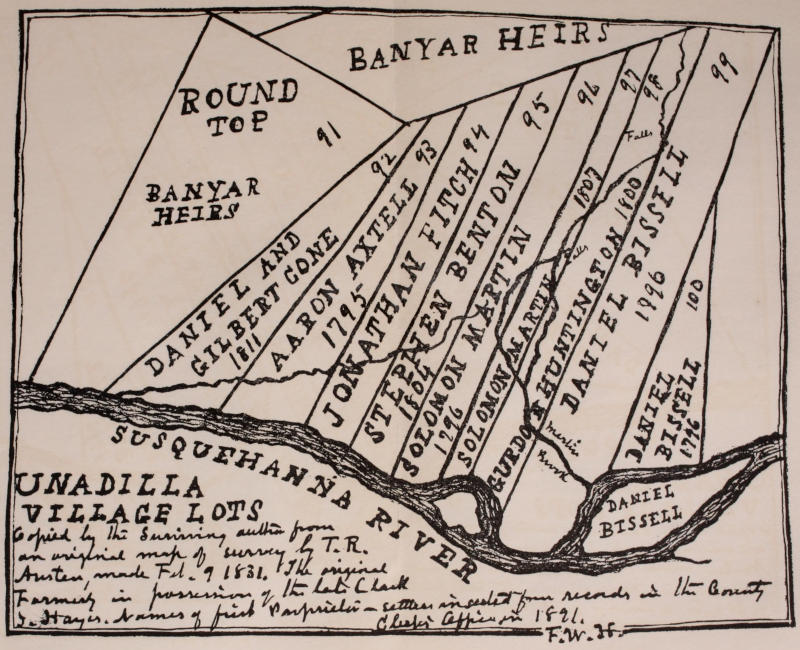
The records of those early transactions are not complete. Searches made for the author leave several gaps to be filled. It was not a universal custom in those times to record deeds. A buyer often accepted the old deeds from the man from whom he purchased. Even in cases where deeds were eventually recorded several years might have elapsed after the purchase. In the period from 1772 until 1791, during which Unadilla was part of Tryon, or Montgomery County, no records exist of any sales by Mr. Banyar or of any sales to or by the Livingstons, Lansings or Van Vechtens, searches for the same having been made for the author in vain at Fonda. In Cooperstown the author has fared better. Here titles to almost any lot can be traced back to the formation of the county in 1791. From these records alone has it been possible to prepare the appended account of first sales to settlers.[3]
First to purchase outright, so far as the records show, was Aaron Axtell, the pioneer blacksmith of the village, who was here before 1794. In August 1795, he secured a part of lot 93 for £110. He made the purchase from Mr. Banyar. Lot 93 lies in the western end of the village. Mr. Axtell’s house stood on the site of the future Owens or Salmon G. Cone residence just beyond the railroad crossing, which some twenty odd years ago was burned. In 1810, Uriah Hanford had become the owner of this lot.
Mr. Axtell was of Welsh origin, and another of the name who came to Unadilla was Moses Axtell. Moses Axtell had lived in Boston before the Revolution, where he was one of the famous party who disguised themselves as Indians and threw the tea into Boston harbor,—the act by which, in the trouble with the Mother Country, the gauntlet was definitely thrown down by the Colonists. Moses Axtell afterwards fought in the battle of Lexington and at Bunker Hill.
Next as a purchaser came Solomon Martin, who in June 1796 secured lot 96, embracing perhaps 150 acres. He paid for it the sum of £141 5s. The sale was made by the Van Vechtens. Like all these lots it ran back to the hills for a distance of about a mile from the river bank.
The third purchase was made by Daniel Bissell. In August 1796 he obtained from Mr. Banyar lots 99 and 100, comprising nearly 400 acres, for which he paid £345. These lots extended from the extreme eastern end of the village down to about where St. Matthew’s church stands. Mr. Bissell sold a part of lot 100 in 1801, to his kinsman Guido L. Bissell for $250. Another part of the same lot he sold to Solomon Martin in the following year for $450.
Gurdon Huntington was the next purchaser. He did not acquire title, however, until 1800, which was about ten years after he came into the country. He then purchased from John Livingston a part of lot 98 for $352. Probably Dr. Huntington had already erected on this lot, the yellow house that still stands in the rear of the building long used as the post office. He seems to have built the house while occupying the land under a lease with the privilege of purchase.
Aaron Axtell in 1803 purchased a further part of lot 93 from William Fitch and Sarah, his wife. He paid $1400 for it, which would indicate that improvements had been made by the former owner. Mr. Fitch had a house in the village before 1803. As Mr. Axtell bought his first part of lot 93 from Mr. Banyar, Mr. Fitch’s part had, of course, originally been purchased from the same owner.
Stephen Benton, in 1804, became the owner of lot 95. He purchased it for $1095 from Peter Betts who then lived in Bainbridge and whose wife was Eliza Fitch, a sister of Amasa Fitch, an early settler on village land. Peter Betts owned other lands in the Wallace patent below the village. He, with William Fitch and Jonathan Fitch, had secured titles to land within the village limits somewhat earlier than the settlers already named; but the Cooperstown records give no clue to the date of their purchases which indicates that he made the purchase before 1791. There were Fitches in Lebanon, Connecticut, and these men perhaps came into the country with the Wattles families in or soon after 1784, which would make them the first settlers who took up village lands.
Jonathan Fitch in 1805 sold to Jacob Hayes the land he lived on in lot 94. For a part of that lot Mr. Hayes paid $800. Here again improvements obviously were included in the purchase price. Mr. Fitch is known to have had a house in the village at that time.
Next among the purchasers came Solomon Martin a second time. He bought lot 97 from Mr. Banyar in 1807, paying £153 14s. On this lot stood General Martin’s house and store. He at this time was the largest land owner in the village. After his death in 1816, the estate was said to be “land poor.”
The records now proceed to the purchase made by Daniel and Gilbert Cone, in 1811. This was lot 92 which lay beyond the Axtell purchase. The Cones bought of the Lansings and paid $563.39 for the tract. Three years later they sold one acre of it to Niel Robertson for $400, which must have included improvements. From Mr. Banyar in 1813 the Cones bought another lot for $501.25. This was lot 108, but it was outside village limits.
Daniel Bissell who in some respects is the most interesting of these pioneers was a native of Lebanon where he was born in 1748. He married in that place Sarah Wattles and was approaching forty years of age when, about 1792, and perhaps earlier, he came to Wattles’s Ferry. In Lebanon he had already become a man of varied and useful activities. He possessed a considerable tract of land there and papers now owned by Harriet Bissell Sumner show that he had had many transactions with Sluman Wattles. A paper characteristic of the period, containing an “account of Benjamin Bissell’s estate that Daniel Bissell took”, names pistols valued at £2, a greatcoat valued at 12s., leather breeches at 5s. and one gun at £1, 12s., 6d. Another paper signed “Jonathan Trumbull, Captain-General”, who was the original “Brother Jonathan”, his home being in Lebanon, is dated in 1773 and excuses Daniel Bissell from military service owing to “a lameness of the arm caused by fracture and a pain in the chest caused by a sprain.”
Still another paper dated in March 1792 gives a list of articles delivered to Daniel Bissell from the estate of Mr. Fitch. It includes one large kettle, valued at 8s., one meal chest at 3½s., one small feather bed at 30s., one pair of saddle bags at 6s., one small bedstead 10s., and one copy of Gibbs’s “Architecture”, 24s. Some of these articles no doubt found their way to the new settlement. Mr. Bissell had a family of nine children, three or four of whom had reached their twentieth year. He brought with him the large sum of $7,000 in specie, which completely filled a good sized basket.
One of the recorded facts in Mr. Bissell’s life is that he kept the first hotel. A license issued to him, though not the earliest in the town by five or more years, still exists with the seal attached. It is signed by Solomon Martin, in whose hand the whole paper is written, and by Peter Schremling and Gurdon Huntington. By virtue of law these gentlemen, Commissioners of Excise for the town of Unadilla, say they “do hereby permit Daniel Bissell to retail strong and spirituous liquors according as it is in said law made and provided, from the date hereof until the first Tuesday in May next after this date.” The license is dated September 9, 1799.
Mr. Bissell’s relations with other settlers are shown in several letters. One from Noble and Hayes, of which he was the bearer, dated in 1806, is addressed to Bogardus and DuBois of Catskill, and informed them that the Unadilla merchants sent by Mr. Bissell three barrels of wheat, with other articles which were to be sold “if you can and credit us the avails.” Another from Dr. Huntington was addressed to Packard and Conant of Albany. Dr. Huntington sent by Mr. Bissell a few rags and said “I expect you will give four dollars for rags, or more, and if they do not come to the amount of the paper [the rags were to be exchanged for writing paper] I will be I suppose in Albany in about two weeks and will settle for the same.” The date of this is November 1808, when Dr. Huntington was a Member of the Assembly.
About the same time came a relative of Daniel Bissell, though not a near one, Guido L. Bissell, Mrs. Sumner’s ancestor. He was born in 1769 and was the father of that other Daniel Bissell whom many men and women can still remember. He was also the father of Hannah Bissell who became the wife of John Veley. In 1796, as Mr. Bissell’s account book records, “John Barsley began to work for me”, and in the following spring “Sevenworth began to work for me.” In this ancient volume, another entry under date of Franklin, March 23rd, 1798, is this: “I promise to Guido Bissell 15 shillings on demand, being for value received, John Pooler”, and still another, “Mr. Guido Bissell and I have settled and find a balance of 2 pounds due said Bissell on account, James Hughston.” Mr. Bissell for some time was engaged in trade. His book has many entries of sales of “jane”, velvet, cloth, etc., as well as charges for work done by himself and men whom he employed. He did some of the work in building Wright’s store in 1815, and when St. Matthew’s church was built made note of “work on the church five days by Mr. Beadle.”
A numerous and influential family in Connecticut had been the Bissells. John Bissell, a pioneer of Windsor, and believed to be the ancestor of them all, was the first white man who ventured across the Connecticut River from Windsor, where he built a house and began the East Windsor settlement. For forty-four years his descendants, Aaron Bissell and Aaron Bissell, Jr., filled the office of town clerk. In Windsor in the last century was a Daniel Bissell and a Daniel Bissell, Jr. The latter performed secret service for Washington, that won for him a badge of merit. Members of this family have been prominent in various walks of life. One of them was a Protestant Episcopal bishop.
Solomon Martin came to Unadilla some years before 1790. In 1792 he already had a store here. He was a native of Woodbury, Connecticut, one of the oldest towns in that state outside the Connecticut River valley, and was a son of another Solomon Martin, descended from one of the first settlers. The family was English and one of them, Captain John Martin, went around the world with Drake. They were entitled to bear arms and had for their motto “Sure and Steadfast.” Solomon was born June 15, 1762. His name is given by Cothran among natives of Woodbury who served in the Revolution, although he was only a boy of thirteen when the war began. His title of general—a militia title, I believe—belongs to a late period in his life. In 1792 he was a captain and in 1806 a colonel. He served in the war of 1812.
His store in Unadilla was the first set up. Its site was on Main just west of Martin Brook Street. Here also he lived, the house and store having been built together. At a late date he appears to have been in partnership with Gurdon Huntington. Many years afterwards there stood near the present White store block a building called the Dr. Huntington store. It was afterwards moved to the site of the present L. L. Woodruff residence and then conveyed to the street that fronts on the river where it still stands adjoining the churchyard grounds. Solomon Martin had a distillery as early as 1803, when Guido L. Bissell charged him “to work at trough at stillhouse 18 shillings,” “to work in the still house 6 shillings”, and again “to work on the still.”
Solomon Martin and Sluman Wattles had close business relations. Mr. Wattles sold him boards “delivered to your store” in 1792, and in the same year charged George Johnson 3 pounds, 17 shillings for “goods taken at Captain Martin’s store.” In 1794 he charged Martin 6 shillings as “fees for license”, and the same year Roger Wattles with “an order on Solomon Martin for three quarts of rum for 7 shillings.” When Martin was in the Legislature in 1806, Sluman Wattles sold him a yoke of oxen “which he agrees to allow me as much for as he can sell them to the McAlpins for and answer the same to Lansing at Albany towards the Mill place which I bought of him (Lansing) between now and the last of August next.” Martin appears to have made his journey to the State Capital in a conveyance drawn by these oxen.
Solomon Martin’s wife was Susan Scott of Catskill, whom he married in 1796. In 1816 he died, and Mrs. Martin with her four sons and her unmarried sister continued to occupy the home in Unadilla for many years. He was elected Supervisor in 1798, 1799, 1800, 1801 and 1802. He was Sheriff of Otsego County from 1802 to 1806, and was twice a Member of Assembly. His business relations were large. Among plaintiffs in suits before Sluman Wattles in and about the year 1794, Martin often appears, some twenty suits and confessions of judgment in his behalf being entered.
During his term as Sheriff, Martin became associated with a murder case in a way that gave his name considerable notoriety. Stephen Arnold of Burlington had so severely whipped a girl six years old that she died of her injuries. Arnold was tried, convicted and sentenced to be hanged. On the day appointed for the execution, thousands of people assembled to witness it in an open field on the banks of the river in Cooperstown. An address was made by a clergyman, the prisoner spoke a few words, Sheriff Martin adjusted the rope, and then, while the assemblage was breathlessly waiting for the final scene, Martin produced a letter from Governor Lewis granting a respite. It appeared that this letter had reached Martin early in the morning and it was now past noon. His excuse for his conduct was that he and a few others whom he had consulted thought it would be improper to make the letter public except on the scaffold.
Solomon Martin’s permanent memorial in this village is the stream that bears his name. It was formerly divided into two streams running through village lands, and then coming together, thus forming an island. When the owners of land on and near this island desired to erect buildings they thought it proper that the brook should be confined to one channel, and accordingly attempted so to make it.
More than half a century has passed since that step was taken, but the stream in high water time is still true to its old time habit: the brook pushes out to the westward and asserts dominion over its old time territory. All the efforts of two generations to prevent this again and again have failed. Across this stream on Main street originally stood a wooden bridge. At the sides horses could be driven down for water. A stone arched bridge erected a great many years ago, admirably took the place of this primitive structure and so remained until 1893, a striking monument of the care with which it was built.
Solomon Martin for many years had a sawmill on this brook. It stood a short distance above the tannery site and here for many years the road came to an end. The building of this sawmill goes back of the year 1796. Solomon Martin, his store and his sawmill were long since gone. They are all forgotten to this generation. A dark stone slab marks his burial place in St. Matthew’s churchyard. Meanwhile the unruly brook remains forever to strengthen recollections of his name.
Further up this stream other sawmills were afterwards built. What was the dwelling house adjoining these mills still does duty there as a home on a different site, and here in their old age long lived Lewis, or “Luke”, and Edward Carmichael. Beyond that site Martin Brook now possesses a newer and more lasting memorial of individual enterprise. Athwart the stream have been erected imposing dams of stone serving reservoirs and standing as firm and permanent as the hills that form their abutments. Solomon Martin had been nearly forty years in his grave when was born the citizen of Unadilla who in that secluded ravine was to erect these enduring and beneficent structures,—Samuel S. North.
Gurdon Huntington, whose home for many years was in the historic building that still stands at the corner of Main and Martin Brook Streets, came to Unadilla before 1794, and here he lived until 1830. He was a native of Franklin, Connecticut, which lies within a few hours’ walk of Lebanon, Daniel Bissell’s home. His father was Deacon Barnabus Huntington, and he belonged to the sixth generation in descent from Simon Huntington, a noted early emigrant from England who sailed for the new world in 1633 with his wife and children, and on the voyage over died and was buried at sea. From his surviving sons a very distinguished family of descendants were to be raised up in many parts of this country—Samuel who was governor of Connecticut and a signer of the Declaration of Independence, Samuel who was governor of Ohio, Daniel the artist, and Collis P., the railroad magnate, whose home in early life was in the Susquehanna Valley at Oneonta.
Gurdon Huntington was born on July 3rd, 1768. He was educated by his father’s pastor, the Rev. Dr. Nott. One of his schoolmates was that Eliphalet Nott who rose to much eminence as president of Union College. The boy read medicine in Connecticut and then came to Unadilla. In 1798 he married Esther, the only daughter of Benjamin Martin of Woodbury, Connecticut. Benjamin Martin was Solomon Martin’s eldest brother.
Dr. Huntington “became a successful and deservedly popular physician” in Unadilla. His practice is known to have extended to places distant forty or fifty miles from home, and one may well believe the statement that “a more welcome visitor never entered those scattered homes.” In this laborious field he made journeys by day and night and often wended “his solitary way along almost untrodden paths”, forded unbridged streams and yet was a “cheerful and happy man”, as well as a “skillful and prosperous physician.” He is said to have accumulated in his time “a handsome property.” He was a man of genial manners and by nature companionable.
Dr. Huntington was elected supervisor of Unadilla in 1803 and again in 1809 and 1811. For seven years he was town clerk. He served four terms in the Legislature—in 1805, 1806, 1807 and 1808. In 1813 he removed to Cairo, Greene County, where he died in 1847 at the age of seventy-nine.
In this early pioneer history, other names besides these are found—Adam Rifenbark, Seth Abel, Capt. Uriah Hanford, Jacob Boult, Abel Case and Jonas Sliter. Each was here before the eighteenth century closed. Capt. Hanford came before 1796 and was a freeholder in 1809. He died here more than thirty years afterwards. He was the father of Theodore Hanford. Jonas Sliter dates as far back as 1795 and probably several years further. He seems to have belonged to the family which settled in the old paper mill region before the Revolution. Perhaps he came back as soon as the war closed. Seth Abel was living in the town before 1798 and long served as tax collector and pathmaster. Abel Case was probably here before the century closed. In 1809 he was a freeholder and in 1810 a commissioner of highways. He owned land that joined Solomon Martin’s and was one of the first vestrymen of St. Matthew’s Church. Guido L. Bissell worked on his wagon house and roofed over his barn in 1806. Jacob Boult was living in the village in 1800 “near the bridge” and was still a resident in 1837. Giles Sisson was living on the river road above the village before 1808. Still another name is William Wheeler, to whom in 1797 Guido L. Bissell sold “15 lights of sash for 7 and 6 pence”, “290 feet of timber for 10 shillings and 1300 shingles for 1 pound.”
The life story of these pioneers is really a history of this settlement in its formative period. Their activities widely differed, and so did their importance. But all were among the first pioneers and they all had a share in laying the foundations.
III. TWO FRONTIER MERCHANTS. 1800.
While Solomon Martin, Gurdon Huntington and Guido L. Bissell had sold goods in Unadilla before the century closed, the first merchants, in any large and permanent sense, were Curtis Noble and Isaac Hayes. Among settlers who came after the century had just ended, special distinction belongs to both men. They were contemporary in their coming with the building of the turnpike, and both were young, Mr. Noble being twenty-five and Mr. Hayes twenty-four. Here they remained in partnership until Mr. Noble died more than a generation afterwards. Their varied activities extended far along the valley and to the north and south of it. They were typical frontier merchants, a class of whom New York State in those times had many examples—men of youthful energy, largeness of aims, honorable purposes, capacity for toil and fine mercantile instincts.
Curtis Noble was descended from Thomas Noble, an Englishman who reached Boston as early as 1653. Descendants of Thomas Noble make up a genealogical record filling a book of more than 600 pages. He settled in Westfield, Massachusetts, and there died in 1704. His eldest son, John, was the first white man who settled in New Milford, Connecticut, and there in 1750 was born John’s son Elnathan, and in 1754 his son Jesse.
Elnathan Noble in 1794 bought for $750 a farm of 100 acres in Otsego County on the Butternut Creek in what is now New Lisbon. When he moved to the farm in April of that year, there was a log house on it ten feet by twelve, with an elm bark roof and a chimney of sticks and clay. In a cart covered with tow cloth and drawn by two yoke of oxen he arrived early in May with Johanna Bostwick, his wife, and their one daughter and four sons, finding the land heavily timbered, the settlers few, and these chiefly Dutch or German.
Here Elnathan Noble lived until his death in 1824, his funeral being conducted by the Rev. Daniel Nash, known better as “Father” Nash, with whom he had long co-operated in support of the Episcopal faith. Jesse had followed him to New Lisbon, and Jesse’s son Thomas found in Unadilla a wife in Eliza Ann Beach, daughter of Abijah H. Beach, by whom he had eight sons, Whitney B., George N., Edward B., Thomas H., Carrington T., John Henry and Clark. Jesse’s daughter Hetty became the wife of the Rev. Russell Wheeler, the first rector of St. Matthew’s church in Unadilla.
Elnathan Noble’s eldest son Curtis did not go to New Lisbon with his father. He had already entered upon a mercantile life at New Milford in the store of Elijah Boardman, where also had been employed his future partner, Isaac Hayes, and there Curtis Noble remained until 1800 when he and Mr. Hayes formed their partnership and set out for Unadilla. In that year Mr. Noble married Mr. Hayes’s sister, Anna, who survived him until 1865 when she died at eighty-four.
Mr. Hayes was born in 1776. His father was Thomas Hayes of Ilminster, Somersetshire, England. Mr. Hayes in 1798 was sent by Mr. Boardman to the Western Reserve of Connecticut, now a part of Ohio, under contract to clear up a tract of land, sow grain and otherwise prepare the way for settlers. These lands were in the present township of Medina.
Early in 1800 Mr. Hayes had returned to New Milford and entered into his agreement with Curtis Noble to conduct a business “as merchants or shopkeepers in the State of New York at such place as may by them be thought most proper under the name and firm of Noble and Hayes for a term of time not less than ten years.” They contributed each at the beginning one thousand dollars. Mr. Hayes was soon afterwards to increase his amount, while Mr. Noble had the privilege of doing so. Each was to “devote his whole time and attention to the business, use and benefit of the said company.”[4] Instead of ten years this partnership continued for nearly forty. Formal settlement was finally made in 1841 with George H. Noble and Charles C. Noble as executors of their father’s estate.
These Unadilla pioneers came by way of Catskill, the turnpike being then in process of construction. On reaching the river they stopped at the Wattles’s Ferry hotel and soon concluded that the lands across the stream offered the most promising site they had seen for their enterprise. Here was the terminus of the turnpike over which their goods could be brought from Catskill and from here down the Susquehanna could be sent in boats the produce of the country which they expected to acquire in exchange for goods.
Their first stock of goods arrived on a Saturday, when they were living in the house afterwards called the Priest house, a close copy of the Gurdon Huntington house. It occupied the site of the present Horace Eells residence. In one of the rooms of this dwelling the goods were opened and on the following Monday Mr. Hayes on horseback made a tour of the Ouleout country and the upper Susquehanna, announcing to all the inhabitants that a new store had been opened. Solomon Martin, who had a rival store, predicted disaster for the new firm. But Mr. Hayes’s tour brought a crowd of customers at once and a large trade was soon secured.
In the following year the firm was able to send a large quantity of local produce to Catskill and Baltimore. Pearl and pot ashes, pork, bacon, wheat, cattle, dried apples and eventually whiskey became staple articles of export. An old account book records that in 1808 Mr. Noble, on one occasion, sold 30 barrels of pot ashes “for cash in York”, and in 1809, “588 pounds of rags.” Shipments to Catskill were made by well known residents of the town—John Pooler, John Carley, Aaron Axtell, James Hughston and others. The business eventually grew to large proportions. Wheat, rye and corn were grown in vast quantities and everyone was overburdened with the stock on hand. In a single week the firm was known to ship to Catskill 3,000 bushels of wheat, which meant 90 sleigh-loads. These circumstances forced the firm into distilling rye and corn into whiskey, and for this purpose the stone building, afterwards used as a tannery was erected.
Between Unadilla and Baltimore regular ark loads of produce made journeys down the river. As described to the author by the late Clark I. Hayes, these arks were from 20 to 30 feet long and from 15 to 20 feet wide, the depth being from 3 to 4 feet. Boats similar to them were in general use on inland waters at that period. On the Mohawk the favorite boat was called the Schenectady boat, which was “a broad and shallow scow some 50 feet in length steered by a sweep oar of 40 feet and pushed upstream by man power.” On these boats when the river was high 10 tons of freight could be carried.
The ark proper was the invention of a Pennsylvania farmer named Kryder living on the Juniata. In 1792, when flour and lumber were dear, he first resorted to this kind of boat in order to reach Baltimore, and thus realized an excellent profit. The ark afterwards came into very general use all along the upper as well as the lower Susquehanna. In favorable water 80 miles a day could be traversed. Mr. Kryder’s first ark carried 300 barrels of flour. Later ones were large enough to bear the weight of 500 barrels. It was by means of these boats that the vast grain product of Central and Western New York was for many years transported to southern markets.
The arks of Noble and Hayes were loaded at a cut in the river bank that may still be seen opposite their old store. Having been hauled near the bank, planks were thrown out to the arks from the shore. In seasons when the water was at its most favorable stage,—which was usually falling high water that enabled a boat to be kept in the centre of the stream,—loading was done at other points in order to start several arks at one time. All the products of the country went down the river in these arks—at least all for which a market existed at the end of the journey. They were loaded sufficiently well to draw from 20 to 24 inches of water. From three to five of them were usually coupled together in line and placed in charge of an experienced pilot who understood the course and currents of the stream. Men with long oars steered them at each end of the line under directions from the pilot.
Lumber intended for Baltimore went in rafts which were put together at places along the river where some quiet eddy could be found near a sawmill. One of the best spots of this kind near Unadilla was the eddy below the Condensery which formerly covered a large territory that has since been filled in by the action of the water, leaving scarcely a trace of the water area that formerly existed. After making their sales in Baltimore, Mr. Hayes or Mr. Noble went on to New York to purchase goods, shipping them by way of the turnpike.
Refuse grain from the Noble and Hayes distillery was fed to cattle and hogs. It was a common thing to slaughter from 200 to 300 hogs in the fall, and to feed half that number of cattle through the winter. In the time of Jefferson’s Embargo the firm met with heavy losses. Mr. Hayes used to tell how a supply of crockery that had cost $1200 just before the Embargo was raised was afterwards worth only $112.
When the Embargo was imposed however, it not only affected the stock of merchants favorably but the farmer’s produce unfavorably. Grist mills had been busy with heavy crops all through the autumn of 1807 in anticipation of high prices, due to the foreign demand; but when the ports were closed, the demand ceased and farmers often found themselves in possession of a staple article for which they could not get the cost of the labor put into it—the sowing, reaping and grinding. The loss in New England to each family because of this measure was reckoned in 1808 to be about $100. Thousands of men were ruined by it, and notices of sheriff’s sales covered tavern doors and guide posts at forked roads. Men in those days could be sent to jail for debt and thus in New York City during a period of less than a year 1300 persons were imprisoned. That city has been described as looking “like a town ravished by pestilence.” Streets were deserted and grass grew on the wharves.
Isaac Hayes in 1804 built the house in which his son so long lived—the house still occupied by descendants of his. It was for many years regarded as the finest residence on the road between Catskill and Ithaca. This may readily be believed, for in 1804 the common dwelling house was a log hut, while the three “yellow houses”, then standing in the village, one of which the Huntington house still survives, were fine modern residences.[5] Mr. Hayes’s house for that time was indeed a palatial country mansion. A remarkable feature of it was the height of the rooms, as may still be seen; they are as high as rooms in many dwellings of our day. Remarkable also was the design of the house—the elevation, the mantels, above all the circular stairway. In the existence here of that edifice in those early days lay a sign of the culture which someone has said “corrects the theory of success.”
On the island opposite this house formerly existed a race-course. It does not appear to have been in use long, however,—perhaps not for more than two seasons. A temporary foot bridge was erected across the stream, made of planks resting upon benches having legs long enough to keep the planks above water. This bridge was wide enough for two persons to pass. After the races were over it was removed. Horses and carriages reached the island by the fordway.
Mr. Hayes’s activities in this community, apart from his mercantile business, were wide and varied. He was postmaster for many years, supervisor in 1805, and for seven other years, and was elected to the Legislature in 1811 and in five other years. He had an important share in founding St. Matthew’s Church. He had come from the home of Congregationalism and did not embrace the Episcopal faith until some years after he came to Unadilla, when he joined with others in promoting the services held by “Father” Nash. He was a vestryman, warden and treasurer of the Church for many years and was senior warden at the time of his death, which occurred in 1857 at the age of eighty years and ten months.
Isaac Hayes’s wife was Sarah, daughter of Benjamin S. Mygatt, of New Milford. To the same family belonged the late Henry R. Mygatt of Oxford and his sister, Mrs. Frederick A. Sands, of Unadilla. The two families of Noble and Hayes, as already shown, were related by marriage, Mrs. Noble being Mr. Hayes’s sister. No family accounts were kept at the store; each took what it needed. Eventually the two family homes contained twenty children. One of these children survived elsewhere until 1892; when he died in Bennington, Vermont, at the age of eighty-three,—Joel M. Hayes.
Thomas Hayes of Ilminster had seven children besides Isaac. They were Abraham, Polly, Jacob, Hannah, Daniel C. and Thomas. Abraham’s daughter Anna married Dr. David Walker, who succeeded Dr. Huntington as the occupant of the “yellow house”, and whose brother Francis built the house across the street that was long the home of the late Henry S. Woodruff. Dr. Walker lived in Unadilla as late as 1835, and finally died in the West. A daughter of Jacob Hayes, Julia Ann, became the wife of Col. A. D. Williams, for many years a merchant in Unadilla, of whom more will be said hereafter.
Isaac Hayes’s daughter Sarah Ann, who was born in 1815, became the wife of the Rev. Louis LeGrand Noble, a cousin of Curtis Noble, whose career as a clergyman began in the historic St. Peter’s Church in Albany and included successive charges in North Carolina, Catskill, Chicago, Glens Falls and Hudson City, New Jersey. He became in 1872 professor of English literature in St. Stephen’s college at Annandale. He was a friend of Thomas Cole, the artist, became one of his executors, edited his papers, and wrote his life.
Like Mr. Hayes, Curtis Noble was active in many affairs apart from his own business. He was supervisor in 1825 and 1829 and held the office of town clerk for a longer period than any other citizen of the village has ever done—from 1805 to 1824. A story that has survived to this day is that he once brought down with his gun from the top of a pine tree a Susquehanna shad. This was strictly true. He had shot a hawk and with the hawk fell a shad which the hawk had taken from the river.
Curtis Noble’s eldest son was Col. George H. Noble, whose wife was Sherman Page’s daughter, Elizabeth Butler. He was a man of extensive knowledge and deeply impressed those who knew him. For some time he was engaged in business in the brick store at Main and Depot Streets. The stone part of the Arnold residence was built by him. Colonel Noble at one time edited a paper called the Unadilla News. In 1840, Edward H. Graves had started a paper called the Susquehanna News, which Col. Noble purchased of him in the following year and changed the name. After a brief career it was followed by the Weekly Courier, of which Edson S. Jennings was editor.[6] Colonel Noble died in 1847 at the age of forty-two.
Curtis Noble’s second son was Charles Curtis, a graduate of Union College who became a lawyer at Owego, but after his father’s death returned to Unadilla. He was County Judge in 1843, and a Member of Assembly in 1849. He died in 1851 at the age of forty-five, while on a visit to Owego, where he hoped a change of air might improve his health. By way of Deposit, the body was brought back to Unadilla by rail and from Bainbridge a funeral train of thirty carriages conveyed it to Unadilla. His stone law office, near the house where his widow long afterwards lived, stands as a familiar relic of his career.
His widow survived until July 13, 1890. She was a large-minded, gifted woman. Few like her have dwelt so long in this valley. She was born in Owego in October 1808 and was married in 1834, becoming the mother of six children, three of whom grew to maturity and one to the age of fifteen. All these children soon passed away in the steps of their father. With the finest resignation, Mrs. Noble bore these recurring afflictions which left her for more than a quarter of a century a solitary figure in the home where her young life had been spent. One who knew her long, when writing of her early life, described her as “the centre of a large social circle and the brightest intellectual force within it.” It was, indeed, women like her who could make one realize what Steele meant when he said of Lady Elizabeth Hastings that “to love her was a liberal education.”
Curtis Noble’s daughter Harriet Amelia, the widow of Henry H. Howard, was long the sole survivor of Mr. Noble’s family in the village. Mr. Howard was a citizen of the village for nearly sixty-five years: he came in 1827 and died in 1890. He was a native of Madison County, his father being Samuel Howard a native of Bridgewater, Massachusetts. He married Harriet Noble in 1837, their only surviving child being Dr. Frederick S. Howard of New York. Men and women can now recall the Fourth of July celebrations of their childhood to which Mr. Howard usually contributed the balloons made by him on his own premises. He was a man of bright and original mind, capable of varied and forceful wit, and had considerable knowledge of human nature.
Curtis Noble had a brother named Elnathan who went from New Lisbon to Michigan in 1833, where he gave to a town in Livingston County, the name of Unadilla,[7] and a sister named Sally who in 1808 was married to Dr. Willis Edson. Dr. Edson was a native of Pittsfield, Massachusetts. He read medicine with the famous Dr. White of Cherry Valley and in 1815 came to Unadilla, where he died in 1823 at the age of forty, leaving a son Willis who was long in business here.
A daughter of Dr. Edson was the wife of Col. Robert Hughston who led a regiment to the front in the Civil War. Col. Hughston was descended from the Ouleout pioneer and spent many years on the farm where a bridge crosses that stream to the lands that were taken up after the Revolution by Timothy Beach. Dr. Edson’s son Darwin was the father of William D. Edson, the author’s friend and schoolmate, who practiced law in Unadilla for some years and afterwards joined other men from the village in finding a new home in the “zenith city of the unsalted seas.” In that distant town Mr. Edson is now City Judge.
IV. EARLY TOWN MEETINGS, ROADS AND HOUSES. 1787-1810.
Otsego County was formerly part of Montgomery. Montgomery had before been called Tryon County after the Colonial Governor, William Tryon. Governor Tryon became a Tory during the Revolution and hence the change in name. At the close of the war Montgomery embraced lands enough to have formed a small state—the lands that now comprise the counties of Montgomery, Otsego, Herkimer, Fulton, Hamilton, St. Lawrence, Lewis, Oswego, Jefferson and parts of Delaware, Oneida and Schoharie.
Otsego was formed from Montgomery in 1791, but the need for a division of the large territory comprising Montgomery had been felt soon after it was set off from Albany County in 1772 under the name of Tryon. The Legislative Council in 1775 set apart a certain tract called the Old England district, in which were included settlements on the Unadilla River and Butternut Creek: under this name the tract was known during the Revolution. After the war, it was reorganized under the same name with new officers and so continued until Otsego was set off in 1791 and then the name disappeared.
Otsego first comprised only two towns—the towns called Otsego and Cherry Valley, but in 1792 the town of Otsego was divided and the name Unadilla was given to its southern half. In that town of Unadilla were then embraced lands that have since been made to constitute seven Otsego County towns, and which by the census of 1890 had a population of 20,024, divided as follows: Butternuts, 2,723; Morris, 1,920; Milford, 2,051; Laurens, 1,659; Oneonta, 8,018; Otego, 1,840; Unadilla, 2,723; Oneonta Village,[8] being not only the largest community in Otsego County, but the largest between Albany and Binghamton. When Oneonta was first taken off from Unadilla, it was named Otego from the creek that still flows across its territory—the Wauteghe Creek of earlier times.
The division of the Unadilla territory began in 1796 when Butternuts (with lands afterwards taken from Butternuts and called Morris), Oneonta, (including lands that afterwards were taken from Oneonta to make Laurens), and Milford were erected as separate towns. The present Otego lands remained a part of Unadilla until 1822. This division found its justification in the growth of population which had been surprisingly large before the 18th century closed. As early as 1794, Otsego County was able to cast 1,487 votes for Member of Congress, which would mean a population of probably more than 10,000. The town of Otsego alone in 1795 had 2,160 male inhabitants above the age of sixteen. Six years later the entire county contained 21,343 souls. Spafford in 1813, which was before Otego was taken off, credited the town of Unadilla with a population of 1,426, and the taxable property was valued at $141,896. Unadilla had five distilleries and fourteen schoolhouses. The land was “held in fee.”
A study of the records of this town of Unadilla, as contained in a large pigskin-bound volume, now in the office of the Town Clerk, sheds interesting light on many aspects of frontier life. It contains the record of the town meeting held in 1796, which met in the house of Daniel Bissell, on the site of the present residence of Samuel D. Bacon, which for so many years was the home of Dr. Evander Odell. This meeting was presided over by Nathaniel Wattles of Wattles’s Ferry. David Baits was elected supervisor and Gurdon Huntington town clerk. It was voted that the next town meeting should also be held in Daniel Bissell’s house, but later meetings held their sessions “in the schoolhouse near Daniel Bissell’s.” In 1798 the house of Solomon Martin was used; in several other years the schoolhouse.
Suggestions were often made that meetings be held outside the village, because of the long distances which many persons had traveled for the earlier meetings. In 1817, and some other years, voters assembled at the house of Capt. Elisha S. Saunders, several miles up the river. Motions were afterwards made that meetings take place on the Unadilla river, in the paper mill country, and in Unadilla Centre, but these were lost.
At the meeting in 1797 it was voted that “the town will be at the expense of sending after Esquire Scramling, or some other magistrate, to qualify the town officers”, and in 1797 that “the town will allow the Town Clerk five dollars for his services for the last year.” The same sum was voted in 1803 to Solomon Martin and David Baits for “services done heretofore as supervisors of this town.” Lawful fences were declared to be those “four feet nine inches high”, with the “poles or rails not more than six inches asunder.” Earmarks were registered as follows: Abner Griffith, “slots in the right ear”; Daniel Bissell, “a square crop on ear, with a half penny on the under side of the left ear”; John Sisson, “a hole through the right ear and a half penny the underside of the left”; William Fitch, “a half penny under side each ear.”
It was voted that hogs “with yokes eight inches long above the neck and four inches below be allowed to run as free commoners”, and that “the town will give for each wolf killed within the limits thereof forty shillings.” Wolves seem to have been plentiful until a rather late period. Dr. Odell in 1872 said men were then living who could remember the site of the railroad station in the village as “a tangled thicket from which the cry of the panther and howl of the wolf were frequently heard.”
In 1796 the number of persons assessed in Unadilla was ninety-nine; the total real and personal property was set down at £2,275, and the tax at £52. A year later the persons assessed numbered 106; the property was $12,045 in value and the taxes were $370. In 1808 a memorandum declared the number of “Quakers returned in this town, 1, viz: Stephen Wilber, tax $4.”
Signs of the discontent, due to an inconveniently large town, which eventually led to taking off Huntsville (Otego) from Unadilla were seen very early. One was the holding of the town meeting at the house of Captain Saunders; another was a proposal in 1817 to divide Unadilla by adding to Chenango County “all that part lying in Upton’s Patent”, which was the valley of the Unadilla River, and coming east to the “west end of the village of Unadilla.” This proposal emanated from “the western portion of the town.” But the town meeting of 1817 resolved to “use all due diligence to prevent such division.” Nine-tenths of the people were declared to be opposed to it, its strongest advocates lying outside the town, and their motives being “to divide and distract the citizens of our territory.”
Some twenty-five years after Otsego County was formed a project was started for setting off a new county comprising parts of Otsego, Chenango and Delaware, and to be called the County of Unadilla, with the village of Unadilla as the county seat. In 1818, the sum of $250 was voted to defray the expenses of a committee while attending the Legislature “for the purpose of obtaining a new county.” Other papers on this subject may be found in the State archives down to a period so late as 1856.
In 1802 it was resolved that the town should have two pounds. One was to stand “not to exceed half a mile from Hubbell’s Mills, so-called, and the other within half a mile of Yates’s Ferry, so-called.” The two were to be built of “logs rolled up in form or manner of a house.” William Potter was Poor Master in 1793, and in October he charged the town with “a winding sheet for F—— twelve shillings”, and “for F——’s attendance and doctrine £3, 12s. 3d.” In March 1794, he received as license money $10 each from Isaac Gates, Nathan Hill and Barrett Overheyser, and in 1795 the same from nine other persons.
First among enterprises having in view the general good came roads which at the start were mere clearings through the forests. Above all things the scattered settlements in the upper valley needed communication with each other. The road by which they reached the outer world ran from Wattles’s Ferry to Catskill,—a road much older in its first state than the turnpike and one which the turnpike finally supplanted. The original road had been opened about fifteen years before the turnpike was established. A wheeled vehicle as early as 1787 is known to have made a journey over its entire length.
By the summer of 1788 this first road was in passable condition. The State now took its improvement in charge. G. Gelston made a survey of it in August 1790, and during the next year Sluman Wattles did some work on it, his cousin, Nathaniel, having a contract with the State for the work. In 1792, Solomon Martin drove a yoke of oxen over it to Catskill and back, taking fifteen days, which meant an average of six miles a day. The road was only twenty-five feet wide. In the same year a regular weekly mail route was established over it from the Hudson to the Susquehanna.
A State road that dates from 1790, led from Unadilla by the Susquehanna and Charlotte to Schoharie Flats. In that year Sluman Wattles reported to State officials that it was worth £12 per mile “to clear out and make this road.” It became an important highway to the settlers.
To about the same period belongs the building of Main Street in Unadilla village, which was extended westward to the Unadilla River. The survey was made by Nathaniel Lock of Westchester County. The original map made by him may still be seen in Albany. In December 1791, a certificate, signed by Solomon Martin, David Baits, Israel Smith, Elijah Heyden, Nathaniel Lock and other “inhabitants of the Ouleout and Unadilla”, declared that this road had been completed agreeable to Lock’s map by Benjamin Hovey[9] and John Massereau. The signers added that “said road had been amended so that loaded ox teams or carts can pass and repass the whole distance with ease.” Originally the road in Unadilla village ran closer to the river. It was several times altered and once at the instance of Solomon Martin, to whom credit is given for the obtuse angle formed near the Post Office.
Solomon Martin and others certified in 1791 that they had completed a road from the Unadilla to the Chenango River. A road also had been opened down the Susquehanna, where were many settlements, and at Windsor in 1791 one had been started across the hills to Cookoze (Deposit) on the Delaware “to serve”, says Lincklaen, “to transport commodities to the Philadelphia market.” By 1794, a road ran all the way over to Carr’s Creek from the Ouleout, beginning at a point near the stone house on the W. J. Hughston farm. It had been begun somewhat earlier. In that year a bridge was constructed across Carr’s Creek, Sluman Wattles charging 8 shillings for one day’s work on it.
For the records of later road building we must turn to the town archives instead of the State. In 1796, there was made “a return of a highway, laid out through the town of Unadilla, beginning at Abner Griffith’s on the river and running north to the Sand Hill Creek where the patent line crosses; then crossing the creek; thence northerly through lot number 119 until it runs twenty-five rods on the lot of Elisha Lathrop”, from whence it proceeded to the north line of the town. These records show how early the Sand Hill and Hampshire Hollow parts of the town were settled.
The northern central parts of the town were at first approached from the Unadilla River and the Butternut Creek. Earliest among records concerning a road running directly north from the village is “a return for an alteration of a road beginning near Captain Solomon Martin’s on the line between him and Daniel Bissell and running on said line northerly as far as the land will permit.” This return is dated May 10th, 1796; but there is nothing to show anything further in connection with such a road. The present Martin Brook road through to the north part of the town from Martin’s saw mill, was not opened until nearly fifty years after the date of this paper.
In June 1796, commissioners, on the application of twelve freeholders, laid out a road “beginning near Aaron Axtell’s house at a stake, thence running a northwesterly course to a pine tree marked H; then to a pine tree marked with a blaze; thence to a walnut staddle, also marked with a blaze; then running nearly the same course to a pine tree marked with an X; thence running until it intersects the old road six rods north of the five-mile tree.” To this project, which points to what was afterwards the old Kilkenny road, there was opposition and it was referred to a jury of twelve men, who reported that it was “not consistent; neither do we think it necessary and therefore we do protest against said road.” Built, however, this road was in early times, though it had some years to wait. Mention of it first occurs in the list of road districts for 1810.
Earliest of all roads actually opened from the village leading over the hills to the north, seems to have been the one running from near the store of Noble and Hayes, of which mention occurs in the road list for 1809, but a return for the survey of it had been made in 1808. The town in 1800 had already been divided into road districts of which there were fifteen. They show with much force the extent to which the Unadilla township lands had been opened up at that early day. They are as follows:
“First district, beginneth at the town line at Stephen Harrington’s and runneth to the Unadilla River road.
“Second, beginneth at the Butternut Creek and runneth on the said Unadilla road to the Eel Ware Bridge.
“Third, beginneth at the Eel Ware Bridge and runneth on the said road to a pine tree marked No. 4 at the foot of the hill.
“Fourth, beginneth at the pine tree at the foot of the hill marked No. 4; from thence to the State road and from the ferry to the line of Banyar Patent.
“Fifth, beginneth at Banyar Patent line and running to the two-mile tree on the State road, and from Colonel Baits’s.
“Sixth, beginneth at the two-mile tree and from thence to the Grog Shop Creek to include the bridge.[10]
“Seventh, beginning at the east end of the village, thence to the foot of still water.
“Eighth, beginning at the foot of still water and up the cross new road as far as Laban Crandall’s house; from thence to the eight-mile tree.
“Ninth, beginning at the eight-mile tree; from thence to the Otsdawa bridge.
“Tenth, beginning at the Susquehanna River road up the Sand Hill Creek road to the north line of the town.
“Eleventh, beginning at Merriman’s sawmill; from thence to the northwest line of the town.
“Twelfth, beginning at Laban Crandall’s house; thence through the north line of the town on the Sisson road.
“Thirteenth, beginning at the river road; thence up Wheaton Creek to Joseph Peam’s house.
“Fourteenth, beginning at the Wheaton road; from thence to the Sand Hill Creek road.
“Fifteenth, begins at the west branch of the Otsdawa Creek; thence to the town of Otego [now Oneonta] at or near Thurston Brown’s.”
Such were the roads that established communication among the settlers—primitive highways the most of them, and greatly inferior to the turnpike that came in in 1800 as the model road for all this territory and which remained for many years the chief highway to many parts of central and southern New York. One of the earliest highways in the State west of the Hudson and south of the Mohawk was this one from Wattles’s Ferry to Catskill, and it stands as a historic landmark of that great turnpike era which began with the new century.
The turnpike grew out of stern necessity. So great had been the demand for roads pouring in upon State authorities from all neighborhoods, that it was impossible to meet them. The State in consequence gave to private corporations permission to open and improve roads and impose tolls as their recompense. Among the men who took stock in the Catskill Turnpike were Stephen Benton, Solomon Martin and Sluman Wattles, the price of shares being twenty dollars and the amount of stock twelve thousand dollars. Caleb Benton, who lived in Catskill and was a brother of Stephen, at one time was president of the company. Two stages were kept regularly on the road, the fare being five cents per mile, making the cost of the trip from Unadilla to Catskill about the same as the fare by rail from Unadilla to New York now, while the time consumed was three days.
Dr. Dwight came over the road in 1804 and tells how he saw “a few lonely plantations recently begun”, and how he “occasionally passed a cottage and heard the distant sounds of an axe and of a human voice”, while all else “was grandeur, gloom and solitude.” He describes Franklin as “for some miles a thinly built village, composed of neat, tidy houses”, in which everything “indicated prosperity.” Further down the Ouleout the country “bore a forbidding aspect, the houses being thinly scattered and many of them denoted great poverty.”
At Wattles’s Ferry he was unable to find a boat. Even a dinner was denied him. A bridge had been begun but he had to cross “a deep and rapid ford.” Further down the river William Hanna supplied him with a dinner. It was the opening of this turnpike[11] which, as I have said, determined that a village should grow up at its western terminus. Here was a stopping place, the end of the land journey, a place for stores and hotels, the point where pioneers might enter boats and thus be conveyed to destinations south and west.
The number of houses standing in the village in 1808 could not have been more than fifteen or seventeen. At the extreme eastern end near the bridge lived a man named Morgan. His house was a rude affair dug into the bank.
To the west of Morgan came one of the yellow houses, then occupied by Guido L. Bissell, who seems to have built it.
Next was the home of Curtis Noble whose family comprised at this date his wife and his two sons George and Charles, then five and two years old respectively, and an infant daughter.
Beyond stood the Isaac Hayes residence, built four years before, and already famous as the most attractive dwelling between Catskill and Ithaca.
Beyond this lived Captain Amos Bostwick, whose wife was Sally Hayes, an aunt of Isaac Hayes. Captain Bostwick had served in the Revolution in the same regiment with Elijah Boardman of New Milford. His wife died in 1825 at the age of seventy-seven, and he in 1829 at the age of eighty-six. Clark I. Hayes could just remember him as “an old, infirm man, sitting by his open fire on the hearth, cane in hand, poking the ashes.”
Several rods to the west were the home and shoe shop of Fowler P. Bryan, the father of Alexander Bryan, standing near where the Frank Bacon house is.
To reach the next dwelling, involved a walk to the home of Gurdon Huntington on the corner of Martin Brook Street. This house was built by Guido L. Bissell and Jerome Bates and has long been the oldest house in the village. Except for the rear part, put on afterwards, it has scarcely been altered since its original erection. The flight of time long since raised it to the eminence of a centenarian. Besides Dr. Huntington, those who have owned and occupied it include Dr. David Walker, Dr. G. L. Halsey and Albert T. Amsden, while at one time it was owned by Col. A. D. Williams. The last occupant who owned it was Peter Hodges, who, on the death of his wife in 1889, sold it to Dr. Halsey, who thus became its owner a second time. The design of the house is Flemish. Houses like it may be seen to this day in the older parts of Bruges and Ostend. Readers will perhaps pardon the personal pride which prompts the statement that beneath that roof, on an October day, some time “befo de war,” was born the writer of this chronicle.
Beyond the Huntington house came the store and house of Solomon Martin on the land now occupied by the residence of Marvin P. Sweet. This structure remained standing for more than twenty years when it was torn down to make way for the present house, which was built by the Rev. Norman H. Adams.
The land thence westward was vacant as far down as the site of the present residence of Milo B. Gregory, on which had been erected a few years before the home of Stephen Benton.
No other house existed until one reached the site of the E. C. Belknap home, where a house is said to have existed at that time, but its occupant’s name remains unknown to me.
Beyond this all was vacant until the yellow house of Aaron Axtell, the pioneer blacksmith, was reached.
On the southern side of the street were fewer houses than on the northern—in all not more than six. First at the eastern end came the Abijah H. Beach home, where Oliver Buckley lived in later years. It had been erected as early as 1805. Mr. Beach was a native of New Milford, and thus had for neighbors across the way three other New Milford families,—Hayes, Noble and Bostwick. Next to the west was the Daniel Bissell house, where Mr. Bissell at first had erected a log dwelling. He put up a frame house in 1794, which remained until 1817 when Joel Bragg built on this site his first hotel.
To the west came the home of John Bissell on the site of the Dr. Gregory house. John Bissell owned the neighboring fertile island, a gift from his father. His house was torn down when Joel Bragg erected the brick dwelling.
Further on stood the Sampson Crooker residence on the L. B. Woodruff site, a portion of which still remains at the rear of the later building.
Next came the hotel which Dr. Cone built on the site of the present Unadilla House at the corner of Clifton Street.
Beyond stood Jacob Hayes’s house, just below the site of the Presbyterian Church.
From this point there was no house until the Sliter place was reached beyond the present barns of James White.
Such was the village of Unadilla, twenty-five years after Sluman Wattles and Timothy Beach made their settlements on the banks of the Ouleout. Seven years later the number of houses was thirty, in which fact we see the influence of the turnpike in building up the settlement. Dr. Dwight in his notes of the visit made in 1804, gives as follows his impressions of the place and its surroundings:
“That township in which we now were is named Unadilla and lies in the county of Otsego. It is composed of rocks, hills and valleys, with a handsome collection of intervales along the Susquehanna. On a remarkably rugged eminence, immediately northwest of the river, we saw the first oaks and chestnuts after leaving the neighborhood of Cat skill. The intervening forests were beech, maple, and so forth.
“The houses were scattered along the road which runs parallel with the river. The settlement is new and appears like most others of a similar date. Rafts, containing each from twenty to twenty-five thousand feet of boards, are from this township floated down the Susquehanna to Baltimore. Unadilla [the township] contained in 1800 823 inhabitants.”
V. LATER MEN OF MARK. 1804-1815.
Important additions to the population soon followed the coming of Curtis Noble and Isaac Hayes. They included men who for a long period were to remain foremost citizens. One was Stephen Benton, who came from Sheffield, Massachusetts, and from Peter Betts of Bainbridge in 1804 purchased his farm of 115 acres. Guido L. Bissell in July 1805 charged Mr. Benton with “three day’s work at harvest 18 shillings”, “to making drag 10 shillings”, and “to putting up partition 6 shillings.” Two years later Mr. Bissell charged against him “to making of bedstead 17 shillings”, and “to making table 6 shillings.” In 1810, when work was going forward on St. Matthew’s Church, Mr. Bissell charged for “5½ days work on Church, £2, 6s.”
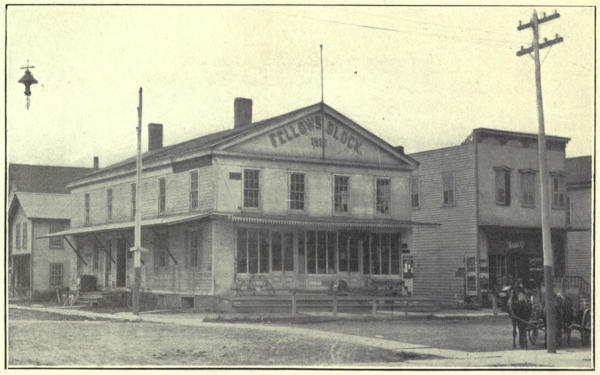
THE BENTON AND FELLOWS STORE.
Mr. Benton opened a store on the northwest corner of Main and Clifton Streets. Across the street may still be seen the building in which on the former site he and his son Albert long did business: it has the date 1816 still upon the pediment. From Sheffield Mr. Benton in 1816 secured as clerk a young man then fourteen years old named Christopher D. Fellows. Mr. Fellows came to Unadilla over the Catskill turnpike, and in 1823 became a partner in the store with Albert Benton. He thus was launched upon a business career that was to last nearly eighty years, his span of life extending to his ninety-third year.
Major Fellows’s share in building up the village was large. He became an active and intelligent force in nearly all that advanced its interests. A feature of the Benton and Fellows business was a distillery. Like Noble and Hayes this firm suffered from a surplus of grain. There was no other way by which the stock could be disposed of. A merit of this whiskey, however, was its purity. Much of the product was consumed by men engaged in lumbering. So great was the demand for it, that a hogshead was sometimes sold at retail in one day. Large quantities in casks were shipped down the river every year.
The Benton distillery stood in the rear of the present residence of Milo B. Gregory. This house dates from 1823, and was erected by Major Fellows and Albert Benton after an earlier house, built by Stephen Benton, had been destroyed by fire. Stephen Benton died in April 1840 at the age of sixty-six. The wife of Major Fellows was his daughter. Major Fellows was elected to the Assembly in 1845 when John A. Dix and Daniel S. Dickinson were chosen United States Senators. In 1894, almost fifty years after that event, Major Fellows went to Albany and was invited to sit in the speaker’s chair.[12]
Contemporary with the coming of Stephen Benton was the coming of Sherman Page, a native of Cheshire, Connecticut, where he was born in 1779. His father was Jared Page, who settled in what is now the town of Greene, Chenango County, at a place still known as Page Brook, on a stream that flows into the Chenango River a few miles above Port Crane. About 1799 Sherman Page went over into the adjoining town of Coventry and there taught the first school in the place. He read law about this time and went to Unadilla to open an office, being the first man in the village to practice that profession regularly.
He was here as early as 1805 and in 1807 was elected a path master. With his father he had come into the country by way of Wattles’s Ferry of which he must have retained the vivid recollections of youth. Into most enterprises, Mr. Page’s energies appear to have entered, whether these were social, religious or commercial. He was supervisor in 1826 and in three other years, a member of Assembly in 1827, and a member of Congress from 1833 to 1837. He was also county judge. He built and long occupied the house where now lives Mr. George W. Hardy, but later on his home was in the stone house across the street. His wife was a niece of Sampson Crooker, and he had five children,—Robert who was a lawyer in Flint, Michigan, Vincent who also went West and long afterwards died in Unadilla, Elizabeth who became the wife of George H. Noble, and long survived as the widow of her second husband, Arthur Yates of Waverley, Mary who was the first wife of William H. Emory, and Maria, the first wife of Frederick A. Sands. Judge Page died in September, 1853.
Mr. Emory was a native of Maryland and was born in 1811. He came to Unadilla about sixty years ago and was all his life engaged in the dry goods trade, at one time in the building that now adjoins White’s store on the west, but which then stood on the lot opposite J. Fred. Sands’s residence, later at the corner of Main and Clifton Streets, in the brick building that was destroyed in the fire of 1878, and still later in the old brick store uptown. He was an active member of the Methodist Church and his home was the westerly one of the two stone houses, its builder having been Frederick A. Sands.
As early as 1805 had come the first of four brothers who were to leave a distinct mark on the growth of the village,—Dr. Adanijah Cone. His first home was the original hotel that stood at Main and Clifton Streets which he built, and of which for several years he was the proprietor. He then built the rear portion of the house that was afterwards the home of his son, Lewis G. Cone, and in which now lives his grandson, Frederick L. Cone. In 1808, his two brothers, Daniel and Gilbert, followed him, and in 1815, the fourth brother, Gardner. Daniel and Gilbert first lived in an old house on the south side of the road about one hundred rods from the present James White house. The White house was built by them in 1815. These brothers Cone came from Hebron, Connecticut. Their varied interests comprised farm lands, a fulling mill, a store, a hotel and the practice of medicine.
Daniel and Gilbert Cone in 1808 bought 300 acres of land from Mr. Sliter and in 1811 Lot 92 of the Wallace Patent from the Lansings of Albany. They did a large business in fulling and dressing cloth, people coming from far and near with the cloth they had woven at home. Theodore Hanford and Erastus Kingsley at one time were employed by them. Gardner Cone settled on the farm afterwards the home of Salmon G. Cone, who was his nephew. Gardner Cone’s wife was Sarah Robertson, a sister of Niel Robertson. Daniel married Margaret Hull, a sister of Mrs. Calvin Gates, and for second wife married Hannah Taylor, a sister of Lydia Taylor, the wife of Dr. Cone. Lydia Taylor had a niece also named Lydia Taylor who became the wife of Erastus Kingsley. Hannah Taylor Cone, after her husband’s death, removed to Connecticut, where on January 8, 1894, she died at the age of ninety-four.
Dr. Cone died in 1862 at the age of eighty-four. His widow when she died was past ninety. Their son Lewis G. Cone was for a great number of years one of the best known citizens of the village. With his brother-in-law Frederick A. Bolles, he was long engaged in business. Captain Bolles came to the village in 1838 and remained here until his death in June, 1891. He arrived from Oxford, to which place he had gone from his native town of Vernon, Oneida County. He purchased the hotel at Main and Bridge Streets and conducted it for several years when he sold the property to Colonel Thomas Heath. He married Julia A. Cone in 1839, and afterwards went into the hardware trade with Lewis G. Cone. For almost forty years the two were partners. On the death of Mr. Cone in 1878, the partnership was continued with Mr. Cone’s only son, Frederick L. Cone.
Captain Bolles in 1845 was captain of a company which went out from this village during the anti-rent difficulties in Delaware County. It was a company of light infantry from the 151st Regiment, described by Jay Gould as “composed mostly of young men who with a little drilling made excellent soldiers”. Colonel Samuel North, who afterwards came to Unadilla where the remainder of his life was spent, commanded the regiment. His orders were to hold it “in readiness to answer any call that may be made for additional force should it be deemed necessary”. At the funeral of the murdered Deputy Sheriff Steele in Delhi on August 10, the Rev. Norman H. Adams from Unadilla assisted in the services. Captain Bolles was supervisor of Unadilla in 1851 and in 1861 was a member of Assembly. His first wife died in 1868, and in 1871 he married Mrs. W. S. Bryant of Guilford.
Following Captain Bolles came his brother, Frank G. Bolles, who spent the remainder of his life almost entirely in this village. He was long associated with his brother and Lewis G. Cone in the hardware business, at one time as employe, at another as partner. He was prominently identified with Free Masonry in this part of the State, and was Postmaster under President Cleveland, and saw service in the Civil War. He was all his life one of the most agreeable personalities in the village, his gift of humor being marked and its manifestations incessant. He knew everybody and everybody knew him. His death did more than any other event in a long period of years to eclipse the gaiety of life in public places. Fare-you-well, friend of us all.
Of those four brothers Cone, Dr. Cone’s grandson, Frederick L. Cone, now alone in the male line survives on village soil to preserve the family name. To this family belonged the late Salmon G. Cone, but neither of the four brothers was his ancestor. They were his uncles. His father was Zachariah Cone, who remained in Connecticut where Salmon G. was born and grew up. Salmon taught school in Connecticut, afterwards in Sag Harbor on Long Island and in Kentucky. He came to Unadilla in 1843, and thenceforth until his death few men in this part of the upper Susquehanna valley were better known. He had often been elected supervisor and always by an unusually large majority. The energies of his nature were mainly directed to private enterprises extending much beyond the limits of the village. One who knew him well for the most of his life thus wrote of him after his death:
“He was a bold and outspoken advocate of any cause which he espoused. While this sometimes made his conduct seem rash and injudicious, no one who knew him could fail to have respect for his character, which seemed to be above the use of means to which men ordinarily resort. He could do nothing by indirection. His antagonisms were open as the day, and he was the most firm and steadfast of friends. Mr. Cone’s early training, habits and proverbial industry and thoughtfulness would have made him successful anywhere. He saw all his projects thrive. From small investments he watched his fortune grow to imposing proportions and he was proud in the contemplation that it was all the work of his hands. He lived a great, generous, liberal, manly life and he was in accord with whatever was brave and manly in the community, as he understood it.”
Mr. Cone died in April, 1890, in his seventy-eighth year. He lies buried on the outer edge of that elevated plain where a new cemetery has been opened, overlooking the peaceful village from the Sidney shore of the Susquehanna.
In those first years of the century came other settlers of note,—William Wilmot in 1800, Niel Robertson and John Eells in 1811, and David Finch in 1814. William Wilmot was the first cabinet maker. A memorandum made by Guido L. Bissell in April, 1800, reads, “Wilmot and Hayes began to board with me”, and another “Hayes left of the 12th of December.” Mr. Wilmot was born in Danbury, Connecticut, in 1780, and died in 1849. Near the home of the late A. P. Gray still stands the building where he did business. The house in which his son Daniel W. Wilmot long lived was built by him. Mr. Wilmot married Rachel Wattles, a relative of Nathaniel Wattles. She died in 1812, and he then married her sister Octavia, who was the mother of Daniel. Mr. Wilmot’s third wife was Nancy Cleveland. Later he married Ann Smith. He and they all lie buried in the village churchyard. His business was continued until quite recent times by his son, with whom was associated Colonel Thomas Heath.
Colonel Heath from 1844 until 1858 kept the hotel at Main and Bridge Streets and at one time was Sheriff of the county. He was afterwards proprietor of the Oquaga House in Deposit which got its name from the ancient and historic Susquehanna town, Oghwaga. From the doorway of this hotel many persons, born in Unadilla, first saw a railway train. After the opening of the Albany and Susquehanna Railroad, Colonel Heath returned to Unadilla. Here he died in 1889. He was born in Walton in 1812 and was the father of George W. Heath.
Niel Robertson came from the same place as the Cones,—Hebron. He bought from them his Unadilla land in 1814 and thereon built the house which still stands under the hill at the extreme lower end of the village. Elsewhere he survived to a very old age. His wife died from a lightning stroke. When Mr. Robertson came to Unadilla he brought a child five years old who was afterwards married to the Rev. Lyman Sperry. Another daughter became the wife of A. P. Gray.
Mr. Sperry, who was the father of Watson R. Sperry, for many years managing editor of The New York Evening Post, and who afterwards went to Persia as the United States Minister under President Harrison, was born in Alford, Massachusetts, in 1808, and was a son of Nathan Sperry, whose family had settled originally in Hartford, Connecticut. He became a minister of the Methodist Episcopal church and at one time was Presiding Elder of the Otsego district. Mr. Sperry died in 1892. I recall him best in his old age, when the stoop of senility was upon him, and the kindly, almost eager, interest he always took in anything I chose to say to him. I cannot forget those conversations, each summer for many years in vacation time, on sidewalks and in dooryards, with this beautiful old man.
Mr. Gray was a native of Durham, Greene County. He was born in 1811 and came to Unadilla in 1832. He was an old friend of the Rev. Norman H. Adams who had lived at the neighboring town of Oak Hill. Mr. Gray engaged in harness making in Mechanic’s Hall, and later in carriage trimming. After marriage he lived in the house that Sampson Crooker owned on the L. B. Woodruff site. Late in life he was employed in a responsible place by the Albany and Susquehanna Railroad Company. In the rear of his house on land of his, once existed a brickyard where were made the bricks used in constructing the store destroyed in the fire of 1878. Mr. Gray died in November, 1886.
John Eells came from Walton. He followed marked trees to find the way. He was a shoemaker and tanner, and near the residence of the late John Van Cott opened the first tannery in the village. For a time he lived in the Priest house. The rear portion of Elizabeth Clark’s home was built by him as a shoe shop on lower Main Street. He died in 1870 at the age of eighty-four. His son Horace Eells survived in Unadilla until about three years ago. For a long period he continued the business of tanning and was actively identified with the Presbyterian church.
David Finch was a son of Daniel Finch, an Englishman who settled in Litchfield, Connecticut, before the Revolution. David Finch was one of four children. He married Ruth Mallery of Cornwall, Connecticut, whose father, like his own, had come from England to America before the war. After his marriage David Finch lived for some years in Oxford, Connecticut, where he engaged in manufacturing woolen cloth and where four children were born. His business declined after the War of 1812, and in 1814 he set out for Unadilla where he engaged in building.
His first home in the village was in the western end beyond the Wilmot house. He afterwards bought a farm in Sidney, opposite the old fulling mill, but some years afterward returned to the village and lived in the Masonic Hall, while it occupied the old Brick Store lot. In 1820 he acquired the house afterwards removed to its present site by Horace Eells. It was then an unfinished building which had been begun by Thomas Noble. Mr. Finch, assisted by William J. Thompson, completed it and made it his home.
His first considerable work as a builder was the Roswell Wright house, afterwards the residence of Senator David P. Loomis, which was erected in 1823 or 1824. The panel lumber used for it cost only five dollars per thousand. Mr. Finch built the Edson house below the Presbyterian church about the same time, and in company with Lord and Bottom did work on St. Matthew’s church. Of him William J. Thompson learned his trade. Mr. Finch was born in 1782 and died in 1841. His son, William T. Finch, who died a few years ago in Chicago was long a citizen of Unadilla. A daughter was the wife of Rufus G. Mead.