REMINISCENCES OF VILLAGE LIFE AND OF PANAMA AND CALIFORNIA. 1840-1850.
Reading edition
PREFACE.
These reminiscences were written by Dr. Halsey for “The Unadilla Times” and were printed in the columns of that newspaper in the spring and summer of 1890. In the following winter they underwent revision, with a view to their appearance in pamphlet form for distribution among his old friends. He had long been in failing health and on February 17, 1891, he passed away at his home in Unadilla. The last mental exertion in which he ever engaged occurred two days before his death and was connected with these papers.
Beginning in the spring of the same year the present writer undertook to prepare a series of footnotes to these papers, with an introduction, giving a brief outline of the early history of this part of the upper Susquehanna Valley. As the subject was investigated, it became evident that for such an introduction a great mass of material, largely unpublished, could be had in libraries and state archives,—in New York City and Albany, and in the Harvard University library and the Wisconsin State Library at Madison. The work of years, rather than of weeks was seen to be necessary to prepare a record that could aspire to be at all worthy of the historic interest of the subject.
Researches from year to year finally resulted in the preparation not of a mere introduction to the reminiscences, but a formidable manuscript of many hundred pages and more than 150,000 words, embracing not only the history of Unadilla village, but the entire upper Susquehanna valley from Otsego Lake to Old Oghwaga, and many neighboring localities. This manuscript that has since been divided into two parts, one of local interest, the other of general,—“The Pioneers of Unadilla Village”, now submitted to the public, and “The Old New York Frontier.” The real germ of the two volumes, therefore, lies in these reminiscences. Indeed, except for my father’s work, those volumes never would have been undertaken.
F. W. H.
146 W. 119th St., New York. Dec. 10, 1901.
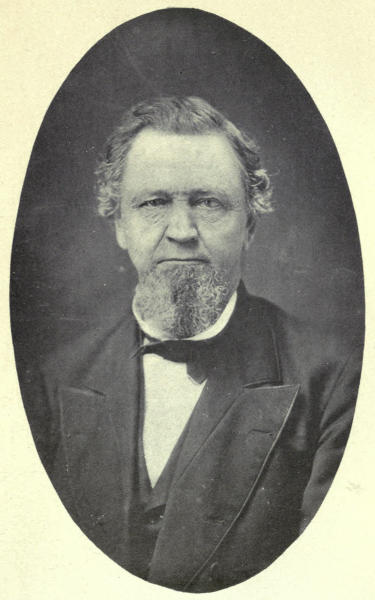
DR. GAIUS L. HALSEY.
Born in 1819, Died in 1891.
I. KORTRIGHT AND UNADILLA. 1819-1840.
Readers of our village paper may find some interest in the personal reminiscences of one who came to Unadilla just half a century ago in April of this year, 1890. Such a record may properly include a brief reference to my childhood and early youth, which were spent elsewhere, the object being to contrast old circumstances with the advantages now accessible for training and educating the young that they may the more readily and completely fulfill the purposes of the Great Father of us all.
It must be evident to intelligent minds that there is a Great First Cause from which emanate all the phenomena of organized life; and equally evident that the governing motive of that intelligence is something higher and more elevating than the enslaving of masses of men in order that a few may accumulate wealth and power. Conditions are indeed improving, though not as rapidly as we might wish to see them. The facilities of the present day for enlightening all classes through higher education are so ample, varied and often so free, as compared with fifty years ago, that none need now be launched upon the uncertain sea of life without being better able to understand and fulfill the purposes of their existence.
I was ushered into the world, according to the record, on the fourth of May, 1819, twenty days before the Queen of England;[40] among the bleak and stony hills of Kortright, Delaware County, New York.[41] My father was born at Bridgehampton, which lies at the eastern end of Long Island, where his ancestors had lived and died since 1640. Thomas Halsey, the first settler there, was a Hertfordshire Englishman who had lived in Naples, Italy, and then in Lynn, Massachusetts,—in the latter place some time before 1637. From Lynn in 1640[42] he sailed with a company of men and women to Long Island, where they founded Southampton, the oldest town, I believe, in this state settled by Englishmen.
My father, after whom I was named, was also a physician and had emanated from the office of the elder Dr. White of Cherry Valley[43] and was of more than average prominence along the Catskill Turnpike in those early days. Being a profound lover of his profession, he was very devoted to its practice.[44] He was never known to refuse a call from rich or poor, day or night, if able to go. Naturally sociable and fond of mirth he was a great story teller, ever ready to give or receive a joke.
I will give an instance when a rather expensive one was perpetrated upon him, but he took it as it was intended, and repaid it in due time with compound interest. A man of the name of William Blakely kept a noted hotel about three miles west of our home. A shooting match was being held there one winter day. My father had great pride in his abilities with the rifle and was present. He and Blakely each had a new beaver hat, which kind of head covering was all the style in those days, costing eight dollars, then a large sum for a hat. Blakely began to banter my father about his marksmanship, and finally offered to set up his beaver forty rods off as a mark at sixpence a shot, Blakely to pay a shilling when the hat was struck, the trial to begin after dinner. While at dinner Blakely exchanged hats and set up father’s as the target instead of his own. A confederate in the joke was sent to report on every shot. He reported a failure until the hat had been struck several times, but finally brought it in, when my father found he had ruined his own hat.
The old Catskill turnpike, that starts at our upper village river bridge, and runs eastward through to Catskill on the Hudson, passes the door of my father’s house. On one of the red mile stones that stood within a few rods of the house was cut “56 miles to Catskill.” It was the goal for many a frolic in boyhood with my neighboring playmates.
As there were no canals or railroads in those days, this turnpike was the outlet for a large portion of western and southern New York, and also for parts of the state of Ohio. The products of the farms, butter, grain lumber, wool, etc., had to be drawn by teams over this road to reach a market at Catskill. Droves of hundreds of head of cattle and sheep were passed daily. Stages with three and four extra teams heavily loaded hourly passed both ways. Hotels were to be found as often as every two miles the whole length of the road, and all crowded every night. Private carriages without number were to be seen loaded with people and their baggage, going on journeys to visit friends at a distance. This vast amount of travel to and from Catskill, naturally made that place a point of great interest in my boyish mind; to see it was the height of my ambition.
In those early days the motto of the civilized world was “to spare the rod is to ruin the child.” My father not only endorsed it but improved upon it, using the rawhide in place of the rod, but as I felt then and am now positive it was a grave mistake. I believe most emphatically that no child, whatever may have been his characteristics, was ever improved mentally or physically, through having the base feeling of fear instilled into him. To this day, when that instrument of torture is brought up and I recall my sufferings from the use of it, the old feeling of resentment and denunciation is aroused. I know it was a great damage in my mental development, and I have no knowledge of any instance where it served a beneficial purpose.
Training and persistent appeals to the budding reasoning faculties of the youthful brain are the only correct method for the parent who would secure control of his children. Love and reverence, not fear and hate, are the principles to inculcate. Are the rod and rawhide calculated in their nature to inspire love and reverence? Parents should rather make companions of children, reason with them, let them see and know there are two sides to all pictures, good and bad; familiarize them with the two sides of all moral questions and then show them through reasoning powers why the right one should be adopted. Brutal chastisement with rod or rawhide never drove a moral idea into a youthful brain and never can.
What a change in every department of life since those times has taken place. Kitchen stoves were then unknown; no carpets covered floors. My father brought the first cooking stove into the town, and his house became as it were a hotel for many days, owing to the callers who came out of curiosity to see the wonderful “Jew’s Harp” cooking stove. Matches were unknown. Many and many a cold, stormy night, have I been called up to harness or unharness my father’s horse, and many a cold morning have I had to go to a neighbor’s forty or fifty rods away, for a shovel of live coals to start the morning fire.
My school days at Kortright were confined to the district school, and three years in a private school kept by the village clergyman.[45] I then spent a year at Hartwick Seminary[46] near Cooperstown from which place I walked at the close of the term to my home in a day, a distance of 30 miles. The greater portion of the three years of private instruction I have always looked upon as lost or wasted, it having been mainly devoted to acquiring a smattering of the dead languages, Latin and Greek. I say wasted, unless the case were that of a person desirous of becoming a teacher, or of diving into moss covered theological traditions. Even such persons however would be better fitted to advance the general welfare of the race, if they devoted more energies to acquiring a knowledge of what pertains to that welfare, through methods of mental development that belong to modern times. I recently read in the Delhi Gazette a notice of the death of Robert F. McAuley, a member of the bar, at Kingston, on the Hudson river. He was an old schoolmate, and the youngest child of the Rev. William McAuley, referred to above as the village clergyman, whose private school I attended.
The son and I were very intimate in our youthful associations. This led to what I may call an epoch-making incident in my youthful history. In those days the military law of the state called for a general training day; all males between the ages of 18 and 45 were required to be enrolled and to do two days’ duty yearly—one day of company, and one of general training. General training was looked forward to yearly as a very important event, not only for doing military duty, but as a general holiday for the amusement and recreation of old and young, both male and female. Our fathers decided, in order to encourage us in our studies, to give us the privilege of attending the coming general training, which was to be held that year at Delhi; that is, provided we were studious, and attentive to our school duties.
On the morning of the anxiously looked for day we received a letter of introduction to General Erastus Root,[47] of Delhi, who at that time was the most prominent lawyer and statesman in that section of the country, if not in the State, and the commanding officer of the military force assembled. We were received very kindly, and placed in charge of his son, who took pleasure in showing us over the field where the exercises took place, and we went home at night feeling greatly elated over the reception and other delights of the trip.
Mr. McAuley was one of the most highly educated men of his day, a graduate of Glasgow, Scotland; he was as familiar with Latin, Greek, and Hebrew, as with the English language. His church was of the Scotch-Irish Presbyterian faith—“Seceders” as they called themselves in those days; he was looked up to and revered by the entire community, and was the peace-maker in all differences that arose among his parishioners. The communicants numbered several hundred. The grounds about his church on every Sunday were crowded with teams; in fact Sunday was like a general training day in point of numbers. Within a radius of six miles from his church I am sure it is no exaggeration to say there would not be fifty of the populace absent from the services, which were made up of two long sermons each day, opening and closing with a prayer of corresponding length.
At his death the congregation split up into three churches which I am told have a comparatively feeble existence; in fact I was told on a recent visit to the old home by one of the most prominent members of the parent church, that he doubted whether they could longer sustain a clergyman and that they would probably be obliged to sell their building to the Methodists. Mr. McAuley raised to maturity 16 children—9 sons and 7 daughters; he lived to bury all I think but four or five. He was totally blind for several years before he died.
At the age of sixteen I was left an orphan by the death of my father, my mother having died five years previous. They both lie buried in a favorite corner of the ground he owned near the old home which was reserved at the sale of the estate after he died. Time and the elements have not dealt kindly with their monuments, but it has recently been a reverent occupation of my brothers and myself to restore them and enclose the grounds with a new wrought iron fence. The old buildings are still standing, but in a very dilapidated condition; the office, a two story building—the upper story, used by his many students as a dissecting room—stands unoccupied; even the outside front door was unclosed on a recent visit. But in most other things there has been little change. Kortright presents today essentially the same scene that I looked upon in boyhood,—except that the inspiring scenes of busy life along the highway are known no more.
On reviewing at this date the following few years of my free intercourse with the world, unchecked and uninfluenced by parental restraint, I am astonished at my escape from moral destruction, through the wiles and baneful influences, which are every where so prevalent and attractive in appearance to the uncultured, easily impressed, youthful mind. Does the world and do parents, realize their responsibility in watching over and guiding children through this, the most critical period, morally speaking, of life, from sixteen to twenty-one? If we only look about we may see a horde of stranded, mental and physical wrecks as compared with the few who are carried safely through that period.
After spending three years required by law as a medical student, beginning with Dr. E. T. Gibbs in Kortright, two years after the death of my father and ending with Drs. Fitch and Hine of Franklin, I was graduated and received my diploma from the Fairfield Herkimer County Medical College, which was afterward moved to Albany and merged into the college established there.[48] This was in the winter of 1839-40, three months before I reached my majority.
As an example of the wonderful advancement in all departments of knowledge, allow me here to mention the little that was then known of the wonderful, all-pervading principle of electricity. The professor of chemistry at the Fairfield College, James Hadley, when lecturing upon that subject, said to the class before him that this principle, so omnipresent throughout nature, could never be of practical use, for the reason that it could only be made to produce motion, being without other power, and to prove it he had an apparatus, driven by electricity, by which a wheel was made to revolve rapidly, but the slightest obstruction, as a feather, would stop it. He was estimated to be one of the highest of chemical authorities. Could he return to life again with what amazement would he look upon the influence that this element is exerting upon the enlightenment and advancement of the world.
In looking about for a place in which to open an office for the practice of my profession, I decided to stop at what is now Scranton,[49] Pennsylvania, then a hamlet known as Razorville and a lumbering section. Coal was known and the people of the region were burning it but it had no commercial value, for the simple reason that there were no railroads or other facilities for transporting it to market. I finally abandoned the idea and on the 9th day of April, 1840, landed in Unadilla and took board with Erastus Kingsley but not having the traditional shilling piece in my pocket; instead I had $5 borrowed money, and a debt of $700 on my shoulders.
The 9th day of April, 1840, was a clear beautiful spring day; the ground was dry, roads were dusty and farmers busy with their spring’s work. On my way from Franklin to Unadilla on horseback, when opposite the old Daniel Beach Hotel,[50] two miles west of Franklin, a hotel having a reputation far and wide, my horse stumbled throwing me over her head sprawling into the dust, but luckily doing me no damage other than covering me most thoroughly with dust.
Unadilla Village was then a hamlet estimated to contain 300 inhabitants; there were three physicians, one of whom had come in the year before and bought the old Bragg Hotel, the property known in later years as the Dr. Odell place. Had I known that this gentleman intended to practice his profession, in addition to keeping a hotel I probably should not have ventured to remain here, but once arrived and circumstanced financially as I was, I could see no alternative but to stay, and sink or swim as the fates might decree. The two other physicians, Drs. Cone and Colwell, had been here many years, and were firmly established practitioners. While their deportment toward me as a new comer and competitor, was cool and dignified, I had no reason to complain of their treatment. The outlook at best was anything but encouraging for a young stripling lacking a month of being of man’s age.
II. UNADILLA SIXTY YEARS AGO. 1840.
The village as it would have appeared upon the map in 1840 I may describe as follows: Beginning at the upper or east end, the first building was a one story, weather-beaten house, standing near the shanty occupied by Mrs. Slavin; it was the home of our venerable disciple of St. Crispin, S. H. Fancher.
Then came the house now owned and occupied by Horace Eells. It then stood on the opposite or eastern corner of the old Butternuts road—the site is now occupied by another house—and was owned by David Finch, father of Wm. T. Finch, Esq.
A few rods back on the old Butternuts road stood a small, low shanty that had been used in connection with the Noble and Hayes distillery (since occupied as a tannery by Mr. Eells) as a hog pen; it was then occupied by a family of the name of Nichols—Ti Nichols, who was one of my first patrons. I shall ever retain a feeling remembrance of the premises, for the reason that on my first visit in a dark night, the crown of my head came in violent contact with a knot in a beam over head, the room being not over five feet in the clear.[51]
On the site now occupied by Mr. Eells’s house there stood one of the first houses built in this place, the house on the present Post Office corner being the other and of the same style. The one in question was then occupied by Amos Priest, who was the practical farmer for the Noble and Hayes firm.[52]
Next was the old store building of the above firm, soon afterward used as a tobacco and cigar factory by Noble and Howard.
The two next as now standing were the residences of the Noble and Hayes families with the farm house next adjoining. Mr. Noble had died a few years previously. Mr. Hayes was still living and dealing quite largely in fat stock.
Next came the old yellow building that was recently torn down and a double tenement house erected on its site.
Thence was a vacancy down to the premises now occupied by Frank Bacon, where was a small house afterward succeeded by the present neat cottage.
Next was the adjoining property with the present rear portion of the house; the front was afterward built. This house and the small house to the east of it were then owned and occupied by Thomas H. Graves, a partner in the stage route between Ithaca and Catskill.
The two next were as now the H. H. Howard and Benjamin H. Ayers houses,[53] the latter being years after remodelled by the late Simeon Bidwell.[54]
Thence we pass to the stone law office of C. C. Noble.[55]
Thence was a vacancy down to the site of the A. B. Watson house now occupied and owned by H. C. Gregory, where then stood the Masonic Hall afterwards moved to its present location on Watson Street, and converted into a dwelling by William J. Thompson.[56]
Between this hall and the brick hotel stood the Mechanic’s hall, afterwards moved to its present site and now owned and occupied by R. M. Brant as a grocery and dwelling.
The brick store was then occupied by the firm, I think though am not positive, of Noble and Emory, but it was soon changed to Watson and Noble and finally to Watson and Hayes.
Next came the brick hotel opened that spring by Erastus Kingsley who was probably as well known as a hotel landlord as any man in the rural part of the state. He could count his patrons by the hundred; when traveling they would go 10, 15, and 20 miles extra, just to stay over night with “Old Kingsley.”
All was now vacancy again down to the old yellow house on the corner of Martin Brook Street now owned by the writer.
There were no buildings on Martin Brook Street except a small one story one which is now a part of Dr. Joseph Sweet’s residence; it was then occupied by the widow Lamb and two sons, Lewis and Gurdon.
Next on Main Street came the Rev. N. H. Adams house with farm attached, Lewis Lamb, above mentioned, being his farm hand. This is the house now owned and occupied by M. P. Sweet.[57]
Again was a vacancy down to the stone houses; the first or eastern one was built and occupied by George H. Noble, the other was built by F. A. Sands and occupied by Judge Page, who had purchased it on the death of Mrs. Sands, who was the Judge’s daughter.[58]
Where now stands the Lyman Sperry house stood an old house owned by Bradford Kingsley, the father of Erastus.
Then was a vacancy again to the corner of Clifton Street, since opened, where stood the old Benton and Fellows store, the front of which—afterward built on—was moved across the street and is now the Fellows Block, occupied by M. B. Gregory, the printing office, etc. The firm name was then, I think, Benton and Fellows, but it was soon changed to Fellows, Mead and Finch.
Next was the old Benton house, then occupied as now by Major C. D. Fellows in whose house the elder Benton, his father-in-law, died a few days or a short time after my advent.
A vacancy occurred again and extended down to the house then owned and occupied by Col. Daniel Cone, since remodelled.[59]
A small house stood next, on the lot now occupied by Col. Samuel North’s residence; it was afterward moved farther down on the south side of the street and is now owned by Mr. Bryant, the cooper.
Next was the adjoining brick house, owned by Esq. Eells, father of Horace Eells, and of the wife of E. C. Belknap, the present owner.
Then came the frame part of Edson and Hanford’s carriage shop;[60] and then the brick shop and Wilmot’s cabinet shop.
The adjoining house now owned by the A. P. Gray estate[61] was then owned by a blacksmith of the name of Chatfield, whose wife, a sister of our old patriarch O. F. W. Crane, was in the last stages of consumption, and was put into my hands as a patient by her then attending physician, one of my old preceptors, Dr. Francis W. Hine,[62] of Franklin.
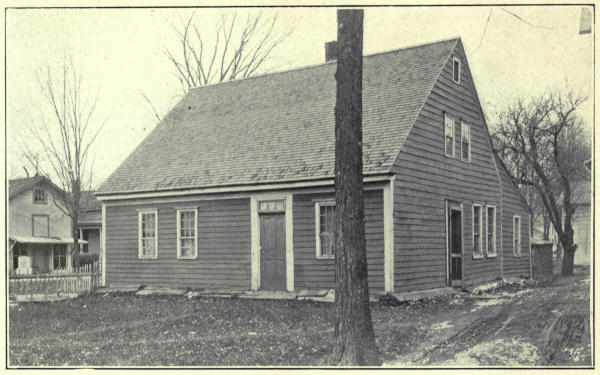
DR. GURDON HUNTINGTON’S HOME
The Oldest House in the Village.
After the A. P. Gray house came the Wilmot homestead.
The next was an old rookery where the residence of the widow Briggs now stands and in the same yard stood a small house which was afterward burned.
Then came a house patterned after the old house behind the Post Office. An incident attached to the latter dwelling I overlooked in its proper place and will give it here. I bought this property, on the corner of Martin Brook Street, in 1850, of Col. A. D. Williams, and lived in it seventeen years. Here my sons were born. While living there I took out the chimney and in doing so, came across a brick, on which were the initials of a man and the year 1809, thus giving at least a hint as to the age of that chimney.[63] The house mentioned above stood on the site of the fine residence afterwards erected by Evans Owens, which was burned mysteriously.
Next was the Dr. Nijah Cone house, now owned by his grandson Frederick L. Cone, and then the Gilbert Cone house, now owned by James White.
If we now cross the road and return, we find the house at the foot of the hill which was the Niel Robertson residence.
The next house stood where the John Van Cott residence now is[64] and was owned by Johnson Wright who conducted a tannery in the rear of the house. He had a leather store in a building which was moved and now stands on Martin Brook Street where it has been converted into a house for rental.
Then came the house[65] and store owned by Colonel Sheldon Griswold, now the property of the Rev. Mr. Hayes. The store was occupied by Griswold and Cone, Lewis Cone being Mr. Griswold’s partner.
A house occupied by A. P. Gray who was running a harness shop came next.
From there all was vacant up to the Dr. Edson place, now belonging to the Peter Rifenbark estate.[66]
From there the land was all open up to the hotel now the Unadilla House.[67]
Next came the old Page house now owned by H. E. Bailey.
From there all was vacant up to the old school house site now occupied by the Teller residence, except that there was a building on the corner of Main and Walnut Streets, which was afterward moved and is now the upright part of the Jordan place on Walnut Street.
Adjoining the school house stood, as now, the H. S. Woodruff place, and next a small house, where now the L. L. Woodruff house stands. This house was moved and is now occupied by Mr. Price, on Watson Street.
Next came the Episcopal Church and adjoining it a house where the rectory stands, which was moved to Martin Brook Street for a house to rent.
Next was a small house which is now the rear part of the L. B. Woodruff house.[68]
Next across the street came the store and dwelling of Colonel A. D. Williams, now owned respectively by A. Mallory and D. P. Loomis.
Then came the brick house owned by Joel Bragg and now the property of Dr. Gregory.
The next was the hat shop of B. H. Ayers, afterwards converted[69] into a dwelling and now owned by Lyman DeForest and occupied by Charles Mulligan.
The next was the old Bragg Hotel now owned by our agent at the railroad station, Mr. Adams.[70]
From there was an open space up to the old Bissell residence which recently passed into the hands, by purchase, of Mr. and Miss Jeyes.
Next was an old house, since torn down, occupied by Daniel Hayes, a hatter. Lastly came the old Judge Beach house which now is the Oliver Buckley residence.[71]
Thus I have mentioned every house and building of any importance which constituted the village of Unadilla when I first became a resident and which stood on Main Street. Watson Street has since been opened through to Bridge Street with the exception of the portion that runs through the land between the Misses Raitt and Miss Elizabeth Veley residences, but there were no buildings yet erected on it. There was not a dwelling or other building standing on Mill Street except the Woodruff stone blacksmith shop, J. Hanford’s wagon shop, the mills and the house where Hiel Crandall lives, which was then the Mill house and stood on the corner by the Condensery.
Martin Brook road had been opened a few years previous. It was opened in its upper part largely through the efforts of A. B. Watson and A. D. Williams who desired to bring business from the Rogers Hollow country to the upper end of the village. The land on either side was in a state of nature, covered from near the Eells tannery, with pine and hemlock; nearly an unbroken forest through to the Wheeler Warrener farm on the Rogers Hollow side of the hill. There was a small clearing on what is now the John Osborn farm, and just beyond, a man of the name of Wycott, had rolled up the year before, a small one room log house. The road was hardly passable the greater portion of the way and I had quite a serious time one very dark, stormy night in getting home from a visit to one of the Bartholomew families, then living beyond the Rogers Hollow Creek.
I was on horseback, and started for home about eight or nine o’clock, as near as I can remember. It was raining and as dark as a pocket, but I had no difficulty until I reached the summit of the ridge, coming toward the village, where I struck the thickest of the woods. The limbs and underbrush began to whip me in the face, and I soon became aware that my horse had lost the trail—it was not fit to be called road—but I could do no better than give her the reins, protect my face from the brush, and allow her to go where she pleased. After what seemed to me hours, I discovered in the distance, a slight glimmer of light and pointed for it. I found it to be the reflection, through the unmudded chinks, of the Wycott house fire place. They were all abed, and had left the brands burning and the light showing between the logs. I hallooed and induced the old man to lend me his lantern. When I reached home the clock was striking twelve so that I was certainly three hours traveling some three and a half or four miles.
An amusing incident in my experience in that neighborhood occurred on the Osborn farm above referred to. An old log house standing near the creek below the Osborn barn was occupied by Ethan Allen, known as “Capt. Horn,” who was given, as those who remember him will recall, to boasting and telling pretty tough yarns, one of which gave him the nickname above mentioned. This yarn related to his grabbing a bull by the horns and hurling him off a bridge and twisting off the horns.
Well, I was called to see him one cold night and found him suffering severely from pleurisy; while preparing to bleed him, which was the accepted treatment in those days for that disease, he made the remark, in his boastful way, that he had never fainted in his life, and that I might take as much blood out of him as I pleased; I could not make him faint. Feeling a little mischievous I concluded to test his powers of endurance. I drew him up before the fireplace, where a roaring fire was burning, corded his arm, made a free opening into the vein, and the blood poured out in a stream nearly as large as my little finger. In less than two minutes he was on his back on the floor in a complete faint. After a few moments he came to; looking up and rubbing his eyes he said: “Doctor, I was not the least bit faint. I was only a little sick at the stomach and thought I would lie down a moment.”[72]
III. OLD INHABITANTS AND EARLY PRACTICE.
The following are the names, I believe, of all persons now living whom I found here in April, 1840, and who are still residents in April, 1890: S. H. Fancher, C. I. Hayes, Mr. and Mrs. H. H. Howard, Mrs. C. C. Noble, Mrs. Curtis Gregory, Mrs. A. P. Gray, Major C. D. Fellows, Mrs. E. C. Belknap, Miss Elizabeth Veley, David Hanford, Samuel D. Bacon, Mrs. Louisa Hanford, Mrs. Edson Jennings, Emeline Wilmot and Captain F. A. Bolles. Others who were then here and are still living elsewhere are these: Mrs. George H. Noble, Waverley; Mrs. A. B. Watson, New York; Samuel Robertson, Corning; Mrs. R. S. Hughston, Delhi; William T. Finch, Chicago, and J. I. Laraway. C. W. Carpenter arrived a month later.[73]
J. I. Laraway and his father-in-law Weidman had recently purchased the water power and mills of Joel Bragg, and had moved in from Schoharie County a month or two ahead of me. Older citizens will remember the disaster which befell them soon after their arrival, by the going out of the river dam.
The only Church was St. Matthew’s, of which the Rev. N. H. Adams was rector. He was universally beloved and was very attractive in the pulpit, the church being well filled upon all occasions when he preached. The district school offered the only facilities for educating the young, but it was generally supplied with excellent teachers.
Captain “Horn” was one of my first and most constant patrons. He then lived on the old Butternuts road, about two miles from the village, in a tumbled down log house—log houses were the rule in those days; outside of the villages a frame dwelling was comparatively rare—with a flock of small children nearly as wild as Arabs. My day book for the year 1840 will show that I averaged visits twice a week professionally and my only recompense was the working of my poll tax and an occasional day’s work he did on the lot which I now occupy purchased of A. B. Watson and Isaac Hayes in 1841.
As an instance of how lasting an impression a slight and insignificant matter will make on a person’s mind I give the following: In the woods as you climb the hill on the old Butternuts road going north one day I saw a bird about half the size of a robin, of a dirty red plumage, which had as I remember, but two notes to its song and these of a mournful character. Whenever I have since heard that bird’s song it has brought to my mind the idea of pinching poverty, so closely associated was it with my frequent travels to that poor family.
Col. Williams’ store, on the corner of Mill Street, was a rendezvous in those days for the genial spirits of the village including the Colonel himself. It was rare fun to listen to the jokes and repartee of a coterie of fun-loving men, made up of Dr. Colwell, Rufus G. Mead, Benjamin H. Ayers, L. Bennett Woodruff, A. B. Watson, David Finch and others. The shots and jokes flew thick and fast, keeping the room in a roar of laughter.
Mr. Woodruff was then running the blacksmith shop. He had recently bought a pair of sporting fowls. Mr. Mead rushed into the shop one morning, saying to Mr. Woodruff hurriedly, “there’s a crow in your walnut tree; let me take your gun.” Mr. Woodruff had a double barrelled gun, and prided himself on his abilities as a marksman. He insisted on using it himself—just what Mr. Mead wanted him to do. Mr. Woodruff loaded both barrels and creeping out very cautiously to a proper distance, blazed away and brought down his blooded hen. It was a long time before he heard the last of that joke.
When “Mesmerism” began to attract attention, Dr. Colwell took quite an interest in it. Mr. Mead thought he saw an opportunity to accomplish a good joke on the doctor. He proposed to mesmerize him and appointed a time for the experiment. He prepared on the sly a dinner plate, covered on the bottom with lamp black, which he gave to the doctor to be held by him in front with the clean side opposite his face, Mr. Mead sitting in front with a similar plate, minus the lamp black. Dr. Colwell was to make every motion that Mr. Mead made. Mr. Mead drew his finger across the bottom of his clean plate, and then across his forehead. Dr. Colwell started to make the same motion on his blackened plate—he of course being ignorant of the lamp black—but instantly fathomed the aims of the enemy and putting his thumb to his nose, said, “Don’t you wish you could!”
The street was alive with similar episodes in those days, but when town meeting occurred, then what a tumult! The cries were “up-street” and “down-street!” and “Hurrah, boys”; there was war to the knife for the two factions and a triumph duly celebrated by the winning side. Happily those days, so suicidal and damaging to the welfare of the village, are fast becoming mere matters of history.
Some time in the month of June following my advent in Unadilla, a renowned menagerie—June, Titus and Angevine’s—appeared for exhibition; they stayed over night with Kingsley, where I was boarding, leaving before day break. Mr. June, on going out of his sleeping room in the dark, fell down the stairway, bruising himself severely and had to remain behind for two days. I being in the house was called up to see to his injuries, for which I charged him one dollar. This was the first money I received from my profession.
My first act in dental surgery was performed on the person of the well known Lewis Carmichael, who at that time was a rising influential politician; in fact he almost controlled the politics of the town, though he was not old enough to use the franchise himself.[74]
At the close of my first year of practice I had charged the sum of $125, as my day book will show and three quarters of it still stands unpaid. I owed Kingsley ninety odd dollars for board for which I gave him a note, that was current in the community for several years, apparently legal tender; it passed through many hands before it finally reached mine again. This was anything but encouraging. The future had a decidedly blue look but I could do nothing less than hang on and hope.
I had then a friend to whom I owe a lasting debt of gratitude, which it has ever been a great pleasure to repay so far as has been in my power by rendering similar encouragement to the young man just starting out. His name was Harry Wolcott; he lived on the farm now owned by Gardner Rider on the Franklin road in Sidney and was a bachelor living with an invalid maiden sister. Whenever I met him his encouraging words were “stick doctor; you will finally succeed.” No one but he who is similarly situated can realize and appreciate the value of such a friend as he was. He held a high position in the community as an intelligent, thorough-going business man. That his surroundings in his present state of existence are more in consonance with his faculties and aspirations I can have no doubt.[75]
Asking pardon for this digression, I resume my story. In the fall of 1840—when I cast my first vote, which was cast for Martin Van Buren—I married Theodora Kirby, daughter of Reuben Kirby,[76] of Bainbridge, and began house keeping in the spring of 1841, in the house now owned by Mr. Morse on the corner of Main and Walnut Streets which had been built in the summer of 1840. Death claimed her a little over two years afterwards, beloved by all who had ever known her.
In the spring of 1841 a boy came asking me to go over to what was then known as the Baxter Saw Mill, on Carr’s Creek,[77] to see his brother. On reaching the bridge crossing the creek on the river road, I met another boy urging haste. I hurried accordingly, and when I reached the house a young man stood in the door in great agony for want of breath. Just as I reached him after tying my horse he began to settle down in a suffocating condition. I caught him in my arms and laid him on the bed. After a hasty inquiry, the house being filled with the family and neighbors, I surmised where the difficulty was, unbuttoned his shirt collar and took out my thumb lancet—having no other instrument with me. Mr. Chester Sweet, father of the two Drs. Sweet, a giant of a man, then stepped up and asked, “what are you going to do doctor, cut his throat?”. I replied “yes.” “You must not do it” said he, “let him die a natural death” making a motion to push me away. I replied, “Stand back! I am the doctor here, and you interfere at your peril.” I passed the lancet into the trachea or wind pipe, just below the “Adam’s apple,” or prominence in the male neck, and called for a goose quill, having rolled the man over on his face to prevent the blood from running into the opening.
The instant the lancet entered the trachea the air rushed into the lungs with a whistle, so forcibly were the muscles endeavoring to inhale air into the lungs. In a few moments he recovered consciousness and continued to breath through the quill until the next morning. This operation had taken place in the afternoon. In the night, or toward morning, an abscess broke, discharging a large amount of pus. The operation thus was successful and the fellow lived many years. News of the operation was carried far and near. The young doctor had actually brought a dead man back to life; so went the report, and from that time on I had my share of business.
My first opportunity for treating a broken bone was the case of a young lady living two miles below Teedville, on Trout Creek, a sister of Mrs. H. B. Crooker of this village. On her return from a visit to her parents to resume her position in the woolen mill, then in operation at Crookerville, she was thrown from her carriage, breaking the bone between the knee and hip. In passing over the road to reach her I did not wonder at the accident; a worse road to be called a highway could not be found. I never had better success in all my experience in after practice.
Many years afterwards I had a similar case which proved disastrous to the patient from causes beyond control, but resulted in my having to defend a charge of mal-practice at Delhi. A Mr. Bundy, of East Masonville, had the misfortune to break his thigh. He was past the prime of life, and had been a sufferer for many years from chronic diarrhœa, from which cause he was very thin in flesh, his physical powers poorly conditioned to withstand the strain of a long confinement upon his back as was necessary in the treatment of his injury. I apprised him of the fact at the time, that he might understand his danger.
I used every effort to support his feeble condition but with such slight success that at the end of seven weeks I was obliged to relieve him from the close restraint in order to save his life—three months is the average duration of time necessary in such cases. He fully understood the condition and refused any professional counsel, which I tendered, expressing himself as having confidence in the wisdom of my management. The result was a bending at the seat of the fracture, the callosity not having become sufficiently hard to offset the contraction of the muscles and he was a cripple for the remainder of his life. More than a year afterward, through the influence of professional rivalry, he became dissatisfied, and prosecuted me. The case was tried at Delhi and resulted in disagreement of the jury. Before the sitting of the next court the plaintiff voluntarily offered, through his attorney, to drop the case by each party paying his own costs, which I accepted, notwithstanding Judge Mason, before whom the case was tried, told my counsel he never saw a more complete defense established, and that I was entitled to a verdict.
My first obstetrical case was in the family of John Butler,[78] father of Captain Frank Butler. Dr. Cone was the family physician but was not obtainable, and as a last resort I was called to officiate. I shall never forget the reception I met with, and the close scanning by the sharp black eyes of the patient, with the severe catechising I had to endure. Expecting her “old doctor,” and seeing a young stripling—“Dr. Bean Pole”[79] I was called in those days—she as a matter of course was taken by surprise, never having seen me before. That straight laced moralist, who believes the sin of lying should be denounced under any and all circumstances, would I am sure admit that there are exceptions to all rules, had he been in my shoes at that time and thus forced to give an encouraging answer to the many questions as to my experience in such cases, a truthful answer to which would have driven me from the house. The case terminated happily for all concerned and we have been fast friends ever since.[80]
My horse when I got her was an unbroken three year old colt. She proved to be a remarkably fleet roadster. I drove her six years and during that time had many a frolic with other drivers on the road. I was driving once from Mt. Upton down the Unadilla river, and overtook a man on horseback near where the old Oxford turnpike joins the river road. He refused to let me pass him by whipping in ahead whenever I attempted to pass. My horse soon “caught on” to the situation and was as anxious for a little fun as I. Having a long bow-tipped whip I drew up on the lines and chirupped to the mare. When close enough I gave his horse a cut with my whip which caused him to jump and came very near unhorsing the rider. He had not more than recovered his equilibrium before I brought the whip down again and so on continued to lash the horse which was soon running his best gait.
It became so interesting for the rider that he finally offered me the road by getting outside the track, but I refusing the offer followed up another cut of the whip which brought him back into the road. I ran him in this way to Rockdale, a distance of a mile or more. On reaching his home he rolled himself off without waiting for his horse to stop, and with an oath said: “Now get out of that wagon and I will whip you.” I stopped and laughingly said to him “next time a stranger in civil manner asks for the road I am inclined to think you may find it worth while to give it,” bade him good day and passed on.
On another occasion I was driving home from Cooperstown. Just this side of Portlandville a road comes down off the hill on which a man in a cutter was that day coming. He apparently saw me as he struck his horse into a sharp trot. I allowed him to come in ahead of me, but soon my horse’s head was over the back of his cutter puffing her breath against his head. He lashed his horse into a run but was unable to get away; the mare’s nose still kept his ears warm. Thus I ran him to where he turned up the hill road just this side of Milford Centre. Bidding him good night as I passed him—it was a bright moonlight evening—I came on home.
I could give many like incidents, and cannot refrain from giving one such frolic I had with Dr. Colwell. He had just got a very fast mare from “Bill” Green of Mt. Upton. We were both called in counsel in the case of Zachariah Prindle, father of Judge Prindle of Norwich. He lived in Ideuma and it was his last sickness. It was fine sleighing and when we were putting on our overcoats Colwell said: “Doctor if you get started first, I will try and keep in sight of you.” I replied, “Well, if you do, I will either give you the road or drive fast enough to get out of the way.” I started out first and soon after striking the Hollow Creek road, the doctor’s mare’s nose was in my neck. I drew up on the lines, chirupped to my horse, and soon was out of his way. I doubt whether two horses were ever driven over that road to the village in so short a time. When I drove up to my barn, which still stands in the rear of the Teller residence, the doctor was about where the railroad crosses Martin Brook Street. He never referred to the matter afterwards.
Dr. Colwell was a bachelor, somewhat eccentric, sharp, quick witted, and could be very sarcastic when occasion required it. As an instance, I have heard the following anecdote often told. When he came to Unadilla, Dr. Edson was practicing here—grandfather to our present Supervisor. He was said to have been a nervous excitable man, easily irritated. He met Colwell one day on the road, not long after Colwell settled here, stopped his horse and said to him, “Young man, you had better leave here while you can, for I shall starve you out.” Colwell promptly replied, “You can’t, for I won’t board with you.”
[As an illustration of Dr. Halsey’s fondness for animals may be introduced here a little item written by him on another occasion for the Unadilla Times. Dog Daisy whom he describes was a poodle having a coat as white as Angora wool:
“Kind nature once bestowed upon a household in Unadilla a dear girl baby as another link in the unending chain of organized life in human form. While yet in her infant years an elder brother, grown to manhood, gave her as an evidence of his interest in her welfare an infant specimen of the canine species for a companion and plaything. The two became almost inseparable, by day and by night. Years passed, and their love and friendship strengthened.
“When the child arrived at the proper age to require the pedagogue’s aid in the development of her intellectual faculties, the little white bundle of animated wool would be seen in constant daily attendance upon her, going to and from the school room, during the hours of study, reclining under her seat and by her side during recitations. Upon arrival home at the close of the day’s session he would bound into the house with the happiest possible expression of laughing face and wagging bushy tail, fully understood by the parents as saying ‘One more day of faithful protection for your child.’
“Such were his characteristics of faithfulness and gentleness that both teachers and scholars recognized his claims to an exception in school rules; he was allowed free entrance and occupancy of the general school room. But age and its attendant infirmities which have no respect for any human or other being, gave at last the final decree of change which we call death and Daisy has gone where all good dogs go.”[81]]
For the following few years up to 1847, I had a full share of patronage, but in consequence of the scarcity of money in circulation, the original load diminished slowly. In 1845 I had found and married my present wife in Yankeeland, Connecticut. Here allow me to perform the most grateful and pleasing duty of my life and say that to her unselfish, and devoted efforts for my interests, I am largely indebted for any measure of success I have attained in life. She had a strong affection for her native State and place of birth. I knew that my ledger showed I had more than enough to balance my obligations. Confident that there was an inviting field at her old home, I decided to emigrate to Connecticut, and in 1847 sold out to Dr. Odell,[82] and left Unadilla as I supposed for good—so little do we know what the future has in store for us. I located first in the town of Southington, Hartford County. The year following I bought a house and lot in Plainville, four miles north and a promising town of recent origin. Here I considered myself a permanent fixture and was building up a good practice when the whole course of my life was changed for a year. The scene was shifted to the tropics and then to California, in the course of which I nearly lost my life.
IV. PANAMA AND CALIFORNIA. 1849.
In 1848 the news of finding gold in California was a prominent feature of newspapers all over the country. A fever for emigration to the mines spread with unheard of rapidity throughout the civilized world. Companies were being formed everywhere.[83] California was the only topic of interest. The question of how to get there was a knotty one; there were no railroads, and the Rocky Mountains, with an intervening, desolate, unexplored barren waste, offered apparently unsurmountable obstacles to an overland route. There was no course other than a voyage around Cape Horn—a six to ten months’ trip—or across the Isthmus of Panama, taking the chances of a vessel from that point—at that time a bye place rarely visited by sailing vessels. There were not vessels enough afloat to take the multitude anxious to make the venture.
A comic entertainment was put on the stage of one of the New York theatres in Broadway showing “Mose trying to go to California.”[84] I witnessed its performance while waiting to sail for the Isthmus with the company to which I was attached. It was exceedingly amusing. “Mose,” the leading character, was so strikingly like one of our company that we dubbed him “Mose” and he is still known by that name by the old members of the company, five of whom are still living. We have for several years had an annual meeting and a barbecued lamb dinner in a very romantic locality in Connecticut, beside a charming sheet of water, called Compounce Pond, under a high steep ledge of granite rocks, where we meet, with a few choice friends, and renew our experience in California gold digging.
Our company as organized consisted of eight men afterward taking in two more, one of whom was “Mose.” We had a capital of $4,000 invested in part in an outfit, including a years’ supply of provisions, and a twenty gallon cask of brandy which we kept full by putting in water whenever a draft was made upon it. We finally sold that brandy and water in Sacramento for $108. The original cost was $20.[85] We bought our tickets in New York for passage from Panama to San Francisco, on the steamer California[86] on her second trip from Panama. She was the first steamer sent out from New York by the Pacific Mail Steamship Company to San Francisco, and was billed to be due at Panama the 1st day of March, 1849, to make her second trip.
We took passage from New York on a sailing vessel, her name “Abrasia”—which was sent down by the Panama Railroad Company with supplies for making the preliminary survey of the road now running across the Isthmus.[87] She was lightly loaded with freight and the members of our company were the only passengers. We had a bouncing trip. The second day out from New York, just after striking the Gulf Stream, we encountered a terrific storm of wind and rain which lasted five days, the wind blowing right in our teeth and one day it was so violent that we were obliged to run on our back track 150 miles, under bare poles.
The most striking demonstration of man’s powerlessness and complete subjection to the mercy of the elements that I ever witnessed was on the day above mentioned—the wind blowing a hurricane with rain in sheets. As far in the misty distance as the eye could discern, was a vessel scudding under bare poles, and not a living soul was to be seen. The situation was anything but pleasant for green landsmen; not one of the passengers failed to pay his tribute to old Neptune in an involuntary effort to turn himself inside out.
As soon as it became evident that the captain knew his business and was attending to it, we buried our fears and really enjoyed the excitement. I was awakened one night by the captain swearing a perfect torrent of oaths. He had gone out on deck, as was his custom through the night, to see that everything was all right. He had nothing on but his shirt. Just as he reached the deck from his stateroom door a tremendous wave dashed over the vessel, drenching him thoroughly. It would be useless to attempt giving a description of the torrent which poured out of his mouth, but I laughed until my sides ached. Several years afterwards I met him at the United States Hotel in New York and reminded him of the storm. He told me it was one of the worst he had ever encountered.
We reached Chagres[88] on the Atlantic side of the Isthmus on the thirteenth day from New York, when we embarked on a little steamboat which had been sent down to navigate the Chagres river.[89] Could that stream, with its banks an impenetrable mass of vegetation, lofty trees covered with vines hanging in festoons with myriads of flowers of all colors, besides monkeys, parrots, paraquets, and many other birds making a perfect babel of song and chattering, bewildering to the northern ear—could it be easily reached by only a day or two of travel from New York, it would attract thousands of visitors.[90] At the head of navigation we were transferred to large dug-outs or canoes, manned by two natives with long poles, to take us to Gorgona[91] some twelve miles higher up the stream. These boatmen were stripped entirely naked for this work and every few rods would run their canoes on to a sandy shore, dive into the water and swim around until cooled off. We paid them fifty cents each for poling us twelve miles against the current. A Real (10 cents) was a day’s wages before the advent of California travel across the Isthmus.
Being ahead of time for the steamer we put up our tent at Gorgona, sent our Captain over to Panama—about 24 miles—to the agent of the steamship company for information. The Chagres river was simply alive with fish. When we threw in a handful of crumbs the water would fairly boil from their efforts to secure them, but if you baited a hook they would not touch it. We exhausted all plans for catching them. We had a net in our outfit 150 feet long, and thought that it would work; we got it out and strung it; got two boats and launched them into the water. Then we surrounded a host of fish and could we have landed them I have no doubt we would have had two wagon loads at least, but with three men to each rope, before we could get to the shore the fish began to jump over the cork line exactly like a flock of sheep over a stone wall; we secured only a few, perhaps a dozen.
Gorgona was at that time a village of perhaps fifty huts, standing on a beautiful plateau at an elevation of fifteen or twenty feet above low water mark. We remained there two weeks, then starting for Panama—distant 24 miles. All freight had to be packed on mules or natives’ backs. It was surprising the loads those natives would shoulder and not lie down until they reached their destination. They had a rack made of reeds to which the freight was lashed; when it had been placed on the shoulders a strap was passed around the points of shoulders and chest, and another around the forehead. I saw a large trunk, which weighed 225 pounds, thus lashed to a native and he started on a lope for Panama, which he reached next day without laying it down as the owner told me afterward. The road was simply a trail such as cattle make, very rough and rocky, making it very tedious to travel with a load. We were a part of two days on the route across, reaching Panama[92] on Sunday afternoon.
The first view I had of the Pacific ocean as it makes inland some 600 miles to form Panama Bay was a memorable event to me. The sea was as smooth as glass with not a ripple, and the reflection of the sun’s rays from the west giving the water a rich yellow appearance, made an impression that I shall never lose. My attention has since been called to some famous lines by the poet Keats on the discovery of the Pacific by the Spaniards. Keats says that when he first read Chapman’s translation of Homer he felt
“Like stout Cortez[93] when with eagle eyes He stared at the Pacific and all his men Looked at each other with a wild surmise Silent upon a peak in Darien.”
Our messenger whom we had sent ahead, finding that we were fated to be held there for an indefinite period, had secured rooms where we could live and we moved in at once. The house, a two-story stone building, belonged to the governor of the state. His residence was on a corner of the plaza, and our house was opposite. He offered the building entire to us for 150 dollars or to rent for two dollars a day. This will give an idea of the value of real estate at that time. A large three story building standing on the main street was bought that spring for 300 dollars and opened as the “American Hotel.” It is still run as a hotel as I have noticed in the news from there.
As I have before mentioned, the city up to the California gold excitement had had for many years a location on the map but no business; in fact grass was growing in the streets. The English government had a line of steamships trading with South American governments, on the Pacific side, which came monthly to Panama to unload and pack their ingots of silver on mules’ backs to cross the Isthmus, to be reshipped for England. I saw two cargoes of ingots landed; there were 150 or 200 ingots, shaped like a capital V, and weighing 150 pounds each. They were guarded across by soldiers.
The city was then surrounded by a heavy wall 12 to 14 feet high, laid in cement as hard as stone. On the water side it was built on the bed rock so far out that the tide coming in had pounded holes through the wall. There were two gates for ingress and egress, one the main gate from the land side, the other on the water side. Just inside the main gate and facing it was a nice little stone building having but one room; inside was a life size image of the Virgin Mary, beautifully dressed, with diamonds sparkling all about her breast. She stood on an elevated platform—at her feet a pretty box for contributions. It is a Catholic country and every person on coming into the city was expected to pass into the room, kneel before the Virgin in an attitude of prayer for a moment or two, throw in his mite and go about his business. The priests removed the offerings at intervals.
Gambling and cock fighting, the latter on Sunday afternoon after services when even the clergy were to be seen, with an occasional mock bull fight outside the walls were the leading amusements. I saw a man who was tantalizing a bull with a red rag, caught on its horns and hurled against a stone building, apparently killed, but he finally came to himself and walked off.
There was a large cathedral with several churches. The cathedral was never closed. I was there during Lent and Passion Week and the displays were simply gorgeous—processions by day and torch light ones by night, the entire population in line, bare headed. One night the Virgin was placed upon a raised three step platform, and carried about the streets on men’s backs. I counted 180 wax candles eighteen inches in length, enclosed under glass resting on the steps of the platform, a beautiful sight. Apostles and Saints had processions making rich displays.
Palm Sunday was a noisy one; every individual native had his whistle, made of palm leaf and there were thousands of shrill toots, until in the middle of the afternoon, a procession appeared escorting an image of Christ, with His crown of thorns, astride an ass, a large number of the clergy with banners being in advance, and they preceded by a bevy of 40 or 50 little girls, dressed in white, with their arms full of flowers, scattering them as they walked, and all singing. The next morning a rope was stretched across the street, with an image of Judas hanging, by the neck, and every passer by hurling some missile at him. I was strolling one day behind a church building and saw a hole in the wall some four feet from the ground; on looking in I saw deep down, perhaps 10 or 12 feet, small human bones. On inquiry I was told they were the bones of still-born infants who died unbaptised and were thrown in with quick lime to destroy the soft parts.
I walked one day out to the cemetery which is nearly a mile outside the walls. There was an acre of ground surrounded by a wall of 8 feet or more thick and 10 or more high, laid in cement. On the inside were three tiers of openings in the wall large enough to admit a coffin. The dead were placed in a nice coffin, dressed as the circumstances of the friends could afford, covered with a profusion of flowers, carried in state to the cemetery, then stripped of everything, put in a tight rough box, the box filled with quick lime and finally pushed into the opening in the wall and sealed up with cement. After a proper interval, to allow the soft parts to be destroyed by the action of the lime and when the hole was wanted for another, it was opened and the contents, bones and all, emptied on the ground and another body put in. The ground was covered with bones. I picked up a human jaw bone which must have belonged to a giant; it was more than twice as large as any one I ever saw before or since. I brought it home as a curiosity and loaned it to William Johnston, of Sidney, an eccentric man descended from the pre-Revolutionary pioneer of the same name, and he forgot to return it.
The water for the city was all brought in on the heads of women, in earthen crocks holding three gallons and sold for 10 cents a crock; the spring was the best part of a mile outside the city, walled up nicely, and ran about a half inch stream as I remember it. The tide comes in at Panama 23 feet twice a day, while on the Atlantic side at Chagres one would hardly notice that there was a tide. The places are only 50 miles apart. This is an anomaly I have never seen explained to my satisfaction; there must be some other than the moon theory I think.
When the tide is out at Panama one can go out on the rocks two miles, but he must look out for the incoming tide. I was out one day looking for shells very busily; when I looked up I was nearly surrounded by water; you may rest assured I ran for life once certainly; I could not get into the city but got out of the water about a quarter of a mile down the coast.[94]
We had arrived in Panama the first of March and expected to meet the steamer California for which we had tickets. She failed to appear on account of her crew deserting her on her first arrival at San Francisco; the result was we were obliged to lie there until the Panama which left New York the same morning we did, and aboard which we were now to sail, came around the cape and reached Panama when the agent of the steamship company put us aboard her. It was estimated that there were 3,000 people from the States in Panama awaiting vessels to proceed to California. The condition became more and more alarming as the detention and increase of people increased the congestion. Sickness was very prevalent, funerals were of daily occurrence, a plot for a cemetery had to be purchased and it was rapidly filled. Many having but little money soon found themselves without means for living and with no prospect of getting away they took the back track and returned home.
The excitement increased daily and so desperate became the situation that had not vessels appeared just as they did I think there would have risen a riot that would have perhaps destroyed the city; in fact there were several outbreaks which were quelled with difficulty.[95] The demonstrations of joy made upon the arrival of the steamer Panama and a sailing ship the Humboldt[96] were as cheering as the previous excitement was alarming. The intense heat on the Isthmus—the thermometer standing at 100 daily—was very trying to northern people, unless protected under the shade. Being nearly under the Equator exposure to the direct rays will strike one blind, but the cool trade winds from off the salt water, with quiet in the shade, relieve the oppression so completely, that reclining in a hammock with an interesting book became a luxury.
The natives are of mixed blood made up of Spanish, Negroes, and Indians and are a very strong athletic race. The language is a corrupt Spanish and in tone and expression charmingly beautiful. I was frequently stopped on hearing parties in conversation; there was so much excitement and emphasis that I looked next for blows and knock downs. The people are very friendly in manner but quick to resent an insult. They are free and unsuspecting in conversation. What would be denounced here as highly indecorous and improper is unnoticed. As an instance I recall that one day a nicely dressed lady was passing whose maternal ambition was soon to be gratified. I tipped my hat saying “Senora, pickaniny poco tempo?” She replied “Si Senor” and was as far from showing any expression of false modesty as though I had inquired the time of day. Children of both sexes up to 10 or 12 years are seen everywhere entirely naked, and pass unnoticed. The female dress is very picturesque and beautiful being made of light material with great profusion of ruffles and laces.
Without intending in the least to detract from the fame of our own beautiful sisters of the north, I must in truth say that the handsomest, most queenly and dignified woman I ever saw was a full blooded Spanish lady, who entered the cathedral at Panama one morning, at early mass, followed by her female servant carrying a handsome piece of carpeting for her mistress to kneel upon during her devotional service.
On the appearance of the “Panama” the local agent notified us to get aboard at once and we were not long in complying. Our detention had obliged us to pay in rent for the building we occupied money enough to have paid for the title as offered by the owner. Our Captain engaged a five ton dug-out, with two natives to take us and the outfit to the steamer which was lying at anchor six miles out in the bay. As I think of that day’s trip to the steamer a shiver will run over me to this day. We were loaded almost to the water’s edge, with but one sail, the wind strong in our teeth. We were obliged to start while the tide was coming in so as to reach deep water before the tide could leave us stranded on the rocks, and had to tack and beat against the wind and the inrushing tide for several hours until it changed to the opposite direction. We embarked about 8 o’clock A.M. and only reached the steamship after dark; thus the entire day was spent in a six miles’ straight line voyage; why we were not capsized has always been a mystery, loaded as we were and frequently flooded with water from the waves. The boat required almost constant bailing.
A very exciting incident occurred soon after our arrival on board. A difficulty had arisen between two ladies on their arrival at Panama. One was the wife of a distinguished Government officer, stationed in California to whom she was going. She is still living and somewhat famous. The other was a lady of equal social rank who had been the head of a prominent temperance organization in Philadelphia. She was possessed of stinted means and was anxious to emigrate to California to improve her financial condition. She had arranged with the first named lady to travel with her as a “companion,” her passage and other expenses being furnished as compensation. On their arrival at Panama the first named lady registered at the American Hotel as Mrs. —— and servant, to which the other took prompt exception, rightfully claiming that she was an equal in status as “companion” and should not be ranked as servant. The excitement among the Americans, whose numbers were estimated at 3,000, was very great, the sympathy being with the companion lady.
When the boats, or dug-outs containing the two ladies, arrived at the steamship, the commander, Capt. Bailey,[97] who had evidently been apprised of the trouble, refused to allow the second lady to get aboard. The passengers, who all understood the case, arose en masse and insisted, that having a ticket for passage, she must and should be allowed to go. The Captain, seeing the determined feeling, yielded, but declared she should have neither a stateroom, which her ticket entitled her to, nor a berth—no sleeping or toilet facilities whatever. The vessel was a side-wheel steamer, and a bridge called the hurricane deck spanned across from the boiler deck to the wheel house. Underneath this bridge the passengers were allowed to put a temporary berth, where she could lie protected from rain, but over her head was a shelf used as a catch-all for bolts, pieces of iron, etc.
One night the vessel was rolling badly and a large iron bolt rolled off striking the sleeping lady. At first she was supposed to be dead. She was married and the result of the injury was a premature confinement. The Captain barbarously refused to allow the ship’s surgeon to attend her, and a physician from New York was selected from among the passengers to officiate. She recovered after a dangerous illness, caused by unavoidable exposure, and reached San Francisco where she opened a first-class boarding house, and prospered as long as I knew anything of her. A few years after this incident the newspapers announced the death of Captain Bailey, from cholera. I know of one of those passengers who threw up his hat and cried for joy on hearing the news.
I should add here that after the vessel got out to sea a meeting of the passengers was called to make an authorative statement of affairs to send back to the east for publication. When we had assembled however the Captain came on deck and ordered us to disperse or he would bring his guns—two cannons, one on each side the deck—to bear upon us, run his ship into the first port he came to, and declare a state of mutiny. Of course we could only submit.
The voyage up the Pacific was a delightful one. The water was as smooth as glass with not a ripple to break its mirror-like surface—nothing but an undulating, regular swell, like the pulsations of the human heart. We were in sight of land nearly all the way. The mountain scenery, although so distant, was grand with the coast range of mountains, rising skyward thousands of feet, peak after peak, occasionally a nearly extinct volcano belching forth smoke, and all covered with a forest of dark, perpetual green. My only fear was that being so near the coast, we might run onto a sunken rock.
Aside from the view of the coast the voyage was devoid of interest. Occasionally whales were seen at a distance, blowing water as they came to the surface to breathe. We had a fine view of one which came alongside the vessel, within 30 feet, as I remember it. He played around the ship several minutes, finally diving and throwing his tail high in the air. A number of blackfish—a fish weighing I judged from 600 to 1000 pounds—followed in the wake of the vessel, for several days, apparently seeking the refuse as it was thrown overboard.
Three days before the trip ended it was announced that our provisions were giving out and we would have to submit to close rations. The coal was also giving out; in fact everything that would burn, oil, pork, resin and every surplus spar, was used up. We were reduced to sour krout for the last meal we had on board, the morning we entered San Francisco Bay. I have often wondered why I escaped death from eating that meal. I was very hungry from the short rations, and I don’t think I ever enjoyed a meal better. I must have stowed away at least a quart with no bad result.
The only stop we made was at San Diego where the Bay is quite large, but I judged shallow, the entrance so narrow that one could almost have jumped ashore from the vessel. Cape St. Lucas is usually a very windy locality, similar to Cape Hatteras on the Atlantic; it blew very strong when we rounded it and at that point we passed through what appeared to be oil, very offensive and foul smelling, covering a large area of water—and supposed to have come from a burned whale ship.
The entrance of San Francisco Bay, the Golden Gate and the bay itself, are marvelous works of nature. The “gate” is narrow, perhaps 200 feet wide—just a gap out of solid rock, rising perpendicularly upon each side perhaps some hundreds of feet. When we passed through, the tide was going out with a velocity, bewildering and frightful to behold. It did not seem possible that our vessel could move in the current but she proudly walked through, like a strong sea monster. As she was entering the bay what a marvelous scene was presented to the eye—a vast expanse of fathomless water running sixty miles north and sixty south from the gate and thus one hundred and twenty miles in length and having an average of ten miles of width. This reservoir of two mighty rivers—the Sacramento and San Juaquin—draining the entire country west of the Sierra Nevada range of mountains, has all to be emptied into the ocean through that narrow “gate,” and is truly one of the greatest marvels on the globe. The entire floating war vessels of the world could find anchorage with room for more. How strange that all this wonderful arrangement of nature for the benefit of man should have lain idle, and comparatively of no benefit, until it came into the possession of Yankee enterprise and of a nation the youngest in history and then hardly out of its teens. With what rapidity it has arisen in importance within the past forty years. Has blind chance caused this marvelous advancement?
The Bristol and California Co. the name of our mining association was made up of the following members: George W. Bartholomew, manager, Wellington Winston and Isaac Pierce of Bristol, Conn., Jared Goodrich, Andrew Jackson Norton, A. L. Dodge, Geo. W. Dresser, Eldridge Atkins, and the writer, all of Plainville, Conn. Bartholomew, Pierce, Goodrich, Norton, Dodge, with the writer are still alive, the writer being the youngest except Dodge. To Norton I am doubtless indebted for my life and ability thus to make a public record of our story; further history of this fact in detail will be given later on and I will simply say here that a more noble-hearted, self-sacrificing man never lived. May the declining years of “Capt. Dick” be as peaceful and happy, as he deserves to have them.
Large vessels, like the “Panama,” had to anchor three miles from shore in the bay; passengers and freight were sent ashore in lighters. This shallow water has now been done away with by filling in and docking out to deep water so that the business portion of the city of San Francisco stands now where then was water.
V. SAN FRANCISCO AND SACRAMENTO. 1849.
The city of San Francisco[98] then had perhaps a hundred board shanties and cloth tents scattered about. We arrived the fourth day of June and when we returned from the gold diggings the next October there were blocks of buildings, three and four stories high, a busy city of 15,000 inhabitants as estimated. The most prominent business was gambling. Thousands of dollars, yes hundreds of thousands, in gold dust, I have seen lying upon the table awaiting the turn of a single card or the wheel.[99]
A gambler came into the diggings where we were and opened a dive. I saw him on winning a pile made up of ten cent pieces, scrape them off the table and throw them, in disgust, out into the brush as too small a matter to spend his time with. Coins of ten cents were comparatively of the same value there as the cent is here for the reason that they would buy no more; in fact there was nothing on sale, from a drink of poisonous whiskey up, for less than one dollar. Flour, corn meal, dried fruit, sugar, onions, etc., etc., were a dollar a pound. Consequently fractional money was a nuisance. When we went into the diggings our freight from Sacramento cost one dollar per pound. The result of such prices was that thousands of dollars worth of outfits were thrown away; storage for a common trunk was three dollars per month and everything else was in proportion. A rag picker, junk and old clothes man could have found his paradise in the streets of San Francisco and Sacramento in those days.[100]
We put up our tent in San Francisco and remained a week before we obtained a chance to reach Sacramento, vessels being very scarce. We finally found a thirty ton sloop which was about to make the trip loaded with freight; we started late in the afternoon, the vessel loaded so near the water’s edge that the waves would throw water through the scupper holes on to the deck. The captain was a sleepy thick headed fellow, evidently a chance “pick up” for the trip, with an equally intelligent crew of three. There was no system or discipline, every one doing just as he pleased. I have often wondered why we were not swamped and drowned before we reached the mouth of the Sacramento river.[101]
It would take a more alluring excitement than gold digging to induce me to undertake a like trip; in fact the whole enterprise from the outset was a fearfully reckless one, whatever the route taken, around the Cape, across the Isthmus, or overland. It is no wonder that disasters, deaths and total failures were far, far in excess of the successes.[102] Fortunately we induced the captain to cast anchor near the head of the bay for the remainder of the night. The next morning we sailed along up the river very nicely until we reached what was called the “sleugh” a stretch of deep, still water five miles long, having but little current. On the left bank was a thick forest of large, tall trees, the right bank being swampy and called Tulare Swamp. The latter was covered with bull rushes large enough for fish rods, 10 to 15 feet long, and gallinippers or mosquitoes were as large as horseflies and came in clouds. It was impossible to protect one’s self. They would think nothing of the pantaloon leg as an obstruction to their voracity.
The trees on the left bank being higher than our sloop’s mast, the wind could not reach our sails—the north west trade winds blew from that direction—consequently the vessel had to be warped up through the five miles; that is, a large rope shipped into a small boat which all vessels carry for emergencies was drawn out its full length, fastened to a tree and then all hands began to pull at the other end. Thus the vessel by main strength was forced up to the tree. We then anchored and paid out the cable for another stretch. Three members of the crew were unable to perform the task, and consequently we who were passengers had to do the work. At night we would tie up the ship, go ashore, build a big fire, get a meal, roll up in our blankets with our feet as near the fire as possible and sleep, the fire giving partial protection from the gallinippers.
We were five days warping through the “sleugh.” When we again got wind, every man was a fearful yet comical sight, face and hands swollen from the bites of the insects beyond recognition, eyes nearly closed, fingers and hands looking like small pumpkins with sticks in them. We were so long in getting through the warping that our provisions gave out and starvation was showing his grinning teeth very forcibly, but fortunately a boat passed us one day; it had no provisions to spare, but the captain informed us there was a camp of woodchoppers about two miles off; we sent out a committee of exploration; they were gone so long that we began to fear they had become lost in the forest, but they finally came in just at dark with several pounds of pork for which they paid two dollars a pound; all now was serene again.
I think the handsomest sight I ever beheld was while we were laboring so hard pulling our little vessel by main force up stream inch by inch. A large full rigged ship with every sail set and bending to the wind hove in sight several miles below us, the water flying in sheets from her prow. She moved along like a giant as she approached us and passed us as a thing of life, loaded with passengers, her captain in full dress pacing the deck giving his orders with all the dignity of an autocrat as he was. She soon passed us and was out of sight in a few moments, leaving us poor devils exerting our muscles to force our little craft inch by inch. Had our safety depended entirely upon my efforts I could not have used them while that magnificent scene was before us: my imagination was, and is to-day, so charmed with its soul inspiring beauty that I was completely overwhelmed with the scene and was unconscious of our condition. It was the most striking because of the great contrast between the conditions of the two vessels.
When we finally arrived at Sacramento that ship was moored to the bank with her sails all furled. I went aboard of her one day to take a good look at her and whom should I run against but Vincent Page of Unadilla, sitting on a stool cleaning up his gun. Through him I learned of R. G. Mead, Charles Smith, Henry Wright and others.[103]
Sacramento when we landed was a city in name only; there were only two board shanties, one being a store house for dry hides collected for shipment and market, the only business in the country previous to the gold excitement. The plot of land embraced in the city limits was originally owned by that old and now famous settler, Captain Sutter, who had a large ranch under a title from the Mexican Government. His residence was surrounded by a heavy wall for protection against attacks from Indians. In his later life he was unfortunate, with irregular pursuits, and finally lost his estate piecemeal and died in comparative poverty.[104]
Among his professed friends was “Sam” Brannon, a Mormon who managed to get title to the section embraced in the city which numbered in population the following October, when we returned from the diggings, 10,000.[105] Jay Street was built up with imposing two and three story solid blocks for a long distance back from the river; buildings of all descriptions were springing up in all directions. Had our company not been blinded, as were nine-tenths of the men who came into the country, by the gold fever, we might have made our “pile” in three months without seeing the diggings or doing a single stroke of labor. We were among the first to arrive and of course knew of the vast multitude who were on the way.
Had we invested what little of our capital we had left, with running our credit as far as it would carry us, in real estate, we could have been ready to return home when I did, the following November with all the money necessary for any reasonable company of men, but the argument was that we had started for the diggings where gold could be shoveled up like wheat in the bin. I made an effort with my company to allow me to remain, put up a big cloth house, open a hospital, put out my sign and they go to the mines. I had an interview with Brannon and he advised carrying out the idea by all means, and told me to select my location—that I might have any lot on Jay Street, now the Broadway of the city, for $300, and have six months’ time for payment. I selected two adjoining 25 foot fronts, but I could not prevail upon my company to release me. I was their physician and must be with them. The next October, when we returned for the winter from the mines these lots had been sold for $13,000 each and were occupied by fine three-story buildings.[106]
We arranged to have two of our company, who understood butchering, remain in Sacramento and open a market. Just across the river was a large ranch devoted to raising cattle for their hides. We made a bargain with the owner to sell us cattle as we wanted them to kill at $13 per head and furnish two men to help catch and drive them to the slaughter house. Beef was selling at 75 cents a pound just as fast as it could be cut up. On the morning when we were to start for the mines these two rebelled and thus broke up our arrangements.
After selling what of our outfit we could and throwing away the balance except our trunks, which we stored, we made a bargain with a man from Connecticut whom our captain accidentally met and recognized as formerly a professor in Yale College—his name I cannot recall. He had invested in a pair of oxen and a lumber wagon, and was hauling freight for a living.[107] We paid him one dollar per pound for carrying our kit on to the Middle Fork of the American river, or as near as the team could haul the load. The distance was estimated, I think, as 80 miles from Sacramento.
The party all had to walk, of course, and camp out at night. Except for being disturbed by the howling of wolves—and a big fire would keep them at a proper distance—camping out in the open air was really a luxury after a hard day’s journey in the hot sun. The air, during the dry season of the year—seven to nine months—is devoid of moisture; the regular northwest trade winds are robbed of all moisture while passing over the snow mountains, where it is condensed and falls as snow; there are no dews, but a delicious coolness calling for a pair of woolen blankets to lie under.
Sacramento City is situated at the junction of the American river with the Sacramento. We stopped there a week and decided to go on to the Middle Fork of the American. The American river is made up of three branches—north, middle and south. To reach the middle fork we had to follow up the main river some 40 miles when we struck the mouth of the south fork on which was located the sawmill built by Mr. Sutter, where the first gold was discovered in the tail raceway.[108] Here we exchanged our ox-team mode of travel for a train of mules.[109]
VI. IN THE GOLD DIGGINGS. 1849.
From Sutter’s mill our route now lay over the steep rocky divide between the South and Middle Forks of the American river with nothing but a mule path to follow. The mountains before us called the Coast Range were from 2,000 to 3,000 feet high, very steep and rocky, covered with several varieties of oak and red cedar; wolves and bear were numerous, and also deer. We encountered no bear, but saw many fresh tracks soon after leaving camp in the morning.
There were numerous flocks of fowl larger than our partridge, the plumage a bluish color and a cockade of feathers curving from the top of the head toward the bird’s bill. From the crest of the mountain at the foot of which the Middle Fork, our destination, came in sight, it seemed impossible for a human being, much less a loaded mule to make the descent, the grade was so nearly perpendicular, but a zig zag or rail fence shaped path led down and we succeeded in traveling it without any mishap. A few days after, happening to look up the mountain, I saw a loaded train of mules coming down; one mule made a misstep, lost his balance and rolled head over heels to the bottom; he must have rolled 80 rods at least. I supposed he was killed of course, but the next morning he was feeding around apparently no worse for the trip.