THE PIONEERS OF UNADILLA VILLAGE. 1784-1840. (continued 2)
Reading edition
Mr. Thompson was born in Saratoga in 1805 and came with his father to Otego in 1808, and to Unadilla as an apprentice to Mr. Finch in 1824. He and Mr. Finch were afterwards partners and together reared many structures still standing in Unadilla village, as well as in other places, including Meredith Square and Coventry. Mr. Thompson was a member of St. Matthew’s Church for sixty years or more. He died in Savannah, Georgia, in January, 1895, and his body was brought to the old churchyard for burial. In the Masonic Hall, while an apprentice, Mr. Thompson found his first Unadilla home, scarcely dreaming that he would live to move the edifice to its present place as his own residence for nearly fifty years—the house now the summer home of his son-in-law Lester T. Hubbell.
A friend of Curtis Noble and Isaac Hayes who soon followed them to Unadilla, was Melancthon B. Jarvis who was born in Norwalk, Connecticut, in June, 1775, where he had known Josiah Thatcher. He settled on the Timothy Beach farm near the mouth of the Ouleout, but later moved to the village and occupied part of the house Sheldon Griswold long lived in. He died in 1856.
Captain Josiah Thatcher about the same time settled on a neighboring farm, part of which has since been known as the Sternberg place. He had served in the Revolution three years. In the house which still stands on the place he lived until he died in 1856 at the age of eighty-six. His wife was Anna Reed, and his children were Polly, George, Esther, Harriet, Nancy, Amelia and Frances. His ancestor was an Englishman from Kent, who on arrival in America was shipwrecked off Cape Cod, where a lighthouse was afterwards set up and named after him.
VI. A GRIST AND SAWMILL CENTRE. 1790-1812.
Until the new century had well started on its course, the only business in the country yielding much cash was lumbering, which involved journeys down the Susquehanna and Delaware rivers to Harrisburgh, Baltimore and Philadelphia. So extensive became this industry that others were neglected and prophets of evil predicted the ruin of the country. Every settlement in the valley had many sawmills, not only on the river but along tributary streams. Spafford in 1813 reported that Unadilla alone had sixteen, five of which were accompanied by grist mills.
Among the mills which exerted influence in fixing the sites of villages considerable eminence belongs to those situated in Unadilla village near the mouth of the Binnekill. Originally they were known as the Bissell mills. This site was chosen in order to make use of the waters of Martin Brook and other streams which there found a way into the Susquehanna. Martin Brook at that time was a much larger stream than now. Indeed, on village land, it consisted, as already stated, of two streams which formed an island, a branch starting some distance below the old Peter Weidman place, proceeding westward and southward until it crossed Main Street near a willow tree at the old Post Office corner, and thence went across the Woodruff lands to join the main channel in the churchyard. Besides the waters of this brook, there flowed through the village two smaller creeks then having a larger volume than now, one near the residence of Samuel D. Bacon, the other crossing Main Street several rods further east. Before the timber was cut these three streams combined to pour into the river a large volume of water.
The first mill on the site of the present mills was the sawmill built by Daniel Bissell some years before 1800 and supplied by the waters of these three creeks. At the point near where the combined streams emerged into the river, the banks on both the island and the mainland shore were high, thus affording a natural site for a dam. Daniel Bissell probably erected his sawmill here as early as 1790. We, therefore, have in this mill the pioneer industry for Unadilla village, the first distinct industry in which men engaged aside from farming.
As early as 1803, additional water had been secured from the river through a small raceway dug by John Bissell and a man named Mason. The volume of water was further increased by a dam thrown across the river at the head of this raceway. The lumber industry having expanded, other mills had been erected further up Martin Brook, thus interfering with the supply of water, and making it necessary to obtain a new source from the river. The original raceway, still called the Binnekill, was a much smaller affair than the present one. By using a pole one could leap across it. It is not unlikely that some water always flowed through from the river, except when the water might be very low. It became an easy matter to enlarge the volume by deepening the bed. Evidence exists above the present river dam on the island side that an earlier dam had been built there running diagonally up the stream, instead of straight across as now. M. W. Duley, who owned the property for many years and often made repairs to the present dam, held to the opinion that the original dam was a primitive affair constructed of brush and stone like an eel rack dam.
There still exists in Mrs. Sumner’s hands a certified copy of the contract for the sale of this property to Sampson Crooker in 1803, as made by the owners, Daniel Bissell and John Bissell. It provided that Mr. Crooker should have “the privilege of opening the artificial raceway called the Binekill wider if necessary to supply the mill with water and throwing out the dirt on the bank of said Binekill, together with all the privileges and appurtenances unto the said land, sawmill and Binekill[13] belonging, and also the dam on the river.” With the mill, the raceway and the dam Mr. Crooker acquired a considerable tract of land, in lots 98 and 99 of the Wallace patent, on which were houses inhabited by Brewster Platt and Elijah Ferry.
The contract further specified that Mr. Crooker should have “the privilege of digging a ditch through on the line between said Livingston’s land and said Bissell’s land from the mill to the river, on condition that Livingston stop the water where it now runs into the river.” For this property Mr. Crooker was to pay eleven hundred dollars. He was described as “of Canton, Greene County.” Mr. Crooker probably erected the grist mill soon after 1804. It was standing in 1808 and he owned the property until finally sold to Joel Bragg. Mr. Crooker’s home stood on the site of the L. B. Woodruff house in a lot which then embraced also the St. Matthew’s Church ground and the cemetery. His brothers George and Jacob soon followed him to Unadilla from Cairo.[14]
From Sampson Crooker these mills passed to Joel Bragg, whose life was one of the most stirring and impressive to be found in these annals. Mr. Bragg was a native of Vermont. With his father early in the century he went to Chenango County. The father seems to have been a “Vermont sufferer”, one of those who were deprived of their Vermont lands by the settlement of the disputes growing out of the New Hampshire Grants, and had received land in Chenango County as compensation for his losses. About the year 1812, Joel Bragg came to Unadilla and purchased land that had been a part of the original Daniel Bissell purchase. He built a new hotel on the site of Mr. Bissell’s hotel, and when this was burned he rebuilt it. George W. Reynolds of Franklin, a few years ago, recalled how in 1828 he had stopped at this hotel with his father, finding it “full of brawny men whose business seemed to be hauling logs to the sawmill and boards to the Delaware at Walton for rafting to Trenton and Philadelphia markets.”
After Mr. Bragg bought the grist and sawmill property from Mr. Crooker, he met with a second misfortune. The mills were burned. It is related that, on the morning after the fire, Mr. Bragg was seen coming down the street smoking a pipe and with an axe over his shoulder. Asked where he was going, his reply was, that he was starting for the woods to cut timber for a new mill. This illustrates the indomitable pluck of Joel Bragg. He not only erected a new sawmill but the stone building used for the gristmill was his work.
Later on Mr. Bragg built the present brick house belonging to the Dr. Gregory estate, making the bricks himself, in the lot between the schoolhouse grounds and the railroad station. This was not long after 1837. Students at the old Academy can recall the ditches that formerly existed in that ground, where clay had been taken out to make bricks. The land being marshy there, these ditches were commonly full of water and became populous with frogs. I well remember going there with other boys to catch these frogs with spears, roasting their legs at the fire we built nearby.
Mr. Bragg died in 1870 at the age of eighty-five years and ten months. A son of his who was reared in this village rose to honors elsewhere,—Edward S. Bragg. He was born in Unadilla in 1827, was educated at Hobart College and read law in the office of Judge Noble. Admitted to the bar in 1848, he soon removed to Fond du Lac, Wisconsin, where he had held several offices before 1860, and in that year became a delegate to the Charleston Convention which nominated Stephen A. Douglass. He became a captain in the army in 1861 and rose to the rank of Brigadier-General, with which he was mustered out in October, 1865, having served in nearly all the campaign of the Army of the Potomac. He was a delegate to the Democratic conventions which nominated Seymour, Greeley and Cleveland. The first nomination of Cleveland was seconded by him in a speech which became celebrated all over the country for its allusion to Tammany Hall’s opposition to Cleveland, General Bragg saying Cleveland was admired “for the enemies he had made.” General Bragg has been repeatedly elected to Congress where he was always a conspicuous figure on the Democratic side. He was seriously mentioned as a candidate for President on the Sound Money Democratic ticket, to run during the first Bryan campaign.
These village mills have had many names contemporary with their owners. Besides the Bissells and Mr. Bragg, the owners have included N. F. Brant, Albert T. Hodges, M. W. Duley and H. Y. Canfield, the present owner. Historic among industries in this village they stand. Elsewhere in the town, few, if any, pioneer mills still remain, and fewer still have any work to perform. Even here the familiar hum of wheel and buzz of saw, which aforetime were often the only sounds that the village heard in still summer afternoons, and which formerly were often heard through the night time also, now seldom startle even the most listening ear. What piles of logs have I not seen gathered about that site in boyhood times; what sleigh-loads have I not seen pass through village streets, now and then to climb upon their tops for a ride to the mill site to watch their unloading! Grass is now growing close to the highway where logs once were piled to the utmost limit, and seldom does any sound emerge from either mill roof or shed.
VII. CHURCHES, BRIDGES AND A SCHOOL. 1809-1824.
The earliest religious services held in Unadilla village appear to have been conducted by “Father” Nash. He came to Otsego County as a missionary near the end of the eighteenth century and labored in many parts of the county with great zeal and fruitful results for the remainder of his life. His wife often went with him to distant places on horseback, she leading in the singing while he conducted the services. Of many Episcopal Churches in the county, he, in a spiritual sense, was the founder.
“Father” Nash had held services many times in Unadilla before St. Matthew’s Church was founded, the meetings being held in private houses and even in barns. To his influence was largely due the denominational character of that Church, established as it was in a community composed so largely of men who had come from the home of Congregationalism. It was due to his influence upon them, combined with the fact that several of these men had already acquired some acquaintance with the Episcopal faith, that the Church took on the Episcopal character. These men were Curtis Noble, Isaac Hayes, Josiah Thatcher, Abijah H. Beach, Solomon Martin, Dr. Cone and Sherman Page. They had all come from some of the few Connecticut towns in which Episcopalianism had been able at last to secure a foothold. To its forms and faith they were not wholly strangers.
Among the first Episcopal clergymen who preached in Connecticut was a member of the family to which Mr. Beach belonged, the Rev. John Beach, who changed to that faith from Congregationalism in 1732, and became an active man in the formation of Episcopal Churches in several Litchfield towns. In 1740, he rendered such services to Woodbury, the ancestral home of Solomon Martin, where in 1783 was held a meeting which has historic fame as the first step taken in this country to secure Episcopal authority, Samuel Seabury being selected as bishop.
In 1736, the Rev. Jonathan Arnold, another Episcopal clergyman, held services at New Milford, the home of Mr. Noble and Mr. Hayes, “where the use of the Lord’s prayer, the creed and the ten commandments, or the reading of the scriptures in divine service was never before known”, while at New Milford in 1764 a church was organized. At Hebron, the home of the Cones, was formed in 1734 the sixth Episcopal Church ever known in the state of Connecticut; while at Cheshire, the home of Sherman Page, a Church edifice had first been erected in 1760. The Nobles of New Milford were among the most active supporters of the Episcopal Church in that place. Mr. Hayes when he came to Unadilla, although his sympathies as an Englishman’s son, were perhaps in that direction, was not a professing Episcopalian. In New Milford dwelt friends of Episcopalianism named Thatcher. Partridge Thatcher, who went there originally from Lebanon, was the architect of the New Milford church. To the same family belonged Josiah Thatcher who came from Norwalk, where also Episcopal beginnings had been made.
When finally it was decided to form a Church in Unadilla, the chief inspiring cause was a desire to elevate the moral tone of the community: a frontier settlement seldom maintains a high standard of social life. The motive, therefore, was not so much to found a Church of any one denomination, as to found a Church of some kind. The denominational character of the society was finally determined by a vote. Sherman Page presided at the meeting and the vote was equally divided between Episcopalians and Presbyterians. Mr. Page was therefore called upon to give a casting vote, and thus turned the scale in favor of an Episcopal Church. This meeting was held in 1809.
For the first permanent rector, the wardens and vestrymen sent to Connecticut and secured the Rev. Russell Wheeler who came in the spring of 1814, remaining until August 1819. Josiah Thatcher made a special journey to Connecticut to arrange for his coming. Mr. Wheeler was a graduate of Williams College and had studied divinity under Bishop Hobart. Before coming to Unadilla he had been rector of a Church in Watertown, Connecticut, ten miles from New Milford. After leaving Unadilla, he was rector of the Church in Morris. For him was built the house that formerly stood where now stands the Sperry residence, and in which afterwards lived Albert Benton and Bradford Kingsley.
For one year following Mr. Wheeler, the Rev. James Keeler was rector, and then came the Rev. Marcus A. Perry who remained five years, his home being in the Howard house. Next came the rector who of all men that ever ministered over this Church perhaps made the deepest personal impression and exerted the widest influence on the community, the Rev. Norman H. Adams. He was rector of St. Matthew’s from 1825 until 1853, the year of his death. In the year of his coming, Colonel George H. Noble addressed to his cousin, Susan E. Hayes, who was then in New York, a letter in which he said:
“We are now preparing for Christmas, on which occasion we calculate to have Mr. Adams preach for us. He commences an engagement to preach for us for half the time for six months. He has preached here two Sundays and was very much liked by all who heard him. He writes elegantly and is quite an orator; so I think we shall not have so many dull, go-to-meetingless Sundays this winter as we had anticipated.”
The grave of Mr. Adams with the striking monument that indicates its site is a familiar spot in the churchyard. Mr. Adams came from Greene County and was an old friend of Arnold B. Watson, who came to Unadilla from the same neighborhood.
Ground for a Church edifice and burial purposes was purchased in January 1810. A headstone in the churchyard still marks that date as the year of the first interment. A contract was let in the same year to Sampson Crooker for the construction of a building thirty feet by fifty, but for want of means the frame stood as a skeleton for two years afterward, when the structure was at last finished. Trinity Church of New York city supplied the parish with the money needed for this purpose—fourteen hundred dollars. The means by which that opulent corporation was induced to make the contribution forms an interesting story. It has come down from Judge Page, through the recollections of Lester Hubbell.[15]
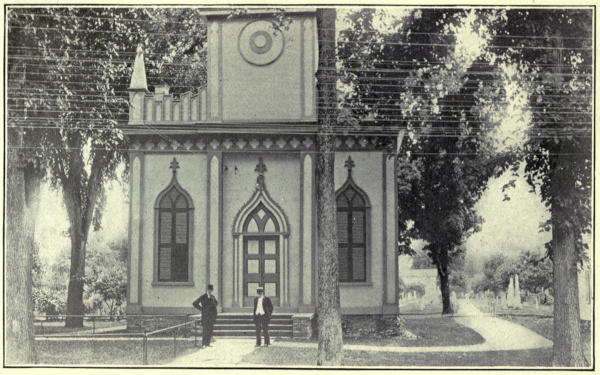
ST. MATTHEW’S CHURCH.
Consecrated in 1814, Enlarged in 1845, and Again in 1852.
LLOYD L. WOODRUFF AND SAMUEL D. BACON STANDING ON THE SIDEWALK.
The vestry of St. Matthew’s had decided to ask Trinity for help and Judge Page was sent to New York to make the application. He found on arrival that Trinity had so many applications of the kind that its policy had been to decline all, but the Judge, by means of the City Directory, ascertained the personal addresses of all members of the vestry and proceeded to call upon them. On meeting with a refusal from the first one he told him how much he regretted to return home without securing a single vote, and asked as a favor that he might have this man’s vote. The vestryman at last consented, but assured the Judge he could not possibly secure the gift. The Judge then called upon the other vestrymen and employed the same methods as with the first. Each was to give him one vote in order to save his pride on returning home. When the vestry of Trinity came together, the request from St. Matthew’s was duly read by the clerk, put to a vote, and, to the surprise of every one present except the Judge, was passed unanimously. The Judge is said to have kept his countenance in a state of rigid repose, when he rose to his feet and thanked the vestry for their generosity.
Bishop Hobart consecrated the Church in 1814 and in 1817 a bell that had been cast in London was set up. In 1845 the church at a cost of fifteen hundred dollars was enlarged and entirely remodeled by William J. Thompson. This was during the administration of Mr. Adams: it was newly consecrated by Bishop DeLancey. About seven years afterwards another enlargement of the nave was made by Mr. Thompson and Lewis Carmichael, during the rectorship of the Rev. Samuel H. Norton. About the time when Trinity Church gave the fourteen hundred dollars, Gouldsborough Banyar gave the Church 116 acres of land two miles below the village,—a property which was retained until some years after the Civil War, when it was sold and the present rectory in part built from the proceeds.
The first grave opened within the burial ground was that of Edward Howell, a sea captain, who, early in the century, had abandoned his roving life and settled on the Nathaniel Wattles place intending there to spend the remainder of his days. When the purchase of this land was under consideration, Mr. Howell was asked for a subscription. He declined on the ground that he had just sold his farm with the intention of going with his family to Bath, Steuben County. A few days afterwards, Captain Howell was taken ill and died. Thus his grave was the first ever opened in those grounds. As may still be seen, the stone that marks Captain Howell’s grave was “inscribed by his children.” The family removed to Bath where one of his sons became a judge and member of Congress.
In this churchyard are buried many of the first Unadilla pioneers, as well as men who followed them in the first half of the nineteenth century, among the number Solomon Martin, Guido L. Bissell, Josiah Thatcher, James Hughston, Isaac Hayes, Curtis Noble, Stephen Benton, Sherman Page, William Wilmot, Adanijah, Daniel, Gilbert and Gardner Cone, Abijah H. Beach, David Finch, Niel Robertson, Fowler P. Bryan, Joel Bragg, Col. A. D. Williams, Henry Ogden, Dr. John Colwell, Erastus Kingsley, Arnold B. Watson, Col. Samuel North, Frederick A. Sands, Rev. Norman H. Adams, L. Bennett Woodruff, Henry S. Woodruff, and Dr. Gaius L. Halsey.
An earlier burial place than this stood just east of Lester Hubbell’s summer home. There was buried Daniel Bissell. Mr. Thompson remembered the head stone that marked his grave. What disposition was made of these graves when the grounds were abandoned as a burial place, the author has been unable to ascertain.
Contemporary with the founding of St. Matthew’s Church was the founding of Freedom Lodge. Its charter dates from the same year—1809. De Witt Clinton was then Grand Master of the Grand Lodge of the State. At the organization of the lodge, Stephen Benton was made master, Abijah H. Beach senior warden, and Sherman Page, junior warden. For some years meetings were held in the house of Stephen Benton. During that period, the lodge records were lost in a fire which destroyed Mr. Benton’s house. In the time of the anti-Masonic movement, growing out of the Morgan tragedy, the lodge was practically closed. But in 1854, it was reorganized, with A. B. Watson as Master, and R. G. Mead and A. D. Williams as wardens. To a much later date belongs the Chapter.
After St. Matthew’s, the next oldest village Church is the Presbyterian, the influence of which has been an important factor in spiritual and social life. Two Presbyterian missionaries had been here before 1800, and possibly as early as the coming of “Father” Nash. Perhaps it was due to them that so much early Calvinistic strength had been shown in Cooperstown and Sidney. But Elihu Spencer and Gideon Hawley had been more than forty years in advance of them, those men coming as missionaries to the Indians. It is, therefore, true that the earliest religious teachings in the valley came from men of the Presbyterian faith, although on village soil the pioneer,—in so far as depth of impression was concerned, and possibly as a matter of date also—was “Father” Nash, an Episcopalian.
The Presbyterian Church in Unadilla was organized in 1823. Its first members were Uriah Hanford, Rhoda Hanford, Jesse R. Hovey, Mary Hovey, Holley Seeley, Garrett Monfort, Sarah Monfort, John Eells, Sophia Bottom, Daniel Castle, and Philo L. Phelps. For several years services were held in the school-house and in private dwellings. The building of a Church edifice was delayed until 1844, the year in which at Sand Hill the Baptist church was erected.
Since the building of the Episcopal church thirty years had now gone by, in which fact we see the historic importance in early village annals of St. Matthew’s. At Unadilla Centre, as early as 1830, a Methodist Church had been set up, but it was not until a quarter of a century afterward that a Methodist Church building was erected in Unadilla by a society destined to exert marked influence, and to-day existing in a fine state of vigor and usefulness.
The Baptist Church dates from 1847. Judge Page gave the land on which the building stands, valued by him at two hundred dollars. Frederick A. Sands, William J. Hughston and Simeon Bidwell were among the other contributors. Many gifts were in small sums. Scores of persons gave twenty-five and fifty cents. Anything was acceptable. On the original subscription book may still be read items like these: “$3 in boots and shoes”; “$10, one-half in cash, half in hats”; “$5 in boots and shoes”; “$3 in a United States map”; “2 dozen papers of tobacco”; and twenty-five cents in the form of “one bottle of Cholera Morbus Specific.”
Spafford records that in 1824, Unadilla possessed “a handsome toll bridge across the Susquehanna, 250 feet long, with three arches well covered and painted, as ornamental to the village as it is useful.” This bridge had been erected in 1817, the builder being Luther Cowles and one of the workmen Guido L. Bissell. It supplanted an older and inferior structure which had been partly completed as early as 1804, and which stood a few feet further up the stream where remains of one of the piers were still visible a few years ago in clear water. The piers of the new bridge were originally formed of plank boxes filled with stone. These proved inadequate in times of high water and projecting piers of stronger masonry were erected in their place. The bridge continued in use until 1893, when the present structure of iron was erected. It was owned by a company which had the privilege of raising money by issuing bank notes.
The building of another bridge on a new site at Unadilla was probably influenced somewhat by the enterprise which was building up a settlement at Crookerville. It was also inspired by the growing interests of the lower business centre of the village. On June 29, 1822, in the presence of Daniel Cone, Stephen Benton gave the Commissioners of Highways a quitclaim deed to a strip of land running “from the turnpike near Foster’s Tavern[16] on the west side of Sherman Page’s line south.”
This land was granted for a public highway and was to revert back to Stephen Benton or his heirs “in one year after the bridge which is contemplated to be built across the river shall become impassable for teams and loads, unless a new bridge shall be built, and that in good repair for passing with loads and teams.” On the same day a similar deed to land one rod wide adjoining Mr. Benton’s was given to Sherman Page in Daniel Cone’s presence for similar uses and on the same conditions. Benjamin Saunders, W. D. Spencer and Eber Ferris, Commissioners of Highways, laid out this road “agreeable to the request of Gilbert Cone, Albert Benton and John Bissell, trustees for building the free bridge.” This bridge remained free for ten years and then became a toll-bridge. The road was not opened earlier than 1823. A new iron bridge was erected on this site in the summer of 1894.
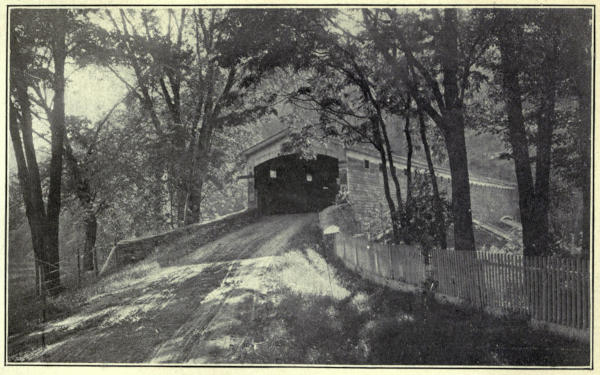
SECOND BRIDGE ON THE SITE OF WATTLES’S FERRY.
Built in 1817, Taken Down in 1893.
In 1821, a handsome two-story building was erected as a school-house, including a classical school of about thirty scholars and a common district school. The land for a site had been granted by Robert Harper of Windsor in July, 1820, the consideration being “one dollar and other divers good causes and considerations him thereunto moving.” This edifice, on the site of the present home of R. K. Teller, continued in use as a school for about sixty-five years, when it was sold for a hundred dollars, moved to a street across the railroad track and converted into a dwelling.
VIII. PIONEERS IN TRIBUTARY NEIGHBORHOODS. 1784-1823.
The rapidity with which the lands in this valley were taken up, once they had been made accessible, is most striking. Not only was the site of the village put under cultivation before the century closed, but many tracts elsewhere, on the hills to the north and south and along the two rivers, Susquehanna and Unadilla. Of those pioneers this volume should contain some record. They became familiar figures in village streets. Here they found a market for their produce; here many of them attended Church; here was the bank; here lived their family physicians and their lawyers; here was the post office, and here were the dry goods and grocery stores. Some of these localities have since built up villages of their own, such as Sidney Centre (or Maywood) and Wells Bridge; but for three-quarters of a century Unadilla was the central village with which all their interests were closely identified.
Across the river from the village in the Crookerville neighborhood, a settlement had been started by Stephen Wood before the eighteenth century closed, and here was a sawmill. Mr. Wood’s wife was a sister of William Gordon who afterwards came to live on the Nathaniel Wattles place. Mr. Gordon was the father of Samuel Gordon of Delhi who was stationed at Unadilla during the Civil War as Provost Marshall. The sawmill in Crookerville had been built some years before 1800, when Guido L. Bissell charged Mr. Gordon “to two days on the mill, six shillings”, “to repairing the sawmill, 14 shillings”, and in 1801, “to work on sawmill, 6 shillings”, and “to work on sawmill and gate 6 shillings.” Soon afterwards a grist mill was erected. It was owned by a man named Bennett who sold it to Mr. Crooker, after whom the place got its name.
Mr. Crooker gave a new start to the settlement by erecting a woolen mill in which yarn was spun, cloth woven and carpets made. For some of these carpets he found a market in New York. He erected seven houses around the mills, one for himself, the others for his employes. He died in 1842, and his son Edmund continued the business, with Elisha Thompson, a brother of William J. Thompson, but in 1844, the property passed into the hands of Major Fellows who, in 1845, converted the woolen mill into a grist mill.
Early among those who reached the hills north of the village were Peter Rogers, Abel DeForest and a man named Morefield. In 1799, Mr. Rogers’s dwelling was described as an “old house,” indicating that it had been built before the Revolution. Town records show that Mr. DeForest was living there as early as 1797. Other men who came to this region were Elijah Place and Rufus Fisk, as early as 1799, and James Maxwell, John Butler and Lysander Curtis, who arrived later.
Abel DeForest was a member of Assembly in 1810, 1813 and 1814. The DeForest name has been well preserved in numerous descendants. According to the census of 1890, there were fifty-eight persons of the name living in the town. William DeForest for more than thirty years was a groceryman in the village. Over his counter, in exchange for peanuts and oranges, were to pass the most of the pennies that came into the author’s hands when a boy.
Lysander Curtis outlived all his contemporaries. When he died in December, 1890, his age was ninety-eight years, nine months and twenty days. For nearly sixty years he had lived on the same farm. He was born in Columbia County in 1792 and came to this valley with his father when twelve years old. He served in the War of 1812, and in 1833 settled on 300 acres of unimproved land at the upper end of Rogers Hollow. Out of this land he made a valuable farm, which at the time of his death was still in his possession. Mr. Curtis had voted at every election save one since he became of age.
Noah Gregory, whose son settled in that part of the town called Unadilla Centre, was a native of Norwalk, Connecticut, where he was born in 1796. He lived in Gilbertsville, and after him was named Gregory Hill. His son, Ebenezer Gregory, in 1823 married James Maxwell’s daughter and moved to a farm where he built the stone house that still stands in Unadilla Centre. He reared four sons and four daughters who have contributed for more than one generation familiar figures to the social and business life of the village.
One of his sons was Jared C. Gregory who died in Madison, Wisconsin, in 1891. He lived in Unadilla for many years, reading law with Judge Noble, and practising it here until 1858 when he removed to Wisconsin, having been two years before the Democratic candidate for Congress. In Wisconsin he had success as a lawyer, became a Regent of the University of the State and postmaster of Madison under President Cleveland. His wife was Charlotte Camp, a sister of Mrs. Charles C. Noble. She is still living in Madison. The author had the pleasure of meeting her there in the summer of 1900, while securing material for “The Old New York Frontier” in the Library of the State Historical Society. He spent two hours in her home, and they passed as might one.
Another son was Dr. Nelson B. Gregory, who in the last years of his life was a conspicuous figure in the village. In his youth he had learned dentistry and went to France where he became a pioneer American dentist. He had among his patients men of whom the world everywhere has heard, including Thiers. He returned to Unadilla about twenty years ago and devoted himself to farming and stock raising on the fertile island farm formed by the Susquehanna and the Binnekill. He died in 1895.
In 1804, Abel Holmes came from Connecticut to Morris, bringing with him a son Amos, then one year and a half old. In 1809 Mr. Holmes went to Unadilla Centre, built a log house and cleared up a farm, with his nearest neighbor living one mile away. He lived to be eighty-four years old, and his son Amos died at ninety-five. Amos learned to ride a bicycle when he was ninety-three. The last years of Amos’s life were spent in the village and he distinctly remembered the place as he had seen it in boyhood.
By 1820 many families were living along the old Butternut road, running north from the Noble and Hayes store. Beginning at the north line of the town and coming south, the first farm was occupied by Richard Musson, who had settled there in 1804. Then came in the order named, Daniel Adcock, Jehiel Clark, Captain A. Bushnell, a family on the Peter Coon farm, Simeon Church, L. Farnsworth and James Maxwell. This brings us to Unadilla Centre where Mr. Maxwell kept a hotel. South from this point the settlers were Mr. Lamb, Mr. Carr, William Derrick, a colored man who had formerly been a slave owned by General Jacob Morris, another Mr. Carr, Jarvis Smith, John Haynes, who was a blacksmith, Joseph Smith, Mr. Allen, and finally Mr. Hemenway. This brought the traveler to the hill overlooking the village, at the base of which lay a group of buildings belonging to merchants, stock dealers, and farmers, gathered about the store and distillery of Noble and Hayes.[17]
In the Sand Hill and Hampshire Hollow regions, the town road records show that lands had been taken up before the eighteenth century closed. Among the early names are Daniel Buckley, John Sisson, Samuel Merriman, Elisha Lathrop, Thomas Wilbur, and John Cranston, all of whom had arrived as early as 1796 when Abner Griffith and Samuel Betts were living on the river road south of those settlements. John Sisson came as early as 1790, living first on the river road and then removing to the neighborhood afterwards called Sisson Hill. Other early names are Eber Ferris, John Palmer, Aaron Sisson, Lee Palmer, Hezekiah and William Carr, Edward Smith, Harvey Potter, Bethel Lesure, Samuel Patterson, and Captain Seth Rowley.
Captain Rowley had taken part in the siege of Fort Schuyler in 1777, that historic event which, combined with the battle at Oriskany, precipitated the Border Wars of the American Revolution. Captain Rowley spent three weeks at Fort Schuyler. He died at the age of ninety-one. On the river road near the mouth of Sand Hill Creek settled Captain Elisha Saunders, who was a physician as well as a soldier. He was killed at the battle of Queenstown in the War of 1812, and left two sons, one of whom became a physician in Otego, while the other, B. G. W. Saunders, lived for many years in Unadilla.
Benjamin Wheaton had settled in the eastern part of the town before 1796. He survived in that neighborhood as the traditional hero of many hunting tales, some of which are worthy of Baron Munchausen. One of them relates to a panther. Mr. Wheaton, after a long tramp through the woods, on sitting down to rest, fell asleep. When he awoke, he found himself covered with leaves and concluded that a panther had thus bestowed upon him the attentions received from other creatures by the celebrated Babes in the Woods. He believed however that the panther’s attentions had been prompted by self interest, in that she expected to return with her young and make a meal of him. Accordingly, he climbed a tree and when the big cat came back with her kittens, the mighty hunter slew all three.
The condition of Hampshire Hollow, which was settled by seven families from New Hampshire, has been described by Sylvester Smith as it existed in the early part of the century.[18] The heads of families and the number of their children were these: Parker Fletcher, seven children; Whiting Bacon, (the father of Samuel D. Bacon of Unadilla), eleven; Peter Davis, six; Walter Winans, four; Gaius Spaulding, four; Ephraim Smith, ten; Abraham Post, ten; John Cranston, ten; Samuel Lamb, four; Levi Lathrop, twelve; Asa Lesure, eight; Ephraim Robbins, six; Theophilus Merriman, seven; William Chapin, seven; John Lesure, eight (Mr. Lesure was living in 1891 at the age of eighty-nine); Thomas J. Davis, three, and B. M. Goldsmith, three. Nearly all of these families in Mr. Smith’s boyhood were still living in log houses.
With the building of the road from the Ouleout over to Carr’s Creek, in 1794, an important beginning was made in opening up the Sidney Centre neighborhood—a road little used now-a-days because of the heavy grade, but it seems to have been the original means of approach to Sidney Centre. Settlers came in slowly. The first to arrive came before the road was open. Jacob Bidwell settled there in 1793 and found two or three families had preceded him, but they did not remain long. Mr. Bidwell built a house on the farm owned in recent years by Harper W. Dewey. His brother taught the first school on Carr’s Creek and in 1798, at this wilderness home, was born a son who spent his old age in Unadilla village—Simeon Bidwell.
At Smith Settlement homes were planted about the same time, the pioneer having been Samuel Smith. On the Niles farm the first settler was John Wellman who sold the place to Joseph Niles in 1810. Mr. Niles came from Connecticut. He was drafted for the War of 1812 and for twenty-five dollars hired a man to go in his place. This man went to Sackett’s Harbor under General Erastus Root of Delhi. Mr. Niles’s son Samuel lived on this farm all his life, I think. In 1816, David Baker, the father of Horace and William Baker, came to this neighborhood.
Another early settler was Jonathan Burdick. His father had settled in Kortright in 1810. Jonathan came to Carr’s Creek in 1836. Except for the Smith settlement, the country was still in large part a wilderness. Assisted by his wife Mr. Burdick rolled up a log house. His father had been present as one of the guard at the time Major André was taken from the old Dutch Church at Tappan to his place of execution, for complicity in the treason of Benedict Arnold. The father was also present at the surrender of Cornwallis. Another pioneer in the Sidney Centre neighborhood was Windsor Merithew. He came in 1835. The first school-house in this region was built in 1825 and was constructed of logs.
In the paper mill district some of the first settlements in the town were made. Here stood the original village of Unadilla, a village of scattered farms, planted in 1772 and burned by the American soldiers under Colonel William Butler in 1778, when it had become a settlement of Indians, British Tories and runaway negroes who had driven out the original Scotch-Irish pioneers. To these lands came some of the first settlers who returned to the valley after the war, which was about 1784. On the paper mill site, saw and grist mills had been built within a few years and around them was gathered a thriving settlement. The mills were owned by Abimileck Arnold. A carding mill and cloth dressing factory were also established here. Mr. Arnold arrived soon after the war closed and seems to have been here before the conflict began.
On the farm just below the paper mill site, where the Johnstons spent their first season, was made one of the settlements that belong to a time previous to the war. Here now William Hanna, a Scotchman from Cherry Valley, made his home and here he long lived and kept a hotel. Mr. Hanna was possibly a relative of the Rev. William Hanna, who twenty years before had been pastor of the first Presbyterian Church established in Albany and had corresponded with Sir William Johnson, from which we may, perhaps, infer that the younger William Hanna had come into the valley before the war. The younger Hanna had served in the Revolution in the Third Regiment of Tryon County Militia. Witter and Hugh Johnston were in the same regiment. In this regiment David McMaster was a captain.
Two Ouleout names that appear on the muster roll are Abraham Fuller who built the mill there probably before the war, and Abraham Hodges, while among other names are Daniel and David Ogden of Otego, and Henry Scramling and John Van Dewerker of Oneonta. Jonathan Carley the pioneer of the family that still survives on the Ouleout, had served in the Revolution and came into the country in 1796 from Duchess County.
A sister of the Johnstons was the wife of Stephen Stoyles who settled on the farm where recently lived Norman D. Foster and whose daughter was married to Obel Nye. Mr. Stoyles had served in the Revolution and came into the valley in 1788. Descendants of Mr. Nye lived on this farm until it passed to Mr. Foster. Here for many years cider was made and to this mill and the rival manufactory at the Ryder farm on the Ouleout many boys from the village years ago were accustomed in the autumn to make their pilgrimages. With delight the author recalls that among these boys he was often one.
Captain David McMaster came with the Johnstons. He lived across the way from the Ephraim Smith house. C. Frasier settled on the A. N. Benedict farm and David Bigelow on the Evans place, not far from the site of the old Indian Monument, all trace of which I believe has now disappeared. As early as 1796 Moses Hovey had settled in this neighborhood—I believe on the Sylvester Arms place.
To the Luther farm early came back one of the Sliters of the Revolution and then Phineas Bennett who was here at the beginning of the century, or before. Elisha Luther, a Revolutionary pensioner, came from Clarendon, Vermont, in 1825, and bought the farm from a family named Sherwood. Mr. Sherwood’s daughter was the wife of Moses Foster whose coming was contemporary with Mr. Luther’s. Mr. Foster left behind numerous descendants.
Other daughters of Mr. Sherwood by another wife were those who became the three wives of Colonel David Hough, owner of the farm on which stands a brick house. One of these daughters when married to Colonel Hough was already the widow of a man named Lord. Another was the widow of Dr. Slade, the father of Chauncey Slade, a citizen of the village for many years. Colonel Hough bought his farm from a family named Hurd who were relatives of the Jewell family of Guilford. On this farm bricks were made and many thousands of them were used for chimneys in Unadilla village. Alvin Woodworth lived in this neighborhood early in the century and his son Alvin Clarke Woodworth, who died in 1818, was the first person buried in the cemetery near the home of Norman D. Foster. Here Chauncey Slade lies buried.
With Elisha Luther came his son, Martin B. Luther, whose death in the summer of 1890 removed a citizen of much personal worth and superior intellectual endowments. He had been supervisor in 1841 and 1842 and was a justice of the peace for several terms. He was an authority on titles in the Wallace and Upton patents and was a surveyor of long experience. He was prominent in Masonry. He joined to wide reading a clear and large understanding. Mr. Rogers[19] did not exaggerate in describing him as “a man of great capacity, much modesty, an honored citizen, a good farmer, and a gentleman of unquestioned honor.”
On the Unadilla river a large family of the name of Spencer settled,—so large indeed that a part of that neighborhood was known as “Spencer Street.” The father was Jonathan Spencer and one of the sons was Orange Spencer. These men appear to have first settled here before the Revolution. Following them were several families to whom they were related by marriage, sisters of Jonathan being the wives of Jeremiah Birch, Jonathan Stark and Jeremiah Thornton.
Mr. Birch was the grandfather of Albert G. Birch.[20] Jeremiah Birch came soon after the Spencers and was from the same locality in Montgomery County. He as well as the Spencers had served in the Revolution in the Third Regiment of Tryon County Militia and probably was at Oriskany. Mr. Stark made his home on the Horace Phelps place and died about sixty-five years ago. Another relative of Jonathan Spencer was Jalleal Billings, who was a son of one of his sisters. He settled near the bridge that now crosses to Shaver’s Corners. Mr. Billings’s mother had for her second husband Enos Yale, who settled in that valley several years before the eighteenth century closed. Mr. Yale was prominent in town affairs.
To this same valley, near the mouth of the river, some time afterwards came another family named Spencer. Their ancestor, Amos Spencer, originally was from Connecticut and had served in the Revolution. He had settled in the town of Maryland, Otsego Co. On the Unadilla river settled two of his family, Simeon and Porter, who afterwards came to the village, leaving descendants, some of whom are still living there.
Samuel Rogers, the ancestor of P. P. Rogers, came to Unadilla before 1795. Four children and his wife came with him. They settled first on the Gates place above the Salmon G. Cone farm, but went afterwards to the Unadilla river. Mr. Rogers was a native of North Bolton, Connecticut, where he was born in 1764, and his wife a native of the neighboring town of East Windsor. He died in 1829. Mr. Rogers was one of those shoemakers who have been remarkable for other things than their trade. He worked at that trade for the most of his life, but had great love of books and was possessed of much knowledge in several directions. Like Sluman Wattles, he was a typical pioneer of the best class, a man who could do many things and do them well. He was a practical surveyor and knew enough medicine to have practised it. He had learned some law, and after he was fifty-five years old acquired a good reading knowledge of the Latin language. Judge McMaster, who knew him well, said: “There was no man in this society in his time of so much intellectual culture as Mr. Rogers except the minister, and not always excepting him.”
Mr. Rogers’s son Jabez was long a resident of the village, as was his grandson, Perry P. Rogers, whose later life was spent in Binghamton where he died in 1894, to the regret of every person who had known him. He had a most intimate knowledge of the early settlers of this part of the valley. He was born on the Unadilla river, but in boyhood went to Steuben County and thence to Buffalo, where he was admitted to the bar. He came to this village in 1857 and practised law here until 1871, when he went to Binghamton and there spent the remainder of his days. He lies buried in St. Matthew’s churchyard. My school mate, his son Joseph, grew up in this village, and in the churchyard sleeps.
At the mouth of the Unadilla river grist and saw mills were owned at the beginning of the century, if not earlier, by a man named Nickerson. Sixty or more years ago they had passed into the hands of Harry Hoffman. The farm where Delos Curtis lives was occupied by John Abbey, the Bryan farm by Silas Scott. Seth Scott is an early name connected with the Thomas Monroe farm, and another name connected with it is Phineas Reed, who built the stone house in 1832. On a portion of this farm lived Major David Francis, who came into the country as early as 1790. His house stood near the creek that crosses the highway where the road turns off to East Guilford. Older residents well remembered many amusing stories of this man.
Seth Scott and his brother Silas had arrived as early as 1796. Seth’s wife was Amy Birch, an aunt of Albert G. Birch. Silas Scott, William D. Mudge, father of the late William L. Mudge of Binghamton, and Jesse Skinner all lived in this neighborhood and married sisters named Lee, daughters of Philemon Lee. Of this family of Scott was “Granther” Scott, who kept the first toll bridge at Wattles’s Ferry. Henry Dayton, who surveyed many of the first town roads, lived where Julius Utter more recently lived. Jerome Bates was another early resident on the Unadilla river. He was a carpenter and with the builder Bottom erected the house on the Bundy farm. Here also settled Zachariah C. Curtis who died in 1891 in his ninety-second year. His parents were from Stratford, Connecticut, and had settled in Madison County. About 1800, he was born. Mr. Curtis settled on the Unadilla river in 1823, where he was a pioneer in the cultivation of hops. For many years his yard was the only one in the southern part of the county. Mr. Curtis was the father of J. Delos Curtis.
IX. MAIN AND MILL STREET MEN. 1815-1840.
Early in the eighteenth century the village had become divided in its business interests, two trade centers having been created. Sharp rivalry had well begun before the new century was ten years old. As time went on, this rivalry deepened and spread until it permeated the entire community. Indeed, for three generations it formed a pivot around which many interests revolved.
At the beginning of the settlement, the indications were that the center would be in the neighborhood of what is now Main and Martin Brook Streets, where the first goods were sold. The desire to be as near as possible to the terminus of the Catskill Turnpike, and directly accessible to the river from their store, led Noble and Hayes to begin their enterprise at the extreme eastern end of the village. But the interests which centered at that distant point were afterwards shifted to Main and Mill Street, largely because new enterprises had grown up there. Here was found a site more nearly central; here were the thriving mills of Joel Bragg; here Roswell Wright in 1815 built his store; nearby was Bragg’s Hotel; here was St. Matthew’s Church; and here was established the post office.
Meanwhile, had occurred the opening of the store of Stephen Benton at Main and Clifton Streets, and the building of the hotel by Dr. Cone diagonally across the way. Here therefore was now another center. Thus had been cast the die from which so much of the subsequent history of the village was to take its rise—two rival centers of trade. Colonel North has shown with fullness, in a paper reprinted in a later chapter, what had been the growth of the two ends by 1828. Each in some respects had advantages. If the eastern, or upper, end had a young ladies’ private school, the western end had two physicians as against the other’s one. Up-town had the only church building and the grist and saw mill; but down-town had the fulling mill and the tannery. Each had a hotel. Wagons were made down-town and clocks and watches were there repaired, but hats were made up-town and so were coats and trousers. In one respect the honors were notably easy. Each had its own distillery; but this fact may have increased rather than allayed the disputatious tendencies.
The opening of the two stores of Stephen Benton and Roswell Wright was almost simultaneous. Mr. Wright at the beginning did business alone, but soon had as partner Moses G. Benjamin. Mr. Wright had come from Wethersfield, Connecticut, where he was born in 1785, and had previously started in business in Catskill. After remaining his partner in Unadilla for several years, Mr. Benjamin went to Bainbridge. Their store stood on the southeast corner of Main and Mill streets, and among those who helped to build it was Guido L. Bissell. Standing in the centre of the village, it supplanted for its immediate area the store formerly conducted by Solomon Martin and Gurdon Huntington, General Martin having died in 1816 and Dr. Huntington having gone to Cairo in 1813. It continued for a long period of years to be the up-town centre of village business life. Mr. Wright was postmaster for a number of years and he had in his employ, or as partners, at one time and another, young men who were to become notable factors in the future of the village. More than one was to remain a resident for sixty years.
Arnold B. Watson, one of the number, was a native of Albany County, and came to the village in 1821 to take charge of a classical school in the upper story of the building that long stood on the site of R. K. Teller’s residence. He was then twenty-three years old. Two and a half years later he entered Roswell Wright’s store and in a short time was a partner, the firm becoming Wright and Watson. Later it was Wright, Watson and Company, Abiel D. Williams having joined the firm.
Mr. Wright died in 1832 and Mr. Watson went into business on his own account in the brick store which had been erected across the street in 1832, on the site of the Masonic Hall. The Masonic Hall was then ten years old. It had been built by Lord and Bottom and was now removed eastward to the site of the present beautiful residence afterwards built by Mr. Watson. Here Mr. Watson continued to do business for many years, and here he established the Unadilla Bank, which for more than twenty years was perhaps the most widely known bank in this part of the valley. Clark I. Hayes became his partner, and by this firm the extensive operations of Noble and Hayes were revived and long continued.
Mr. Watson’s activities outside his firm extended in many directions. He became active in the organization and building of the Albany and Susquehanna railroad and his name was one of those proposed for president. Of St. Matthew’s Church he was senior warden and treasurer for thirty years. To him more than to any other one person was the village indebted for the old Academy. He not only had the largest amount of stock but in every possible way promoted its welfare afterwards, his interest never ceasing until his death.
Mr. Watson had twenty-two shares of the Academy stock; A. D. Williams had sixteen; L. B. Woodruff, twelve; Erastus Kingsley, thirteen; Mrs. Charles C. Noble, eight; C. I. Hayes, eight; the estate of Isaac Hayes, twelve; Mrs. Isaac Hayes, seven; Joel Bragg, five; and W. J. Thompson, two. An effort was made to secure for the Academy the land known as the Harper lot, which faced Main Street opposite the present Sands and Arnold residences. Subscriptions were solicited, but disputes arose, ending in the purchase of the present site from Joel Bragg, land which was then an orchard.
The absence of down-town names from the list of stockholders would indicate that down-town men had been disappointed in the selection of the site, the stock being entirely taken by men living uptown. The building was erected by Mr. Thompson in 1851. It continued in use until 1894, when the present fine structure of brick was erected and the old building sold and taken down, the Academy site and its endowment fund being united with the new school.
Mr. Watson, in 1832, built for his residence the brick structure which now forms part of Bishop’s Hotel. Erastus Kingsley afterwards acquired this property and enlarged it for hotel purposes. Later on Mr. Watson erected the residence which still stands east of the brick store. Mr. Thompson built it for him. This involved the second removal of the Masonic Hall, which was taken to its present site where with its enlargements it stands as the summer home of Lester T. Hubbell. Mr. Thompson found a model for Mr. Watson’s new house near Utica, or at least some suggestions for it; but otherwise he was the architect as well as the builder of that noble village residence.
Mr. Watson’s first wife was Susan Emily, daughter of Isaac Hayes. Their children were Henry M., now of Buffalo; Julia N., who died in her youth; Sarah A., who was married to the Rev. E. Folsom Baker; Susan H., the wife of Frederick T. Sherman of Brooklyn, and William H. of Buffalo. In 1865 Mr. Watson married Isaac Hayes’s daughter Augusta, who survived him until December 20th, 1891, when at the age of seventy-three she died in the house her father had built in 1804. In this house she had been born. In St. Matthew’s Church she was baptised; she remained all her life a member of it and in its churchyard she lies buried.
Mrs. Watson’s brother, Clark I. Hayes, at the age of seventy, followed her to this last resting place a little more than a year afterwards. Mr. Hayes during his business career was universally popular throughout a large territory. Mr. Rogers, whose acquaintance with him was intimate, has described him as “a gentleman by instinct, courteous, pleasant, affable.” Amid many changes of fortune he maintained through life a placid, hospitable and manly relation towards society and those who compose it. Born as he had been to rural affluence and reared in refined surroundings, he personally seemed never altered by trials which might have been sufficient to break the spirit of men trained in sterner schools. Under his influence, probably more than that of any other man in the community, was due the elevation of the standard of farm stock in this part of the valley.
Like his sister Mr. Hayes was born in the house in which he died. Her home for some years was elsewhere, but Mr. Hayes spent all his days in this dwelling, which was part of his inheritance. Few lives have embraced so long a period of village history as these two. When this brother and sister first saw the light scarcely more than twenty houses were standing; the turnpike was still the main highway from the Hudson to this part of the state; lumbering was the chief industry and produce arks were making voyages down the Susquehanna. These lives were interesting in many other ways, ways more personal, for all who knew and understood this man of staid courtesy and sweet spirit, this woman of bright and gentle life, whose careers closed in the very place where they began.
Another year brought to this churchyard another child of Isaac Hayes, his son Frederick T., of whose boyhood more than one pleasing glimpse is given in Henry Noble’s diary, of which extracts will be printed in a later chapter. Frederick Hayes spent his business life in a New York bank of which he was an officer, but he often came back to Unadilla, pleased once more to walk among the scenes of his youth.
In Erastus Kingsley was seen perhaps the most popular landlord which this valley ever knew. He was a native of Franklin where he was born in 1800, his father being Bradford Kingsley. On coming to Unadilla, he was employed by Daniel and Gilbert Cone. For a short time he kept the hotel at Main and Bridge Streets. A sister of his was the first wife of Marvin C. Allen and the mother of Chester K. Allen. Mr. Allen for some time lived in the Bradford Kingsley house and later on bought a house then standing on the corner of Main and Walnut Streets, where he died. For his second wife he married Caroline Gregory. Mr. Kingsley died in 1865. His hotel at Main and Depot Streets was the headquarters in stage-coaching times and in the rear of it travelling circuses usually fixed their tents.
Around this village corner gather many other memories. After Mr. Watson perhaps comes Colonel Williams, at least in point of duration of associations. He was a native of Westford, Otsego County and a son of Israel Williams. He began life in Unadilla as a clerk in Wright’s store and afterwards was a partner. In 1827 he removed to Honesdale, Pennsylvania, where with his wife’s brother, Thomas Hayes, he was engaged in trade for ten years. He then returned to Unadilla and resumed business on the old site, Mr. Wright having died. Mr. Wright’s house became Colonel Williams’s home. He was elected supervisor in 1855 and died in 1871 at the age of sixty-nine. Long after his death his son Thomas and his daughter Elizabeth remained familiar and pathetic figures amid the scenes of their father’s life, which had been active and honorable in youth and prime but which closed in misfortune. Thomas Williams died in Cooperstown in 1890, and was buried in the churchyard here at his father’s side.
Contemporary with these names is the name of John Colwell. Dr. Colwell was a bachelor, and a bachelor he died. He was born in Richfield in 1794. An authentic story of his youth relates to his dislike of school. Found missing one day, he was long searched for in vain until at last discovered by his mother half way down a well. Being urged to emerge from his cool retreat, he refused to do so unless assured that he would be neither punished nor made to go to school. Dr. Colwell read medicine in Cherry Valley with the elder Dr. White and settled in Unadilla as early as 1820. Here he remained until his death, widely known and always beloved. His office still stands on Mill Street just below the blacksmith shop. He boarded for many years at Kingsley’s hotel and previously had lived at Bragg’s hotel.
Mr. Kingsley was tolerant of Dr. Colwell’s eccentricities in money matters. The doctor never kept any book accounts, seldom made collections and infrequently made payments. Mr. Kingsley in consequence acquired a habit of collecting some of the doctor’s bills himself, and thus took care of his own claims; it might now be money that he collected, or it might be a “side of beef.” This simple method of paying two debts by one transaction seemed to accord admirably with the doctor’s liking for simple methods in finance. He was supervisor in 1845 and 1846 and died in 1868 at the home of Dr. Joseph Sweet. He was laid away in St. Matthew’s churchyard.
Dr. Colwell was an old schoolmate of Levi Beardsley, the author of the “Reminiscences.” Contemporary with him in Unadilla was Henry Ogden, whom Beardsley describes as “a fine, talented fellow, but amazingly fond of hunting and fishing and a most keen sportsman.” Mr. Ogden was from Catskill. He had four sons and two daughters, the eldest son being a graduate of West Point, who died a brevet-major in the regular army, receiving his rank for meritorious conduct. He served in the Black Hawk war of 1832 and in the Florida wars of 1837-38 and 1840-42. He died at Fort Reilly, Kansas, in 1845, and lies buried in the churchyard here with his father and mother. Henry Ogden’s two other sons removed to California. Mr. Ogden was a lawyer and his office building still exists as part of the home of William H. Sewell on Watson Street. His house occupied the site of the church rectory and was built as early as 1815. It now occupies a new site on Martin Brook Street.
Another name permanently connected with this village corner is that of Levi Bennett Woodruff. Mr. Woodruff was a native of Hartford County, Connecticut, whence he went with his father, Joel Woodruff, to Meredith, in Delaware County, when ten years old. In coming to Unadilla he was the forerunner among four brothers, one of whom, Lloyd L. Woodruff, is still living here. Joel Woodruff spent his last years in the old house on the turnpike just above the Foster Thompson farm, an ancient dwelling with an old sweep well and once owned by Ira Spaulding. A portion of this structure had formerly been used as a schoolhouse on another site.
L. B. Woodruff came to Unadilla in 1829 in company with Edwin J. Smith, who also was from Meredith. The two engaged in blacksmithing near the present stone shop and for many years conducted a prosperous business. Blacksmithing had previously been carried on in the same place by Turner McCall and Charles Wood. Mr. Woodruff in 1835 or 1836 built the stone shop still standing and later on the spacious dwelling on the Main Street corner. Retiring from the shop, he engaged in trade in a store near his house, and during the railroad building years conducted a large business. He died in 1879.
Mr. Woodruff was followed in 1835 by his brother, Henry S. Woodruff, who survived him several years. He also was a blacksmith, but he abandoned that calling from ill health and for a long term of years was proprietor of the stage line from Unadilla over the old Turnpike to Delhi, by way of Meredith Square. He had exceptional eminence for familiarity with that road. He was born upon it in the town of Meredith and had travelled over its western end more times than any one else living in his day. When he died the buildings on his premises were found stored full of many curious relics of the stage business, from the smaller hardware of sleighs and harnesses, to worn-out whips and ancient buffalo robes, from two-horse vehicles to an old-time covered sleigh that marked in signal manner the passing away of an interesting era.
The year 1841 brought to the village the third of these brothers, Lloyd L. Woodruff, who engaged in trade as a merchant tailor and then as a general dry goods merchant, builder, &c., with his brother-in-law, Milo B. Gregory, in the uptown brick store. John Woodruff, the fourth brother, spent some years as a clerk in the old brick store when a young man, but finally removed to Delhi where he became an eminent citizen and merchant.
More than sixty years ago, when the Masonic Hall stood on its original site, one of its occupants was Seleck H. Fancher, whose sudden death from heart failure in March, 1891, startled the community. He was found in his garden about eight o’clock in the morning with life extinct. He was a native of Connecticut and died at eighty-two years of age. Until the hour of his death, his life had been an active one. Several generations of boys and girls will long preserve the memory of this open-minded man, this kind-hearted friend of theirs. He was a shoemaker and like Samuel Rogers was wise in many things besides his craft. A building that will long be associated with his activities is the octagon house built by him and which was his home for more than twenty years. Mr. Fancher was himself as many-sided as the house he dwelt in. His mind had as many windows open to the sun.
X. TWO MEN OF NOTE. 1828-1835.
At the junction of Main and Mill Streets two other men, destined to notable distinction in village annals, began their careers. Each had been born in another place, each came to Unadilla as a young man, each spent here the most of his remaining days, and here finally each was to pass away and be buried in the old churchyard, the one fifty-one years afterwards, the other sixty-six—Frederick A. Sands and Samuel North.
Mr. Sands, as early as 1835, was a clerk in the Wright store. He had come to the village from Franklin and was a son of Judge Obadiah Sands, a native of Sands Point on Long Island, descended from Captain James Sands[21], an Englishman, who came to this country about 1642, landing at Plymouth. Capt. Sands had been born at Reading, England in 1622.
Benjamin Sands of Sands Point married Mary Jackson, and Obadiah Sands, the father of Frederick A. Sands, was their son. Leaving Sands Point in May 1795, when in his twenty-first year, Obadiah, fifteen days later arrived at Cookoze, now Deposit, then a large centre of the lumber industry. He had with him as cook a colored boy who was a slave. Mr. Sands engaged actively in lumbering and dealt in real estate, following these pursuits at Cookoze until 1802, when he settled in Delhi, remaining there three years. He then removed to a place in Sidney, about three miles below Franklin village on the turnpike, and in the same year was married to Elizabeth Teed of Somers in Westchester County. In 1811 he removed to Jericho[22], afterwards Bainbridge Village, where he engaged largely in the purchase and sale of real estate.
Mr. Sands afterwards purchased a tract of land in Franklin, one mile east of the village, and in 1818 went there to live. On this farm Abel Buell of Lebanon, Connecticut, had settled in 1790, or earlier, and thus was near his old Connecticut neighbor, Sluman Wattles. Franklin thenceforth until 1840 continued to be Judge Sands’s home. For a short time afterwards he lived in Meredith and in 1845 went to Oxford where he died in 1858. He was buried on the farm in Franklin, but his remains were afterwards brought to Unadilla and now rest in the churchyard. He had six sons and three daughters. All but three of them survived him. The survivors were Dr. William G. Sands of Oxford, Jerome B., of Bainbridge, Marcellus, Dr. A. Jackson, who lived many years in Unadilla, Frederick A., and Elizabeth E., who became the wife of Joshua C. Sanders and is still living in New York.
Frederick A. Sands was born in Bainbridge February 19th, 1812. Following his employment as a clerk in the Wright store, Mr. Sands engaged in business first with Christopher D. Fellows, under the name of Fellows and Sands, and next with Mr. Watson as Watson and Sands. He then removed to Oxford where he was active in business with his brother-in-law, James W. Clark, along with whom and an old personal friend, Henry L. Miller, and others, he became interested in the First National Bank of that place, an institution that has had a prominent and successful career. Mr. Miller and he were lifelong friends. They were buried at the same hour and on the same day in 1886.
On the death of his father in 1868, Mr. Sands, who was executor and trustee of the estate, abandoned his mercantile pursuits and devoted himself to the affairs of the estate, which was a large one for that period. In his management of this property the necessity never arose for a lawsuit. He possessed what Matthew Arnold called “sweet reasonableness.” When he died, it was said of him that “few men have done so much business with so little litigation.” He was familiar with real estate titles in the neighborhood where he lived, and his papers have been described as “models of neatness and brevity and always as correct as care and labor could make them.” With this scrupulous exactness went also a fine integrity. In politics Mr. Sands was a democrat, though he had small liking for the profession of politics. Official place he never sought. Mere office could scarcely have added anything to the esteem in which for two generations he here was held.
Mr. Sands’s first wife was Maria, daughter of Sherman Page. Two years after the marriage she died. In January 1841 he married Clarissa A., sister of the late Henry R. Mygatt of Oxford, who survived him only a few months. Mr. Sands had dwelt in both of the stone houses in the centre of the village, having built the western one and enlarged the other, which was his home for more than forty years. Between these ancient dwellings his son, J. Fred. Sands, in later years erected a beautiful modern home, and far to the rear of them, on an elevated plateau where agricultural fairs were annually held long ago, opened up streets and erected a number of houses.
The story of this Main and Mill Street centre, of the Academy and the old brick store, connects itself closely with the life of another citizen of the village who was Mr. Sands’s son-in-law. In the Academy building Frank B. Arnold’s life in the village had its beginning. In the brick store he had his office and there he died. He lived in Unadilla more than twenty years, and first came to take charge of the Academy. Dr. Odell and Mr. Thompson were the trustees who engaged him. He was from Gilbertsville, where he had just been graduated from the school, and now wished to teach in order to help himself through Hamilton College. Under Mr. Arnold the Academy became very prosperous, and never was teacher more popular with students. A memorial of his career may be seen in the trees that still stand near the side-walk in those school grounds. They were planted by the hands of Mr. Arnold and his pupils.
Having read law and been admitted to practice, Mr. Arnold soon removed to Nebraska, but he came back in a few years and thenceforth always lived in the village. Although a Republican, he was several times elected supervisor in this Democratic town by majorities as large as were ever given to any candidate. In 1885 and 1886 he was elected to the Assembly and in 1887-1888 served in the Senate. He became the Republican candidate for Congress in 1890, but was defeated by a small majority. His health was seriously undermined at this time, and on December 11th he died in his office at Main and Depot Streets.
Mr. Arnold made a distinct mark in the Legislature and became known throughout the State. He had many attractive personal qualities, with tastes quite apart from those which the law and politics fostered. He had read extensively in general literature and had collected many books. His law library was the one which formerly belonged to Daniel S. Dickinson. Mr. Arnold was born in Ireland and came to this country when a child. His father settled in East Hartford, Connecticut, where some years later the boy was seen by Major C. P. Root of Butternuts, and under his influence made his home in Butternuts.
On this corner in Roswell Wright’s store the business life of Samuel North in Unadilla was begun. His age was fourteen when he arrived in May, 1828, remaining in the store until he was twenty-one. The history of his family goes back to pioneer days in the valley of the Delaware. The Norths are of Long Island origin and of English ancestry. At Newtown the line comes down from Thomas to Benjamin and then to Robert, who in 1784, with twenty other persons, mostly from Long Island, set out for what is now the village of Walton by crossing the wilderness from Kingston to the Delaware. With Robert North came his wife and an infant son named Benjamin who was the father of Colonel North. Mrs. North for the last portion of this journey rode on horseback with her infant in her arms and with a bed and pieces of furniture fastened on the horse behind her.
The owner of the Walton patent was William Walton, a man of much note and affluence in New York at that time. He had offered to give a tract of land in his patent to the first male child born there on condition that the child should bear his name. The first child thus born was a son of Robert North. Mrs. North had wished to call him Samuel, and, in spite of the offer, the name Samuel was adopted. This boy went to Albany as a clerk in the Assembly, and afterwards became a lawyer, but died in early life. Long after this event Samuel’s brother Benjamin became the father of a son, in whom was revived the name of Samuel. This was Colonel North, who for many years was probably the most distinguished citizen of the village.
After leaving Unadilla when he became of age, Colonel North pursued his mercantile calling for a time in New York. Returning to Walton he became colonel of a regiment of Hamden and Walton militia which was called out during the Anti-rent difficulties. He once more settled in Unadilla and in 1849 was elected County Clerk. In 1853 he was made principal clerk in the appointment division of the General Post Office Department in Washington, and soon afterwards was made special agent of the department for a portion of New York and New England. He was a delegate to the Charleston convention of 1860 and voted for Stephen A. Douglass. By this act he incurred the displeasure of President Buchanan and lost his position. Returning to Unadilla he engaged in the hardware business. While acting as one of the fifteen special agents of the Post Office Department he had been rated as No. 1 as to the value of his services.[23]
Colonel North’s wife was Eliza Gray of Durham, Greene County, whom he married in 1835. She died in 1891 and he followed her in 1894 in the 81st year of his age. Their son Thomas Gray North, was born in Walton, August 15, 1840, and for years filled a large place in the business life of Unadilla. He was the head and manager of the banking house then known as Thomas G. North & Co. which, for more than thirty years, has been among the prominent and successful banks in this part of the State. Since his death the house has been continued as North & Co., Samuel S. North, Colonel North’s only surviving child being the head. Thomas G. North’s untimely death in 1885 cast a shadow over the village such as few events have done. He was educated at Geneva and began business with Charles C. Siver in 1865, first as hardware merchant and then as banker. Mr. Siver’s poor health ending finally in his lamented death broke up the partnership and Mr. North continued the business with his father until he died.
XI. HOUSES STANDING SEVENTY-THREE YEARS AGO. 1828.
Colonel North, near the close of his life, published an interesting and valuable description of the village at the time of his first arrival in 1828.[24] By his kind permission, secured at the time of its appearance, the greater part of this paper is given here. The description begins at the eastern end of the village and first embraces the north side of Main Street through to the western end as follows:
“The first dwelling was a one story house in which lived an aged couple, Jesse Noble and his wife.
“Next was the residence of David Finch and family consisting of himself and wife, four sons and four daughters.
“At this point was a diverging road, then as now, leading over the hills to the town of Butternuts. On the west side of this road, a few rods from Main Street, stood the distillery of Noble and Hayes, one of the seeming necessary adjuncts of the then new country, to work up the surplus grain of those days, for which there was no market except in a liquid form.
“Next was what was known as the tenant house of Noble & Hayes, in which lived Amos Priest and his wife on the site of which now stands the residence of Horace B. Eells, being the same house with additions and improvements in which David Finch lived, but was moved to where it now stands, because of railroad encroachments.
“Next was the store and storage buildings of Noble & Hayes, one of the earliest mercantile firms established in this section. The store, since abandoned for such use, has been altered into a dwelling, and is now occupied by George Wolcott and family.
“Next was the residence of Curtis Noble and family, consisting of himself, wife, four sons and four daughters.
“Next was the residence of Isaac Hayes and family, consisting of himself, wife, four daughters, two sons and a niece. It is now the home of Clark I. Hayes and family.
“Next was the residence of Captain Amos Bostwick, a Revolutionary soldier, and family, consisting of himself, wife and one daughter. It is now known as the tenant house attached to the farm of Clark I. Hayes.
“Next passing an intervening space of several rods of open field, came what was designated as the “yellow store” built by Henry A. Beach, but never successfully utilized for business purposes. It became a sort of “catch all” for migratory tenants. It occupied the lot on which now stands the residence of LeGrand Stone.
“Next was an open field to where Hiram Benedict and family resided in a small house, detached from which was a shop in which he carried on the tailoring business. The house at a later day was improved and modernized by Jared C. Gregory, and is now the residence of Mrs. Wm. McLaury and daughter.
“Next was the house now the residence of Mrs. Henry H. Howard, then occupied by Arnold B. Watson and family.
“Next was the residence of Daniel Castle and family, consisting of himself, wife, two sons and a daughter. It is the same house modernized and improved, now the property and residence of Mrs. Hurlburt.
“Next was an intervening cultivated field, upon the west side of which was an unoccupied house, formerly the residence of Jacob Hayes and family. It was at a later day removed, and the lot with some addition to it was afterward built upon by Hon. Charles C. Noble. The place has lately been purchased by James Collins, who with his family now occupies it.
“Next was an open field a distance of thirty rods down to where H. C. Gregory and his family now reside in the house built by Mr. A. B. Watson. Within the grounds of the same as now inclosed, stood near the east line, the dwelling of Mason DeForest, and near thereto a shop in which he worked at shoe making. Both the house and shop were demolished when Mr. Watson built his house.
“Next was the Masonic Hall standing about two rods east of the brick store since built, in which lived Henry A. Beach and his family. Masons at that time being in a languishing condition, the lodge room was soon used for a young lady’s school, kept by a Miss Seymour from Connecticut. The Hall was afterward purchased by William J. Thompson, moved to Watson Street, and by him converted into a dwelling which is now his residence.
“Next passing an intervening space of several rods down to where White’s Hall now stands, there was an unoccupied building known as the Dr. Huntington store, which was afterwards moved off, and is now the residence of Nicholas Price on Watson Street.
“Next was the yellow house yet standing, then the residence of Dr. David Walker, his wife, and one child, a son.
“Next after an interval of several rods was the house occupied by the family of General Solomon Martin, deceased, consisting of his widow, her maiden sister, Mary Scott, and four sons, Edward, William, Benjamin and Robert. It is the place whereon now stands the residence of Marvin Sweet, which was built by, and for many years, was the residence of the Rev. Norman H. Adams.
“Next was an open space of about forty rods down to what is now known as the Elder Sperry place, where was a house occupied by Albert Benton and family, on the site of which now stands the Sperry mansion.
“Next were the store and storage buildings of Benton and Fellows, back of which was their distillery and tenant house. It is worthy to be remarked that, notwithstanding the cheapness and abundance of whiskey in those spiritual times—two shillings per gallon at retail—there was more drinking and fewer drunkards than there are now. Delirium tremens was not a resultant effect of over indulgence, nor was such a thing known in Unadilla, until after the local distilleries had ceased to make pure extract of rye and corn and the merchants introduced as a substitute therefor that vile decoction of the Devil’s invention, New England rum.
“Next was the residence of Stephen Benton, where now Major C. D. Fellows, one of the old and honored survivors of the long ago now eighty-nine years of age, resides, and rejoices in the possession of pleasant home surroundings and the comforting consciousness of an upright life, having been always a Democrat without variableness or shadow of turning.
“Next passing along an intervening distance of some forty rods there was a house in which David Scott and family resided.
“Next was a building adjoining the west line of the house, lot and premises of Samuel North, in which Deacon John Eells carried on the business of shoe making.
“Next was the wagon shop and manufactory, of Horace and Sheldon Griswold, since made into a dwelling and now the residence and property of Mrs. Isaac Crandall.
“Next was the cabinet shop of Wm. Wilmot still standing, but changed to a tenant house.
“Next was the residence of Wm. Wilmot and family consisting of himself, wife, three daughters and one son. The residence is now occupied by the survivors of the family, one daughter and the widow of Daniel.
“Next was the residence of Deacon John Eells and family, which he abandoned a little later to occupy the brick house he had built and in which his son-in-law E. C. Belknap and family now live.
“Next was an old house occupied by Luke Washburn, jr., which served the double purpose of a residence and a shop in which he manufactured chairs. It is the locality on which now stands the residence of Mrs. Henry Briggs.
“Next on the west part of Mrs. Briggs’s lot was a one story building occupied by a man named Hovey, a repairer of watches and clocks, who did business under the then attractive sign of an immense outhanging wooden watch.
“Next was the Capt. Uriah Hanford place with a frontage of some forty rods on which standing well back from the road was a red house in which Major Fellows commenced housekeeping.
“Next was a diverging road from Main Street, leading from Kilkenny and Rogers Hollow, facing which on the corner west stood a small building in which Niel Robertson carried on the business of saddle and harness making.
“Next was the residence of Dr. Nijah Cone and family consisting of himself, wife, son and daughter. The place is now owned and occupied by the widow of his son Lewis G. and his grandson Frederick L.
“Next was the residence of Daniel and Gilbert Cone, now owned and occupied by James White and family.
“Next and last on the north side of the street about forty rods further west was a tenant house of D. & G. Cone, since demolished, in which lived a man named John Hough and his family.”
Colonel North next describes the south side of Main Street, returning first to the eastern end as before, and then proceeding west as follows:
“First came the residence of Judge Abijah H. Beach and family, consisting of himself, wife, two daughters and one son, and is now the residence of the widow of Oliver Buckley.
“Next where Miss Jeyes and her brother now reside, was the home of Guido L. Bissell, his wife, two daughters and two sons. The house was built by the accumulated earnings of the two daughters, Betsy and Hannah.
“Next was the residence of Capt. Daniel Hayes, his wife and four sons. Within the same inclosure was a shop in which Capt. Hayes worked at the business of making hats.
“Next at a distance of several rods further down was the hotel kept by Joel Bragg, in which he with his wife and their children, four sons and two daughters resided. It was lately the residence of Dr. Evander Odell and family and is now owned by F. O. Adams.
“Next passing along a few rods below stood the shop in which Daniel Castle and Benjamin H. Ayers dealt in furs and manufactured hats. The building since altered into a dwelling, is now owned by Lyman H. DeForest.
“Next was the residence of “Uncle John Bissell” (he was everybody’s uncle). “Uncle John,” who was a widower, lived here with his son Benjamin and family. The old house was at a later day torn down to make place for the brick mansion now the residence of Dr. Gregory, which was built by Joel Bragg, who at that time owned the farm property therewith connected.
“Next was the residence built for himself by Roswell Wright, now owned and occupied by Ex-Senator D. P. Loomis and his family.
“Next standing on the corner of the road leading to the grist and saw mills of Joel Bragg, was the store of Roswell Wright, occupied by the firm of Wright, Watson & Co., composed of Roswell Wright, Arnold B. Watson and Abiel D. Williams. It is the same building, modernized and now owned by Albert Mallery in which the grocery business is carried on by Heimer & Mallery.
“Next, turning down the mill road, there stood, some ten rods from the corner, on the west side of the road, a wood framed blacksmith shop, occupied successively by Turner McCall and Charles Wood. Later this building was abandoned and the more commodious stone building as now used was erected by Levi B. Woodruff in which he continued the business.
“Next standing near the present residence of Hiel Crandall was a house in which lived a very respectable colored family of the name of Howell of which the husband and father, Peter, was a trusty man and a recognized favorite.
“Next on the opposite side of the road midway between the brook and the sawmill, lived Richard Ferguson, the sawyer, and his wife, in a small, one story plank house long ago demolished.
“Next the grist and saw mills stood together at the end of the road which was a Cul de sac ending thereat.
“Next on the corner of Main and Mill Streets opposite Wright’s store, there stood an old house in which lived the family of a man by the name of Robinson who attended to grinding the grain of customers and taking judicious tolls at the gristmill.
“Next was the law office of Henry Ogden, Esq., occupying the site on which afterwards was built by Rufus Mead the store now standing vacant. The office was moved down near the mills and altered into a dwelling.
“Next was the residence of Henry Ogden and family, consisting of himself, his mother, his wife, four sons and two daughters, occupying the site of the present Episcopal rectory.
“Next was St. Matthew’s Episcopal Church, occupying the site on which it now stands, then and for several years afterward, the only church edifice in town.
“From the church to the old district school house there were no buildings.
“From the school house to the present residence of H. E. Bailey was an open field known as the “Harper lot,” on which were no buildings. It was a place of resort for pitching quoits, ball playing, military parades, shows and circus performances.
“The residence of Mr. Bailey, referred to in the preceding paragraphs, was built by the Hon. Sherman Page, and at the time we write of, was the residence of his family, consisting of himself and wife, two sons, three daughters and a niece. Mr. Page was a representative man and a notable figure in public affairs of that time. On the east of the house, close to the street, stood his law office, long since moved off and appropriated to other uses.
“Next was the well-kept hotel of James Williams which since its modernization and extensive alteration and improvement, now bears the name of the Tingley House. In the now open space, corner of Main and Bridge Streets, stood the hotel barn, in front of which was a commodious open shed for the use of travellers and local patrons of the hotel. On the road leading to the bridge, then as now, spanning the Susquehanna river, a distance of about seventy rods, there were no buildings of any kind.
“From the corner of Main and Bridge Streets down to the Edson place, the present residence of W. E. Rifenbark, a distance of over fifty rods, there were no buildings. On the west side of the house, next to the west line of the premises, was the office of Dr. Edson but that has disappeared.
“Next was the house that is now the home of William Ingraham and family then occupied by John Bottom and family who afterward moved to Boston and were there known by the name of Bottome.
“Next was a small house on the site of the house now belonging to the Rev. Mr. Hayes in which lived Melancthon B. Jarvis and his family of which the late Mrs. A. S. Ames was one of the daughters.
“Next was the tanning and currying shop of Johnson Wright which, with his house nearby, since demolished or removed, were on the lot and premises on which stands the fine residence of the family of the late John Van Cott.
“Next was the residence of Deacon Holley Seeley and family and a little further on was his blacksmith shop in which he wrought skillfully and industriously at his trade of shoeing horses and fashioning implements of farming for his customers. The family long ago moved away and the house was transported to a location on Martin Brook Street. The old shop fell into disuse and went to decay.