THE PIONEERS OF UNADILLA VILLAGE. 1784-1840. (continued 3)
Reading edition
“Next was an open space of some forty rods down to the residence of Niel Robertson and family where John Armstrong now lives with his family.
“Next was the office of Dr. Nijah Cone near the present gateway entrance to the barnyard of James White.
“Next was the cloth dressing and finishing shop of D. and G. Cone who carried on work in that line largely.
“Next were the barns of Messrs. Cone who, among their other industries, were quite extensive farmers.
“Next and last was a red house in which Elias Mead, his wife and three sons lived. Mr. Mead worked at chair making and house painting. The premises are now owned by Dr. Johnson and his family.
“A little further down near Bartholomew’s shingle mill was the fulling mill of Messrs. Cone.”
XII. THE UNADILLA HUNTING CLUB AND THE JUBILEE OF INDEPENDENCE. 1820-1826.
When the century had passed through its first quarter, Unadilla had become a thriving frontier settlement. Affording as it did a terminus for two great highways, the one to Catskill, the other to Ithaca, and with a navigable river giving an outlet to Southern markets for lumber and farm products, notable prosperity had been secured. As we have seen, two new bridges had been built across the river, a fine schoolhouse erected, and church societies established. There were thriving stores and hotels, woolen industries, blacksmith, cabinet and wagon shops, a hat factory, lawyers and physicians. In the township the cloth produced in the year 1824 comprised 19,206 yards. There were four grist mills, three fulling mills, six carding machines, and one ashery.[25] On farm lands the number of sheep was 5,044; of cattle, 2,324, and of horses 439.
The population of the village was somewhat less than 300: in 1827 it was 282, and in that year it was incorporated. It so remained for thirty years when after an interval of more than thirty, it was incorporated again. Under that early incorporation one-third of the highway tax was applied to the construction of side walks. At the same time, efforts were made in other directions for improvements. In the spring of 1828 the large trees that now adorn Main Street, were set out—“by the united work of willing hands, gratuitously rendered”, said Col. North.
The population of the township in 1824 was 2,194, of whom 506 men were farmers and 110 mechanics, in the latter class being embraced the carpenters, masons, blacksmiths, mill operators, etc., the proportion to farmers indicating very promising activity outside mere soil cultivation. Thirteen men were classed as traders, or storekeepers. Six were foreigners, by which term seems to have been meant persons not of an English speaking race. Nineteen were free blacks, men who a short time before had doubtless been slaves. Throughout the county the population had grown surprisingly everywhere. By 1820 Otsego counted up 44,800 souls, or nearly as large a population as it has ever had since.
On the side of social life for a period ten years later, the next chapter will give interesting glimpses from Henry Noble’s journal. The village had already become a well known centre for deer hunting. Indeed, its fame in that respect had extended far beyond its borders. Nowhere in the upper valley were deer to be had so plentifully as among these hills. Men came from distant places in the autumn, having formed what they called the Unadilla Hunting Club, of which a charming account has been left us by Levi Beardsley.[26] Among its members were Sherman Page, Henry Ogden and Dr. Colwell, with professional and other friends of theirs from Oxford, Utica and elsewhere, among them General Rathbone, Colonel Clapp, Judge Monell, Judge Morris, and John C. Clark. Sherman Page was the Grand Sachem of the club.
The meetings extended over four days. After lasting for five years a Legislative enactment interfered with them. At each meeting a dinner was given by Judge Page, at which were consumed one or two saddles of venison, Susquehanna pike—then plentiful in the river, and in the capture of which Henry Ogden was an expert,—wine and brandy. The general meeting place was the village inn, on the site of the present Unadilla House, which adjoined Judge Page’s home and was called Hunters’ Hall. The game mostly sought was deer. From early Indian times this region had been celebrated as a favorite haunt of these fleet-footed and mild-eyed creatures. In a letter written some years after the meetings ceased, Judge Page said:
“We killed twenty-seven deer one week. Among them were twelve large bucks. That week we ran fifty-two well trained hounds. We had thirty-two men who put out the dogs, some in pairs, others singly, and about thirty bloods; some men were on horseback and others on foot; some watching the points of hills, others at the fords of the river, and always one or more at the Indian Monument.[27]
“Imagine yourself on the high bank at Pomp’s Eddy,[28] the sun just resting over Burnt Hill, Round Top at the south, Poplar Hill at the north [the points of the compass are here obviously reversed] the famous eel weir above and the cave bank below you. A hound breaks forth on Poplar Hill; another and still another on Burnt Hill and Round Top. By this time twenty are in hearing. You know not when the dog may come. You hear a rifle at the cave bank and now another at the eel weir, and perhaps at the haystack and Ouleout. Crack, crack, crack, and still the music of the dogs grows louder and more shrill as they approach. All is expectation and excitement. You are flurried.
“At this moment a large buck with antlers erect is seen on the opposite side, making his way directly to you. Pop goes a smooth-bore, and Spickerman,[29] the poacher, has killed him. Your agitation and excitement cease, for you are angry and wish John Carley was there to lick the rascal. You despair of killing anything, but are not discouraged for another deer will soon be along, and as for Carley he will certainly flog the poacher when he meets him.
“The dogs are still in full cry in every direction and your morning’s sport has just commenced. Keep your place for another deer will be here; and so it turns out. You have killed him and Carley has found and licked Spickerman, and got away his buck, but has finally restored it at your request after the flogging.”
Mr. Beardsley wrote of those times thirty years afterwards:
“I have seen nineteen fat bucks and does lying side by side in the ballroom of our hotel at Unadilla. Even in my sleep and often within the last twelve months I have dreamed of those Unadilla hunts, and the well known cries of the hounds that used to traverse those romantic hills. That music has in fact ceased; the deer are all gone; the huntsmen have laid by their rifles, and civilization and agricultural improvements have spread over those rugged hills as well as those delightful valleys.”
On July 4, 1826, the Jubilee of Independence was celebrated with enthusiasm along the valley and on the Turnpike. Toast lists that still survive show with what keen interest the political topics of that time were discussed. The strife of parties and the flow of patriotic speech were as intense in that period as in any that since has passed, save perhaps during the Civil War. It was an important era of expansion and development, in which our new civilization was broadening out into the democratic spirit that has since pervaded it, supplanting the aristocratic tendencies of public life in earlier times. The presidents who had been in office were Washington, John Adams, Jefferson, Madison and Monroe. In the year of the Jubilee, John Quincy Adams was President. Four years later was to begin the long supremacy of Andrew Jackson, with all that this implied in making the general government what Lincoln afterwards declared that it should still be,—a “government of the people, by the people, for the people.”
In those Jubilee orations were contained valuable suggestions of the political temper and stress out of which the Jacksonian spirit was to rise into control of the National Administration. Along this valley, and in the towns on the Catskill Turnpike with which Unadilla had the most intimate relations,—more intimate than with settlements on the Susquehanna—these political sentiments were everywhere strong.
Among the celebrations was one at Kortright Centre, now a mere handful of scattered farmhouses, but then a thriving village where had gathered for the celebration practically all the population within a radius of perhaps twenty miles. The Turnpike was then in its most flourishing state, with hotels so frequent as often to stand within sight of each other. Along this highway dwelt a homogeneous, though long drawn out, community, ninety miles in length, with its pulse beating as from the throbbings of one heart, its main interests practically identical from Catskill to Unadilla. The oration spoken at Kortright in that Jubilee celebration discloses the prevailing public sentiment of the time.[30] Of Washington the speaker said:
“Endowed by nature with a frame of the greatest strength, which had not been enervated by parental indulgence or a puny education, with a strength and depth of mind to which to find a parallel we may search the records of the world in vain, he seemed from infancy destined to command. The inflexibility of his virtues astonished his enemies; his coolness and self-possession in the hour of danger pointed to him as the master spirit of the Revolution, peculiarly fitted ‘to ride the whirlwind and direct the storm.’ His valor had been tested in the French war, and long will the banks of the Monongahela bear witness to his youthful prudence and courage in saving the remnant of Braddock’s defeated army.
“On accepting the chief command, his modesty and diffidence betrayed the greatness of his soul. After showing his countrymen the way to conquest and victory he concluded the American war with honor to himself and his compatriots in arms. He resigned his commission into the hands which gave it and retired to his farm to enjoy the sweets of domestic life, and this, too, at a time when an exasperated and injured people were ready to confer upon him absolute power. But, preferring the happiness of his country and the approving smiles of his own countrymen to the glittering diadem, he once more endeared himself to the land of his nativity, gaining the paternal appellation of the Father of his Country.
“When it became necessary to secure the Federal compact by adopting a proper constitution, fitted to the growing wants of the young and rising republic, he presided in that august assembly that framed it. He was the first to administer the government under its regulations, and for eight successive years, beset with perils and dangers, guided by wisdom, he steered the bark of state into the port of safety.
“For all these services and self-denials, what did he ask as a recompense? The crown had been refused when within his grasp. Did he lay his hands upon the national treasury? No; he refused pay for the seven years he had spent in arduous service. Did he ask for peculiar privileges for himself and his family? No; none of these. He retired sublimely to the shades of Mount Vernon, there to enjoy the happiness rural life affords, content with the honor of having assisted his countrymen to achieve their independence and establish their liberty upon a permanent basis. History furnishes no parallel to this. Compared with Washington, Alexander becomes a selfish destroyer of the human race, Caesar the ambitious votary of power, and Bonaparte the disappointed candidate for universal empire.”
To the Border Wars of the Revolution, which were still fresh in the memory of many of his auditors, the speaker referred as follows:
“The sufferings of many peaceful inhabitants were little inferior to those of actual combatants. Their fields were laid waste and devastated; their homes burned over their heads; their sons murdered upon the paternal hearth; their wives and daughters outraged by a licentious soldiery, and to cap the climax of British butchery, the merciless savages were let loose on our defenseless frontier settlements and a bounty was given for American scalps. How often were the scattered inhabitants led captive into the howling wilderness; how often was the murderous tomahawk plunged into the defenseless bosom; how often was the smiling babe torn from its mother’s arms and its brains beat out against the wall!
“Alas! the records of those days furnish too many incidents of tragic scenes. How could that nation, which we have been told was the bulwark for that religion taught by the Prince of Peace, authorize such barbarity? How could that nation, which still wishes to lord itself over our minds and style itself the pattern of refinement, assist in those acts so revolting to human feelings? But such was the fact. If any in this assembly have a doubt of the truth of this assertion, I appeal for confirmation to those whitehaired patriots before me whose eyes I see moisten at the recollection of the tragic scenes. Certainly the curse of an offended God must fall upon that people so lost to the feelings of honor and humanity.”
Of England’s direct complicity in the barbarities committed during the Border Wars there no longer exists any doubt. Joseph Brant, during his visit to London, in 1775-6, entered into an understanding with Lord George Germaine, the member of Lord North’s cabinet, who had direct charge of the conduct of the war in America, while the correspondence between at least one other member of the Cabinet and the commander of the English army in this country settles beyond all question the complicity of the home government in the employment of Indians during the war.
A large mass of testimony also exists to show that the Indians were not only urged to take part in the war, but were promised immediate pecuniary rewards, were lavishly supplied with presents, and were assured that, however the war might terminate, their material condition should be made as good as before. It was not the Indians who were responsible for the most barbarous scenes on the frontier, but the English themselves—Tories who had gone to Canada and come back, of whom the master fiend was Walter N. Butler and a leader scarcely less culpable, his father, John Butler. Brant himself declared, on more than one occasion, and notably at Cherry Valley, that the Tories were “more savage than the savages themselves.”
How high ran party spirit in 1826 further passages from this oration by my grandfather will show:
“There is one reflection painful to the feelings of every well-wisher of our land. It cannot be denied that party spirit has had a baneful influence upon national character. Long must the moralist deplore its effects on the manners and morals of the present age. Why has the hated demon been permitted to stalk through our land uncontrolled, embittering the cup of domestic happiness and poisoning the social intercourse of friends and neighbors? But thanks to the wisdom and enlightened policy of our late president, James Monroe, the administration was shown to be the representative of a nation and not the instrument of party feeling, and under him we have enjoyed a political calm that is both salutary and refreshing.”
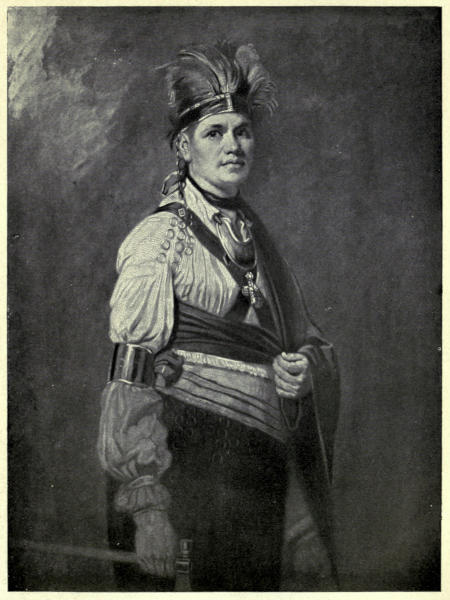
JOSEPH BRANT—THAYENDANEGEA, Born in 1742, Died in 1807.
From the Original Painted from Life in London in 1776.
From “The Old New York Frontier.” Courtesy of Charles Scribner’s Sons.
President Adams, having recommended what is known as the Panama Mission, the speaker remarked that for this he “had been denounced by the aristocratic slave-holders of the South and a few renegades from the cause of freedom and humanity in the North”, and then added the following words on slavery and disunion, subjects which even then had become portentous to men’s minds:
“These men style themselves patriots and republicans. Yet we have been told by the mouth of this faction (I mean the beardless man of Roanoke)[31] that our Constitution is a falsehood; that it carries a lie upon the face of it in asserting that men are born free and equal. Our legislative halls have been polluted by hints at the dissolution of the Union. May that tongue cleave to the roof of the mouth that dares to utter such a treacherous sentence, and may that arm be paralyzed that shall be raised to carry the unrighteous threat into execution.”
In concluding, a few words were addressed by the speaker “to the surviving patriots of the Revolution who this day honor us with their presence”:
“Ye war-worn remnant of that patriotic band who were the stay and defense of your country in the hour of danger, what cause have we not to venerate those silver locks, bleached in the service of your country, those war-worn features the consequence of many a painful campaign, and those scars received in defense of American liberty? They are the emblems of merit and the true badges of honor, serving as marks of distinction by which we are enabled to point you out from among your less fortunate citizens. They are far more honorable than those toys of knighthood so eagerly sought after by the sycophants of monarchical power.
“Long will your country respect that valor which shielded her liberty from the attacks of an infuriated foe. May your country still reward you for those services performed a half century ago. Although the liberal intentions of our chief magistrate have been frustrated toward you for the present by the illiberality of a faction, yet I trust that the day is not far distant when you will acknowledge that republics are not always ungrateful. May the evening of your days be as happy and serene as its meridian was glorious and honorable. Although time has greatly thinned your ranks and each succeeding year makes your number less, your fame will be as durable as the everlasting hills of your own dear country.”
XIII. VILLAGE LIFE SEVENTY YEARS AGO. 1830-1833.
A newspaper as already shown, was first established here about sixty years ago.[32] For a period earlier than that, no better light could be shed on social and business life than is found in an old journal kept by Henry C. Noble from November 1830 to January 1833, now in the possession of Mr. Noble’s nephew, Dr. Frederick S. Howard of New York. When he began this journal, Henry Noble was twenty-one years old, serving as a clerk in the store of his father and Isaac Hayes. In company with Frederick T. Hayes, his cousin, he afterwards began business for himself in the old Noble and Hayes store, but died of fever in May 1833.
That he was a young man of much promise this journal alone would show. Any one may see that who reads the subjoined passages. While writing the journal its pages seem to have been accessible to his companions including his brother George H., and Rufus G. Mead, who occasionally made entries some of which were prompted by refreshing boyishness. Here and there were signs of good literary ability, especially on the part of his brother. The following items are taken from the last six months of 1830:
“Dec. 5. Page and Benton party mustered all hands today and sent them all over town to get signers to have Isaac Hayes (the now postmaster) put out of office and C. D. Fellows appointed in his stead. Do not fear for the result of their labors much; think they mean to effect more at town meeting than at Washington.
“Dec. 8. Employed considerable part of the day in arranging post office concerns. We have a stage from Catskill every night and one from Ithaca every morning; one from Albany and one from Cooperstown weekly. The post office spirit is abroad. Everything that has a sound echoes post office.
“Dec. 20. Cotillion party at night; had Arnold extra music; a very pleasant time. Eat a bowl of oysters and come home.
“Dec. 23. Alarmed about two o’clock this morning by the cry of fire. As Fred sallied out the first thing to attract our attention was a bright blaze flashing at intervals towards the heavens. We hasten to the scene of conflagration which was Mr. J. Bragg’s sawmill and his stone gristmill. Not anything could be done to save them as they were so far gone before discovered. All the village folks assembled to see the destruction that was going on. Much sympathy was shown as Mr. Bragg is one of the most unfortunate men that ever lived in the tide of time. About four years ago his house was burned. I do not think $8,000 would make good his loss that he has suffered for four years past.
“Came home from the fire; went to bed; got up at daylight and in the course of the day all of us fixed for the wedding. Christmas eve and Mary Hayes is to be married to Nathaniel Piersol, in the church before such an audience as always attend on Christmas eve. Miss E. B. Page, H. A. Noble and A. Edson were bridesmaids, and Hen, Fred and George groomsmen. All of us started from Isaac Hayes’s house to the church. We soon found ourselves before the altar and the holy man. The ceremony soon performed and all took a seat in the right hand corner of St. Matthew’s exposed to the wonderment of a thousand eyes. Came home and had a merry time.
“Dec. 27. It is supposed Mr. Bragg’s mills were set on fire—by whom none knows.
“Dec. 28. Mr. Bragg is getting out timber to repair his sawmill immediately. They have got a subscription to help him; which has been signed very liberally.”
During the first six months of 1831, the record embraces parties, a music school, a stirring town meeting, the finding of a boy lost in the woods and the raising of Joel Bragg’s new sawmill:
“Jan. 3, 1831. Much is said about clearing the dams out of the Susquehanna. They are to have a great meeting down the river.
“Jan. 15. All went to cotillion party in the evening; last one we are to have; eight or ten couples from Franklin, some from Huntsville and Bainbridge; had a very fine company of ladies, say twenty-five, and about thirty gentlemen; had Pyro to play, a blind boy and Arnold; danced until about two o’clock.
“Jan. 28. All went down to Williams’s to music school, the last they have; had some very fine music and all the young folks from the village there; girls and boys and some old women; went from there to Dr. Walker’s and spent the rest of the evening very pleasantly; got home at twelve.
“Feb. 1. Benton’s store down town, folks say, is the centre of business. Let them think, for after a close examination we find we have as many mechanics at the upper side of the schoolhouse as below and more merchants, more lawyers, doctors, etc., and much more taxable property, and take a great many more newspapers by one-third.
“Feb. 4. We did but little business in the store except we sold a bill of drygoods to T. Allen to amount of $230.
“Feb. 19. Bragg raised his sawmill this afternoon.
“Feb. 27. Caucus meeting at Williams’s; all met and up-street and down-street could not agree upon the mode of making nominations. Therefore, they quit and came up to Bragg’s and nominated Curtis Noble supervisor and David Walker for town clerk. Down-street folks held up John Eells for supervisor, H. Griswold town clerk, etc., and anti-Masons held a meeting at Maxwell’s and nominated David Hough for supervisor and D. Walker for town clerk. S—— kept open doors all day; kept a bottle of whiskey in readiness and free for all who wished to drink, but, by the bye, must vote as he wants to have them.
“March 2. Town meeting day and three parties. S—— store turned into a grog shop and all the poorest shacks in town voted his ticket and got drunk on his whiskey. Eells got 130 votes, C. Noble 108, Hough 80, a close run; took a vote to move the town meeting up to Bragg’s and tied; tied again to move to Betts’s, and lost by fifteen votes; therefore it must be at J. Williams’s again.
“March 27. Some of the Clipknockey[33] Dutchmen ran against the free bridge.
“May 18. S. Pooler had a boy of twelve years old lost in the woods near Judson’s mill[34] on Thursday, and all the people for five or ten miles about turned out to look for him, say about 500 men each day, until Sunday all went out and the number was estimated at more than 1,000. They formed companies and each company formed a line and scoured the woods until about two o’clock P. M., when they found him. Then they all rushed to Pooler’s house (and it was a splendid sight), to hear the horns, guns and the hallooing and the multitude altogether produced a scene seldom witnessed anywhere. A joyous smile seemed to light up every countenance. The boy was out three nights and four days. He was able to run about and to all appearances would have lived a month longer.”
A celebration of the Fourth of July, a mad dog scare, the Catskill and Erie railroad,[35] Dr. Walker’s new store, Thanksgiving Day, and the marriage of the Rev. Norman H. Adams are topics touched upon in the ensuing six months:
“July 4. Called very early in the morning; boys firing an old gun; heard the thirteen guns fired down at Williams’s from a three-pounder; worked very hard in the store until ten o’clock; then went down to Williams’s orchard and heard a very good oration from Samuel Gordon, Esquire; marched over to the tavern and sat down to a good dinner; paid four shillings for it; gave one shilling to sit at the wine table. Commodore M. T. Woolsey presided; Captain Thatcher commanded the gun and thirteen regular toasts were drunk, accompanied by the hurrahs of the people and the thunders of the cannon.
“Came home about four o’clock, opened the store and stayed here until about eight o’clock, and then started for Bragg’s where the Bachelors of Unadilla had assembled and all the girls in the village and some from Huntsville and Walton, etc., and together with the officers of the day occupied the whole house; the company a large one and very select. About eleven o’clock the doors to the dinner table were thrown open and all turned in and everyone helped him or herself to whatever they wished. The rooms were handsomely decorated and the tables were furnished with all the luxuries the land produced—berries, cakes, wine, etc. Each and all ate what they wanted, then went down below and promenaded from room to room until they were satisfied, all following the dictates of their own feelings. At a seasonable hour retired each to his respective homes in the best spirits possible. Thus we celebrated the Fourth of July, and it was said by all to be the happiest day Unadilla had to boast of.
“July 16. Some droviers here to buy cattle. George added up accounts of sales to-day and found the month of June $1,900. Store full of hired hands to get their pay for harvesting.
“July 24. In the evening all the girls and boys went to take a walk, say a company of seventeen assorted; went up to the bridge and down to Williams’s corner and home. We have now in our village E. A. Ogden, R. H. Martin, C. C. Noble, three young men, two of whom, Noble and Martin, have just been admitted to the bar and Ogden is a graduate of West Point.
“July 30. Charles[36] started with Piersol for Owego to look at the place and see about going there to settle down. George and all the commissioned officers gone over to Butternuts to officers’ election; returned at night; made A. D. Williams lieutenant-colonel.
“Aug. 30. Great cry about mad dogs. Every person that ventures out in the evening now carries a large cane to kill mad dogs with.
“Sept. 1. Pooler and I went on the island and fixed the race course, three-fourths of a mile long.
“Oct. 13. Horse-racing people collecting from all parts of the country to see the sport; race course on the island. About four o’clock the horses trotted, and Pooler’s mare by beating the two first heats took the money without running the third. At night, Fred and myself took the stage for Catskill; from there we went to Albany and looked about the city; went up to the railroad to see the cars (steam) come in from Schenectady and go out.[37] Started for New York on Sunday morning. Nothing new or old that is worth recording happened until Saturday morning when we started for Connecticut in the steamboat. New Milford is a dull old town and a very rich one. Some fine girls and many old folks.
“Oct. 28. Norman H. Adams came home with his wife; had been out to Rensselaerville and got married.
“Oct. 30. Have been to church all day. Adams preached and his wife was at church exposed to the gaze of a large congregation that wished to satisfy their curiosity to see the priest’s wife.
“Nov. 16. Dr. Walker has opened a store one door west of the church. Warsaw is in the hands of the Russians, but the Poles still fight like heroes. England is agitating her Reform Bill and France, unhappy France, is losing what she gained in the ever-memorable days of July, 1830.
“Nov. 30. People talk about a railroad coming down the river from about ten miles below Cooperstown and from there to Catskill. When such a project shall be carried into effect, then I think our part of the country will flourish again, for it is the only thing that will shake off the curse that was put upon us by the construction of the Erie Canal.
“Dec. 4. Talk about having a dance to-morrow night at Williams’s, but can get but few ladies to agree to go. Many of them have a kind of religious scruple about the matter: think it is wicked, but dare not say so for fear of being thought foolish.
“Dec. 8. This day is Thanksgiving, but people hardly know it; they read so little of newspapers and think so little of the day. Nothing is done to distinguish it from any other day. In earlier times it used to be set apart for eating pumpkin pies, pudding and molasses. Shocking degeneracy. The usages of olden times have given place to cranberry tarts, mince and apple pastry.
“Dec. 9. We held a meeting a few days since to appoint delegates to Owego, the object of which is to take into consideration the contemplated railroad from Catskill to Lake Erie, and at the same meeting agreed to apply for a charter for a toll bridge where the free bridge now is.
“The cold water folks are as active now as any we have. They are making great efforts to reform the whole community and say the time is not far distant when drinking ardent spirits will be completely done away with.
“Came home, got horse and went down to Foster’s with Mead and Colwell; got supper for ourselves and a bit of hot toddy, and came home about twelve o’clock.”
Below is an interesting collection of entries ranging from a remarkable freshet and rafting time to the raising of Mr. Adams’s new house; from the marriage of men who were afterwards well known citizens to the cholera in New York, and from oyster suppers at Foster’s tavern to the departure of Samuel North for New York where he had obtained employment in Pearl Street:
“1832. Jan. 16. News, news, news, news! This day William J. Thompson, a bachelor, was married to Miss Eliza Betts in the morning and a good many of us village folks went up to bear witness.
“Jan. 19. Benton’s free bridge went off with the ice last night. The ice went out of the river here to-day. It came down from above and dammed up before the store so much that it stopped and turned the water onto the island, which in a few minutes was almost all flooded, but after a few hours the water forced a way through. It was a splendid sight to see the rolling and tumbling, cracking and breaking up of the ice (say sixteen inches thick) and to see the anxiety of the multitude that lined the bank gazing with a pleasure approaching terror to see the operation of such tremendous powers. It left the island covered with large cakes.
“Jan. 22. Cone has been down to the Unadilla river and says the bridge has gone; also the Sidney bridge has turned up about a foot and must go off with the ice; but few bridges stand the ice freshet this winter. It is the hardest we have had this twelve years, so say all.
“March 13. The island is almost all flooded. George and myself went onto it in the boat and sailed all over from head to foot. Crooker’s part is almost wholly flooded. Up at Boalt’s the road is drowned out, so much so that no one can pass, and the Sidney bridge went off last Sunday. Almost all our communications with the other villages are cut off.
“March 17. The vestry have voted Mr. Adams one hundred dollars and have raised one hundred more by subscription to assist him in building a house on the Martin farm which he has bought for $1,500. God prosper him.
“As a bachelor and a member of the club, I feel it a duty to note particularly all the marriages that take place, whereby our society is affected. Therefore, the case of Levi Bennett Woodruff must be commented upon. The bachelors have given him a discharge. Woodruff, in short, is a fine fellow of uncommon attainments, rather interesting than otherwise, in his manners good-natured and good-looking. His wife (Silva Eldridge) I do not know much about, although I have long been acquainted with her; but think she is of good disposition and possessed of generous feelings.
“April 5. Heard from George today by some raftsmen that have been down to Philadelphia and sold their lumber and returned. The best brought $23. Mr. Wright was buried today.
“April 15. All the young ladies in this end of the street are getting to be religious. Three or four of them ‘obtaining a hope’ as it is called (where one is convinced of her duty towards God and the light of the everlasting gospel works upon her).
“May 6. Wednesday Samuel North left Watson and Williams and has gone to New York. Samuel was a good fellow and well liked and one and all expressed a regret to lose him.
“May 30. Samuel North was over from Walton and returned on Tuesday. He has been since he was here to New York and obtained a situation in Pearl Street with O. O. Halsted and Company—very good place indeed.
“June 5. Watson is building a new house, almost opposite his store; also Adams is pulling down the old Martin house and is to build a new one this summer.
“June 17. Concert on Thursday evening last at W. H. Scott’s[38] where he had assembled all the finest girls in the neighboring towns as well as of this. He had three pianos and the young ladies played in succession from the youngest to the oldest. The room was crowded with the most respectable audience I ever beheld in this place upon any occasion of the kind.
“June 21. The Indians in the Northwest Territory have declared war against the United States. My old friend E. A. Ogden is with the United States troops in the enemy’s country.”
The building of the brick store, protracted meetings at Esquire Eells’s and a visit from Bishop Onderdonk are chronicled during the next half year:
“July 10. Went in the afternoon to help raise the Adams house. Samuel North returned home. He left the city on account of the cholera which rages hard in New York; 100 to 150 cases a day.
“Who talks about anything else but the cholera: it is prayed and preached and sung and laughed about. The city of New York vomits out its inhabitants by thousands daily as if it had itself got the cholera and was throwing the disturbed contents of its prodigious stomach over the whole country. The steamboats puff and the coaches groan under their heavy loads. When the stage driver winds his melodious horn as he comes round the hill all the good old ladies and some of the men run to the door to see if the cholera is coming.[39]
“July 22. Bishop Onderdonk here and preached two sermons, and in the forenoon confirmed about thirty-five of the young people, principally young ladies. Bishop Onderdonk is good sized and well proportioned (two hundred and thirty pounds) for a man; performs his duty in a very impressive and solemn manner, and supposing none equal to Bishop Hobart we were happily disappointed.
“July 28. Cholera meeting at Williams’s tonight.
“August 26. Cholera still continues to rage in New York, Albany, Rochester and Syracuse. Dr. Colwell gone to New York, sent by the inhabitants of this village.
1833. “Jan. 6. On the evening of January 1st, the good people of the village had what is called a donation party at the Rev. Mr. Adams’s, at which was a very large and respectable company assembled, and together with the fine supper and very good address by Mr. Adams made the evening very pleasant. Donation amounted to about sixty dollars and the effect produced was very good.”
Under later dates are many entries in the journal in another hand, the hand of Henry Noble’s friend Frederick T. Hayes, who seems to have been his most intimate and constant friend. Some of these passages were written years afterwards in New York city; others here in Unadilla. Following are a few of them:
“Henry C. Noble died in Unadilla the 15th of May, 1833, at twenty minutes before seven o’clock.
“1843. August 6. Looking over this old journal and much disposed to feel melancholy. Had he lived, today would have been his birthday. I even now feel the pang of the separation. Time has been multiplied but has not lessened my friendship. I can even now shed a tear. I can say no more.
“George H. Noble died in Unadilla 26th July, 1847.
“1853. August 30. Henry A. Ogden died this day at 6 A. M.
“1868. Tuesday, May 19. Obituary of Dr. John Colwell in the Unadilla Times. He died on the morning of the 13th at the house of Dr. Joseph Sweet, full of honors and full of years. Thus are those whose names are written in this book passing away from off the earth.
“1870. January 6. While over to Hudson City yesterday, Carrington I. Hayes told me Mr. Joel Bragg of Unadilla died last Monday.”
Mr. Hayes survived until 1894, when he died in Montclair, New Jersey, and as already stated, his body was brought to Unadilla for burial. Opposite the house in which he was born, has since been erected as a memorial a large and beautiful seat cut from granite. Standing there in a small park-like enclosure, overlooking the Susquehanna, it may well testify to the fondness Mr. Hayes always had for the village on whose soil he was born, and in whose soil he sleeps.
And so have passed away these pioneers—they and many of their descendants. A kind of desolation has indeed overspread this beautiful land, in the midst of which, even in broad noonday, one seems to hear “the footsteps of bygone generations passing up the village street.”