Volume 52 — EVENTS IN FILIPINAS, 1841–1872
Reading edition
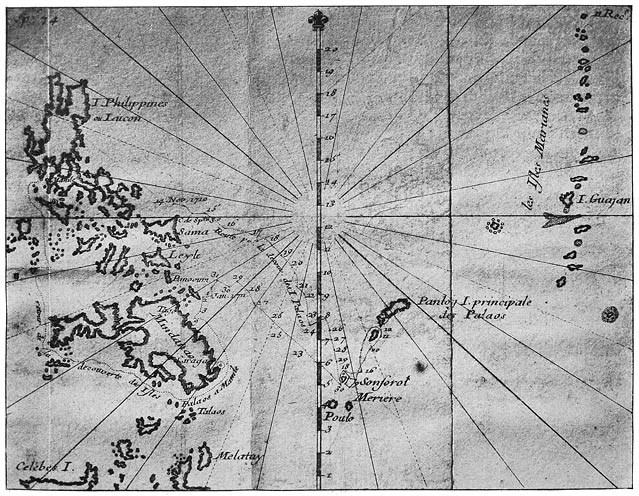
Map of the Philippine and Mariana Islands; from Lettres édifiantes (Paris, M. DCC. XV)
[From copy in Library of Harvard University]
Conditions in Spain were to a certain extent reflected in the islands. Confusion and uncertainty in the Peninsula had their counterpart in the colony. The administrational experiments of the Madrid officials extended to the government of the colonies, and there were many changes which vitally affected the Philippines. Some of the new laws were good; others show a greater or less ignorance regarding the islands. Throughout, however, the prevailing tone is one of greater liberalism.
To be classed under foreign politics of the period were the laws regulating foreign commerce; the slight contact with the Dutch who appeared to be making overtures for a settlement in the Southern Islands; some negotiations with the celebrated Rajah Brooke; and the campaign of Cochinchina, in which the Spaniards aided the French.
Local politics show great activity. Provincial limits were changed and fixed, and new provinces were created. Special subordinate governments were created for the Visayan Islands and for the Marianas. Police regulations were made, and bodies of police created. There were city improvements in Manila. Reforms were instituted in the various provinces in regard to the alcaldes-mayor. Various departments of the government were also reorganized. In 1867–68 new regulations were adopted for the management of the Audiencia of Manila.
In nothing is the upward trend more strongly marked than in economic lines. The measures passed were often groping, it is true, but yet on the whole looked toward the greater light. There was an attempt to exploit the coal mines of the islands, and mining regulations were made. Agriculture received attention (see post, appendix on agriculture). Commerce was given greater concessions, and the customs duties were revised. Provincial chiefs were forbidden to engage in trade. Various acts of legislation regarding monetary conditions, the establishment of a mint, and the coinage of special money for the Philippines attest the greater commercial activity. There was considerable legislation in regard to tobacco. The many laws regarding the Chinese have a purely economic basis. Topographical maps which were ordered made and the new roads ordered constructed indicate a desire to know the country and its conditions better. Exhibits of Philippine products were made at the world’s fair in London in 1851 and 1862. Telegraphic regulations were made in 1869.
For religious and educational influences of this period see the religious appendix in our VOL. XXVIII, and the educational appendices in VOLS. XLV and XLVI. An important order of January 15, 1849, forbade the religious orders to alienate their property. A decree of June 20, 1849 gave the Recollects charge of the island of Negros, and they did considerable work there and developed the island somewhat, although they but built on previous efforts, and did not accomplish as much as has been claimed. The reëstablished Society of Jesus was given control of the mission work of Mindanao in 1861. The suppression of the house of St. John of God in Manila and the establishment of the Sisters of Charity were asked from the pope in 1852, at the time of the reëstablishment of the Jesuits. The conciliar seminaries were given into charge of the Fathers of St. Vincent de Paul on their establishment in the islands. The Franciscans were allowed to maintain a college in Spain for the training of missionaries for the Philippines.
The history of the development of the people during this period has been greatly neglected. There was a decided advance educationally and politically, as well as a growing discontent, that were due to a complexity of factors, among which were the easier communication with Spain, the greater number of Spaniards in the islands, and the spread of books and papers through the capital and provinces. On the side of the government there were expeditions into the north country against the Igorots and other tribes. In the south there were almost continual campaigns against the Moros, over whom some important victories were obtained. The usual decrees ordering good treatment of the natives were issued, with as little effect as of old. The liberal policy that the government was inclined to adopt toward the natives is evidenced by the efforts made to secure educational laws, and by the regulations of 1863. By an order of October 31, 1844, a casino was opened for the natives in Manila. Another order prohibited the smoking of opium by Chinese and natives. Discontent in the native body is seen in the revolts of native soldiers and police. It was forbidden to carry arms without a license. The lottery established in 1850 had a bad influence. The vaccination board established at Manila and the leper hospital established in 1850 at Cebú, were on the other hand good measures, but were not welcomed so heartily as the lottery. The surreptitious introduction and circulation of books and plays caused the government in 1854 to attempt to regulate the book trade. Government pawnshops were opened in 1860 in Manila. Pensions were granted to the parents of those natives who were killed in the service of the country. The earthquake of 1863 proved especially disastrous, and the cholera epidemic of the same year, while not so severe as that of 1820, decimated the people considerably. The Moret decrees (see VOL. XLV, pp. 163–165) were distinctly in favor of the natives, but were never carried out. The discontent ever grew more pronounced, and at last broke out actively in the Cavite rebellion, which was instigated and promoted by the secular clergy and others. There has been no attempt to do more than point out general tendencies during this period, and to note some of the most important matters. For a good working bibliography, which will be found to cover this period see Mr. LeRoy’s article The Philippines, 1860–1898—Some comment and bibliographical notes, which immediately precedes the present document.