Volume 51 / Part 1 — PART I
Reading edition
THE PHILLIPPINES
Of the numerous groupes of islands which constitute the maritime division of Asia, the Phillippines, in situation, riches, fertility, and salubrity, are equal or superior to any. Nature has here revelled in all that poets or painters have thought or dreamt of unbounded luxuriance of Asiatic scenery. The lofty chains of mountains—the rich and extensive slopes which form their bases—the ever-varying change of forest and savannah—of rivers and lakes—the yet blazing volcanoes in the midst of forests, coeval perhaps with their first eruption—all stamp her work with the mighty emblems of her creative and destroying powers. Java alone can compete with them in fertility; but in riches, extent, situation, and political importance, it is far inferior.
Their position, whether in a political or commercial point of view, is strikingly advantageous. With India and the Malay Archipelago on the west and south, the islands of the fertile Pacific and the rising empires of the new world on the east, the vast market of China at their doors, their insular position and numerous rivers affording a facility of communication and defence to every part of them, an active and industrious population, climates of almost all varieties, a soil so fertile in vegetable and mineral productions as almost to exceed credibility; the Phillippine Islands alone, in the hands of an industrious and commercial nation, and with a free and enlightened government, would have become a mighty empire:—they are—a waste!
The population of the Marianas and Calamianes Islands, with that of Palawan, which are all included in “The Kingdom of the Phillippines,” are comprised in this number, but the whole of these does not exceed 19,000.
Of this number about 600 only are European Spaniards, with some few foreigners: the remainder are divided into various classes, of which the principal are, 1st, The Negroes, or aborigines; 2d, the Malays (or Indians, as they are called by the Spaniards); and the Mestizos and Creoles, who are about as 1 to 5 of the Indian population.
These people are small in stature, some of them almost dwarfish, woolly-headed, and thick-lipped, like the negroes of Africa, to whom indeed they bear a striking resemblance, though the different tribes vary much in their stature and general appearance. They subsist entirely on the chase, or on fruits, herbs, roots, or fish when they can approach the coast. They are nearly, and often quite naked, and live in huts formed of the boughs of trees, grass &c., or in the trees themselves, when on an excursion or migration. Their mode of life is wandering and unsettled, seldom remaining long enough in one place to form a village. They sometimes sow a little maize or rice, and wait its ripening, but not longer. These are the habits of the tribes which border on the Spanish settlements. Farther within the mountains they are more settled, and even form villages of considerable size, in the deep vallies by which the chains of mountains are intersected. The entrances to these they fortify with plantations of the thorny bamboo, pickets of the same, set strongly in the earth and sharpened by fire, ditches and pit-falls; in short all the means of defence in their power are employed to render these places inaccessible. Here they cultivate corn, rice, and tobacco; the last they sell to Indians, who smuggle it into the towns. This being a contraband article, as it is monopolized by government, the defences are used against the Spanish revenue officers and troops, who on this account never fail to destroy their establishments when they can do so, though many are impregnable to any force they can bring against them, from the nature of the passes, and from the activity of the negroes, who use their bows with wonderful expertness. There are indeed instances of their repulsing bodies of one or two hundred native troops, but affairs of this magnitude are very rare.
The government have many missions established for the purpose of converting them, but with little success. Like most savages, their mode of life has to them charms superior to civilization, or rather to Christianity (for here the terms are not synonimous); and they rarely remain, should they even consent to be baptized, but on the first caprice, or exaction of tribute, which immediately takes place, and sometimes even precedes this ceremony, return again to their mountains.
They are not represented as very mischievous; but if strangers venture too far into their woods, they consider it an aggression, and repel it accordingly with their arrows. Those who frequent the Spanish settlements are rather of a mild character; and there are instances of Spanish vessels being wrecked on the coast, whose people, particularly the Europeans, have been treated by them in the kindest manner, and carefully conducted to the nearest settlement.
The character of the different tribes appears, however, to vary in this particular: some are described as treacherous and cruel, and those which inhabit the north western coasts of the Bay of Manila are accused of having frequently attacked the boats of ships, when these were not sufficiently guarded in their intercourse with them. The natives of the town in the Bay of Mariveles, at the entrance of that of Manila, assured the writer of these pages, that it would be madness to attempt accompanying them into the woods, even in disguise; and in this they persisted, though money was offered them to allow him to proceed with them.
The Indians are the descendants of the various Malay tribes which appear to have emigrated to this country at different times, and from different parts of Borneo and Celebes. Their languages, though all derived from one stock (the Malay), has a number of dialects differing very materially; so much so, that those from different provinces frequently do not understand each other.
The Indian of the Phillippine Islands has been strangely misrepresented. He is not the being that oppression, bigotry, and indolence, have for 300 years endeavoured to make him, or he is so only when he has no other resource. Necessity, and the force of example have made those of Manila, what the whole are generally characterized as—traitors, idlers, and thieves.
Such a system, incredible as it may appear, has been proposed to a Spanish cortes; and still more wonderful, plans like these excited no reprobation in Manila. Such were Spanish ideas of governing Indians! Justice would almost tempt us to wish that this scheme had been carried into execution, and that the Indian had risen and dashed his chains on the heads of the authors of such an infernal project. And yet the Indian is marked out as little better than a brute; so many of them are, but to the system of government, and not to the Indian, is the fault to be ascribed.
The cause, then, of their little progress is “because there is no security for property;” or in other words, the smallness of the salaries of the officers of justice, as well as of other members of government, and the profligacy inseparable from all despotic governments, have laid the inhabitants under that curse of all societies, venal courts of justice. Does an unfortunate Indian scrape together a few dollars to buy a buffalo, in which consists their whole riches? Woe to him if it is known; and if his house is in a lonely situation—he is infallibly robbed. Does he complain, and is the robber caught? In three months he is let loose again (perhaps with some trifling punishment), to take vengeance on his accuser, and renew his depredations.
Does the Indian, in spite of all this, escape, and by patient industry make a little way in the world? he is vexed with offices; he is chosen Alguazil, Lieutenant, and Captain of his town; to these offices no pay is attached, they always occasion expenses and create him enemies; he is pinched or cheated by the Mestizos, a forestalling, avaricious, and tyrannical race. Does he suffer in silence? it is a signal for new oppressions: does he complain? a law suit. The Mestizos are all connected, they are rich, and the Indian is poor.
The imperfect mode of trial, both in civil and criminal cases (by written declarations and the decisions of judges alone), lays them open to a thousand frauds; for if the magistrate be supposed incorruptible, his notaries or writers (escribanos and escribientes) are not so; and from their knavery, declarations are often falsified, or one paper is exchanged for another whilst in the act of or before signing them.
To such a degree does this exist, that few Indians, even of those who can read Spanish tolerably, will sign a declaration made before a magistrate without threats, or without having some one on whom they can depend, to assure them they may safely do so. Nor is this to be wondered at, when it is known that declarations on which the life or fortune of an individual may depend are left, often for days, in the power of writers or notaries, any of whom may be bought for a doubloon; and some of them are even the menial servants of the magistrate! This applies to Luzon. In the other islands, this miserable system is yet worse: they have seldom but one communication a year with the capital, to which all causes of any magnitude are sent for decision or confirmation; and, as the papers are often (purposely) drawn up with some informality, the cause, after suffering all the first ordeal of chicane and knavery, experiences a year’s delay before it is even allowed a chance of being exposed to that which awaits it at Manila. Or should the cause be at length carried to the Audiencia, or Supreme Court, and there, as is sometimes the case, be judged impartially, the delay of the decision renders it useless—the sentence is evaded—or treated with contempt! This may appear almost incredible, but known to any person who has resided in Manila.
“And mony jobs that day begun,
Thus they unsettle and disturb the course of their labours by calling off their attention from their domestic cares; and by continually offering occasions of dissipation destroy what little spirit of economy or foresight may exist amongst so rude and ignorant a people. Nor is this all; they are subject to numerous other vexations and impositions under the title of church-services; such are, in some towns, five or six men attendant daily in rotation to bring the sick to the church to confess, or to carry the “Padre” with the host to their houses, and many others; all of which, though in themselves trifles, are more harassing, from their unsettling tendency, than pecuniary imposts. An encouragement to celibacy and its consequent evils is also to be found in the (to them) heavy expenses attendant on all the domestic offices of religion, as matrimony, baptism, &c., as well as in the increase of the poll-tax on married persons, for the whole of which the husband is responsible. The ecclesiastical expenses of a marriage between the poorer classes are about five dollars: the others, as christenings, buryings, &c., in proportion. These appear trifles; but if to these are added the confessions, bulas, [i.e., of the Crusade] and other exactions, it will be seen that these constitute no trifling part of the oppressive and ill managed system which has so much contributed to debase their real character.
I say nothing here of the natural effect of the Roman Catholic religion on an ignorant people, who imagine, that verbal confession and pecuniary atonements (rarely to the injured person) are a salvo for crimes of all magnitudes: that such is the case, is notorious to every one who has visited Catholic countries.
Let us for a moment retrace this picture. To whom after this is it attributable that the Indian is often a vicious and degraded being, particularly in the neighborhood of Manila?
The government of the Phillippine Islands is composed of a governor, who has the title of Captain General, with very extensive powers; a Teniente Rey, or Lieutenant Governor; the Audiencia or Supreme Court, who are also the Council. This tribunal is composed of three judges, the chief of whom has the title of Regent, and two Fiscals or Attorney Generals, the one on the part of the king, the other on that of the natives, and this last has the specious title of “Defensor de los Indios.” The financial affairs are under the direction of an Intendant, who may be called a financial governor. He has the entire control and administration of all matters relative to the revenue, the civil and military auditors and accountants being under him. Commercial affairs are decided by the Consulado, or chamber of commerce, composed of all the principal, and, in Manila, some of the inferior merchants. From this is an appeal to a tribunal “de Alzada” [i.e., of appeal] composed of one judge and two merchants, and from this to the Audiencia, without whose approbation no sentence is valid.
The civic administration is confided to the Ayuntamiento (Courts of Aldermen or Municipality). This body, composed of the two Alcaldes, twelve Regidors (or Aldermen) and a Syndic, enjoy very extensive privileges, approaching those of Houses of Assembly; their powers, however, appear more confined to remonstrances and protests, representations against what they conceive arbitrary or erroneous in government, or recommendations of measures suggested either by themselves or others. They have, in general, well answered the object of their institution as a barrier against the encroachments of government, and as a permanent body for reference in cases where local knowledge was necessary, which last deficiency they well supply.
To him are also subject the Indian Captains and Officers of towns, who are annually elected by the natives. These settle small differences, answer for disturbances in their villages, execute police orders, impose small contributions of money or labour for local objects, such as repairs of roads, &c. &c. They also have the power of inflicting slight punishments on the refractory. To them is also confided the collection of the capitation or poll-tax, which is done by dividing the population of the town or village into tens, each of which has a Cabeça (or head), who is exempt from tribute himself, but answerable for the amount of the ten under him. This tax is then paid to the Alcalde or Corregidor, and from him to the treasury. The Mestizos and Chinese have also their captains and heads, who are equally answerable for the poll-tax.
The different districts and islands, which are called provinces, and are 29 in number, are governed by Alcaldes. The more troublesome ones, or those requiring a military form of government, by military officers, who are also Corregidors. Samboangan on the south west coast of Mindanao, and the Marianas, have governors named from Manila, and these are continued from three to five years in office.
“It is indeed common enough to see the barber or lacquey of a governor, or a common sailor, transformed at once into the Alcalde in chief of a populous province, without any other guide or council than his own boisterous passions.
“Without examining the inconvenience which may arise from their ignorance, it is yet more lamentable to observe the consequences of their rapacious avarice, which government tacitly allows them to indulge, under the specious title of permissions to trade (indultos).
——“and these are such that it may be asserted, that the evil which the Indian feels most severely is derived from the very source which was originally intended for his assistance and protection, that is, from the Alcaldes of the provinces, who, generally speaking, are the determined enemies and the real oppressors of their industry.
“It is a well known fact, that far from promoting the felicity of the provinces to which he is appointed, the Alcalde is exclusively occupied with advancing his private fortune, without being very scrupulous as to the means he employs to do so: hardly is he in office than he declares himself the principal consumer, buyer, and exporter of every production of the province. In all his enterprises he requires the forced assistance of his subjects, and if he condescends to pay them, it is at least only at the price paid for the royal works. These miserable beings carry their produce and manufactures to him, who directly or indirectly has fixed an arbitrary price for them. To offer that price is to prohibit any other from being offered—to insinuate is to command—the Indian dares not hesitate—he must please the Alcalde, or submit to his persecution: and thus, free from all rivalry in his trade, being the only Spaniard in the province, the Alcalde gives the law without fear or even risk, that a denunciation of his tyranny should reach the seat of government.
“To enable us to form a more correct idea of these iniquitous proceedings, let us lift a little of the veil with which they are covered, and examine a little their method of collecting the ‘tributo’ (poll-tax).
“The government, desirous of conciliating the interests of the natives with that of the revenue, has in many instances commuted the payment of the poll-tax into a contribution in produce or manufactures: a year of scarcity arrives, and this contribution, being then of much higher value than the amount of the tax, and consequently the payment in produce a loss, and even occasioning a serious want in their families, they implore the Alcalde to make a representation to government that they may be allowed to pay the tribute for that year in money. This is exactly one of those opportunities, when, founding his profits on the misery of his people, the Alcalde can in the most unjust manner abuse the power confided to him. He pays no attention to their representations. He is the zealous collector of the royal revenues;—he issues proclamations and edicts, and these are followed by his armed satellites, who seize on the harvests, exacting inexorably the tribute, until nothing more is to be obtained. Having thus made himself master of the miserable subsistence of his subjects, he changes his tone on a sudden—he is the humble suppliant to government in behalf of the unfortunate Indians, whose wants he describes in the most pathetic terms, urging the impossibility of their paying the tribute in produce—no difficulty is experienced in procuring permission for it to be paid in money—to save appearance, a small portion of it is collected in cash, and the whole amount paid by him into the treasury, while he resells at an enormous profit, the whole of the produce (generally rice) which has been before collected!” Comyn, p. 134 to 138.
While treating of the government of the Phillippines, we must not forget the ministers of their religion, and the share which they have in preserving these islands as dominions to the crown of Spain. This influence dates from the earliest epoch of their discovery. The followers of Cortes and Pizarro, with their successors, were employed in enriching themselves in the new world; and the spirit of conquest and discovery having found wherewith to satiate the brutal avarice by which it was directed, abandoned these islands to the pious efforts of the missionaries by whom, rather than by force of arms, they were in a great measure subdued; and even in the present day, they still preserve so great an influence, that the Phillippines may be almost said to exist under a theocracy approaching to that of the Jesuits in Paraguay.
The ecclesiastical administration is composed of an Archbishop (of Manila), who has three suffragans, Ylocos, Camarines, and Zebu; the first two on Luzon, the last on the island of the same name. The revenue of the Archbishop is 4000, and that of the bishops 3000 dollars annually. The regular Spanish clergy of all orders are about 250, the major part of which are distributed in various convents in the different islands, though their principal seats are in that of Luzon; and many of them, from age or infirmity, are confined to their convents in Manila.
It is painful, however, to remark, that much that might have been done, has been left undone. The exclusive spirit of the Roman church, which confines its knowledge to its priests, is but too visible even here: they appear to be more anxious to make Christians, than citizens, and by neglecting this last part of their duty, have but very indifferently fulfilled the first,—the too common error of proselytists of all denominations, which has probably its source in that vanity of human nature, which is as insatiable beneath the cowl as under any garb it has yet assumed.
Some of them too have furnished a striking but melancholy proof of the eloquent moral,
“It is not good for man to be alone.”
The next and lowest order of ecclesiastics are the Indian clergy (clerigos); they are in number from 800 to 1000, and though from the want of Spaniards, the administration of many large districts and towns is confided to them, they are as a body far from being worthy of such an important charge. The majority of them are ignorant to the last degree, proud, debauched, and indolent: in a word, they unite the vices of the priesthood to those of the Indian, and form a class of men who may almost be said to be distinguished by their vices only.
This arises from various causes, of which the principal appears to be that of their being entirely excluded from the higher ecclesiastical situations. This alone, by depriving them of the most powerful stimulus to correct conduct, together with the very confined education they receive, and the impassable line drawn between them and the Spanish clergy, whom they are never allowed to approach, and who treat them with much contempt, are sufficient to account, in a great measure, for their apparent demerit. The fact, however, is such, whatever be its cause; and seldom a week passes, or at most a month, but some of them are brought before the ecclesiastical tribunals, under accusations but little creditable to their cloth.
Their ordinary resort at Manila is the cockpit or the gaming table, where they shew an avidity and keenness which are disgraceful and shameless to the last degree. Yet to the guidance of beings like these is the unfortunate Indian in a great measure abandoned, even in his last moments: for from the very great proportion of these to the Spanish priests, and from the recluse lives of the latter, nearly nine-tenths of all the clerical duties are performed by the Indian clerigos, such as I have described them. The few who do form an exception, are men whose conduct is highly creditable to themselves, and more striking from its unfrequent occurrence.
Such are the civil and ecclesiastical government of the Phillippines. We turn now to the Revenue and Expenditure, Military establishments, &c.
Until very lately these rich islands have been a constant burden to the crown of Spain, money having been annually sent from Mexico to supply their expenses. The establishment of the monopoly of tobacco has principally contributed to supply this deficiency. It was established by an active and intelligent governor (Vasco) about 1745 [sc., 1785] and still continues to be the principal revenue of the country; and large sums have been from time to time sent home to Spain, as a balance against those received from Mexico. The sales of this article amount more or less to a million of dollars per annum. The extensive establishment which is kept up to prevent smuggling, and the expenses of purchase and manufacture, reduce its net produce to 500,000 dollars per annum. The plant is cultivated in the districts of Gapan in Pampanga, in a part of the province of Cagayan, and in the island Marinduque to the south of Luzon. It is delivered in by the cultivators at fixed prices, and sent to Manila, where it is manufactured in a large range of buildings dedicated to that purpose, and retailed to the public at about 18 to 19½ dollars per arroba of 25 lbs. (Spanish), the prices varying a little according to the harvests.
The administration, inspection, and manufacture of this article, employ several thousand persons of both sexes (the manufacturing process being almost wholly carried on by women). This is not only the most productive, but the best conducted branch of the revenue; while it is at the same time the least vexatious in its operations, though not exempt from those objections which are common to all government monopolies.
The poll-tax (tributo) is the other great branch of the revenue; the manner of collecting it is described in p. 29. Its amount to each individual is, with some exceptions and variations in different provinces, 14 rials, or 1¾ dollars for every married Indian, from the age of 24 to 60. The Mestizos pay 24 rials or 3 dollars, and the Chinese 6 dollars each: this last branch is generally farmed. The amount of Indian and Mestizo tribute may be stated in round numbers at 800,000 dollars: the expense of collecting it diminishes it to about 640,000. The exemptions from it are disbanded soldiers, who pay less than others, men above 60 years of age, and the cultivators of tobacco, or makers of wine for the royal monopolies.
The expenses of administration are as follows. The civil and ecclesiastical officers of government, 250,000 dollars. The military, including all classes, about 600,000; and the marine, about 550,000.
The excess of revenue over the expenditure is stated by Comyn to have been in 1809 about 450,000 dollars, but in this is included 250,000 received from Mexico.
In 1817, by an account published by order of the Ayuntamiento of Manila, the amount of the revenue was—
of which a surplus would remain when all the expenses were liquidated. In preceding years, some surplus has been remitted to Spain.
The military establishment consists of three regiments of infantry, one of dragoons, a squadron of hussars, and a battalion of artillery, in all about 4500 regulars. The militia are numerous, but only one regiment is under arms: the total of men may be estimated at 5000, but on an emergency, large bodies of irregulars can be called into activity. In 1804, the governor, Don J. M. de Anguilar, [i.e., Aguilar] is said to have had upwards of 20,000 men under arms, being in expectation of an attack from the English.
These troops (which are all natives) are in general badly disciplined and officered, mostly by country-born officers, without the advantage of an European education, ignorant of their military duties to the last degree, many of them (more especially in the Mestizo regiments) connected with the soldiers by relationship, or at least by the tie of mutual indulgence, the soldier performing every menial office for the officer, who in return winks at the excesses of the soldier. This is carried to such an extent, that, not to mention such trifles as a garden wall or gate, a bathing house, or a stable, or at times a little smuggling; there are instances on record, where the commanding officer of a regiment has built himself a country house! the whole of the masonry and carpentry being performed by soldiers of his regiment! Another is of a captain collecting his debts by means of a piquet of infantry; taking possession of his debtor’s house until payment was made!
These remarks apply more particularly to the Mestizo officers. The Spaniards, and some of the creoles, who are but very few in number, form a respectable class of military men, of whom some few may be cited as models of spirit and discipline: but they are not sufficiently numerous for their example to influence the despicable beings with whom they are unavoidably associated; and the wealth and influence being generally on the side of the native-born officers, these abuses are permitted, and the complaints of others disregarded.
It is but just, however, to remark, that their pay is excessively mean; it is a bare, and miserable subsistence; and due weight should be given to this circumstance in extenuation. A captain of regulars has not more than 80 dollars per month! and so on in proportion, and when we reflect, that from the low value of the circulating medium, a dollar will barely command more than a rupee in any part of India, much must be allowed for men so situated.
Hence, though the men, arms, and accoutrements are not bad, the troops are, from abuses, embezzlement, and neglect, miserably deficient in a military point of view, and but poorly calculated to answer any efficient purpose. To this description, the regiment of artillery and Pampango militia are exceptions: the style of equipment and discipline of the first are a high testimony of the activity and military talents of their colonel. The queen’s regiment is by far the most respectable of the infantry.
Their cavalry are badly mounted, the horses being very small, and by no means good. The men too are clumsily equipped, with swords manufactured apparently in the 14th century, being straight, disproportionably long, and furnished with a steel poignet or basket, above which is a cross, resembling the rapiers of that time.
Like the army, the navy is almost entirely officered by creoles and Mestizos, whose pay is but a subsistence, and consequently no prospect is offered to young men of family and enterprise who may have other resources.
The arsenal at Cavite, about 10 miles from Manila, is well provided with officers and workmen, but has no docks. Vessels, however, may heave down with great safety; and the work, though expensive, is remarkably well executed.
The agriculture of this very fertile country is yet in its infancy. Oppressed with so many enemies to his advancement, and placed in a climate where the slightest exertion insures subsistence, the Indian has, like the majority of his Malay brethren, been content with supplying his actual wants, without seeking for luxuries. Hence, and from the expulsion of the Jesuits, they have made no advances beyond the common attainments of the surrounding islanders.
This spirited and indefatigable order of men, who, both by precept and example, encouraged agriculture, not only as the source of national greatness, but as preparatory to, and inseparable from, conversion to Christianity, which they well knew did not consist alone in ceremonies, but in fulfilling the duties of citizens and men, and who, whatever were their political sins, certainly possessed more than any other the talent of converting men from savage to civilized life, have left in the Phillippines some striking monuments of their wide-spreading and well-directed influence. Extensive convents (the ground stories of which were magazines), in the centre of fertile districts formerly in the highest state of cultivation, but now more than half abandoned,—tunnels,—canals,—reservoirs and dams, by which extensive tracts were irrigated for the purposes of cultivation, attest the spirit with which they encouraged this science; and if their expulsion was a political necessity, it certainly appears to have been in this country a moral evil.
The buffalo is universally used in all field labours, for which, however, he is but poorly calculated: the slowness of his pace, and his great suffering from heat, which obliges the labourer to bathe him frequently, occasion a very considerable loss of time, which is scarcely compensated by his great strength and little expense in keeping. Indeed, the bullock should perhaps be on all occasions substituted for him, excepting only in the cultivation of rice fields. In a few districts, this is the case; but it is with reluctance that the native uses him in preference to the buffalo.
Their breed of horses is small, but very hardy: they are never used for agricultural purposes, though but few of the peasants are without one for riding, and many of them have two or three. In the province of Pampanga (the finest tribe of Indians in the Phillippines), they risk considerable sums on races! of which they are very fond.
Their plough is of Chinese origin: it has but one handle, and no coulter or mould-board, the upper part of the share, which is flat, and turned to one side, performing this part of the work. The common harrow is composed of five or six pieces of the stems of the thorny bamboos, which at the lower part are almost solid; these are united by a long peg of the same, passing through all the pieces: to these the hard branches of thorns are left appending, and being cut off at a short distance from the stem, form the teeth of the instrument, which, rude as it is, performs its work well, and usefully, and is seldom out of order.
A hoe, like that of the West Indies, answers the purposes of a spade; and (with the basket) of a shovel. A large knife (the Malay Parang), called “Bolo,” completes the list of their agricultural instruments. Machinery they cannot be said to possess, except a rude mill of two cylinders for cane, and another for grinding their rice, can be called such. The greater part of the rice is beaten from the husk in wooden mortars, and by hand.
The rainy season commences with the S. W. monsoon, and ends in October. The rice (the aquatic sorts) is planted by hand in July and August, and reaped in December. The upland rice, of which they have two varieties, is planted earlier, and comes sooner to maturity. The cane is planted in the manner called “en canon” by the French, that is, the plant piece is stuck diagonally into the ground; and thus, from the roots being often on the surface, the plant suffers frequently from drought, and they have seldom two crops from a piece of cane: their sugar, though clumsily manufactured, is of excellent grain, and highly esteemed by the refiners of Europe.
The indigo plant is very fine; and though, as in all countries, a precarious crop, yet it is far from being so much so as in India: it has been manufactured equal to Guatemala, but in the present day is of a very inferior quality: this arises from various causes, of which the principal are ignorance in the manufacture of it, a want of capital, and spirit of enterprise. They have no tanks of masonry, the whole process being carried on in two wooden vats of a very moderate size, from which the fecula is taken once a week. It is needless to remark, that the quality of the indigo is materially injured by this alone: it is also subject to many adulterations in the hands of the Mestizos, before being brought to market.
The cultivation of cotton is as yet but very partial. It is of the herbaceous species, of a very fine quality, almost equalling the Bourbon, but excessively adherent to the grain: so much so indeed, that none of the attempts to separate it from the seed by machinery have hitherto succeeded; the grains passing through the rollers, and staining the cotton. It is cleared by the natives by means of a hand-mill, very clumsy in its construction, and performing so little work, that the cleaning costs six dollars per pekul.
A quinion of land requires four ploughings and three harrowings, say six ploughings in all.
This supposes the proprietor of the cane to be possessed of a mill, buffaloes, &c. for the wear of which no estimate is made.
The 150 pilones of sugar, each weighing about 150 lbs. gross, will produce the refiner who has purchased them about 100 piculs of sugar, of which
S. Ds.
80 1st sort, worth 6¼ Dollars 500 0
20 2d ditto, and Molasses, &c. 3¾ 75 0
575 0
They have cost him about 487 4
Refiner’s allowance on 100 Pilones, S. Ds. 47 8
The profits of the refiner would appear high; and they have been so; but are far from what this statement appears to give, from various reasons, of which the chief are, the heavy capital sunk in buildings, interest on advances, &c. and from a want of knowledge, the enormous waste of labour in the process. A glance at this may give an idea of what trade is at these antipodes of commercial knowledge.
The sugar being thus clayed, is now to be mixed, pounded, and dried. The last process is performed by laying it on small mats in the sun, on the terraces and pavements of the court-yards. On the slightest appearance of rain, it must be hurried under cover, and brought out again when this is past. So that in a manufacture of any size, when from 3 to 400 Chinese are employed at 4½ dollars per month, fully ⅓d of their labour is expended on this operation alone. The management of the rest requires no comment.
The cost of production of any of the other articles cannot be estimated to any degree of correctness, from the very small scale on which they are cultivated, and the limited knowledge of the writer of these remarks. Those of Comyn are erroneous.
In addition to this he must lay his account with another obstacle, and this none of the smallest—the chance of bad faith on the part of those with whom he is connected; a chance which by no means will diminish in proportion to his success; for, let no foreigner deceive himself on this head in Manila; if he cannot flatter as low, or bribe as high as his adversary, his cause is lost by some means or other.
The Phillippines also produce cacao of an excellent quality, though not sufficient for their consumption, a large quantity being imported from New Spain.
Pepper is also an article of exportation, but in very limited quantities, the utmost the Phillippine Company have been able to procure being about 60,000 lbs. in favourable years.
It is also used in large quantities in washing the earth of rivers and streams, to separate the gold from them. It is not cultivated, but exists in great abundance in the forests, in which are also the sapan-wood (called Sibacao), the sandal, ebony, and vanilla. They abound in gums and resins, large portions of which are washed down by the torrents; but these are for the most part useless, either from the ignorance of the natives, or from the impossibility of venturing far in the interior.
Their timber is excellent, and in a country so covered with forests, of course plentiful; but the want of roads and other conveniences of transport, renders it, in Manila, rather an expensive article.
Their forests are not infested with those ferocious animals which are the terror of those of other Asiatic countries. The tiger, elephant, and rhinoceros are unknown: the wild buffalo and hog are the only ones of which the native has any dread. These attain an enormous size, but are not mischievous, unless provoked. The dried flesh and hides of these animals, as well as of deer and wild cattle, which are in immense numbers, form a considerable article of trade amongst the natives, the “tappa” or dried flesh being used for food, and the hides for exportation.
Of other varieties they have great numbers; some of which, as the “dahun palay,” or leaf of rice, of a deep green and yellow, which frequents the rice fields, and the “mandadalag,” or whip-snake, are excessively venomous: accidents from these animals are not, however, very frequent; from whence it may be concluded, that the superstition of the natives has greatly exaggerated the number of venomous ones: and this may be the more readily inferred, not only from their excessively superstitious character, and the common custom of all nations in this particular; but also from the thousand ridiculous fables told by them of the cameleon, which is very common in the woods, and perfectly harmless. The Indian name for it is “Ynyano.”
Of minerals they have an inexhaustible supply: gold is found in almost all the streams, and even in the sands of the shores of the Bay after blowing weather: no mines of it have as yet been wrought, though they are known to exist. The quantity obtained by the rude efforts of the natives merely washing the sands of the torrents, is very great, and certainly does not fall short of 4 to 500,000 dollars worth annually, as great quantities are expended in gilding for the churches, &c. &c.
Silver is also found, but in small quantities. Virgin copper is another produce of their mountains: pieces of it are frequently met with in the torrents, and on the shores of some of the islands (Masbate, Burias, and Ambil). The negroes have also been seen with rude ornaments, and even with utensils made from it.
Cinnabar, lead, and tin are supposed to exist; but of these last there is no certainty.
Sulphur is found in the neighbourhood of the volcanoes in considerable quantities, and is an article of export to Bengal and other places: the principal part of it is collected on the island of Leyté, which is next to Samar on the south side of the strait of St. Bernardino. It is collected on the edges of numerous small apertures, which emit at times flames and smoke. These are situated in an extensive plain near the sea-coast in the vicinity of the village of Dulag, on the eastern side of the island. With these natural advantages, and those are not few that still remain to be enumerated, the commerce of this country, like its agriculture, is still in its infancy: and this has been principally owing to two great causes—the trade to Acapulco, and the prohibitory system invariably pursued by Spain in regulating the intercourse with her colonies, and which here has been burdened with an additional weight, the monopoly of the Phillippine Company.
It were a task far exceeding the intention and ability of the writer of these remarks to point out the causes and effects of these extensive evils:—a few observations only will be made to elucidate such remarks as may follow on the commerce of Manila.
In the Philippines, this system, though followed for a long time, has been of late years successively relaxed, and the good effects of this modification are visible to the most indifferent observer: it has however left deep traces of its operations, and much is still wanting: the foreign merchant or adventurer, how much soever he may be smiled upon and caressed, has still to contend against a rooted and long cherished jealousy of all that is not Spanish.
The Acapulco trade is another and a principal cause of the very confined state of the commerce of this valuable colony. A few remarks will be sufficient to justify the apparent paradox.
The merchant of Manila (says Comyn), is “entirely different from the merchant of other parts of the world; he has no extensive correspondence, no books, or intricate accounts; his operations are confined to a shipment of bales to Acapulco, and to receiving the silver in return: and in 40 years, only one or two instances have occurred wherein bankrupts have been able to produce a correct set of books to the Consulado (or Chamber of Commerce)!” This description was doubtless correct at the time when it was written (1809); but it is just to observe that they are now much improved, and though not excessively enterprising, are better acquainted with the true principles of commerce. Such were the merchants: let us examine a little the trade.
Coffee, about 400 pekuls, at 28 dollars; Cotton, 1,000, at 20 to 25 dollars; Indigo, 1,000 quintals, at 90 to 110 dollars per quintal; wax, 600 pekuls at 40 to 50 dollars; red wood, &c. &c. in large quantities. In a printed account, the number of foreign vessels for that year (1818) are stated to be, English, 18; American, 10; French, 4; Portuguese, 2; Chinese Junks, 10, and 8 Spanish vessels. The value of imports as follows:
Goods, 2,296,272 dollars
Cash, 758,239
$3,054,511
The imports consist of piece-goods for the Acapulco market, and for home consumption from Bengal; cambrics and handkerchiefs of plaided patterns from Madras; woollens, wines, spirits, silks, printed cottons, hosiery, hardware, &c. from Europe (principally from France); bird’s nests, tortoise and mother-of-pearl shell, bich-de-mar [i.e., balate], wax, dried fish, &c. from Soolo, Borneo, and other islands of the Archipelago; toys, silks, nankeens, teas, and dollars from China; dollars from the United States; and from South America, silver, cochineal, and cacao. Of these articles the specie and cochineal are mostly exported to Bengal and Madras, and the produce of the Soolos and Borneo to China; the other exports have been noticed in a preceding page.
They have but a few manufactures: the principal one is that of coarse gauzes, and rope from the Abaca plant, the first of which has a very extensive consumption and is universally worn by all classes of the natives. It is principally carried on in the province of Camarines, at the S. E. angle of the island.
Considerable quantities of coarse canvas and striped cloths are manufactured from cotton in the province of Ylocos; and in those in the more immediate vicinity of the capital, the striped cloths called “tapis” are universally worn by the native women over their petticoat. None of these articles except the Abaca rope are exported, and probably the whole of the cloths might be imported at a cheaper rate than they are made. The Phillippine Company, by a mistaken policy, expended large sums in endeavoring to render these manufactures articles of export to Spain and the Americas; but after heavy and repeated losses, the attempt was at length abandoned.
I am not certain whether there was not a clause in their charter, obliging them to attempt this; and from the interfering spirit of Spanish legislature throughout the last two centuries, it is more than probable it was so. For the Company must have seen the impropriety of endeavoring to establish manufactures in a country so thinly populated, and where the little security for property or power of enforcing contracts, must have exposed them to a thousand losses unknown in Europe.
An attempt was made in 1817, by a Spanish merchant, to commence something of this sort. He purchased a quantity of Turkey opium from an American, with an understanding that it was to be reshipped, on payment of a small additional duty. It was so, but a quantity of the opium was plundered from the custom-house godowns, and the proprietor was told “that the king was not responsible for losses.”
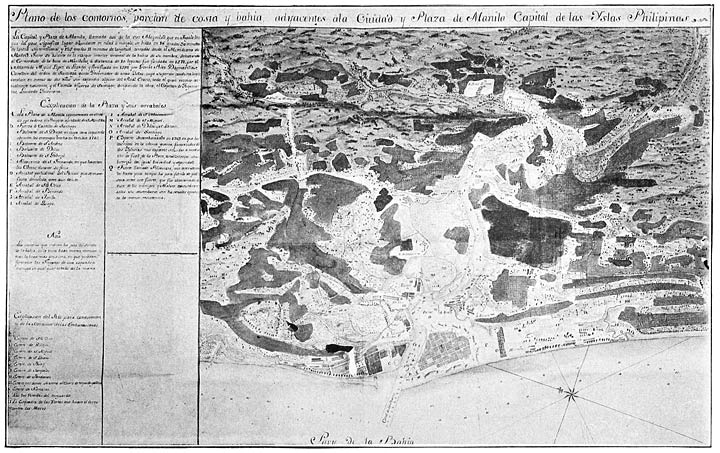
Plan of the environs, and a portion of the coast and bay adjacent to the city of Manila, 1779 (?)
[From original MS. map (in colors), in Archivo general de Indias, Sevilla]