Volume 51 / Part 2 — REFORMS NEEDED IN FILIPINAS
Reading edition
Opinion regarding the causes which antagonize the security and progress of the Filipinas Islands
Most Excellent Sir:
The Filipinas Islands, on account of their great extent, their advantageous location in the center of the commercial world of Asia, their considerable population, and the fertility of their soil—which is capable of yielding all the products which are grown between the two tropics—require from his Majesty’s paternal government a carefully planned system of measures which shall strengthen their peace and internal security, and at the same time advance their agriculture, industry, and commerce to that high degree to which they have been destined by Providence.
As I am charged by order of the king our sovereign to furnish information regarding the measures which can contribute to objects so important, it will be my plan to point out (but with that circumspection which is so necessary in matters of colonial policy and administration) the causes which today are antagonizing both the internal and external security of those islands and their successful administration—civil, economic, and commercial—proposing in regard to each one of these the correctives which have been impressed upon me by my experience as consulting attorney [asesor] and judge in all the public affairs of justice, army and navy, the government, revenues, and commerce; and my own observations under popular revolutions, changes in the system of government, and other vicissitudes and critical positions in which that colony has been seen during the long period of my residence therein.
OF THE CAUSES WHICH ANTAGONIZE THE INTERNAL SECURITY OF THE FILIPINAS ISLANDS, AND OF CORRECTIVES FOR THEM
Of the present composition of the divisions of the army
The army of the Filipinas Islands, in view of the class of men of whom it now consists, offers very little (if any) moral confidence for their resisting the force of the revolutions which may be formed in the very bosom of the islands. It is officered, in great part, by Spaniards of the country, and by some Americans and mestizos; and the disposition, tendencies, and education of the latter class are (with very rare exceptions) absolutely different from those of the other and European officers; consequently, there exists between the two classes, from the outset, a certain insuperable disunion of feeling, between not only individuals but the two classes. The officer who is a native of the country has all the lax characteristics which the climate induces. He lives in exclusive intercourse with his neighbors, and separated from the Europeans. He likes the military career solely for the conveniences connected with his office; he is incapable of a noble emulation, and limits himself in the service to the outside and very inexact fulfilment of the necessary obligations of his position; and when the cause of the legitimate government exacts on his part sacrifices incompatible with his own interests or those of his neighbors, he disowns and absolutely abandons his duties. For these reasons the officers born in that country have never come to merit the confidence of their chiefs; and if from the rank of cadets they have been promoted to that of captain, it has been more from the peremptory necessity of completing the military corps and protecting the service than on account of their fitness, military spirit, or appreciation of the confidence and honor which the king bestows on them. Such sentiments they can never possess until they undergo a rigid training moral and political, in the colleges of España. This mental divergence, and the natural contrariety of their temperaments, so mischievous in the ordinary service of military bodies, are much more lamentable in the crisis of a revolution. The officers of the country, being nearer to the Indian soldiers in their customs and language, make common cause with the latter, and seduce and lead them into their own faction, with a marvelous readiness; this I have repeatedly seen in the mutinies of military bodies which have occurred in the Americas, and especially in that of the troops in the kingdom of Guadalajara in the year ’21, and in that at Manila in the year ’23.
Of the enlargement of the army of the islands
The colonies are governed and maintained more by opinion, justice and example than by force of arms. When opinion in them becomes corrupted up to the point of forming great conspiracies, the offensive action of the army produces no other effect than to hasten the ruin of the legitimate government. [In the Filipinas Islands, the persuasions and example of the ministers of religion, and the measures taken by the civil authorities, have been usually sufficient to put down an uprising; but it is not well to rely too much on military force in such cases, since such action causes rankling resentment and unites the discontented in the common effort to throw off the yoke. It is impossible, in such a climate, to employ only Spaniards in the army, since they cannot endure it, and the expense of such an army would also be too great a burden on the royal treasury.] The army of Filipinas, then, ought not to have a greater force than is sufficient to defend and maintain, in any event, a post or locality that is impregnable, which can serve as a protection and defense to the government, its interests and employees, and the families of Spanish blood. A center of strength, ordered and disciplined, of this sort (the locality of which I will mention later), will be inaccessible not only to three millions of inhabitants who now people the islands, but to thirty millions who might inhabit them; and this idea alone in the mind of the Filipino Indian is the most efficacious for disconcerting, in its origin or progress, any plan for conspiring or taking by surprise. [In such a point of vantage, the government can use measures of policy,] which in revolutions are more effective than arms for reëstablishing order, without leaving in the minds of the people, as war does, deep feelings of resentment at being repressed; and the partial revolutions in the provinces will be always broken—as thus far have been those of Ilocos, Cebú, Bataan, and others—by the zeal and sagacity of the European religious and coöperation of the civil employees of the king. In such a crisis, the principle is, to disunite sagaciously the opinions and feelings of the people; and repression by force only unites them. [If the military forces, the forts, and the navy be augmented, the only results will be to demoralize the army, make unnecessary display of the government’s power, teach the Indians the art of war (which as few of them as possible ought to know), and impose unendurable burdens on the treasury. Plans of this sort ought to be postponed until the country can bear such burdens. The present permanent veteran force of the islands seems to Bernaldez sufficient for the above purpose;] it consists of four battalions of infantry, each containing approximately one thousand men; of a cavalry corps, recently increased to three squadrons; and a brigade of artillery, with a force of four hundred forty-four men, including a light-armed company. The following may also be regarded as permanent troops: a company, called the Pampanga, annexed to the service of the engineer corps; and three brigades called the “pirate marines” [marina corsaria], who have been in service twenty years. [The system of rewards is costly and useless. The soldier receives enough pay to live comfortably, in a country where living is so cheap; “it is equivalent for an Indian, and even for a Spaniard, to three times the same amount in Europa.” The rewards given to the soldiers ought to be reduced in such measure as the circumstances of the colony demand, “taking for a basis the fact that with four hard dollars a month any inferior employee can maintain himself and all his family comfortably in the provinces, and that all beyond that is extravagance.” The Pampanga company has no organization; it ought to be placed on a military basis, with European officers, and ranked as a company of pioneers, when it would be very useful in the service. The militia troops of the islands have been neglected, although they are (especially the pirate marines) so important in checking the Moro pirates. The commanders are “men of no force, arbitrarily chosen by the governor there, from the class of merchants and private citizens of Manila, who possess only honorary titles, without any military instruction or love for the military career.” The militia forces do not cost the government much, but they are of very little use. Bernaldez thinks that the pirate marines ought to be regarded as a part of the regular army, with the same pay, and with European officers. The cavalry corps of Luzon is untrained, and would be of little use in an invasion of the country; it ought to be replaced by light and irregular cavalry, and supplemented by a small body of veterans. Two squadrons in the corps of dragoons of Luzon would be sufficient to preserve order in Manila, and the third ought to be abolished as unnecessary.]
Of the artillery and its dependent branches
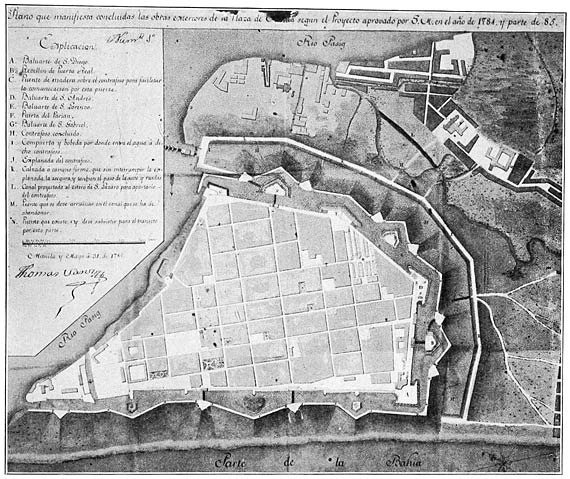
Plan showing outer works of Manila, according to the plan approved by his Majesty in 1784–1785, drawn by the engineer Tomás Sanz
[From original MS. map (in colors), in Archivo general de Indias, Sevilla]
Of the forts of Manila and Cavite
No location like that of Manila could have been selected by the conquistadors of the island of Luzon for fortifying themselves and founding the capital of an infant colony. [Its position is described, with mention of its earlier fortifications; but these were only suitable for the defense of its inhabitants against piratical attacks. Its present condition is a dangerous one, for its fortifications are unable to withstand a siege by European troops; it has no bomb-proof magazine, and hostile batteries across the Pasig River could easily reduce the city to ashes. Manila is not suitable for a military center, and the efforts of the government ought to be bent toward the fortification of Cavite, which would render that place a first-class fortress; its advantages for this are enumerated in detail, and the measures which should be taken to render it impregnable.] The feeble fortifications of Manila and its citadel may be preserved for the present, in order to shelter the government and the property of the Spaniards from a sedition; but in case of war and the landing of an enemy let them be abandoned and destroyed, in order to proceed for safety to the impregnable point of Cavite. In this manner will be laid the foundation for the perpetual security of the [Spanish] government in those islands, and for their preservation against all enemies, whether within or without.
Of the piracies of the Moros
Longer tolerance of the piratical raids by the Moros is another cause which in time must compromise our secure possession of the islands, through the plundering of their maritime villages and the captivity of their inhabitants, and the stoppage of the commerce and the coasting trade. Much more is this true because some ports of the islands, which are in the possession of those pirates, are already frequented by foreign vessels, which provide the pirates with military supplies and firearms; and it is to be feared that later the foreigners will furnish them with plans, vessels, leaders, and other aids, like those which they have furnished to the disaffected peoples in the Americas, to wage steady war on the Spanish government. [The Spanish colony has carried on defensive warfare with the Moros ever since the conquest, but has gained no permanent advantage therein, while the enemy have increased in numbers and strength, inflicting ravages on the southern provinces that are “continually greater and more scandalous.” The Spaniards have spent enormous sums in forts, vessels, and other defenses; but with little effect, on account of the immense extent of the coasts of Filipinas and the great number of uninhabited places where the pirates can hide themselves from pursuit.] Their vessels, called pancos, are of extraordinary swiftness. The Moros make these of planks lashed together with rattans, without nails or any [other] ligature. Their masts are three bamboos, their rigging a few pieces of rattan or the bark of trees, their sails are certain petates, or mats, which they call saguran; and their provisions are reduced to the flour made from a tree, called yoro [i.e., sago] and dried shellfish. Nearly all their pancos have two banks of oars, and two men for each oar. And with this slight though warlike equipment, with their harpoons, javelins, campilans, and arrows (in handling which weapons they are very dextrous), and with their swarming crews—composed of their slaves, who row under the lash; and of a multitude of pirates, who thus make their living, and traffic in their booty—they attack, among many, with the odds on their side, surround, and jump aboard, any Christian vessel which cannot defend itself on account of a small crew or the inaccurate firing of its cannon. [If they are caught in some bay by the Spanish who pursue them, they abandon their pancos, hide in the mountains, where they find enough to live on, and, as soon as the Spaniards depart, the pirates easily construct new boats and resume their raids. The pirate marine with the forts, troops, and cannon supported by the Spaniards make a heavy burden of expense on the treasury and on the people; and the amount thus spent in half a dozen years is enough to equip a strong naval expedition which could humble the insolence of the pirates. In view of this, and of the importance of Joló—which is the headquarters of the Moro pirates and of their government, and the general market for the Christian slaves and property which they carry away—Bernaldez advocates the immediate conquest of that island, and its repopulation from the more thickly settled parts of the northern islands. This can easily be done. Thousands of families whose members have been enslaved, especially in Bohol, are ready to join such an expedition, if leaders and provisions are supplied to them; and there are a multitude of skilled inter-island pilots—mestizos who are efficient and rich—who would act as leaders for the sake of their own profit and reward in such an enterprise. For ships they could use the government armed vessels, and the multitude of boats which ply among the islands; and sufficient rewards could be furnished to the soldiers in the distribution of the conquered lands and of the plunder which they would obtain. By this plan, the Moro piracies could be suppressed, and the islands thus gain peace from those fierce enemies.]
Of the large Indian villages
Although the laws of the Indias endeavor to establish firmly the peace and good government, both temporal and spiritual, of the villages by placing limits to their extent and the number of their residents, the inattention of the governors of Filipinas in regard to this so important subject, on the one hand, and on the other the interested motives of the parish curas and the ministers of the doctrinas, have given rise to the abuse of the villages of excessive size which are now found established in Filipinas. These, as they cannot be properly governed by their respective local authorities, maintain within themselves a source of internal civil discord, and from time to time they have broken out in disturbances which have placed the islands in a very critical situation.
If the reports of their population be examined, it will be found that in a great number of villages it does not fall below 10,000, 11,000, or 12,000 souls; and it is impossible that so many can be well directed spiritually by the one parish cura alone which each village has, or in secular matters by only one gobernadorcillo or alcalde. In this class of towns the most notable are the following: Tondo, with 13,424 souls; Binondoc, 22,570; Tambobo, 21,378; Pasig, 14,465; Malolos, 19,655; Vigan, 17,320; Pavay, 14,840; Lavag [Laoag], 25,242; Bacarra, 13,064; Balayan, 18,631; Taal, 23,526; Banan, 17,438; Batangas, 19,566; Cabatuan, 17,359; Xaro, 14,911. In these populations which do not conform to the rule there has always been recognized more or less instability, for the class of the plebeians, or caylianes, is immense, and out of proportion to that of the timauas, or nobles; and likewise because the unarmed authority of a gobernadorcillo must necessarily be vacillating, at the mercy of that great mass of people, who are easily set in motion by a seditious person, a few drunkards, or the superstitious tale of some old man.
The successive revolts of various towns in the province of Ilocos in the years 1810, 1812, and 1816 had no other source. The cause of this last uprising was decided by me, in my official character as fiscal of the royal Audiencia of Manila. In my reply I explained the origin of those repeated insurrections, analyzed the degree of perverseness which progressively in each of them had been revealed in the purpose of the conspirators, and deduced the necessity of dividing the province of Ilocos into two, to the end that its large towns should each have a ruler closer at hand who might keep them in check. The Audiencia made a report, with my opinion as fiscal thereon to the king our sovereign; and, his Majesty having deigned to command that immediately the said province should be divided into two, it has been maintained on that footing, up to the present time, in the greatest order and tranquillity.
[Even more surprising is the neglect of the governors to enforce the law that no houses shall be erected close to the castles and fortresses.] Within cannon-shot of the walls of Manila, and even no farther away than the breadth of the river, one hundred thousand souls—Indians, mestizos, and Chinese—have been allowed to establish themselves; a people of foreign origin, in great part, without passports, classification, settled occupation, or any other requisite of a well-ordered social condition, and whose formidable number is threatening Manila with an inevitable blow. The sudden movements of that great mob of people, ignorant and swayed by blind passion, reached the point of approaching close to the defenses of the city, in the year of 1820, even before this was known to the government and the military council (which for this object had been called together, and of which I was a member)—notwithstanding that the object of their revenge was in the outer suburbs, and that their aim was not, at least for the time, directed against the city. [These facts ought to make the authorities of the colony realize that no other considerations ought to interfere with their prime obligation, which is to preserve peace and order in the towns and maintain the military posts in security. Bernaldez recommends that new regulations be formed regarding the settlements of the islands; that no town be allowed to contain over five thousand souls and one thousand houses (except the capitals of the provinces, which might have ten thousand souls and two thousand houses); that the large towns be divided into villages on the above basis, which should be kept separate from one another; and that in the suburbs of Manila there should be more rigorous police control of the people. The Indians there should be classified by occupations, to each being appointed a chief or leader who should be responsible for the conduct of those in his class; the use of all dangerous weapons should be forbidden; passports should be required for all persons coming from the provinces; and vigilant watch should be kept over the occupations and mode of life of every family.]
Of the titles to landed property belonging to the Indians and the villages
The lack of clear and exact laws for properly authenticating the documents regarding the ownership of the lands of the Indians, and the uncertain and unlimited possession which the villages have of lands under the pretext, of their being communal, have been and always will be in Filipinas the origin of a multitude of ruinous lawsuits and contentions—sometimes those of Indians and villages among themselves, sometimes between these and the Spanish and mestizo proprietors. The Indians, as a rule, have no title of ownership in the lands which they possess, and if any one has such it is a private document, signed by other Indians—who with the greatest readiness deny, change, and forge their signatures—or it will be simply a writing signed by the alcalde-mayor, a copy of which, if it remains in the court, will disappear or be mutilated, with equal readiness, by the Indian clerks of the alcalde, in whose charge the archives are—if indeed these are not entirely destroyed in the frequent fires which occur in the villages. The most common method which the Indians of the villages have for proving their territorial property is by tradition, and the depositions of witnesses; and with that powerful weapon they undertake and maintain the most contentious lawsuits, aided by the fiscals of the Audiencia—who often forget that their office of defenders of the Indians is bona fide, and for the sake and protection of the natives in the tribunals to which the laws commend them. But any person who may have exercised the duties of magistrate for any time in Filipinas will know that in the decisions of judges there is nothing more discredited than the evidence presented by Indian and mestizo witnesses, who are not restrained from perjury by either an intimate acquaintance with the obligations of religion or by sentiments of conscience, honor, and reputation. It is very common to see, in court cases, that witnesses of that sort will swear, and then contradict their own testimony, according as the witnesses [are affected by] either their own interests or the influence of the litigant who presents them.
These causes, besides rendering the lawsuits of this kind eternal, have very frequently produced scandalous disobedience of the villagers to the enactments of the Audiencia of the islands, and uprisings of armed men in order to prevent effectually even the judicial possession of the crown lands which had been sold, with all the formalities of the laws, by the government there; and, finally, they withhold the Spanish families and persons of wealth from purchasing rural establishments in order to undertake on a large scale the cultivation of the products of the country, which is perhaps the only means of promoting the agriculture of the islands.
Of the ecclesiastical orders which are conferred on Indians and mestizos
The irregular procedure of the reverend archbishops and bishops of the islands in conferring ecclesiastical orders on the Indians and mestizos there, will be in that colony, as it has already been in America, one of the causes which most incite revolutions. The Indians receive through the priesthood a standing which they cannot worthily sustain, because they never lay aside the affections, passions, and usages of Indians. Educated by the religious, they afterward come to be their decided enemies; they divide with the religious the opinions of the villagers, who finally, even though they know the deficient morals of the native priests, always respect the sacred functions which these exercise. The least political evil which the latter occasion is [through] their neglect of their obligations as parish priests, the irregularity of their mode of life, and their carelessness in everything pertaining to divine worship. The inhabitants of the villages administered by Indian curas are very different from those of the religious from Europa, whose people are distinguished by their simplicity, docility, and religious training. He who knows the active and leading part played by this class of persons in accomplishing the independence of America will not be surprised that in the establishment of the constitution in Filipinas Indian curas have almost all been the directors of the elections in their villages, the electors, and the deputies in Cortes and for the province—in all these functions distinguishing themselves by their officiousness, and their pretensions against the legitimate government of the islands.
This class of persons, dominating the consciences of the ignorant and unfortunate, can easily drag them into error. As simple farmers and artisans, they would have been useful to their families and to the government; but mistakenly raised to the dignity of priests, other interests now move them, and they form a commonwealth apart in the safe retreat of the provinces. A consideration of justice wrongly understood by the prelates of the islands, and a vehement desire in the Indian or mestizo heads of families to ennoble these by placing their sons in the priesthood, have caused there an excessive ordination of Indians—which I cannot avoid characterizing as such, since, besides the many clerics who are actually administering villages, there is a considerable surplus of others who are scattered through the provinces. These evils were foreseen in the laws of the Indias (ley iv, tit. vii, lib. i), which cautions and exhorts the reverend prelates of the Indias not to ordain so many clerics as they were doing; but this has not sufficed, and it is necessary that the government, recognizing the unfortunate experience that it has already had with this abuse, should take the most efficacious measures for the purpose of limiting the authority of the prelates in Filipinas, in conferring ecclesiastical orders on Indians and mestizos, strictly to the number of clerics which the religious orders of those islands agree upon and propose as necessary to have for their coadjutors, and for Indian villages not now occupied, or which in the future the religious shall fail to occupy—ordering the governor of Filipinas to secure, by mild and discreet means, that the vacant curacies of clerics be conferred on European religious.
Of the European religious in Filipinas
The lack of European religious in the Filipinas Islands for filling at least four-fifths of their curacies is incompatible with the permanent preservation of that colony. It can be safely asserted that the government of his Majesty has in this class of ministers the most powerful force for maintaining that possession in attachment to his sovereignty. Their virtuous and unworldly mode of life; their absolute disinterestedness in regard to temporal matters, which is a marvelous contrast to the greed and ambition of the European trader, the mestizo, and the Chinese; their extraordinary sacrifices in living apart from the society of their equals for nineteen, twenty, and [even] thirty years in those almost uninhabited islands, which are unprovided with the sort of nourishment suitable to their estate; their discretion and patience in correcting and teaching the Indians; their resignation in all kinds of adversity: everything, in short, contributes to make the inhabitants of that land regard them as supernatural beings, and in the light of this conception the fathers exercise over the Indians a moral force more powerful than even that of the government. The Indians live in entire moral separation from the Spaniards; they have their own laws of tradition, their own opinions and customs, entirely unknown to any one who is ignorant of their language or has not continual intercourse with them. The European religious are the only persons in the confidence of the government who by favor of these circumstances, and with a practical and intimate knowledge of the nature and inclinations of the natives there, can find a way into their hearts, incline their wills to what is right, enlighten them, and keep them peaceful and submissive; and without this larger armies would be of no avail.
[The religious are the only persons who understand the condition of their respective villages, and the alcaldes-mayor are usually indolent and inefficient, relying on native interpreters, and caring little for aught save their own profit; they depend on the religious in all cases of difficulty, and the higher authorities are jealous of this superiority of the religious. The government ought to maintain as many religious as possible in the islands, and give them as much political authority as is consistent with their ministry; five hundred of them should be sent there, and the alcaldes-mayor should be obliged to consult every month with their respective curas on the best means of promoting the interests of the people, and the central government can then act on reports of these conferences.]
On the settlement of banished and vagabond foreigners in the islands
Of the residence of European Spaniards in Filipinas
By a necessary and inevitable effect of certain causes, physical and moral, which would take too long to explain here, the Spanish race in the colonies—or the descendants of Europeans, and mestizos of these, born and reared there—have from their birth political sentiments which are entirely opposite to those of their ancestors and other Europeans. They regard the Indian as an entirely passive being, the European as a foreigner, and the land as exclusively their own. The educational institutions which thus far have been founded in the colonies, with the object of uniting their inhabitants, by means of enlightening them, under the same principles of religion, morals, and politics, have not been able to uproot those ideas; on the other hand, recent events in the Americas have proved that the men who had most education and acquaintance with the sciences were the party leaders [corifeos] of revolution and independence. It ought to be regarded as an incontestable truth that as soon as the Spanish race in Filipinas reaches a greater number than that of the Europeans, and with this increase acquires a certain degree of moral force, a war for independence will be declared; and according to this idea the educational institutions, when there is not sincerity in the minds of the persons and in the laws that aim at encouraging this class of population in the colonies, have a tendency hostile to the preservation of the royal government in them. This class of Spanish families is, for another reason, very unfortunate in Filipinas, and may be regarded as condemned to perpetual slothfulness and misery. They cannot devote themselves to agriculture, because in that burning climate only the Indian resists labor so hard; nor to handicrafts, because the wages which the Indian and the Sangley mestizo alike earn, which is sufficient to meet their simple needs, is insufficient to pay for another sort of food and clothing for the Spaniards. For these same reasons, they cannot occupy themselves in the coasting trade; nor, finally, in the commerce of the islands on a large scale, for lack of sufficient capital, since by inheritance is divided among all the sons the wealth which their European parents left to them; and the practice of law is there a career to which resort is very unfortunate. All these causes, added to the lassitude which the climate inspires, maintain that class of people in such a condition of idleness and poverty, especially the women, that it has been necessary to establish in the capital alone six seminaries and beaterios in which to shelter and educate Spanish girls; and that in the ordinance regarding the Acapulco galleon his Majesty should grant to the Spanish widows of merchants the special favor of a pension or widow’s usufruct on the boletas of that vessel, their only means of making a living.
[Bernaldez declares that these European Spaniards, “there abandoned, as it were, to the mercy of charity, or to vices,” are not only useless but dangerous to the country; that among them revolutions are born; that it is for the best interests of España to retain her population at home, and, while furnishing means for Spaniards to enrich themselves in the colonies or their trade, to attract to the mother country all possible wealth and capital, not allowing her children to remain abroad after acquiring wealth; and, finally, “to remove from the colonies all cause of insurrection, than which there is none greater and more terrible than the propagation [therein] of the Spanish race.” Moreover, the Europeans settled in the colonies “have too much influence, through their exclusive wealth and connections, for weakening governmental action there; and care nothing for any political changes except as they can find therein opportunity for speculations” (on which he instances the action of European Spaniards in Mexico in Iturbide’s short reign, and in other events of the revolution there). “The Filipinas Islands need, to maintain them in tranquillity, nothing more than a stable system of administration, civil and spiritual, by means of religious, and an army trained and commanded by competent European leaders, officers, sergeants, and corporals, with the necessary number of civil officials.” The creole inhabitants should be diminished as much as possible, all Spaniards being required to return with their families to their own country; and “aid given to destitute widows and orphans of Spaniards who die in Filipinas would be better employed in paying for their removal to Europa.” This matter should be considered in the residencia of every governor. Convicts and exiles should no longer be sent to the islands. No foreigner should be allowed to marry there except on condition of leaving the country with his wife. No European adventurer or idler should be allowed to remain in the islands unless he proffer sufficient security for his good conduct and occupation; he may then remain not longer than ten years; otherwise, he should be at once sent back whence he came. Every ship should carry back to España as many Spaniards as it brought to the islands; and European Spaniards should not be allowed to remain in Filipinas more than ten years, after which they should be compelled to return with their families to España.]
Of the residencias
[It is highly desirable that public officials should undergo strict residencia, and that regulations be made for these, which are adapted to the special needs of Filipinas. This is especially true of the alcaldes-mayor, who, as they have permission to trade, are more tempted to evade or infringe the laws; and many persons are appointed to that office who “lack all the qualifications necessary for obtaining any public office whatever.” Unfortunately, since the royal decree of August 24, 1799, no alcalde has been or can be subject to residencia, and they consequently enjoy absolute impunity in their transgressions; for that decree does not allow a sufficient time for complaints to be made in a country like Filipinas, where intercourse between the provinces and the capital is so uncertain, interrupted, and difficult, on account of the vicissitudes of weather and climate, the lack of roads and postal facilities, and the great distance of many provinces from Manila. “This impunity has most serious results, very detrimental to the peace and quiet of the islands; for such has been the class of persons whom necessity has compelled to appoint as alcaldes-mayor that not only have they used their authority to possess themselves of the property of the Indians—seizing the boats of traders, which injured the natives in their traffic—and defrauded the Indians with unjust exactions; but they have humiliated the religious, stolen moneys from the king, outraged young girls, burned houses, and, in short, have thrown the provinces into a condition of effervescence and of conspiracy against the government which sent to the natives such a ruler.” Bernaldez urges the government to take such measures that the residencia of the alcaldes may be made effective and just.]
Of the selection of all classes of employees for the Filipinas Islands
[On this point, the writer urges greater care and more sense of responsibility. All government officials, of every grade, should be of good morals, old enough to have stability of character, sufficiently competent and experienced to understand their duties, and such as will set a good example to the natives.] The imprudence of one man alone has often been sufficient to incite a sedition in the minds of various parties or castes in those islands; and in any case it is very dangerous to entrust positions of command to persons who are not endowed with well-proved ability and discretion. I cannot attribute the laxity which in recent times is evident in all branches of the administration and government of those islands to any other cause than the injudicious selection of many of their employees. The military corps, whose former captains and subalterns had been mainly sergeants sent from the Peninsula, were kept in the best order and discipline until, in the year ’23, those officers were added to them who accompanied General Martinez—of some of whom, according to the documents which were executed for my court, their appointment to the Indias, with their scandalous conduct, looks like a proof that in España there was neither religion, morality, nor subordination. [Bernaldez urges that certain qualifications be required for office in Filipinas; the governors should be members of learned bodies, and excel in discretion and ability, and in the art of governing, and of promoting the welfare of a country, rather than in the military art. The intendants should be “enlightened economists, capable of creating and promoting the great wealth of which that virgin country is capable.” The officials of the Audiencia should be at least thirty-five years old, with ten years of service, and experienced in legal practice; and other employees should be trustworthy, experienced, and not mere youths. “The Filipinas Islands, like every colony, are the country of the corruption of youth, and where it is necessary to work with men whose characters are already formed.”]
Of the use of weapons in Filipinas
[The writer protests against the carelessness which, contrary to the laws of the Indias, has allowed the natives to possess and carry weapons—even including campilans and sabers, pistols and guns. These arms have, through culpable negligence of the government officials, been imported in the foreign ships and sold publicly; and, possessing them, the natives are a constant source of danger to the whites. He recommends that the governor of Filipinas be commanded to disarm the natives, using mild and politic methods, and allow them no implements or tools save those required in their labor; to stop the importation of arms into the islands; to compel all coasting vessels to deposit with the authorities, during their stay in the harbor, the arms which they carry for defense against the pirates; to see that no weapons be allowed in the villages save those needed by the local guards; and to stop all clandestine manufacture and sale of gunpowder.]
Of the despatch of assistance to the Filipinas Islands
[This section is devoted to the evils resulting from the remoteness of the islands, and the neglect of providing them with facilities for communication with España; it is necessary, if the government desires to keep the islands; to remedy this deficiency at once, for their material prosperity, the administration of justice, their safety from enemies, their loyalty to the crown—all are at great risk under present conditions. “The establishment of postal service in vessels of the royal armada would be a most burdensome expense to the treasury of España and to that of Filipinas. Unfortunately, previous to the royal decree of 1820 in regard to the commerce of Filipinas, in the long period of forty years only twenty trading ships have gone to those islands, leaving them without assistance or communication during the long space of three, four, five, or [even] seven years.” However, this can be remedied, and without expense, by suitable measures for the promotion of commerce between the islands and España, “an attempt at which has been made in these last six years, during which time more expeditions direct to Filipinas have been effected than in the preceding forty years—that is, sixteen from Cadiz, three from Santander, Coruña, and San Sebastian, and five whose return is now expected.”]
OF THE CAUSES WHICH OPERATE IN THE BACKWARD CONDITION OF THE ADMINISTRATION, BOTH CIVIL AND ECONOMIC, OF THE FILIPINAS ISLANDS; AND THEIR CORRECTIVE
[Of the failure of governors and intendants to make reports]
[Exact and circumstantial information is of course, necessary for the guidance of the home government in all measures relating to the resources, needs, development, and administration of the islands, and annual reports on all these matters are demanded from governors and intendants by the laws of the Indias. Essential as this requirement is, it has always been neglected.] What those officials sometimes write, when questioned about these matters, are but generalities; their reports and information are reduced to how much has been produced and how much spent, in the résumé of the royal exchequer accounts. Thus it is not known with what necessity and justice certain extraordinary expenses have been incurred, what number of employees the king has in that colony, what causes have occasioned the increase or decrease in the product of the revenues, and, finally, how the means and resources of the people who contribute to the royal income can be augmented so that the latter can likewise be increased, all which the government ought to know. [It is true that the governors are laden with multifarious routine duties, which often prevent them from attending to these important matters, and from examining conditions personally, for which they have to depend upon the reports of their subordinates; and these are apt to be actuated by self-interest and they do not like reforms, so their statements are not very reliable. The reports made by the municipalities, commercial consulate, and other bodies are of the same sort, as being always from the standpoint of their corporation; and neither authorities nor corporations have the same stimulus to thoroughness, accuracy, and energy as has the private person who undertakes an enterprise. It is through the latter class that great projects and advances are made, but such persons hesitate to present plans for these to the authorities there, because the authorities do not examine them personally, “but by means of a contentious, voluminous, and annoying expediente,” and likewise have no authority to adopt these plans until they are referred to Madrid—where, too, they are not encouraged to bring such projects before the royal government, and these, moreover, would have to be sent to Manila first (apparently to contend there with the aforesaid expediente). Bernaldez continues:] In order, then, to awaken this interest of enterprising private persons in the agriculture, manufactures, and commerce of Filipinas, it is necessary to have there a body expressly devoted to this object, and authorized to adopt provisionally any plan for improvement and progress which may be proposed to it and examined by it with the aid of its special knowledge of the country; and this body ought to be the superior council of the royal exchequer of the islands …. This council, as such, has very little occupation; its ministers, like all who are employed in Filipinas, attend to their official duties only in the forenoons, remaining free during all the afternoons and evenings for employment in a service of so great importance as this.
I am, then, of opinion that his Majesty should deign to establish the following: That the superior council of the royal exchequer in Filipinas constitute a similar council for the improvement and prosperity of the country, with the object of stimulating in every way the Indians to work, and capitalists to undertake enterprises. That its members hold weekly meetings for this purpose, at such hours as the president shall designate. That it also call in the proprietors of lands, agriculturists, manufacturers, and merchants of the country, listen to their views, and encourage them to propose reforms and plans for promoting the useful arts. That it be authorized to decide upon the execution of projects, provisionally, until the approbation of his Majesty is secured, in all matters which do not occasion loss to the country or injure the interests of the treasury. That it can draw upon the treasury of the community for a moderate amount of necessary expenses for the encouragement and reward of enterprises, for anything which can bring a positive and general benefit to the Indians and the government.
Of the royal court
Of the administration of justice in general
The consideration and respect which the Audiencia of Manila merits among the Indians proceeds also from those times in which its members made official visits to the provinces, and in these visits did so much good to the villages. The visiting auditors were, in reality, friendly mediators in the disputes between the Indians; and they made agreements, placed limits to the villages, furnished a sort of municipal ordinance, and protected the natives against the oppressions of the alcaldes-mayor. Notwithstanding my high opinion of that tribunal, I regard as very proper the provisions of law xxxiv, título ii, book ii of the laws of the Indias in regard to the removal and promotion of its ministers, basing my opinion on the same arguments as did the law—that is, that it is very desirable not only to reward them, but to uproot them from the friendships which they contract in places where they remain a long time. These friendships, whose influence is always detrimental to the equitable administration of justice, are in Manila an almost necessary result of the small Spanish population, of the lack of all public amusement or diversion, and of the fact that with the enervating effect of the climate the rectitude and vigor of European morals is lost after some years of residence in the country. [The Audiencia has been unable to attend to the administration of justice in the islands as it has desired, for it has always been hindered by the many obstacles which arise from the storms, the lack of roads and mail service, the attraction of all the lawyers in the islands to the capital, the ignorance of the gobernadorcillo and the alcalde of each other’s language and of judicial procedures, the dilatory mode of carrying on these between the provinces and Manila, etc. “Thus it is very common that these lawsuits, besides being always full of defects, last three, four, or six years; and that in that long period either the delinquents take to flight, or the documents are lost.” Even in the Audiencia itself there are many obstacles to its action. Its subordinate officials are Indian or mestizo lawyers, who often are neither competent nor qualified for their positions;] and that which most contributes to retard the despatch of business, and to maintain the offices of the court without any organization, is the unfitness of those who occupy the class or purchasable and renunciable offices. The court clerk, the special commissioners, and the attorneys know nothing else than how to obtain the greatest possible advantage from the purchase of their offices. Without any instruction in the obligations of those positions, because they cannot acquire it in that country, and incapable of carrying out even what the ministers themselves have the patience to teach them, those men are, notwithstanding, the only ones whom the ministers can choose for those offices, because they are likewise the only ones who can outbid others in the sale of them. These positions are also of little advantage, because in the immense extension of the military jurisdiction, among the wealthy persons of Filipinas, the tribunal of the War Department has drawn to itself all the civil causes of importance in the islands; and the Audiencia has been reduced to criminal causes, and the minor controversies over land among the Indians, for which reason it is impossible to have educated Europeans who will purchase those posts and serve in them. The consequence of this is that the offices of the Audiencia are in the utmost disorder; that they do not contain even the books of entry which the laws provide for, or registers, citations, or reports of cases; that in order to record a decree or an official report it is necessary for a minister to take upon himself the task of doing that; and, finally, that the administration of justice must necessarily be slow. [Bernaldez therefore recommends that the ministers of the Audiencia be promoted at least every ten years to other appointments; that the minor offices be no longer purchasable or renunciable, but filled directly by royal appointment, and given to suitable persons, with good salaries (which are specified); and that the government of the islands provide some expedient for raising money to pay the salary of an attorney-general in each province.]
Of the alcaldes-mayor and military governors of the provinces
[The office of alcalde-mayor and provincial governor involves the civil government and defense of the province, the administration of justice, and the collection of the taxes; but those who are appointed to it are usually only traders, in reality, and care more for the profits yielded by the trade that is permitted to them than for the obligations of their office. They are paid twenty-five hard dollars a month for salary, “and they pay to the treasury the same sum for the indulto [i.e., privilege], as it is called there, of trading,” to which pursuit they devote all their time and energies during the term of their office.] A system of alcaldeships so anomalous and irregular nevertheless produced at the outset some benefits to the islands, because, by reason of the great lack of capitalists there, many products of the agriculture and industries of the provinces would have received no encouragement if the alcalde had not speculated in them for the sake of his own trade. It is also necessary to note that there are provinces with which, on account of their remoteness and the little advantage which they have for the coasting trade, there was hardly any other means of communication than the barks of the alcalde. But now, when the coasting trade has become so general, it is a necessity to abolish, in most of the provinces of the islands, that absurd system of trading alcaldes; and to appoint in their places corregidors, lawyers educated in España, with only a salary, and the charge of making collections for the royal revenue, with the right to the offices in the Audiencia there. This increase in expenditure should be covered by the duties which ought to be imposed on the coasting trade, which by this means remains free from all impediment. [Bernaldez urges that the provincial magistrates be carefully selected, for their knowledge, experience, discretion, and executive ability; and that they be men who will devote themselves to the proper administration of justice, the study of those regions hitherto unknown, plans of reform, and the encouragement of industry and commerce among the people—not forgetting to preserve friendly relations with the parish priests. He recommends that seventeen of the provinces in the islands of Luzon, Panay, and Cebú be divided into corregidorships, eight into those of the first class, and nine into those of the second, with specified salaries to each; that appointments to these posts be made for six years; and that corregidors of the first class be proposed by the Audiencia.]
Of the taxes
[At present, the tribute paid by the Indians should not be increased because so many of them would be distressed by any heavier tax; but this might be done later, when the class of large proprietors may have increased in numbers. The payment of this tax in kind is a source of loss, not only in the quantity and quality of the products paid in, but in the damage caused by transportation and storage; and in selling the products thus received by the government there is loss, because its agents are poor managers of such business, not having the shrewdness or the knowledge of the markets which enable private merchants to make their profits. The commutation of the payment from money to kind was only partly due to the influence of the alcaldes, who preferred it for the benefit of their own trading;] the cause which has rendered that commutation almost necessary and which operates directly to the prejudice of the Indian, is the lack of a colonial money peculiar to the Filipinas Islands, like that which the other possessions in Asia have (of the necessity of which I will speak in another chapter), in order to revive internal commerce and promote and facilitate the payment of taxes.
The indirect taxes by means of government monopolies in Filipinas are, in my opinion, those most suitable to the native disposition of inhabitants who, furnished most abundantly by the soil with all the income necessary for their support, convert the superfluous enjoyments of life into objects of prime necessity. It should be a firm principle of good government to protect and rectify the administration of these indirect taxes, especially those on tobacco and wine—not only because these will be sufficient to cover abundantly all the expenses of army and navy, but because in case of a war and the absolute cessation of trade the government will have this firm support for its existence; and therefore no hearing should be given to the suggestions and proposals of those persons who are craftily working to free the islands from those monopolies. But so long as these taxes are not made general through all the provinces of the archipelago, so that the fire of the contraband trade (which always finds lodgment in the exempt provinces) may be extinguished, and until certain reforms are adopted in their administration and protection, the produce [of these taxes] in favor of the royal exchequer must be very disproportionate to the amounts consumed by that large population.
Of the revenue from tobacco
The revenue which supports the Filipinas Islands, which cannot be replaced by any other, and which if it were properly established and administered would yield incalculable advantages, is that from tobacco. Three millions of inhabitants, all without exception of sex or age consumers of that article—and for each one of them, on the average, and at a very low estimate, can be set down a consumption of four pesos [worth] a year—would produce an addition to the revenue of twelve million pesos, which they would obtain from the land and from their industries, in order to give at the same time a great impulse to commerce. This is not a paradox, for the use of tobacco is of so prime necessity for the Indians that the same calculation can be made for that object that would be made for the use of bread in España. [Bernaldez considers the injurious effects of enforcing this monopoly in only a part of the islands—“although more than half the population is today subject to the monopoly, its income is only one-tenth of what, at a reasonable estimate, it ought to be”—and those of its careless and negligent administration. He makes the following suggestions:] That the collection of the tributes from the Indians of Filipinas be made compulsory in money, as soon as the colonial money can be placed in circulation in their provinces. That the monopoly of tobacco in Filipinas be extended to all the [now] exempt provinces, without exception; and the government there will succeed much better in establishing it therein by sagacity than by authority or force. That the examination and appraisal of the leaf tobacco which the monopoly purchases from the growers be made before a board which the government there shall appoint annually, composed of officials from the capital who are most trustworthy and intelligent in that branch of administration, such tobacco as proves to be unfit for use being burned in their presence. That all the tobacco which can be collected in Filipinas be conveyed to España, by means of contracts with private persons for the freighting of ships; and with it the amount which can be remitted from the [different] branches of the royal exchequer, and the annual surplus of their funds.
Of the revenue from wine
Of the head-money, or personal tax, from the Chinese
[The Chinese were at first allowed in Filipinas only to cultivate the soil and work in handicrafts; but they have drawn into their possession the control of trade and commerce, “winning the good-will of the government and the tolerance of the inhabitants of Manila with a thousand intrigues unknown in the country. They have done in Filipinas what the Europeans ought to have done, that is, to acquire wealth and send it, or themselves go with it, to their own country to establish commercial houses;” and thus they have added a marvelous amount to the wealth of China. Their method of doing business is explained—practically the same as is done in the United States at the present time; united capital and effort, division of the gains accordingly, quick sales and small profits, etc. They have obtained the exclusive retail trade in Manila, and a great part of the wholesale trade, “and thereby have aroused the hostility of corporations and private persons, notwithstanding that they are a class of peaceable and industrious people in the country.” Bernaldez thinks that their tax of six pesos a year is much too small, considering the advantages which they enjoy and the large fortunes which they acquire in the islands; in Batavia the Chinese pay the government as much as thirty pesos a month for merely the permission to trade. The tax on them at Manila is farmed out to a Chinaman, and does not yield as much as it should. The following recommendations are made:] That measures be immediately taken to correct and render accurate the registration of the Chinese settled in Filipinas. That the individuals of that nation be divided into three classes: first, wholesale merchants, understanding by that term all those who embark for China and receive thence goods on commission or for their own account; second, retail merchants, or shopkeepers; third, artisans of every class. That these be distributed by groups under head-men [por cabecerias], which shall not exceed sixty individuals to each one. That every Chinaman, as soon as he is registered, shall be joined to one of these groups, the head-man becoming responsible for him. That these Chinese heads of barangay must give security for the tribute from those under them, and collect the tax and deliver it to the alcalde-mayor of their respective province, being responsible in every case for the residence and occupation of their tribute-payers; and for this commission collecting the three per cent. That in future the tax on the Chinese already settled and those who shall settle in Filipinas shall be as follows: the wholesale merchant, ten pesos fuertes a month; the retail merchant, four pesos ditto; the artisan of every class, two pesos ditto. That every Chinaman settled there shall be free to return to his own country, provided he is not married, the limit of six months being allowed for this. That the Chinaman, of whatever class, who shall not pay his respective tax within one year shall be sent and delivered up to one of the ranch-owners for compulsory labor [por repartimiento], in order that there he may work at the day-wages agreed upon, which must not fall below two reals a day and food-rations of rice; and that the ranchman shall with these wages pay the tax [due], at the rate of two pesos a month.
Of the custom-house duties
The royal decree of August 25, 1818, by which it was decided that the exaction of import and export duties should be made in the Manila custom-house from the owners of the vessels, without considering the ownership of their lading, and that if the vessel were Spanish it should pay three per cent, and if foreign six per cent, has been a special favor or privilege granted to half a dozen Spanish ship-owners (for those who conduct the commerce with China and Bengala cannot be more than that number), with serious loss to the exchequer. This is, of course, annually deprived of the considerable income of the three per cent rebate on all foreign goods imported into Manila, which is a direct benefit to the foreigners who own nearly all the commerce in those goods. The manufacturers of Filipinas, especially those of cotton fabrics—which are able to compete with, and even exceed in cheapness, those of China, since the cotton of which these are made is of their own raising—are being ruined, because that rebate of duties brings the prices of the Chinese goods so near to those of their infant industry that the former ought always to be preferred; and, finally, the above arrangement has also given opportunity for various frauds proceeding from the pretended sale of foreign vessels to Spaniards, solely for the purpose of availing themselves of the rebate of duties on their cargoes, and to the possession (under assumed names) by Chinese settled in Manila of Spanish vessels.
[Bernaldez states the considerations which should regulate these duties, and the following recommendations for the payment of duties on various classes of merchandise, this amount to cover in each case the entire exaction: On national goods in transit, carried to Manila—on a Spanish vessel, three per cent; on a foreign ship, six per cent. The same goods for consumption in the country shall pay nine and ten per cent respectively. On foreign goods from India and China, for domestic consumption, ten and fifteen per cent respectively; from this class should be excepted the wines, brandies, pig iron, small articles of cast iron, dry beans, and foreign paper, which should pay twenty and twenty-five per cent respectively. Goods, whether national or foreign, not declared as in transit at leaving Manila shall pay two and four per cent respectively; but those registered on a Spanish ship from India, China, and all Asia for España, ten per cent. Coined silver and gold, and silver bullion, shall pay no entrance duty at Manila, but on leaving that port shall pay three and six per cent respectively; and foreign gold in bullion shall pay eight per cent at entering Manila (whether on Spanish or foreign vessels). National products, and those of the industries of Filipinas, shall pay when exported eight per cent on a foreign vessel, but nothing on a Spanish ship. The duty of the merchant’s peso [peso marchante] which the municipality of Manila collects should be abolished as obstructive to commerce; for the legal origin of this imposition is unknown, and it is very unsuitable for a municipality which is rich through its rents, revenues, and imposts. Bernaldez believes that this tariff would promote agriculture, industry, and navigation, and benefit the royal treasury. More coin would be brought into the islands, the plan of exempting it from duties having been adopted for that purpose by all the other governments of Asia. The burden of these duties will fall mainly on the rich class, and not on the Indians. The “infant industries” [fabricas nacientes] will be protected, and the Spanish merchant marine will be given the advantage over the foreigners.]
Of the inter-island trade
The inter-island trade of the Filipinas Islands is at present quite active, as is shown by the latest reports received. Its importance is well worth consideration, since the commodities which are traded in this way constitute the greater part of the cargoes of the export commerce. Tortoise-shell, gold, birds’-nests, balate, wax, cacao, and other products form cargoes of great value which come from the provinces. The exclusive proprietors of this commerce are the alcaldes-mayor of the provinces, and the rich mestizos and Chinese, who in this traffic have made exorbitant profits, for it is these alone who exclusively avail themselves of the rise in prices which is produced in Manila by the arrival there of foreign vessels together. This causes those posts of alcalde there to be very eagerly sought, since in only three years of holding them they allow [the making of] a fortune; and also that the class of mestizos and Chinese is the only one that is sure of becoming rich in Filipinas …. The result is, that with the exception of the great fortunes which in other times were made in the privileged commerce of Nueva España, it is this [coasting trade] from which have proceeded the fortunes of Manila. [This branch of trade is exempt from all duties, a privilege which does not benefit either the agriculture or the other industries of the Indians, since they always sell at the same price, and have no share in the profits of the trade. Nor is this commerce promoted by the freedom from duties, for it will always continue and always yield great profits to those who carry it on—who can well afford to pay a moderate tax on their lucrative trade, especially as it is partly for their benefit that the government incurs so great expense for curbing the piracies of the Moros. It is recommended:] That all commodities, whether natural products or those of industry, which arrive at the port of Manila by sea from the provinces shall pay one per cent on the prices current in that city; and from this tax shall be exempted only rice (whether in the hull or cleaned), cocoanut oil, and fresh fruits, as being articles of prime necessity for the Indians. That no duty shall be collected for those same products when they are transported by land, or by the rivers and bayous of the island of Luzon. And that, from the time when this law shall go into effect, the power which the municipality of Manila has to tax the value of the provisions which come from the provinces shall be suppressed. The exemption from duties will tend, in regard to the provinces of Luzon, to encourage in that island preëminently, as is desirable, agriculture and industry, and at the same time will save to the custom-house the new expenses which it would [otherwise] have to incur for establishing posts and men to guard against smuggling.
Of money
The Spanish peso is the universal money in the commerce among all the nations of Asia; and, as therefore the exterior commerce is constantly drawing it into circulation, the governments of all the colonies in that part of the world have found themselves obliged to create a colonial money, which on account of its provisional value cannot be taken out of the country, and, being directed into the internal commerce of the province, feeds and multiplies exchanges. In Filipinas there was no need of adopting that measure while its commerce with Nueva España lasted, because then those islands were receiving annually a million of Mexican pesos, and the situado of two hundred and fifty thousand; and, besides this, the business that was carried on during that period in the natural and industrial products of the country was almost insignificant. And if in Filipinas at this present time enough money circulates to support the outside traffic, that results from the fact that the profits which the colony has gained from the commerce with all the nations of Europa (the balance of which is in favor of Filipinas) are greater than the losses of money which it experiences in its commerce with India and China. [This is of course a very precarious situation; for the contingencies of war, diversion of commerce from the islands, or poor crops may at any time compel Filipinas to send out all its money to India or China for the supply of its needed commodities; and this would ruin even the internal commerce, “on account of the serious difficulties which the establishment of a system of public credit there presents.”] Besides that, considering now the matter of giving a strong impulse to the agriculture and industry of those islands, there would be needed for the former project many millions of pesos in constant circulation in the provinces, and there must be a great reversion of the capital employed in commerce to the interior of the islands; and this cannot be practiced in a country in which hardly enough money circulates to support the government and the demands from without, and which had undertaken to promote its interests by commerce before placing its agriculture and industry on a sound basis. In almost all the provinces of the islands very little money circulates, and in some of them there is not even what is necessary in order that the natives can pay the government taxes; and from this has proceeded the necessity of commuting the tribute from money to kind. The Spanish pesos go from and return to the provinces rapidly; and it can be said that the produce of the taxes which has to be sent annually to the capital, and the importations of the alcaldes and the mestizos, are equal. Most of the Indians trade among themselves by means of simple barter, and the mestizos make them pay dearly with their products for the money that they need for clothing themselves and paying their taxes.
Of the charitable funds established in Filipinas
Of the arsenal of Cavite
[Bernaldez declares that the works of naval construction, etc., for the government can be accomplished for half the cost by means of private contracts awarded to the lowest bidder, which is proved by the history of all the enterprises which have been undertaken by the government in those islands, whether in agriculture, mining, or metal-working; “for, however great the disinterestedness and economy which can be ascribed to the officials who conduct the enterprise, in this direction nothing can take the place of the contractor’s activity and vigilance.” In the cutting and gathering of timber there is abundant cheating and graft, as that work is directed by Indian overseers, or by mestizos and Chinese; the latter have abandoned the system of day wages (“which the natural slothfulness of the Indian renders very costly”), and instead pay the natives so much for a certain amount of work (which they call paqueao). “In this way the Indians, who always are cheated in these calculations, have to redouble their efforts to gain the amount bargained for, thus allowing to the mestizo the benefit of at least one-third of the usual daily wages.” After the timber is cut, its transportation, storage, and seasoning cost more when done by the government than by the mestizo contractor, and occasion much loss and damage. Ships of war could be built at Manila to great advantage, so far as the abundance and cheapness and location of the timber is concerned; but the lack of iron and copper there is a serious hindrance to such plans. There are mines of both metals in the islands, but they are not worked for lack of enterprising persons and suitable machinery. Bernaldez recommends: That the crown offer large rewards for the successful operation of the iron and copper mines in the islands, the supply therefrom of metal sufficient for the construction of ships and cannon, and the introduction of machinery for mining and iron-working. That arrangements be made for building war-ships each year, by contracts for the supply of timber and the manual labor. That competent engineers and constructors be sent from España, at good salaries; that necessary supplies and materials be secured by contracts, bid for in public; and that funds from the royal exchequer be set aside for this purpose to the amount of one hundred thousand to one hundred and fifty thousand pesos annually. That all the construction and repairing of war-ships for Filipinas be done through contracts, at public bidding; and that the arsenal of Cavite be reduced to a simple depository for the articles required for arming the ships, with such officials as may be necessary for the custody of these.]
Of the agriculture of the Filipinas Islands, in general, and of their principal productions
The Filipinas Islands, on account of the fertility of their land, their abundant rains, and the great number of animals for labor, constitute an agricultural colony; and to the readiness with which the country supplies the principal articles for human support has been due the rapid increase of its population. And although the Indians, as a general thing, only devote themselves to the cultivation of what they actually need for subsistence, the annual production so far exceeds the necessities of the people that very seldom has the failure or scarcity of provisions been experienced. The abundance of its arable lands and the excellence of its products have also rendered this colony capable of a considerable commerce with the other nations, at a much greater advantage over the other colonies, inasmuch as the land is tilled by free labor, which costs only the value of its food and clothing; and not by slaves, who, besides those expenses, occasion that of the premium or interest on the money invested in their purchase, which causes a difference of at least a third more in the cost of the manual labor employed in agriculture.
The neglected condition in which agriculture is in Filipinas, considered under this last aspect, and the backwardness in knowledge of the manipulations required in the preparation of its raw products for their consumption in trade, proceed from the following causes: (1) The lack of a stable and regular system of commerce which can assure to the inhabitants of the islands the annual exportation of the produce of an extensive agriculture. The foreign vessels resort to the ports there, some years in excessive number and others very infrequently; and this irregularity always produces an effect opposed to the interests of the colony. The extraordinary rise in prices—which during the last three years has reached a value double that from which the ability to sell at all times would enable the colony to gain a profit—and the consequent lack of commodities for supplying all the vessels, prevent them from returning in the following years; while the decline of prices below what is fair, caused by the non-arrival of ships, discourages large production in agriculture. The Indians are absolutely without capital and storehouses which would enable them to hold back their produce for another market. They are induced to cultivate the soil solely by their present advantage; they always sell, but they suffer from the stern law of trade which, although it flatters them in years of scarcity, equally tyrannizes over them in years of abundance—for they are always deceived regarding the actual prices of the general market, of which they are ignorant; and one year only of unsuccessful sales, whether from lack of foreign ships, or through the loss of their crops, will be a warning to them for a long time. In short, the agriculture of Filipinas at this time depends on the irregular and transient stimulus which is furnished to it by the peripatetic capital of the mestizo, who buys only in the years when he calculates that he must in view of the condition of the crops and the market, make a profit; while the Indian farmer always sows his seed heedless of results, and without the guidance of that elementary principle in affairs of commerce that the estimate of what he acquires ought to be based on a calculation of the market for it. For the corrective of this evil, and assuming that, for reasons that are rightful and conformable to sound policy (as I have set forth), the residence of foreigners in the islands ought not to be permitted, I find no other means than this, that the government encourage, by judicious measures, the direct and unlimited commerce of España with that colony—of which I shall speak in another chapter, [presenting] the rough sketch of a plan which ought to produce the following effects: (a) The definite and reliable annual exportation from those islands, not only of the great quantity of sugar, indigo, coffee, and other native products which are needed in the ordinary consumption of España, but of that which Spanish commerce can dispose of in the other nations and free ports of Europa. (b) The establishment of Spanish trading posts [factorias] in the interior of the provinces of Filipinas, which the Spanish mercantile interests will carry on for the sake of acquiring the agricultural produce at first hand, freeing the Indians from the oppressive rule of the mestizo trader, and forming contracts with them, at prices agreed upon, for a certain number of years.
[The backward condition of agriculture proceeds] (2) from the lack of great agricultural establishments. One of the causes for this is the fact that the capital of the islands, which ought to be employed for that object, has been diverted by the commerce of India, China, and Nueva España, which offers greater and quicker profits. The religious orders administer their estates as in mortmain, or by ecclesiastical rules. The Indians cultivate, not from inclination but through necessity, the little plots of ground on which they have fixed their abodes. They lack the buildings and appliances necessary for the preparation of the little sugar and indigo that they collect; and from that results the wretched and unreliable quality of those articles which so discredits them in the trade. They lack also the capital to incur the expenses of a regular plantation, and these enterprises require costly outlays at the start. But this cause of backwardness would be remedied by the impulse which would be given to commerce by the exportation of native products, which would attract to agriculture the capital which it has hitherto lacked, and by the special protection which the government can grant to large capitalists who may devote themselves to agriculture.
(4) And, finally, the cause which likewise exerts a powerful influence in [causing] the neglected and backward condition of agriculture is the slothfulness of the Indians and their absolute indifference to acquiring and keeping property. [This sloth is caused by the climate, the abundant supply of the necessities of life with little labor, and the hospitality which prevails among the natives;] and if it were not that in the capital and its adjacent provinces there has now been introduced a certain degree of decency and [even] luxury in some families of that class, it would be difficult to find any one to render service or to practice the useful arts that are necessary in villages. [With a people like this, it would be hazardous to attempt to compel them to work; but “even if they are naturally slothful, they have their likes and dislikes; and a wise government ought to avail itself of these two powerful resources to urge them to work.” The Indians dislike to pay direct taxes, and hate the collector of these; also they are passionately fond of cockfighting and spectacles of all sorts, and of office-holding; and if these characteristics are considered in the policy of the government much can be done to make them industrious. Bernaldez recommends: That a system of direct, unlimited, and regular commerce be established between España and Filipinas, for the purpose of maintaining a reliable and definite annual exportation of the latter’s products. That agricultural establishments be protected by the government, being allowed (although at their own expense) the assistance of a band of irregular soldiers. That machines, tools, and other aids to agricultural production be admitted free of duties. That skilled workmen be taken to the islands as instructors in the manufacture of sugar and indigo, and cultivators of coffee, etc., with their machinery and tools; their salaries for three years and their transportation to Manila being paid from the communal funds of the Indians. That large rewards be paid to the farmers who shall make large plantations of coffee and other useful trees or establish the silk industry. That the owners of these large plantations shall be allowed to keep on their lands each a cockpit for his laborers, free of expense. That groups of Indians, Chinese, and mestizos, limited to twenty families each, who shall maintain an indigo or sugar plantation of a certain extent in good condition, shall be relieved from paying the tribute so long as the plantation is kept up. That every Indian who works for wages during five consecutive years, to the satisfaction of his employer, shall be perpetually exempted from tribute, the employer paying the laborer’s tax for twenty years. That the Indians and mestizos who cultivate large plantations on their own account shall have the preference for the offices in their respective villages. That the government of Filipinas take measures to avoid frauds in connection with these proposed changes.]
Of the anfion, or opium
[Bernaldez describes the efforts made by the English East India Company to import opium into China, although against the will of the Chinese government, and states that a certain amount is smuggled into Manila to supply the Chinese settled in Filipinas; he supposes that the prohibition of this trade in the islands arose from the fear of the governors that the Indians would become habitual users of this drug and thus be injured; but in his experience of seventeen years in various judicial positions in Filipinas he has never seen a scandalous case of opium inebriacy among the Chinese of Luzon, nor any Indian brought into court for using the drug; and “the Indians without exception regard the use of opium with the utmost indifference and contempt.” He thinks that it should not be prohibited in Filipinas, since its use appears not to injure the Chinese there, or to be necessary for the Indians; while the islands] ought not to be deprived of a revenue that is exceedingly lucrative for agriculture, commerce, and the treasury; of an article which in the order of nature ought to be exclusively for the trade and benefit of the islands; and a means by which the Manila commerce would draw great wealth from China, turning in its favor, and with large sales, the balance of trade with that empire, which is now and always has been against Manila. A chest of opium, weighing one pico of Filipinas or 100 cates of China (each of 22 onzas), would probably cost the Manila grower for all expenses at most 100 pesos; and its value in China is usually 1,400 to 1,600 pesos. Add to this advantage that of the large and secure market which Filipinas has close at hand, since there would be annually consumed in China more than eight millions pesos’ worth of this article from the islands; this would permit all the extension which they choose to give to the cultivation of this article. And if 8,000 chests of opium produced in Filipinas would yield in China 12,000,000 dollars, the royal exchequer, which ought to secure its proportion of the great advantages to agriculture and commerce, could without any difficulty load that product with a duty so considerable that it would produce four to six millions of pesos a year. [Bernaldez therefore recommends: That the government, without abrogating the present prohibition of the importation and use of opium in the islands, give free permission to capitalists to cultivate the poppy and export opium from Filipinas; that the poppy-fields be close to the capital and enclosed; that the harvest be superintended by trustworthy persons from the revenue service, as is that of tobacco; and that the entire product be deposited in the magazines of the custom-house. That at the time of its exportation a duty of 25 per cent be collected on the value of the opium, at the prices current in China. That the concession of raising opium should be granted by preference to the planters who already are maintaining large plantations of sugar, indigo, coffee, and other useful products.]
Of the cotton manufactures
The Madrast commerce annually carries into Filipinas fabrics of cotton, called cambayas, to the value of $300,000 to $350,000, a sum which the traders carry back to their own country in cash, without taking away any natural or industrial product of Filipinas. Likewise the Chinese carry into the islands annually, by means of their champans, cotton fabrics with the names of manta Hipo, Chuapo, and others, to the value of $300,000, nearly all of which sum they carry back to their own country in cash. The Armenians of India and the Chinese had likewise the control, from the time of the conquest of the islands, of importing into them annually the enormous quantity of small cotton articles [pañuelos] and ordinary cambayas which the natives of the country consume, until intercourse with those coasts was interrupted in the late war with Inglaterra. Then necessity and the high price of those goods induced the natives of Filipinas to manufacture them, and in such abundance that the ships which arrived at Manila, after the peace, with those commodities suffered great loss; and from that time the importation of those fabrics ceased, and the natives continued to manufacture them in the country. This has not been the case, however, with the fine cambayas and kerchiefs from Madrast, nor with the cotton fabrics from China; for the former are dyed with the beautiful and permanent Indian colors, furnished by certain plants which are to this day unknown in Filipinas, and the latter [are desired] on account of the very low prices at which the Chinese sell them. Thus, although various manufacturers of Manila have attempted to weave and dye that class of goods, they have not obtained favorable results, and have abandoned to the Armenians and Chinese the exclusive provision of Filipinas with those commodities. It seems impossible that a colony in which is produced cotton of a quality superior to that of all the other colonies in Asia, whose natives are industrious, and where the general consumption of the country offers a large and sure market for cotton fabrics, must be dependent for its supply on foreign manufacturers, and carry on with them a commerce which is one-sided [pasivo] and ruinous. Nevertheless, the causes of this incongruity lie in the great population of India and China as compared with that of Filipinas, which causes the wages paid for the spinning of the thread (and it is this item which increases or diminishes the cost of the woven goods) to be very low; in the enormous crops of cotton which those countries produce as compared with that of Filipinas, which abundance causes a diminution in the price of the raw material there; and, finally, in the superiority of the dyes of India, which no colony has been able thus far to imitate.
In order to compensate for the cheapness of hand labor in the great populations of India and China, it is necessary that in Filipinas cotton-spinning machinery should be introduced, and that this project be encouraged by all means; that instructors in weaving and dyeing cambayas and kerchiefs be taken thither from Madrast, who shall at the same time introduce into Filipinas a knowledge of the plants from which the Oriental dyes are obtained, with the methods of planting and cultivating these—meeting this expense from the communal funds of the Indians. [These measures, and the promotion already urged for large plantations of cotton, would furnish employment to many natives of Filipinas, and “place in circulation within the country itself the $650,000 which annually are carried out of it in hard money to foreign lands for the value of the cambayas and other fabrics imported into it.” Moreover, a new and important line of goods would be added to the exports of Filipinas in these fine cotton fabrics, which would be equal to those of India and even cheaper; while the islands can always supply their own coarse cottons much more cheaply than these can be manufactured in España, an industry which should therefore be fostered in Filipinas. These coarse commodities could thus be supplied also to España, more cheaply than they can be manufactured there; thus Spanish commerce would be liberated from its present dependence upon foreign countries for them, and the money paid for them would instead go into the hands of Spaniards, in Spanish possessions. To secure these ends, the government of Filipinas should be cautious in imposing import duties on the fine foreign goods, gradually increasing them according to the ability of Philippine manufacturers to displace foreign goods by native products. Bernaldez therefore recommends: That encouragement and rewards be conferred on those who introduce cotton-spinning machinery; that instructors in weaving and dyeing be brought from India, as above mentioned; that the manufacture of coarse cotton fabrics in the islands be promoted; that duties on the fine goods should be gradually increased; that raw cotton be permitted free exportation from the islands; and that the authorities of the exchequer there confer on these matters with the local manufacturers and merchants.]
Of the means for establishing regular communication and frequent and permanent mercantile relations between España and the Filipinas Islands.
[The writer urges the necessity of more interest and care for the needs of the islands, and action by the Spanish government in their behalf, if they are to be retained as a Spanish possession. For this purpose a regular commerce with the islands should be maintained, sufficient to keep twelve ships in constant employment, six sailing for the islands every year; and thus could be kept in efficient condition the large force (more than one thousand two hundred) of government employees in all the departments of the island service. He warns the ministry against plans which may be proposed by selfish interests and intrigues, for leaving the islands in their present poverty and isolation from the mother country. The commercial interests of the latter should unite to carry on this work, partly for their own profit, partly as a matter of patriotism. “The Filipinas Islands ought to be the center of the Spanish government’s power in Asia, the great market for Spanish commerce,” and the source of enormous revenues to the Spanish treasury; they should be to España what India is to England, and are even more capable, by their natural endowments, of being a source of power and opulence to the mother country. Spanish commerce is being greatly injured by the restrictions laid upon trade with the countries of Asia, and the treasury should adjust the duties it exacts to those of other countries; this would put an end to the smuggling which wastes more than half of its revenues under the present system, cheapen prices, increase the consumption of goods, and augment the revenues of the crown. Bernaldez compares the restrictive Spanish policy with that pursued by the Dutch and English in Asia, the latter being “based on the principle of maintaining and protecting their principal possessions in those regions;” and illustrates this by allusion to their leading colonies, while he censures Spain’s negligence and folly in regard to Filipinas, and her apathy in allowing foreign nations to seize her commerce. The royal decree of January 10, 1820, although aiding Philippine commerce only as a temporary measure, has already done much for the islands; their commerce with España has placed in circulation considerable quantities of capital, and has increased the products of agriculture and the exportation of these from Manila to such a degree that their value has risen to almost double what it was before. This has been mutually beneficial to both countries; but the colony “will become the victim of this very prosperity” unless the home government shall grant certain exemptions and privileges to render it permanent and solid. The present restrictions on Spanish commerce prevent the exportation of silver to Filipinas, and enable the foreigners to monopolize the trade of the islands in iron, wine, brandy, paper, and other wares which, being Spanish products, ought to be furnished by Spanish merchants—who, in this fettered condition, are “unable to find any way of placing funds in Manila for the purchase of their cargoes.” Moreover, “the premiums on insurance have been considerably increased for [vessels bearing] the Spanish flag, on account of the risk from the insurgent corsairs; and these same risks compel the merchants to increase, for their part, the expenses for the armament and crews of their ships.” The merchants of Manila have only two commodities to offer to Spanish trade, sugar and indigo, and the latter of these is not practicable for the sole lading of a vessel; while if the sugar crop should fail, those merchants are left without other resource, to say nothing of the uncertainty in prices caused by that in the number of foreign customers who will arrive at Manila. The Spanish government, therefore, “should open to the commerce of España with Filipinas a wider range of objects in all the productions of India and China, both natural and industrial, in which commerce can engage in speculation and with which it can furnish cargoes for its ships;” for the trade in sugar alone is far too inadequate and uncertain to support the ships needed for the maintenance and protection of Filipinas. Bernaldez urges forcibly such action by the government, and makes these recommendations: That Spanish ships be allowed to trade with Filipinas, without any restrictions or duties, save that on foreign goods carried by them a duty of ten per cent be paid, and five per cent on arrival at Manila. That returns from these consignments which consist in products of Filipinas shall be free from any duties or imposts whatsoever, at either end of the voyage or on their circulation in España. That ships may complete their cargoes at Manila, if they wish, with any products of India, China, and other Asiatic countries, to the extent of 30 toneladas of lading for every 100 toneladas of Philippine products carried in the vessel; these foreign goods shall pay ten per cent duty at Manila, and ten per cent on reaching the Spanish ports, reckoned on the cost of the goods at Manila as shown by the official registers. Any ship-owner who shall have carried only Spanish goods to Filipinas and Philippine products on the return trip shall be given the right to make another voyage to the ports of India or China, carrying the goods most suitable for those markets and returning to España with white cotton stuffs and other goods at their pleasure. In these latter voyages, Spanish products carried to Asia shall be exempt from all duties; and foreign products carried thither shall pay a duty of ten per cent on the values in the general tariffs; and Asiatic goods brought back to España shall pay the same rate on the first cost in Asia, as shown by the original invoices. That silver may be freely exported from España for all these trading expeditions, by paying two per cent. And that the shipments of moneys due from the colonial revenues to the Spanish government be made through the Spanish ships which shall be at Manila at the beginning of the monsoon, in proportion to their respective tonnage.]
Of the necessity of forming a special code of laws for the Filipinas Islands; and of ordaining that a periodical visitation of that colony be made by officials from the Peninsula.
[Such visitation should be made] every five years, by officials despatched from the Peninsula for the purpose of inspecting the manner in which the laws are fulfilled, and the conduct of government employees of all classes; to examine the progress made in all the branches of administration, and matters that are worthy of reform; to make provisional arrangements for these, according to the instructions that shall be entrusted to them; and to furnish information to his Majesty’s government, from their positive knowledge and examination of the facts. The climate of Filipinas, and the disposition, passions, and customs of its inhabitants, are very different from those of the two Americas, by whose code the islands are governed. Although they form a naturally agricultural colony, they lack agrarian laws suited to the nature and resources of the country. The administration of justice demands many modifications of the general laws; and the institutions of the municipality and the [commercial] consulate, similar to those of the Peninsula, have not corresponded to the beneficial ends which the sovereign intended in them, on account of the character of the persons who in Manila compose that class of corporations, and of their clashing interests and relations. The chairs of theology, laws, and philosophy should, I am forced to say, be abolished, on account of the abuse which is made of the knowledge gained in those branches of learning; and in their places be substituted chairs of agriculture, botany, mineralogy, arts, and commerce—throwing open the colleges and universities of España to the natives of Filipinas who desire to cultivate the former branches. In the laws which regulate law-suits, in the tariffs, in the penalties—in short, in all which has been adopted from other countries and another condition of human life—there is a certain discord with the character, usages, and customs of the inhabitants of Filipinas which it is necessary to correct. A periodical visitation by officials experienced in affairs, would set everything in motion in that colony, fill the natives with hope, correct the arbitrary use of power (which usually increased in proportion to the distances from the center of government), and furnish to this government accurate and impartial data for making its decisions. It is a great mistake, in my judgment, to seek for light on affairs of government in the colonies from the information furnished by their authorities and corporations; they are always prone to support their own jurisdictions or interests, and, in whatever matter these may cross, it is impossible to expect impartiality. The laxity which the climate inspires, the pleasures, the relations of friendship, kindred, and interest in a small population of Spaniards - all these things cause the neglect of affairs of government, and the domination of private interests. Points of mere etiquette, questions of little importance to the [royal] service, and discords (which furnish a bad example) between married persons - it has been mainly these things which for many years have filled the official correspondence of the colonies and kept their authorities occupied. Many of the subjects which are touched upon in this writing are either absolutely unknown to the government, or have not been discussed with the specifications and explanations which their importance deserves.