Volume 51 — EVENTS IN FILIPINAS, 1801–1840
Reading edition
[At the beginning of VOLUME L may be found a brief summary of events during the latter third of the eighteenth century, a record which is here continued as above. As before, we epitomize from Montero y Vidal’s Hist. de Filipinas (tomo ii, pp. 360–573; iii, pp. 6–32), using his own language wherever practicable, usually distinguished by quotation marks.]
Under Governor Aguilar the “Ordinances of good government,” as revised by Governor Raon in 1768 (for which see VOL. L, pp. 191–264), were reprinted in the year 1801. “On September 8, 1804, Don Fray Juan Antonio Zulaibar, a Dominican, and formerly a professor in the university of Alcalá, took possession of the archbishopric of Manila.” In November following, the governor sent despatches to the king explaining his action in appointing to certain curacies regular instead of secular priests, saying that the latter were seldom qualified for those charges. He said, in regard to this: “No one is ignorant how different are the appearance and the degree of prosperity of all the churches and settlements administered by religious from those in the villages which are in charge of Indian clerics. Of the latter, some are doubtless men of virtue and pious intentions; but in general it is notorious that, on account of their origin, lack of education, the very obscure condition in which they are reared, and the little (if any) knowledge that they possess, they do not inspire in their parishioners that respect and veneration with which the latter regard the religious—who, on account of being Spaniards, possess the art of dominating the minds of the Indians, in order to maintain them in those conditions on which depends the preservation of these your Majesty’s dominions. The religious know how to guide the Indians, without violence, to whatever ends are expedient for both religion and the State, as the results of never becoming too familiar with the natives. The Indian clerics not only follow the opposite course, but, lacking the dignity that belongs to their character as priests, they mingle familiarly with their parishioners not only in their sports, but in feasting and other things which are entirely unfitting; and not seldom they dress themselves in the same manner as do the natives, abandoning the very garb of their priestly estate.” He proceeded to say that only deplorable consequences could result from the surrender of the curacies entirely to the native priests; and that the religious of the orders must be employed therein, unless they could be supplied with properly qualified secular priests who were Spaniards. The same ideas were expressed by the municipal council of Manila, who said of the native priests: “The weak and yielding disposition which has been for so long a time noticed in these islanders does not permit in them that steadfastness which is so proper for the priestly character and the difficult office of the care of souls.”
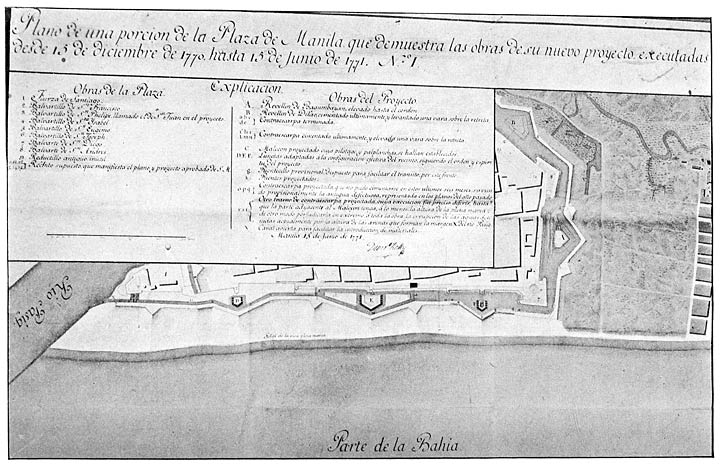
Plan of a portion of Manila, showing new works constructed December 15, 1770–June 15, 1771, drawn by the engineer Dionisio Kelly, 1771
[From MS. map (in colors), in Archivo general de Indias, Sevilla]
On Aguilar’s death (August 8, 1806), the rule of the islands was assumed by the king’s lieutenant at Manila, Mariano Fernández de Folgueras; and his first measures were for the defense of Manila, as there were rumors of another attack by the English. In the summer of 1807, there arose a rebellion in the mountains of Ilocos Norte, begun by certain Spanish deserters from Vigan in conjunction with some vagabond Indians; afterward it spread to many of the Ilocans, who resented the government monopoly of wine and prohibition of native manufacture of basi (a liquor produced by the fermentation of the juice of sugar cane). This revolt was put down without much difficulty, and the leaders were hanged at Manila; much was accomplished by the Augustinian fathers of Ilocos in restoring peace. In February, 1809, the news arrived at Manila of the French invasion of Spain, and the captivity of Fernando VII; the Manila authorities promptly declared their loyalty to that monarch. Somewhat later a French schooner of war was captured off the coast of Batangas, and the French authorities at Isle de France endeavored to persuade those at Manila that England, not France, was the enemy of Spain, and that the people of Filipinas ought to support the French interests. Folgueras answered, refusing to accept any such propositions, and would do no more than to return the French prisoners from the captured vessel.
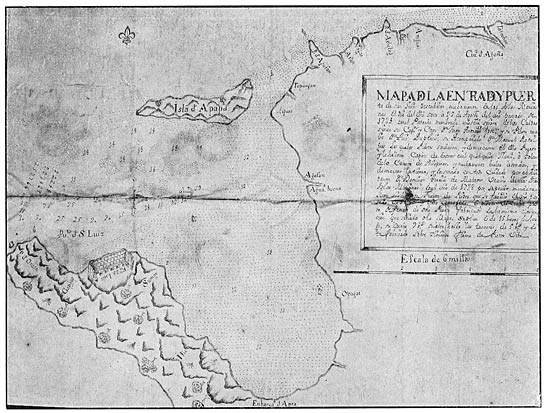
Chart of the port of San Luis, in the Marianas Islands, 1738; by Adjutant Domingo Garrido de Malavar
[Photographic facsimile from original MS. in Archivo general de Indias, Sevilla]