Volume 45 — THE COLLEGE AND UNIVERSITY OF SANTO TOMAS
Reading edition
I
ERECTION INTO A UNIVERSITY
Of the honorable apostolic and royal erection of the University of Santo Tomás of Manila
Another and very serious matter was transacted by that religious father, namely, the erection into a university of the college of Santo Tomás of Manila. That event is as follows. While that venerable father, Fray Juan Bautista de Morales, was in Roma during the years 1643 and 1644, negotiating matters touching the province, as its procurator, and the matters of China, father Fray Mateo de la Villa, who was also procurator of the province in that capital, wrote him from Madrid asking him to petition from his Holiness, Urban Eighth, who was then head of the Church, for the erection and foundation as a university in said college of Santo Tomás of Manila. He had gained for that purpose a favorable letter from his Majesty, Filipo Fourth the Great, our king and sovereign, in which his Holiness was asked to deign to concede his apostolic bull for that purpose. Father Fray Juan made his efforts, but by reason of all the matters and accidents which happened at that time, it was not accomplished. Consequently, he went to España without negotiating it that said year of 44. In that year, on the last day of July, the pontiff Urban Eighth, passed to the better life. Innocent Tenth having been elected September 15 of the same year, another letter was obtained from the king, our sovereign Filipo Fourth, for his Holiness. Since father Fray Victorio Riccio, a Florentine who had come [to España] in order to go to this province, was in Madrid, and was a very suitable person since he was an Italian, to be entrusted with that and other matters which were left pending in Roma by father Fray Juan, it was thought best to send him thither. He accomplished that as well as the other things, which have been continued in the service of the order and of this province. He is a great missionary of China, of whom this history will tell at the proper time the many things that there are to tell, for at present he is prior of the convent of Santo Domingo in Manila. The letter of his Majesty to the supreme pontiff Innocent is as follows:
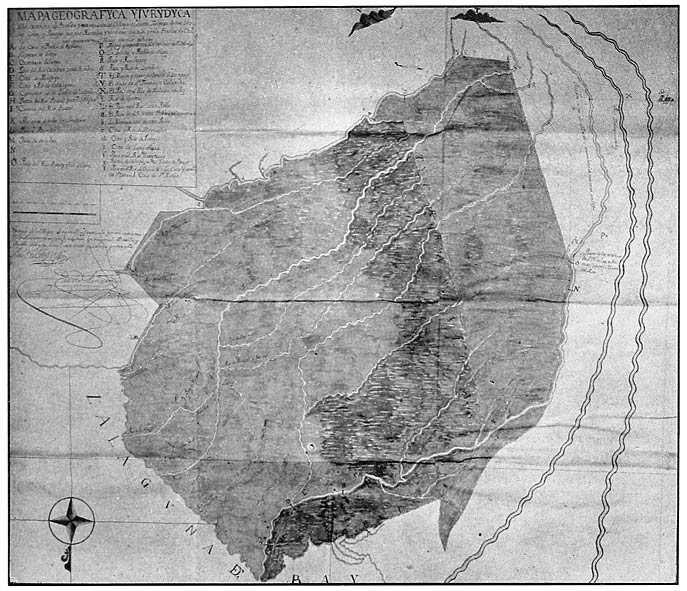
Chart of the stockfarm of Biñán, belonging to the College of Santo Tomás, of Manila, 1745; by the land-surveyor Francisco Alegre
[Photographic facsimile from original MS. in Archivo general de Indias, Sevilla]
[This letter will be found in VOL. XXXV, pp. 199, 200. The letter to the count of Ciruela, which is not given by Santa Cruz, will be found in the same volume, pp. 201–203.]
This brief was presented to the royal Council of the Indias, and the gentlemen of that council having read it, ordered a testimony of its presentation to be given July 28, 1646. That was attested on the thirty-first of the same month by Diego Lopez de Leytona y Mendoza, chief official of the papers of grace, government, and war, of the secretary’s office of the royal Council of the Indias for the district of Nueva España. The fact that he was also the chief official of the said royal Council, and that credit must be given to him, was testified by the royal notaries, Diego Carreño Aldrete, and Antonio Gomez, on the said thirty-first of July of the said year. Likewise, the said brief was presented, and the testimony of its presentation, in the royal Council of the Indias before the members of the royal Audiencia of this city of Manila. They having read it, determined that the party of the university of Santo Tomás could make use of the said brief. Consequently, they so voted by an act on the eighth of July, 1648, of which testimony was given on the said day by Captain Diego Nuñez Crespo, assembly clerk of the said royal Audiencia of Manila. Likewise, the said brief was presented before the dean and cabildo of this holy metropolitan church of Manila with the said presentations of the royal Council and Audiencia. The said gentlemen considered it as presented, and allowed the college of Santo Tomás to make use of it, and its rector, now or in the future, in the form and manner which is contained in the said bull. The clerk of the cabildo, Fernando de Caravajal, attested that on the same day on which the said act was voted, namely, July 14, 1648. This university having been inaugurated, then, and erected with so great honor into a pontifical and royal institution, its rector and first chancellor, namely, father Fray Martin Real de la Cruz, by virtue of his apostolic authority, made the necessary statutes, following in them all the custom and practice of the royal university of Mexico (of which from its beginning it has esteemed itself as the close daughter, and in which it has found the just functions of a noble mother with the exchange of letters and favors which the latter has given to it). Thus the said father rector ordained them, August 28, 1648, and they are observed inviolably and are like those of the said their royal and always noble mother, which were determined after the style and form of the most celebrated university of Salamanca.
In 1651 this university and its rector wrote to the said university of Mexico giving an account of its erection, stating that in it was born their obligation of attentive respect as daughter of that royal university, since the king our sovereign had given that university to it as mother and mistress. Consequently, it yielded and dedicated itself to that university and in regard to this the father concluded his letter with all due consideration and affection. In the year of 53, that most noble and ever famous university wrote this our university the following letter, which was written in full cloister.
Very illustrious Sirs:
After his signature were those of eight doctors and masters and lastly that of the blessed secretary, Christoval Bernardo de la Plaza. This university erected with so fortunate beginnings with all that luster worthy of all estimation, has continued to advance. There have been and are very learned persons who have studied there, who have occupied prebends and dignities in the holy church of Manila, and in other churches of our España, and it has had three sons, most worthy bishops, one of whom ascended to the archiepiscopal see of this city, of whom we shall treat in due time.
II
ROYAL DECREE GRANTING TITLE OF “ROYAL” TO THE COLLEGE OF SANCTO TOMAS
I the King
By command of the king our sovereign:
Antonio Ventura De Taranco
III
HISTORICAL ACCOUNT
[Below follows an interesting account of the university of Santo Tomás, by the Dominican friar, Evarista Fernandez Arias, from his Discurso leido en la apertura de sus estudios (de la universidad) el dia 2 de Julio de 1885—i.e., “Discourse read at the opening of its studies (of the university) July 2, 1885” (Manila, 1885). Its author was a professor of the university.]
The university of Santo Tomás, of Manila, graced with the titles of royal and pontifical by the Catholic kings and the supreme pontiffs, holds the first place among all the educational institutions of the Philippines on account of its antiquity, its history, and its importance. It was established in 1619, under the name of College of Santo Tomás, having, as its basis, a holy legacy from his Excellency, Fray Miguel de Benavides, of the Order of Preachers, second archbishop of Manila, who is considered as its true founder. By this legacy, the sum of 1,600 pesos was turned over to the fathers of his order, of the province of the Santísimo Rosario, who, accepting it, in accordance with his purposes and intentions, immediately proceeded to carry the plan into effect. Thus, after various contingencies, on the day of the festival of the Assumption of the Virgin, in the year mentioned, after having been authorized by the general government of these islands, and by both the ecclesiastical and the secular chapters, Fray Baltasar Fort, its first rector, proceeded to the inauguration of its studies by giving fellowships to twelve young men belonging to the most distinguished families of Manila. The permission granted by the general government and other authorities of this capital, was formally confirmed by his Catholic Majesty, Felipe IV, in his royal decree of November 29, 1623, in which he said of this institution: “It has afforded and affords great advantages to the young, the preaching of the gospel, and the instruction of the children of the inhabitants.”
The year following the erection of this university by Innocent X and Felipe IV, its first rector and chancellor, Fray Martin Real de la Cruz, who so distinguished himself in the conversion of the Cagayanes, framed the laws, which continued in force until 1785. The greater part of these were similar to the laws of the university of Mexico, to which his Catholic Majesty desired to conform them, as appears from his letter written on December 20, 1644, to his ambassador at Rome.
The eighteenth century arrived, and, with the coming of the Bourbon dynasty to the Spanish throne, new germs of civilization took root throughout the monarchy, and were felt as far as these remote shores. Then the faculty of jurisprudence and canonical law was established (the establishment of which the Dominican corporation had endeavored to secure years before), because with the increase of the native and mestizo population, and with the consolidation upon a religious basis of the social life of these peoples, there was not a sufficient number of lawyers for the administration of justice. Lawyers did not come from the Peninsula, and for that reason, if not for other better and more noble reasons, it was necessary to seek them within the bounds of the islands. Hence, faculties of jurisprudence and canonical law were established, with courses in Roman law and institutes and the sacred canons. The pupils could hope for the degree of licentiate in jurisprudence and canonical law after a four years’ course in these studies, and four other years called pasantía years, which were taken in connection with the law course, and were years of practice in the office of some lawyer. During these so-called pasantía years, the pupils were required to defend a proposition every week and sum up the opposing arguments, and were permitted to act as substitutes during the absence of any of the professors of the faculty.
The course of institutes and canonical law was the only course in law given in most of the universities of that period, the professors being charged with making the applications necessary to the Spanish laws and those of the Indias, explaining the points in which they differed from the Roman and canonical laws.
The instruction continued thus during the greater part of the eighteenth century, the university conferring degrees in theology, philosophy, and canonical and Roman law. The courses in moral theology and the humanities were pursued without the formalities of enrolment and without a fixed number of terms, until toward the end of that century. With the increase of the commerce and the intercourse of these islands with Europe, and under the influence of the government of Carlos III, it was decided in the university assembly of 1785, to extend the faculty of theology by the establishment of chairs in literature and sacred writings, and that of law by two additional chairs of canonical and Roman law. It was also decided to create the faculty of medicine, together with a chair of mathematics, applied to commerce and navigation in conformity with the necessities of the times. Father Amador, professor of canonical law, having been appointed to form the new laws, in accordance with the resolution of the assembly, concluded them during the same year, 1785. These laws, after being approved by the superior government of these islands, are now in force except in the points modified by subsequent laws. These laws provided that all professorships, with the exception of those belonging to the private patronage of the Order of St. Dominic, should be conferred by competitive examinations. It also prescribed rules for the conferring of academic degrees by the faculties of theology, canons, law, philosophy, and the new one of medicine, it being provided that, in order to secure the degree of bachelor of theology, canons, civil law, and medicine, it was necessary to have passed in four courses, and for philosophy in three, and that, after having obtained the title of bachelor, it was necessary to exercise the pasantía for four years in the schools of theology and law, and for three years in the other schools. Rules werealso provided for the courses, the enrolments, and the examination fees. These laws were taken to a great extent from those in force in the universities of Salamanca, Mexico, and Lima.
About that time the king of Spain confirmed the privilege of exemption from tribute for all those who had received the degree of bachelor, and also for the pupils of the university, in consideration of “the utility and necessity for this branch of the state to encourage these studies, without which no community can flourish; for, if it should be ordered, contrary to the practice observed up to the present time, that the tribute be paid, the schools would be deserted, to the general injury of these islands.”
Because of the indolence of the times and the lack of pupils, it became necessary to abolish the school of medicine and the class of mathematics and drawing, which were afterwards incorporated by the consulado, and the superior studies continued during the first part of the present century as they existed at the beginning of the eighteenth century. It was not until the year 1836, on the petition of the corporation of St. Dominic, that the chair of Spanish law was created, increasing the faculty of laws.
By a royal order of 1837, continuing the progressive course initiated in the instruction at the university, a commission, presided over by the director of the university, was appointed for the purpose of studying the method of extending the instruction, and making a report upon the manner of filling the chairs which should be created, at the same time preparing a plan of studies, conforming as far as possible with that in force in the Peninsula. The report of this commission was awaiting the decision of the court of appeals when a new royal order of April 2, 1842, provided for the appointment of a new commission, also presided over by the director of the university, and consisting of one associate justice of the royal court of appeals, a prebendary of the cathedral chapter, a member of the municipal council, and one of the economic association, for the purpose of preparing a new plan of studies in harmony with the necessities of the times. The new commission, having worked with great activity, presented its completed report, submitting a plan of laws for this university which included the college of San José, notwithstanding the opposition of its rector, who, as prebendary, formed part of the commission. According to this plan of studies, instruction in theology, philosophy, and jurisprudence was improved, chairs of medicine, pharmacy, and chemistry were created, and that of physics was extended. Upon the submission of this plan of studies to the supreme government of his Majesty, it was provided by another royal order of April 2, 1846, that funds be secured for the establishment of said change in the university, without injuring the interests of anybody, but respecting those existing in so far as possible.
Unfortunately this commission was dissolved just before the completion of its work, on account of the absence of some members in the Peninsula, there remaining only one (in addition to the rector of the university), who later resigned his membership in the commission, under date of October 28, 1848. But by a royal order of April 19, 1849, the action of this superior government in not accepting said resignation was approved, and in the place of the absent members, Señor Montes de Oca was appointed and instructions given that another competent person should associate with them, in order that the work of university reform might continue. But as the commission did not hasten the matter with the speed desired by the government of his Majesty, another royal order was issued, under date of October 19, 1852, urging the commission to conclude the plan, and budget of studies, in accordance with the wishes and the interest of his Majesty for the welfare and prosperity of this colony. However, the difficulty of reconciling very great extremes, such as the preservation, in a new plan of studies, of everything already in existence that should be in harmony with the studies of the universities of Spain, the formation of a budget without injuring the interests of anyone, and a thousand other necessary considerations, placed under the charge of the commission by more than one royal decree, were more than sufficient causes to prevent the board from finishing its laborious contract and including its complicated work in the brief period desired. Hence, it was not until February 16, 1856, that its work was done, and the long-desired plan of studies concluded. This plan was at once sent to the superior government of these islands, in order that it might finally be forwarded when it should be deemed convenient. The papers were still in the hands of the secretary of the government in March, 1859, when a fire occurred in the town of San Miguel, where said secretary resided at the time, and unfortunately the papers, in the compilation of which so much valuable labor had been expended, were burned. So unfortunate an occurrence must naturally have delayed this matter, although by chance there was in the possession of the rector of the university a copy of all these works and the previous writings of the board which were used in the compilation of the desired plan. The rector of the university was requested by the government of these islands to furnish all the previous writings in his possession on the works and plan of studies which had been destroyed while in the possession of the secretary, and which should serve as a basis for the new papers treating of the same subject.
But before sending the report to his Majesty, for his final approval, the superior government received some copies of the plan of studies newly established in the universities of the Peninsula, together with a royal order directing that it be adapted in so far as possible to the plan for these islands which was to be presented for the approbation of his Majesty. This circumstance led to the suspension of the proceedings instituted, and obliged this superior government to appoint another commission, or, rather, to complete the old one, which had already become disintegrated by the absence of some of its members, to revise the work and the plan of studies formerly proposed, and to harmonize it, if possible, with the plan of studies, a copy of which was sent to the members of the board for the purpose indicated.
Thus, on April 5, 1861, General Lemery appointed the lacking members of said commission, in which figured, as in the former commissions, the director and chancellor of this university. The commission concluded its work on February 20, 1862. The plan of studies prepared by this last commission was presented on the same day to the superior government of the islands and was finally transmitted with a favorable report to the government of his Majesty without the sovereign approval for its establishment having as yet been given.