Volume 45 — CONCILIAR SEMINARIES
Reading edition
I
SUPERIOR DECREE IN REGARD TO THE THREE PER CENT DISCOUNT FROM THE STIPENDS OF THE PARISH PRIESTS FOR THE SUPPORT OF SEMINARIES
“Manila, July 30, 1802.
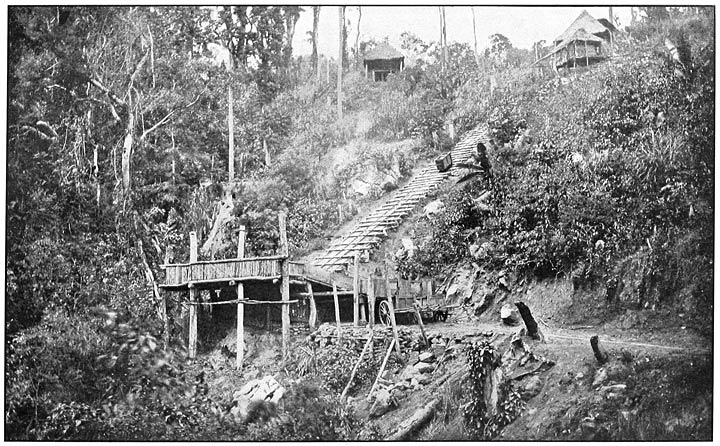
A Cebú coal mine
[From photograph procured in Madrid]
As thereafter fuller instruction was given because of what was shown in the reply of his Excellency, the bishop of Nueva Segovia, in regard to the building of the seminary of his diocese; and considering the information given by the royal officials in regard to the method to be observed for putting into practice the abovesaid exaction: I have resolved in general upon the following, which I send to you with that superior determination for its fulfilment and observance in the part touching you.
Manila, March 26, 1803. Since the collection of the three per cent, assigned to the seminaries in the manner prescribed by the royal decree of February twenty-two, one thousand seven hundred and ninety-six, is now determined to include all the parish priests of these islands with the exception of the hospitals, according to the declaration of June first, ninety-nine; and that in the cathedral churches where said seminaries are not established, they be founded, without prejudice to the fact that the above-mentioned three per cent shall be collected in the meanwhile, and deposited in a chest with three keys: it only remains to advise that one of these keys shall be held in Nueva Segovia, by the bishop of the diocese, another by the alcalde-mayor, and the third by the father sacristan placed or appointed in that church. It is to be noted that the chest shall be kept in the episcopal palace, and when the see is vacant it will go to the royal house, where the alcalde-mayor lives, for its due safety. This same order must be kept in the bishoprics of Cebú and Camarines, and information shall be given in this regard to the respective bishops; although since the first see is vacant it shall be given for the present only to his Excellency, Don Fray Domingo Collantes, who has charge of its government; and in case anything inconvenient is found in its execution, he shall have the goodness to inform this superior government in regard to what he should esteem convenient according to the situation of each church. The three per cent shall be collected by the alcaldes-mayor of Ilocos, Camarines, and Cebú, as subdelegates of the government, and the proper discount shall be made for each of the parish priests at the time of paying them their stipends, and the sum shall be placed in the above-mentioned chest in the presence of the other keyholders. For that purpose they shall send to them the proper advice, with the assignment of the day and hour in which it must be done, at the disposition of his Excellency, the prelate, and when the see is vacant, to those who shall have his key. Inasmuch as the amount collected must be placed in said chest with three keys, as ordered, a balance shall be struck at the end of each year, in the presence of the three keyholders, and a copy of it shall be sent by the subdelegates to the general superintendency, with expression of the assets which are pendent. The governors, corregidors, and alcaldes-mayor of the other provinces, shall send the amount of their collections at the order of their respective prelates, so that in the presence of the other keyholders, the same deposit may be made. Since it was determined by the above-mentioned royal decree, the persons who are to have charge of the three keys, so far as this archbishopric is concerned, are this vice-patron [i.e., the governor], his Excellency the archbishop, and the member of the cabildo who shall be elected; it is only to be noted, in order to avoid any reason from which any doubt can result prejudicial to this important object, that the peculiar provision for the collection of the three per cent corresponding to the curacies of the district, is comprehended in the preceding article; and by this methodical order, all the governors, corregidors, and alcaldes-mayor, except those of Cebú, Camarines, and Ilocos, must be guided. For the foundation of the seminary of Nueva Segovia, the alcalde-mayor shall confer with his Excellency, the bishop of that diocese, in order that they may select a site fitting for the extension which should be given to it, with respect to the number of persons whom it can maintain, and who are necessary for the discharge of the duties of the bishopric. For that purpose a plan of the work must be made by experts, and at the same time its cost must be estimated, so that after it has been sent to the superior government, with expression of the funds existing in the three per cent, and of what it is calculated that those funds will yield annually, the government may take the fitting measures, in order that the construction may not be undertaken if it must be suspended later through lack of funds. May God preserve you many years. Manila, March 26, 1803.
II
MODERN CONDITIONS
[The following is taken from Archipiélago Filipino (Washington, 1900), i, pp. 343, 344.]
There are five seminaries in Filipinas, corresponding to the archdiocese of Manila, and to the four suffragan dioceses of Cebú, Jaro, Nueva Cáceres, and Nueva Segovia, in which the bishops, in accordance with the terms of the Council of Trent, have established the training of the secular clergy. They cannot properly be said to have begun to perform their functions until 1862, when the fathers of the congregation of St. Vincent of Paul came to these islands. Those fathers took said seminaries in charge and direct them at present, with the exception of that of Nueva Segovia, which was in charge of the calced Augustinian fathers. Before the year 1862, the majority of the secular clergy was educated in the colleges of Manila, especially in that of San Juan de Letran, and in that of San José....
The expenses of the staff and those for material were paid from the proceeds of the three per cent collected by the diocesans from the allowances which a certain part of their clergy received from the government. In the seminary of Nueva Cáceres alone, were the expenses of the staff met by the royal treasury. According to the statistics of the university, the students of secondary studies in the seminary of Cebú, for the term of 1896–1897, numbered 504; those in that of Jaro, 211; those in that of Nueva Cáceres, 268; and those in that of Vigan (Nueva Segovia), 201.
[We add the following from Census of Philippines, iii, pp. 611, 612.]
In order that the branches taught herein, as well as those taught in private schools, should be considered valid and be recognized by the university of Santo Tomás, it was necessary that the pupils pay the enrolment and examination fees prescribed by said university.
The report submitted at the exposition of Amsterdam in 1883, says of these conciliar seminaries:
“... The administration of the property is under the charge of the vicar general of the archbishopric of Manila, and of the district vicars of the respective rectories, under the supervision of the bishops. The seminary of [Nueva] Segovia has been in charge of the Recoletos since the middle of 1876, when the Augustinian friars left it, and who also had charge since 1882, the Paulist fathers having the honor of having inaugurated the studies now given. These zealous priests are those at present in charge of the other seminaries.”
From statistical tables on file at present in the archives of Manila, the following facts concerning two of these conciliar seminaries may be gathered. The enrolment for the seminary of San Carlos, of Manila, from 1863 to 1886 was 971. The enrolments for the seminary of Nueva Segovia from 1882 to 1886 were: dogmatic and moral theology, 171; philosophy, first year, 181, second year, 99, and third year, 93; Latin grammar, first year, 317, second year, 301, and third year, 256; Spanish grammar, 275.
After the conciliar seminaries passed to the charge of the Paulist fathers, affairs continued in the same manner, because these priests were subject and subordinate to the rigid tutorship of the monastic orders and the universitarian feudalism which the Dominican friars exercised in the Philippine Islands, and it was not possible for them to develop their own initiative, or to explain their own opinions....
The first duties of our bishops consist in establishing a good seminary in their respective dioceses, which may serve as a training-school for new priests, educated according to the new doctrines of the independent Filipino church.
They shall exercise their whole care in seeking a suitable although modest locality, and in catechising as many young men as possible, who are fit for the lofty ministry of God. We desire that not only our church, but more than anyone else the most reverend bishops themselves recognize the great necessity for these seminaries. Consequently, their negligence in this particular will be very fatal, and merit censure.
The effort shall be made to give the young men a complete instruction, one concise and more nutritive than that of the interminable years of unnecessary dissertations and fruitless “therefores,” with which the Roman priests feed the best years of our youth.
The plan of studies shall be based on the principle that we must begin to learn the most necessary, secondly, the most useful, and thirdly, the sciences that ought to always adorn the worthy priests of God. The plan recommended in the fourth epistle of our church shall be followed.
But knowledge will be vain and useless in a priest, if he is not adorned with the Christian virtues of holiness, altruism, obedience, and zeal for the greater glory of God. Consequently, the young men shall be instructed in the practice of an ascetic and disciplined life, and they shall become accustomed to prayer, the sacraments, and the exercises of evangelization.
Adjoined to the seminaries, the effort shall be made to create Catholic schools and colleges for both sexes. Thus the selection of priests will become more easy; and furthermore, [this shall be done] inasmuch as it is of great importance for us to teach the divine teachings of Jesus Christ and the redeeming doctrines of our church to the children.
[Pp. 42, 43, of the same rules, contain the following:]
The chief bishop shall contrive ways and means, now by imposing a tax among the parish priests, now by begging alms for the support and creation of Catholic seminaries and colleges, which are very necessary for the propagation and defense of our church; as well as to comply with our most sacred obligation of evangelizing the heathen tribes, and satisfy other considerations of the subsecretaryship of the propaganda of the faith.
In all other things not covered by these rules, the chief bishop shall have power to decree, provided that he do not violate the spirit of the same, after obtaining the opinion of the superior economical Council.
[The plan of studies above-mentioned is found on pp. 67, 68, of the same book, and is as follows:]
5. The diocesan committees shall exert their efforts very earnestly in creating with all haste, seminaries, in order to be able to provide all the parishes with young and learned priests, since the scarcity of priests is the principal pretext of the Roman priests, in order that they may introduce foreign priests here. They shall endeavor to attract as great a number of students as possible, with the assurance that in two years’ time only they will be given a complete, concise, and more nutritive instruction than the interminable years of unnecessary dissertations and fruitless “therefores” with which the friars feed the best years of our young men, in order by that method to hinder the multiplication and true education of our priests.
The plan of studies which shall be followed for the present shall be as follows:
Baccalaureate
If the students are very young, they shall have to pass in all the courses of secondary instruction. But if they are twenty years old, only the following courses shall be demanded of them:
English or Spanish, geography, history, arithmetic, natural sciences (natural history, physics, and chemistry), and rhetoric.
Priesthood
1st year: Bible and theology simplified.
2d year: Amplification of the preceding course, and application of the Bible to all the problems of life, social and private, to the ceremonies and to the priestly life, and to ecclesiastical discipline.
By simply passing these courses, and if the good deportment of the students be proved, they shall be ordained as presbyters and placed in the parish churches.
But not on that account shall they cease to continue their studies, and as is now the custom among the Roman priests, they shall be examined annually, to determine whether they are fit to continue the duties of priest, in the following manner.
1st year: History of religions.
2d year: Study of the distinct philosophical and theological systems.
3d year: Canons.
4th year: The studies of the baccalaureate which they have not passed.
Those who shall have studied theology already in the Roman seminaries, shall be ordained as soon as possible as sub-deacons, deacons, and presbyters, successively.