Volume 45 — COMMERCE OF THE PHILIPPINES WITH NUEVA ESPAÑA
Reading edition
(Concluded)
PERIOD IX
[Here] is set forth what occurred in regard to the commerce of Philipinas from the year 1730 until that of 1733, in consequence of the practice of the ordinance of the year 1726, with occasion of the complaint made by the merchants of Andalucia.
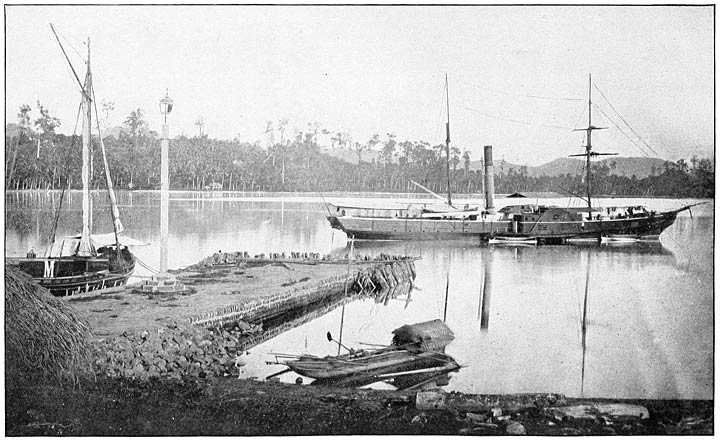
View of port of Tacloban, in the island of Leyte
[From photograph procured in Madrid]
186–188. [The viceroy’s letter was referred to the royal Council; the deputies from Filipinas—at that time, Lorenzo de Rugama y Palacio, and Miguel Fernandez Munilla—thereupon asked for all the documents belonging to the Council which bore upon this subject; the Council consented (March 26, 1733) to do so, with the reservation of certain documents, and the deputies then drew up a long memorial protesting against the proposed restrictions on their commerce.]
191–192. [This memorial was sent by the Council to the fiscal; his reply was handed in on November 10, 1733. He thinks that the islands need indispensably the traffic to Nueva España, including the Chinese silks, notwithstanding the remonstrances of the viceroy of that country; and that the prohibition made by the latter ought to be raised. Moreover, he finds that the royal treasury is the gainer by the new arrangement: the duties up to 1702 amounted to 74,000 pesos, and from that time to 1729, to 100,000 pesos; but in 1730 (the first year in which goods were shipped under the permission of 1726) the duties, including the 20,000 pesos of contribution, were 202,754 pesos, and in the following year 229,552 pesos. He would not make a positive regulation regarding the Manila-Acapulco trade until the five-years’ term is completed; but he makes the following recommendations: that the commerce be free in all kinds of goods, not excluding the Chinese silks and ribbons, but that the lading of the galleon be restricted to 3,600 piezas, of which 400 may be in those silk goods and others which do not allow the use of the press; and that the duties on all packages be the same as those specified in the decree of 1726, and that Manila be freed from the contribution of 20,000 pesos. He also recommends that Manila be allowed to send wax in cakes of eighteen (instead of twelve) arrobas net; and that his proposed arrangement be put in force for five years, in order to test its practicability—or, if the king so prefer, that the decree of 1726 be extended for another term of five years.]
198–200. [When this opinion was ready to be sent to the king, letters arrived from the governor and Audiencia of Filipinas, remonstrating against the orders of the viceroy regarding the galleon of 1734. At the same time, the Manila deputies at Madrid presented another memorial to the Council, which accordingly held a new conference over this matter. On December 23 (after having consulted the fiscal), they reported to the king their opinion, which they said had not been changed by the aforesaid despatches. The king approved of their advice in regard to recalling the viceroy’s orders, and in regard to the controverted point of the amount which should be allowed to Manila, he approved the opinion of Zuñiga and his associates, that of the increase to 500,000 and 1,000,000 pesos. The letters from the governor and Audiencia ask that the cargoes be estimated by piezas, and propose 300 or 400 chests of Chinese silk goods, instead of the 500 formerly asked; the memorial of the deputies urges that the sales for the first three of the five years had averaged only 1,350,000 pesos, and the succeeding ones could not exceed 1,200,000 pesos, which latter sum was necessary for the preservation of the islands.]
[At this point (fol. 214 verso–264) is inserted the Memorial informatorio presented to the Council of the Indias in 1637 by Juan Grau y Monfalcón, procurator-general for the Philippine Islands at the court of Madrid; we have already published this document, in our VOL. XXVII, pp. 53–212. Abreu says that he places it here (as “an appendix to Period ii”) simply because he did not find it until after the fortieth sheet of the Extracto had been printed; and he speaks of it as “treating of the subjects of that undiscovered memorial” of 136 numbers which was cited in “Period ii” of the Extracto (see our VOL. XXX, p. 25)—“plainly showing that whatever discussion of this matter has occurred in these late years, and what will be said in the future, in regard to the commerce of that region is new talk, but not talk of a new thing [es decir con novedad, pero no decir cosa nueva].” For “Periods i and ii” of the Extracto, which, with Monfalcón’s memorial, should be read as a preliminary to the present summary of that work, see our VOL. XXX, pp. 23–109. Cf. the earlier memorial by Monfalcón (1635) in VOL. XXV, pp. 48–73.]
PERIOD X
Relation is made of what occurred in regard to this commerce from November in 1734 until the present month of May in 1736, with occasion of the petition made by the consulate and commerce of Andalucia, proposing to surrender to that of Manila the traffic and transportation of all the cinnamon, pepper, and cloves which the kingdom of Nueva España can consume; and that Manila may ship the chintzes (of fine, middling, and ordinary qualities), and the silk, raw and spun [beneficiada], if these are separated from the commerce in the silken fabrics and ribbons of China.