Volume 43 — Letters from Father Mateo Gisbert to the Reverend Fathers and Brothers of Veruela
Reading edition
Dávao, January 4, 1886.
Pax Christi.
My most beloved Fathers and Brothers in Christ:
Now I have to answer your fine letter, by telling you something of these missions, which I do not doubt will interest you greatly. In this and in the other letters which I plan to write you, I shall limit myself to mentioning things which I have either seen myself or have heard from eyewitnesses.
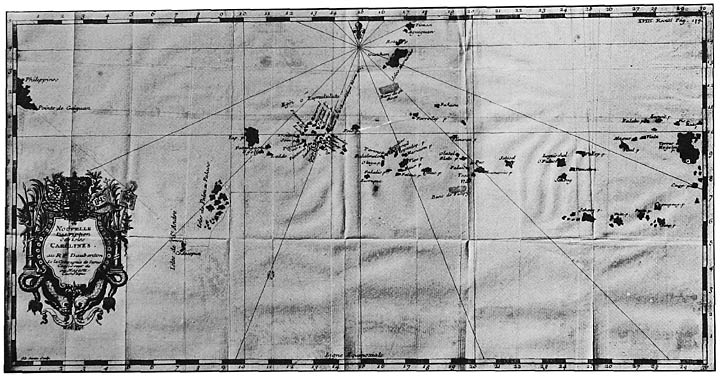
Map of the Coraline Islands; photographic facsimile of map in Lettres édifantes (Paris, 1728)
[From copy in library of Harvard University]
You must already have had news of the numerous races of heathens that people the mission of Dávao. The heathens nearest to this capital are the Guiangas, who are scattered among the rivers and rancherías of Dulían; Guimálan, Tamúgan, Ceril, and Biao, and number in all six thousand four hundred souls. They talk a language difficult to understand, for it does not resemble the languages of other races. Those heathens sow rice, maize, sweet potatoes, bananas, and sugarcane. In addition they gather a considerable quantity of wax in their forests. There are some excellent smiths among them, and in general they reveal a sufficient amount of intelligence. But since they are still in a savage state, they commit many acts of barbarism, among which are human sacrifices. As yet they have not heard a father missionary who can talk to them in their language, and only a few of those who come to Dávao have been baptized. I have had something to do at times with the nearest who understand and talk the language of the Bagobos, their neighbors. This very week I am to visit those of the Malá River where there are some Christians and catechumens who are constructing a chapel for me when I go.
The Bagobos recognize two beginnings: and say that they have each two souls. God, or Tiquiama is very good they say and has created all things, although he has been aided by other small gods who are under his orders: such as Mamale, who made the earth; Macacóret, the air; Domacólen, the mountains; and Macaponguis, the water. Of the two souls, one goes to heaven and the other to hell. For they believe that both in this life and in the other, they belong to the devil, to whom they concede the same rights and almost the same power as to God, only with the difference that the devil is very bad, and fond of blood, and the beginning of all evil and confusion. On that account, quite neglectful of God, the being whom they serve and adore in all things is the devil. When they marry, if the lovers think that it will be of any use, they make a human sacrifice so that they may have a good marriage, so that the weather may be good, so that they may have no storm, sickness, etc.: all, things which they attribute to the devil. In the same way also when they learn that there is any contagious disease, or fear death, several of them assemble and make a human sacrifice, asking the devil to let them live, since they generously offer him that victim. They also believe that the disease can be conjured. But the time that it appears that it is necessary to make a sacrifice according to the law of the Bagobos is at the death of any one of the family, before they can remove the laláoan or mourning. In that case the sacrifice announced among them as a feria or a pilgrimage is usually announced among the Christians. At the point and on the day assigned, all the sacrificers assemble, or possibly one member of each of the families who are in mourning, at times fifty or more. The value of the slave sacrificed is paid among them all, and he who pays most has the right to sacrifice first. The victims cry out at such times as long as they can and ask pity of all; but instead of pitying them, they drown the pitiful cries with the most horrible and terrifying shouts that can be imagined. If they perform the sacrifice near the Christians, then they strike without any shouts, and even gag the mouth of the victim.
But let us leave for another letter the relation of not less horrible barbarities. O Fathers and Brothers of my soul, pray for the conversion of these wretched beings, and do not be forgetful of me in your holy sacrifices and prayers.
The servant in Christ of you all,
Mateo Gisbert, S. J.
Dávao, February 8, 1886.
My dearly beloved Fathers and Brothers in Christ:
On reading the horrible sacrifices that I described in my last letter, you will have asked: “How has the father been able to learn so minutely the inhuman customs which the savages conceal so carefully in the midst of their forests?” Your Reverences will understand indeed that I have not been able to be present at those sacrifices, but they have been explained to me by the Bagobos, who, having been baptized, recount those and other barbarities of heathenism. I have learned it also from the mouth of some victims who, being at the very point of being sacrificed, managed to escape by the aid and management of the father missionary.
I am going to mention some of the customs of the Bagobos to you which must, I believe, arrest the attention because of their ridiculousness and superstition. When the Bagobos have an evil presentiment, for which it is enough for them to see a snake in the house, or that the jar breaks in the fire, etc., they hasten to their matánom, in order to have him conjure the misfortune by means of his great wisdom. The matánom, who preserves the customs and religions of their ancestors, makes a doll with his knife, giving it the face of a man, and then addressing God, says the following words: “O God, Thou Who hast created men and trees, and all things, do not deprive us of life, and receive in exchange this bit of wood, which has our face.” After that ceremony with or without the doll, they set in the water a small bag containing a little morisqueta or rice, to which they at times add a cock. By this means they think that they have rid themselves of the disease. When they are sick, they perform the diuata in their tambaro. That consists in a dish on top of a bamboo which is fixed in the ground, on which they place buyo, bonga, lime, and tobacco, while they say to their god: “We offer thee this. Give us health.” When they visit a sick person, they have the custom of placing copper rings on their wrists or on their legs, in order that the soul which they call limócod may not leave. When anyone dies, they never bury him without placing for him his share of rice to be eaten on the journey. When they harvest their rice or maize, they give the first fruits to the diuata, and do not eat them, or sell a grain without first having made their hatchets, bolos, and other tools which they use in clearing their fields eat first. The song of the limócon is for them the message from God. It is of good or evil augury according to circumstances. Accordingly, when the limócon sings, every Bagobo stops and looks about him. If he sees for instance, a fallen tree, the limócon advises him not to advance farther for the fate of that tree awaits him, and he turns back. If he sees no particular thing which indicates or prognosticates any ill, he continues, for then the song of the limócon is good. Sneezing is always a bad omen for them, and accordingly if anyone sneezes by chance when they are about to set out on a journey, the departure is deferred until next day.
There are not as a rule many thefts among the Bagobos, for they believe that the thief can be discovered easily by means of their famous bongat. That consists of two small joints of bamboo, which contain certain mysterious powders. He who has been robbed and wishes to determine the robber, takes a hen’s egg, makes a hole in it, puts a pinch of the abovesaid powder in it, and leaves it in the fire. If he wish the robber to die he has nothing else to do than to break the egg; but since the thief may sometimes be a relative or a beloved person the egg is not usually broken, so that there may be or may be able to be a remedy. For under all circumstances, when this operation is performed, if the robber lives, wherever he may be, he himself must inform on himself by crying out, “I am the thief; I am the thief;” as he is compelled to do (they say) by the sharp pain which he feels all through his body. When he is discovered, he may be cured by putting powder from the other joint into the water and bathing his body with it. This practice is very common here among heathens and Moros. A Bagobo, named Anas, who was converted, gave me the bongat, with which he had frightened many people when a heathen.
Enough for today. Another time I shall speak of the Tagacaolos, Manobos, and Atás. Meanwhile, will you pray the sacred heart of Jesus for them all and for your most affectionate brother and servant in Christ.
Mateo Gisbert, S. J.
Dávao, February 20, 1886.
My dearly beloved Fathers and Brothers in Christ:
In order that you may all be encouraged more and more to aid us with your prayers in the great undertaking that we are engaged upon, I am going to mention, as I promised, a few of the customs of several races of this mission. The Tagacaolos belong to a numerous race of heathens, who inhabit the mountains of Culáman from Sarangani to Malálag. The whole mission contains approximately about twelve or fourteen thousand. Their language is easy to understand to him who knows Visayan. They are much divided among themselves and are continually at war, the weak being the slave of the stronger, and being frequently sold to the Moros. The Bagobos almost always supply themselves from this race for their human sacrifices. Do not believe, however, that they are a people inferior to those of other races. The Tagacaolos are lighter complexioned and more docile than the other known heathens. They also have human sacrifices at times, but they easily abandon their barbarous customs.
The Atás are another race of wild and savage heathens who live in the interior. Only the ranchería of Dato Lasiá, which is the nearest, has been visited as yet. It is the least known race, but it is believed with foundation, to be the most numerous, aggregating not less than twenty-five thousand souls. They speak their own tongue. I have baptized a few Atás, by making myself understood in Visayan or Bagobo. On that day that the Atás hear a father missionary speak their language, I have no doubt of their conversion. The difficulty, even supposing that there were father missionaries who could give their work to the mission, will always be very great, because it is in the interior, through mountains, rivers, and woods remote from the coast, where there are no roads or any human aid. Nevertheless, one must pray for them, confident that God will open the way through His infinite mercy.
In the island of Sámal I have also a Christian village, where the heathen Sámals are gradually becoming reduced and baptized. There are now some hundred and thirty-seven baptized.
The other reductions in my care are all on the southern part of this coast, extending from Dávao to Malálag, inclusive. They are Malálag, Piapi, Dígos, Santa Cruz, Astorga, Daliao, Bagó, and Taumo. Among them all there are nine hundred who have been baptized. In general they follow the instructions of the father missionary docilely. Almost all of them possess their little homes on the suitable street, and many of them are beginning to cultivate cacao and other plants which are given to them here, and are highly esteemed. The majority of those baptized as yet in these reductions belong to the Tagacaolo and Bagobo races. Then follow successively the Manobos, Sámals, and Calágars. I shall also endeavor to open the door quite soon to the Guiangas, Bilanes, and Atás. In order to begin, nevertheless, as is fitting, and to carry on this work, some father missionaries are needed, not only because of the great number of the heathens to be administered, but also because they talk several languages, and have habits and customs that differ considerably among themselves.
I conclude this letter by commending myself to the holy prayers and sacrifices of all the Fathers and Brothers of that holy house. From your most affectionate servant in Christ,
Mateo Gisbert, S. J.
Dávao, July 26, 1886.
I have just received your favor of the fourteenth inst. I am very glad that you have returned from your long journey without having experienced any misfortune. Welcome to the Fathers and Brothers of the new mission! A fraternal embrace to them all!
I desired to write your Reverence a long letter, but since the post has found me alone, in Dávao, for Fathers Perelló and Moré have not returned from their excursion to Libuac, I shall not be able to write at great length, as I must attend to the other duties necessary here during the days for the steamboat. May God repay your Reverence for the charity which you extend me in the good news that you give me. What shall I tell you on this occasion? The circumstances of this mission offer me some material, especially the consideration of the condition of the various races of heathens who inhabit it, and especially the race of the Bagobos. To what extremities do their ignorance and the malice of the common enemy reduce them! This latter, being the prince of darkness, rules them thoroughly, no longer by insinuating himself and presenting himself under the forms of apparent goodness, in order to take possession of their hearts and souls without intimidating them, acting as a seductive deceiver, but in the midst of the shadows of this heathenism, he does not fear to appear so frightfully horrible and cruel as he is in reality.
I have considered, at times, as did our holy Father, Ignacio, Satan on his throne of smoke and fire, with horrible and frightful face, in the great field of Babilonia, and this formula, which is feigned by means of the imagination to aid the understanding in consideration of the truth that it claims, is here a reality. What is it but that large field inhabited by so many heathen races, whose confusion of tongues forms the labyrinth of the mission in which we work! What signifies this volcanic mountain Apo, in which the great Mandarángan lives as in his throne of smoke and fire, as is believed and related by the Bagobos, who bathe themselves in the blood of thousands upon thousands of human victims! Is not this truly the field of Babilonia, where the prince of darkness reigns? And who can tell the years of his dominion here? The Bagobos of Sibúlan usually show their antiquity by the following genealogies. Mánip, the present dato, had for father Panguílan; Panguílan was the son of Taópan; Taópan, son of Maliadí; Maliadí, son of Banga; Banga, son of Lúmbay; Lúmbay, son of Basian; Basian, son of Bóas; Bóas, son of Bató; Bató, son of Salingólop. They say that of all their ancestors, Salingólop was the most powerful, and his name was always preserved among all his descendants. Before him there were already Bagobos with the same customs as those of today, that is, they were heathens and slaves of the great Mandarángan or Satan, to whom it appears that they always sacrificed human victims. The father of Mánip was the dato of Sibúlan, who died a few months ago at a very old age (perhaps he was as much as a hundred), and whom they say had already attained to the condition of immortality, which was due to the matuga guinaua, or good heart of Mandarángan, because of the many victims that he had offered that being. It is said that when he was yet a youth, he sought a wife, but did not obtain her until he had cut off fifty human heads, as was attested by the hundred ears which he carried in a sack from the river Libagánon to Sibúlan. How many victims must that single Bagobo have offered up! Even after his death it was necessary to seal his sepulcher with the blood of human victims. For his son Mánip and his other relatives did not remove the mourning or lalaoan, as they call it, until after they had barbarously sacrificed seven slaves, according to the relation of Itang. That man fearing to be one of the victims, presented himself to the father missionary in order to place his temporal and eternal life in safety, and that was quickly done for he was baptized a while ago under the name of Juan.
I have been able to ascertain the facts about this and other horrible sacrifices through the sacrificers themselves who have been converted to the Catholic faith, who have not hesitated to relate them to me with the above details and others which I omit. The above will suffice for your Reverence to understand that human sacrifices are a real business here, and are maintained not only by Bagobos, but also by Moros and other heathen races. It is an infamous traffic which can only be wiped out by means of the civilizing action which España is exercising over Mindanao. Some heathens having been reprimanded on a certain occasion by the governor of this district in regard to so barbarous a custom, had the audacity to reply to him in the following manner: “Sir, is not every one allowed to spend his money as he pleases? Slaves answer the purposes of money among us, and we spend that money according to our pleasure and custom.”
Much more barbarous are they than the Ammonites, who sacrificed their sons to Moloch, and those other idolaters who sacrificed to Saturn, for both of them did it only several times a year, for the Bagobos sacrifice very frequently. There is no ranchería in which they do not annually make their feasts to the demon—Búsao, Mandarángan, or Daragó, for they are wont to give him these and many other names. On the day of the great assembly at the house of the dato or chief of the ranchería, they only eat and drink, sing and dance with joy, and there is no appearance of anything evil, except the scandals which reveling and the worship of Daragó generally occasion. There with cup of wine in hand, they mutually pledge one another, and yielding the word to the old man or chief of the feast, they drink toasts with him in honor of the great Daragó, whom they promise to follow and honor forever, offering to him, as did their ancestors, the blood of many human victims, so that he may be their friend and aid them in their wars. Curious persons who are present at those feasts, do not understand the language of the old men nor see anything that hints of a human sacrifice, but those who are fully initiated in the Bagabo customs, will note immediately the token of the human sacrifice which was made in the woods on the preceding day among the branches placed in the bamboo or drum, before which the old men above mentioned make their invocation to Daragó.
When any contagious disease appears, or whenever any of their relatives die, the Bagobos believe that the demon is asking them for victims, and they immediately hasten to offer them to him so that he may not kill them. They are accustomed generally to show their goodwill in the act of sacrifice in the following words: Aoaton no ian dipánoc ini manobo, tímbac dipánoc co, so canac man sapi, [that is] “Receive the blood of this slave, as if it were my blood, for I have paid for it to offer it to thee.” These words which they address to Búsao, when they wound and slash the victim, show clearly that they believe in and expect to have the demon as their friend by killing people for him. For they hope to assure their life in proportion to the number of their neighbors they deliver to death, which they believe is always inflicted by Búsao or the demon who is devoured continually by hunger for human victims.
Now it is seen, your Reverence, my Father, whether I said with reason that this place appears the kingdom of the prince of darkness as horrible and cruel as it is in reality. His subjects, or better, his slaves, although they easily comprehend the existence of a god, creator and omnipotent, since they believe as they do, that sickness and death come from Búsao, and that the latter is only fond of blood and revolution, dedicate their altars and sacrifices to him, consenting to the impious and iniquitous pact of eternal servitude, which their ancestors, deceived and reduced by the great Mandarángan, made at the foot of the Apo Volcano. Let us beseech the intercession of the angels and the saints, and especially that of the Queen and Lady, our Mother, the most holy Virgin, before God our Lord, so that by His grace, He may unite the hearts of all those who can aid us in the material and spiritual conquest of these peoples.
Here I take leave of your Reverence, saluting all the Fathers and Brothers of those colleges, to whose holy prayers and sacrifices I commend myself.
Your Reverence’s servant in Christ,
Mateo Gisbert, S. J.
Dávao, December 24, 1886.
Pax Christi. My dearly beloved Father Superior in Christ:
[Once] since the seven months in which I have been able to visit San José of Sámal, I went there lately to say mass and preach to those poor people, at that time solemnizing eight baptisms and one marriage. It is fitting for the Sámals who were always visited and cared for by the father missionaries of Dávao, to be specially visited and cared for now when some of those who formerly showed most opposition, offer themselves for baptism. During this last visit I baptized Mal-lúyan, the headman, a son-in-law of Captain Baguísan. The latter has become a fury, and refuses to allow any of those whom he calls his sácopes to be baptized, and he threatens with his gun the one who does not conform to him, and commits real outrages. He is a madman of a bad kind, worse than Búsao himself. For if the demon looses the chains of heathenism on anyone and that person becomes baptized through the mercy of God, Baguísan hastens to fasten them on again. That happened lately to Cabáis, who, one day going to get his wife in order that they two might be baptized and live in San José with two daughters already Christians, has been detained and rigorously forbidden to present himself before the father.
On account of this war against baptism by Baguísan, which is both obligatory and of long standing in Sámal, it is advisable to pay heed to that field of Christendom, so that it may increase, although that increase be but gradual, and so that the entire island may finally be converted. The appointment, by the governor, of the Christians of San José as captain, lieutenant, etc., has produced an excellent result. It might be said that those Christians are the real datos of the island, and the only ones who obey the orders that they receive, who cultivate cacao, and form a true village.
Since the Moros do not agree in any part, and much less here, where we have so many other good and numerous races, it would be very politic, in my opinion, to encourage the spirit of the Moros who are attempting to separate from their datos and panditas, so that the latter may become isolated and without any authority. If it is thought advisable to assemble them into a settlement, since, counting all the Moros of the gulf, their number does not reach five thousand, it would be an excellent thing to assemble them in one village, at a point where they can be better watched and governed. But if they were ordered to assemble in one single village, it would always be necessary to permit those Moros who wished, to separate from their datos and panditas in order that they might take root in the villages and reductions as do the other heathens. Being baptized like them, if they wish, they may do it freely without the obstacle of datos and panditas. As they are now, although there are but few here, they fill and dirty the whole thing; for scarcely is there a river or a valley whose mouth has not its dato and pandita, who, together with their sácopes, the latter of whom do not number ten at times, say that they are making a village by order of the governor. But what they are really doing is to prevent other heathens from being reduced and making a village, which would actually be of real advantage for the future.
I will close by asking your Reverence to commend me to God in your holy prayers and sacrifices.
Mateo Gisbert, S. J.
Letter from Father Pablo Cavalleria to Father Francisco Sanchez
Isabela de Basílan, December 31, 1886.
Pax Christi.
My very dearly beloved in Christ, Father Sánchez:
Replying to your favor, in which your Reverence asks for information concerning the inhabitants of this island of Basílan, I have deemed it best to write the following.
Races
The races of this island are the indigenous race and the Moros. The indigenous is Christian and there is little or nothing to say of them, since they are well known to your Reverence.
The indigenous race forms the settlement of Isabela de Basílan, consisting of some eight hundred souls.
Further sixteen families of Christian Indians reside in the visita called San Pedro de Guibáuan distant six leguas from Isabela. Their absolute lieutenant in chief is Pedro Cuévas.
The Moro race is now greatly degenerated, for many are coming down from the Bisayas who were formerly captives.
The Moros of the coast are called Sámales Laút. They are employed, although little, in fishing. They are pirates, and whenever they can do so with impunity, they capture the Christians, or the Moros of the interior themselves, or those of distant Sámal rancherías, or those of other islands. On that account there is a certain hostility between the Sámales and the Yácanes. At present, Pedro Cuévas, so far as he is able, executes justice upon those who exercise such boldness, and applies the law to them.
Among the Sámales Laút, there are Joloan Moros, and Malays.
Religion
They are not very observant in their ceremonies.
They practice baptism or gúnting, which they have learned, although badly, from the Christian captives.
For the administration of baptism, they prepare cocoanut oil, rice flour, water from the cocoanut and natural water. When the child is four or six months old, on that day that they think best, the imam takes a little of each of those ingredients abovesaid, and places them on the forehead of the child, at the same time uttering certain words from the Koran. At the end of the ceremony the feast follows, and the imam is the first to whom the large tray of food must be presented.
Marriage
The fathers or owners of the young girls rather sell than give them for wives. Fees are assigned for the petitions made by the young men to the fathers or masters of their sweethearts. Consequently, it is seldom that the young woman is given to the suitor at his first or second petition. The young woman is granted to the suitor, who pays greater or less fees, according as the family is more or less principal and as the young woman is more or less good-looking. Consequently, thirty, fifty, or more pesos are demanded for her delivery, besides the marriage feast.
The ceremonies observed by them, as I have seen them, are as follows. The groom chews his buyo as he is required, then goes into the midst of the guests, makes some wry faces, and passes his hands along his face. By that means they say that he is asking pardon of God by confessing his sins. This is called magtanbat. Then if the groom has not paid because of poverty, for a suitable banquet, some of the chiefs present strike him several blows on the back with a rattan formed like a hand, more or less numerous, according to what he has neglected to prepare for the banquet.
At intervals they play the culintíngan, and if the groom is an influential person, there is a discharge of musketry, and a cow or carabao is killed, and innumerable Moros invited in. The richer one is the more guests there are; and at intervals there is generally a war dance.
Burial
If any of the family of the deceased do not wish that guard to be made, the imams and some others circulate the rumor that the dead person has escaped and is running through the hills terrifying the passers-by. That ghost they call pañata, and until the guard has been made, that rumor does not cease to be circulated.
Religious feasts
When they unite for public worship, which is when it pleases them, the people are summoned by loud sounds produced by the blows of a stick upon a sort of drum. The imam begins an invocation in a sad tone to their impostor and reads a bit of the Koran. In the meantime the people chew buyo, talk, lie down, laugh, scream, and then they retire without either the imam or the people having understood what has been read.
The principal feast, and almost the only one that they celebrate is the maúlut or birth of Mahomet. Each ranchería, and at times each family even, celebrates it on whatever day they choose. They ought to hold it on the tenth night of the month called Rabié aual, which corresponds to the month of September. But they generally celebrate it after the harvest. This year the Moros of this place have celebrated it in December. I asked them once why they did not celebrate it on a fixed day. They replied that they celebrated it when they had food for a good feast. On the said occasions several chiefs are accustomed to meet with the imam and sing in so doleful a voice that the song appears to come from a cavern, the while the women prepare the feast. This year I have noted that the imam of Panigáyan has gone on separate days to celebrate the feast at different rancherías.
They are very superstitious, and greatly fear Saítan (the devil) whom they endeavor to placate. When the epidemic of 1882 was here, the Moros of Panigáyan, among whom the cholera made especially severe ravages (for one-half of them died), threw boatloads of food into the sea, so that on encountering them, the devil might be satisfied with the food and leave them in peace. They also hung food to the trees with the same end in view.
On that occasion, the sherif reaped a fine harvest by selling clear water, which had curative properties, as he asserted. In return for the cure they had to recite some Moro prayers. If they were cured, it was by the water; but if they were not cured, it was because they had not recited well the prayers of Mahomet. The affair did not result ill for him.
In January 1883, I had occasion to observe another superstition in Lucbútun, a Moro ranchería one legua distant from this place by sea. A sailing fragata, which they called an enchantress, because they did not descry at a distance more than its sails passed not far from the said ranchería. Then because they did not salute it, they believed that they had irritated the devil, and in order to repair the fault they made two closets, and placed in the midst of them burning brasiers and lamps.
Some Moros believe also that the sherif can by his mere will send a sickness on whom he pleases. All is for the purpose of terrifying them and so that the sherif can get whatever he wishes from them. Whenever I have opposed this error, I have asked them why, if the sherif had this power, he did not send diseases upon the Christian village, since he is hostile to the Christians, but they do not reply to the question, but remain in their obstinacy.
For their long voyages they look at the cuticáan, which is a book containing certain figures. By means of that they try to discover whether they have fortunate voyages or not.
Follies
He who knows most among them is the sherif yet his learning does not go beyond the ability to write a few words in Arabian characters. In regard to heaven and hell they know nothing more than their existence. In regard to the soul they know almost nothing.
The following is what a sherif asserted regarding heaven and hell. There are seven heavens and seven hells to express the various rewards or punishments:
1. A heaven called Yattu Atúan. Here there is only rest.
2. A heaven, [called] Firdéos. Here there are good things to eat.
3. A heaven [called] Naím. If one wishes to eat, there is plenty of food [here].
4. A heaven [called] Nauá. The water [here] has the taste that one desires.
5. Aínum naím. Here [there is] great wealth.
6. Salsabila. Here [there are] golden vessels from which to drink.
7. Jatard al Cots. Here [there are] pearls and diamonds.
Hells
1. Naruk Yahanna. Here [there is] confusion.
2. Naruk Sacar. [Here there are] contrivances and animals for inflicting torture.
3. Naruk Sigmilti. [Here there are] tortures in language.
4. Naruk abus. [Here there are] most ugly things.
5. Naruk Jauya. Here one is run through with spears.
6. Naruk Zaalt. Here one suffers thirst.
7. Naruk Jamia. Here one is tortured with fire.
So did one Tuan Sarib describe heaven and hell. On a certain occasion several chiefs and imams gathered together; and when speaking of Adam and Eve, they did not succeed in telling who were their parents, and they had recourse to the missionary in order that he might instruct them on that point. They do not know either, the day on which their Mahomet was born, or much less any of his history.
They scarcely know their era, nor do they know how old they are. Once a man asked me to tell him how old he was. They count by moons, saying “Only two moons have passed;” “Three moons from now we shall do this;” etc., etc.
Much more might be said of their errors and foolishness, but I consider this sufficient, and it would be a prolixity to adduce more facts to prove those errors and follies.
Dress
The dress consists of pantaloons narrow at the bottom and wide at the top and a tight shirt. The women dress like the men except that they cover themselves with a loosely sewed mantle (jábul) which covers them from top to toe and is fastened under the armpit thus forming folds.
They cut their hair to a little fringe on the forehead, and shave themselves. Their teeth are dyed black in order to distinguish them from the Christians.
The Sámal Moros dress in pantaloons that are tight from top to bottom.
The Moros are dirty, lazy, fickle, importunate, stingy in giving, and fond of conversation and amusements.
In their wars against the Spaniards or Christians, they build forts defended by ditches, and invested with thick earthen walls. They are fierce and bold, and when dripping with blood they fight until death on the field of battle, impelled by their hatred toward the Christian or Spaniard.
Pagcalanta acó isá Saliban Sáuan da sa Sábab aun súcut dasa. Tumulak acó salasa. Maluag can sanchata Bacucús in sacay in sa Bisan uay bantata Marayao pañab quita. Yari Saliban Sauan Mallo pa Zamboangan Bisan uay dangat Midda pa subangan. Castila piañgayu Simacat na tinuyo Catacus niangayu Ynacujan sa nag buno. Aco catcal magbuno na Ampa lasa aun co na Bauk aco dumungu na Sagui na Bismil-lá. Jida manung lasap Magcalis samsil dasak Minsan co dugu nasak Limagut parrán lisak. Un canto entonaré Que es del Saliban Sauan Para tener suerte Al embarcarme el mártes. Busca las lantacas Las armas en la embarcacion Y aunque no haya enemigos Bueno es èstar prevenidos. Este Saliban Sauan Vá para Zamboanga Aunque no haya comercio Volverá pronto. Al castila pidió Subió con traicion Sus armas pidió Se las cogió con la muerte. Yo siempre pelearé Y hasta gusto tendré si caigo Arrostraré el peligro En nombre de Dios. Tengo gusto en hablar Esgrimiré con valor el cris afilado Y aunque mi sangre corra por el suelo Tajearé al oir tocar.
A song I will chant,
In order that I may have luck
At my sailing on Tuesday.
Look after the lantacas,
The weapons at embarking;
And though there are no enemies
It is wise to be prepared.
This Saliban Sauan
Is going to Zamboanga;
Although there is no trade,
He will return quickly.
He begged from the Castilian;
He mounted treacherously;
The Castilian demanded his arms;
He got them with his death.
Ever will I fight,
And even glad will I be if I fall;
I will encounter danger
In the name of God.
I take pleasure in talking;
I will fight valiantly with my keen kris;
And although my blood is poured on the ground,
I will slash on hearing it fall.
The language that they speak consists of Tagálog, Visayan, and Malayan words. But they make no difficulty about changing, omitting, and adding letters and syllables.
This is as much as I have to tell your Reverence. Pray excuse me for not having written before, for I have already stated the reason. I beg you to overlook the faults of this document.
I have no time to copy it, for I have to go to Joló.
Your Reverence’s most affectionate servant in Christ,
Pablo Cavalleria, S. J.
Manila, April 20, 1887.
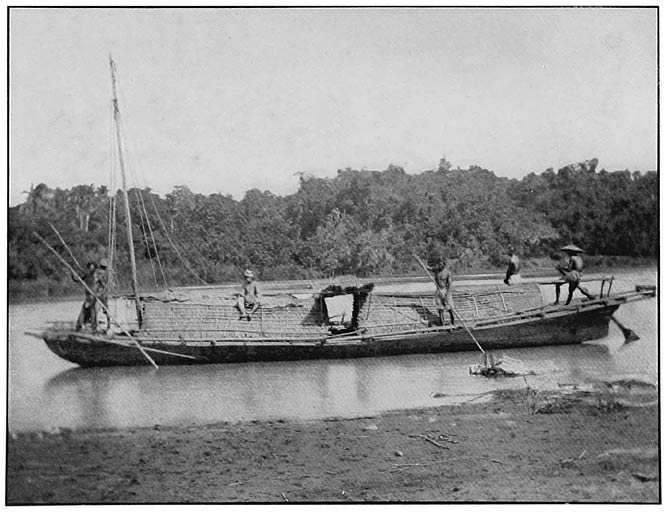
The Philippine barangay
[From photograph taken by Otto Fischer, 1888; procured in Madrid]
The new Christians, from 1876 to the present time, reach some 25,000. In their general characteristics and customs, they are not distinguished from the races to which they owe their origin. Nevertheless, after they receive holy baptism, and while they live as Christians under the civil and religious organization to which they are subjected by the father missionaries, a very marked difference is noted, for by the habit of subjection to law which they acquire by means of the mild means of Christian education which the missionary who has been able to merit their confidence, strikes, the change of their customs is facilitated in a remarkable manner, and in a short time the moral condition of their families and individuals is changed. I mean [that the above is true] when they persevere [in the Christian life] for in regard to this, there are some tribes who are more fickle than others. Thus for example, the converted Mandaya is much less inconstant than the Manobo, for the importance of being subject to a beginning of authority is more impressed on his mind.
The Mandayas (man-daya, “people of the upland”—ilaya) is a tribe extending from Tago to Mati, and from Gandía to the source of the Agúsan, and in the district below the Sálug, as may be seen at color no. 34, of the adjoined ethnographical map. The manners and customs of the Mandayas are described in a letter written by Father Héras, June 8, 1878. The Mandayas number about 30,000 of whom 8,000 are already reduced and baptized.
The Tagabili or Taga-bulú are, together with the Bilanes, the owners of the lake of Bulú-an, and live on the southern shore of that lake. This tribe is warlike and friendly to the Moros, Tirurayes, and Manobos, who live near them. The Moros of Sarangani are wont to ally themselves with the Bilanes of Bálud and Tumánao in order to fight against the Tagabilíes. I believe that their reduction will be as easy as is that of the Bilanes. In the map they occupy the place corresponding to no. 14.
The Lutangos Moros are Calibuganes. They are of a timid and peaceful nature and live in Silanga de la Olutanga. They engage in fishing, and have no other dwelling, according to Figueroa, than their vintas in which they live. Each family carries with it its miserable possessions, and they pass years without setting foot on the land for even the fuel that they need is furnished by the mangrove trees. They generally go naked. Their number does not exceed three or four hundred. On the map they occupy color no. 20.
The Calibuganes are Moro and Subano mestizos, who are peaceful and but little warlike. They share in the religion of the Moros which is altered by the superstitions of the Subanos. They are considered by the Moros as a free people, and hence the latter only exact from them personal service with their vintas. That runs at the account of the datos, on whom depend the maintenance of the same people. They live in small groups on the coasts of the peninsula of Sibuguey and occupy color number 21 on the map.
The worst Moros are those of Joló and some rancherías of the coasts of Basílan called Sámal Laut (see color no. 23); the Illanos (no. 18), who occupy the bay of Illana which gives them their name, and who form a few groups on the coasts of Sibuguey; those of the lake of Lánao; those of the valley of the Rio Grande; and those of the coast between Cottabato and the gulf of Sarangani.
The most pacific are the Yácanes Moros (no. 22) of the interior of Basílan; the Sánguiles (number 19); and those of Sarangani, except some who have come from the Rio Grande. The Moros of the gulf of Dávao and Mayo are not feared both because of their isolation and their small number.
[Continuing Father Pastells speaks of the ethnographical map that accompanies this volume of the Letters. He mentions the fact that Blumentritt published a map of like character in 1884. The present map is made from information obtained directly by the Jesuit missionaries. Concrete information as to the various dialects is still in so incipient a condition that nothing can as yet be written definitely on the subject, but Father Pastells holds out the hope that such information may be given in the near future.]