THE WEEK.
Reading edition
September 29.—This day, popularly called Michaelmas, has been observed in the Christian Church, at least since towards the close of the fifth century, as the “Feast of St. Michael and All Angels.” St. Michael has always enjoyed the reputation of preeminence over all the other angels and archangels—and some theologians, indeed, have held that he is the only archangel. The reverence paid to this name was equally great under the Jewish dispensation as it has been since the introduction of Christianity. The churches dedicated to St. Michael, in conformity to this notion of his superior dignity, have been usually erected upon elevated ground; that of St. Michael’s Mount, in Cornwall, is quoted as an instance in this country. Michaelmas is now observed in England principally as one of the four regular quarter days on which rents are paid: but both here and in other parts of Christendom the day was anciently, among all classes, one of distinguished hospitality and festive enjoyment. Our custom of dining on goose at Michaelmas has given occasion to the expenditure of a great deal of antiquarian ingenuity in the attempt to trace its origin: but it seems to have arisen merely from the circumstance of the bird being naturally in season at this time of the year. Evidence has been produced of its existence so far back as about the middle of the fifteenth century, and it may possibly be much older. The old poet Gascoigne, in the work called his ‘Posies,’ published in 1575, thus alludes to this and other similar customs, which appear to have originated in the same way:—
“And when the tenants come
To pay their quarter’s rent,
They bring some fowl at Midsummer,
A dish of fish in Lent;
At Christmas a capon,
At Michaelmas a goose,
And somewhat else at New-year’s tide,
For fear their lease fly loose.”
September 29.—The anniversary of the birth of Nelson. Horatio Nelson was born in 1758, at the parsonage-house of Burnham-Thorpe, in Norfolk, of which parish his father was rector. He went to sea at the age of twelve, as a midshipman. In 1777 he was made a lieutenant, and in 1779 a post-captain. He now went out to the West Indies in command of the Hinchinbroke, and distinguished himself by several gallant exploits on that station. While here he married Mrs. Nesbit, the widow of a physician, by whom however he had no family. But the most splendid part of Nelson’s career commenced with the war of 1793. It would be altogether impossible for us here to present even the most rapid recital of the numerous actions in which he bore a part from this date till his death. Among many bright names which illuminate this part of the naval history of England, his shines the brightest of all. Wherever the cannon thundered on the deep, it might be said, there was Nelson. When early in 1798 he presented his claim for a pension, in consequence of the recent loss of his right arm in an attack on Teneriffe, he stated in his memorial that he had been present in more than a hundred engagements. On occasion of his receiving that wound, which nearly proved fatal, he came home for a short time to England; and Mr. Southey, by whom the story of the hero’s life has been told with singular fascination, relates the following anecdote in illustration of the popular feeling with which he was regarded, which we transcribe as equally honourable to all the parties concerned:—
“His sufferings from the lost limb were long and painful. A nerve had been taken up in one of the ligatures at the time of the operation; and the ligature, according to the practice of the French surgeons, was of silk instead of waxed thread: this produced a constant irritation and discharge; and the ends of the ligature being pulled every day, in hopes of bringing it away, occasioned fresh agony. He had scarcely any intermission of pain, day or night, for three months after his return to England. Lady Nelson, at his earnest request, attended the dressing his arm, till she had acquired sufficient resolution and skill to dress it herself. One night, during this state of suffering, after a day of constant pain, Nelson retired early to bed; in hope of enjoying some respite by means of laudanum. He was at that time lodging in Bond Street; and the family was soon disturbed by a mob knocking loudly and violently at the door. The news of Duncan’s victory had been made public, and the house was not illuminated. But when the mob were told that Admiral Nelson lay there in bed, badly wounded, the foremost of them made answer, ‘You shall hear no more from us to-night:’ and, in fact, the feeling of respect and sympathy was communicated from one to another with such effect, that, under the confusion of such a night, the house was not molested again.”
Nelson’s two greatest victories, as all our readers know, were those of the Nile and of Trafalgar. The first was gained on the 1st of August, 1798, and effected the complete destruction of the enemy’s force, all their ships, except two, being either captured or sunk. For this brilliant achievement he was elevated to the peerage by the title of Baron Nelson of the Nile. The battle of Trafalgar was fought on the 21st of October, 1805; and there this renowned captain fell amidst the blaze of the most splendid triumph ever gained upon the seas. In reference to Nelson’s character as an officer, Mr. Southey says, “Never was any commander more beloved. He governed men by their reason and their affections: they knew that he was incapable of caprice or tyranny; and they obeyed him with alacrity and joy; because he possessed their confidence as well as their love. ‘Our Nel,’ they used to say, ‘is as brave as a lion, and as gentle as a lamb.’ Severe discipline he detested, though he had been bred in a severe school; he never inflicted corporal punishment, if it were possible to avoid it; and when compelled to enforce it, he who was familiar with wounds and death suffered like a woman. In his whole life Nelson was never known to act unkindly towards an officer. If he was asked to prosecute one for ill-behaviour, 256he used to answer: ‘That there was no occasion for him to ruin a poor devil, who was sufficiently his own enemy to ruin himself.’ … To his midshipmen he ever showed the most winning kindness, encouraging the diffident, tempering the hasty, counselling and befriending both.”
It is to be lamented that the private character of this gallant officer was in his later years, deeply stained by an infatuated attachment, which not only separated him from his wife, who ill deserved this desertion, but also hurried him on one occasion, in order to gratify the profligate and heartless woman who had obtained so unfortunate an ascendancy over him, into the perpetration of an act, as foreign, we may safely say, to his real nature, as it was opposed to humanity and to justice.
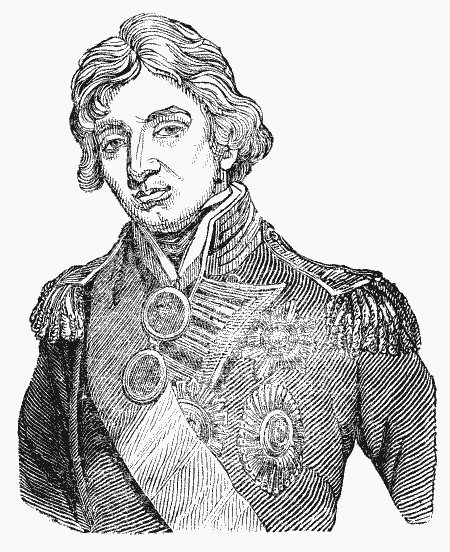
[Horatio Lord Nelson.]
October 3.—The birth-day of Dr. John Tillotson, one of the most eminent of the English prelates. He was the son of Robert Tillotson, a clothier of Sowerby, near Halifax, in Yorkshire, and here he was born in 1630. His father, who was a rigid presbyterian, educated him in his own principles. After having studied for some years at Clare Hall in the University of Cambridge, young Tillotson became tutor in the family of Prideaux, Cromwell’s Attorney-General. He had also taken orders as a preacher among the Presbyterians; but, on the passing of the Act of Uniformity soon after the King’s return, he submitted, and was presented to the rectory of Cheshunt in Hertfordshire. Although, however, he had thus conformed to the Established Church, he attached himself to that party in it which was most favourably disposed to the communion he had left; not perhaps the most common course with those who pass over from one denomination, whether religious or political, to another. In 1664 he married Miss French, daughter of Dr. French, Canon of Christ Church, and of Robina, the sister of Oliver Cromwell. He had already obtained great distinction as a pulpit-orator, and had been chosen to the honourable office of preacher to the society of Lincoln’s Inn, from which so many eminent men have stepped to the highest preferments in the church. Soon after he was also made Dean of Canterbury and one of the Prebendaries of St. Paul’s. It was while he was residing at his deanery in 1677 that the incident occurred which first introduced him to the Prince of Orange. About the end of that year the Prince arrived in Canterbury from London, accompanied by his wife the Princess Mary, to whom he had just been united, and whom he was conducting to Holland. They had been hurried from London (in order to withdraw them from the entertainments and other marks of respect which the public enthusiasm was eager to bestow upon them) in such haste, that when they reached Canterbury they found themselves so scantily supplied with money that they were obliged to apply for a loan to the corporation. After deliberating upon the matter, however, that body declined advancing the required sum. In this emergency, Dr. Tillotson hastily collected all the plate as well as cash which he possessed or could borrow from his friends, and making his way with it to the Prince’s attendant, Mr. Bentinck, (afterwards Duke of Portland,) requested that he would accept of it for the service of his master. The Prince was extremely gratified by this proof of attachment, and Dr. Tillotson was immediately introduced to their Highnesses. On the Revolution, King William appointed him his Clerk of the Closet, and soon after allowed him to exchange the deanery of Canterbury for that of St. Paul’s. On the deposition of Archbishop Sancroft in 1691 for refusing to take the oaths of allegiance to the new sovereign, Tillotson was reluctantly prevailed upon to accept the See of Canterbury. His elevation, in the peculiar circumstances in which it took place, exposed him to a great deal of bitter obloquy from the high-church party, the virulence of whose animosity was not diminished by the liberality and toleration of his demeanour in his high office, and the desire he manifested rather to conciliate the adversaries of the establishment by the removal of all unnecessary barriers of separation, than to retain what occasioned their conscientious opposition for the mere sake of abiding by whatever had once been adopted, and attempting to preserve a formal and useless consistency. He was carried off by an attack of paralysis after an illness of five days, on the 24th of November, 1694, having held the primacy only about three years, during which short space, however, he had become completely wearied and disgusted with its cares and troubles. Archbishop Tillotson’s Sermons, commonly printed in three volumes folio, or in ten volumes octavo, are still perhaps more popular and more generally read than those of any other of our old theological writers, except perhaps Dr. South, &c. They are written rather in an easy than in a very polished style, and have no pretensions to eloquence of the highest sort; but they are marked by a manly character both of expression and of thought, and by very considerable powers of argument and persuasion. The author, as has been already noticed, was one of the most favourite preachers of his day.
⁂ By the accidental substitution of one cut for another, we gave, in No. 28, a view described as the “Remains of the Parthenon,” which is really a representation of the Temple of Apollo Epicurius, near Phygalia, and which was intended to accompany an account of the Phygalian Marbles in the British Museum. We shall add a view of the Parthenon to the next article on the Elgin Marbles.
⁂ The Office of the Society for the Diffusion of Useful Knowledge is at 59, Lincoln’s Inn Fields.
LONDON:—CHARLES KNIGHT, PALL-MALL EAST.
Shopkeepers and Hawkers may be supplied Wholesale by the following Booksellers, of whom, also, any of the previous Numbers may be had:—
London, Groombridge, Panyer Alley, Paternoster Row.
Bath, Simms.
Birmingham, Drake.
Bristol, Westley and Co.
Carlisle, Thurnam; and Scott.
Derby, Wilkins and Son.
Doncaster, Brooke and Co.
Exeter, Balle.
Falmouth, Philip.
Hull, Stephenson.
Leeds, Baines and Newsome.
Lincoln, Brooke and Sons.
Liverpool, Willmer and Smith.
Manchester, Robinson; and Webb and Simms.
Newcastle-upon-Tyne, Charnley.
Norwich, Jarrold and Son.
Nottingham, Wright.
Oxford, Slatter.
Portsea, Horsey, Jun.
Sheffield, Ridge.
Worcester, Deighton.
Dublin, Wakeman.
Edinburgh, Oliver and Boyd.
Glasgow, Atkinson and Co.
Printed by William Clowes, Duke Street, Lambeth.
Transcriber’s Notes
New original cover art included with this eBook is granted to the public domain. Itemized changes from the original text:
p. 256: Added period after picture caption “Horatio Lord Nelson.”