FALLS OF THE CLYDE.
Reading edition
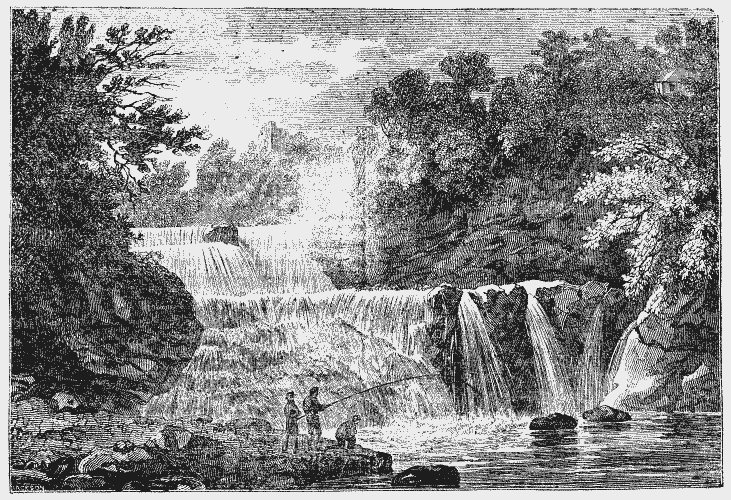
[View of Corra Linn.]
The river Clyde in the neighbourhood of the town of Lanark presents, according to the testimony of all travellers, some of the most romantic and picturesque scenery in the world. We shall confine ourselves at present to a short notice of the Linns or falls which have been so much celebrated. The word Linn, we may remark, is the Gaelic Leum, and signifies merely a fall or leap.[1] Its application to a cataract, or fall of water, is general throughout Scotland. Burns has introduced the word with very happy effect in his humorous and well-known song of Duncan Grey, where, in describing the perplexity and despair of the rejected suitor, he says—
“Duncan sighed baith out and in,
Grat his een baith bleer’d and blin’,
Spak o’ loupin’ owre a linn;
Ha, ha, the wooin’ o’t.”
“Spak o’ loupin’ owre a linn,” writes one of his correspondents, the Honourable A. Erskine, to the poet, “is a line of itself that should make you immortal.” But to return to the linns on the Clyde. The first precipice over which the river rushes, on its way from the hills, is situated about two miles above Lanark—and is known by the name of Bonnington Linn. It is a perpendicular rock of about twenty, or, as some authorities state, thirty feet in height, over which the water after 254having approached its brink in a broad sheet, smooth as a mirror, and reflecting the forests that clothe its margin, tumbles impetuously into a deep hollow or basin, where it is instantly ground into froth. A dense mist continually hovers over this boiling cauldron. From this point downwards the channel of the river assumes a chaotic appearance; instead of the quiet and outspread waters above the fall, we have now a confined and angry torrent forcing its way with the noise of thunder between steep and meeting rocks, and over incessant impediments. The scenery on both sides, however, is exquisitely rich and beautiful. A walk of about half a mile, which may be said almost to overhang the river, leads to the second and most famous of the falls, that called Corra Linn, from the castle of Corra, now in ruins, which stands in its neighbourhood. “The tremendous rocks around,” says the report on the parish of Lanark, published in Sir John Sinclair’s Statistical Account of Scotland, “the old castle upon the opposite bank, a corn-mill on the rock below, the furious and impatient stream foaming over the rock, the horrid chasm and abyss underneath your feet, heightened by the hollow murmur of the water, and the screams of wild birds, form a spectacle at once tremendous and pleasing. A summer-house or pavilion, is situated on a high rocky bank, that overlooks the linn, built by Sir James Carmichael, of Bonnington, in 1708. From its uppermost room it affords a very striking prospect of the fall; for, all at once, on throwing your eyes towards a mirror, on the opposite side of the room from the fall, you see the whole tremendous cataract pouring as it were upon your head. The Corra Linn, by measurement, is eighty-four feet in height. The river does not rush over it in one uniform sheet like Bonnington Linn, but in three different, though almost imperceptible, precipitate leaps. On the southern bank, and when the sun shines, a rainbow is perpetually seen forming itself upon the mist and fogs, arising from the violent dashing of the waters,”—as Byron has beautifully sung of the Cataract of Velino, in Italy:—
⸻“On the verge,
From side to side beneath the glittering morn,
An Iris sits, amidst the infernal surge,
Like Hope upon a death-bed, and, unworn
Its steady dyes, while all around is torn
By the distracted waters, bears serene
Its brilliant hues with all their beams unshorn;
Resembling, ’mid the torture of the scene,
Love watching Madness with unalterable mien.”
A short distance below Corra Linn is another fall called Dundaff Linn, the appearance of which is also very beautiful, though it is only about three feet and a half high. About three miles farther down, and a considerable way past the town of Lanark, is the last of the falls, that called Stonebyres Linn. It is a precipice, or rather a succession of three precipices, making together a height of sixty-four feet. The same general features of rugged rocks, here appearing in all their dreary bareness, there concealed by trees and shrubs, of wild birds winging their flight over the bounding cataract and mingling their screams with its roar, and of cultivated nature in its most luxuriant beauty contending all around with the sublimity of the untamed torrent, which belong to Corra Linn, mark that of Stonebyres also, though with some diminution of the romantic effect. A peculiar phenomenon which is to be seen here, is that of the incessant endeavours of the salmon, in the spawning season, to mount the lofty barrier by which they now find their migration from the sea for the first time opposed. Their efforts, it is almost needless to say, are quite unavailing. It is also stated that the horse muscle, the pearl oyster, and some other species of fish, which are found in great numbers below this fall, are never seen above it. Trouts, however, have been observed to spring up the small ascent of Dundaff Linn apparently without difficulty.