THE BANANA, OR PLANTAIN.
Reading edition
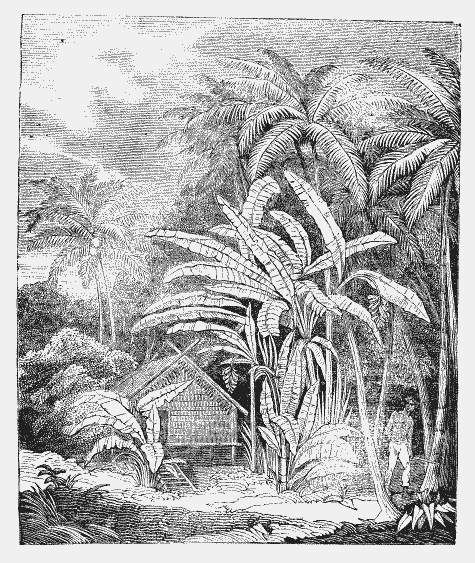
[The Banana, or Plantain Tree, with Cocoa-Nut Trees in the back-ground.]
The banana, or plantain, forms a principal article of food to a great portion of mankind within and near the tropics, offering its produce indifferently to the inhabitants of equinoctial Asia and America, of tropical Africa, and of the islands of the Atlantic and Pacific Oceans. Wherever the mean heat of the year exceeds 75° of Fahrenheit, the banana is one of the most important and interesting objects for the cultivation of man. All hot countries appear equally to favour the growth of its fruit; and it has even been cultivated in Cuba, in situations where the thermometer descends to 45° of Fahrenheit.
The tree which bears this useful fruit is of considerable size: it rises with an herbaceous stalk, about five or six inches in diameter at the surface of the ground, but tapering upwards to the height of fifteen or twenty feet. The leaves are in a cluster at the top; they are very large, being about six feet long and two feet broad: the middle rib is strong, but the rest of the leaf is tender, and apt to be torn by the wind. The leaves grow with great rapidity after the stalk has attained its proper height. The spike of flowers rises from the centre of the leaves to the height of about four feet. At first the flowers are inclosed in a sheath, but, as they come to maturity, that drops off. The fruit is about an inch in 253diameter, eight or nine inches long, and bent a little on one side. As it ripens it turns yellow; and when ripe, it is filled with a pulp of a luscious sweet taste.
The banana is not known in an uncultivated state. The wildest tribes of South America, who depend upon this fruit for their subsistence, propagate the plant by suckers. Eight or nine months after the sucker has been planted, the banana begins to form its clusters; and the fruit may be collected in the tenth and eleventh months. When the stalk is cut, the fruit of which has ripened, a sprout is put forth, which again bears fruit in three months. The whole labour of cultivation which is required for a plantation of bananas is to cut the stalks laden with ripe fruit, and to give the plants a slight nourishment, once or twice a year, by digging round the roots. A spot of a little more than a thousand square feet will contain from thirty to forty banana plants. A cluster of bananas, produced on a single plant, often contains from one hundred and sixty to one hundred and eighty fruits, and weighs from seventy to eighty pounds. But reckoning the weight of a cluster only at forty pounds, such a plantation would produce more than four thousand pounds of nutritive substance. M. Humboldt calculates that as thirty-three pounds of wheat and ninety-nine pounds of potatoes require the same space as that in which four thousand pounds of bananas are grown, the produce of bananas is consequently to that of wheat as 133:1, and to that of potatoes as 44:1.
The facility with which the banana can be cultivated has doubtless contributed to arrest the progress of improvement in tropical regions. In the new continent civilization first commenced on the mountains, in a soil of inferior fertility. Necessity awakens industry, and industry calls forth the intellectual powers of the human race. When these are developed, man does not sit in a cabin, gathering the fruits of his little patch of bananas, asking no greater luxuries, and proposing no higher ends of life than to eat and to sleep. He subdues to his use all the treasures of the earth by his labour and his skill; and he carries his industry forward to its utmost limits, by the consideration that he has active duties to perform. The idleness of the poor Indian keeps him, where he has been for ages, little elevated above the inferior animal;—the industry of the European, under his colder skies, and with a less fertile soil, has surrounded him with all the blessings of society—its comforts, its affections, its virtues, and its intellectual riches.