BRITISH MUSEUM.—No. 6.
Reading edition
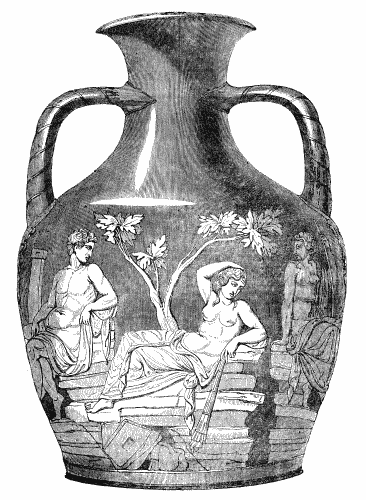
[The Portland or Barberini Vase.]
One of the proudest ornaments of the Museum is the beautiful and celebrated Portland, or, as it used to be called, Barberini Vase. It stands on a table in the middle of the small ante-room at the head of the stairs leading to the gallery of antiquities. This vase is in every respect among the most exquisite productions of art. It is undoubtedly a work of Grecian genius, and is fortunately still as perfect as when it left the hands of its fabricator. Its dimensions are small, its height being only about ten, and its diameter at the broadest part only six inches. But its shape is very elegant, the swell of the lower and central portion diminishing gradually 250to a narrow neck, and that again gracefully opening towards the lip, like an unfolding flower. It is supported by two handles, inserted at the concave or narrow part. The material is a dark but transparent blue substance, undoubtedly a sort of vitrified paste, of glass, although long supposed to be some species of stone. Upon this the figures, formed of a delicate opaque white substance, are laid in bas-relief; and so firmly are they united to the ground upon which they are thus fixed, that they seem rather to have grown out of it, and to be a part of itself, than to be fastened on by art. It is difficult, indeed, to conceive by what process the union between the two substances was effected. They must of course have been first brought into contact when both were in a soft state, and then apparently they were run together by heat. If the action of fire, however, was employed for this purpose, it has not injured the finest line in any of the figures. Every stroke is as sharp and unbroken as in the most finished delineations that were ever drawn by the pencil, or cut by the graver, or struck from the die. Of the scene represented no satisfactory explanation has yet been given, and therefore any description of the figures would be little better than a catalogue of unconnected particulars. But we may say in general that they are fashioned with admirable grace and animation, and are full of expression in every look and attitude. It is impossible not to feel that there is great dramatic force and pathos in the sketch, even without being able to interpret it completely. The Portland vase was discovered about the middle of the sixteenth century, enclosed in a sarcophagus, within the monument of the Emperor Alexander Severus and his mother Julia Mamæa, commonly called the Monte del Grano, about two miles and a half from Rome, on the Frescati road. The sarcophagus itself, which is a very noble work of art, is still in Rome, and the vase also remained for more than two centuries in the palace of the Barberini family in the same city, of which it was considered to form one of the chief ornaments. At last it fell into the hands of Sir William Hamilton, from whom it was purchased nearly forty years ago by the Duke of Portland. A mould of the Barberini vase was taken at Rome before it came into the possession of Sir William Hamilton, by the gem-engraver Pechler; and from this the late Mr. Tassie, the celebrated modeller, took sixty casts in plaster of Paris, and then broke the mould. Some very beautiful imitations of it have also been fabricated by the Wedgewoods, in which not only the shape, but the colour of the original has been attempted to be preserved. Modern art, however, cannot imitate the vitrified appearance of the material in the ancient vase.