WESTMINSTER ABBEY.
Reading edition
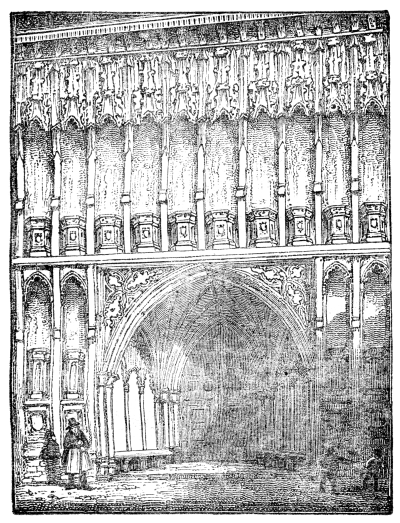
[Western Entrance.]
This magnificent and venerable pile, the second architectural glory of our metropolis, is, like St. Paul’s, the last of several successive structures which have occupied the same spot. The ground on which Westminster Abbey stands was anciently part of a small island, called Thorney Island, or the Isle of Thorns, formed by a branch of the Thames. This branch, leaving the main course of the river near the end of Abingdon Street, ran in a westerly direction along the line of the present College Street, and the south side of Dean’s Yard. It then turned northwardly, skirting the western side of Dean’s Yard, and, crossing Tothill Street, continued its course along Prince’s Street (then Long Ditch). From thence it ran in an eastern direction along Gardener’s Lane, crossing King Street, Parliament Street, and Cannon Row (formerly Channel Row), and rejoined the river near the southern termination of Privy Gardens. The hollow bed of this water-course is still mostly preserved, forming part of the sewers; and in the twelfth century, and probably for a long time afterwards, the open stream was crossed by a bridge at the place where it passed through King Street. Originally, as was indeed the case with the borders of the Thames along nearly the whole of its course to the sea, the ground beyond this hollow was probably to a considerable distance a mere marsh. There is reason to conclude that this was the case almost as far as the present Chelsea Water-Works in one direction, and to the north side of St. James’s Park in another. The island itself may be supposed to have been nearly in the same state. It is said to have derived its name of Thorney from the quantity of thorns with which it was covered. As our old legends have placed a temple of Diana on the site of the present Cathedral of St. Paul’s, so they have conceived it necessary to maintain the equal honour of the Abbey Church by making it the successor of a temple to Apollo; of the existence of which, however, no traces ever have been found. Thorney Island, nevertheless, is generally considered to have had its Christian church as early as its rival in sanctity, the mount on which St. Paul’s is built. The account which has been commonly received is, that Sebert, King of Essex, having been baptized about the year 605, immediately afterwards, to give proof of the sincerity of his conversion, built a church here and dedicated it to St. Peter. It is certain that Sebert was in old times universally regarded as the original founder of the Abbey; no better evidence of which can be desired than the care which is known to have been taken on more than one occasion to preserve his remains and those of his queen Ethelgotha on the repair or reconstruction of the building, and to re-deposit them in the most honourable place within it. Some writers, however, have contended that this church could not really have had any existence till more than a century after the time of Sebert. According to other accounts, again, Sebert was not only the founder of Westminster Abbey, but also of St. Paul’s Cathedral. So imperfect, obscure, and perplexing are the notices that have come down to us of those times.
A fable of no ordinary audacity was invented by the monks in regard to the first consecration of this Abbey. It was pretended that the ceremony had been actually performed by St. Peter in person. We need not repeat the circumstantial details of the story; suffice it to mention, that towards the middle of the thirteenth century the brethren of the monastery actually sued the minister of Rotherhithe for the tithe of the salmon caught in his parish, on the plea, as Fleta informs us, that St. Peter had given them this right at the time when he consecrated their church. After the death of Sebert, his subjects relapsed into paganism, and the church fell into decay. It was restored by the celebrated Offa, King of Mercia, but was again almost entirely destroyed in the course of the Danish invasions. King Edgar, instigated by St. Dunstan, in the year 969, once more repaired the establishment, and endowed it both with lands and privileges. But it was Edward the Confessor who, nearly a century after this, first raised it to the consequence which it has ever since maintained. This monarch, having fixed upon the Abbey for his burial-place, resolved to rebuild it from the foundation, and spared no cost in his endeavour to render the structure the most magnificent that had ever been erected in his dominions. He devoted to the work, we are told, “a tenth part of his entire substance, as well in gold, silver, and cattle, as in all his other possessions.” It was completed in the year 1065, and the 28th of December, the day of the Holy Innocents, was appointed for its dedication. The King, however, was seized on Christmas-day with the illness which proved fatal on the 4th or 5th of January following; and he was not, therefore, present at the ceremony. On the 12th of January his body was interred with great pomp before the high altar; and the Abbey has since received the remains of many of his royal successors. Here also, on Christmas-day the year following, was performed the coronation of William the Conqueror; and in the same place has been crowned (with the single exception, we believe, of Edward V.) every prince who has reigned in England during the nearly eight centuries that have since elapsed.
The structure raised by the Confessor (which was built in the form of a cross, and is supposed to have been the first English church built in that form) remained without receiving any repairs or additions till the reign of Henry III. That king, finding the eastern portion of the edifice much wasted by time, took it down, and began to rebuild it in a style of still greater magnificence than before. Edward I. and succeeding monarchs continued the work which had been thus commenced; but, owing probably in great part to the distracted state of the kingdom, it proceeded so slowly that it was still incomplete when Henry VII. came to the throne, towards the close of the fifteenth century. Henry added the chapel dedicated to the Virgin, which is commonly known 141by his name, and which, admirably restored as it has recently been, may challenge competition, not certainly in magnitude or grandeur, but in elegance and richness of ornament, and in what we may almost call gem-like beauty and perfection, with any specimen of architecture which the world has elsewhere to show. The principal repairs or alterations that have been made since the time of Henry VII., are those executed by Sir Christopher Wren, under whose superintendence the western towers, which had been till then of unequal heights, were raised to the same elevation, and the whole building was strengthened and renovated. These, it must be confessed, are not in the best taste. Sir Christopher, who despised Gothic architecture, was not the most fit person to be employed in restoring such a structure.
The following wood-cut is a view of the Abbey, from St. James’s Park, before the alterations of Wren. It is copied from a very rare print.
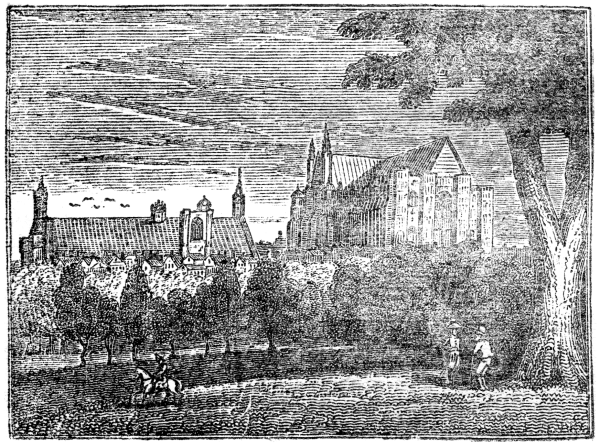
[Westminster Abbey and Hall.]
It is impossible for us, within our narrow limits, to attempt either an enumeration of the various curiosities and objects of interest which this Abbey contains, or even any description of the form and architectural character of the building. What is properly the church is in the form of a cross; but its eastern end is surrounded by chapels, varying both in their shape and dimensions. Of these there were formerly fourteen; there are still twelve; and although that called Henry VII.’s stands out from the rest in richness and beauty, several of the others also display considerable luxury of decoration. Here, as probably all our readers are aware, is preserved the famous stone which was brought from Scone in Scotland, by Edward I. in 1296, and upon which our kings have since been crowned. But the principal attraction of Westminster Abbey to the generality of its visitors, arises from the numerous tombs which it contains, some of which are monumental erections of great splendour. Here, all around us, and under our feet, are the mouldering remains of kings, queens, nobles, statesmen, warriors, orators, poets—of those who have been most illustrious during the successive centuries of our history, for rank, power, beauty, or genius. This is surely a field of graves that cannot be trodden by any without emotion, or without many of those thoughts that make us both wiser and better. “I know,” says Addison, in a paper on this subject, “that entertainments of this nature are apt to raise dark and dismal thoughts in timorous minds and gloomy imaginations; but, for my own part, though I am always serious, I do not know what it is to be melancholy; and can therefore take a view of nature in her deep and solemn scenes, with the same pleasure as in her most gay and delightful ones. By this means I can improve myself with those objects which others consider with terror. When I look upon the tombs of the great, every emotion of envy dies in me; when I read the epitaphs of the beautiful, every inordinate desire goes out; when I meet with the grief of parents upon a tombstone, my heart melts with compassion; when I see the tomb of the parents themselves, I consider the vanity of grieving for those whom we must quickly follow; when I see kings lying by those who deposed them, when I consider rival wits placed side by side, or the holy men that divided the world with their contests and disputes, I reflect with sorrow and astonishment on the bitter competitions, factions, and debates of mankind. When I read the several dates of the tombs, of some that died yesterday, and some six hundred years ago, I consider that great day when we shall all of us be contemporaries, and make our appearance together.”
Perseverance.—King Robert Bruce, the restorer of the Scottish monarchy, being out one day reconnoitring the enemy, lay at night in a barn belonging to a loyal cottager. In the morning, still reclining his head on the pillow of straw, he beheld a spider climbing up a beam of the roof. The insect fell to the ground, but immediately made a second essay to ascend. This attracted the notice of the hero, who, with regret, saw the spider fall a second time from the same eminence, It made a third unsuccessful attempt. Not without a mixture of concern and curiosity, the monarch twelve times beheld the insect baffled in its aim; but the thirteenth essay was crowned with success: it gained the summit of the barn; when the King, starting from his couch, exclaimed, “This despicable insect has taught me perseverance: I will follow its example. Have I not been twelve times defeated by the enemy’s force? on one fight more hangs the independence of my country.” In a few days his anticipations were fully realized by the glorious result to Scotland of the battle of Bannockburn.