THE CAPE BUFFALO—BOS CAFFER.
Reading edition
[From a Correspondent.]
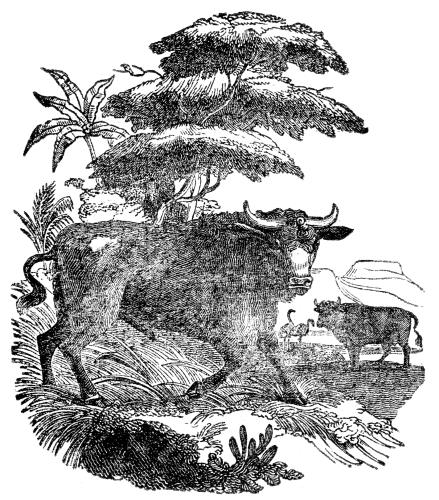
[Cape Buffalo.]
Of the South African buffalo I had not many opportunities for personal observation during my residence in that part of the Cape Colony of which this animal is still an inhabitant; but, living among people by whom he is frequently and eagerly hunted, I heard a good deal of his character and habits, which may be comprised in the following sketch.
The Boors and Hottentots describe the buffalo to be, what his aspect strongly indicates, an animal of a fierce, treacherous, and cruel disposition. Even when not provoked by wounds or driven to extremity in the chase, they say he will attack, with the utmost ferocity, his great enemy man, if he happens to intrude incautiously upon his haunts; and what renders him the more dangerous is his habit of skulking in the jungle, when he observes travellers approaching, and then suddenly rushing out upon them. It has been remarked, too, (and this observation has been corroborated by the Swedish traveller Sparrman,) that if he succeeds in killing a man by goring and tossing him with his formidable horns, he will stand over his victim afterwards for a long time, trampling upon him with his hoofs, crushing him with his knees, mangling the body with his horns, and stripping off the skin with his rough and prickly tongue. This he does not do all at once, but at intervals, going away and again returning, as if more fully to glut his vengeance.
Although I have no reason to question the truth of this description, it ought to be qualified by stating that though the buffalo will not unfrequently thus attack man, and even animals, without any obvious provocation, yet this malignant disposition will be found, if accurately inquired into, the exception rather than the rule of the animal’s ordinary habits.
The bos caffer is no more a beast of prey than the domestic ox, and though much fiercer as well as more powerful than the ox, and bold enough sometimes to stand stoutly on self defence even against the lion, it is, I apprehend, nevertheless his natural instinct to retire from the face of man, if undisturbed, rather than to provoke his hostility. The proofs that are adduced of his vicious and wanton malignity arise chiefly from the following cause. The males of a herd, especially at certain seasons of the year, contend furiously for the mastery; and after many conflicts the unsuccessful competitors are driven off, at least for a season, by their stronger rivals. The exiles, like some other species of animals under similar circumstances[1], are peculiarly mischievous; and it is while skulking solitarily about the thickets, in this state of sulky irritation, that they most usually exhibit the dangerous disposition generally ascribed to the species.
It is, nevertheless, very true that the Cape buffalo is, at all times, a dangerous animal to hunt; as, when wounded, or closely pressed, he will not unfrequently turn and run down his pursuer, whose only chance of escape in that case is the swiftness of his steed, if the huntsman be a Colonist or European. The Hottentot, who is light and agile, and dexterous in plunging like an antelope through the intricacies of an entangled forest, generally prefers following this game on foot. Like all pursuits, when the spirit of enterprise is highly excited by some admixture of perilous adventure, buffalo hunting is passionately followed by those who once devote themselves to it; nor do the perilous accidents that occasionally occur appear to make any deep impression on those that witness them. The consequence is, that the buffalo is now nearly extirpated throughout every part of the Cape Colony, except in the large forests or jungles in the eastern districts, where, together with the elephant, he still finds a precarious shelter.
It was in this quarter that the following incident in buffalo hunting, which may serve as a specimen of this rough pastime, was related to me by a Dutch-African farmer, who had been an eye-witness of the scene some fifteen years before. A party of Boors had gone out to hunt a troop of buffaloes, which were grazing in a piece of marshy ground, interspersed with groves of yellow wood and mimosa trees, on the very spot where the village of Somerset is now built. As they could not conveniently get within shot of the game without crossing part of the valei or marsh, which did not afford a safe passage for horses, they agreed to leave their steeds in charge of their Hottentot servants and to advance on foot, thinking that if any of the buffaloes should turn upon them, it would be easy to escape by retreating across the quagmire, which, though passable for man, would not support the weight of a heavy quadruped. They advanced accordingly, and, under cover of the bushes, approached the game with such advantage that the first volley brought down three of the fattest of the herd, and so severely wounded the great bull leader that he dropped on his knees, bellowing with pain. Thinking him mortally wounded, the foremost of the huntsmen issued from the covert, and began reloading his musket as he advanced to give him a finishing shot. But no sooner did the infuriated animal see his foe in front of him, than he sprang up and rushed headlong upon him. The man, throwing 138down his empty gun, fled towards the quagmire; but the savage beast was so close upon him that he despaired of escaping in that direction, and turning suddenly round a clump of copsewood, began to climb an old mimosa tree which stood at the one side of it. The raging beast, however, was too quick for him. Bounding forward with a roar, which my informant (who was of the party) described as being one of the most frightful sounds he ever heard, he caught the unfortunate man with his horns, just as he had nearly escaped his reach, and tossed him in the air with such force that the body fell, dreadfully mangled, into a lofty cleft of the tree. The buffalo ran round the tree once or twice apparently looking for the man, until weakened with loss of blood he again sunk on his knees. The rest of the party then, recovering from their confusion, came up and despatched him, though too late to save their comrade, whose body was hanging in the tree quite dead.