THE WEEK.
Reading edition
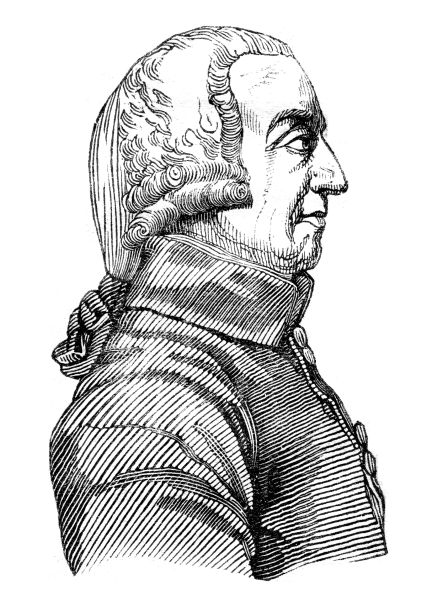
June 5.—The anniversary of the birth of Adam Smith, the celebrated author of the ‘Wealth of Nations.’ He was born in 1723, at Kirkaldy, in the county of Fife, in Scotland, where his father, who died, however, a few months before he came into the world, was comptroller 94of the customs. He was of delicate health from his infancy: and in consequence, although he was put to school in his native town, he mixed but little in the out-of-door sports and exercises of his more robust companions; but during the hours he was not in school occupied himself for the most part with his books at home. In 1737 he was sent by his mother to the university of Glasgow, and three years after from thence to Baliol College, Oxford, on one of several exhibitions, or yearly allowances, to which Glasgow students are entitled while pursuing their studies at that college. The intention of Smith’s relations was that he should enter into orders, with the view of becoming a clergyman in the Scotch episcopal church. After remaining at Oxford, however, for above eight years, he gave up all thoughts of this distinction, and, returning to Scotland, introduced himself to public notice by delivering a course of lectures on rhetoric and the belles lettres in Edinburgh. The ability with which he acquitted himself in this attempt brought him the notice and the friendship of Lord Kames, and several other distinguished literary men who then resided in the Scottish capital; and in 1751 he was, through their influence and his own reputation, elected to the professorship of logic in the university of Glasgow, which he exchanged the year following for the chair of moral philosophy. He held this situation for about twelve years, during which time the eloquence and originality of his lectures rendered him the chief ornament of the seminary, and attracted crowds of students to his class from all quarters. His mode of lecturing was not to write out what he intended to say; but, after making himself completely master of his subject, to trust to the moment for expression; and in this way, we are told, he never failed to keep up the eager attention of his audience to the discussion of even the most difficult and abstract parts of his subject. In 1759 he gave to the world his first publication, the ‘Theory of Moral Sentiments.’ It was an exposition of the leading metaphysical views which he had been in the habit of addressing to his class, the design being to show that all our feelings and judgments with regard to the morality of different actions arise from, and are regulated by, the principle of sympathy, which accordingly he makes the fundamental characteristic of our mental constitution, and that without which we could not exist as social beings. This work, when it first appeared, was more applauded for its ingenuity and the subtlety of thought and beauty of expression by which many parts of it were marked, than for the conclusiveness of its reasonings; but still it brought to its author a large accession of admiration and fame. In 1763 Smith was induced to resign his professorship for the purpose of accompanying the Duke of Buccleuch on a tour to France and other parts of the Continent. He was absent from England about three years, the greater part of which was spent in Paris, where he made the acquaintance of all the distinguished literary men of that capital. After his return home, in 1766, he retired to his native town of Kirkaldy, and taking up his abode in the house of his mother, spent the next ten years in seclusion and hard study. The result was the publication, in the year 1776, of his ‘Inquiry into the Nature and Causes of the Wealth of Nations,’ a work which may almost be said to have done for political economy what Sir Isaac Newton’s Principia did for physical science—laid for it, namely, that new foundation upon which all that has since been done has been reared. But of this great work we shall present our readers with a more detailed account in an early number, under the head of the ‘Library.’ They still, we believe, show at Kirkaldy the room in Smith’s house in which the ‘Wealth of Nations’ was written, with the impression left upon the wall by the head of the philosopher as he used to lean back in his chair, buried in profound thought. Though but a simple memorial, it is one of which his townsmen may well be proud. In 1778, through the interest of the Duke of Buccleuch, Smith was appointed to the lucrative office of commissioner of the customs, in consequence of which he removed with his mother to Edinburgh, and here he spent the remainder of his life in comfort and affluence. He died on the 8th of July, 1790, in the sixty-eighth year of his age.
June 6.—This is the birth-day of Peter Corneille, the greatest of the French dramatists, who was born at Rouen in 1606. He was educated for the bar. A love adventure which befel him after he had practised for some years as an advocate in his native city first turned his thoughts to dramatic composition, and furnished him with the subject of his comedy entitled Mélite. The success of this piece, when it was exhibited at Paris, was so great that Corneille determined for the future to devote himself to writing for the stage. Several of his next efforts were also comedies; but in 1636 he produced his tragedy of Medea, and, soon after, that of the Cid, compositions in which his genius first displayed itself in its natural region and in its true grandeur. The ‘Cid’ was followed by a succession of other tragedies—among which those entitled Horace and Cinna are especially celebrated, and remain to this day unrivalled in the dramatic literature of his country. Corneille’s reward during his life-time, however, consisted of little else than his glory; for it is related that after the death of Colbert, a pension which that minister had bestowed upon him was withdrawn, though he was then poor, old, sickly, and dying, and it was only on the intercession of Boileau, who generously offered to resign his own pension on condition of Corneille’s being restored to him, that the king, Louis XIV., was moved to make him a present of 200 louis d’ors. Corneille, after he dedicated himself to the drama, exhibited a remarkable example of devotion to the path which he had chosen—studying, we are told, scarcely anything except what bore, or might be made to bear upon his favourite pursuit. This great man died on the 1st of October, 1684.
June 8.—The birth-day of John Dominic Cassini, a very celebrated astronomer, and the progenitor of a son and a grandson of nearly equal eminence in the same department of science. His family was noble, and he was born in Piedmont in the year 1635. The accidental perusal, while he was yet very young, of a work on astronomy, first inspired Cassini with a taste for that study; and so extraordinary was the progress he made that, in 1650, being then only about fifteen, he was, on the invitation of the Senate of Bologna, appointed to the professorship of mathematics in that university. Two years after this he observed with remarkable care, a comet which appeared and confirmed the opinion which Tycho Brahe had published long before respecting the nature of these bodies, proving, in opposition to the ancient doctrine, that they were not mere meteors. He also this same year resolved an astronomical problem which had baffled the ingenuity of the greatest of his predecessors and contemporaries, and which even Kepler had given up in despair. This brilliant success at so early an age was followed in the case of Cassini by a corresponding eminence in his maturer years. In 1669 he left Bologna for Paris on the earnest invitation of Louis XIV., and was immediately made a member of the Academy and Astronomer Royal. On the completion of the Royal Observatory, in 1671, he was appointed to preside over it. The rest of his life was spent, as the preceding part of it had been, in the service of his favourite science. Even the loss of his sight, some years before his death, although it terminated his actual observation of the heavenly bodies, failed to withdraw his mind from its wonted field of speculation. He died in 1712, at the age of seventy-seven, leaving many able works on astronomical and mathematical subjects.
95