THE CROCODILE.
Reading edition
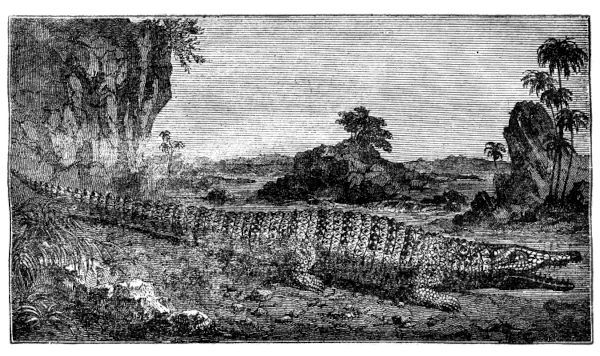
We have already translated an account of the mode of killing the hippopotamus, from Dr. Rüppell’s Travels; to which we shall now add, from the same writer, a description of the somewhat similar way in which the crocodile is caught by the natives of Dongola.
“The most favourable season for catching the crocodile is the winter, when the animal usually sleeps on sandbanks to enjoy the sun; or, during the spring, after pairing-time, when the female regularly watches the sand-islands where she has buried her eggs. The native spies out the place, and on the south side of it (that is, to the leeward) he makes a hole in the sand by throwing up the earth on the side on which he expects the crocodile. There he hides himself, and if the crocodile does not observe him, it comes to the usual place and soon falls asleep in the sun. Then the huntsman darts his harpoon with all his might at the beast. To succeed, the iron end ought to penetrate at least to the depth of four inches, in order that the barb may hold fast. The wounded crocodile flies to the water, and the huntsman to his canoe, with which a companion hastens to his assistance. A piece of wood fastened to the harpoon by a long cord swims on the water, and shows the direction in which the crocodile is moving. The huntsmen, by pulling at this rope, draw the beast to the surface of the water, where it is soon pierced by a second harpoon.
“The dexterity consists in giving to the spear sufficient strength to pierce through the coat of mail which protects the crocodile, who does not remain inactive after he is wounded, but gives violent blows with his tail, and tries to bite asunder the harpoon rope. To prevent this, the rope is made of thirty different thin lines, placed side by side, and tied together at intervals of every two feet, so that the thin lines get entangled and fastened in the hollows of the animal’s teeth. Very frequently the harpoons, through the pulling, break out of the crocodile’s body, and it escapes. If I had not seen the fact with my own eyes, I could hardly have believed that two men could draw out of the water a crocodile fourteen feet long, fasten his muzzle, tie his legs over his back, and finally kill the beast by plunging a sharp weapon into his neck, and dividing the spinal nerve. The iron part of the harpoon which is used by the huntsmen is a span long; towards the point it is formed like a penknife, being sharp at one end and on one side. There is a strong barb immediately following the edge, and at the other end is a projecting piece to which the rope is fastened. This iron is put on a wooden shaft eight feet long.
“The flesh and fat of the crocodile are eaten by the Berbers, among whom they pass for a dainty bit. Both parts, however, have a kind of musk smell so strong, that I could never eat crocodile’s flesh without vomiting afterwards. The four musk glands of the crocodile are a great part of the profit which results from the capture, as the Berbers will give as much as two dollars in specie for the four glands, which they use as a perfumed unguent for the hair.”
When Herodotus was in Egypt about 450 years before the Christian era, the following was the way in which this formidable reptile was taken prisoner:—
“There are many ways of catching crocodiles in Egypt, but the following seems to me best worth relating. The huntsman puts the chine of a pig as a bait on a hook, and lets it down into the river. In the mean time he takes his station on the bank, holding a young pig, which he beats in order to make it squeal out. The crocodile, on hearing this, makes towards the sound, but meeting with the bait on his way he swallows it down. Then the men begin to pull, and after he is fairly hauled out on dry land, the first thing the huntsman does is to plaster the crocodile’s eyes up with mud. If he can succeed in doing this, there is no difficulty in managing the beast; otherwise it is a very troublesome affair[1].”
The different treatment which this monster received in different parts of ancient Egypt is curious, and not very easily accounted for. In the southern parts, near the cataracts, the crocodile was an article of food, but probably only with a particular caste, as in Dongola at the present day. In other parts, as at Thebes and near the great Lake Moeris (now Keroun), it was fashionable to have a pet crocodile, who was fed daintily and treated with great respect. “They put,” says Herodotus, “pendents of glass and gold in their ears, and 90rings round their fore-legs: they also give them a regular allowance of bread and meat, and take all possible care of them while alive. When they die, the Egyptians embalm them and put them in sacred sepulchres.” Fortunately for the credit of Herodotus, a mummy of a crocodile has been found with his ears pierced for pendents, which fact is particularly mentioned by M. Geoffroy St. Hilaire[2].
Strabo tells an odd story of a crocodile which he saw when he visited Egypt, somewhat more than 400 years after the visit of Herodotus. “In this district they honour the crocodile very much, and they have a sacred one which lives by itself in the lake, and is quite tame to the priests. He is called Suchus, and is fed with bread, and meat, and wine, which he gets from strangers who come to see him. Our host, who was a person of importance in the place, accompanied us to the lake, taking with him from table a small cake, some roasted meat, and a little cup full of some sweet liquor. We found the crocodile lying on the margin of the lake. The priests went up to him, and while some opened his mouth, another crammed into it, first the cake, then the meat, and, last of all, poured the drink down his throat. The crocodile, after this treat, jumped into the lake, and swam over to the other side[3].” In the Townley Gallery of the British Museum (Room VI. No. 88) there is a piece of sculpture representing a man mounted on the back of a crocodile, in a singular attitude, which will be best understood by a visit to the Museum.