THE NIGHTINGALE AND GLOW-WORM.
Reading edition
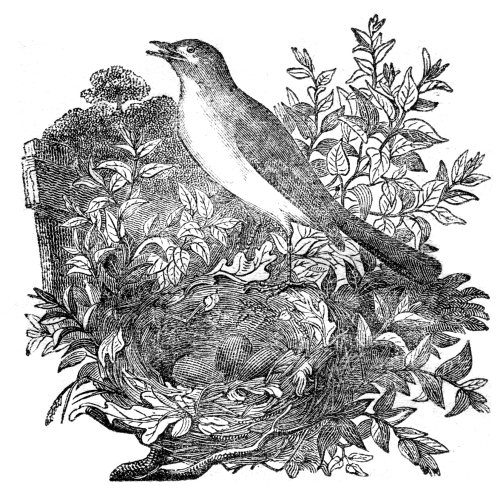
[Nightingale.]
A Nightingale that all day long
Had cheer’d the village with his song,
Nor yet at eve his note suspended,
Nor yet when eventide was ended,
Began to feel, as well he might,
The keen demands of appetite;
When, looking eagerly around,
He spied far off, upon the ground,
A something shining in the dark,
And knew the glow-worm by his spark,
So, stooping from the hawthorn top,
He thought to put him in his crop.
The worm, aware of his intent,
Harangued him thus, right eloquent:—
Did you admire my lamp, quoth he,
As much as I your minstrelsy,
You would abhor to do me wrong,
As much as I to spoil your song;
For ’twas the self-same Power Divine
Taught you to sing, and me to shine;
That you with music, I with light,
Might beautify and cheer the night.
The songster heard his short oration,
And warbling out his approbation,
Released him, as my story tells,
And found a supper somewhere else.
Hence jarring sectaries may learn
Their real interest to discern;
That brother should not war with brother
And worry and devour each other;
But sing and shine with one consent,
Till life’s poor transient night is spent,
Respecting in each other’s case,
The gifts of nature and of grace.
Those Christians best deserve the name,
Who studiously make peace their aim;
Peace, both the duty and the prize,
Of him that creeps and him that flies.
Cowper.
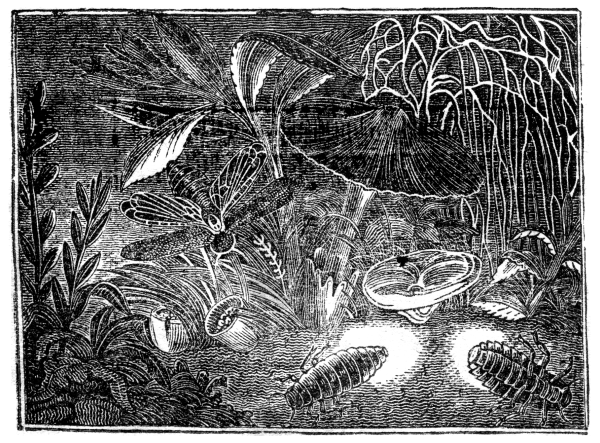
[Male and Female Glow-worms. Male winged, Female wingless.]
State of Europe in the Dark Ages.—In less than a century after the barbarous nations settled in their new conquests, almost all the effects of knowledge and civility, which the Romans had spread through Europe, disappeared. Not only the arts of elegance, which minister to luxury, and are supported by it, but many of the useful arts, without which life can scarcely be considered as comfortable, were neglected or lost. Literature, science, and taste, were words little in use during the ages which we are contemplating; or, if they occur at any time, eminence in them is ascribed to persons and productions so contemptible, that it appears their true import was little understood. Persons of the highest rank, and in the most eminent stations, could not read or write. Many of the clergy did not understand the breviary which they were obliged daily to recite; some of them could scarcely read it. The memory of past transactions was, in a great degree, lost, or preserved in annals filled with trifling events or legendary tales.—Dr. Robertson’s Introduction to the History of Charles V.
Remarkable Detection of Fraud.—A few years ago an important suit, in one of the legal courts of Tuscany, depended on ascertaining whether a certain word had been erased by some chemical process from a deed then before the court. The party who insisted that an erasure had been made, availed themselves of the knowledge of M. Gazzeri, who, concluding that those who committed the fraud would be satisfied by the disappearance of the colouring matter of the ink, suspected (either from some colourless matter remaining in the letters, or perhaps from the agency of the solvent having weakened the fabric of the paper itself beneath the supposed letters) that the effect of the slow application of heat would be to render some difference of texture or of applied substance evident, by some variety in the shade of colour which heat in such circumstances might be expected to produce. Permission having been given to try the experiment, on the application of heat the important word re-appeared, to the great satisfaction of the court.—Babbage, on the Decline of Science.
London Mile-stones.—The various roads from London are now measured from ten or eleven different places, two, three, and even four miles distance from each other. The catalogue is curious. Hyde Park Corner and Whitechapel Church; the Surrey side of London Bridge and Westminster Bridge; Shoreditch Church; Tyburn Turnpike; Holborn Bars (long since removed); the place where St. Giles’s Pound formerly stood; the place where Hicks’s Hall once stood; the Standard, in Cornhill, of which no other tradition remains, its exact site being unknown; and the Stones’-end, in the Borough, which moves with the extension of the pavement. Thus the actual distance of any place cannot be known without minute inquiry and local knowledge of London. “The easy remedy,” says Mr. Rickman, from whose admirable ‘Statement of Progress in the Population Inquiry for 1831,’ this is taken, “consists in adopting the mileage of the Post-office, when it shall have been re-measured from the new site of that office, the frontage of which grand centre of communication could not be more appropriately adorned than by an obelisk which would become a London Stone, in imitation of that which stood in the Forum of ancient Rome. The vicinity of St. Paul’s, the most conspicuous object in London, recommends the new Post-office especially for this purpose; and turnpike-road trustees would not refuse to accommodate to it their mile-stones, under the direction of the road-surveyor of the Post-office.”
Nelson, when young, was piqued at not being noticed in a certain paragraph of the newspapers, which detailed an action wherein he had assisted. “But, never mind,” said he, “I will one day have a Gazette of my own.”
LONDON:—CHARLES KNIGHT, PALL-MALL EAST.
Shopkeepers and Hawkers may be supplied Wholesale by the following Booksellers:—
London, Groombridge, Panyer Alley, Paternoster-Row.
Bath, Simms.
Birmingham, Drake.
Bristol, Westley and Co.
Carlisle, Thurnam.
Derby, Wilkins and Son.
Falmouth, Philip.
Hull, Stephenson.
Leeds, Baines and Co.
Lincoln, Brooke and Son.
Liverpool, Willmer and Smith.
Manchester, Robinson; and Webb and Simms.
Newcastle-upon-Tyne, Charnley.
Nottingham, Wright.
Sheffield, Ridge.
Dublin, Wakeman.
Edinburgh, Oliver and Boyd.
Glasgow, Atkinson and Co.
Printed by William Clowes, Stamford Street.
Transcriber’s Notes
New original cover art included with this eBook is granted to the public domain. Itemized changes from the original text:
p. 91: Added opening single quotation mark before phrase “Keep up your spirits, and you will be soon out of danger.”
p. 94: Added comma after phrase “some years before his death.”