THE BRITISH MUSEUM.—No. 3.
Reading edition
OBELISKS.
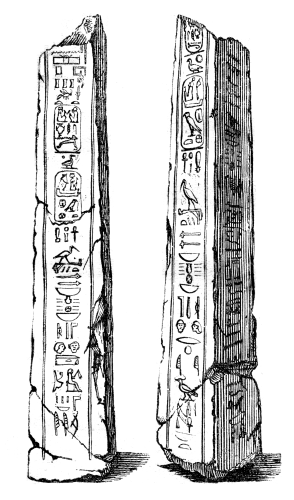
An obelisk is a single block of stone with four faces, which are not quite perpendicular, but inclined a little, each towards the opposite face, so that the width of each side gradually diminishes to the top of the shaft, which is crowned with a pyramid. There are two small obelisks of basalt in the British Museum, numbered 70 and 5. They are entire from the base upwards, but the upper part, together with the little pyramid at the top, is broken off. Both of them were brought from Grand Cairo in Egypt, where they were first taken possession of by the French, but they afterwards came into the hands of the English when the French army capitulated at Alexandria in 1801, and quitted the country.
The one numbered 70 was used as the door-sill of a mosque in the castle of Cairo, where that excellent traveller, Niebuhr, saw it in 1762, and copied part of the figures. By comparing his drawing with the north side of this obelisk (as it now stands), we readily discover it to be the same. This obelisk, besides losing its top and part of the shaft, has been broken into two unequal pieces, which are now united. The lower part, however, is quite complete, which is evident from there being a smooth unsculptured surface on all the four sides, to the height of about 10¼ inches above the base. In all the obelisks that have been accurately measured, at least in all of which we have been able to procure a complete account, the width of the adjacent sides is different. For example, in this Museum obelisk, as it now stands, the north and south sides are of the same dimensions, being about 1 foot 4⅞ inches wide, while the east and west sides are each about 1 foot 5½ inches: the height of this fragment is about 8 feet 1¾ inch, measured along one of the faces.
These two obelisks have a great number of figures cut on each face, representing either natural objects, such as birds and serpents, or various other things which it is not in all cases easy to identify. They are cut deep into the stone, and, in some instances, a considerable elevation or relief is given to the parts contained within the deep incision, for the purpose of showing the round and prominent parts of the figure. On all Egyptian monuments of an early age, animals are cut with great accuracy of outline and spirit, especially birds, of which this obelisk offers some excellent specimens in the goose, the ibis, known by his long beak and legs, and another bird in walking attitude, near the base of the south side. The execution of this last is above all praise.
It is now ascertained that the figures enclosed in oblong rings contain the titles and names of kings. These are the same on the two obelisks, and they happen also to be the same as those on the great sarcophagus, No. 6.
There have been many disputes among the learned as to the origin and meaning of obelisks, into which we shall not enter here. We know that they were generally placed in pairs at the entrances of the great Egyptian temples and palaces; and there are still two standing, in their original position, before the gateway of a large edifice at Thebes. When the Romans got possession of Egypt, Augustus removed two of the largest obelisks from Heliopolis (the city of the sun) to Rome, where they still exist, and attest the fact of their removal at that period, by a Latin inscription on the pedestal. During the troubles of the city and the disastrous period of the decline of the Roman Empire, these and other obelisks were thrown down and broken; but they have since been set on pedestals by the enterprising spirit of some of the popes. Sixtus V., in 1586, set the first example, in which he was followed by several of his successors; and Pius VI. restored other obelisks in the years 1786, 1789, and 1792. Two have been raised since the last-mentioned date.
The largest obelisk now at Rome, and perhaps the largest in the world, is that which stands in front of the Lateran church. It was originally erected by the Emperor Constantius[4], in the Circus Maximus, by means of a most cumbrous machinery of wood-work and ropes, after having been brought from Egypt in a ship built expressly for the purpose, and manned with three hundred rowers. Pope Sixtus V. set it up in its present place in 1588, after it had lain on the ground broken in three pieces for several centuries. Though the shaft has sustained some damage at the base, it is still 105 feet long; the width of the two larger sides at the base is 9 feet 8⅗ inches, and of the smaller 9 feet. It now stands on a kind of pedestal, quite unsuited to the simple character of the genuine Egyptian supports. The whole height at present, with its pedestal and ornaments on the top, is about 150 English feet, and the weight of the obelisk itself may probably be about 440 tons. The material is the red granite of Syene, resembling that of the altar, No. 2, in the British Museum.
It is not so much the actual magnitude of an obelisk which excites our wonder, for the London monument is 50 feet higher than the tallest of the Roman obelisks—but the simplicity of the obelisk form, which is not disfigured by any irregularity, its gradual diminution towards the summit, which takes away all appearance of heaviness, the beautiful sculptures with which most of them are covered, and the unity of the huge mass cut from the quarries of Syene, conveyed so many hundred miles, and then set firmly on its pedestal—all these combined fill us with admiration at the boldness and taste of the designer, and the unwearied patience and skill of the sculptor.
93The following account of the mode in which an obelisk was carried down the Nile, is preserved in Pliny’s Natural History[5], a book containing a mass of information in a very crude, and often almost unintelligible shape.
“A canal was dug from the river to the place where the obelisk lay, and two boats were placed side-by-side, filled with pieces of stone of the same material as the obelisk. These pieces were in the shape of a brick, and a foot in length (or cubical pieces, each side measuring one foot), so that the proportion between the quantity of matter in the obelisk and that held by the boats could be determined. The boats were loaded to twice the weight of the obelisk, in order that they might go under it, its two ends resting on the two sides of the canal. Then, as the pieces of stone were taken out, the boats of course rose, and at last supported the obelisk and carried it off.”
This obelisk, according to the same authority, was eighty cubits high, or about 120 English feet[6], and was erected at Alexandria by Ptolemæus Philadelphus, the second Greek king of Egypt.
The obelisk in St. George’s Fields, London, will give some idea of the figure of one of these stupendous masses, though it is deficient in accurate proportions, insignificant in size, and placed on an ugly pedestal. The obelisk at Alexandria, commonly called Cleopatra’s Needle, stands first of all on a block of stone, which is in height about one-ninth of the whole height of the obelisk itself; and this block again rests on three rectangular plinths, placed one above another, the base of the lowest being larger than that of the stone above it, and this larger than the third; so that the three plinths form three steps on each of the four sides of the obelisk.
The following are the dimensions of Cleopatra’s Needle, as given by the French:—
Feet. Ins.
Height of shaft from its base to the base of the pyramidal top 57 62⁄5
Ditto of pyramidal top 6 64⁄5
Height of pedestal on which obelisk stands 6 11
Whole height of the three steps 5 517⁄20
Whole height 76 61⁄20
This is not quite the whole height of the obelisk, as the French measures do not seem to include about 3 ft. ¼ in. of one side, of which they have given the dimensions.
It has been stated in the House of Commons (April 15th, 1832) that this obelisk is 64 feet long, which is exactly the height of the shaft according to the French measurement, and that it weighs 284 tons. We are not able to learn whether it is this obelisk that is to be brought to England, or another at Thebes, which is in a much better state of preservation. The Alexandrine obelisk is so much damaged by the atmosphere of the sea, particularly on the south side, that it is hardly worth bringing. Our climate would, perhaps, be still more unfavourable to its preservation.
It has been suggested to us that this Theban obelisk, if it be brought to England, should be set up in some advantageous position in the metropolis, where it might not only form a great ornament, but serve the useful purpose of a centre to measure roads from—a thing, the want of which is generally known and felt.